絵でわかる日本語
Meaning
Extremely 〜
How to use it
い-adjective・noun +といったらない
Explanation
「〜といったらない」 is a sentence pattern meaning “extremely ~” or “the most ~.” It is used to emphasize degree or emotion 😊 The colloquial form of 「〜といったらない」 is 「〜ったらない」 😮
[Examples]
① The cold in Hokkaido is unbelievable.
=It’s unbelievably cold in Hokkaido.
② The curry at that restaurant is unbelievably spicy.
=The curry at that restaurant is unbelievably spicy.
Remember that 「〜といったらない」 and 「〜ったらない」 can be used for both positive and negative things 😉
【Related articles】
In context 5 examples
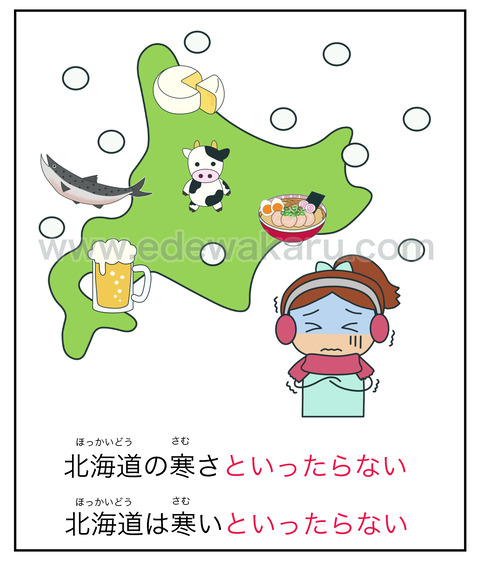
北海道の寒さといったらない
→北海道はとても寒いThe cold in Hokkaido is unbelievable. →Hokkaido is extremely cold.
北海道は寒いといったらない
→北海道はとても寒いHokkaido is unbelievably cold. →Hokkaido is extremely cold.
あの店のカレーは辛いといったらない
→あの店のカレーはとても辛いThe curry at that restaurant is unbelievably spicy. →The curry at that restaurant is extremely spicy.
お母さんの料理はおいしいといったらない
→お母さんの料理はとてもおいしいMom’s cooking is unbelievably delicious. →Mom’s cooking is extremely delicious.
宿題の面倒くささといったらない
→宿題はとても面倒くさい(復習:〜くさい)The hassle of homework is unbelievable. →Homework is extremely troublesome (Review: 〜くさい)
Read the original source text
Meaning
とても〜だ
How to use it
い形容詞・名詞+といったらない
Explanation
「〜といったらない」は「とても〜だ」「最高に〜だ」という意味を表す文型です。程度や感情を強調するのに使われます😊また、
「〜といったらない」の話し言葉は「〜ったらない」です
😮
[例]
①北海道の寒さ
といったらない
=北海道の寒さ
ったらない
②あの店のカレーは辛い
といったらない
=あの店のカレーは辛いったらない
「〜といったらない」「〜ったらない」はプラスのことにもマイナスのことにも使えると覚えておきましょう
😉
【関連記事】
日本語文型辞典
Meaning
N / i-adjective + といったらない (とい)ったらない. Explanation: Attached to a noun or i-adjective, it emphasizes an extreme degree. It means “so … that it cannot be expressed” or “there is nothing else so ….” In speech, the form …ったらない is also used. といったらありはしない has the same meaning, but is used only for negative evaluations. Example sentences: ① She was indescribably beautiful in her wedding dress. ② The loneliness of being left alone in the hospital room after everyone had gone home was indescribable. ③ He makes jokes with a serious face during meetings; it's so funny. ④ After ten years of being forced to live apart from my wife since we got married, I can finally live with her. I couldn't be happier.
Read the original source text
Meaning
基本情報NといったらないA-い(とい)ったらない説明名詞やイ形容詞に付いて、その程度が極端であることを強調するのに用いる。「とても言い表せないほど…だ」「そんなに…ことは他にはない」という意味。話しことばでは「…ったらない」の形も使われる。また、「といったらありはしない」も同じ意味だが、マイナス評価の時だけに用いる。例文① 花嫁衣装を着た彼女の美しさといったらなかった。② みんなが帰っていったあと、一人きりで病室に取り残されたときの寂しさといったらなかった。③ 彼は会議中にまじめな顔をして冗談を言うんだから、おかしいったらないよ。④ 結婚以来今まで10年も別居せぎるをえなかった妻とやっと一緒に暮らせるのだ。うれしいといったらない。
日本語文型辞典 英語版
Meaning
【といったらない】[Nといったらない][A-い(とい)ったらない]
Attached to nouns or i-adjectives to emphasize an extreme degree of something. Means “so...that it can’t be expressed in words” or “there is nothing else as...as.” In spoken language, the form ...ったらない may also be used. Although といったらありはしない conveys the same meaning as といったらない, the former is used only when expressing a negative evaluation of something (dissatisfaction, criticism, etc.).
In context 4 examples
花嫁衣装を着た彼女の美しさといったらなかった。
Wearing her bridal costume, she was indescribably beautiful.
みんなが帰っていったあと、一人きりで病室に取り残されたときの寂しさといったらなかった。
Left all by myself in the hospital room after everyone had gone home, my loneliness was beyond description.
彼は会議中にまじめな顔をして冗談を言うんだから、おかしいったらないよ。
The way he tells jokes with a straight face during our meetings is too funny for words.
結婚以来今まで 10 年も別居せざるをえなかった妻とやっと一緒に暮らせるのだ。うれしいといったらない。
Ever since we got married ten years ago, my wife and I have had to live apart, and now we can finally be together. I can't tell you how happy I am!
くらべてわかる日本語表現文型辞典
Meaning
Indicates that A is so remarkable that nothing else can compare.
How to use it
Explanation
【Contrast 1】
「A たるや B」(Meaning 1, p. 130)
Notes
【Note 1】
・「ありゃしない」is a colloquial expression.
・It can also be used in the form 「i-adjective / na-adjective + こと」.
○あのお化け屋敷の怖いことといったらない。
In context 4 examples
最近夜中になると暴走族が走り回り、うるさいといったらない。
Lately, the biker gangs race around in the middle of the night, and they’re unbelievably noisy.
南の島に着いたときの開放感といったらなかったよ。
The sense of freedom I felt when I arrived on the southern island was incredible.
電車の網棚から荷物が落ちそうで、気になるったらなかった。
I was so worried that the luggage would fall from the train’s overhead rack.
あのホテルは、コーヒー一杯1000円というんだから、高いったらありゃしない。
That hotel charges 1,000 yen for a cup of coffee, so it’s outrageously expensive.
Read the original source text
Meaning
他に比べるものがないほどAはすごいことを示す。
How to use it
Explanation
【対比1】
「AたるやB」(意味1 P.130)
Notes
【注意1】
・「ありゃしない」はくだけた言い方。
・「イ形容詞・ナ形容詞+こと」の形で使うこともある。
○あのお化け屋敷の怖いことといったらない。
DoJG 日本語文法辞典(全集)
Meaning
So; extremely; indescribably; indescribable; incredibly; awfully; terribly; cannot tell you/describe/etc. how; too much of
How to use it
(i) {V/Adjectiveい}informal nonpast | (と言)ったらない | |
| 腹が立つ(と言)ったらない | (I’m) so mad |
| つまらない(と言)ったらない | (It’s) so boring |
(ii) Adjectiveなstem | (と言)ったらない | |
| 退屈(と言)ったらない | (I’m) so bored |
(iii) Adjective(い/な)さ | (と言)ったらない | |
| その面白さ(と言)ったらない | (something is) so interesting |
| その下手さ(と言)ったらない | (someone is) so bad at it |
(iv) Vinformal nonpast | こと(と言)ったらない | |
| 疲れること(と言)ったらない | Something is so tiring |
(v) Adjectiveいinformal nonpast | こと(と言)ったらない | |
| 美味しいこと(と言)ったらない | Something is so delicious |
(vi) Adjectiveなstemなこと | (と言)ったらない | |
| 新鮮なこと(と言)ったらない | Something is so fresh |
Explanation
(と言)ったらない A phrase used to express a strong sensation or emotion.
In context 16 examples
つまらないミスで試合に負けて悔しい(と言)ったらない。
I'm so mortified because I lost the game due to a stupid mistake.
老眼が進んで眼鏡なしでは近くの字が読めないので、不便(と言)ったらない。
My farsightedness has gotten worse so I can't read words up close without my glasses—it's so inconvenient!
大きな書類を保存するのを忘れてコンピュータがフリーズした時の情けなさ(と言)ったらない。
The miserable feeling you get when the computer freezes and you forgot to save a large file is indescribable.
この辞書は使いにくいこと(と言)ったらない。
This dictionary is incredibly hard to use.
5分ごとにジェット機が離陸するのでうるさいと言ったらない。
There's a jet taking off every five minutes—I can't even describe (to you) how noisy it is.
いつもよくしゃべる俊子が慎一の前で赤くなって何も言えないので、おかしいったらなかった。
It was so funny to see Toshiko, who is usually talkative, blush and turn speechless in front of Shin'ichi.
ティムにデートをすっぽかされて頭に来るったらない。
Tim stood me up, and that makes me so mad.
この仕事は一日中細かい字を見ているので目が疲れると言ったらない。
Because I look at small print all day for this job, my eyes get awfully tired.
出張したところはインターネットも携帯も使えず、不便と言ったらなかった。
In the area where I went on my business trip I couldn't use the Internet or my cell phone; I can't tell you how inconvenient it was.
プロジェクトに変更があるたびに関係者全員に知らせた上で承認を得なければならないので、面倒と言ったらない。
Every time there is a change to the project, we have to notify everybody involved and get their approval, so it is incredibly tiresome.
夏、暑い外から帰ってきた後の冷えたビールのうまさったらない。
In summer, the taste of a cold beer is indescribably good after coming in from the heat outside.
この国ではインターネットが自由に使えないので、その不便さったらない。
In this country we cannot use the Internet freely, so it's so inconvenient.
ハイヒールで砂利道を歩かされたので歩きにくいことと言ったらなかった。
I had to walk on gravel in high heels, and I can't tell you how hard it was!
雪に覆われた山々が早朝の朝日を受けて宝石のように輝く姿の美しいことと言ったらない。
When the snow-covered mountains receive the early morning sun and sparkle like gems, they are indescribably beautiful.
昔、痛風にかかったことがあるが、その痛みと言ったらなかった。
I've suffered from gout before; the pain was indescribable.
学生がいいのは、学期が終わったら次の学期の始まりまでは自由なことだ。試験やレポートが全部終わった時の解放感と言ったらない。
One good thing about being a student is that after the term is over, you're free until the next term begins. The feeling of release after finishing all the exams and term papers is indescribable.
どんなときどう使う 日本語表現文型辞典
Usage 1
Meaning
inexpressibly; extremely
How to use it
イAい / N + といったらない
Explanation
口では表現できないほど~と思う/非常に~だ
1)「~といったらない」の形で、「~」の程度が極端だと言いたいときに使う。プラス評価でもマイナス評価でも使える。
2)例文 ❸ ~ ❺ の「といったらありはしない・といったらありゃしない・ったらない」は「といったらない」とほとんど同じ意味だが、マイナス評価にだけ使う。
3) ❹ の「といったらありゃしない」、 ❺ の「ったらない」はくだけた話し言葉である。
2)The patterns といったらありはしない, といったらありゃしない, and ったらない in sentences ❸ to ❺ have nearly same meaning but are used as negative evaluations.
3)The forms といったらありゃしない in sentence ❹ and ったらない in sentence ❺ are used in informal speech.
1)Extreme degree in either positive or negative evaluation.
In context 5 examples
この仕事は毎日毎日同じことの繰り返しだ。つまらないといったらない。
This job is the same thing over and over, day after day. It’s unbelievably boring.
海を初めて見たときの感激といったらなかった。今でもよく覚えている。
I was overwhelmed when I saw the ocean for the first time. I still remember it well.
外国で一人暮らしを始めたときの心細さといったらありはしない。
The loneliness I felt when I started living alone in a foreign country was beyond description.
となりの人は大きな音でロックを聴く。うるさいといったらありゃしない。
The person next door listens to rock music at full volume. It’s unbelievably noisy.
弟の部屋の汚さったらない。3日前に使った食器がそのままおいてある。
My younger brother’s room is unbelievably filthy. Dishes he used three days ago are still lying around.
Read the original source text
Meaning
inexpressibly; extremely
How to use it
イAい/N+といったらない
Explanation
口では表現できないほど~と思う/非常に~だ
1)「~といったらない」の形で、「~」の程度が極端だと言いたいときに使う。プラス評価でもマイナス評価でも使える。
2)例文 ❸ ~ ❺ の「といったらありはしない・といったらありゃしない・ったらない」は「といったらない」とほとんど同じ意味だが、マイナス評価にだけ使う。
3) ❹ の「といったらありゃしない」、 ❺ の「ったらない」はくだけた話し言葉である。
2)The patterns といったらありはしない, といったらありゃしない, and ったらない in sentences ❸ to ❺ have nearly same meaning but are used as negative evaluations.
3)The forms といったらありゃしない in sentence ❹ and ったらない in sentence ❺ are used in informal speech.
1)Extreme degree in either positive or negative evaluation.
Usage 2
Meaning
inexpressibly; extremely
How to use it
イAい / N + といったらない
Explanation
といったらない
口では表現できないほど~と思う/非常に~だ
1)「~といったらない」の形で、「~」の程度が極端だと言いたいときに使う。プラス評価でもマイナス評価でも使える。
2)例文 ❸ ~ ❺ の「といったらありはしない・といったらありゃしない・ったらない」は「といったらない」とほとんど同じ意味だが、マイナス評価にだけ使う。
3) ❹ の「といったらありゃしない」、 ❺ の「ったらない」はくだけた話し言葉である。
2)The patterns といったらありはしない, といったらありゃしない, and ったらない in sentences ❸ to ❺ have nearly same meaning but are used as negative evaluations.
3)The forms といったらありゃしない in sentence ❹ and ったらない in sentence ❺ are used in informal speech.といったらない
1)Extreme degree in either positive or negative evaluation.
In context 5 examples
この仕事は毎日毎日同じことの繰り返しだ。つまらないといったらない。
This job is the same thing over and over, day after day. It’s unbelievably boring.
海を初めて見たときの感激といったらなかった。今でもよく覚えている。
I was overwhelmed when I saw the ocean for the first time. I still remember it well.
外国で一人暮らしを始めたときの心細さといったらありはしない。
The loneliness I felt when I started living alone in a foreign country was beyond description.
となりの人は大きな音でロックを聴く。うるさいといったらありゃしない。
The person next door listens to rock music at full volume. It’s unbelievably noisy.
弟の部屋の汚さったらない。3日前に使った食器がそのままおいてある。
My younger brother’s room is unbelievably filthy. Dishes he used three days ago are still lying around.
Read the original source text
Meaning
inexpressibly; extremely
How to use it
イAい/N+といったらない
Explanation
といったらない
口では表現できないほど~と思う/非常に~だ
1)「~といったらない」の形で、「~」の程度が極端だと言いたいときに使う。プラス評価でもマイナス評価でも使える。
2)例文 ❸ ~ ❺ の「といったらありはしない・といったらありゃしない・ったらない」は「といったらない」とほとんど同じ意味だが、マイナス評価にだけ使う。
3) ❹ の「といったらありゃしない」、 ❺ の「ったらない」はくだけた話し言葉である。
2)The patterns といったらありはしない, といったらありゃしない, and ったらない in sentences ❸ to ❺ have nearly same meaning but are used as negative evaluations.
3)The forms といったらありゃしない in sentence ❹ and ったらない in sentence ❺ are used in informal speech.といったらない
1)Extreme degree in either positive or negative evaluation.