絵でわかる日本語
Usage 1
Read this source entry ↗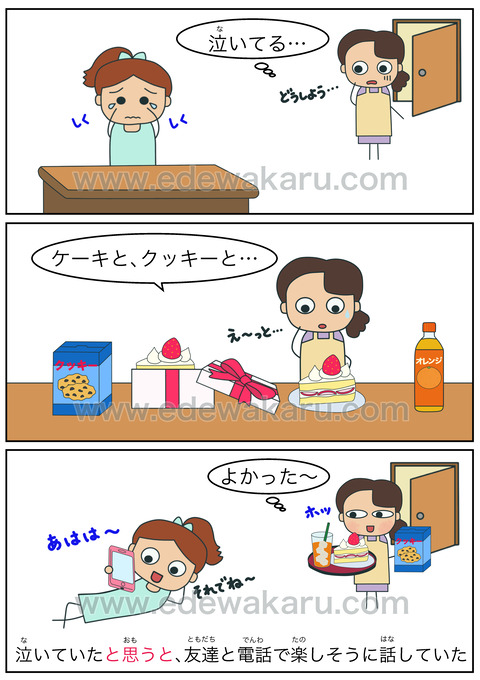
Meaning
A rapid change from ~ to ~
How to use it
Verb [dictionary form] + かと思うと
Verb [た-form] + かと思ったら
Explanation
“Aと思うとB” is a sentence pattern meaning “the change from A to B is rapid” or “it changes immediately from state A to state B.” It is used when you want to say that the shift from being in state “A” to being in state “B” happens very quickly. In most cases, “A” and “B” are actions or states that express opposites. Also, “〜と思うと” can be changed to “〜かと思うと,” “〜と思ったら,” or “〜かと思ったら.”
[Examples]
① Just when I thought she had been crying,
she was happily talking on the phone with her friend
→The change from a crying state to a happy state is rapid
② Just when I thought she had gotten angry,
she burst out laughing
→The change from an angry state to bursting out laughing is rapid
③ Just when I thought he had finally started studying,
he started playing a game
→He started playing a game soon after he began studying
④ Just when I thought the rain had stopped,
it started raining again…
→The change from having stopped to starting again is rapid
⑤ Just when I thought it was starting to feel like summer,
today was as cold as February
→It had felt hot like summer, but suddenly it got cold
“〜と思うと・〜と思ったら” have other usages too, so let’s review them 😊
In context 5 examples
泣いていたと思うと、友達と電話で楽しそうに話していた
Just when I thought she had been crying, she was happily talking on the phone with her friend.
彼女は怒ったと思うと、大声で笑い出した
Just when I thought she had gotten angry, she burst out laughing.
やっと勉強し出したと思うと、ゲームを始めた
Just when I thought he had finally started studying, he started playing a game.
雨がやんだと思うと、また降り出した…
Just when I thought the rain had stopped, it started raining again…
夏らしくなってきたと思うと、今日は2月のような寒さだった
Just when I thought it was starting to feel like summer, today was as cold as February.
Read the original source text
Meaning
〜から〜への変化が速い
How to use it
動詞[辞書形]+かと思うと
動詞[た形]+かと思ったら
Explanation
「Aと思うとB」は「AからBになる変化が速い」「AからBの状態にすぐに変わる」という意味の文型です。これは「A」していた状態から「B」の状態に切りかわるのが、とても速いと言いたい時に使います。ほとんどの場合には「A」と「B」には、反対を表す動作や状態が入ります。また、
「〜と思うと」は「〜かと思うと」「〜と思ったら」「〜かと思ったら」
にチェンジすることができます。
[例]
①泣いていた
と思うと、友達と電話で楽しそうに話していた
→泣いていた状態から、楽しそうにしている状態への変化が速い
②彼女は怒った
と思うと、大声で笑い出した
→怒っていた状態から、笑い出す状態への変化が速い
③やっと勉強し出した
と思うと、ゲームを始めた
→勉強しだしてから、すぐにゲームを始めた
④雨がやんだ
と思うと、また降り出した…
→やんだ状態から、降り出すまでの変化が速い
⑤夏らしくなってきた
と思うと、今日は2月のような寒さだった
→夏らしい暑さだったのに、急に寒くなった
「〜と思うと・〜と思ったら」には、他の用法もありますので復習をしておきましょう😊
Usage 2
Read this source entry ↗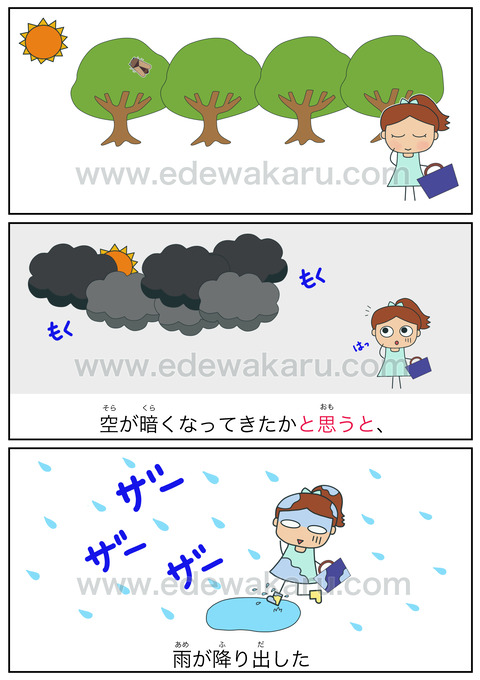
Meaning
When ~ happens, immediately ~
Almost at the same time as ~ happens
How to use it
Verb [dictionary form] + かと思うと
Verb [た-form] + かと思ったら
Explanation
“Aと思うとB・Aと思ったらB” is a sentence pattern meaning “when A happens, B happens immediately” or “B happens almost at the same time as A.” This pattern conveys the speaker’s [surprise] or [feeling that something is unexpected]. It is used when you want to say “something unexpected, B, happened immediately after A.” Also, “〜と思うと” can be changed to “〜かと思うと,” “〜と思ったら,” or “〜かと思ったら.”
[Example]
The sky started getting dark
と思うと, it began to rain
= The sky started getting dark
かと思うと, it began to rain
= The sky started getting dark
と思ったら, it began to rain
= The sky started getting dark
かと思ったら, it began to rain
Also, be careful: this cannot be used about oneself.
[Examples]
❌ I got home
と思うと, I went out again
⭕️ When I got home, I went out again right away
“〜と思うと・〜と思ったら” also has a usage that expresses [rapid change], so let’s learn that as well 😊
[Related patterns]
In context 5 examples
空が暗くなってきたと思うと、雨が降り出した
→空が暗くなってきたら、すぐに雨が降り出したJust as the sky started getting dark, it began to rain. →As soon as the sky got dark, it began to rain.
娘は学校から帰ってきたと思うと、またすぐに出かけていった
→学校から帰ってくると、またすぐに出かけていったJust when my daughter got home from school, she went out again right away. →When she got home from school, she went out again right away.
空が光ったと思うと、雷が鳴った
→空が光ったら、すぐに雷が鳴ったJust as the sky flashed, thunder rumbled. →As soon as the sky flashed, thunder rumbled.
彼女は、下を向いたかと思うと泣き始めた
→下を向くと、すぐに泣き始めたJust as she lowered her gaze, she began to cry. →As soon as she lowered her gaze, she began to cry.
兄は、ぼくの顔を見たかと思うと殴りかかってきた
→ぼくの顔を見ると、すぐに殴りかかってきたJust as my older brother saw my face, he lunged at me. →As soon as he saw my face, he lunged at me.
Read the original source text
Meaning
〜したら、すぐに〜
〜するのと、ほとんど同時に
How to use it
動詞[辞書形]+かと思うと
動詞[た形]+かと思ったら
Explanation
「Aと思うとB・Aと思ったらB」は「Aすると、すぐにB」「Aするのとほとんど同時にB」という意味の文型です。この文型は、話し手の【驚き】や【意外だと思う気持ち】が入ります。
「Aの後、すぐに続いてBという意外なことが起こった」
と言いたい時に使います。また、
「〜と思うと」は「〜かと思うと」「〜と思ったら」「〜かと思ったら」
にチェンジすることができます。
[例]
空が暗くなってきた
と思うと、雨が降り出した
=空が暗くなってきた
かと思うと、雨が降り出した
=空が暗くなってきた
と思ったら、雨が降り出した
=空が暗くなってきた
かと思ったら、雨が降り出した
また、自分のことには使えませんので注意しましょう。
[例]
❌私は家に帰った
と思うと、また出かけた
⭕️私は家に帰ると、またすぐに出かけた
「〜と思うと・〜と思ったら」には【速い変化】を表す用法もありますので、一緒に覚えておきましょう😊
【関連文型】
NINJAL 日本語文型データベース
Meaning
Used when you want to say that another event or major change occurs right after the speaker notices “〜.”
How to use it
Vたと思ったら
Notes
It is not used to describe the speaker’s own actions.
An unexpected event often follows “〜と思ったら.” A sentence expressing the speaker’s hope or intention, or a sentence urging the listener to do something, does not follow.
In context 6 examples
やっと風邪が治ったと思ったら、今度はインフルエンザにかかってしまった。
I thought I had finally recovered from my cold, but then I came down with the flu.
電車の中で、誰かの電話が鳴ったと思ったら、ドアの前に立っていたおじさんが急に大きな声で話しはじめた。
On the train, I thought someone’s phone had rung, but then the man standing by the door suddenly started talking loudly.
1年間の留学はあっという間で、生活にやっと慣れてきたと思ったらもう帰国の日が近づいてきてしまいました。
My year abroad flew by, and just as I was finally getting used to life there, the day to return home was already drawing near.
この花は花期が短くて、咲いたと思ったらすぐに散ってしまう。
This flower has a short blooming season; it blooms and then immediately withers.
あの俳優は、結婚したと思ったらすぐに離婚してしまった。
That actor got married and then divorced almost immediately.
猫は気まぐれで、私の足元でぐっすり寝ていたと思ったら、もう姿が見えなくなった。
Cats are fickle. The cat was sound asleep by my feet, and then before I knew it, it was nowhere to be seen.
Read the original source text
Meaning
話し手が~に気づいたすぐ後に、続けて次の出来事や大きな変化が起こると言いたいときに使います。
How to use it
Vたと思ったら
Notes
話し手自身の行為の描写には使いません。
「〜と思ったら」の後には意外性のある出来事を表す文がくることが多いです。話し手の希望・意向を表す文や相手への働きかけの文はきません。