AIUEO JLPT Grammar
Meaning
This sentence pattern expresses possibilities or abilities.「〜得る」means “can” or “is possible,” and「〜得ない」means “cannot” or “is impossible.”
How to use it
Verb (ます-form) + 得る; Verb (ます-form) + 得ない
In context 5 examples
彼の言うことは信じ得ません。
What he says is not something I can believe.
そんなことが起こり得るとは思わなかった。
I never thought such a thing could happen.
これ以上の改善は望み得ないでしょう。
No further improvements can be expected.
そんな事件はあり得ないと思っていたが、実際に起こっていた。
I thought something like this couldn't happen, but it did happen.
今の状況を考えると、計画の変更はあり得るだろう。
Considering the current situation, changes to the plan are possible.
Read the original source text
Meaning
This sentence pattern expresses possibilities or abilities.「〜得る」means “can” or “is possible,” and「〜得ない」means “cannot” or “is impossible.”
How to use it
動詞ます形+得る動詞ます形+得ない
Explanation · 日本語
この文型は、可能性や能力について述べる表現です。「〜得る」は「できる」「可能性がある」という意味を持ち、「〜得ない」は「できない」「可能性がない」という意味を持ちます。
文法
Meaning
Can happen / cannot happen.
How to use it
V (ます-stem) + 得る / 得ない
Notes
① It cannot be used to mean “be capable or incapable of doing something.”
❌ Tom-san can read a little kanji.
② 得る can be read as either “える” or “うる,” but the negative form is only read “えない.”
In context 12 examples
日頃から気をつけていても、事故は起こり得るものだ。
Even if you’re careful every day, accidents can happen.
地震はいつ起こるか予想し得ないから、事前に家族との連絡方法や避難場所などを決めておいた方がいいでしょう。
Since it is impossible to predict when an earthquake will occur, it would be best to decide in advance how to contact your family and where to evacuate.
学校一の成績を誇るジョンさんがJLPT N1に合格しなかったなんて、あり得ないよ。
There’s no way John, who boasts the best grades in the school, could have failed the JLPT N1.
結婚しているのに、浮気するなんてあり得ないよ。
You’re married, so there’s no way you should cheat.
考え得る原因は全て考えので、これ以上の原因究明は不可能と言っていいだろう。
I have considered all conceivable causes, so it would be fair to say that further investigation into the causes is impossible.
長所は時に短所になり得る。
A strength can sometimes become a weakness.
毎年出生率は下がっているし、経済もよくないし、今後もこのような状況が続くのであれば経済破綻もあり得るかもしれない。
The birth rate is falling every year, and the economy is poor; if this situation continues, an economic collapse might be possible.
地震がいつ来るかなんて、予測し得ないことだ。
It is impossible to predict when an earthquake will strike.
検証作業は、起こり得る全てのテストパターンに基づいて実施します。
The verification work will be carried out based on all possible test patterns.
タバコの吸いすぎや、お酒の飲み過ぎは病気の原因になり得ます。
Smoking too much or drinking too much can cause illness.
どんな人だって、失敗することはあり得ます。
Anyone can make a mistake.
今の気持ちは言葉で言い表し得ない。
My current feelings cannot be expressed in words.
Read the original source text
Meaning
〜できる / 〜できない
How to use it
V(ます形)ます + 得る / 得ない
Notes
①「能力的にできる・できない」の意味では使えない。
❌トムさんは少しだけ漢字を読み得る。
②「得る」は「える」と「うる」の2つの読み方があるが、否定形の場合は「えない」のみ。
Bunpro Grammar Reference
Meaning
Is able to, Can, Possible
How to use it
Verb[stem]+ える(1)
Exceptions:
Verb[stem]+ えない(*)
Verb[stem]+ えた(*)
Verb[stem]+ えなかった(*)
(1) うる
(*) For negative, past and negative past forms, only conjugations of える are used
Verb[stem]+ えます(1)
Exceptions:
Verb[stem]+ えません(1)
Verb[stem]+ えました(1)
Verb[stem]+ えませんでした(1)
(1) For polite forms, only conjugations of える are used
Nuance
A formal expression which focuses on having or gaining the possibility to do (A).
Explanation
得る is a る-Verb that has the meaning of 'to gain', or 'to acquire'. When attached to the conjunctive form of verbs, it takes on the nuance of 'for (A) to be possible', or 'to be able to (A)'.
順調にいけば、二年後に会社を立ち上げることもあり得る。
It's possible that I'll set up my own company if everything goes well after two years.
いくら気をつけていても、交通事故は起こり得るものだ。
No matter how careful you are, it's possible for a car accident to occur.
Compared to できる, which means that the potential to do something exists, 得る means something closer to 'there is a possibility that (A) can be done', or 'the possibility to do (A) has been gained'.
Caution
得る may be seen as either える or うる. The primary difference between the two being that うる is a relatively old form that is often seen in literature, and spoken far less frequently than える. Despite this, there is a tendency for うる to be the preferred spoken choice when the kana that appears before it is え, such as 教える becoming 教えうる, rather than 教ええる.
そういう事はセクハラにもなりえるので、そういう事はやらない方がいい。
Things like that can be considered as sexual harassment, so you shouldn't do that.
考えうる事は、すべてこの企画書に書いておきました!
I wrote everything I can think of on this proposal!
Fun Fact
得る is far more formal/bookish than できる. However, there are several set phrases that are very common in daily speech that use this particular grammar point, such as あり得る 'possible', and あり得ない 'impossible'.
うん、それもあり得るね...
Yeah, that is also a possibility...
電気代がまた値上がりするみたいだよ。マジあり得ない。
It looks like the electricity bill is going to go up again. There's no way.
In context 18 examples
- それはあり得る。
That can be possible!
- いくら気をつけていても、交通事故は起こり得るものだ。
No matter how careful you are, it's possible for a car accident to occur.
- 順調にいけば、二年後に会社を立ち上げることもあり得る。
It's possible that I'll set up my own company if everything goes well after two years.
- その対策は考え得る。
It is possible to consider that countermeasure.
- 災害はいつだって起こり得る。
Disaster can occur at anytime. (there is a possibility that it can occur)
- 対応次第でストライキは回避し得る。
A strike can be avoided depending on how it is dealt with.
- 耕し得る土地を持っている方は田植えができます。
People who own arable land can plant rice. (can be farmed)
- 消防士である彼は、信頼し得る人です。
Being a firefighter, he is a person you can trust. (there is a possibility it can be done)
- 彼なら、もっと大きなことを成し得るだけの力がある。
In his case, he has the power to be able to accomplish even greater things. (there is a possibility that it can be accomplished)
- この仕事で知り得た情報は、誰にも話してはいけません。
I can't talk to anyone about the information I was able to obtain through this job.
- 生じ得るあらゆる事態を想定するのは不可能です。
It is not possible to predict every circumstance that can arise. (there is a possibility that it can arise)
- その言い方は恐喝にもなり得るから、やめた方がいい。
It would be better if you stopped, since saying it in that way can become a threat/blackmail.
- 我が社にでき得るだけの努力はいたします。
I will put in as much effort as our company is capable of. (there is a possibility it can be done)
- 彼は群衆の目にも耐え得る精神力の持ち主だ。
He possesses the force of will to be able to endure the piercing eyes of the crowd. (there is a possibility that it can be endured)
- そういう事はセクハラにもなりえるので、そういう事はやらない方がいい。
Things like that can be considered as sexual harassment, so you shouldn't do that.
- 考えうる事は、すべてこの企画書に書いておきました!
I wrote everything I can think of on this proposal!
- うん、それもあり得るね...
Yeah, that is also a possibility...
- 電気代がまた値上がりするみたいだよ。マジあり得ない。
It looks like the electricity bill is going to go up again. There's no way.
DoJG 日本語文法辞典(全集)
Meaning
Can; possible; -able
How to use it
Vます | うる/える | |
| 起こり{うる/える} | Can happen |
| あり{うる/える} | Can exist |
Explanation
得る (うる・える)An auxiliary verb that expresses possibility.
In context 7 examples
二十一世紀に日本語は国際語になり得ると思う。
I think it's possible for the Japanese language to become an international language in the 21st century.
株の変動はいつでも起こり得る。
The fluctuation of stocks can happen any time.
ほとんどの癌は予防し得る。
The majority of cancers are preventable.
一度に記憶し得る単語の数は限られている。
The number of vocabulary items one can memorize at one time is limited.
運動をすることによって健康を維持し得る。
By doing exercise one can maintain one's health.
日本語の基礎はだいたい二年間で学び得る。
One can learn the basics of Japanese in roughly two years.
日本の経済が不況になることだって十分にあり得る。
It is quite possible that the Japanese economy will go into a slump.
どんなときどう使う 日本語表現文型辞典
Meaning
can
How to use it
Vます+得るF
Explanation
できる/~の可能性がある
1)辞書形は「うる」「える」の二つの読み方があり、ます形、ない形、た形は「えます」「えない」「えた」と読む。
2)「Vうる」は、「そうすることができる」「そうなる可能性がある」の意味で、「Vえない」は、「そうすることができない」「そうなる可能性がない」の意味である。
3)「能力的にできる、できない」の意味では使わない。
1)Two readings of the dictionary form:うるand える. When with the ます, -ない, or -たforms, read as えます, えない, and えた respectively.
2)Vうる means "that can be done, that is possible." Vえない means something cannot be done or is impossible.
エ行うる
3)Not used to indicate something is impossible because of lack of ability.
In context 5 examples
これは仕事を成功させるために考え得る最上の方法です。
This is the best method we can think of to make this work a success.
この事故はまったく予測し得ぬことであった。
This accident was something that could not have been predicted at all.
これは彼でなくてはなし得ない大事業である。
This is a major undertaking that only he could accomplish.
この事故はいつでも起こり得ることとして十分注意が必要だ。
We need to be very careful, since this accident could happen at any time.
彼が事件の現場にいたなんて、そんなことはあり得ない。
It's impossible that he was at the scene of the incident.
Read the original source text
Meaning
can
How to use it
Vます+得るF
Explanation
できる/~の可能性がある
1)辞書形は「うる」「える」の二つの読み方があり、ます形、ない形、た形は「えます」「えない」「えた」と読む。
2)「Vうる」は、「そうすることができる」「そうなる可能性がある」の意味で、「Vえない」は、「そうすることができない」「そうなる可能性がない」の意味である。
3)「能力的にできる、できない」の意味では使わない。
1)Two readings of the dictionary form:うるand える. When with the ます, -ない, or -たforms, read as えます, えない, and えた respectively.
2)Vうる means "that can be done, that is possible." Vえない means something cannot be done or is impossible.
エ行うる
3)Not used to indicate something is impossible because of lack of ability.
絵でわかる日本語
Meaning
〜there is / is not a possibility of 〜
〜can / cannot 〜
How to use it
Verb [ます-form] + 得る
Verb [ます-form] + 得ない
Explanation
“〜得る・〜得ない” is used to mean “there is / is not a possibility of 〜” or “can / cannot 〜.” The first thing to watch out for is the reading 😮
There are two readings, “うる” and “える,” and you need to distinguish their usage 😨
“得る” → うる・える
“得ます” → えます
“得ない” → えない
“得ません” → えません
“得た” → えた
“得ました” → えました
In other words, only “得る” has two readings, “うる” and “える”; all the other forms must be read with “え” 😊 (Review: 〜ということだ)
Also, remember that this pattern cannot be used simply to express [ability] 😌
⭕️ She can speak Japanese.
❌ She can speak Japanese (using 話し得る).
When expressing [ability], use “〜ことができる” or the potential form.
“〜得る・〜得ない” is a written expression, but “あり得ない” meaning “there’s no way” is also very commonly used in conversation 😊 Try using it in everyday conversation 😉
In context 4 examples
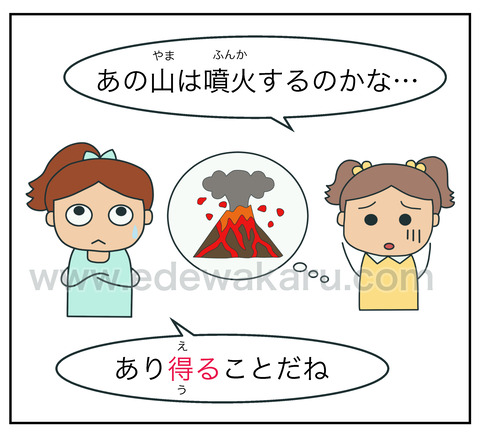
A:あの山は噴火するのかな…(復習:〜かな・〜かしら)B:あり得ることだね→噴火する可能性があるね
A: I wonder if that mountain will erupt… (Review: 〜かな・〜かしら) B: It’s possible. →There’s a possibility it will erupt.
彼が負けるなんてあり得ないよ!
→彼が負けるなんてあるはずがないよ!There’s no way he could lose! →There’s no way he could lose!
事故は誰にでも起こり得ることだ
→事故は誰にでも起こる可能性があることだAn accident is something that could happen to anyone. →An accident is something that could happen to anyone.
お酒やタバコは病気の原因になり得ます
→お酒やタバコは病気の原因になる可能性がありますAlcohol and tobacco can cause illness. →Alcohol and tobacco can possibly cause illness.
Read the original source text
Meaning
〜可能性がある / 〜可能性がない
〜できる / 〜できない
How to use it
動詞[ます形]+得る
動詞[ます形]+得ない
Explanation
「〜得る・〜得ない」は「〜可能性がある・〜可能性がない」または「〜できる・〜できない」という意味で使用される文型です。まず気をつけなければいけないのは読み方です😮
「うる」「える」
と2つ読み方がありますが、使い分けが必要です😨
「得る」→
う
る・
え
る
「得ます」→
え
ます
「得ない」→
え
ない
「得ません」→
え
ません
「得た」→
え
た
「得ました」→
え
ました
つまり、「得る」のみが「うる・える」と2つ読み方がありますが、その他は「え」と読まなければいけないということです😊(復習:〜ということだ)
また、この文型は
ただ「能力」を表す場合には使えないということを覚えておいてください
😌
⭕️彼女は日本語が
話せる
❌彼女は日本語が
話し得る
「能力」を表す場合には「〜ことができる」「可能形」を使うようにしてください。
「〜得る・〜得ない」は書き言葉的ですが、「あり得ない=あるはずがない」は会話でもとてもよく使われます😊みなさんも日常会話で使ってみてくださいね😉
日本語NET JLPT文法解説まとめ
Meaning
Can happen / cannot happen.
How to use it
V (ます-stem) + 得る / 得ない
Explanation
can / cannot
① It cannot be used to mean “can/cannot” in terms of ability.
❌Tom can read a little kanji.
② 「得る」 can be read as either 「える」 or 「うる」, but in the negative form only 「えない」 is used.
In context 12 examples
日頃から気をつけていても、事故は起こり得るものだ。
Even if you’re careful every day, accidents can happen.
地震はいつ起こるか予想し得ないから、事前に家族との連絡方法や避難場所などを決めておいた方がいいでしょう。
Since it is impossible to predict when an earthquake will occur, it would be best to decide in advance how to contact your family and where to evacuate.
学校一の成績を誇るジョンさんがJLPT N1に合格しなかったなんて、あり得ないよ。
There’s no way John, who boasts the best grades in the school, could have failed the JLPT N1.
結婚しているのに、浮気するなんてあり得ないよ。
You’re married, so there’s no way you should cheat.
考え得る原因は全て考えので、これ以上の原因究明は不可能と言っていいだろう。
I have considered all conceivable causes, so it would be fair to say that further investigation into the causes is impossible.
長所は時に短所になり得る。
A strength can sometimes become a weakness.
毎年出生率は下がっているし、経済もよくないし、今後もこのような状況が続くのであれば経済破綻もあり得るかもしれない。
The birth rate is falling every year, and the economy is poor; if this situation continues, an economic collapse might be possible.
地震がいつ来るかなんて、予測し得ないことだ。
It is impossible to predict when an earthquake will strike.
検証作業は、起こり得る全てのテストパターンに基づいて実施します。
The verification work will be carried out based on all possible test patterns.
タバコの吸いすぎや、お酒の飲み過ぎは病気の原因になり得ます。
Smoking too much or drinking too much can cause illness.
どんな人だって、失敗することはあり得ます。
Anyone can make a mistake.
今の気持ちは言葉で言い表し得ない。
My current feelings cannot be expressed in words.
Read the original source text
Meaning
〜できる / 〜できない
How to use it
V(ます形)ます + 得る / 得ない
Explanation
can / cannot
①「能力的にできる・できない」の意味では使えない。
❌トムさんは少しだけ漢字を読み得る。
②「得る」は「える」と「うる」の2つの読み方があるが、否定形の場合は「えない」のみ。
毎日のんびり日本語教師
How to use it
Verbます-form + 得る
Explanation
Expresses circumstantial possibility.
It cannot express possibility based on ability.
◯ I can speak Japanese.
✕ I can possibly speak Japanese. (with 「話し得る」)
It is generally read as 「うる」, but 「ありうる/ありえる」, 「起こりうる/起こりえる」, and 「なりうる/なりえる」 are exceptions; either reading is correct.
「~得る」 is a relatively formal expression, but 「ありえる」 is also frequently used in conversation.
Notes
Related grammar: 「【N2文法】~得ない(えない)」
In context 12 examples
宇宙はこんなにも広いんだから、宇宙人の存在はきっとありえる話だ。
Since the universe is so vast, the existence of aliens is surely possible.
この急カーブではよく曲がりきれず事故になっている。早く対策しなければ今後も起こりえるだろう。
On this sharp curve, accidents often happen because vehicles can’t make the turn. If we don’t take measures soon, it could happen again in the future.
話しうることは全て話した。あとは結果を待つだけだ。
I’ve said everything that could be said. Now all that’s left is to wait for the result.
これは考え得る最悪の事態だ。
This is the worst situation imaginable.
短所は見方を変えると長所となり得る。
A weakness can become a strength if you look at it differently.
安価なネイルは爪を傷める原因になり得る。(便宜的指甲可能会损伤指甲。)
Cheap nail polish can damage your nails. (Inexpensive nail products may cause nail damage.)
交通事故はいくら自分が注意していても他人あってのことなのでいつでも起こりうる。
No matter how careful you are, traffic accidents can happen at any time because they also depend on other people.
どんな人間でも間違いをしでかすということは十分あり得る。(任何人都有可能犯错误。)
It is quite possible for anyone to make a mistake. (Anyone can make a mistake.)
交通事故は誰でも起こりうる問題です。
Traffic accidents are a problem that can happen to anyone.
私の知り得る情報全てを包み隠さず話していきます。
I’ll tell you all the information I can obtain, without hiding anything.
男女間の友情ってあり得ると思いますか?
Do you think friendship between men and women is possible?
人類が持ち得る戦力を結集させないと宇宙人には勝てない。
We can’t defeat the aliens unless we bring together all the military strength humanity can muster.
Read the original source text
How to use it
動ます形+得る
Explanation
状況可能を表します。
能力可能は表せません。
◯日本語を話せる。
✕日本語を話し得る。
基本的には「うる」と読みますが、「ありうる/ありえる」「起こりうる/起こりえる」「なりうる/なりえる」は例外的にどちらでも正しいです。
「~得る」は比較的硬い表現ですが、「ありえる」は口語としても頻繁に使われます。
Notes
関連文法「【N2文法】~得ない(えない)」
NINJAL 日本語文型データベース
Meaning
It indicates that there is a possibility of “〜” happening.
It is a formal expression, but 「あり得る」 is an idiomatic expression that is also used in casual conversation.
How to use it
Notes
When used in the dictionary form, it is usually read 「うる」, though it can also be read 「える」. Forms other than the dictionary form use only 「え〜」, as in 「えます・えない・えて・えた」.
In context 7 examples
人間は変わり得るのだ。若ければもちろん、何歳になっても。
People can change. When they’re young, of course, but at any age.
「途中で充電が切れるってこともあり得るから、一応充電器も持って行ったほうがいいんじゃない?」
“The battery might run out partway through, so shouldn’t you take the charger just in case?”
この建設計画によって、どんな問題が起こり得ますか。
What kinds of problems could arise from this construction plan?
この問題を解決するために、今考え得る方法は、以下の3つです。
The following are the three methods we can think of right now to solve this problem.
我が国は本当に世界に誇り得る国家と言えるのだろうか。
Can we really say that our country is one we can be proud of before the world?
資源不足の日本では、利用しうるものはできる限り利用する知恵が必要だ。
In Japan, which lacks resources, we need the wisdom to make use of whatever we can, as much as possible.
これは、今まで我々がなしえた研究の成果を記録したものです。
This records the results of the research we have managed to carry out so far.
Read the original source text
Meaning
〜の可能性があることを表します。
硬い言い方ですが、「あり得る」は慣用的な言い方として、くだけた会話でも使います。
How to use it
Notes
辞書形で使う場合はふつう「うる」と読みますが、「える」と読むこともあります。辞書形以外は「えます・えない・えて・えた」のように「え〜」だけです。