どんなときどう使う 日本語表現文型辞典
Meaning
no doubt
How to use it
[Plain form] (な-adjective / な-adjective + である / N / N + である) + に違いない
Explanation
きっと~と思う
1)「きっと~と思う」という話者の確信を述べる推量の表現。「たぶん~だろう」より確信の程度が強い。
2)その確信を特に強調するとき以外に使うと不自然になる。
3)「にそういない」より口語的。
1)Speaker's conviction about conjecture. Level of conviction is higher than with たぶん~だろう.
3)More colloquial than にそういない.
2)Sounds unnatural if used other than for emphasizing conviction.
In context 3 examples
リンさんは旅行にでも行っているに違いない。何度電話しても出ない。
Mr. Lin must have gone on a trip or something. No matter how many times I call, he doesn’t answer.
彼は何も言わなかったが、表情から見て、本当のことを知っていたに違いない。
He didn’t say anything, but judging from his expression, he must have known the truth.
課のみんなが知らないということは、田中さんがちゃんと報告しなかったに違いない。
If nobody in the department knows about it, Mr. Tanaka must not have reported it properly.
Read the original source text
Meaning
no doubt
How to use it
〔普通形〕(ナA・ナAである/N・Nである)+に違いない
Explanation
きっと~と思う
1)「きっと~と思う」という話者の確信を述べる推量の表現。「たぶん~だろう」より確信の程度が強い。
2)その確信を特に強調するとき以外に使うと不自然になる。
3)「にそういない」より口語的。
1)Speaker's conviction about conjecture. Level of conviction is higher than with たぶん~だろう.
3)More colloquial than にそういない.
2)Sounds unnatural if used other than for emphasizing conviction.
IMABI
No doubt that
Read this IMABI lesson ↗Explanation
No Doubt that: ~に違いない, ~に相違ない, & ~に決まっている
~に違いない and ~に相違ない are not necessarily difficult, but there are certain problems that students have. The unusual way it connects to adjective/verb expressions, not properly understanding what can follow them, and not understanding formality differences are the main sources of error. The lesson will be ended with the similar ~に決まっている.
~に違いない VS ~に相違ない
First and foremost, these expressions are both translated as “there is without a doubt that…”. This is the immediate source of confusion because you can add phrases like “I think that” or “probably” in English without causing ungrammaticality. However, with these Japanese expressions, doing so does. First, consider the following defining of these terms.
~に違いない: Not from objective proof or logical speculation, but rather from the speaker’s own experience, this phrase shows one’s intuitive speculation/confidence. With such a bold move, it is without surprise that this is quite strong. It is often used in situations where it’s as if one is talking to oneself in attempts to verify one’s own guess or deliberation.
~に相違ない: Like ~に違いない, it shows intuitive speculation/confidence, but it is more stiff and formal. This formality difference is very important to keep in mind. One reason is that speech modals more akin to the spoken language like the final particle から, which is commonly used with ~に違いない, are not typically used with ~相違ない. This also implies that there is no mistake in it; thus, it gives a more confident tone. Thus, although adverbs like きっと are common with ~に違いない, it is not with ~に相違ない due to the tone. Although perhaps of old logic, some speakers feel this is more so indicative of middle-aged/old men as they are more likely to use old-fashioned expressions, which would not be old-fashioned for them, and fits the traditional tone for masculine speech.
These patterns attach to phrases in the following manner.
Nouns N(である)+~に{違い・相違}ない
形容詞 形容詞 + ~に{違い・相違}ない
形容動詞 形容詞(である) + ~に{違い・相違}ない
Verbs Verb + ~に{違い・相違}ない
Notice that it does not say Adj/V + こと + に{違い・相違}ない. It is a set phrase, and like other phrases with に, the reason for why this is allowed stems from a Classical Japanese grammatical maneuver of using conjugational parts of speech as nominal phrases when in the 連体形. As this base has changed appearance for many items, it’s not surprising that in Modern Japanese this technique is limited.
Examples
1. 政府の報道官の応答はどんなに(か)悔しかったに違いない。
The response of the government spokesperson was in no doubt overly regrettable.
Grammar Note: In a more literary sense どんなに(か) may be replaced with いかばかりか. Also note that the use of か with this in the first place is hardly ever heard.
2. 違いない(その通り)、君の言う通りだ。
That’s right. It’s just as you say.
3. この計画の実行は困難に違いない。
It is without a doubt that this plan’s implementation is difficult.
4. 泥棒どろぼうが入ったに違いない。
There is no doubt that a robber came in.
5. 馬鹿者ばかものには違いないが、責任を取らざるをえないだろう。
Although it’s without a doubt that you’re an idiot, there’s no other way but to take responsibility.
By 大仏次郎おさらぎじろう
6. 明日は曇くもるに違いない。
It will definitely be cloudy tomorrow.
7. 社長は天才であることに相違ない。
There’s no doubt that the company president is a genius.
8. 「あの女の人は誰でしょうか」「ケンさんのガールフレンドに違いありません。手を繋つないで一緒に歩いていますから」
“Who is that woman?” “There’s no doubt that she’s Ken’s girlfriend because they’re holding hands walking together”.
9. 「あの人は何語なにごの学生でしょうか」「日本語の学生に違いありません。読んでいるものに「新しい」と書いてありますから」
“What language student is that person? “That person is no doubt a Japanese student because the thing (that person) is reading has “atarashii” written on it”
10. 「あの人は日本に住んでいたんでしょうか」「そうに違いありません。日本の新聞を読んでいますから」
“I wonder if that person lived in Japan” There’s no doubt about it because he’s reading a Japanese newspaper”
11. 「あの女の人は結婚しているんでしょうか」「そうに違いありません。指輪ゆびわを嵌はめていますから」
“I wonder if that woman is married” “There’s no doubt about it because she’s wearing a ring”
~に決まっている
~に決まっている means “it is certainly…” and follows nouns, adjectives, or verbs. This speech modal shows 100% certainty and is reflective of 話し言葉. It shows that the speaker is very confident in labeling something as so. It is also used in chastising.
12. 彼は嘘うそをついているに決まっている。
He’s certainly lying.
13. 夏は暑いに決まっている。
It is certainly hot in summer.
14. 負けるに決まってる。(Casual)
(They) will certainly lose.
In context 14 examples
政府の報道官の応答はどんなに(か)悔しかったに違いない。
The response of the government spokesperson was in no doubt overly regrettable.
違いない(その通り)、君の言う通りだ。
That’s right. It’s just as you say.
この計画の実行は困難に違いない。
It is without a doubt that this plan’s implementation is difficult.
泥棒どろぼうが入ったに違いない。
There is no doubt that a robber came in.
馬鹿者ばかものには違いないが、責任を取らざるをえないだろう。
Although it’s without a doubt that you’re an idiot, there’s no other way but to take responsibility.
明日は曇くもるに違いない。
It will definitely be cloudy tomorrow.
社長は天才であることに相違ない。
There’s no doubt that the company president is a genius.
「あの女の人は誰でしょうか」「ケンさんのガールフレンドに違いありません。手を繋つないで一緒に歩いていますから」
“Who is that woman?” “There’s no doubt that she’s Ken’s girlfriend because they’re holding hands walking together”.
「あの人は何語なにごの学生でしょうか」「日本語の学生に違いありません。読んでいるものに「新しい」と書いてありますから」
“What language student is that person? “That person is no doubt a Japanese student because the thing (that person) is reading has “atarashii” written on it”
「あの人は日本に住んでいたんでしょうか」「そうに違いありません。日本の新聞を読んでいますから」
“I wonder if that person lived in Japan” There’s no doubt about it because he’s reading a Japanese newspaper”
「あの女の人は結婚しているんでしょうか」「そうに違いありません。指輪ゆびわを嵌はめていますから」
“I wonder if that woman is married” “There’s no doubt about it because she’s wearing a ring”
彼は嘘うそをついているに決まっている。
He’s certainly lying.
夏は暑いに決まっている。
It is certainly hot in summer.
負けるに決まってる。(Casual)
(They) will certainly lose.
絵でわかる日本語
Meaning
I’m absolutely sure that…
I’m sure that…
How to use it
Verb, adjective, or noun [dictionary form] + に違いない
Explanation
“〜に違いない” is a sentence pattern used when you want to say “I’m sure that〜” or “I’m certain that〜.” It is used when there is some reason or basis for thinking something, and the speaker says with confidence, “So, I’m sure that〜.” 😊 “〜に違いない” is a somewhat formal-sounding expression, so in everyday conversation, “きっと〜だと思うよ” is used more often. 😀
If you’re taking N3 or above, remember it together with
“〜に決まっている.”
【Related sentence patterns】
In context 4 examples
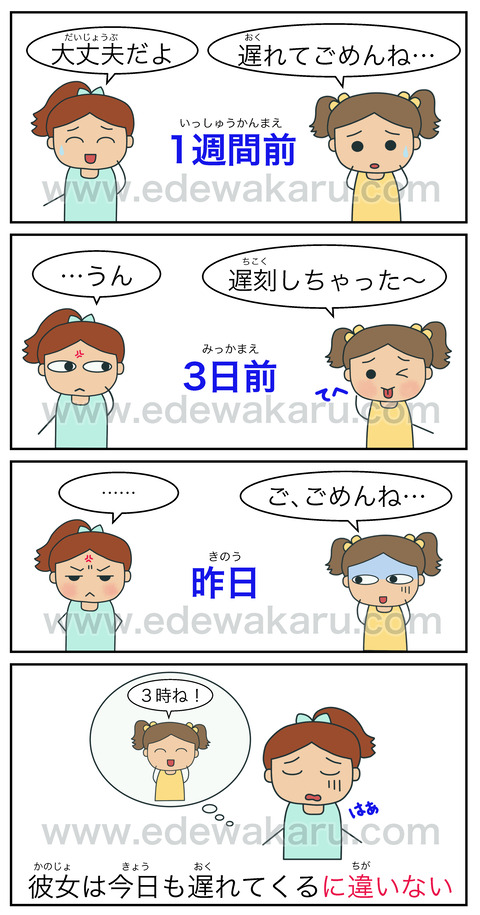
彼女は今日も遅刻するに違いない
→彼女は今日も絶対に遅刻すると思うShe’s sure to be late again today. → I’m sure she’ll be late again today.
彼女はアメリカに10年も住んでいたから、英語が話せるに違いない
→彼女はアメリカに10年も住んでいたから、きっと英語が話せると思う(復習:〜も(数量詞+も))She lived in America for as long as ten years, so she must be able to speak English. → She lived in America for as long as ten years, so I’m sure she can speak English. (Review: 〜も (quantity word + も))
あそこのケーキは安い上においしい。人気があるに違いない
→あそこのケーキは安い上においしい。きっと人気があると思う(復習:〜上に)The cakes over there are cheap and delicious. They must be popular. → The cakes over there are cheap and delicious. I’m sure they’re popular. (Review: 〜上に)
彼に何度もLINEしたが、返事がない…既読スルーされているに違いない
→彼に何度もLINEしたが、返事がない…きっと既読スルーされているんだと思う(復習:「Google」や「Twitter」は日本語でどう読むの?)I messaged him on LINE many times, but there’s no reply… I’m sure he’s leaving me on read. → I messaged him on LINE many times, but there’s no reply… I’m sure he’s leaving me on read. (Review: How are “Google” and “Twitter” pronounced in Japanese?)
Read the original source text
Meaning
絶対に〜だと思う
きっと〜だと思う
How to use it
動詞・形容詞・名詞[辞書形]+に違いない
Explanation
「〜に違いない」は「絶対に〜と思う」「きっと〜だと思う」と言いたい時に使う文型です。何か理由や根拠になるものがあって、「だから、きっと〜だと思う」と、話者が確信をもって言う時に使います😊「〜に違いない」は少しかたい言い方なので、日常会話(にちじょうかいわ)では「きっと〜だと思うよ」の方がよく使われます😀
N3以上を受ける人は
「〜に決まっている」
と一緒に覚えておきましょう。
【関連文型】
くらべてわかる日本語表現文型辞典
Meaning
X is probably A. An expression of conjecture with a high degree of certainty.
How to use it
Explanation
【Contrast 1】
“Aに相違ない” (Meaning 1, p. 241)
“(X is) Aに相違ない” is an expression that strongly asserts that X is A.
○「あなたが今述べたことは、真実に相違ないですか?」「はい、真実に相違ないです。」 — “Is what you just said the truth without a doubt?” “Yes, it is undoubtedly the truth.”
“Aには違いない” (Meaning 1, p. 256)
“(X is) Aには違いない” acknowledges as fact that X is A, but is followed by a partial denial or qualification.
○彼女の妹だったら、美人に違いない。 — If she is her younger sister, she must be beautiful.
○彼女の妹は美人には違いないが、とてもわがままだ。 — Her younger sister is certainly beautiful, but she is very selfish.
In context 4 examples
彼はお金を落として、きっと困っているに違いない。
He has lost his money, so he must be in a difficult position.
両親が俳優なんだから、息子もハンサムに違いない。
Since his parents are actors, his son must be handsome too.
こんないたずらをするのはあの子に違いないわ。
That must be that child who is playing such pranks.
筆跡からすると、この手紙は山本さんが書いたに違いない。
Judging from the handwriting, Mr. Yamamoto must have written this letter.
Read the original source text
Meaning
たぶんXはAだろう。確信度の高い推量表現である。
How to use it
Explanation
【対比1】
「Aに相違ない」(意味1 P.241)
「(Xは)Aに相違ない」はXはAだと強く断言する表現。
○「あなたが今述べたことは、真実に相違ないですか?」「はい、真実に相違ないです。」
「Aには違いない」(意味1 P.256)
「(Xは)Aには違いない」はXはAであることを事実として認めるが、続いてその一部否定や補足がくる。
○彼女の妹だったら、美人に違いない。
○彼女の妹は美人には違いないが、とてもわがままだ。
毎日のんびり日本語教師
How to use it
Verb plain form + に違いない
い-adjective plain form + に違いない
な-adjective stem + に違いない
Noun + に違いない
Explanation
Expresses the speaker’s strong judgment or assertion based on some kind of grounds.
Notes
Similar grammar: 「【N2 Grammar】~に決まっている」
Similar grammar: 「【N2 Grammar】~に相違ない」
「~に決まっている」「~に違いない」 and 「~に相違ない」 all have the same meaning, but 「~に決まっている」 is the softest expression. 「~に相違ない」 is used mainly in written language.
In context 6 examples
彼女の表情を見る限り、何か秘密があるに違いない。
Judging from her expression, she must be hiding something.
私が抱いているこの感情は、きっと彼女に対する恋心に違いない。
This feeling I have for her must surely be romantic love.
見た感じ、彼は相当な手練れに違いない。
From the way he looks, he must be quite skilled.
みんなが口を揃えて言うんだから、そうに違いない。
Everyone says the same thing, so that must be true.
神はいるに違いない。(神肯定存在。)
God must exist. (God affirmatively exists.)
これらは何らかの陰謀に違いない。
These must be some kind of conspiracy.
Read the original source text
How to use it
動詞普通形+に違いない
い形容詞普通形+に違いない
な形容詞語幹+に違いない
名詞+に違いない
Explanation
何らかの根拠に基づく、話し手の強めの判断・断定を表します。
Notes
似ている文法「【N2文法】~に決まっている」
似ている文法「【N2文法】~に相違ない」
「~に決まっている」「~に違いない」「~に相違ない」はそれぞれ同じ意味ですが、最も柔らかい表現は「~に決まっている」です。「~に相違ない」は主に書き言葉として用いられます。
NINJAL 日本語文型データベース
Meaning
Expresses the speaker's strong conviction, based on some grounds.
How to use it
V plain form + に違いない
i-A plain form + に違いない
na-A plain form + に違いない (however, “na-Aだ” becomes “na-A + に違いない” or “na-Aである + に違いない”)
N plain form + に違いない (however, “Nだ” becomes “N + に違いない” or “Nである + に違いない”)
Other
Notes
In polite speech, “~に違いありません” is more commonly used than “〜に違いないです.”
In context 23 examples
正確な居場所はわからないが、今日のSNSの写真からすると、太郎は今、アメリカにいるに違いない。
I don't know his exact location, but judging from today's social media photos, Taro must be in America now.
木村さんはお酒が苦手だと言っていたから、今日のパーティでもお酒を飲まないに違いない。
Kimura said he wasn't good with alcohol, so he surely won't drink at today's party either.
今日は寒いので、高齢の方は今夜の集まりにはいらっしゃらないに違いありません。
It's cold today, so elderly people surely won't come to tonight's gathering.
部屋の電気がついているから、お隣の一家はもう旅行から戻ったに違いない。
The lights are on in the room, so the family next door must already have returned from their trip.
太郎君が「隣の部屋から焦げ臭い匂いがする」とアパートの管理人に知らせてくれなかったら、このアパートは火事になっていたに違いありません。
If Taro hadn't told the apartment manager that there was a burning smell coming from the next room, this apartment surely would have caught fire.
花子が泣きそうな顔をしている。今日の面接がうまくいかなかったに違いない。
Hanako looks as if she's about to cry. Today's interview must not have gone well.
父がこんなふうに笑うのを見るのは初めてだ。弟の優勝がよほどうれしいに違いない。
This is the first time I've seen my father laugh like this. He must be extremely happy that my younger brother won.
あの新藤監督のアクション映画なら、面白いに違いありません。楽しみです。
A new action movie by that Director Shindo is bound to be interesting. I'm looking forward to it.
昼時なのにこの店には客がいない。おいしくないに違いない。別の店にしよう。
There are no customers in this restaurant even though it's lunchtime. It must not be good. Let's go somewhere else.
昨年のチャンピオンの西田が負けてしまうとは……。対戦相手はよほど強かったに違いない。
I can't believe last year's champion Nishida lost... His opponent must have been very strong.
その日、友恵は先生に質問されても、ろくに返事もしなかったそうだ。いつもと違う彼女の様子を不思議に思ったクラスメートも少なくなかったに違いない。
I hear that Tomoe barely replied even when her teacher asked her questions that day. Quite a few classmates must have wondered why she was acting so differently from usual.
都会育ちの彼には、この小さな村での暮らしは不自由に違いない。
Life in this small village must be inconvenient for him, having grown up in the city.
裕のアキへの恋心を僕が勝手にアキに伝えるなどというおせっかいは、裕には迷惑であるに違いない。
It must be a nuisance to Yutaka if I meddle by telling Aki about his feelings for her without his permission.
漢字を1つでも多く覚えようとする今の努力は無駄ではないに違いない。しかし時々くじけそうになるのも本当だ。
My current efforts to memorize as many kanji as possible surely aren't in vain. But it's also true that sometimes I feel like giving up.
恵の結婚式に私は行けなかった。真っ白なドレスを着た恵はきっと素敵だったに違いない。
I couldn't go to Megumi's wedding. Megumi must have looked lovely in her pure white dress.
太郎はすっかりやせ細ってしまって顔色も悪かった。あの様子だと離婚後の彼の生活はあまり健康的ではなかったに違いない。
Taro had become terribly thin and looked pale. Judging by how he looked, his life after the divorce must not have been very healthy.
あの事故は、非常に大きな事故だったので、直後には死亡者の数も定かではなかったに違いない。
That accident was so serious that the number of deaths must not have been clear immediately afterward.
この空模様だと、明日は雨に違いない。
With the sky looking like this, it must rain tomorrow.
あの制服からすると、あの子たちは南高校の生徒に違いありません。
Judging by those uniforms, those children must be students at Minami High School.
隣のテーブルのあの人たちは、この辺りの人ではないに違いない。聞こえてくるのがこの地方の方言ではない。
Those people at the next table must not be from around here. What I hear is not the local dialect.
先月は、ずっと胃の調子が悪かった。きっと仕事のストレスが原因だったに違いない。
My stomach was bothering me all last month. It must have been caused by stress at work.
明美は帰って来るとすぐ自分の部屋に入って出てこなかった。試験の結果が彼女の期待通りではなかったに違いない。
As soon as Akemi came home, she went into her room and didn't come out. Her exam results must not have been what she hoped for.
あれ? さっきまで手に持っていた傘がない。電車の中に忘れてきたのだろうか。きっとそうに違いない。
Huh? The umbrella I was holding just a moment ago is gone. Did I leave it on the train? That must be it.
Read the original source text
Meaning
ある根拠から生じる話し手の強い確信を表します。
How to use it
V普通形+に違いない
i-A普通形+に違いない
na-A普通形+に違いない(ただし、「na-Aだ」→「na-A+に違いない・na-Aである+に違いない」)
N普通形+に違いない(ただし、「Nだ」→「N+に違いない・Nである+に違いない」)
その他
Notes
丁寧体で使うときは、「〜に違いないです」より「~に違いありません」のほうをよく使います。