くらべてわかる日本語表現文型辞典
Meaning
Meaning 1: To conform to the state of A.
Meaning 2: In a state where A remains unchanged; without changing A.
Meaning 3: In the forms “AたままB” and “AないままB,” B occurs without the action or event that would normally follow A taking place.
How to use it
AままB (Aまま / Aのまま / Aがまま)
Connection 1:
[Verb—た form] まま
[Verb—dictionary form (が)] まま
Connection 2:
[Verb—た form] まま
[Noun—の] まま
Connection 3:
[Verb—た form] まま
[Verb—ない form] まま
Explanation
[Contrast 2]
“AとおりにB (AとおりB)” (Meaning 2, p. 163)
“AとおりB” focuses on A and B being the same, while “AままB” focuses on not changing the state of A.
○子どもは寝ていたのでそのまま部屋に置いてきた。 — The child was asleep, so I left them in the room just as they were.
×子どもは寝ていたのでそのとおり部屋に置いてきた。 — The child was asleep, so I left them in the room exactly as they were (とおり).
○あなたが見たとおりのことを話してください。 — Please tell me what you saw, just as you saw it.
○あなたが見たままを話してください。 — Please tell me what you saw, just as it appeared to you.
[Contrast 3]
“AてB”
With “AたままB,” A is the state resulting from an action that has actually taken place and exists now. “AてB” can be used for a resulting state or for something that has not yet been done.
○診察室にはガウンを着たままお入りください。(今ガウンを着ている) — Please enter the examination room while still wearing your gown. (You are wearing the gown now.)
○診察室にはガウンを着てお入りください。(今からガウンを着る) — Please put on your gown and enter the examination room. (You will put on the gown now.)
“AながらB” (Meaning 1, p. 195)
“AなりB” (Meaning 3, p. 204)
“Aたきりだ” (Meaning 1, p. 112)
“Aっぱなし” (Meanings 1 and 2, p. 137)
In context 12 examples
彼女の音楽には楽譜がない。いつも心に感じるままに演奏している。
There is no sheet music for her music. She always plays as she feels in her heart.
足の向くまま気の向くまま、自由な旅に出たいものだ。
I'd like to set off on a free-spirited journey, going wherever my feet and my heart take me.
課長は部長の言うがままだ。
The section chief does exactly as the department head says.
高熱でうなされていたので、看護師のされるがままだった。
I was delirious with a high fever, so I was completely at the nurse's mercy.
あなたの見たままの状況を話してください。
Please describe the situation just as you saw it.
サインが消えるまで座席に座ったままでお待ちください。
Please remain seated and wait until the sign goes out.
久しぶりに帰った我が家は家を出たときのままだった。
When I returned home after a long time, it was just as it had been when I left.
よくわからないので、私が聞いたままをお伝えします。
I don't know the details, so I'll pass on what I heard just as I heard it.
彼は部屋のドアを開けたまま出て行った。
He left with the room door open.
酔っぱらって、服を着たままベッドに倒れ込んだ。
Drunk, I collapsed onto the bed still wearing my clothes.
部長の許可を得ないまま計画を進めてしまった。
I went ahead with the plan without getting the department head's approval.
A国との交渉は互いに主張を譲らず、暗礁に乗り上げたままだ。
Negotiations with Country A have reached an impasse, with neither side yielding its position.
Read the original source text
Meaning
意味1:Aの状態に従う。
意味2:Aが変わらない状態で。Aを変えない状態で。
意味3:「AたままB」「AないままB」の形で。Aの動作・行為の後、次に行われるはずの動作・行為が行われない状態でB。
How to use it
AままB(Aまま/Aのまま/Aがまま)
接続1:
[動詞-た形]まま
[動詞-る形(が)]まま
接続2:
[動詞-た形]まま
[名詞-の]まま
接続3:
[動詞-た形]まま
[動詞-ない形]まま
Explanation
【対比2】
「AとおりにB(AとおりB)」(意味2 P.163)
「AとおりB」はAとBが同じことに視点があり、「AままB」はAの状態を変えないことに視点がある。
○子どもは寝ていたのでそのまま部屋に置いてきた。
×子どもは寝ていたのでそのとおり部屋に置いてきた。
○あなたが見たとおりのことを話してください。
○あなたが見たままを話してください。
【対比3】
「AてB」
「AたままB」のAは現実にいま存在している行為の結果の状態であり、「AてB」のAは、結果の状態にも、まだ行われていないことにも使える。
○診察室にはガウンを着たままお入りください。(今ガウンを着ている)
○診察室にはガウンを着てお入りください。(今からガウンを着る)
「AながらB」(意味1 P.195)
「AなりB」(意味3 P.204)
「Aたきりだ」(意味1 P.112)
「Aっぱなし」(意味1,2 P.137)
DoJG 日本語文法辞典(全集)
Meaning
As it is; unchanged; undisturbed; leave as is; remain
How to use it
(i) Vinformal past | まま | |
| (電気を)つけたまま | Leaving (the light) on |
(ii) Adjective い | まま | |
| 大きいまま | As something is big |
(iii) {Adjective な stem/ Noun の} | まま | |
| 不便なまま | Leaving something is inconvenient |
| 昔のまま | Leaving something as it was |
Explanation
An already given situation or condition remains unaltered.
In context 14 examples
弟はテレビをつけたまま寝てしまった・しまいました。
My younger brother went to sleep leaving the TV on.
弟はテレビをつけたままにしておいた・おきました。
My younger brother left the TV on.
弟はテレビをつけたままだ・です
My younger brother has left the TV on.
この部屋は昨日のままだ・です。
This room is as it was yesterday.
ここはこのままにしておく・おきます。
I'll leave this place as it is.
テレビがついたままになっている・います。
The TV was turned on and is still on.
帽子を被ったままの学生が教室にいた・いました。
A student who kept his hat on was in the classroom.
電気をつけたまま寝てしまいました。
I fell asleep leaving the light on.
ビールを買ったまま飲まなかった。
I bought beer, but didn't drink it.
聞いたままを友達に話しました。
I told my friend exactly what I heard.
あの人はあれからずっと寝たままだ。
He's been in bed (literally: all along) since then.
高山さんはアメリカへ行ったまま帰らなかった。
Mr. Takayama went to America never to return.
車のエンジンをかけたままにしておいた。
I left the car engine on.
今のままにしておいてください。
Please leave it as it is now.
日本語文型辞典
Meaning
Basic information: In spoken language, it is also said as “まんま.”
Indicates that the same state continues without change. As in ①–④, when attached to a noun, na-adjective, or i-adjective, it indicates that a state at some point in the past continues unchanged up to the present. Also, as in ⑤–⑩, when attached to the ta-form of a verb, it indicates that after the action expressed by “V-た” is completed, the same state continues. It is often used when something that would normally be expected to happen next has still not happened. For example, ⑤ indicates “borrowed it and still hasn’t returned it,” and ⑥ indicates “still hasn’t shown up at the office.”
Means “without changing, in the same state.” As in ①–④, it indicates not changing or remaining unchanged from the current state; as in ⑤–⑩, attached to the ta-form or negative form of a verb, it means “do … in that state.” It is used when a verb expressing an instantaneous action is followed by another action or event while the result of that action remains. The subjects of the two verbs must be the same.
a. V-るまま(に)
Means “leaving things to take their course, as one pleases.” The verbs used are limited, as in “足の向くまま” and “気の向くまま.”
b. V-られるまま(に)
Indicates going along with another person’s wishes or circumstances and doing as one is told. It is also used in the form “V-られるがままに.”
c. …ままに なる/する
Means “remain in the same state without changing / keep something in the same state.” In ①–③, “V-たままにしておく” and “このままにしておく” mean that, for some reason, the speaker deliberately leaves the state unchanged. ④ and ⑤, “V-たままになっている,” mean that something has been left in that state.
Means “as it is, without making any changes.” Other expressions used include “感じたまま,” “見たまま,” and “聞いたまま.”
A fixed idiomatic expression indicating that one follows something as it is, without making any changes. ① and ② are the same as “V-られるまま(に)”: ① means “exactly as one was told,” and ② means “let oneself be acted upon without resisting.” ③ means “one’s unadorned, natural self.”
How to use it
…ままだ
Nのままだ
Naなままだ
A一いままだ
V-たままだ
…まま(で)
Nのまま(で)
Naなまま(で)
A-いまま(で)
V-たまま(で)
…まま(に)
V-たままに なる/する
V-たままを
…がまま
V-る/V-られる がまま
In context 41 examples
10年ぶりに会ったが、彼は昔のままだった。
I met him for the first time in ten years, but he was just as he had been.
テーブルの上は、朝出かけた時のままだった。
The table was just as it had been when I left in the morning.
このあたりは開発もされず、昔と変わらず、不便なままだ。
This area has not been developed and remains inconvenient, just as it was in the past.
小学生の息子に辞書を買ってやったが、あまり使わないのか、いつまでも新しいままだ。
I bought a dictionary for my elementary-school-aged son, but perhaps because he doesn’t use it much, it has stayed like new.
彼には、去年一万円借りたままだ。
I still owe him the 10,000 yen I borrowed last year.
彼は、先週からずっと会社を休んだままだ。
He has been off work continuously since last week.
母は一時ごろに買物に出かけたままだ。
My mother went shopping at around one o’clock and still hasn’t come back.
桜の木は台風で倒れたままだ。
The cherry tree is still lying where it fell in the typhoon.
新幹線は込んでいて、大阪から東京までずっと立ったままだった。
The Shinkansen was crowded, and I stood the whole way from Osaka to Tokyo.
彼はずっとうつ向いたままだった。
He kept his head bowed the whole time.
日本のトマトは、煮たりしないで生のまま食べた方がうまい。
Japanese tomatoes taste better eaten raw, without cooking them.
店員:袋にお入れしましょうか。客:いや、そのままでけっこうです。
Clerk: Shall I put it in a bag for you? Customer: No, it’s fine as it is.
年をとっても、きれいなままでいたい。
Even as I get older, I want to stay beautiful.
日本酒はあたためて飲む人が多いが、私は冷たいままで飲むのが好きだ。
Many people drink sake warmed, but I like to drink it cold.
靴をはいたまま部屋に入らないで下さい。
Please don’t enter the room with your shoes on.
クーラーをつけたまま寝ると風邪をひきますよ。
If you sleep with the air conditioner on, you’ll catch a cold.
ストープを消さないまま学校に来てしまった。
I came to school without turning off the heater.
三日前に家をでたまま行方がわからない。
He left home three days ago and has been missing ever since.
急いでいたので、さよならも言わないまま、帰ってきてしまった。
I was in a hurry, so I came home without even saying goodbye.
戦後の混乱で父とはずっと連絡がとれなかった。結局父は、私が結婚したことも知らないまま亡くなった。
Because of the postwar turmoil, I was unable to contact my father for a long time. In the end, he died without even knowing that I had gotten married.
(誤) 電車はこんでいて、山田さんは立ったまま、私はすわっていた。
(Incorrect) The train was crowded, and while Mr. Yamada was standing, I was sitting.
(正) 電車はこんでいて、山田さんは立ったままだったが、私はすわっていた。
(Correct) The train was crowded, and Mr. Yamada was standing, while I was sitting.
(誤) 彼が待っているまま、私は他の人と話していた。
(Incorrect) While he was waiting, I was talking to someone else.
(正) 彼を待たせたまま、私は他の人と話していた。
(Correct) I kept him waiting while I was talking to someone else.
足の向くまま、気の向くまま、ふらりと旅に出た。
I set off on a casual trip, going wherever my feet and my mood took me.
気の向くままに、絵筆をはしらせた。
I let my paintbrush move as the mood took me.
あなたの思うまま、自由に計画を立ててください。
Please make your plans freely, however you like.
春の凰に誘われるままに、公園を散歩した。
Drawn in by the spring breeze, I took a walk in the park.
彼は、上司に命令されるままに行動していただけだ。
He was simply acting as his boss ordered him to.
被害者は犯人に要求されるままに金を渡していたようだ。
It seems the victim kept handing over money as the criminal demanded.
暑いのでドアはあけたままにしておいてください。
It’s hot, so please leave the door open.
病気はだんだん悪くなってきている。このままにしておいてはいけない。
The illness is gradually getting worse. We can’t leave things like this.
家族を失って、彼女は悲しみにうちひしがれている。今は、そっとこのままにしておいた方がいい。
Having lost her family, she is crushed by grief. For now, it’s best to leave her alone like this.
電気がついたままになっていた。
The light had been left on.
あの事件以来、ドアはこわれたままになっている。
The door has remained broken since that incident.
見たままを話してください。
Please tell me exactly what you saw.
遠慮なく、思ったままを言ってください。
Please speak freely and say exactly what you think.
田中さんに聞いたままを伝えただけです。
I only passed on exactly what I heard from Mr. Tanaka.
言われるがままに、はんこを押してしまった。
I ended up stamping my seal exactly as I was told.
なぐられても、けられても、彼はされるがままになっていた。
Even when he was punched and kicked, he let them do whatever they wanted to him.
あるがままの姿を見てもらいたい。
I want you to see me just as I am.
Read the original source text
Meaning
基本情報説明話しことばでは「まんま」とも言う。
同じ状態が変わらずに続くことを表す。①~④のように、名詞、ナ形容詞、イ形容詞に付いて、過去のある時点の状態が現在まで変わらずに続いていることを表す。また、⑤~⑩のように動詞のタ形に付いて、「V-た」で表された動作が完了した後、同じ状態がずっと続いていることを表す。普通ならば、当然引き続いて行われることがまだ行われていない場合に使われることが多い。例えば、⑤は「借りて、まだ返していない」⑥は「まだ会社にでてこない」ことを表している。
「変化せずに同じ状態で」という意味を表す。①~④のように、現在の状態を変えない、あるいは変わらないこと、⑤~⑩のように動詞のタ形や否定形に付いて、「その状態で…する」という意味を表す。瞬間的な動作を表す動詞が使われて、その結果が続いた状態で、次の動作や事態が行われるという場合に使う。二つの動詞の主語は同じでなければならない。
a. V-るまま(に)
「なりゆきにまかせて、好きなように」という意味を表す。「足の向くまま」「気の向くまま」など、使われる動詞は多くない。
b. V-られるまま(に)
だれか他の人の意志や状況に従って、言いなりになる様子を表す。「V-られるがままに」の形でも使われる。
c. …ままに なる/する
「変えないで同じ状態が続く/続ける」という意味を表す。①~③の「V-たままにしておく」「このままにしておく」は、なんらかの理由で、話し手がわざとその状態を変えないでおく、④⑤「V-たままになっている」は、そのままの状態で放置されているという意味。
変更を加えずに、その通りにという意味。この他、「感じたまま、見たまま、聞いたまま」などが使われる。
慣用的に固定した表現で、変更を加えずに従っている様子を表す。①②は「V-られるまま(に)」と同じで、①は「言われた通りに」、②は「されるままになって抵抗しなかった」という意味、③は「かざらないそのままの姿を」という意味。
How to use it
…ままだ
Nのままだ
Naなままだ
A一いままだ
V-たままだ
…まま(で)
Nのまま(で)
Naなまま(で)
A-いまま(で)
V-たまま(で)
…まま(に)
V-たままに なる/する
V-たままを
…がまま
V-る/V-られる がまま
絵でわかる日本語
Meaning
Without changing, in a state of ~
Do ~ while remaining in the same state.
How to use it
Verb [た-form]+まま
Verb [ない-form]+まま
い-adjective [remove ーい]+まま
な-adjective [remove ーな]+まま
Noun+のまま
Explanation
「〜まま」is a grammar pattern meaning “in a state of ~ without changing.” It is used when you want to say “~ in the same state, unchanged from the current state.”
There are several grammar patterns that use 「〜まま」, so it may be helpful to learn them together 😊
In context 6 examples
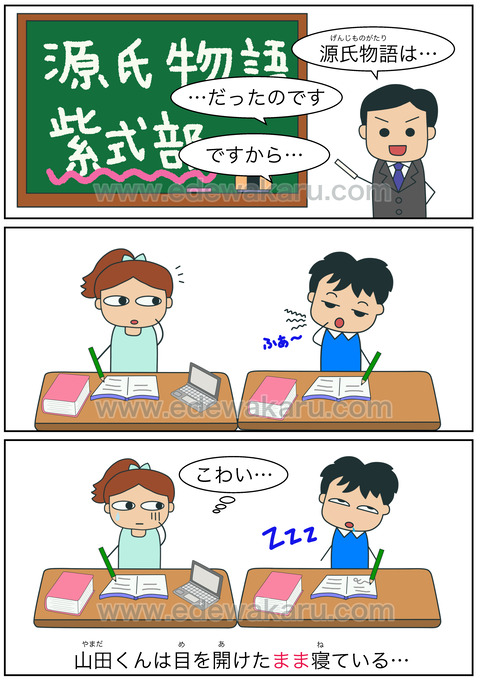
山田くんは目を開けたまま寝ている…
→山田くんは目を開けている状態で寝ている…Yamada-kun is sleeping with his eyes open… → Yamada-kun is sleeping in the state of having his eyes open…
電気を消さないまま出かけたら、お母さんに怒られた
→電気を消さない状態で出かけたら、お母さんに怒られたI went out without turning off the lights, and my mother got angry. → My mother got angry when I went out in the state of not having turned off the lights.
クーラーをつけたまま寝たら、かぜをひくよ!
→クーラーをつけている状態で寝たら、かぜをひくよ!If you sleep with the air conditioner on, you’ll catch a cold! → If you sleep in the state of having the air conditioner on, you’ll catch a cold!
靴をはいたまま、家に入らないでください!
→靴をはいている状態で、家に入らないでください!Please don’t come into the house with your shoes on! → Please don’t come into the house in the state of wearing your shoes!
母:コーヒが冷めちゃったから、チンしてから飲むといいわよ娘:冷たいままで飲むのが好きだから、このままでいいわ
→冷たい状態で飲むのが好きだから、この状態でいいわMother: The coffee’s gone cold, so you should heat it up before drinking it. Daughter: I like drinking it cold, so it’s fine as it is. → I like drinking it in a cold state, so it’s fine as it is.
年をとっても、ずっときれいなままでいたいものだ
→年をとっても、ずっと変わらずきれいな状態でいたいものだ(復習:〜たいものだ)Even as I get older, I want to stay beautiful forever. → Even as I get older, I want to remain beautiful forever without changing. (Review: 〜たいものだ)
Read the original source text
Meaning
変わらず、〜ている状態で
変わらず〜状態で〜する
How to use it
動詞[た形]+まま
動詞[ない形]+まま
い形容詞[ーい]+まま
な形容詞[ーな]+まま
名詞+のまま
Explanation
「〜まま」は「変わらず〜ている状態で」という意味を表す文型です。この文型は「現在の状態から変わらずに同じ状態で〜」と言いたい時に使います。
「〜まま」がつく文型はいくつかありますので、一緒に覚えておくといいと思います😊
どんなときどう使う 日本語表現文型辞典
Meaning
stay; remain; as is
How to use it
Vた / [plain form] present tense (ナAな / Nの) + まま (There is no form Vるまま.)
Explanation
ある状態が変わらないで続いていると言いたいときに使う。 ❺ ~❽の「~たまま」「~のまま」は「~」の行為の後の状態や「~」の状態を元の状態に戻してから、または何か手を加えてから次の動作に移るのが普通であるのに、その状態の中で別の動作をすると言いたいときに使う。
Certain condition continues unchanged. In sentences ❺ ~❽, though would be usual to return to original state or proceed to next action after taking certain measures after たまま or のまま, process took different turn.
In context 8 examples
うちの子は遊びに行ったまま、まだ帰りません。
My child went out to play and still hasn't come home.
山口さんから連絡がないまま、1カ月たちました。
A month has passed without any word from Yamaguchi.
久しぶりにふるさとに帰った。ふるさとは昔のままだった。
I returned to my hometown for the first time in a long while. It was just as it had been in the past.
この観光地は長い年月、きれいなままに保たれています。
This tourist spot has been kept beautiful for many years.
きのう、窓を開けたまま寝てしまいました。
Yesterday, I fell asleep with the window open.
コンタクトレンズをつけたまま、プールに入ってしまいました。
I went into the pool while still wearing my contact lenses.
パジャマのまま外に出てはいけません。服に着がえなさい。
You mustn't go outside in your pajamas. Change your clothes.
この野菜は生のままで食べられます。
This vegetable can be eaten raw.
Read the original source text
Meaning
stay; remain; as is
How to use it
Vた/〔普通形〕の現在形(ナAな/Nの)+まま(「Vるまま」の形はない)
Explanation
ある状態が変わらないで続いていると言いたいときに使う。 ❺ ~❽の「~たまま」「~のまま」は「~」の行為の後の状態や「~」の状態を元の状態に戻してから、または何か手を加えてから次の動作に移るのが普通であるのに、その状態の中で別の動作をすると言いたいときに使う。
Certain condition continues unchanged. In sentences ❺ ~❽, though would be usual to return to original state or proceed to next action after taking certain measures after たまま or のまま, process took different turn.
日本語NET JLPT文法解説まとめ
Usage 1
Read this source entry ↗Meaning
Expresses that the same state continues without changing.
How to use it
V (た-form / ない-form) + まま
い-adjective + まま
な-adjective + な + まま
N + の + まま
Explanation
"while"
Used to show the same situation continues.
In context 14 examples
昨日は電気をつけたまま寝てしまった。
Yesterday, I fell asleep with the lights on.
どうぞ、靴を履いたままでお上がりください。
Please come in with your shoes on.
友達に本を借りたまま、まだ返していません。
I borrowed a book from a friend and still haven't returned it.
見て、ジョンさん、目を開けたまま寝てる。
Look, John is sleeping with his eyes open.
息子は朝、家を出たまま、まだ帰ってこない。
My son left the house this morning and still hasn't come back.
この靴は買ってから一度も履いていないので、新しいままだ。
I haven't worn these shoes even once since I bought them, so they're still new.
電子レンジで温めてから、だいぶ時間が経つのに、まだ温かいままだ。
Even though quite a bit of time has passed since I heated it in the microwave, it's still warm.
私の妻は10年前も今も綺麗なままだ。
My wife is still beautiful, just as she was ten years ago.
この街は昔と変わらず不便なままだ。
This town is still inconvenient, just as it was before.
これは生のままでも食べられますか。
Can this be eaten raw?
田中さんの顔は10年前のまま変わっていません。
Mr. Tanaka's face hasn't changed; it looks just as it did ten years ago.
着替えるのが面倒だったので、パジャマのままコンビニへ行った。
Changing clothes seemed like a hassle, so I went to the convenience store in my pajamas.
この街は昔のまま、何も変わってないなあ。
This town is just as it was in the old days; nothing has changed.
スリッパのままでけっこうですよ。
It's fine to keep your slippers on.
Read the original source text
Meaning
同じ状態が変わらずに続くことを表す。
How to use it
V(タ形 / ナイ形) + まま
イAい + まま
ナAな + まま
Nの + まま
Explanation
"while"
Used to show the same situation continues.
Usage 2
Read this source entry ↗Meaning
According to ~ / in line with ~
How to use it
V (dictionary form / passive form) + (が)まま(に)
Explanation
"according to〜 / following from"
In context 4 examples
息子に言われるがままに、指定の口座にお金を振り込んだが、実はそれは詐欺だった。
I transferred money to the designated account just as my son told me to, but it turned out to be a scam.
特に好きなデザインではなかったが、店員に勧められるままに買ってしまった。
It wasn't a design I particularly liked, but I ended up buying it just as the store clerk recommended.
思うままにどうぞ意見を言ってください。
Please feel free to express your opinions as you wish.
足の向くままに旅に出た。
I set off on a journey wherever my feet led me.
Read the original source text
Meaning
〜とおりに / 〜にしたがって
How to use it
V(辞書形 / 〜られる) + (が)まま(に)
Explanation
"according to〜 / following from"
毎日のんびり日本語教師
Usage 1
Read this source entry ↗How to use it
Verb dictionary form + まま(に)
Explanation
Expresses doing what one likes as one pleases.
It carries a nuance of leaving things to happen naturally.
The verbs that can connect to it are limited, as in「気の向くまま」,「足の向くまま」, and「思うまま」.
「~を欲しいままにする」is used with words such as power, fame, and name, and expresses having gained all of them or monopolizing them.
Notes
The 「まま」 series
In context 8 examples
時間と金に囚われず気の向くままゆっくりと旅したい。
I want to travel slowly, following my whims, without being bound by time or money.
気の向くままに描きたいもの描く。
I draw whatever I want, as the mood takes me.
悲しい時は泣いて、嬉しい時は笑って、心のままに生きる。
When I’m sad, I cry; when I’m happy, I laugh; I live as my heart desires.
人々は心のままに生きようとしなくなった。
People have stopped trying to live as their hearts desire.
風の吹くまま気の向くままに色んなところに行きたい。
I want to go to all sorts of places, wherever the wind blows and my fancy takes me.
今朝も足の向くまま辺りを散歩してきた。(今天早上也信步而行地在附近散步。)
This morning, too, I went for a walk around the neighborhood, just following where my feet took me. (This morning, too, I took a leisurely walk around the neighborhood.)
我が子には自分が思うままに夢へ向かって真っすぐ進んでほしい。(希望自己的孩子能按照自己的想法朝着梦想勇往直前。)
I want my child to follow their dreams wholeheartedly, in whatever way they choose. (I hope my child will move straight toward their dreams according to their own wishes.)
彼は数々のコンクールで何度も優勝し、天才ピアニストの名を欲しいままにしていた。
He won numerous competitions time and again, and had the title of genius pianist entirely at his command.
Read the original source text
How to use it
動辞形+まま(に)
Explanation
自分が思うように好きなことをすることを表します。
自然に任せるようなニュアンスがあります。
接続できる動詞は「気の向くまま」「足の向くまま」「思うまま」など限られています。
「~を欲しいままにする」は権力、名声、名などの語について、それらを全て手に入れたこと、独り占めすることを表します。
Notes
「まま」シリーズ
Usage 2
Read this source entry ↗How to use it
Noun + のまま
な-adjective + なまま
い-adjective dictionary form + まま
Verb た-form + まま
Explanation
Indicates that the original state is maintained, or that an action in the latter part is performed while maintaining the action or state described in the preceding part.
Notes
The 「まま」 series
In context 8 examples
今のままが一番良い。(保持现状最好。)
The way things are now is best.
化粧したまま寝てしまった。(化着妆就睡着了。)
I fell asleep with my makeup on.
このままでは終われない。
I can't let it end like this.
玉ねぎを生のまま食べる。(生吃洋葱。)
Eat onions raw.
等身大のままで生きていきたい。(想以和自己能力相称的姿态活下去。)
I want to live as I am.
台風被害で道路が復旧しないまま3か月が過ぎた。
Three months passed with the roads still unrepaired after the typhoon damage.
メガネかけたまま顔を洗おうとしてしまった。(戴着眼镜想洗脸。)
I tried to wash my face while still wearing my glasses.
ドアが開いたままだ。
The door is still open.
Read the original source text
How to use it
名詞+のまま
な形容詞+なまま
イ形容詞辞書形+まま
動た形+まま
Explanation
元の状態が保たれていることや、前件の動作や状態を維持しながら後件の動作を行うことを表します。
Notes
「まま」シリーズ
日本語文型辞典 英語版
Meaning
【まま】In speech, まんま is also used.
Demonstrates that the same situation continues without change. As in examples
(1)
-
(4)
, when attached to a noun, a na-adjective or an i-adjective, it shows that a situation from a point in the past continues into the present without change. Also, as in
(5)
-
(10)
, when attached to a verb in the ta-form, it shows that, once the action denoted by the verb is complete, the same situation continues.
Often used in cases where the thing which is expected to happen next has still not taken place. For example,
(5)
expresses that what has been borrowed has still not been returned, while
(6)
expresses that the person being talked about has still not come in to the company.
客:いや、そのままでけっこうです。
Customer: No, they’re fine as they are.
Means that the same situation continues without change. In examples
(1)
-
(4)
, the present situation is not changed, or does not change. In examples
(5)
-
(10)
, attached to verbs in the ta-form, or in negative forms, it means “in that situation, (I) do....”
This phrase is used in cases where verbs which denote a momentary action are used and the result or effect of that action continues and a subsequent action or situation occurs. The subjects of the verbs must be the same.
(×)電車はこんでいて、山田さんは立ったまま、私はすわっていた。
The train was crowded; Yamada-san stayed standing, and I was sitting down.
(○)電車はこんでいて、山田さんは立ったままだったが、私はすわっていた。
As the train was crowded, Yamada-san remained standing but I was sitting down.
(×)彼が待っているまま、私は他の人と話していた。
He continued waiting; I was talking to someone else.
(○)彼を待たせたまま、私は他の人と話していた。
I kept him waiting while I was talking to someone else.
Means “to let things take their own course” or “to do (something) as it pleases (one).” Can be used with a limited range of verbs, such as 足の向くまま and 気の向くまま.
b. V-られるまま(に)
Shows the way a person is complying with the will or demand of another, doing exactly as s/he was told. The form V-られるがままに can also be used.
c. ...ままに なる/する[V-たままに なる/する]
Means “the same situation continues/is continued without change.” In examples
(1)
-
(3)
, V-たままにしておく and このままにしておく mean that, for some reason, the speaker intentionally leaves the situation unchanged. In examples
(4)
and
(5)
, V- たままになっている means “(a thing) is left as it is.”
Means “without modification” or “in (that) way.” 感じたまま、見たまま、聞いたまま, and so on can be used.
A fixed idiomatic expression expressing that the condition of something is without modification or alteration. Both
(1)
and
(2)
have the same meaning as V-られるまま(に). Example
(1)
means “as (one) was told to do” and
(2)
means “to accept what was done, without resistance.” Example
(3)
means “to (see) the thing/someone, as it/someone is, without adornment or decoration.”
How to use it
1. ...ままだ[Nのままだ][Na なままだ][A-いままだ][V-たままだ]
2. ...まま(で)[Nのまま(で)][Na なまま(で)][A-いまま(で)][V-たまま(で)]
3. ...まま(に)a. V-るまま(に)
4. V-たままを
5. ...がまま[V-る/V-られる がまま]
In context 37 examples
10 年ぶりに会ったが、彼は昔のままだった。
I met him for the first time in ten years, but he was the same as ever.
テーブルの上は、朝出かけた時のままだった。
The table was as they had left it when they went out in the morning.
このあたりは開発もされず、昔と変わらず、不便なままだ。
There’s been no development in this area, so nothing’s changed from before—it’s as inconvenient as ever.
小学生の息子に辞書を買ってやったが、あまり使わないのか、いつまでも新しいままだ。
I bought my son in elementary school a dictionary, but I’m guessing he hasn’t used it much because it still looks brand new.
彼には、去年一万円借りたままだ。
I still owe him the 10,000 yen I borrowed from him last year.
彼は、先週からずっと会社を休んだままだ。
He’s been away from work since last week.
母は一時ごろに買物に出かけたままだ。
Mother has been out shopping since about one o’clock.
桜の木は台風で倒れたままだ。
The cherry blossom tree is still lying where it fell during the typhoon.
新幹線は込んでいて、大阪から東京までずっと立ったままだった。
The shinkansen (bullet train) was crowded and I had to stand all the way from Osaka to Tokyo.
彼はずっとうつ向いたままだった。
He remained looking down all the time.
日本のトマトは、煮たりしないで生のまま食べた方がうまい。
Japanese tomatoes are best eaten raw, without stewing them.
店員: 袋にお入れしましょうか。
Shop assistant: Shall I put them in the bag?
年をとっても、きれいなままでいたい。
Even when I get old, I want to stay pretty.
日本酒はあたためて飲む人が多いが、私は冷たいままで飲むのが好きだ。
There are many people who heat sake to drink it, but I like to have it cold.
靴をはいたまま部屋に入らないで下さい。
Please don’t enter the room with your shoes still on.
クーラーをつけたまま寝ると風邪をひきますよ。
You’ll catch a cold if you sleep with the air-conditioner left on.
ストーブを消さないまま学校に来てしまった。
I came to school without turning off the heater.
三日前に家をでたまま行方がわからない。
He left the house three days ago and I still don’t know where he is.
急いでいたので、さよならも言わないまま、帰ってきてしまった。
Because I was in a hurry, I came back without even saying goodbye.
戦後の混乱で父とはずっと連絡がとれなかった。結局父は、私が結婚したことも知らないまま亡くなった。
Because of the chaos after the war, I lost contact with my father. In the end, he died still not even knowing I had gotten married.
足の向くまま、気の向くまま、ふらりと旅に出た。
I simply set out on a journey to go wherever my feet and mood took me.
気の向くままに、絵筆をはしらせた。
I moved the paintbrush as my mood dictated.
あなたの思うまま、自由に計画を立ててください。
Please feel free to make a plan as you see fit.
春の風に誘われるままに、公園を散歩した。
Lured on by the spring breeze, I walked in the park.
彼は、上司に命令されるままに行動していただけだ。
He was only acting according to the commands of his superiors.
被害者は犯人に要求されるままに金を渡していたようだ。
The victim seems to have handed over the money as the criminal demanded.
暑いのでドアはあけたままにしておいてください。
Because it is hot, please leave the door open.
病気はだんだん悪くなってきている。このままにしておいてはいけない。
His illness is getting worse. We cannot leave it as it is.
家族を失って、彼女は悲しみにうちひしがれている。今は、そっとこのままにしておいた方がいい。
She is heartbroken at the loss of her family. For now, it’s better just to let her be.
電気がついたままになっていた。
The light had been left on.
あの事件以来、ドアはこわれたままになっている。
The door has been left broken since that incident.
見たままを話してください。
Please tell it like you saw it.
遠慮なく、思ったままを言ってください。
Without reservation, please say what you think.
田中さんに聞いたままを伝えただけです。
I’m just saying what I heard from Tanaka-san.
言われるがままに、はんこを押してしまった。
I did what I was told and stamped my seal on it.
なぐられても、けられても、彼はされるがままになっていた。
Even when he was beaten and kicked, he let them do with him as they pleased.
あるがままの姿を見てもらいたい。
I would like you to see it (or someone) as the way it (or someone) is.
Read the original source text
Meaning
【まま】In speech, まんま is also used.
Demonstrates that the same situation continues without change. As in examples
(1)
-
(4)
, when attached to a noun, a na-adjective or an i-adjective, it shows that a situation from a point in the past continues into the present without change. Also, as in
(5)
-
(10)
, when attached to a verb in the ta-form, it shows that, once the action denoted by the verb is complete, the same situation continues.
Often used in cases where the thing which is expected to happen next has still not taken place. For example,
(5)
expresses that what has been borrowed has still not been returned, while
(6)
expresses that the person being talked about has still not come in to the company.
客:いや、そのままでけっこうです。
Customer: No, they’re fine as they are.
Means that the same situation continues without change. In examples
(1)
-
(4)
, the present situation is not changed, or does not change. In examples
(5)
-
(10)
, attached to verbs in the ta-form, or in negative forms, it means “in that situation, (I) do....”
This phrase is used in cases where verbs which denote a momentary action are used and the result or effect of that action continues and a subsequent action or situation occurs. The subjects of the verbs must be the same.
(×)電車はこんでいて、山田さんは立ったまま、私はすわっていた。
The train was crowded; Yamada-san stayed standing, and I was sitting down.
(○)電車はこんでいて、山田さんは立ったままだったが、私はすわっていた。
As the train was crowded, Yamada-san remained standing but I was sitting down.
(×)彼が待っているまま、私は他の人と話していた。
He continued waiting; I was talking to someone else.
(○)彼を待たせたまま、私は他の人と話していた。
I kept him waiting while I was talking to someone else.
Means “to let things take their own course” or “to do (something) as it pleases (one).” Can be used with a limited range of verbs, such as 足の向くまま and 気の向くまま.
b. V-られるまま(に)
Shows the way a person is complying with the will or demand of another, doing exactly as s/he was told. The form V-られるがままに can also be used.
c. ...ままに なる/する[V-たままに なる/する]
Means “the same situation continues/is continued without change.” In examples
(1)
-
(3)
, V-たままにしておく and このままにしておく mean that, for some reason, the speaker intentionally leaves the situation unchanged. In examples
(4)
and
(5)
, V- たままになっている means “(a thing) is left as it is.”
Means “without modification” or “in (that) way.” 感じたまま、見たまま、聞いたまま, and so on can be used.
A fixed idiomatic expression expressing that the condition of something is without modification or alteration. Both
(1)
and
(2)
have the same meaning as V-られるまま(に). Example
(1)
means “as (one) was told to do” and
(2)
means “to accept what was done, without resistance.” Example
(3)
means “to (see) the thing/someone, as it/someone is, without adornment or decoration.”
How to use it
1. ...ままだ[Nのままだ][Na なままだ][A-いままだ][V-たままだ]
2. ...まま(で)[Nのまま(で)][Na なまま(で)][A-いまま(で)][V-たまま(で)]
3. ...まま(に)a. V-るまま(に)
4. V-たままを
5. ...がまま[V-る/V-られる がまま]
AIUEO JLPT Grammar
Usage 1
Meaning
This sentence pattern expresses that a certain state continues without change, emphasizing that the same condition is maintained without alteration.
How to use it
Verb in た-form + まま; verb in ない-form + まま; adjective + まま; adjectival noun + な + まま; noun + の + まま
In context 5 examples
彼女はテレビをつけたまま、寝てしまいました。
She fell asleep with the TV on.
彼はパソコンを開いたまま、席を外しました。
He left his computer open when he stepped away from his desk.
私たちは荷物を持ったまま、観光しました。
We went sightseeing with our luggage.
彼女は、十年前も今も、綺麗なままだ。
She is as beautiful now as she was ten years ago.
彼女はお金を持たないまま、買い物に行きました。
She went shopping without any money.
Read the original source text
Meaning
This sentence pattern expresses that a certain state continues without change, emphasizing that the same condition is maintained without alteration.
How to use it
動詞た形+まま動詞ない形+まま形容詞+まま形容動詞な+まま名詞の+まま
Explanation · 日本語
この文型は、ある状態が変わらずに続いていることを表す表現で、変化せずに同じ状態が維持されることを強調します。
Usage 2
Meaning
This sentence pattern expresses that a certain state or situation is maintained or continues without change.
How to use it
Verb dictionary form + まま (+ に); noun + の + まま (+ に)
In context 5 examples
思うままに絵を描いてみてください。
Try drawing according to how you feel.
このままにしておけば、問題がさらに大きくなるだろう。
If we continue like this, the problem will get even worse.
彼は目の前の光景を見たままに絵を描いた。
He painted the scene just as he saw it.
あなたの思うまま、自由にやりなさい。
Feel free to do as you please.
彼女はその場に立ち尽くしたまま、何も言わなかった。
She stood there without saying a word.
Read the original source text
Meaning
This sentence pattern expresses that a certain state or situation is maintained or continues without change.
How to use it
動詞辞書形+まま (+に)名詞の+まま (+に)
Explanation · 日本語
この文型は、ある状態や状況が維持されたり、変化せずに続くことを表す表現です。
Usage 3
Meaning
This sentence pattern indicates that one’s situation or state changes according to someone else’s action or situation, and the speaker is passively influenced by that action or situation.
How to use it
Verb passive form + まま (+ に)
In context 5 examples
運命に流されるままに生きている。
I am living my life being carried along by fate.
彼女は言われるままに、指示に従った。
She followed the instructions as she was told.
流されるままに彼の言うことに従った。
I followed what he said, being swept along.
相手の言うまま、彼はお金を渡してしまった。
He did as he was told and handed over the money.
相手のペースに乗せられるまま、試合に負けてしまった。
I ended up losing the match, being played at my opponent’s pace.
Read the original source text
Meaning
This sentence pattern indicates that one’s situation or state changes according to someone else’s action or situation, and the speaker is passively influenced by that action or situation.
How to use it
動詞受身形+まま (+に)
Explanation · 日本語
この文型は、他人の行動や状況によって自分が同じ状態に置かれることを表す表現で、自分の意思に関係なく、ある状況や指示に従う場合や、受動的にその状態が続く場合に使われます。
文法
Usage 1
Meaning
Expresses that the same state continues without changing.
How to use it
V (た-form / ない-form) + まま
い-adjective + まま
な-adjective + な + まま
N + の + まま
In context 14 examples
昨日は電気をつけたまま寝てしまった。
Yesterday, I fell asleep with the lights on.
どうぞ、靴を履いたままでお上がりください。
Please come in with your shoes on.
友達に本を借りたまま、まだ返していません。
I borrowed a book from a friend and still haven't returned it.
見て、ジョンさん、目を開けたまま寝てる。
Look, John is sleeping with his eyes open.
息子は朝、家を出たまま、まだ帰ってこない。
My son left the house this morning and still hasn't come back.
この靴は買ってから一度も履いていないので、新しいままだ。
I haven't worn these shoes even once since I bought them, so they're still new.
電子レンジで温めてから、だいぶ時間が経つのに、まだ温かいままだ。
Even though quite a bit of time has passed since I heated it in the microwave, it's still warm.
私の妻は10年前も今も綺麗なままだ。
My wife is still beautiful, just as she was ten years ago.
この街は昔と変わらず不便なままだ。
This town is still inconvenient, just as it was before.
これは生のままでも食べられますか。
Can this be eaten raw?
田中さんの顔は10年前のまま変わっていません。
Mr. Tanaka's face hasn't changed; it looks just as it did ten years ago.
着替えるのが面倒だったので、パジャマのままコンビニへ行った。
Changing clothes seemed like a hassle, so I went to the convenience store in my pajamas.
この街は昔のまま、何も変わってないなあ。
This town is just as it was in the old days; nothing has changed.
スリッパのままでけっこうですよ。
It's fine to keep your slippers on.
Read the original source text
Meaning
同じ状態が変わらずに続くことを表す。
How to use it
V(タ形 / ナイ形) + まま
イAい + まま
ナAな + まま
Nの + まま
Usage 2
Meaning
According to ~ / in line with ~
How to use it
V (dictionary form / passive form) + (が)まま(に)
In context 4 examples
息子に言われるがままに、指定の口座にお金を振り込んだが、実はそれは詐欺だった。
I transferred money to the designated account just as my son told me to, but it turned out to be a scam.
足の向くままに旅をする。
Travel wherever your feet take you.
特に好きなデザインではなかったが、店員に勧められるままに買ってしまった。
It wasn't a design I particularly liked, but I ended up buying it just as the store clerk recommended.
思うままにどうぞ意見を言ってください。
Please feel free to express your opinions as you wish.
Read the original source text
Meaning
〜とおりに / 〜にしたがって
How to use it
V(辞書形 / 〜られる) + (が)まま(に)
Bunpro Grammar Reference
Usage 1
Meaning
As is, While remaining, Left in a state
How to use it
Verb[た](1) + まま
[い]Adjective + まま
[な]Adjective + な + まま
Noun + の + まま
(1) Verb[ない]
Nuance
A grammar point that expresses something left as is, often in some unchanging state.
Explanation
まま, coming from the kanji 儘, which means 'as it is', is a noun in Japanese that is used for describing the 'unchanged state' of something. This expression may be translated as 'while remaining (A)', 'as (A) is', or 'left in the state of (A)'. It can be used after any word in its attributive form. However, when used with verbs, it has a tendency to be used with the た (past) form most frequently.
うぁ〜、マジかよ。電気とガスを点けたままだった。
Whaaat. Are you serious? I left my gas and electricity on.
部屋を汚いままにしていたらゴキブリが沢山出てきた。
So many cockroaches appeared because I left my room dirty.
いつまでも元気なままでいてね。
Please always stay healthy, okay?
今のままだと、一生結婚できないと思うよ。
If you are the way you are now, I don't think you'll ever be able to marry.
まま often expresses that something should be left alone, or undisturbed. This is generally seen with verbs in the ない form.
許可を取らないまま駅で撮影をしていたら、警察が来た。
While I was filming at the station without getting a permit, the police were called.
夕食を食べないまま寝たら、お腹が空いて3時ぐらいに起きてしまった。
Because I slept without eating dinner, I woke up around 3 am from hunger.
Caution
While まま may be followed by the case marking particle に, it is very often omitted. When it appears, however, it will place extra emphasis on the next verb in the sentence.
エンジンを点けたままにしておいてください。
Please keep your engine on.
扇風機を点けたままにして家を出る。
I leave my house with my fan turned on. (Often)
Fun Fact
まま may sometimes be pronounced as まんま. However, this variation is primarily only used in casual speech, or writing that is being made to sound like casual speech.
これどこに片付ければいいかわからないからこのまんまでいい?
I don’t know where to put this so is it okay if I just leave it here?
In context 21 examples
- コートを着たままだと少し暑いです。
I feel a little hot keeping this jacket on.
- 部屋を汚いままにしていたらゴキブリが沢山出てきた。
So many cockroaches appeared because I left my room dirty.
- いつまでも元気なままでいてね。
Please always stay healthy, okay?
- うぁ〜、マジかよ。電気とガスを点けたままだった。
Whaaat. Are you serious? I left my gas and electricity on.
- 夕食を食べないまま寝たら、お腹が空いて3時ぐらいに起きてしまった。
Because I slept without eating dinner, I woke up around 3 am from hunger.
- 今のままだと、一生結婚できないと思うよ。
If you are the way you are now, I don't think you'll ever be able to marry.
- 許可を取らないまま駅で撮影をしていたら、警察が来た。
While I was filming at the station without getting a permit, the police were called.
- 昨日は窓を開けたまま寝た。
Last night I slept with the windows left open.
- 生徒は答えられなくて、黙ったままでした。
The student couldn't answer and stayed quiet.
- このまま行くと図書館が見えます。
If you stay on this course, you will be able to see the library.
- ありのままの君が好きだ。
I like you, just as you are.
- 音楽をつけたまま寝るのが好きだよ。
I like to sleep with music left turned on.
- およそ千人が立ったままで講演を聞いた。
About 1000 people listened to the lecture while standing (the whole time).
- 昨日、ヒーターをつけたまま出かけたんだ。もう少しで、自分の家を燃やすところだった。
While I went out yesterday, I left the heater on. I nearly burned my own house to the ground.
- 車に乗ったままハンバーガーが買えるのは便利ですね。
It's very convenient to be able to buy hamburgers while remaining seated in a car.
- 久しぶりに故郷に帰って、すごく驚いた。十年前、外国へ移住したその日のままだった。
After a long time, I had returned to my hometown and was extremely surprised. It was as it had been the day I emigrated, ten years ago.
- 監督:「このチームでは、今のままだと優勝できないから、あることを変更することに決めた。」
Coach: 'Since the team can't win the championship staying the way it is, I decided to change things up.'
- ポーランドでは、座ったまま握手することは失礼になります。
In Poland, it's rude to shake hands while remaining seated.
- エンジンを点けたままにしておいてください。
Please keep your engine on.
- 扇風機を点けたままにして家を出る。
I leave my house with my fan turned on. (Often)
- これどこに片付ければいいかわからないからこのまんまでいい?
I don’t know where to put this so is it okay if I just leave it here?
Usage 2
Meaning
As (one likes, feels or pleases), Spur of the moment, Wherever one fancies, Spontaneously, On a whim
How to use it
Verb[る]+ (が)+ まま(に)
Nuance
A phrase emphasizing that (A) is done as is, without any alteration caused by unnecessary thought. On a whim, or as one pleases.
Explanation
Unlike the ままに that is partnered with passive structures like れる and られる 'to do as one is told', when paired with verbs in their standard forms, ままに means 'to do (A) as one wishes', or 'to do (A) on a whim'. ままに is a combination of the noun まま 'as is', and the case marking particle に.
ままに will follow verbs in their dictionary form.
これはもうあなたのものだから、自分が思うままに使えばいいよ。
This is yours now, so you can use it as you see fit.
僕はしばらくの間一人で、足の向くままに旅をする。
I will be alone for a while, traveling wherever my feet take me.
文法とかは気にしなくていい!ただ思いつくままに書いてくれればいい。
There is no need to worry about grammar! Just write whatever comes to mind.
In many cases, this use of ままに indicates that the speaker or doer is letting the action of (A) happen in whatever way is most natural, and is not making any particular effort to control the outcome. Due to this, there are only a limited number of verbs that are commonly used with ままに, and it is best not to attempt to use combinations that you have not come across before.
Some standard sequences are 気の向くままに 'in whatever way my attention is inclined', 思うままに 'in whatever way I think up', 思いつくままに 'in whatever way I come up with', 足の向くままに 'in whatever direction my feet are pointed', 赴くままに 'in whatever way it proceeds', 欲するままに 'in whatever way is desired', and 風の吹くままに 'in whatever way the wind blows'.
In context 15 examples
- 足の向くままにバイクで駆けていたら公園に行き着いてしまったのだ。
I was biking where my feet took me and ended up in a park.
- これはもうあなたのものだから、自分が思うままに使えばいいよ。
This is yours now, so you can use it as you see fit.
- 僕はしばらくの間一人で、足の向くままに旅をする。
I will be alone for a while, traveling wherever my feet take me.
- 文法とかは気にしなくていい!ただ思いつくままに書いてくれればいい。
There is no need to worry about grammar! Just write whatever comes to mind.
- 抽象画家は深く考えずに形や色を気の向くままに選ぶ。
Abstract painters choose shapes and colors as they please, without thinking deeply about them.
- A(エー):「ジラヤさんはどこ?」
B(ビー):「わからん。どこかに行ったんだ。」
A(エー):「相変わらず、風の吹くまま、赴くなぁ。」A: 'Where is Jiraya?' B: 'Dunno. He went somewhere.' A: 'As always, he goes wherever the wind takes him.'
- ふぶき:「そのあと、どうするつもり?」
さいたま:「ただ心の欲するまま、自由に生きる。」Fubuki: 'What are you going to do after that?' Saitama: 'I will simply live freely, as I desire.'
- モーガンさん、クリスチャンさんに:「あなたのものですから気兼ねなく自分の思うままに扱ってもいいです。」
Mr. Morgan to Mr. Christian: 'It belongs to you, so feel free to handle it as you please.'
- 小説:「彼女は特に行き先も目的も考えず足の向くままに歩き続けた。」
Novel: 'She kept on going as her feet led her, without any particular goal or destination in mind.'
- 暇なので足の向くままに散歩をしていたら、気づかないうちに隣町までやって来ていた。
When I was walking wherever my feet lead me because I had spare time, I had come to the neighboring town without even noticing.
- 自分が思うままに夢を追いかける事が出来たのは、父と母が支えてくれたからです。
Being able to pursue my dreams as I pleased was due to the support of my mother and father.
- 他の社員が遠慮する中で思うままに意見を言ったところ、社長に気に入られました。
When I spontaneously said my opinion among other employees who hold theirs back, I started to be liked by the boss.
- 他人を思うままに操ろうと心理学を学び始めたが、結果としてそのような事は出来ないと学んだ。
I started to study psychology so that I could manipulate others as I please, but it just ended up with me learning that something like that is not possible.
- 筆者とのインタビュー:「これまで、思いつくままにいろいろと書いてきましたが、出来が良くないような気がしましたので出版しないことに決めました。」
Interview with an author: 'Previously, I wrote many things as they spontaneously came to my mind, but because I felt the end product was not very good, I decided not to publish them.'
- 老後は時間やお金の心配をせずに気の向くままに旅行に行きたいと考えているので、そのために今は必死にお金を貯めています。
Since I think that I would like to travel wherever I fancy in my old age, without worrying about things like time or money, I am currently frantically saving money to that end.
Read the original source text
Meaning
As (one likes, feels or pleases), Spur of the moment, Wherever one fancies, Spontaneously, On a whim
How to use it
Verb[る]+ (が)+ まま(に)
Nuance
A phrase emphasizing that (A) is done as is, without any alteration caused by unnecessary thought. On a whim, or as one pleases.
Explanation
Unlike the ままに that is partnered with passive structures like れる and られる 'to do as one is told', when paired with verbs in their standard forms, ままに means 'to do (A) as one wishes', or 'to do (A) on a whim'. ままに is a combination of the noun まま 'as is', and the case marking particle に.
ままに will follow verbs in their dictionary form.
これはもうあなたのものだから、自分が思うままに使えばいいよ。
This is yours now, so you can use it as you see fit.
僕はしばらくの間一人で、足の向くままに旅をする。
I will be alone for a while, traveling wherever my feet take me.
文法とかは気にしなくていい!ただ思いつくままに書いてくれればいい。
There is no need to worry about grammar! Just write whatever comes to mind.
In many cases, this use of ままに indicates that the speaker or doer is letting the action of (A) happen in whatever way is most natural, and is not making any particular effort to control the outcome. Due to this, there are only a limited number of verbs that are commonly used with ままに, and it is best not to attempt to use combinations that you have not come across before.
Some standard sequences are 気の向くままに 'in whatever way my attention is inclined', 思うままに 'in whatever way I think up', 思いつくままに 'in whatever way I come up with', 足の向くままに 'in whatever direction my feet are pointed', 赴くままに 'in whatever way it proceeds', 欲するままに 'in whatever way is desired', and 風の吹くままに 'in whatever way the wind blows'.
Nuance · 日本語
余計な変更などをせずに、(A)が行われたということを強調する表現。気まぐれに、又は気が向くままに。
Explanation · 日本語
「ままに 」は、動詞の普通形と組み合わせて、「好きなように (A) をする」や「思いつきで (A) をする」といった意味で使われる表現です。これは、名詞「まま」と格助詞「に」からできています。受身の「れる」や「られる」と一緒に使われる「ままに」とは意味が異なるので気をつけましょう。
「ままに 」は動詞の辞書形の後に付けて使われます。
これはもうあなたのものだから、自分が思うままに使えばいいよ。
This is yours now, so you can use it as you see fit.
僕はしばらくの間一人で、足の向くままに旅をする。
I will be alone for a while, traveling wherever my feet take me.
文法とかは気にしなくていい!ただ思いつくままに書いてくれればいい。
There is no need to worry about grammar! Just write whatever comes to mind.
多くの場合、この用法の「ままに」は、話し手や行動をする人が、(A) という行動を自然な流れに任せ、その結果を特にコントロールしようとしないことを表します。この表現と一緒に使われる動詞は限られているので、これまでに見たことがない動詞は使わない方がいいでしょう。
よく使われる組み合わせとしては、「気の向くままに」(意味:その時の気分で)「思うままに」(意味:心に思う通りに)「思いつくままに」(意味:思いついた通りに)「足の向くままに」(意味:目的地を定めずに)「赴くままに」(意味:ある方向や状態に自然に向かう通りに)「欲するままに」(意味:自分がしたい通りに)「風の吹くままに」(意味:風が吹くようにその時の気分や状況次第で)などがあります。
NINJAL 日本語文型データベース
Meaning
[1] Used when you want to say that the same state, 〜, has continued unchanged the whole time.
[2] Used when you want to say that nothing has been done to change the state after an action or event. It typically indicates that something that would normally happen next has not happened. It is used when you want to say that the unchanged state has continued after an action or event.
How to use it
Vるまま/Vないまま
i-Aいまま/i-Aくないまま
na-Aなまま/na-Aでないまま
Nのまま/Nでないまま
Other
Vたまま
Notes
[1] 「〜」 takes words expressing a state.
[2] 「〜」 takes verbs expressing instantaneous actions or events, such as 「着る・開ける・壊れる・切れる」.
In context 28 examples
発熱などの感染症の症状があるまま外出すると、他の人にうつしてしまう危険性があります。
If you go out while showing symptoms of an infectious disease such as a fever, there is a risk you may infect other people.
グループワークでは、話についていけないメンバーがいるまま議論が進行されることがないようにしなければならない。
In group work, you must ensure that the discussion does not proceed while a member is unable to follow what is being said.
弟は世の中のことがわからないまま社会人になって苦労している。
My younger brother is struggling because he entered the working world without understanding how the world works.
雨が降らないまま梅雨が終わり、夏になってしまった。
The rainy season ended without any rain, and summer arrived.
彼と連絡が取れないまま1年が過ぎた。
A year passed without me being able to get in touch with him.
熱い料理は熱いまま食べたい。冷めるとおいしくなくなる。
I want to eat hot dishes while they’re still hot. They don’t taste good once they’ve cooled down.
私は小さい時から気が弱かった。気が弱いまま、3人の子の父親になった。
I’ve been timid since I was little. I became the father of three children while still being timid.
このアップルパイにはりんごが大きいまま入っていて、食べ応えがある。
This apple pie has large pieces of apple in it, making it satisfyingly substantial.
営業成績が芳しくないままセールスの仕事を続けているが、かなりつらい。
I’m continuing to work in sales even though my performance remains poor, and it’s pretty tough.
林選手は少し前からスランプらしい。調子が良くないまま、次の試合に出ることになりそうだ。
It seems that Hayashi has been in a slump for a while. He’ll probably have to play in the next game while still not in good form.
私は運動が苦手なまま大人になった。
I grew up and became an adult without ever getting any better at sports.
健康なまま長生きできるのが理想的だ。
The ideal is to live a long life while staying healthy.
山で遭難した日は、不安なまま夜を明かした。
The day I got lost in the mountains, I spent the night feeling anxious.
震災から3か月が経ったが、まだ道路が整備されず不便なまま生活している。
Three months have passed since the earthquake, but I’m still living in inconvenient conditions, with the roads unrepaired.
勉強が十分でないまま、試験の当日を迎えてしまった。
The day of the exam arrived while I was still inadequately prepared.
目的が明確でないまま留学しても、あまり意味がないと思う。
I don’t think studying abroad without a clear purpose is very meaningful.
時代は変わったが、この町の雰囲気は昔のまま変わっていない。
Times have changed, but the atmosphere of this town remains just as it was in the past.
子どものころから大きな夢を持っていた。夢のまま終わらせたくない。
I’ve had a big dream since childhood. I don’t want to let it end as just a dream.
素足のまま靴を履くと、雑菌が繁殖しやすくなったり、靴擦れができたりするなどの問題が起こる。
Wearing shoes barefoot can cause problems such as bacteria multiplying more easily and blisters forming.
遺産のことでけんかした状態のまま、兄弟はそれぞれの家に帰ってしまった。
The siblings each went back to their own homes while still at odds over the inheritance.
友達にアイドルのライブに誘われて、あまり乗り気ではないままついて行った。
A friend invited me to an idol’s concert, and I went along even though I wasn’t very enthusiastic.
このごろ友達との関係がよくない。このまま何もしなくていいのかな。
Lately, my relationship with my friend hasn’t been good. Is it okay to just leave things as they are?
最近、スーパーでは、あらかじめ切ってあって、そのまま食べられるカットフルーツが人気だそうだ。
These days, pre-cut fruit that can be eaten as is is apparently popular in supermarkets.
夫は朝、山に行くと言って家を出たまま、まだ帰ってこない。連絡もないので心配だ。
My husband left home this morning saying he was going to the mountains, and still hasn’t come back. I’m worried because I haven’t heard from him either.
免許証が先月で切れていた。免許が切れたまま2週間も運転していたのだ。
My driver’s license expired last month. I had been driving for two whole weeks with an expired license.
あの子はこんなところにかばんを置いたまま遊びに行ってしまったらしい。
It seems that child went off to play, leaving their bag here like this.
化粧をしたまま寝ると肌が荒れるから、しっかり洗顔しないといけない。
Sleeping with makeup on damages your skin, so you have to wash your face thoroughly.
生乳というのは、絞ったまま何も手を加えていない乳のことです。
Raw milk is milk that has been squeezed and left unprocessed.
Read the original source text
Meaning
[1] ~という同じ状態が変わらないでずっと続いていると言いたいときに使います。
[2] ある動作や出来事の後、何も手を加えない状態だと言いたいときに使います。通常次に起こるはずのことが起こっていないことを表すときに使います。ある動作や出来事の後、何も手を加えない状態が続いていると言いたいときに使います。
How to use it
Notes
[1] 「〜」には、状態を表す言葉がきます。
[2] 「〜」には、「着る・開ける・壊れる・切れる」など、瞬間的な動作や出来事を表す動詞がきます。
IMABI
Circumstance
Read this IMABI lesson ↗Explanation
Circumstance: まま, 思いきや, & もと
まま
“As is“, with verbs it is primarily seen in the pattern ~たまま(で). It is used to show action “as is” in a certain state without any change in course or situation. However, it is not necessarily the case that the subject in question is still. However, there is a very similarly meaning particle, なり, that we will learn about later which requires the subject be still. So, this is something to keep in mind.
It is not to say that this word is only used with the past tense, although for this meaning it most certainly is. However, in other usages you may see it used with the negative or demonstratives to show how a state is still the same without there being any change, which is of the same vein as above.
Though not really different in meaning, there is also the pattern ままに which is used to show that one leaves something to the course of a situation or to show things are going as thought. In other words, it shows something being left to a natural course of action. You may see this after verbs in the non-past form and even in the passive. You may also see ~がままに, which is very formal and 書き言葉的. A common phrase utilizing this older grammar is 思うがままに. In more modern Japanese, this would become 思いのままに.
Examples
1. 昔のままの風景だよね。
This scenery is just as it was in the old times, isn’t it?
2. そのままにしておいた。
I left it alone the way it was.
3. 何かを生なまのまま食べたことがありますか。
Have you ever eaten something raw?
4a. 意のままに(思ったように)歌う自由があるよ。
4b. 意のままに(思ったように)歌っていいんだよ。(More common)
I have the freedom to sing at will.
5. 彼は、本能のままに行動しただけです。
He only acted out of instinct.
6. 窓を開けたままにしておいてください。
Please leave the window open.
7. このままでは必ず死んでしまう。
As it is now, we will surely die.
8. 彼女は電気をつけたまま寝ちゃった。(砕けた)
She slept with the lights on.
9. このままお待ち下さい。(On the phone)
Please hold the line.
10. 会議がありますから、椅子いすはこのままにしておいてください。
There’s going to be a meeting, so please leave the chairs the way they are.
11. 着きの身着みきのままで逃げること
Running away with only one’s clothes.
12. 自然のままで素敵すてきですわね。(Very feminine)
It’s great keeping it natural.
漢字 Note: まま can be written in 漢字 as either 儘・侭.
Variant/Pronunciation Note: Depending on the speaker, with region being a significant factor, this may also be seen/pronounced as まんま.
ほしいまま, a very important phrase that uses mama that is written in 漢字 as either 恣, 縦, or 擅, means “selfish”.
13. 権勢を恣にする。
To exert one’s power at will.
14. 世界最高の日本語(の)教授としての名声をほしいままにしてるぞ!
I enjoy the reputation of being the greatest Japanese professor in the world!
思いきや
~と思いきや is equivalent to either “despite having thought” or “contrary to expectations”. Its literal translation is “just as I thought…”. Tense is determined by the final verb.
15. あっさり断られると思いきや、彼女は承諾しょうだくしてくれました。
Despite having thought that she would just refuse, she consented to it.
16. このレストランは安いと思いきや、会計は5000円以上だったよ。
Contrary to thinking that this restaurant was cheap, the bill was over five thousand yen!
17. 彼はもう帰ってきたと思いきや、彼にびっくりした。
Just as I thought he had gone home, I was scared by him.
18. 誰もあの講座に出席しないと思いきや、大勢出席しました。
Despite having thought that no one would attend that lecture, a lot of people attended.
19. 日本はどこに行っても渋滞じゅうたいで遅くなると思いきや、交通はアメリカのように普通だった。
Despite having thought that you would be made to slow down by congestion wherever you go in Japan, the traffic was normal like America.
Definition Note: 思いきや is equivalent to 思っていたところが.
もと
もと may be written in 漢字 in different ways depending on how it is interpreted. You will see this word again in regards to ~をもとにして.
下・許
When written as such, it means “under” in a physical sense. It can also refer to be under rules, forces, etc. のもとで and のもとに are both possible, but the former refers to action/movement whereas the latter refers to existence/static situation. Both expressions are rather literary, but the latter is even more so.
20. 行政ぎょうせいの保護の下で税を徴収ちょうしゅうしている。
I’m collecting taxes under the protection of the administration.
21. 法の許に
Under the law
22. 勇将の下に弱卒なし。
There are no weak soldiers under a strong/brave general.
23. 長男は親の下を離れた。
The older brother left from under his parents.
24. 厳しい監視の許に置かれるのは{大変な・酷ひどい}ことでしょうね。
Being placed under harsh surveillance is awful, isn’t it?
25. 販売予想を基にして我々は製品の生産を停止することにしました。
On the basis of the sales forecast, we have decided to halt the manufacturing of the product.
26. 太陽のもとで子供たちが遊んでいる。
Kids are playing under the sun.
27. 街灯のもと{に・で}住民たちが集まっている。
Residents are gathering underneath the street light(s).
元・旧・故
When written as such, もと means “former/previous”. Lastly, it may be used in two important expressions.
28. 元に戻った方がいい。
It’s best to return to the previous condition.
29a. 今日、元同僚もとどうりょうと偶然出会いましたよ。
29b. 今日、かつての同僚と偶然会いましたよ。
I happened to meet my former colleague suddenly today.
30. 元の鞘さやに収まる。(Idiom)
To bury the hatchet.31. 元の木阿弥もくあみ。(Idiom)
Ending up right where you started.
本・元
1. Origin, source, root
2. The basis of things, foundation. This usage may also be written in Kanji as 基.
3. The cause. This usage may also be written in Kanji as 因.
4. Funds, capital; cost price.
5. Food stock, ingredients. This usage may also be written in Kanji as 素
6. A counter that counts the number of stumps of plants.
Usage Notes:
1. 本・元 may also be in 元も子もない which means “losing everything”.
2. As you may have noticed, usage number 4 is the same as the third usage of 下・許.
Examples
32. 失敗は成功の元だ。
Failure is the source of success.
33. 惨事さんじの本もとを辿たどろう。(Literary Spelling)
I will pursue the origin of this horrible accident.
34. 木の元を見つけたか。
Did you find the root of the tree?
35. 風邪は万病の元。
The cold is the source of all sorts of diseases.
36. 酒とタバコが因で健康を{損・害}う。
You lose health due to alcohol and tobacco.
37. 元のかかる商売は高い。
The transaction capital is high.
38. スープの素もとはあるの。
Do we have the soup stock?
39. 私は柳一本を植えた。
I planted a single willow tree.
In context 45 examples
昔のままの風景だよね。
This scenery is just as it was in the old times, isn’t it?
そのままにしておいた。
I left it alone the way it was.
何かを生なまのまま食べたことがありますか。
Have you ever eaten something raw?
意のままに(思ったように)歌う自由があるよ。
I have the freedom to sing at will.
意のままに(思ったように)歌っていいんだよ。(More common)
I have the freedom to sing at will.
彼は、本能のままに行動しただけです。
He only acted out of instinct.
窓を開けたままにしておいてください。
Please leave the window open.
このままでは必ず死んでしまう。
As it is now, we will surely die.
彼女は電気をつけたまま寝ちゃった。(砕けた)
She slept with the lights on.
このままお待ち下さい。(On the phone)
Please hold the line.
会議がありますから、椅子いすはこのままにしておいてください。
There’s going to be a meeting, so please leave the chairs the way they are.
着きの身着みきのままで逃げること
Running away with only one’s clothes.
自然のままで素敵すてきですわね。(Very feminine)
It’s great keeping it natural.
権勢を恣にする。
To exert one’s power at will.
世界最高の日本語(の)教授としての名声をほしいままにしてるぞ!
I enjoy the reputation of being the greatest Japanese professor in the world!
あっさり断られると思いきや、彼女は承諾しょうだくしてくれました。
Despite having thought that she would just refuse, she consented to it.
このレストランは安いと思いきや、会計は5000円以上だったよ。
Contrary to thinking that this restaurant was cheap, the bill was over five thousand yen!
彼はもう帰ってきたと思いきや、彼にびっくりした。
Just as I thought he had gone home, I was scared by him.
誰もあの講座に出席しないと思いきや、大勢出席しました。
Despite having thought that no one would attend that lecture, a lot of people attended.
日本はどこに行っても渋滞じゅうたいで遅くなると思いきや、交通はアメリカのように普通だった。
Despite having thought that you would be made to slow down by congestion wherever you go in Japan, the traffic was normal like America.
行政ぎょうせいの保護の下で税を徴収ちょうしゅうしている。
I’m collecting taxes under the protection of the administration.
法の許に
Under the law
勇将の下に弱卒なし。
There are no weak soldiers under a strong/brave general.
長男は親の下を離れた。
The older brother left from under his parents.
厳しい監視の許に置かれるのは{大変な・酷ひどい}ことでしょうね。
Being placed under harsh surveillance is awful, isn’t it?
販売予想を基にして我々は製品の生産を停止することにしました。
On the basis of the sales forecast, we have decided to halt the manufacturing of the product.
太陽のもとで子供たちが遊んでいる。
Kids are playing under the sun.
街灯のもと{に・で}住民たちが集まっている。
Residents are gathering underneath the street light(s).
元に戻った方がいい。
It’s best to return to the previous condition.
今日、元同僚もとどうりょうと偶然出会いましたよ。
I happened to meet my former colleague suddenly today.
今日、かつての同僚と偶然会いましたよ。
I happened to meet my former colleague suddenly today.
元の鞘さやに収まる。(Idiom)
Return to one’s original scabbard. (Idiom)
The basis of things, foundation. This usage may also be written in Kanji as 基.
4. Funds, capital; cost price.
The cause. This usage may also be written in Kanji as 因.
4. Funds, capital; cost price.
Food stock, ingredients. This usage may also be written in Kanji as 素
6. A counter that counts the number of stumps of plants.
本・元 may also be in 元も子もない which means “losing everything”.
Examples
As you may have noticed, usage number 4 is the same as the third usage of 下・許.
Examples
失敗は成功の元だ。
Failure is the source of success.
惨事さんじの本もとを辿たどろう。(Literary Spelling)
I will pursue the origin of this horrible accident.
木の元を見つけたか。
Did you find the root of the tree?
風邪は万病の元。
The cold is the source of all sorts of diseases.
酒とタバコが因で健康を{損・害}う。
You lose health due to alcohol and tobacco.
元のかかる商売は高い。
The transaction capital is high.
スープの素もとはあるの。
Do we have the soup stock?
私は柳一本を植えた。
I planted a single willow tree.
Read the original source text
Explanation
Circumstance: まま, 思いきや, & もと
まま
“As is“, with verbs it is primarily seen in the pattern ~たまま(で). It is used to show action “as is” in a certain state without any change in course or situation. However, it is not necessarily the case that the subject in question is still. However, there is a very similarly meaning particle, なり, that we will learn about later which requires the subject be still. So, this is something to keep in mind.
It is not to say that this word is only used with the past tense, although for this meaning it most certainly is. However, in other usages you may see it used with the negative or demonstratives to show how a state is still the same without there being any change, which is of the same vein as above.
Though not really different in meaning, there is also the pattern ままに which is used to show that one leaves something to the course of a situation or to show things are going as thought. In other words, it shows something being left to a natural course of action. You may see this after verbs in the non-past form and even in the passive. You may also see ~がままに, which is very formal and 書き言葉的. A common phrase utilizing this older grammar is 思うがままに. In more modern Japanese, this would become 思いのままに.
Examples
1. 昔のままの風景だよね。
This scenery is just as it was in the old times, isn’t it?
2. そのままにしておいた。
I left it alone the way it was.
3. 何かを生なまのまま食べたことがありますか。
Have you ever eaten something raw?
4a. 意のままに(思ったように)歌う自由があるよ。
4b. 意のままに(思ったように)歌っていいんだよ。(More common)
I have the freedom to sing at will.
5. 彼は、本能のままに行動しただけです。
He only acted out of instinct.
6. 窓を開けたままにしておいてください。
Please leave the window open.
7. このままでは必ず死んでしまう。
As it is now, we will surely die.
8. 彼女は電気をつけたまま寝ちゃった。(砕けた)
She slept with the lights on.
9. このままお待ち下さい。(On the phone)
Please hold the line.
10. 会議がありますから、椅子いすはこのままにしておいてください。
There’s going to be a meeting, so please leave the chairs the way they are.
11. 着きの身着みきのままで逃げること
Running away with only one’s clothes.
12. 自然のままで素敵すてきですわね。(Very feminine)
It’s great keeping it natural.
漢字 Note: まま can be written in 漢字 as either 儘・侭.
Variant/Pronunciation Note: Depending on the speaker, with region being a significant factor, this may also be seen/pronounced as まんま.
ほしいまま, a very important phrase that uses mama that is written in 漢字 as either 恣, 縦, or 擅, means “selfish”.
13. 権勢を恣にする。
To exert one’s power at will.
14. 世界最高の日本語(の)教授としての名声をほしいままにしてるぞ!
I enjoy the reputation of being the greatest Japanese professor in the world!
思いきや
~と思いきや is equivalent to either “despite having thought” or “contrary to expectations”. Its literal translation is “just as I thought…”. Tense is determined by the final verb.
15. あっさり断られると思いきや、彼女は承諾しょうだくしてくれました。
Despite having thought that she would just refuse, she consented to it.
16. このレストランは安いと思いきや、会計は5000円以上だったよ。
Contrary to thinking that this restaurant was cheap, the bill was over five thousand yen!
17. 彼はもう帰ってきたと思いきや、彼にびっくりした。
Just as I thought he had gone home, I was scared by him.
18. 誰もあの講座に出席しないと思いきや、大勢出席しました。
Despite having thought that no one would attend that lecture, a lot of people attended.
19. 日本はどこに行っても渋滞じゅうたいで遅くなると思いきや、交通はアメリカのように普通だった。
Despite having thought that you would be made to slow down by congestion wherever you go in Japan, the traffic was normal like America.
Definition Note: 思いきや is equivalent to 思っていたところが.
もと
もと may be written in 漢字 in different ways depending on how it is interpreted. You will see this word again in regards to ~をもとにして.
下・許
When written as such, it means “under” in a physical sense. It can also refer to be under rules, forces, etc. のもとで and のもとに are both possible, but the former refers to action/movement whereas the latter refers to existence/static situation. Both expressions are rather literary, but the latter is even more so.
20. 行政ぎょうせいの保護の下で税を徴収ちょうしゅうしている。
I’m collecting taxes under the protection of the administration.
21. 法の許に
Under the law
22. 勇将の下に弱卒なし。
There are no weak soldiers under a strong/brave general.
23. 長男は親の下を離れた。
The older brother left from under his parents.
24. 厳しい監視の許に置かれるのは{大変な・酷ひどい}ことでしょうね。
Being placed under harsh surveillance is awful, isn’t it?
25. 販売予想を基にして我々は製品の生産を停止することにしました。
On the basis of the sales forecast, we have decided to halt the manufacturing of the product.
26. 太陽のもとで子供たちが遊んでいる。
Kids are playing under the sun.
27. 街灯のもと{に・で}住民たちが集まっている。
Residents are gathering underneath the street light(s).
元・旧・故
When written as such, もと means “former/previous”. Lastly, it may be used in two important expressions.
28. 元に戻った方がいい。
It’s best to return to the previous condition.
29a. 今日、元同僚もとどうりょうと偶然出会いましたよ。
29b. 今日、かつての同僚と偶然会いましたよ。
I happened to meet my former colleague suddenly today.
30. 元の鞘さやに収まる。(Idiom)
To bury the hatchet.31. 元の木阿弥もくあみ。(Idiom)
Ending up right where you started.
本・元
1. Origin, source, root
2. The basis of things, foundation. This usage may also be written in Kanji as 基.
3. The cause. This usage may also be written in Kanji as 因.
4. Funds, capital; cost price.
5. Food stock, ingredients. This usage may also be written in Kanji as 素
6. A counter that counts the number of stumps of plants.
Usage Notes:
1. 本・元 may also be in 元も子もない which means “losing everything”.
2. As you may have noticed, usage number 4 is the same as the third usage of 下・許.
Examples
32. 失敗は成功の元だ。
Failure is the source of success.
33. 惨事さんじの本もとを辿たどろう。(Literary Spelling)
I will pursue the origin of this horrible accident.
34. 木の元を見つけたか。
Did you find the root of the tree?
35. 風邪は万病の元。
The cold is the source of all sorts of diseases.
36. 酒とタバコが因で健康を{損・害}う。
You lose health due to alcohol and tobacco.
37. 元のかかる商売は高い。
The transaction capital is high.
38. スープの素もとはあるの。
Do we have the soup stock?
39. 私は柳一本を植えた。
I planted a single willow tree.