文法
Meaning
An expression used to convey the speaker's intention or plan.
How to use it
V (volitional form) + と思っています
Notes
「〜ようと思っている」 refers to something the speaker has been thinking about for a while; 「〜ようと思う」 refers to something the speaker decides at the time of speaking.
In context 13 examples
大学を卒業したら、国へ帰ろうと思っています。
When I graduate from university, I'm thinking of returning to my country.
夏休みは国へ帰ろうと思っています。
I'm thinking of going back to my country for summer vacation.
将来はマレーシアに住もうと思っています。
I'm thinking of living in Malaysia in the future.
お年玉で新しいゲームを買おうと思っています。
I'm thinking of buying a new game with my New Year's gift money.
来年は本を100冊読もうと思っています。
I'm thinking of reading 100 books next year.
来年はJLPT N2を受けようと思っています。
I'm thinking of taking JLPT N2 next year.
30歳になるまでに、結婚しようと思っています。
I'm thinking of getting married by the time I turn 30.
今度の記念日に彼女にプロポーズしようと思っています。
I'm thinking of proposing to my girlfriend on our next anniversary.
国へ帰る前に、一度相撲の試合を見に行こうと思っています。
Before returning to my country, I'm thinking of going to see a sumo match once.
将来は医者になろうと思っています。
I'm thinking of becoming a doctor in the future.
彼女の誕生日に鞄を買おうと思っています。
I'm thinking of buying a bag for my girlfriend's birthday.
来週、クリスマスパーティーをしようと思っています。
I'm thinking of having a Christmas party next week.
この本を買おうと思っているんですが、どうですか。
I'm thinking of buying this book. What do you think?
Read the original source text
Meaning
話し手の意思や計画を伝える時に使う表現。
How to use it
V(意向形) + と思っています
Notes
「〜ようと思っている」はその前から話し手がずっと考えていたこと。「〜ようと思う」は発話の時点で考えたこと。
絵でわかる日本語
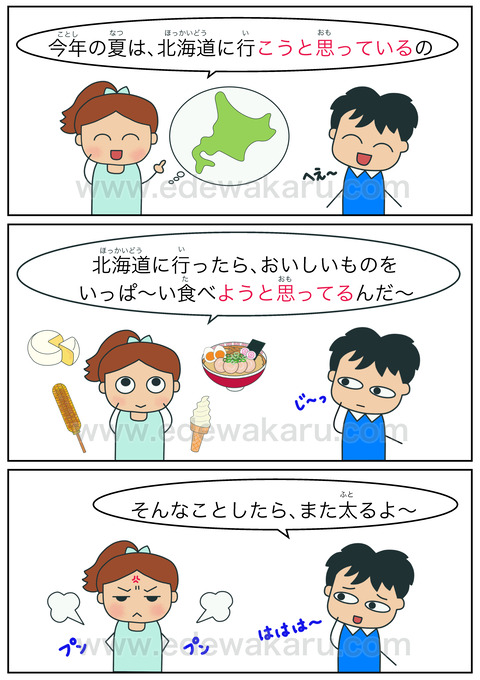
Meaning
Expresses a plan or intention.
How to use it
Verb [volitional form] + と思っている
Explanation
“〜ようと思っている” is a sentence pattern that expresses [intention] or [plans]. It is used to express something planned or considered for some time. When used in the form “〜ようと思っていますか,” it is used to ask about the other person’s intention.
There is also the form “〜ようと思う,” so learn them together 😉
In context 6 examples
今年の夏休みは、北海道に旅行しようと思っているよ
→北海道に旅行する予定だよI’m planning to travel to Hokkaido during summer vacation this year. → I’m planning to travel to Hokkaido.
大学を卒業したら、アメリカに留学しようと思っています
→アメリカに留学する予定ですAfter I graduate from university, I’m planning to study abroad in America. → I’m planning to study abroad in America.
今の仕事をやめようと思っている
→仕事をやめる予定ですI’m planning to quit my current job. → I’m planning to quit my job.
先生:卒業したら、どうするつもりですか?学生:アメリカに帰り、日本語の先生になろうと思っています
Teacher: What are you planning to do after you graduate? Student: I’m planning to return to America and become a Japanese teacher.
将来、どんな仕事をしようと思っていますか?
What kind of job are you planning to do in the future?
A:彼女の誕生日プレゼントは何にするつもりなの?B:指輪をあげようと思っているよ〜
A: What are you planning to get your girlfriend for her birthday? B: I’m thinking of giving her a ring~
Read the original source text
Meaning
予定や意志を表す
How to use it
動詞[意向形]+と思っている
Explanation
「〜ようと思っている」は[意志]や[予定]を表す文型です。この文型は以前から計画していたことや、前から考えていた予定などを表す時に使われます。「〜ようと思っていますか」の形で使われる場合は、相手の意志を聞く場合に使用されます。
「〜ようと思う」という形もありますので、一緒に覚えておきましょう😉
日本語NET JLPT文法解説まとめ
Meaning
An expression used to convey the speaker's intention or plan.
How to use it
V (volitional form) + と思っています
Explanation
Used to talk about the speaker’s determinations or plans.
「〜ようと思っている」 refers to something the speaker has been thinking about for some time. 「〜ようと思う」 refers to something thought of at the time of speaking.
In context 13 examples
大学を卒業したら、国へ帰ろうと思っています。
When I graduate from university, I'm thinking of returning to my country.
夏休みは国へ帰ろうと思っています。
I'm thinking of going back to my country for summer vacation.
将来はマレーシアに住もうと思っています。
I'm thinking of living in Malaysia in the future.
お年玉で新しいゲームを買おうと思っています。
I'm thinking of buying a new game with my New Year's gift money.
来年は本を100冊読もうと思っています。
I'm thinking of reading 100 books next year.
来年はJLPT N2を受けようと思っています。
I'm thinking of taking JLPT N2 next year.
30歳になるまでに、結婚しようと思っています。
I'm thinking of getting married by the time I turn 30.
今度の記念日に彼女にプロポーズしようと思っています。
I'm thinking of proposing to my girlfriend on our next anniversary.
国へ帰る前に、一度相撲の試合を見に行こうと思っています。
Before returning to my country, I'm thinking of going to see a sumo match once.
将来は医者になろうと思っています。
I'm thinking of becoming a doctor in the future.
彼女の誕生日に鞄を買おうと思っています。
I'm thinking of buying a bag for my girlfriend's birthday.
来週、クリスマスパーティーをしようと思っています。
I'm thinking of having a Christmas party next week.
この本を買おうと思っているんですが、どうですか。
I'm thinking of buying this book. What do you think?
Read the original source text
Meaning
話し手の意思や計画を伝える時に使う表現。
How to use it
V(意向形) + と思っています
Explanation
Used to talk about the speaker’s determinations or plans.
「〜ようと思っている」はその前から話し手がずっと考えていたこと。「〜ようと思う」は発話の時点で考えたこと。
NINJAL 日本語文型データベース
Meaning
Expresses the speaker’s intention. Used when the speaker has maintained a particular intention for some time.
How to use it
V (よ)うと思っている
Notes
“~” is a verb expressing an intentional action, such as 「作る・調べる・旅行する」 (make, investigate, travel).
The subject is first person, but it often does not appear in the sentence.
When expressing a third party’s intention, it is used together with an expression of hearsay or conjecture, such as 「~らしい・~そうだ・~と言っている」 (apparently ~, it seems ~, says that ~).
In context 7 examples
今年こそ、新しい仕事を探そうと思っている。
This year, I’m determined to look for a new job.
会社にもっと近いところに引越ししようと思っています。
I’m thinking of moving somewhere closer to my company.
夏休みの自由研究で、この地域の方言について調べようと思っています。
For my summer vacation project, I’m thinking of researching the dialect of this area.
林さんは家族のことを先生に相談しようと思っているようだ。
It seems that Mr. Hayashi is thinking of talking to his teacher about his family.
ケン君は音楽の道に進もうと思っているらしい。
Apparently, Ken is thinking of pursuing a career in music.
クリスマスにローストチキンを作ってみようと思っていたが、面倒になってやめた。
I was thinking of trying to make roast chicken for Christmas, but it started to feel like too much trouble, so I gave up.
親「早く片付けなさい」子「うるさいなあ、もう。今、やろうと思っていたのに」
Parent: “Clean up quickly.” Child: “You’re so annoying. I was just about to do it.”
Read the original source text
Meaning
話し手の意志を表します。ある意志をずっと持ち続けているときに使います。
How to use it
V(よ)うと思っている
Notes
「~」には、「作る・調べる・旅行する」など、意志的な行為を表す動詞がきます。
主語は一人称ですが、文中に現れないことが多いです。
第三者の意志を表す場合は、「~らしい・~そうだ・~と言っている」など、伝聞や推測の表現を一緒に使います。