文法
Meaning
① Not worth doing ~ / There is no need to ~
② Does not fall under ~
How to use it
V (dictionary form) + にはあたらない
N + にはあたらない
※N is a verbal noun used with する.
Notes
① あたる means “correspond to” or “be equivalent to.”
② The は in 〜には may be omitted.
In context 5 examples
私の国では1時間の遅刻は驚くには当たりません。
In my country, being an hour late is nothing to be surprised about.
彼の実力からいって、JLPT N1に合格しても驚くにはあたりません。
Given his ability, it is no surprise if he passes the JLPT N1.
人気監督の新作映画は思った以上にレビューが低く、見るに当たらないそうです。
Apparently, the new film by that popular director got lower reviews than expected and isn't worth watching.
ちょっと怒られたぐらいで、そこまで落ち込むに当たらないよ。
You don't need to get that depressed just because you got scolded a little.
彼のやったことは犯罪には当たらないそうだ。
Apparently, what he did does not constitute a crime.
Read the original source text
Meaning
① 〜するほど価値や重みがない / 〜する必要がない
② 〜には該当しない
How to use it
V(辞書形)+ にはあたらない
N + にはあたらない
※Nはする動詞のN
Notes
①「あたる」とは「相当する」という意味
②「〜には」の「は」は省略可
絵でわかる日本語
Meaning
Not to the extent of 〜
There is no need to 〜
How to use it
Verb [dictionary form] + にはあたらない
Verb [dictionary form] + にあたらない
Noun + する + にはあたらない
Explanation
“Aにはあたらない” is a pattern meaning “not to the extent of A” or “there is no need to A.” It is used to tell someone, “There is no need to do A to that extent” or “It is not such a big problem that you need to do A.” “A” is a verb expressing an emotion, and the “は” in “〜にはあたらない” can be omitted.
[Example]
There is no need to be surprised.
= There is no need to be surprised.
“〜にはあたらない” is written in kanji as “〜には当たらない.” Those taking the N1 exam should learn it 😊
In context 5 examples
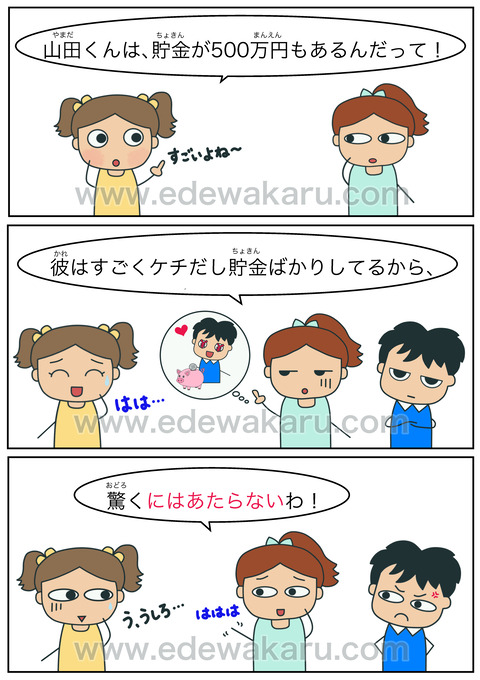
A:山田くんは、貯金が500万円もあるんだって!!B:彼はすごくケチだし貯金してばかりいるから、驚くにはあたらないわ
→驚くほどではないわA: I heard Yamada has as much as five million yen in savings!! B: He’s really stingy and always saving money, so it’s no surprise. →It’s not surprising.
ケガといっても、骨が折れただけだから心配するにはあたらないよ
→心配する必要はないよIt’s just an injury—the only thing is that you broke a bone, so there’s no need to worry. →There’s no need to worry.
A:田中さん、モデルになったそうよ!!びっくりだよね!B:彼女は背が高いし、すごく美人だからびっくりするにはあたらないわ
→びっくりするほどではないわA: I heard Tanaka became a model!! What a surprise! B: She’s tall and really beautiful, so it’s no surprise. →It’s not that surprising.
A :日本語能力試験に合格してよかったね!B:ギリギリで合格したから、喜ぶにはあたらないよ…A:合格したんだから、それでいいんだよ〜
→喜ぶほどではないよ…A: Congratulations on passing the Japanese Language Proficiency Test! B: I only just passed, so it’s not something to be happy about… A: You passed, and that’s what matters. →It’s not something to be happy about…
A:彼、首になったらしいよ…かわいそうだねB:彼は、毎日遅刻していたから同情にはあたらないな
→同情する必要はないなA: I heard he got fired… Poor guy. B: He was late every day, so there’s no need to feel sorry for him. →There’s no need to sympathize with him.
Read the original source text
Meaning
〜ほどではない
〜必要はない
How to use it
動詞[辞書形]+にはあたらない
動詞[辞書形]+にあたらない
Nする+にはあたらない
Explanation
「Aにはあたらない」は「Aほどではない」「A必要はない」という意味の文型です。相手に「そこまでAする必要はない」「Aするほど、大きな問題ではない」と言いたい時に使われます。「A」には、感情を表す動詞が入り、「〜にはあたらない」の「は」は省略することができます。
[例]
驚く
にはあたらない
=驚くにあたらない
「〜にはあたらない」は漢字で書くと「〜には当たらない」です。N1を受ける人は覚えておきましょう😊
日本語文型辞典
Meaning
Basic information
V-るにはあたらない
Attached to verbs such as 「驚く」 and 「非難する」, it means that doing so is not appropriate or misses the point. It is often used with expressions that state a reason, such as 「…からといって」, to mean “given this reason, it is off the mark to be surprised or criticize.”
Examples
① According to a friend who teaches at a middle school, bullying at school is a serious problem. But there is no need to be surprised. It is the same in adult society.
② Just because he left his companions behind and came down the mountain alone, that is no reason to criticize him. Under such weather conditions, there probably was no other way.
③ Just because a child does not listen to their parents at all is no reason to lament. Surely a day will come when they understand their parents’ feelings.
④ Just because he did not say a word at the meeting is no reason to blame him. Anyone would be the same in front of that domineering company president.
Read the original source text
Meaning
基本情報V-るにはあたらない説明「驚く」「非難する」などの動詞に付いて、そうすることは適当ではない、的を得ていないという意味を表す。「…からといって」などの理由を表す表現と共に使うことが多く、「こういう理由で驚いたり非難したりするのは的はずれだ」の意味となる。例文① 中学校で教師をしている友人の話によると、学校でのいじめが深刻だという。しかし驚くにはあたらない。大人の社会も同じなのだから。② 彼ひとりだけ仲間を置いて下山したからといって、非難するには当たらない。あのような天候のもとではそれ以外の方法はなかっただろう。③ 子どもがちっとも親のいうことをきかないからといって、嘆くには当たらない。きっといつか親の心がわかる日がくる。④ 彼が会議でひとことも発言しなかったからといって責めるには当たらない。あのワンマン社長の前ではだれでもそうなのだ。
日本語文型辞典 英語版
Meaning
【にはあたらない】[V-るにはあたらない]
With a verb such as 驚く(be surprised) or 非難する(reprove), expresses the meaning of “it is not appropriate, it is off the point.” Often used with an expression showing some reason, such as ...からといって, and means “it is off the point to be surprised at or blame someone because of such a reason.”
In context 4 examples
中学校で教師をしている友人の話によると、学校でのいじめが深刻だという。しかし驚くにはあたらない。大人の社会も同じなのだから。
According to my friend who is teaching in junior high school, the problem of bullying at school is serious. But there’s nothing surprising about that. The same problem can be seen in adult society.
彼ひとりだけ仲間を置いて下山したからといって、非難するには当たらない。あのような天候のもとではそれ以外の方法はなかっただろう。
You can’t put the blame on him just because he left friends and went down the mountain. I think there was no other thing for him to do under such weather conditions.
子どもがちっとも親のいうことをきかないからといって、嘆くには当たらない。きっといつか親の心がわかる日がくる。
It’s nothing to be surprised at just because a child doesn’t listen to his parents. One day, he will understand how parents feel toward their children.
彼が会議でひとことも発言しなかったからといって責めるには当たらない。あのワンマン社長の前ではだれでもそうなのだ。
There’s no need to criticize him just because he didn’t speak a word at the meeting. In front of that dictatorial president, everybody behaves like that.
日本語NET JLPT文法解説まとめ
Meaning
① Not worth doing ~ / There is no need to ~
② Does not fall under ~
How to use it
V (dictionary form) + にはあたらない
N + にはあたらない
※N is a verbal noun used with する.
Explanation
① It is not worth ~ / There is no need to ~.
② It does not fall under ~ / It does not qualify as ~.
①「あたる」means “to correspond to” or “to amount to.”
② The は in 「〜には」 may be omitted.
Read the original source text
Meaning
① 〜するほど価値や重みがない / 〜する必要がない
② 〜には該当しない
How to use it
V(辞書形)+ にはあたらない
N + にはあたらない
※Nはする動詞のN
Explanation
① It is not worth ~ / There is no need to ~.
② It does not fall under ~ / It does not qualify as ~.
①「あたる」とは「相当する」といみ意味
②「〜には」の「は」は省略可
どんなときどう使う 日本語表現文型辞典
Meaning
~is inappropriate
How to use it
V-dictionary form / N of a suru-verb + に(は)当たらない
Explanation
に(は)あたらない
~のは適当ではない
「そうするのは適当ではない・そうするほどのことではない」という話者の評価を表す言い方。
Expresses speaker’s evaluation that "it is inappropriate to~"; "no need to go that far."にあたらない
In context 3 examples
彼はいい結果を出せなかったが、一生懸命やったのだから非難するには当たらない。
He didn’t get a good result, but he tried his best, so there’s no need to criticize him.
この絵は上手だけれど有名な画家のまねのようだ。感心するには当たらない。
This painting is well done, but it looks like a copy of a famous artist’s work. It’s nothing to be impressed by.
山田さんの成功の裏には親の援助があるのです。称賛には当たりません。
Yamada’s parents helped him achieve his success. It’s nothing to praise him for.
Read the original source text
Meaning
~is inappropriate
How to use it
Vる/する動詞のN+に(は)当たらない
Explanation
に(は)あたらない
~のは適当ではない
「そうするのは適当ではない・そうするほどのことではない」という話者の評価を表す言い方。
Expresses speaker’s evaluation that "it is inappropriate to~"; "no need to go that far."にあたらない
毎日のんびり日本語教師
How to use it
Verb dictionary form + に(は)当たらない
Noun + に(は)当たらない
Explanation
This pattern is used to advise or gently admonish someone who is overreacting, with the meaning “there is no need to ~ to that extent.” It is especially used with words expressing emotions. The preceding clause often gives a cause or reason, accompanied by phrases such as 「~からといって」 or 「~だから/なので」.
Notes
Similar grammar: 「~には及ばない(およばない)」
Similar grammar: 「~までもない/までもなく」
In context 5 examples
多少ミスしたくらいでは心配にはあたらない。(稍微失误一点用不着担心。)
There's no need to worry over a few minor mistakes. (A slight mistake is nothing to worry about.)
彼はバカげたことを言っているが、いつものことなので驚くにはあたらない。
He says ridiculous things, but it's what he always does, so there's no need to be surprised.
誰がやっても難しいのだから、逃げ出してしまったからといって非難するにあたらない。
It's difficult no matter who does it, so there's no need to criticize them just because they ran away.
叱られたからといってそこまで悲しむにはあたらない。
Just because you were scolded, you don't need to be that sad.
まだ挽回できるチャンスはあるし、そこまで悲観するにはあたらないはずだ。
There is still a chance to turn things around, so surely there's no need to be that pessimistic.
Read the original source text
How to use it
動辞形+に(は)当たらない
名詞+に(は)当たらない
Explanation
相手の過剰な反応に対して「そこまで~する必要はない」と進言したり、諭すようなときに用いる文型です。特に感情を表す単語に接続されます。前項には「~からといって」「~だから/なので」などを伴って原因や理由が述べられることが多いです。
Notes
似ている文法「~には及ばない(およばない)」
似ている文法「~までもない/までもなく」