絵でわかる日本語
Meaning
After trying to see whether 〜, it turned out that 〜
How to use it
Verb [て-form] + てみたら
Explanation
“〜てみたら” is a sentence pattern meaning “after trying to see whether 〜, it turned out that 〜.” It is used when you notice or discover something.
[Examples]
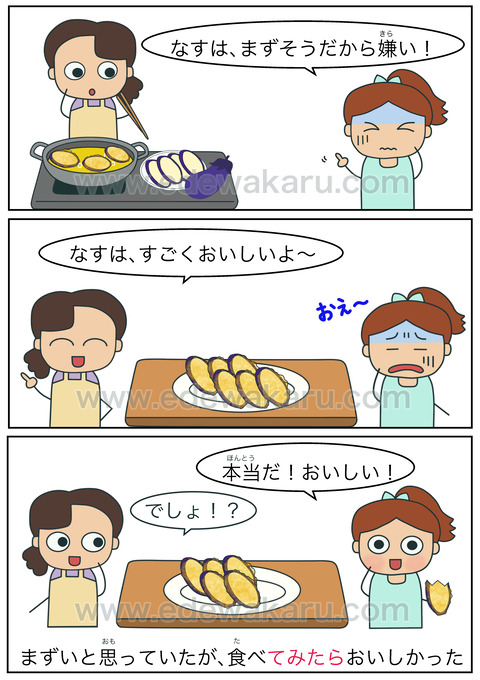
① I thought eggplant tasted bad, but when I tried it, it was delicious.
→ I tried eating it to see if it was tasty, and discovered that it was.
② I woke up in the morning and opened the window, and there was a lot of snow piled up.
→ When I opened the window, I discovered that a lot of snow had piled up.
③ I went to buy a cake that was popular on social media, but it was sold out…
→ I didn’t know if I’d be able to buy one, but when I went to get a cake, I found out it was sold out.
④ When I tried telling my friend about my worries, they gave me good advice.
→ I tried telling my friend about my worries, and they gave me good advice.
⑤ I took N1 on the off chance, and I passed.
→ I didn’t know if I’d pass, but I took it anyway and passed.
Be sure to review “〜てみる” 😊
In context 5 examples
なすはまずいと思っていたが、食べてみたらおいしかった
I thought eggplant tasted bad, but when I tried it, it was delicious.
朝起きて、窓を開けてみたら雪がたくさん積もっていた
I woke up in the morning and opened the window, and there was a lot of snow piled up.
SNSで人気のケーキを買いに行ってみたら、売り切れだった…
I went to buy a cake that was popular on social media, but it was sold out…
悩みを友達に話してみたら、いろいろアドバイスをしてくれた
When I tried telling my friend about my worries, they gave me all kinds of advice.
ダメ元でN1を受けてみたら、合格した
I took N1 on the off chance, and I passed.
Read the original source text
Meaning
〜かどうか試した結果、〜だった
How to use it
動詞[て形]+てみたら
Explanation
「〜てみたら」は「〜かどうか試した結果、〜だった」という意味の文型です。 何かに気づいた時や、何かを発見した時に使われます。
[例]
①なすはまずいと思っていたが、食べ
てみたら
おいしかった
→おいしいかどうか試しに食べた結果、おいしいと気づいた
②朝起きて、窓を開け
てみたら
雪がたくさん積もっていた
→窓を開けたら、雪がたくさん積もっているのを発見した
③SNSで人気のケーキを買いに行っ
てみたら、売り切れだった…
→買えるかどうかわからなかったが、ケーキを買いに行ったら、売り切れということがわかった
④悩みを友達に話し
てみたら、いいアドバイスをくれた
→試しに悩みを友達に話したら、いいアドバイスをくれた
⑤ダメ元でN1を受け
てみたら、合格した
→合格するかどうかわからなかったが、ダメ元で受けたら合格した
「〜てみる」の復習をしておきましょう😊