AIUEO JLPT Grammar
Meaning
This sentence pattern is used to describe something being covered or heavily affected by dirt, sweat, or other unpleasant substances. It is often combined with words carrying negative imagery, such as 「泥まみれ」(covered in mud) or 「汗まみれ」(drenched in sweat).
How to use it
Noun + まみれ
In context 5 examples
彼は泥まみれになって、家に帰ってきた。
He came home covered in mud.
試合後、選手たちは汗まみれだった。
After the game, the players were covered in sweat.
彼の服は血まみれだった。
His clothes were covered in blood.
彼は借金まみれの生活をしている。
He is living a life full of debt.
子供たちは砂まみれです。
The children are covered in sand.
Read the original source text
Meaning
This sentence pattern is used to describe something being covered or heavily affected by dirt, sweat, or other unpleasant substances. It is often combined with words carrying negative imagery, such as 「泥まみれ」(covered in mud) or 「汗まみれ」(drenched in sweat).
How to use it
名詞+まみれ
Explanation · 日本語
この文型は、主に汚れや不快なものが体や物に大量に付いている状態を表すときに使われます。「泥まみれ」「汗まみれ」など、負のイメージを持つ言葉と一緒に使われることが多いです。
文法
Meaning
Describes a surface with a lot of something on it that is dirty and covered in grime.
How to use it
N + まみれ
Notes
[Words often used together]
Blood, mud, dust, sand, sweat, oil
In context 4 examples
息子が泥まみれになって帰って来た。
My son came home covered in mud.
二人は血まみれになるまで、戦った。
The two fought until they were covered in blood.
ずっと使わず隅に置いていたパソコンがいつの間にかホコリまみれになっていた。
The computer that had been left in a corner unused for a long time had become covered in dust before I knew it.
工場にはエアコンがなく、社員は毎日汗まみれになりながら働いている。
There is no air conditioning in the factory, and the employees work every day drenched in sweat.
Read the original source text
Meaning
〜がたくさん付いている表面に汚いものがたくさん付いていて、汚れている様子を表す。
How to use it
N + まみれ
Notes
[よく一緒に使う言葉]
血、泥、ほこり、砂、汗、油
どんなときどう使う 日本語表現文型辞典
Meaning
completely covered in
How to use it
N + まみれ
Explanation
~がたくさんついている
不快な液体や細かいものが体など全体について汚れている様子を言う。体そのものの変化や、ある場所にたくさんあるもの、散らかっているものなどには使わない。
◆ × 傷まみれ/ × しわまみれ/ × 間違いまみれ
ミ行まみれ
Body is filthy because is completely covered in unpleasant liquid or particles. Not used about changes in body or for place that has many or dispersed items.
In context 4 examples
二人とも、血まみれになるまで戦った。
The two of them fought until they were covered in blood.
吉田さんは工事現場で毎日ほこりまみれになって働いている。
Yoshida works at a construction site every day, covered in dust.
足跡から、犯人は泥まみれの靴をはいていたと思われる。
Judging from the footprints, the culprit was probably wearing mud-covered shoes.
汗まみれになって農作業をするのは楽しいことだ。
Working in the fields, drenched in sweat, is enjoyable.
Read the original source text
Meaning
completely covered in
How to use it
N+まみれ
Explanation
~がたくさんついている
不快な液体や細かいものが体など全体について汚れている様子を言う。体そのものの変化や、ある場所にたくさんあるもの、散らかっているものなどには使わない。
◆ × 傷まみれ/ × しわまみれ/ × 間違いまみれ
ミ行まみれ
Body is filthy because is completely covered in unpleasant liquid or particles. Not used about changes in body or for place that has many or dispersed items.
絵でわかる日本語
Meaning
〜covered thickly over the surface
How to use it
Noun [dictionary form] + まみれ
Noun [dictionary form] + まみれの + noun
Explanation
“〜まみれ” is a grammar pattern meaning “a lot of 〜 covers the entire surface” 😊 It is used for negative things 😀 It is helpful to remember it as “a lot of dirty stuff covering the surface.” The previously explained “〜だらけ” (Review: 〜だらけ) also means “a lot of 〜 covers the entire surface,” so review that too 😊
[Exception]
“〜まみれ” means “a lot of 〜 covers the surface,” so unlike “〜だらけ,” it cannot be used for things that do not stick to the surface 😨
⭕️ Last week’s test was full of mistakes.
❌ Last week’s test was covered in mistakes. (“Mistakes” do not stick to the surface.)
However, there is one exception 😮
[Exception]
He is covered in debt. (Meaning: He has a lot of debt.)
“Covered in debt” is a commonly used exception 😌 Of course, you can also say “full of debt” 😉 Remember that, except for “debt,” it can only be used for things that stick to the surface!
The things “〜まみれ” is used with are fairly fixed, so it may be a good idea to memorize some 😊
[Examples]
血まみれ — covered in blood
泥まみれ — covered in mud
ホコリまみれ — covered in dust
油まみれ — covered in oil
汗まみれ — covered in sweat
借金まみれ — buried in debt (exception)
Those taking N1 should make sure to understand the difference from “〜だらけ” 😄
[Related articles]
In context 4 examples
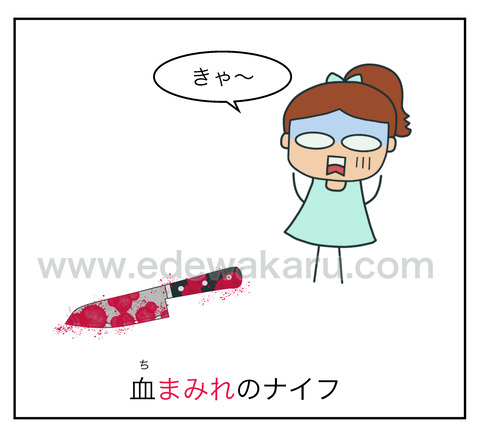
血まみれのナイフ
→血がたくさんついているナイフA blood-covered knife →A knife with a lot of blood on it.
子供達が泥まみれで遊んでいる
→子供達が(服や手足に)泥がたくさんついた状態で遊んでいるThe children are playing covered in mud. →The children are playing with a lot of mud on their clothes and limbs.
ホコリまみれの部屋
→ホコリが(壁や天井に)たくさんついている部屋A dust-covered room →A room with a lot of dust on the walls and ceiling.
キッチンが油まみれだわ…ちゃんと掃除しなくちゃ(復習:口語形〜なくちゃ)
→キッチンに油がたくさんついている…ちゃんと掃除しなくちゃThe kitchen is covered in oil… I have to clean it properly. (Review: colloquial form 〜なくちゃ) →There’s a lot of oil on the kitchen… I have to clean it properly.
Read the original source text
Meaning
〜が表面にたくさんついている
How to use it
名詞[辞書形]+まみれ
名詞[辞書形]+まみれの+名詞
Explanation
「〜まみれ」は「〜が表面全体にたくさんついている」という意味で使われる文型です😊この文型は
マイナスのことに使われます
😀「汚いものが表面にたくさんついている」というように覚えておくといいですね。前回説明した「〜だらけ」(復習:〜だらけ)にも「〜が表面全体にたくさんついている」という意味がありますので復習しておいてください😊
【例外】
「〜まみれ」は「〜が表面にたくさんついている」という意味で使われますので、「〜だらけ」とは違い「表面につかないもの」には使用不可です
😨
⭕️先週のテストは間違いだらけだった
❌先週のテストは間違いまみれだった(「間違い」は表面にはつかない)
ですが、1つ例外があります😮
[例外]
彼は借金まみれだ(意味:彼は借金がたくさんある)
この「借金まみれ」というのは例外でよく使われます😌もちろん「借金だらけ」ということもできますよ😉「借金」以外は表面につくものしか使えないと覚えておけばOKです!
「〜まみれ」はほとんど使われるものが決まっていますので、いくつかは暗記しておくといいと思います😀
[例]
血まみれ
泥まみれ
ホコリまみれ
油まみれ
汗まみれ
借金まみれ(例外)
N1を受ける人は「〜だらけ」との違いをしっかりと理解しておきましょう😄
【関連記事】
日本語文型辞典
Meaning
Basic information: Nまみれ
Indicates a state in which something dirty covers the whole surface. Used in forms such as “Nまみれになる,” “Nまみれだ,” and “Nまみれの.” It is only used with a limited set of nouns, such as “汗まみれ,” “ほこりまみれ,” “血まみれ,” and “氾まみれ.”
Examples: ① The children play without worrying even when they get covered in sweat. ② That statue is covered in dust because it has been left unattended for years. ③ A bloodstained knife was left at the crime scene.
Read the original source text
Meaning
基本情報Nまみれ説明汚いものが全面に付いている状態を表す。「Nまみれになる」「Nまみれだ」「Nまみれの」という形で用いる。「汗まみれ」「ほこりまみれ」「血まみれ」「氾まみれ」など、限られた名詞にしか用いない。例文① 子供たちは汗まみれになっても気にせずに遊んでいる。② あの仏像は何年も放っておかれたので、ほこりまみれだ。③ 犯行現場には血まみれのナイフが残されていた。
日本語文型辞典 英語版
Meaning
【まみれ】[Nまみれ]
Shows the condition that something dirty covers the whole surface of a thing. It can be used in the forms Nまみれになる, Nまみれだ and Nまみれの and can only be used with a limited range of nouns such as sweat, dust, blood, mud, etc.
In context 3 examples
子供たちは汗まみれになっても気にせずに遊んでいる。
The children keep on playing without even caring that they are dripping with sweat.
あの仏像は何年も放っておかれたので、ほこりまみれだ。
Because that Buddhist statue was neglected for years, it is covered in dust.
犯行現場には血まみれのナイフが残されていた。
A knife covered in blood was left at the scene of the crime.
くらべてわかる日本語表現文型辞典
Meaning
Meaning 1: The state of something dirty sticking to and covering an entire surface.
Meaning 2: An abstract expression for being unable to escape, as though an undesirable A is clinging to one.
How to use it
Aまみれ
[Noun—no suffix] まみれ
Explanation
[Contrast 1]
“Aだらけ” (Meaning 1, p. 129)
“Aだらけ” means that A is conspicuously abundant within a space or range. “Aまみれ” means that a considerable part of an object is covered in A.
○ほこりだらけの部屋 ほこりまみれの靴 — a room full of dust; shoes covered in dust
○血だらけの浴室 血まみれのナイフ — a bathroom spattered with blood; a blood-covered knife
[Contrast 2]
“Aづけ” (Meaning 1, p. 134)
“Aづけ” describes being immersed in a state of A and having nothing but A, making for a difficult situation. “Aまみれ” is used for an undesirable situation one has created oneself.
○イギリスでの3年間は英語づけの生活だった。 — My three years in Britain were spent immersed in English.
×イギリスでの3年間は英語まみれの生活だった。 — My three years in Britain were spent covered in English.
○彼は借金まみれで夜逃げした。 — He fled in the night, buried in debt.
×彼は借金づけで夜逃げした。 — He fled in the night, immersed in debt.
In context 8 examples
雨のなか、選手たちは泥まみれになってボールを追いかけている。
In the rain, the players are chasing the ball, covered in mud.
男たちは汗まみれになって働いていた。
The men were working, drenched in sweat.
優勝トロフィーはほこりまみれになって、部屋のすみに放ってあった。
The championship trophy had become covered in dust and was left in a corner of the room.
タンカー事故により、油まみれになった海鳥の救助に向かった。
After the tanker accident, we went to rescue seabirds covered in oil.
彼女は本当はこんな金まみれの生活から逃れたがっている。
The truth is, she wants to escape this life so covered in money.
汚職まみれの政治家には、この際、辞職してもらいたい。
I want the corrupt politicians to resign now.
あれだけ借金まみれだと、立ち直るのは難しいだろう。
With that much debt, it will probably be difficult to recover.
事件の陰にはいつもあの人がいる。まさに疑惑まみれの人物だ。
That person is always behind the scenes of these incidents. They are truly a person shrouded in suspicion.
Read the original source text
Meaning
意味1:汚いものが、全体を覆うようにくっついている様子。
意味2:好ましくないAがついているようで、離れられない様子を抽象的に表す。
How to use it
Aまみれ
[名詞-∅]まみれ
Explanation
【対比1】
「Aだらけ」(意味1 P.129)
「Aだらけ」は、ある空間や範囲の中でAが目立って多いこと。「Aまみれ」は、ある物体がかなりの部分Aで覆われていること。
○ほこりだらけの部屋 ほこりまみれの靴
○血だらけの浴室 血まみれのナイフ
【対比2】
「Aづけ」(意味1 P.134)
「Aづけ」は、Aという状態にどっぷりとつかっているのでAばかりで厳しい状況、「Aまみれ」は自ら作った好ましくない状況に使う表現。
○イギリスでの3年間は英語づけの生活だった。
×イギリスでの3年間は英語まみれの生活だった。
○彼は借金まみれで夜逃げした。
×彼は借金づけで夜逃げした。
日本語NET JLPT文法解説まとめ
Meaning
“Covered with lots of ~”
Describes something dirty because its surface is covered with a lot of dirt or other grime.
How to use it
N + まみれ
Explanation
"covered in 〜 / smeared with 〜 / full of 〜"
To a state where something is completely covered, smeared, or stained with a substance, often in an overwhelming or excessive amount.
It is commonly used to describe situations where an object or person is covered with something unpleasant or undesirable, such as dirt, blood, dust, or sweat.
In context 4 examples
息子が泥まみれになって帰って来た。
My son came home covered in mud.
二人は血まみれになるまで、戦った。
The two fought until they were covered in blood.
ずっと使わず隅に置いていたパソコンがいつの間にかホコリまみれになっていた。
The computer that had been left in a corner unused for a long time had become covered in dust before I knew it.
工場にはエアコンがなく、社員は毎日汗まみれになりながら働いている。
There is no air conditioning in the factory, and the employees work every day drenched in sweat.
Read the original source text
Meaning
"〜がたくさん付いている"
表面に汚いものがたくさん付いていて、汚れている様子を表す。
How to use it
N + まみれ
Explanation
"covered in 〜 / smeared with 〜 / full of 〜"
To a state where something is completely covered, smeared, or stained with a substance, often in an overwhelming or excessive amount.
It is commonly used to describe situations where an object or person is covered with something unpleasant or undesirable, such as dirt, blood, dust, or sweat.
毎日のんびり日本語教師
Meaning
covered with a lot of ~
How to use it
Noun + まみれ
Explanation
Expresses being covered on the surface with a lot of dirty substances.
In principle, it can only be attached to things the speaker considers dirty or unpleasant, such as dust, blood, sweat, mud, oil, sand, garbage, and wounds.
There are occasional exceptions: examples (11), (12), and (14).
「借金まみれ」 (buried in debt) is a set expression.
It originates from the ichidan verb 「塗れる(まみれる)」 (to be covered in).
「汗まみれ」 and 「汗にまみれている」 mean the same thing.
Notes
Nothing in particular.
In context 14 examples
タンスから昔の洋服を出したら、ほこりまみれだった。
When I took some old clothes out of the dresser, they were covered in dust.
手を切り血まみれになった。
I cut my hand and it became covered in blood.
子供が泥まみれになって帰ってきた。
My child came home covered in mud.
ニュースによると、殺人事件が発生したマンションの一室は血まみれだったらしい。
According to the news, a room in the apartment building where a murder took place was apparently covered in blood.
借金まみれの生活から脱したい。
I want to escape a life buried in debt.
正論まみれの世間に嫌気が差す。
I’m fed up with a world covered in self-righteous arguments.
表面的には優良企業だが、その実態は不祥事まみれだ。
On the surface, it’s a fine company, but in reality it’s riddled with scandals.
人間は欲まみれである。
Humans are consumed by greed.
このサイトは広告まみれで見にくいといったらありゃしない。
This site is so covered in ads that it’s incredibly hard to look at.
毎朝起きると枕がよだれまみれだ。
Every morning when I wake up, my pillow is covered in drool.
アイスたくさん買ってきた。冷蔵庫の中はアイスまみれ。
I bought lots of ice cream. The inside of the fridge is full of ice cream.
猫カフェ行ったら猫まみれの至福の時間を過ごせた。
I went to a cat café and spent a blissful time surrounded by cats.
言い訳するアホはウンコにまみれて死ねばいい。
Idiots who make excuses should die covered in shit.
曲を聴くのに飽きたら作曲し、作曲に飽きたら曲を聴き、音楽にまみれた生活をしている。
When I get tired of listening to music, I compose; when I get tired of composing, I listen to music. I live a life immersed in music.
Read the original source text
Meaning
~がたくさんある
How to use it
名詞+まみれ
Explanation
表面に汚い付着物がたくさんついていることを表します。
原則、ほこり、血、汗、泥、油、砂、ごみ、傷などの話者が汚い、不快と感じているものにだけ接続できます。
たまに例外もあります。例文(11)(12)(14)
「借金まみれ」は慣用的な表現です。
語源は一段動詞「塗れる(まみれる)」。
「汗まみれ」と「汗にまみれている」は同義です。
Notes
特になし
IMABI
Appearance
Read this IMABI lesson ↗Explanation
Appearance: ~だらけ, ~まみれ, ~ずくめ, ~めく, ~げ, ~みどろ, & ~気味
There are several suffixes in Japanese that represent states of appearance.
~だらけ
~だらけ attaches to nouns to describe how something is riddled with something. ~だらけ may be used with both physical and psychological items. There is an extent to how you can use this though. Things like 混乱こんらんだらけ would be wrong. This is because it should be used with things that are either physical or dealing with (emotional) phenomenon and not a “state”. Rather than 混乱だらけ, consider phrases like すごく狼狽ろうばいしている or とても動揺どうようしている.
1. 彼女は(口を開けば){不平・不満}{ばっかり言ってる・だらけだ}な。
She’s full of complaints isn’t she?
2. パソコンは埃ほこり{かぶっていた・だらけだった}。
The desktop was covered in dust.
3. 後悔こうかいだらけ
Covered in regret
4. 傷きずだらけ
Covered in injuries
5. 血だらけになった殺人犯さつじんはんは逃にげ場ばがなくなって自殺じさつしたそうだ。
They say that since the murderer covered in blood didn’t have a place to run away, he committed suicide.
~塗れ
~まみれ comes from 塗まみれる which means “to be covered with”. Similar to ~だらけ ~まみれ shows how something is completely covered in something. Unlike ~だらけ, ~まみれ is solely used with physical objects. However, there is a trend to use ~まみれ with things that have a “physical persona”. This, though, is metaphoric. Creating metaphors in any language causes rules to become more flexible.
6. 遺体いたいは血塗れだったということです。
It is said that the corpse was completely covered in blood.
7. メキシコ湾わんは{辺り一面}重油じゅうゆ{埋め尽くされました・まみれになりました}。
The Gulf of Mexico became completely covered in heavy oil.
8. 彼はただの挫折塗ざせつまみれのやつだけだ。
He’s just completely covered in failure.
~尽くめ
~ずくめ shows that something is “completely…”. It is normally either attached to nouns of colors or こと. There is, though, a condition that whatever it attaches to that the context is in relation to human intent.
A similar ending is ~ずくし. It means “all sorts of”. Here, the human intent condition is non-existent. In writing, using づ instead of ず is OK. This is just a conflict between Old and New orthographies that has just been left to the individual to decide.
9. 人が黒尽くめでした。
The person was completely black.
10. いい事づくしの人
A person full of good luck
11a. 白づくめで抗議してる人は窃盗罪せっとうざいで訴うったえられた人達だ。
11b. 抗議をしている、白づくめの人達は、窃盗罪で訴うったえられた。
The people protesting dressed in white were accused of theft.
~めく
~めく shows what something looks like or what condition something becomes, and it may follow nouns, adverbs, or the stem of adjectives and verbs. The closest translation for ~めく is “to show signs of”. Although all tenses are possible, ~めく is normally only used in the non-past or past tense. Depending on the verb, there are may be more options. For instance, うごめく can be seen in things like the progressive.
To be astir ざわめく To flash 閃く To be mysterious 謎めく
To glimmer 仄めく To color 色めく To be spring-like 春めく
To wriggle うごめく To flourish 時めく To be autumn-like 秋めく
Grammar Note: When attached to verbs, the new verb is often seen contracted and then written differently. ~めく is most often used with nouns and 形容動詞.
12. 教室は興奮こうふんで騒ざわめいた。
The classroom stirred with excitement.
13. 庭の楓かえでが色めくのは本当に美しいですよね。
The changing in colors of the maple trees in the garden is really beautiful, isn’t it?
14. {うわぁ・ああ}、{もぞもぞ動いてる・蠢うごめいてる}虫(がいる)!
Ah, a wriggling worm!
15. 彼は今を時めく歌手・有名人です。
He is one of the most prosperous singers/famous people of the time.
16. 謎なぞめいた様子ようすをしている。
To have an air of mystery.
17. 謎めいた様相ようそうを呈ていする。
To be in a situation covered in mystery.
18. 冬めいてきた。
It became winter-like.
19. 陽光に川面が煌めく。
The river surface glistens in the sunlight.
20. どよめいて、人々が飛びのく。一人の背中が飛鳥にぶつかった。はね飛ばされて、壁に肩をぶつける。さらにはね返ってよろめき、あやうく転びかけたときだった。
Making a stir, people jumped back. A person’s back hit Asuka. Being sent flying, she hit her shoulder on the wall. In addition, it was when she had bounced back, staggered, and dangerously started to tumble.
From 野生の風 by 村山由佳.
~みどろ
~みどろ is a less common alternative to the suffix ~まみれ to show things being covered in something.
21. 血みどろの遺体
A bloody corpse
22. 汗みどろの労働者
A sweat covered laborer
~気
~げ conjugates as a 形容動詞けいようどうし. Used to show a sense of true appearance, it describes something with intense fervor and emotion. Lastly, ~げ may be attached to the stem of adjectives and to nouns.
23. 悲しげに泣く。
Cry while being sad all over.
24. 均衡予算を黙殺するのは大人げない。
Ignoring the balanced budget proposal is childish.
25. 彼は何か言いたげな顔をしていた。
He had the face of wanting to say something.
26. 「今も新しい戦争が僕らを追っかけて来ているのかもしれないし、僕らのなかの前の戦争が、亡霊のように僕らを追っかけているかもしれないんです。」と修一は憎さげに、「お父さまこそ、あの娘がちょっと変わっているから、ひそかに魅力を感じて、妙な考えをくどくどもってまわってらっしゃる。女がほかの女とどこかちょっとちがっているだけで、男はつかまるのですからね。」
“A new word may have come its way to chase after us even now, but the war of the past within ourselves may be chasing after us like a departed spirit”, and Shuichi continued odiously with “And you, of course, Father inwardly feel a mystique since she’s changed a little, and you’re going about stuttering long-winded, strange thoughts. That’s man is just something that it’s caught up with the small differences one woman has with other women.”
From 山の音 by 川端康成.
27. 菊子は不審げに信吾を見て、そして顔を赤らめた。
Kikuko looked strangely at Shingo and then blushed.
From 山の音 by 川端康成.
Grammar Note: ~げ is almost never used with verbs. ~げ is closest to ~そうだ, but ~そうだ lacks the emotional emphasis. As emotional emphasis is very important, it is used with nouns that we aspire to be and adjectives that express our emotions.
The reading け and ぎ also exist, and they confusingly are used similarly to the げ reading. Luckily, the latter reading is not written as 気. The reading け is seen a lot in phrases like 飾り気 (affectation), 色気 (sex appeal), and 寒気 (feeling chilly). 人気 has two readings. When it is read as にんき, it means “popularity”, and when it is read as ひとけ, it is the antonym of deserted, but it is usually used in this sense in the phrase 人気がない.
The reading ぎ of 気 is rather restricted to nouns that can have perceptually suitable characteristics. Words such as 商売気 (mercenary mind), 男気 (chivalry), and 女気 (woman care) come to mind, and the only other examples are all literary words unlikely to be used in conversation, or at the very least appear rarely in literature. Examples of such words include 謀反気 (rebelling spirit), 芝居気 (theatrical spirit), 芸気 (theatrical spirit), and 回り気 (worrying and doubtful spirit).
28. お前さんも余程回り気の人だね。
You’re quite the worry wort too, aren’t you.
From 深川女房 by 小栗風葉.
Interestingly enough, the most common examples of ぎ and け are replaced with っけ. Examples of this include人っ気, 飾りっ気, and 商売っ気. Even words that typically only use け such as 真っ黒け and 真っ白け may have っ insertion in actual conversation. Even more interesting is the fact that the phrases 真っ赤っ赤 (bright red) and 真っ黄っ黄 (bright yellow) exist. The first one shows up dictionaries and is used widely, but the latter is rather dialectical. The interesting point here is how the forms seem to mimic the use of っけ for emphasis.
29. 彼は仕事を事もなげにやってのけた。
He pulled the job off as if nothing happened.
~気味
~気味ぎみ is seen after either a noun or the 連用形れんようけい of a verb. It shows a visible indication or slight feeling and is often used in a negative context. Common translations include “sign of,” “on the…side,” and “slight.”
30. 彼は疲れ気味だ。
He has the signs of fatigue.
30. 彼は太り気味だ。
He’s a little on the heavy side.
31. 今朝はちょっと風邪気味だ。
I have a slight feeling of a cold this morning.
Word Note: ~味 comes from 気味, which means “sensation” or “tendency.”
In context 33 examples
彼女は(口を開けば){不平・不満}{ばっかり言ってる・だらけだ}な。
She’s full of complaints isn’t she?
パソコンは埃ほこり{かぶっていた・だらけだった}。
The desktop was covered in dust.
後悔こうかいだらけ
Covered in regret
傷きずだらけ
Covered in injuries
血だらけになった殺人犯さつじんはんは逃にげ場ばがなくなって自殺じさつしたそうだ。
They say that since the murderer covered in blood didn’t have a place to run away, he committed suicide.
遺体いたいは血塗れだったということです。
It is said that the corpse was completely covered in blood.
メキシコ湾わんは{辺り一面}重油じゅうゆ{埋め尽くされました・まみれになりました}。
The Gulf of Mexico became completely covered in heavy oil.
彼はただの挫折塗ざせつまみれのやつだけだ。
He’s just completely covered in failure.
人が黒尽くめでした。
The person was completely black.
いい事づくしの人
A person full of good luck
白づくめで抗議してる人は窃盗罪せっとうざいで訴うったえられた人達だ。
The people protesting dressed in white were accused of theft.
抗議をしている、白づくめの人達は、窃盗罪で訴うったえられた。
The people protesting dressed in white were accused of theft.
教室は興奮こうふんで騒ざわめいた。
The classroom stirred with excitement.
庭の楓かえでが色めくのは本当に美しいですよね。
The changing in colors of the maple trees in the garden is really beautiful, isn’t it?
{うわぁ・ああ}、{もぞもぞ動いてる・蠢うごめいてる}虫(がいる)!
Ah, a wriggling worm!
彼は今を時めく歌手・有名人です。
He is one of the most prosperous singers/famous people of the time.
謎なぞめいた様子ようすをしている。
To have an air of mystery.
謎めいた様相ようそうを呈ていする。
To be in a situation covered in mystery.
冬めいてきた。
It became winter-like.
陽光に川面が煌めく。
The river surface glistens in the sunlight.
どよめいて、人々が飛びのく。一人の背中が飛鳥にぶつかった。はね飛ばされて、壁に肩をぶつける。さらにはね返ってよろめき、あやうく転びかけたときだった。
Making a stir, people jumped back. A person’s back hit Asuka. Being sent flying, she hit her shoulder on the wall. In addition, it was when she had bounced back, staggered, and dangerously started to tumble.
血みどろの遺体
A bloody corpse
汗みどろの労働者
A sweat covered laborer
悲しげに泣く。
Cry while being sad all over.
均衡予算を黙殺するのは大人げない。
Ignoring the balanced budget proposal is childish.
彼は何か言いたげな顔をしていた。
He had the face of wanting to say something.
「今も新しい戦争が僕らを追っかけて来ているのかもしれないし、僕らのなかの前の戦争が、亡霊のように僕らを追っかけているかもしれないんです。」と修一は憎さげに、「お父さまこそ、あの娘がちょっと変わっているから、ひそかに魅力を感じて、妙な考えをくどくどもってまわってらっしゃる。女がほかの女とどこかちょっとちがっているだけで、男はつかまるのですからね。」
“A new word may have come its way to chase after us even now, but the war of the past within ourselves may be chasing after us like a departed spirit”, and Shuichi continued odiously with “And you, of course, Father inwardly feel a mystique since she’s changed a little, and you’re going about stuttering long-winded, strange thoughts. That’s man is just something that it’s caught up with the small differences one woman has with other women.”
菊子は不審げに信吾を見て、そして顔を赤らめた。
Kikuko looked strangely at Shingo and then blushed.
お前さんも余程回り気の人だね。
You’re quite the worry wort too, aren’t you.
彼は仕事を事もなげにやってのけた。
He pulled the job off as if nothing happened.
彼は疲れ気味だ。
He has the signs of fatigue.
彼は太り気味だ。
He’s a little on the heavy side.
今朝はちょっと風邪気味だ。
I have a slight feeling of a cold this morning.