AIUEO JLPT Grammar
Meaning
This sentence pattern explains that a particular result or situation arises from multiple overlapping reasons or factors. It highlights one of the factors leading to an event while implying it is not the sole reason.
How to use it
Verb + こともあって; adjective + こともあって; adjectival noun な + こともあって; noun の + こともあって
In context 5 examples
彼は忙しいこともあって、最近連絡が取れない。
He's been busy so I haven't been able to get in touch with him lately.
引っ越してきたばかりなこともあり、まだ慣れていない。
Partly because I’ve just moved, I’m not yet used to the new environment.
時間がなかったこともあって、十分な準備ができなかった。
Partly because I didn’t have enough time, I couldn’t prepare well.
給料が安いこともあって、彼は転職を考えている。
Partly because his salary is low, he’s thinking of changing jobs.
最近入社したばかりなこともありまして、まだ分からないことが多いですがよろしくお願いします。
Since I have only recently joined the company, there are still many things I do not understand, but I look forward to working with you.
Read the original source text
Meaning
This sentence pattern explains that a particular result or situation arises from multiple overlapping reasons or factors. It highlights one of the factors leading to an event while implying it is not the sole reason.
How to use it
動詞+ことも+あって形容詞+ことも+あって形容動詞な+ことも+あって名詞の+ことも+あって
Explanation · 日本語
この文型は、複数の理由や要因が重なって、ある結果や状況が生じることを説明する表現です。何かが起こった要因のひとつを説明するために使われ、日常会話でよく使われます。複数の理由のうちの一つを強調しているため、必ずしもそれが唯一の理由ではないことを暗示しています。
絵でわかる日本語
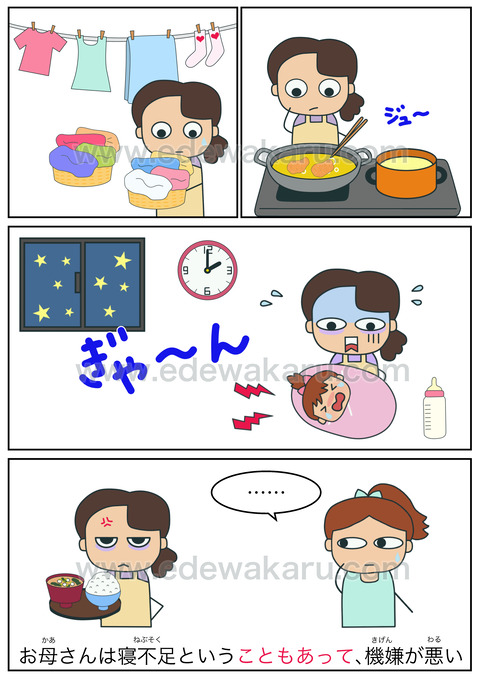
Meaning
There were other reasons, but because ~
There were other reasons, but since ~
How to use it
Verb or adjective [plain form] + こともあって
Noun [plain form] + ということもあって
Explanation
「〜こともあって」 is a sentence pattern meaning “There were other reasons, but because ~” or “There were other reasons, but since ~.” It is used when selecting and mentioning one reason from among several causes or reasons.
[Examples]
① Mom is in a bad mood, partly because she’s sleep-deprived.
→ She’s in a bad mood because she’s sleep-deprived and tired.
② He’s very popular, partly because he’s good at sports.
→ He’s very popular because he’s handsome and good at sports.
③ I get along very well with my cousin, partly because we’re close in age.
→ We get along very well because we’re close in age and have the same hobbies.
④ I was very nervous, partly because my girlfriend had come to watch the match.
→ I was very nervous because my girlfriend, mother, and younger sister had all come to watch.
⑤ Mr. Tanaka got a job at a large company, partly because he can speak English and Chinese.
→ He got a job at a large company because he speaks English and Chinese and is smart.
Let’s review sentence patterns that include 「こと」 and express causes and reasons 😉
【Related patterns】
【Sentence patterns that include 「こと」】
In context 5 examples
お母さんは、寝不足ということもあって虫の居所が悪い
Mom is in a bad mood, partly because she is sleep-deprived.
彼はスポーツができることもあって、すごくモテる
He is very popular, partly because he is good at sports.
いとことは年が近いこともあって、とても気が合う*「年が近い」は「年齢が同じくらい」という意味
I get along very well with my cousin, partly because we are close in age. *「年が近い」 means “about the same age.”
彼女が試合を見に来ていたこともあって、すごく緊張した
I was very nervous, partly because my girlfriend had come to watch the match.
田中さんは英語と中国語ができることもあって、大きな会社に就職した
Mr. Tanaka got a job at a large company, partly because he can speak English and Chinese.
Read the original source text
Meaning
他にも理由があるが、〜ので
他にも理由があるが、〜から
How to use it
動詞・形容詞[普通形]+こともあって
名詞[普通形]+ということもあって
Explanation
「〜こともあって」は「他にも理由があるが、〜ので」「他にも理由があるが、〜から」という意味の文型です。いくつか原因や理由がある中から、1つを選んで言う場合に使われます。
[例]
①お母さんは、寝不足という
こともあって
虫の居所が悪い
→寝不足だし疲れているので、虫の居所が悪い
②彼はスポーツができる
こともあって、すごくモテる
→イケメンだしスポーツもできるので、すごくモテる
③いとことは年が近い
こともあって、とても気が合う
→年が近いし趣味も同じなので、とても気が合う
④彼女が試合を見に来ていた
こともあって、すごく緊張した
→彼女もお母さんも妹も見に来ていたので、すごく緊張した
⑤田中さんは英語と中国語ができる
こともあって、大きな会社に就職した
→英語と中国語が話せるし、頭もいいので、大きな会社に就職した
[原因・理由]を表す「こと」がつく文型の復習をしておきましょう😉
【関連文型】
【「こと」がつく文型】
毎日のんびり日本語教師
How to use it
Verb plain form + こともあって
い-adjective attributive form + こともあって
な-adjective attributive form + こともあって
Noun + という + こともあって
Explanation
This is a grammar pattern expressing a reason, characterized by citing just one cause among several.
In other words, it implies that there are other causes as well.
In many cases, the second clause describes some phenomenon.
Notes
Nothing in particular.
In context 8 examples
深夜ということもあって、みんな変なテンションだった。
Since it was the middle of the night, everyone was in a strange mood.
まだ1年目ということもあって、全然分かっていない。
Since it’s only my first year, I don’t understand anything at all.
気付くのが遅かったこともあって、随分損をさせられた。(因为发现得晚所以损失很大。)
Because I realized it late, I ended up suffering a considerable loss.
お互い酒が回っていたこともあって、秘密を色々打ち明けてしまった。
We had both had quite a bit to drink, so we ended up confessing all sorts of secrets.
先輩とは年が近いこともあって良い関係を築けている。
I’ve been able to build a good relationship with my senior because we’re close in age.
ちょうど受験前ということもあって、息子はピリピリしている。
Since it’s right before the entrance exams, my son is on edge.
筋トレを始めたこともあって、食生活には特に注意するようにしている。
Since I started strength training, I’ve been especially careful about my diet.
生まれつき体が弱いこともあって、過度な運動は避けている。
Because I’ve been physically weak since birth, I avoid excessive exercise.
Read the original source text
How to use it
動詞普通形+こともあって
い形容詞名詞修飾形+こともあって
な形容詞名詞修飾形+こともあって
名詞+という+こともあって
Explanation
理由を表す文法ですが、複数ある原因の中から一つだけ挙げている点が特徴的です。つまり他にも原因があることを暗示します。
多くの場合、後項では何らかの現象のがなされます。
Notes
特になし
NINJAL 日本語文型データベース
Meaning
This is used to say that something becomes a certain state because of ~. It conveys the nuance that there are several other reasons as well.
How to use it
V plain form + こともあって
i-A plain form + こともあって
na-A plain form + こともあって (however, “na-Aだ” → “na-A+なこともあって”)
N plain form + こともあって (however, “Nだ” → “Nな+こともあって・Nである+こともあって”)
Other
In context 26 examples
授業参観日は、教室に親がいることもあっていつもと違う雰囲気だ。
On the day parents visit classes, the atmosphere is different from usual, partly because parents are in the classrooms.
このところ毎日残業していることもあって体がとても疲れている。
Partly because I’ve been working overtime every day lately, I’m extremely tired.
バレー部は、監督が交代したこともあって、練習方針が大きく変わった。
Partly because the volleyball team got a new coach, its training policy changed significantly.
この会社は、自動車通勤が認められないこともあって、自転車で通う人が多い。
Partly because commuting by car is not allowed at this company, many people commute by bicycle.
先月、行われた国際会議にA国の大統領が出席しなかったこともあって、A国とB国の関係は悪化している。
Partly because the president of Country A did not attend the international conference held last month, relations between Country A and Country B are worsening.
多くの子どもたちが試合を見に来ていたこともあって、今日の試合は大変盛り上がりました。
With many children having come to watch, today’s game was very exciting.
このレストランは、店主が子どもに優しいこともあって、家族連れに人気がある。
This restaurant is popular with families, partly because the owner is kind to children.
子どもの体調が悪かったこともあってしばらく在宅勤務をしています。
I’ve been working from home for a while, partly because my child was in poor health.
妹の成績が良かったこともあって母はご機嫌です。
My mother is in a good mood, partly because my younger sister got good grades.
料理があまりおいしくなかったこともあって次の食事会は別の店にしようと話している。
The food wasn’t very tasty, among other reasons, so we’re talking about going to a different restaurant for our next meal together.
年度末は仕事が忙しくなかったこともあって、休みが自由に取れた。
Since work wasn’t busy at the end of the fiscal year, among other reasons, I was able to take time off whenever I wanted.
周りが静かなこともあってここに家を建てました。
I built a house here partly because the area around it is quiet.
韓国ドラマが好きだったこともあって昔はよく韓国旅行に出かけていた。
Partly because I liked Korean dramas, I used to travel to Korea often.
夫があまり外出好きではないこともあって、私たち夫婦はあまり外に出かけません。
Partly because my husband doesn’t really like going out, we don’t go out very often.
弟の体が丈夫でなかったこともあって、私たち家族は弟の健康を考えて、空気のきれいな郊外に住んでいました。
Partly because my younger brother was not in robust health, our family lived in the clean-air suburbs with his health in mind.
両親がずっと健康だったこともあって、幸いなことに、ここまで介護とは無縁でした。
Fortunately, partly because my parents had always been healthy, we had never had to deal with caregiving up to this point.
このところ寝不足なこともあって、授業中に眠くなってしまう。
I’ve been short on sleep lately, among other reasons, so I end up getting sleepy during class.
限定モデルであることもあってこのスマートフォンはとてもよく売れました。
This smartphone sold very well, partly because it was a limited edition.
ここ数年、不景気だったこともあって、日本のデパートが次々と閉店している。
Partly because of the economic downturn over the past few years, department stores in Japan are closing one after another.
同期の中で、私だけがまだ課長じゃないこともあって、仕事の話をするのは少し気まずい。
Since I’m the only one among my peers who still isn’t a section chief, among other reasons, it’s a little awkward to talk about work.
学生時代に積極的な性格じゃなかったこともあって、同窓会にはあまり参加したくない。
Partly because I wasn’t an assertive person as a student, I don’t really want to attend reunions.
人気のあるデザイナーがコラボするということもあってこの製品への人々の関心はとても高い。
People are very interested in this product, partly because a popular designer is collaborating on it.
祖父母は昔教員をしていたということもあってよく宿題を見てくれた。
Partly because my grandparents used to be teachers, they often helped me with my homework.
山川先生は校内で一番若いということもあって生徒たちから人気がある。
Mr. Yamakawa is popular with the students, partly because he is the youngest teacher at the school.
危険だということもあって、生徒は屋上に出てはいけないことになっています。
Because it is dangerous, students are not allowed to go onto the roof.
この本は、経済学の授業で使う教科書ということもあって、大学の書店に大量に並べられている。
Since this book is a textbook used in economics classes, large numbers of copies are displayed in the university bookstore.
Read the original source text
Meaning
〜が原因で、ある状態になると言いたいときに使います。他にもいくつか理由があるというニュアンスを表します。
How to use it
V普通形+こともあって
i-A普通形+こともあって
na-A普通形+こともあって(ただし、「na-Aだ」→「na-A+なこともあって」)
N普通形+こともあって(ただし、「Nだ」→「Nな+こともあって・Nである+こともあって」)
その他