くらべてわかる日本語表現文型辞典
Meaning
Meaning 1: Unless A becomes the case, B cannot be established either. A is a condition for B.
Meaning 2: In the form “AないことにはB.” Unless A becomes the case, the unfavorable state B will result.
How to use it
AないことにはBない (AないことにはB)
[Verb—ない form] ないことには
Notes
[Note 1]
・In conversation and similar contexts, B may be omitted.
○主将のあなたがしっかりしないことには…。(部員はついてこない) — Unless you, as team captain, get your act together… (the team members won’t follow you).
In context 8 examples
社長の許可が下りないことには、話を先に進められないじゃないか。
Unless the president approves it, we can’t move the discussion forward.
雨が降らないことには、今年の収穫は見込めない。
Unless it rains, we can’t expect a harvest this year.
この薬を飲まないことには、病気は治りませんよ。
Unless you take this medicine, you won’t get better.
実物を見ないことには、カタログだけを見ていても決めかねる。
Unless I see the actual item, I can’t decide just by looking at a catalog.
景気が上向きにならないことには、株価も下落を続けるだろう。
Unless the economy improves, stock prices will probably continue to fall.
あの電車に乗らないことには、遅刻してしまう。
Unless we take that train, we’ll be late.
英語が話せないことには、海外勤務は無理だ。
Unless you can speak English, working overseas is out of the question.
原因がわからないことには、対処のしようがありません。
Unless we know the cause, there’s nothing we can do about it.
Read the original source text
Meaning
意味1:Aの状態にならなければBも成立しない。AはBの条件。
意味2:「AないことにはB」の形で。Aの状態にならなければ、Bというマイナスの状態になる。
How to use it
AないことにはBない(AないことにはB)
[動詞-ない形]ないことには
Notes
【注意1】
・会話などでは、Bを省略した形で現れることもある。
○主将のあなたがしっかりしないことには…。(部員はついてこない)
DoJG 日本語文法辞典(全集)
Meaning
If ~ not ~ then; unless
How to use it
Vnegative | ないことには~ | |
| 調べないことには分からない。 | Unless we investigate it, we can’t understand |
| 話してみないことには了解は不可能だ。 | Unless we talk, understanding is impossible |
| 読んでみないことにはコメントできない。 | Unless we read it, comments on it are impossible |
Explanation
A phrase that means "if something has not taken place, something else won’t/can’t take place".
In context 8 examples
この仕事が終わらないことには、家族と旅行に行くこともできない。
If I don't finish this work, I can't go on a trip with my family.
追加予算が下りないことには、このプロジェクトの遂行は無理だ。
Without (money from) an additional budget, it will be impossible to accomplish this project.
書き始めないことには論文ができるはずはない。
Unless you begin writing your thesis, there's no way you'll be able to finish it.
コンピュータが作動しないことには仕事は始まらない。
Unless the computer works, we can't get started on the job.
面接を受けないことには就職はできない。
You can't get a job unless you (first) have an interview.
為替相場が安定しないことには、経済の回復もおぼつかない。
Unless the exchange rate stabilizes, economic recovery will be almost impossible.
日本語学習者は、日本に行かないことには日本語を自然に話せるようになるのは難しいだろう。
If a Japanese language learner doesn't go to Japan, it will be difficult for him or her to learn to speak Japanese naturally.
際立った才能がないことには、一流の音楽大学を出てもソリストになることは夢物語だ。
Without outstanding talent, becoming a soloist, even as a graduate of a top-rated music college, is just a dream.
絵でわかる日本語
Meaning
Unless 〜, 〜 not
How to use it
Verb or adjective [ない-form] + ことには
Noun [〜でない] + ことには
Explanation
“AないことにはB” is a sentence pattern meaning “Unless A, B will not happen.” It is used when you want to say that “if A is not done, the result will be bad” or “if A is not done, B cannot be done”—in other words, that B cannot be achieved without A. 😊 Remember that B must express a negative judgment. 😉 It would also be good to learn some expressions commonly used with this pattern.
[Expressions commonly used with it]
〜ことには〜できない
(cannot do 〜)
〜ことには〜られない
(negative potential form)
〜ことには〜恐れがある
(there is a risk of 〜) (Review: 〜恐れがある)
〜ことには〜かねない
(may well 〜)
“〜ないことには” can also be changed to “〜なければ” or “〜なくては.” 😀 It can likewise be changed to the colloquial forms “〜なきゃ,” the colloquial form of “〜なければ” (Review: 〜なきゃ), and “〜なくちゃ,” the colloquial form of “〜なくては” (Review: 〜なくちゃ). 😀
[Examples]
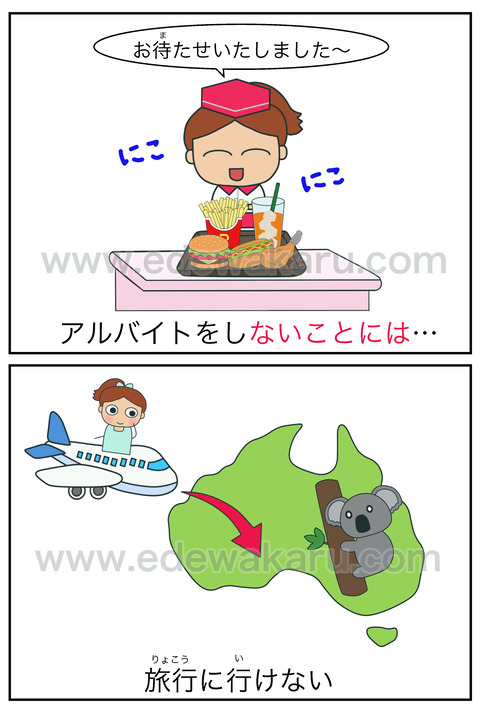
Unless I work part-time, I can’t go on a trip.
Unless I work part-time, I can’t go on a trip.
Unless I work part-time, I can’t go on a trip.
Unless I work part-time, I can’t go on a trip.
Unless I work part-time, I can’t go on a trip.
It would be good to learn together the patterns that can be substituted for one another. 😉
In context 3 examples
アルバイトをしないことには旅行に行けない
→アルバイトをしなければ旅行に行けないUnless I work part-time, I can’t go on a trip. → If I don’t work part-time, I can’t go on a trip.
しっかり勉強しないことにはN1に合格できない
→しっかり勉強しなければN1に合格できないUnless I study hard, I can’t pass N1. → If I don’t study hard, I can’t pass N1.
急がないことには授業に間に合わない
→急がなければ授業に間に合わないUnless I hurry, I won’t make it to class on time. → If I don’t hurry, I won’t make it to class on time.
Read the original source text
Meaning
〜なければ〜ない
How to use it
動詞・形容詞[ない形]+ことには
名詞[ーでない]+ことには
Explanation
「AないことにはB」は「AなければBない」という意味を表す文型です。
「Aしなければ悪い結果になる」「AしなければBはできない」というように
「A」しなければ「B」は成立しないと言いたい時に使用する文型です
😊「B」には必ず
否定的な判断
がくると覚えておきましょう😉また、この文型とよく使う表現をいくつか覚えておくといいと思います。
[一緒によく使う表現]
〜ことには〜
できない
〜ことには〜
られない
(可能形否定形)
〜ことには〜
恐れがある
(復習:〜恐れがある)
〜ことには〜
かねない
また「〜ないことには」は「〜なければ」「〜なくては」とチェンジすることもできます😀同じように「〜なければ」の口語形「〜なきゃ」(復習:〜なきゃ)、「〜なくては」の口語形「〜なくちゃ」(復習:〜なくちゃ)にもチェンジ可能です😀
[例]
アルバイトをし
ないことには
旅行に行けない
アルバイトをし
なければ
旅行に行けない
アルバイトをし
なくては
旅行に行けない
アルバイトをし
なきゃ
旅行に行けない
アルバイトをし
なくちゃ
旅行に行けない
チェンジできる文型をセットで覚えておけるといいですね😉
どんなときどう使う 日本語表現文型辞典
Meaning
unless
How to use it
Vない/イAくない/ナAでない/Nでない+ことには
Explanation
~しなければ
1)「あることをしなければ、または、あることが起こらなければ、後の事柄は実現しない」と言いたいときに使う。後には否定の意味の文が来る。
2)話者の消極的な気持ちを表す場合が多い。
1)Unless something is done or occurs, event following will not happen. Negatives are used in clause following.
2)Often expresses the speaker's passive feelings.
In context 5 examples
ある商品が売れるかどうかは、市場調査をしてみないことには、わからない。
We won’t know whether a product will sell unless we conduct market research.
山田さんが資料を持っているんだから、彼が来ないことには会議が始まりません。
Since Mr. Yamada has the materials, the meeting cannot begin unless he comes.
体が健康でないことには、いい仕事はできないだろう。
Unless you are healthy, you probably can’t do good work.
田中さんがどうして会社をやめたのか、いろいろ言われているけれど、本当の理由は本人に聞いてみないことにはわからない。
People say various things about why Mr. Tanaka quit the company, but unless we ask him, we won’t know the real reason.
ダンス教室を開きたいんですが、部屋がある程度広くないことにはダンスの練習はできませんね。
I want to open a dance studio, but unless the room is reasonably spacious, we can’t practice dancing.
Read the original source text
Meaning
unless
How to use it
Vない/イAくない/ナAでない/Nでない+ことには
Explanation
~しなければ
1)「あることをしなければ、または、あることが起こらなければ、後の事柄は実現しない」と言いたいときに使う。後には否定の意味の文が来る。
2)話者の消極的な気持ちを表す場合が多い。
1)Unless something is done or occurs, event following will not happen. Negatives are used in clause following.
2)Often expresses the speaker's passive feelings.
毎日のんびり日本語教師
Usage 1
Read this source entry ↗How to use it
Verb nai-form + ないことには~ない
Verb te-form + みないことには~ない
Explanation
Expresses that unless the action in the first clause is performed first, it is difficult to achieve something. The latter clause expresses impossibility, with content such as “cannot know” or “cannot do.”
“~てみないことには~ない” can be used when trying something out.
In spoken language, the forms “~ないと~ない” and “~なければ~ない” are commonly used.
Notes
The “~てみる” series
In context 8 examples
何事も経験してみないことには分からないだろう。
You probably won’t know about anything unless you try experiencing it.
挑戦しないことには始まらない。
Nothing can begin unless you take on the challenge.
自ら行動しないことには、自分を取り巻く環境も変わらない。
Unless you take action yourself, the circumstances around you won’t change.
朝起きたら、まずスマホでメッセージ確認しないことには一日が始まらない。
When I get up in the morning, my day can’t start until I first check my messages on my phone.
プライベートで心配事があり、それが解決しないことには気持ちに余裕ができない。
I have worries about my personal life, and unless they’re resolved, I can’t feel at ease.
失敗しないことには自分にとって何の経験にもならない。
Unless I fail, it won’t become any kind of experience for me.
宝くじは買ってみないことには当たりもしない。
Unless you try buying a lottery ticket, you can’t win one.
原因を突き止めないことには、根本的な解決もできない。
Unless we identify the cause, we can’t find a fundamental solution.
Read the original source text
How to use it
動ない形+ないことには~ない
動て形+みないことには~ない
Explanation
まず前件の動作を行わなければ、物事の実現が難しいことを表します。後件では「分からない」「できない」などの不可能を表す内容がきます。
「~てみないことには~ない」は、物事を試しに行ってみるような場面で用いることができます。
口語では「~ないと~ない」「~なければ~ない」の形でよく用いられます。
Notes
「~てみる」シリーズ
Usage 2
Read this source entry ↗How to use it
Verb nai-form + ないことには
I-adjective nai-form + ないことには
Na-adjective stem + で + ないことには
Noun + で + ないことには
Explanation
The first part states a prerequisite for the second part; if the first condition is not met, the second cannot hold either.
The second part must always be in the negative form.
Notes
Nothing in particular.
In context 8 examples
がないことには手が付けられない。
Unless we have [it], we can’t get started.
髪の毛の材料となる栄養がないことには髪の毛は生えてこない。
Unless there are nutrients that serve as the material for hair, hair won’t grow.
一度確認しないことには、はっきりしたことは申し上げられません。
Unless I check it once, I can’t give you a definite answer.
彼がいないことには、この試合に勝てないだろう。
Without him, we probably can’t win this match.
働いてお金を稼がないことには、独立とは言えない。
Unless you work and earn money, you can’t call it being independent.
彼がやったという証拠がないことには何とも言えない。
Unless there is evidence that he did it, I can’t say anything.
実際に会って話してみないことには、その人はどんな人かは分からない。
Unless I actually meet and talk with the person, I won’t know what kind of person they are.
お金とは、使わないことには新しい価値を生み出すこともできない。
Unless money is spent, it cannot create new value.
Read the original source text
How to use it
動ない形+ないことには
い形容詞ない形+ないことには
な形容詞語幹+で+ないことには
名詞+で+ないことには
Explanation
前項は後項が成立する前提条件で、前項が成立しなければ、後項も成立しないことを表します。
後項は必ず否定形をとります。
Notes
特になし
AIUEO JLPT Grammar
Meaning
This sentence pattern expresses that the next event or action will not occur unless a specific condition is met. It emphasizes that the desired result or action cannot happen unless the condition is achieved.
How to use it
Verb nai-form + ことには; adjective nai-form + ことには; na-adjective + で + ないことには; noun + で + ないことには
In context 5 examples
彼が来ないことには、会議を始められない。
We can’t start the meeting unless he comes.
勉強しないことには、試験に合格するのは難しい。
It’s hard to pass the exam unless you study.
予約をしないことには、席が取れないかもしれない。
We might not get a seat unless we make a reservation.
健康でないことには、どんなにお金があっても幸せにはなれない。
You can’t be happy no matter how much money you have if you’re not healthy.
経験がないことには、この仕事はできない。
You can’t do this job without experience.
Read the original source text
Meaning
This sentence pattern expresses that the next event or action will not occur unless a specific condition is met. It emphasizes that the desired result or action cannot happen unless the condition is achieved.
How to use it
動詞ない形+ことには形容詞ない形+ことには形容動詞で+ないことには名詞で+ないことには
Explanation · 日本語
この文型は、ある条件が満たされなければ次の事柄が成立しないことを表す表現です。否定的な条件を提示し、その条件が達成されない限り期待する結果や行動が実現しないことを強調するときに使います。
NINJAL 日本語文型データベース
Meaning
Used when you want to say that unless ~ is established, something will not be realized or you cannot move on to the next stage. It means that for something to be realized, ~ must first be established without fail.
It is also often used in the form “~てみないことには.”
How to use it
Notes
A negative sentence or a sentence expressing difficulty follows “~ないことには.”
In context 21 examples
ペットホテルを開きたいが、お金がないことには無理だ。まずは資金を集めることだ。
I want to open a pet hotel, but it’s impossible without money. First, I need to raise funds.
人間は、ほかの人の力を借りないことには生きていけない。
People cannot live without relying on the help of others.
「会長はまだ? 会長が来ないことには会議が始められないよ」
“Is the chairperson here yet? We can’t start the meeting unless the chairperson arrives.”
私たちのボランティアグループは、もっと会員を増やさないことには団体として市に登録するのは難しいのではないでしょうか。
Unless our volunteer group increases its membership, it may be difficult to register as an organization with the city.
修理業者「屋根の修理にいくらかかるかは、実際に現物を見てみないことには何ともお答えできませんねえ」
Repair contractor: “I can’t really tell you how much it will cost to repair the roof unless I actually see it.”
アルバイトの採用担当者「紹介してくれた白石さんのことですけど、まずは会ってみたいです。会ってみないことにはどんな方かわかりませんので……」
Part-time job hiring manager: “About Shiraishi, who introduced you—first, I’d like to meet them. I can’t tell what kind of person they are without meeting them…”
医師「もう少し詳しく検査してみないことには正確な診断はできません。とにかく今日は調べてみましょう」
Doctor: “I can’t make an accurate diagnosis without examining you in a little more detail. In any case, let’s run some tests today.”
家がもっと広くないことには、田舎から両親を呼び寄せて同居するのは難しい。
Unless the house is bigger, it will be difficult to invite my parents from the countryside to come live with us.
不動産屋の人「お宅のアパートは古いですから、もう少し家賃を下げないことには借り手がつかないだろうと思いますよ」
Real estate agent: “Your apartment is old, so I don’t think you’ll find a tenant unless you lower the rent a little more.”
ジムに通って体を鍛えたい。しかし、ジムがもう少し近くないことには毎日は通えない。
I want to work out by going to the gym. But unless the gym is a little closer, I can’t go every day.
最近のテレビのお笑い番組は面白くない。面白くないことには視聴率をとるのも無理だろう。
The comedy shows on TV these days aren’t funny. Unless they’re funny, getting good ratings is probably impossible.
リーダーとして活躍するには賢さが必要だ。賢くないことにはさまざまなトラブルをうまく処理できないだろう。
To succeed as a leader, you need to be smart. Unless you’re smart, you probably can’t handle various problems well.
静かでないことには、私は勉強に集中できない。
Unless it’s quiet, I can’t concentrate on studying.
体も心も健康でないことには、日々の暮らしを楽しめないと思う。
I don’t think you can enjoy daily life unless you’re healthy both physically and mentally.
本当に子どもが好きでないことには、保育士の仕事は長続きしません。
Unless you truly love children, you won’t last long as a childcare worker.
効果が明らかでないことには、私はサプリメントを飲み続ける気にならない。
Unless its effects are clear, I don’t feel like continuing to take the supplement.
何らかのデータを示すことは、話に説得力を持たせるために役立つ。ただし、データが正確でないことには意味がない。
Presenting some kind of data helps make an argument persuasive. However, it’s meaningless unless the data is accurate.
ガーデニングは土づくりが大切です。いい土でないことにはいい花は咲きません。
Preparing the soil is important in gardening. Good flowers won’t bloom unless the soil is good.
うちは江戸時代から続く老舗のそば屋です。後継者を求めていますが、熱意のある人でないことにはこの店は譲れません。
We’re a long-established soba restaurant that has continued since the Edo period. We’re looking for a successor, but we can’t hand over this shop unless the person is enthusiastic.
竹村さんのような介護のベテランでないことには、気難しい高齢者のお相手は難しいと思う。
I think it would be difficult to look after a difficult elderly person unless you’re an experienced caregiver like Takemura.
平和で自由な環境でないことには、子どもはのびやかには育たないのではないでしょうか。
I wonder if children can grow up freely unless they are in a peaceful and free environment.
Read the original source text
Meaning
~が成立しなければ、ある事柄が実現しない・次の段階に進めないと言いたいときに使います。ある事柄の実現のためには、まず「~」の成立が絶対に必要であるという意味で使います。
「~てみないことには」の形で使うことも多いです。
How to use it
Notes
「〜ないことには」の後には、否定の文や困難を表す文がきます。
IMABI
Negative Patterns
Read this IMABI lesson ↗Explanation
More Negative Patterns: ~ないことには, ~なし・なき, ~なしで(は), ~なしに(は), ~なくして(は), ~ことなく, & 甲斐もなく
This lesson will introduce you to more patterns that utilize ~ない or derivations of it.
~ないことには(~ない)
AないことにはB means “if…don’t/in not…; unless”. So, if you don’t do A, you get stuck with B. B could be positive or negative depending on the outcome that you wish to express. It can be used with verbs, adjectives, or the copula, but don’t forget how to properly use ない! This pattern must be only used in declarative sentences.
品詞 接続 例
名詞 N+でないことには 人でないことには
形容詞 Adj → く-連用形 + ないことには 高くないことには
形容動詞 Adj + でないことには 精密でないことには
動詞 Adj → 未然形 + ないことには しないことには
1. 泳がないことには、海岸に行けなくなった。
In not swimming, I became unable to go to the beach.
2. 急がないことには、間に合わなくなる。
In not hurrying, you won’t make it in time.
3. 勝たないことには、試合しあいに負ける。
If you don’t win, you lose in the tournament.
4. がんばらないことには、今度の韓国語の試験に合格できないよ。
Unless you try hard, you won’t pass this next Korean exam.
Grammar Note: Do not confuse this with …ないことには where は is simply emphatic. The phrase discussed in this section is conjunctive in nature, whereas this is not.
5. 自分に関わりのないことには口を出すなよ。
Don’t interfere in things that don’t concern you!
~なし
無なし means “without” and is after nominal phrases. If なし for some reason is placed before a noun, it becomes 無き. There is more behind this form of ない. The problem lies with how to use ~なしに(は), ~なしで(は), and ~なくして(は). These phrases show that if something were not to happen, a certain event won’t be. These phrases show necessity, and there is a negative phrase in the next clause.
6. コーヒーなしに過ごせない。
I can’t go on without coffee.
7. 涙なしに語ることができない。(書き言葉的)
I can’t tell it without tears coming.
8. 国民の理解と協力なしには実行できない。(書き言葉)
We can’t act forth without the understanding and cooperation of the citizens.
9. 政府開発援助なしではこの革新的な医学研究は続けることができない。
Without government development aid, this groundbreaking medical research can’t continue.
10. しっかりと準備することなくしては成功できぬ。 (硬い書き言葉)
Without properly preparing, you can’t succeed.
11. 先生方のご指導なくして私の大学合格は有り得ませんでした。(とても丁寧; Useful expression)
Without the guidance of my teachers, my college success wouldn’t have been possible.
12. 政治家せいじかはテレプロンプター(原稿)なしで話せない。
Politicians can’t talk without a teleprompter.
13.百害ひゃくがいあって一利いちりなし。(Set phrase/proverb)
To do no good but a lot of harm.
14. 「憲法を改正することなくして、軍事大国になれない」と考える人が増えているそうだ。
It sounds that the number of people who think that without revising the constitution, [Japan] won’t be able to become a military power is growing.
Grammar Note: Also seen as ~ずして(は), ~なくして(は) is a more old-fashioned/archaic equivalent of ~なしに(は), but it can be used in plus and or negative situations.
~なしで(は) VS ~なしに(は)
Although both present a premise X, which makes Y possible, they are slightly different.
1. ~なしで(は) is used with a noun that shows a general condition, and the listener is told that there must be X. Thus, the speaker can use this when pointing out a ban or the need for evasion.
2. ~なしに(は) can’t be used directly towards the listener to get that person working. When these expressions are interchangeable, the former shows an individual cause whereas the latter shows a more obvious situation that is deemed to be evident and necessary. Thus, it is more suited for the written language.
15. スペイン語?無理いうなや。辞書なし{で・に}は、分からんわ。(ちょっと関西弁っぽい)
Spanish? Don’t be unreasonable. I can’t understand it without a dictionary.
16. 客商売だから、ネクタイなし{〇 で・X に}は、困るんだけども。(話し言葉)
Since it’s business (client-oriented), it’d be troubling without a tie.
17. 届け出なし{〇 に・△ で}外泊するのは、キャンプの規則に違反することになります。
Sleeping outdoors is now a violation of camp rules without notification.
18. ノックなしに(は)、ドアを開けないでください。
Don’t open the door without knocking.
Grammar Note: は in the last situation would make it fit well, but the message was probably written on the door rather than spoken. Had the sentence been spoken, with ノックしないで being more common, ~なしに would exemplary demonstrate consideration to the listener.
~ないことには~ない VS ~ことなしに(は)~ない VS ~ことなく
XないことにはYない shows that for the realization of Y, X is necessary. X can be a positive or negative situation. However, ~ことなしに(は)~ない and ~ことなく can only be used with verbs whereas the former pattern is also seen with nouns and adjectives. Furthermore, these latter expressions show that “for Y to realize, X is unavoidable”. So, it’s not positive.
19a. 努力どりょく{することなしには・しないことには}、成功はできない。
19b. 成功するためには、努力を避さけていることはできない。
You cannot succeed unless you put in effort.
20. 「憲法を変え{・ることなしには・ないことには}、軍事大国になれないと考える人が増えている」といわれますが、本当かどうかよく分かりませんね。
It’s said that the number of people that think that without changing the constitution, [Japan] won’t be able to come a military power is growing, but I don’t really know if that’s true.
21. 優しい人でないことには、お金があっても、結婚できませんよ。
You can’t get married even if you have money if you’re not a nice person.
Other things to keep in mind is that both ~ことなしに(は)~ない and ~ことなく are more likely to appear in the written language; however, the former is even more 硬かたい because it has the old なし in it. You do still see ~こと(も)なく in the spoken language, though, in which it has interchangeability with 連用形+もしないで.
22a. 多少のリスクを負わないことには、ビジネスなんかできないよ。とうてい避けられないもんだから。〇
22b. 多少のリスクを負う{ことなく・ことなしに}、ビジネスなんかできないよ。とうてい避けられないもんだから。X
Without taking some risk, you can’t do business. That’s because you can’t avoid it no matter what.23. 石に躓つまづいて転ころんだ子供が{泣くこともなく・泣きもしないで}、笑顔えがおで立ち上がったなんてびっくりしたよ。
I was surprised that the kid who tripped and fell on the rocks got up with a smile without even crying.
24. しょうことなく、メザキさんと並んで、いくら行っても太くもならないし細くもならない道を、長く歩いた。
With it not being helped, I went along with Mr. Mezaki, and we walked a long ways down the road, which no matter how much you go neither widens nor thins.
From 溺レる by 川上弘美.
Phrase Note: しょうことなく = しょうことなしに = やむを得ず.
25. ためらうことなく、消防士は燃えている家に入った。
The firefighters went into the burning house without hesitation.
26. 福田社長はしょうことなしに謝罪をした。
Company President Fukuda apologized with little choice.
27. 試験に合格することなしに、この会社には入れません。
It is not possible to get into this company without passing the exam.
甲斐(かい)もなく
甲斐かい means “avail” and 甲斐かいもなく, thus, means “to no avail/in vain”. Just as in English, it is not really casual.
28. 私たちは練習れんしゅうした甲斐かいもなく負けてしまった。
We lost despite practicing.
29. わざわざフランスから出かけてきた甲斐がありました。
It was worth our while to have come all the way from France.
30. 勉強した甲斐もなく落ちてしまいました。
I ended up failing to no avail of studying.
31. 働はたらき甲斐がい
Just the value of working
32. 年甲斐としがいもなく
Unbecoming to one’s age
In context 35 examples
泳がないことには、海岸に行けなくなった。
In not swimming, I became unable to go to the beach.
急がないことには、間に合わなくなる。
In not hurrying, you won’t make it in time.
勝たないことには、試合しあいに負ける。
If you don’t win, you lose in the tournament.
がんばらないことには、今度の韓国語の試験に合格できないよ。
Unless you try hard, you won’t pass this next Korean exam.
自分に関わりのないことには口を出すなよ。
Don’t interfere in things that don’t concern you!
コーヒーなしに過ごせない。
I can’t go on without coffee.
涙なしに語ることができない。(書き言葉的)
I can’t tell it without tears coming.
国民の理解と協力なしには実行できない。(書き言葉)
We can’t act forth without the understanding and cooperation of the citizens.
政府開発援助なしではこの革新的な医学研究は続けることができない。
Without government development aid, this groundbreaking medical research can’t continue.
しっかりと準備することなくしては成功できぬ。 (硬い書き言葉)
Without properly preparing, you can’t succeed.
先生方のご指導なくして私の大学合格は有り得ませんでした。(とても丁寧; Useful expression)
Without the guidance of my teachers, my college success wouldn’t have been possible.
政治家せいじかはテレプロンプター(原稿)なしで話せない。
Politicians can’t talk without a teleprompter.
百害ひゃくがいあって一利いちりなし。(Set phrase/proverb)
To do no good but a lot of harm.
「憲法を改正することなくして、軍事大国になれない」と考える人が増えているそうだ。
It sounds that the number of people who think that without revising the constitution, [Japan] won’t be able to become a military power is growing.
~なしで(は) is used with a noun that shows a general condition, and the listener is told that there must be X. Thus, the speaker can use this when pointing out a ban or the need for evasion.
Spanish? Don’t be unreasonable. I can’t understand it without a dictionary.
~なしに(は) can’t be used directly towards the listener to get that person working. When these expressions are interchangeable, the former shows an individual cause whereas the latter shows a more obvious situation that is deemed to be evident and necessary. Thus, it is more suited for the written language.
Spanish? Don’t be unreasonable. I can’t understand it without a dictionary.
スペイン語?無理いうなや。辞書なし{で・に}は、分からんわ。(ちょっと関西弁っぽい)
Spanish? Don’t be unreasonable. I can’t understand it without a dictionary.
客商売だから、ネクタイなし{〇 で・X に}は、困るんだけども。(話し言葉)
Since it’s business (client-oriented), it’d be troubling without a tie.
届け出なし{〇 に・△ で}外泊するのは、キャンプの規則に違反することになります。
Sleeping outdoors is now a violation of camp rules without notification.
ノックなしに(は)、ドアを開けないでください。
Don’t open the door without knocking.
努力どりょく{することなしには・しないことには}、成功はできない。
You cannot succeed unless you put in effort.
成功するためには、努力を避さけていることはできない。
You cannot succeed unless you put in effort.
「憲法を変え{・ることなしには・ないことには}、軍事大国になれないと考える人が増えている」といわれますが、本当かどうかよく分かりませんね。
It’s said that the number of people that think that without changing the constitution, [Japan] won’t be able to come a military power is growing, but I don’t really know if that’s true.
優しい人でないことには、お金があっても、結婚できませんよ。
You can’t get married even if you have money if you’re not a nice person.
多少のリスクを負わないことには、ビジネスなんかできないよ。とうてい避けられないもんだから。〇
Unless you take on some risk, you can’t do business. It’s something you simply can’t avoid. 〇
多少のリスクを負う{ことなく・ことなしに}、ビジネスなんかできないよ。とうてい避けられないもんだから。X
You can’t do business without taking on some risk. It’s something you simply can’t avoid. X
しょうことなく、メザキさんと並んで、いくら行っても太くもならないし細くもならない道を、長く歩いた。
With it not being helped, I went along with Mr. Mezaki, and we walked a long ways down the road, which no matter how much you go neither widens nor thins.
ためらうことなく、消防士は燃えている家に入った。
The firefighters went into the burning house without hesitation.
福田社長はしょうことなしに謝罪をした。
Company President Fukuda apologized with little choice.
試験に合格することなしに、この会社には入れません。
It is not possible to get into this company without passing the exam.
私たちは練習れんしゅうした甲斐かいもなく負けてしまった。
We lost despite practicing.
わざわざフランスから出かけてきた甲斐がありました。
It was worth our while to have come all the way from France.
勉強した甲斐もなく落ちてしまいました。
I ended up failing to no avail of studying.
働はたらき甲斐がい
Just the value of working
年甲斐としがいもなく
Unbecoming to one’s age
Read the original source text
Explanation
More Negative Patterns: ~ないことには, ~なし・なき, ~なしで(は), ~なしに(は), ~なくして(は), ~ことなく, & 甲斐もなく
This lesson will introduce you to more patterns that utilize ~ない or derivations of it.
~ないことには(~ない)
AないことにはB means “if…don’t/in not…; unless”. So, if you don’t do A, you get stuck with B. B could be positive or negative depending on the outcome that you wish to express. It can be used with verbs, adjectives, or the copula, but don’t forget how to properly use ない! This pattern must be only used in declarative sentences.
品詞 接続 例
名詞 N+でないことには 人でないことには
形容詞 Adj → く-連用形 + ないことには 高くないことには
形容動詞 Adj + でないことには 精密でないことには
動詞 Adj → 未然形 + ないことには しないことには
1. 泳がないことには、海岸に行けなくなった。
In not swimming, I became unable to go to the beach.
2. 急がないことには、間に合わなくなる。
In not hurrying, you won’t make it in time.
3. 勝たないことには、試合しあいに負ける。
If you don’t win, you lose in the tournament.
4. がんばらないことには、今度の韓国語の試験に合格できないよ。
Unless you try hard, you won’t pass this next Korean exam.
Grammar Note: Do not confuse this with …ないことには where は is simply emphatic. The phrase discussed in this section is conjunctive in nature, whereas this is not.
5. 自分に関わりのないことには口を出すなよ。
Don’t interfere in things that don’t concern you!
~なし
無なし means “without” and is after nominal phrases. If なし for some reason is placed before a noun, it becomes 無き. There is more behind this form of ない. The problem lies with how to use ~なしに(は), ~なしで(は), and ~なくして(は). These phrases show that if something were not to happen, a certain event won’t be. These phrases show necessity, and there is a negative phrase in the next clause.
6. コーヒーなしに過ごせない。
I can’t go on without coffee.
7. 涙なしに語ることができない。(書き言葉的)
I can’t tell it without tears coming.
8. 国民の理解と協力なしには実行できない。(書き言葉)
We can’t act forth without the understanding and cooperation of the citizens.
9. 政府開発援助なしではこの革新的な医学研究は続けることができない。
Without government development aid, this groundbreaking medical research can’t continue.
10. しっかりと準備することなくしては成功できぬ。 (硬い書き言葉)
Without properly preparing, you can’t succeed.
11. 先生方のご指導なくして私の大学合格は有り得ませんでした。(とても丁寧; Useful expression)
Without the guidance of my teachers, my college success wouldn’t have been possible.
12. 政治家せいじかはテレプロンプター(原稿)なしで話せない。
Politicians can’t talk without a teleprompter.
13.百害ひゃくがいあって一利いちりなし。(Set phrase/proverb)
To do no good but a lot of harm.
14. 「憲法を改正することなくして、軍事大国になれない」と考える人が増えているそうだ。
It sounds that the number of people who think that without revising the constitution, [Japan] won’t be able to become a military power is growing.
Grammar Note: Also seen as ~ずして(は), ~なくして(は) is a more old-fashioned/archaic equivalent of ~なしに(は), but it can be used in plus and or negative situations.
~なしで(は) VS ~なしに(は)
Although both present a premise X, which makes Y possible, they are slightly different.
1. ~なしで(は) is used with a noun that shows a general condition, and the listener is told that there must be X. Thus, the speaker can use this when pointing out a ban or the need for evasion.
2. ~なしに(は) can’t be used directly towards the listener to get that person working. When these expressions are interchangeable, the former shows an individual cause whereas the latter shows a more obvious situation that is deemed to be evident and necessary. Thus, it is more suited for the written language.
15. スペイン語?無理いうなや。辞書なし{で・に}は、分からんわ。(ちょっと関西弁っぽい)
Spanish? Don’t be unreasonable. I can’t understand it without a dictionary.
16. 客商売だから、ネクタイなし{〇 で・X に}は、困るんだけども。(話し言葉)
Since it’s business (client-oriented), it’d be troubling without a tie.
17. 届け出なし{〇 に・△ で}外泊するのは、キャンプの規則に違反することになります。
Sleeping outdoors is now a violation of camp rules without notification.
18. ノックなしに(は)、ドアを開けないでください。
Don’t open the door without knocking.
Grammar Note: は in the last situation would make it fit well, but the message was probably written on the door rather than spoken. Had the sentence been spoken, with ノックしないで being more common, ~なしに would exemplary demonstrate consideration to the listener.
~ないことには~ない VS ~ことなしに(は)~ない VS ~ことなく
XないことにはYない shows that for the realization of Y, X is necessary. X can be a positive or negative situation. However, ~ことなしに(は)~ない and ~ことなく can only be used with verbs whereas the former pattern is also seen with nouns and adjectives. Furthermore, these latter expressions show that “for Y to realize, X is unavoidable”. So, it’s not positive.
19a. 努力どりょく{することなしには・しないことには}、成功はできない。
19b. 成功するためには、努力を避さけていることはできない。
You cannot succeed unless you put in effort.
20. 「憲法を変え{・ることなしには・ないことには}、軍事大国になれないと考える人が増えている」といわれますが、本当かどうかよく分かりませんね。
It’s said that the number of people that think that without changing the constitution, [Japan] won’t be able to come a military power is growing, but I don’t really know if that’s true.
21. 優しい人でないことには、お金があっても、結婚できませんよ。
You can’t get married even if you have money if you’re not a nice person.
Other things to keep in mind is that both ~ことなしに(は)~ない and ~ことなく are more likely to appear in the written language; however, the former is even more 硬かたい because it has the old なし in it. You do still see ~こと(も)なく in the spoken language, though, in which it has interchangeability with 連用形+もしないで.
22a. 多少のリスクを負わないことには、ビジネスなんかできないよ。とうてい避けられないもんだから。〇
22b. 多少のリスクを負う{ことなく・ことなしに}、ビジネスなんかできないよ。とうてい避けられないもんだから。X
Without taking some risk, you can’t do business. That’s because you can’t avoid it no matter what.23. 石に躓つまづいて転ころんだ子供が{泣くこともなく・泣きもしないで}、笑顔えがおで立ち上がったなんてびっくりしたよ。
I was surprised that the kid who tripped and fell on the rocks got up with a smile without even crying.
24. しょうことなく、メザキさんと並んで、いくら行っても太くもならないし細くもならない道を、長く歩いた。
With it not being helped, I went along with Mr. Mezaki, and we walked a long ways down the road, which no matter how much you go neither widens nor thins.
From 溺レる by 川上弘美.
Phrase Note: しょうことなく = しょうことなしに = やむを得ず.
25. ためらうことなく、消防士は燃えている家に入った。
The firefighters went into the burning house without hesitation.
26. 福田社長はしょうことなしに謝罪をした。
Company President Fukuda apologized with little choice.
27. 試験に合格することなしに、この会社には入れません。
It is not possible to get into this company without passing the exam.
甲斐(かい)もなく
甲斐かい means “avail” and 甲斐かいもなく, thus, means “to no avail/in vain”. Just as in English, it is not really casual.
28. 私たちは練習れんしゅうした甲斐かいもなく負けてしまった。
We lost despite practicing.
29. わざわざフランスから出かけてきた甲斐がありました。
It was worth our while to have come all the way from France.
30. 勉強した甲斐もなく落ちてしまいました。
I ended up failing to no avail of studying.
31. 働はたらき甲斐がい
Just the value of working
32. 年甲斐としがいもなく
Unbecoming to one’s age
Phrasal こと
Read this IMABI lesson ↗Explanation
Phrasal こと: ~ことに・~ことには・~AことはA~・Aことこの上ない・~ということだ
The grammatical patterns involving the nominalizer こと to be discussed in this lesson are as follows:
~ことに
~ことには
AことはA
Aことこの上ない
~ということだ
Solid understanding of the other pieces to these grammatical structures combined with understanding how nominalization works with こと is essentially all you need to master these patterns.
~ことに
Following verbal or adjectival/adjectival noun predicates, ~ことに can indicate a strong emotional response toward a situation that follows. This following main clause should not indicate volition. This grammar is largely limited to phrases of the same vein as those in the chart below.
悲しいことにsadly…不思議なことにstrangely enough…
驚いたことにsurprisingly…ありがたいことにthankfully…
残念なことにunfortunately…面白いことにinterestingly…
悔しいことにto my chagrin…幸いなことにfortunately…
困ったことにawkwardly…嬉しいことにto my delight…
恐ろしいことにhorribly…興味深いことにintriguingly…
Not only is it the case that volition is absent from either clause, the commentary itself ought not to include the listener’s circumstance. Meaning, it is limited to first and third person scenarios.
1. とても残念なことに、あともう少しだったのに、負けちまった。
Very unfortunately for me, I ended up losing despite how close I was.
2. ありがたいことに、全員が無事だった。
Thankfully, everyone was alright.
3. 住民の恐ろしいことに、洪水で数千頭の家畜が溺死し、一部は木のてっぺんにとどまりました。
To the horror of the residents, thousands of livestock drowned in the floodwaters, some remaining lodged in the treetops.
If additional emphasis is warranted for these phrases, you may also see it topicalized via the particle は.
4. 驚いたことには、欠席どころか、一度遅刻したこともなかったそうだ。
What was surprising was that, far from being absent, apparently, (he) had never even been late once.
5. あきれたことには、あんな人が店長に昇進したんだよ。
It’s dumbfounded how someone like that got promoted to store manager.
に is highly adverbial in nature in this pattern. Given the emphatic tone of ~ことに, it is comparable to sentence-final ~ことだ. Meaning, we are looking at the /ni-/ 連用形 of the copula. It is this adverbial property which then limits ~ことに to adjectival/adjectival noun predicates.
Given the adverbially nature of に and how it relates quite nicely with sentence-initial instances of “-ly” in English, it is important NOT to confuse ~ことに when に functions as an object marker, which would be obvious from the clausal structuring of the sentence.
6. 悲しいことにも、うれしいことにも、 起こってしまうどんなことにも、 そんなに驚かないで、慌てないでいられたらいいなって思う。
I hope that I can remain unsurprised and not panicked by anything happens, whether sad or happy.
As longwinded as Ex. 6 might be, in the case of both 悲しいことに and うれしいことに, they are objects of the verb 驚く that does indeed follow. In which case, the appropriate translation of に would be “at/by.”
~ことには
By Condition A being the case, Condition B is sure to follow.
7. その根源を解決しないことには、一時的に課題を解決しても、また同じ課題になやまされることになります。
Unless you address the root cause, even if you solve the problem for the time being, you will end up suffering from the same problem again.
8. 早く出発しないことには、大変なことになる。
By not departing early, it’ll become a huge ordeal.
As suggested by the translation of “by,” the particle に shown in this pattern relates to its cause marking function. When applied to predicates, it is Situation/Condition A, usually not happening that causes Situation/Condition B to happen.
~ないことには~ない
This pattern is the same as ~ことには but with both the dependent clause and main clause rendered in the negative, creating a conditional statement in which “by Condition A not being met, Condition B does not come about.”
9. まず、事実関係を確認しないことには、何とも言えません。
First of all, there is really nothing I can say about it without checking the facts.
10. 何事も経験してみないことには分からないでしょう。
You won’t know until you experience it, and that’s with anything.
11. 失敗の発生要因をきちんと見つけだして解決しないことには再発防止にはならないのである。
Unless the cause of the failure is properly identified and resolved, preventing recurrence will not be feasible.
12. 本物であるかは買ってみないことにはわかりません。
You won’t know if it’s real until you buy it.
言う(こと)には・・・
This pattern is used when the speaker wishes to pass along information they have directly obtained from Source A which may still be . It is possible to find 言う in the non-past or past tense, but oddly enough, こと is not required when this pattern is used in the non-past. In its absence, it is understood that には follows the 連体形1.
As for the nature of the particle に, it is used in its standard marker capacity.
13. 村民が言う(こと)には、腹を空かせた熊が、餌を探しに街に出没しているらしい。
Villagers say that hungry bears have been lurking in the town looking for food.
14. テイラー君が言う(こと)には、明日は開店日だそうだよ。
From what Taylor-kun is saying, tomorrow is opening day.
15. メアリーさんの言う(こと)には、今年のN1はかなり難しかったらしいよ。
From what Mary-san is saying, this year’s N1 seemed pretty difficult.
16. 今菊池さんが言ったことには、もしかしたら参考になるかもしれない。
Given what Kikuike-san just said, perhaps it might be of help (to you).
While it is not a requirement that 言う be used, the verb must still be an equivalent.
17. 「鳩さんが申します2には、このお嬢さんのおとしは十歳だそうです。お嬢さんあたりましたか」
“From what Hato-san is saying, you fine lady here are ten, is that right?”
From 『電気鳩』 by 海野十三.
18. 陛下が仰せになる(こと)には、それでよいとのことでした3。
From what His Majesty is saying, that will be fine.
It is worth noting that this utilization of ~ことには ought not be confused with the sentence structure is actually [~こと]+にはある or similar sentences.
19. 検察官の仰ることにはどう見ても首をかしげるような事実誤認の部分もありました。
No matter how you look at it, there were some factual errors in what the prosecutor(s) said that made me tilt my head.
AことはA…(が・けれど)
Juxtaposing a predicate pertaining to states – nominal, adjectival, or adjectival noun – with ITSELF, the speaker admits the validity of the truth statement made by said predicate, but the commentary (Situation B) that follows downplays the importance of it in some way. In a broad sense, it is one way of qualifying one’s statement, with a meaning similar to “it is the case that… but…”
By juxtaposing a predicate (Situation A) with itself, both iterations on each side of ことは must match either in predicate type and state of affirmation (positive or negative). As for politeness, it may be marked on Situation B or on the second utterance of Situation A4.
Now, because the 連体形 must be used before こと, you will still need to know when to use な・だ・である in relation to to nominal/adjectival noun predicates.
Predicate TypeExample
動詞食べることは食べるが
形容詞美味しいことは美味しいが
形容動詞便利{な・である}ことは便利だが
20. おいしいことはおいしいが、ちょっと高すぎる。
Sure, it’s delicious, but it’s a little too expensive.
21. それ以降もミステリーを書くことは書いたが、一般小説で脚光を浴びるようになって行った。
Although (I) continued to write mystery novels after that, (I) began to gain attention for my general fiction.
22. 先月開通した道は便利なことは便利だが、事故が多い。
The road that opened last month is convenient, sure, but there are a lot of accidents (on it).
23. 自分が学生の頃は授業に出ることは出たがあんまり熱心には受講していなかった。
When I myself was a student, I did attend classes, but I was not all that enthusiastic about taking them.
Tense is not restricted by this pattern aside from “past… ~ことは non-past…” being ungrammatical. Consider the following.
24. 見ての通り、キュワワー以外にもレア度の高いモンスターが出たことは出たが、出現率が高いとは言い難い。
As you can see, there were other super rare mons that spawned besides Comfey, but I can’t say that their spawn rate was high.
25. 全部分かったことは分かったけど、時間がなくなってしまった。
I know I understood it all, but I ran out of time.
26. 書いたことは書いたんだけど、捨てちゃったかも。
I wrote it, I know it, but I guess I threw it away.
27a. きのう、本屋へ行ったことは行ったが、店が閉まっていて買えなかった。
27b. きのう、本屋へ行くことは行ったが、店が閉まっていて買えなかった。
27a. I went to the bookstore yesterday, that I did, but the store was closed and I couldn’t buy (it).
27b. Yesterday, I did in fact go to the bookstore, but the store was closed and I couldn’t buy (it).
In Ex. 27a, the speaker is emphasizing that Situation A is a thing of the past. Meanwhile, in Ex. 27b, the use of the non-past tense first indicates how the speaker’s mind has rewound to that moment in time, placing the focus on [本屋へ行く] as opposed to the time setting of yesterday. With [行ったことは行った], the emphasis is on the action having occurred in a confirmatory tone.
28a. タイに行く前にタイ語を勉強することはしたのですが、たった2週間だけです。
28b. タイに行く前にタイ語を勉強したことはしたのですが、たった2週間だけです。
28a. I did in fact study Thai before going to Thailand, but only for two weeks.
28b. I studied Thai before going to Thailand, yes, but only for two weeks.
Ex. 28 also illustrates how ellipsis can occur for the root element of a する verb when it is repeated.
w/ Nominal Predicates
Due to nominal predicates already being representations of “X being Y,” which in this case, Y=X, using AことはA with such predicates is generally unnatural5 due to grammatical redundancy. The same can be said for the English equivalent.
i. 道路{である・な}ことは道路だ。X
What is being a road is a road. X
ii. 道路は道路だ。〇
A road is a road.
Aことこの上ない
Following all predicate types, ~ことこの上ない, this emphatic pattern indicates that there is no condition/state that better fits that description than what is being stated. This, though, could be used in a literal and sarcastic sense, so whether the statement is a good thing or not will be contextually based.
29. 発音が弱くて聞き取りにくかったのかもしれませんが、やる気満々の私には悔しいことこの上ありません。
Maybe my pronunciation was poor and it was hard for them to catch what I was saying, but it was the most vexing thing for me ever considering how determined I was.
30. 昨日は雪が大したことなくて良かったですね。しかしながら、寒いことこの上ないです。
I’m so glad the snow wasn’t too bad yesterday. Even so, it was still beyond cold.
31. 床には粉々に砕けたステンドグラスが散乱しており、見ていて危なっかしいことこの上なかった。
Shattered stained glass was scattered all over the floor, making for an extremely dangerous sight to see.
32. 食べにくいことこの上ございませんことよ6!
It is beyond difficult to eat!
When this pattern is being used to modify a noun, it manifests as この上ない~.
33. 皆様を弊社にお迎えでき、この上ない喜びです。
It is my greatest pleasure to welcome all of you to our company.
34. 大切な方やペットとの死別は、この上ない悲しみや苦しみに襲われる場合があり、どうしようもない悲嘆の感情にお困りの方もいらっしゃるでしょう。
The death of a loved one or a pet can cause extreme sadness and anguish, and some people may find themselves overwhelmed by grief that they cannot cope with.
This pattern may also be used adverbially as この上なく.
35. この上なくいい天気でした。
The weather couldn’t have been better.
~ということだ(伝聞)
Oftentimes, especially in formal speech such as reporting, indicating the “facts” of the matter as first stated or observed by others is indicated with ~ということだ.
36. ロケットが打ち上げられたということだ。
This means that a rocket was launched.
37. 駆除されたクマと、4年前に町内の70代の女性を死亡させたクマのDNAも一致したということです。
The DNA of the culled bear also matched that of a bear that killed a woman in her 70s who lived in the town four years ago.
From NHK 7/19/25.
38. この岩石の年代について、放射性元素を使った手法で詳しく分析したところ、太陽系誕生直後のおよそ45億6730万年前に形成されていたことがわかったということです。
Detailed analysis of the rock’s age using radioactive isotypes revealed that it was formed approximately 4.5673 billion years ago, shortly after the birth of our solar system.
From NHK 7/19/25.
In casual conversation, in addition to seeing it manifested as ~ってことだ, tonality heavily affects the implication behind the speaker relaying what they have heard as hearsay (伝聞). For instance, in the following examples, the speaker is not all too happy about the situation and is probing for more information.
39. その夜、ご主人はご帰宅なさらなかったということですが、おかしいじゃありませんか。どうしてなのですか。
I understand that your husband didn’t come home last night, but isn’t that strange? Why did he not?
40. うちの子が怪我したってことだが、いったいどうしてくれるんだ?
So, apparently my child got hurt. What are you going to do about it?
When the statement ~ということだ follows is not necessarily hearsay, the implication is that the speaker is trying to make a matter-of-fact statement, which would be corroborated by past experiences, common sense, or actually quoting someone.
41. 社長が朝礼で言ったのは、「心をひとつにして頑張ろう」ということだよ。
As for what the president was talking about in our morning meeting, he talked about “coming together and doing our best.”
In the spoken language, you may also encounter this use of ~ということだ further abbreviated to ~って. Now, as for whether what follows ~って happens to still be an ellipsed ことだ or some other plausible replacement such as 言う would be contextually based. In any event, the statement would still be backed up in some fashion beyond the speaker simply stating what they believe to be the case.
~とのことだ is largely equivalent to ~ということだ, albeit with a far calmer tone, making it inappropriate for Exs. 39-40 from earlier. It also would not fit well in Ex. 41, either, on the basis that ~とのことだ is not used to persuade the listener that the statement is true.
42. 今夜雨が降る{という・との}ことでした。
(They) were saying how it’s going to rain tonight.
In Ex. 42, while both という・との are possible, the use of という implies a degree of positive reinforcement on the part of the speaker to get the listener up to speed, with との thus being technically politer and unassuming.
~とのことだ shifts the focus to where the information is derived, making it clear that it is not derived (solely) from the speaker’s mind, which aids in the establishing its calm tone.
43. お出かけになるとのことでしたが、まだよろしいのですか。
I had heard about you heading out, but are you still fine (to head out)?
~とのことだ is heavily used in letters and writing, especially when congratulating, sending condolences, etc. Notice also how, in sentence-medial position, this pattern manifests as ~とのこと~.
44. ご子息様、合格なさった{とのこと 〇・ということ X}ですね。
I hear your son passed the exam.
45. お祖父様、ご逝去とのこと、心よりご冥福をお祈り申し上げます。
I would like to extend my heartfelt condolences to you on the passing of your grandfather.
参照
『日本語類義表現使い分け辞典』 by 泉原省二
Case particles could regularly attach to the 連体形 of verbs, and this property of the 連体形 is found fossilized in a handful of patterns such as this one. ↩︎
In uber-polite 敬語-style speech, the 連体形 of ~ます does become frequently utilized despite politeness markers generally not being used in such capacity. ↩︎
The use of ~た should be interpreted as being confirmatory in nature and not that the measure “was” alright in the past. ↩︎
Politeness marking cannot occur in 連体形 position under normal circumstances, which is why both sides may not match in this regard. ↩︎
This also coincides with how the scope marker ~のだ is similarly ungrammatical due to grammatical redundancy, as nominal predicates naturally designate “X = Y, ” unambiguously as the “focus” of defining. ↩︎
~ませんことよ is an example of てよ・だわ言葉. ↩︎
In context 47 examples
とても残念なことに、あともう少しだったのに、負けちまった。
Very unfortunately for me, I ended up losing despite how close I was.
ありがたいことに、全員が無事だった。
Thankfully, everyone was alright.
住民の恐ろしいことに、洪水で数千頭の家畜が溺死し、一部は木のてっぺんにとどまりました。
To the horror of the residents, thousands of livestock drowned in the floodwaters, some remaining lodged in the treetops.
驚いたことには、欠席どころか、一度遅刻したこともなかったそうだ。
What was surprising was that, far from being absent, apparently, (he) had never even been late once.
あきれたことには、あんな人が店長に昇進したんだよ。
It’s dumbfounded how someone like that got promoted to store manager.
悲しいことにも、うれしいことにも、 起こってしまうどんなことにも、 そんなに驚かないで、慌てないでいられたらいいなって思う。
I hope that I can remain unsurprised and not panicked by anything happens, whether sad or happy.
その根源を解決しないことには、一時的に課題を解決しても、また同じ課題になやまされることになります。
Unless you address the root cause, even if you solve the problem for the time being, you will end up suffering from the same problem again.
早く出発しないことには、大変なことになる。
By not departing early, it’ll become a huge ordeal.
まず、事実関係を確認しないことには、何とも言えません。
First of all, there is really nothing I can say about it without checking the facts.
何事も経験してみないことには分からないでしょう。
You won’t know until you experience it, and that’s with anything.
失敗の発生要因をきちんと見つけだして解決しないことには再発防止にはならないのである。
Unless the cause of the failure is properly identified and resolved, preventing recurrence will not be feasible.
本物であるかは買ってみないことにはわかりません。
You won’t know if it’s real until you buy it.
村民が言う(こと)には、腹を空かせた熊が、餌を探しに街に出没しているらしい。
Villagers say that hungry bears have been lurking in the town looking for food.
テイラー君が言う(こと)には、明日は開店日だそうだよ。
From what Taylor-kun is saying, tomorrow is opening day.
メアリーさんの言う(こと)には、今年のN1はかなり難しかったらしいよ。
From what Mary-san is saying, this year’s N1 seemed pretty difficult.
今菊池さんが言ったことには、もしかしたら参考になるかもしれない。
Given what Kikuike-san just said, perhaps it might be of help (to you).
「鳩さんが申します2には、このお嬢さんのおとしは十歳だそうです。お嬢さんあたりましたか」
“From what Hato-san is saying, you fine lady here are ten, is that right?”
陛下が仰せになる(こと)には、それでよいとのことでした3。
From what His Majesty is saying, that will be fine.
検察官の仰ることにはどう見ても首をかしげるような事実誤認の部分もありました。
No matter how you look at it, there were some factual errors in what the prosecutor(s) said that made me tilt my head.
おいしいことはおいしいが、ちょっと高すぎる。
Sure, it’s delicious, but it’s a little too expensive.
それ以降もミステリーを書くことは書いたが、一般小説で脚光を浴びるようになって行った。
Although (I) continued to write mystery novels after that, (I) began to gain attention for my general fiction.
先月開通した道は便利なことは便利だが、事故が多い。
The road that opened last month is convenient, sure, but there are a lot of accidents (on it).
自分が学生の頃は授業に出ることは出たがあんまり熱心には受講していなかった。
When I myself was a student, I did attend classes, but I was not all that enthusiastic about taking them.
見ての通り、キュワワー以外にもレア度の高いモンスターが出たことは出たが、出現率が高いとは言い難い。
As you can see, there were other super rare mons that spawned besides Comfey, but I can’t say that their spawn rate was high.
全部分かったことは分かったけど、時間がなくなってしまった。
I know I understood it all, but I ran out of time.
書いたことは書いたんだけど、捨てちゃったかも。
I wrote it, I know it, but I guess I threw it away.
きのう、本屋へ行ったことは行ったが、店が閉まっていて買えなかった。
27a. I went to the bookstore yesterday, that I did, but the store was closed and I couldn’t buy (it).
きのう、本屋へ行くことは行ったが、店が閉まっていて買えなかった。
27a. I went to the bookstore yesterday, that I did, but the store was closed and I couldn’t buy (it).
タイに行く前にタイ語を勉強することはしたのですが、たった2週間だけです。
28a. I did in fact study Thai before going to Thailand, but only for two weeks.
タイに行く前にタイ語を勉強したことはしたのですが、たった2週間だけです。
28a. I did in fact study Thai before going to Thailand, but only for two weeks.
発音が弱くて聞き取りにくかったのかもしれませんが、やる気満々の私には悔しいことこの上ありません。
Maybe my pronunciation was poor and it was hard for them to catch what I was saying, but it was the most vexing thing for me ever considering how determined I was.
昨日は雪が大したことなくて良かったですね。しかしながら、寒いことこの上ないです。
I’m so glad the snow wasn’t too bad yesterday. Even so, it was still beyond cold.
床には粉々に砕けたステンドグラスが散乱しており、見ていて危なっかしいことこの上なかった。
Shattered stained glass was scattered all over the floor, making for an extremely dangerous sight to see.
食べにくいことこの上ございませんことよ6!
It is beyond difficult to eat!
皆様を弊社にお迎えでき、この上ない喜びです。
It is my greatest pleasure to welcome all of you to our company.
大切な方やペットとの死別は、この上ない悲しみや苦しみに襲われる場合があり、どうしようもない悲嘆の感情にお困りの方もいらっしゃるでしょう。
The death of a loved one or a pet can cause extreme sadness and anguish, and some people may find themselves overwhelmed by grief that they cannot cope with.
この上なくいい天気でした。
The weather couldn’t have been better.
ロケットが打ち上げられたということだ。
This means that a rocket was launched.
駆除されたクマと、4年前に町内の70代の女性を死亡させたクマのDNAも一致したということです。
The DNA of the culled bear also matched that of a bear that killed a woman in her 70s who lived in the town four years ago.
この岩石の年代について、放射性元素を使った手法で詳しく分析したところ、太陽系誕生直後のおよそ45億6730万年前に形成されていたことがわかったということです。
Detailed analysis of the rock’s age using radioactive isotypes revealed that it was formed approximately 4.5673 billion years ago, shortly after the birth of our solar system.
その夜、ご主人はご帰宅なさらなかったということですが、おかしいじゃありませんか。どうしてなのですか。
I understand that your husband didn’t come home last night, but isn’t that strange? Why did he not?
うちの子が怪我したってことだが、いったいどうしてくれるんだ?
So, apparently my child got hurt. What are you going to do about it?
社長が朝礼で言ったのは、「心をひとつにして頑張ろう」ということだよ。
As for what the president was talking about in our morning meeting, he talked about “coming together and doing our best.”
今夜雨が降る{という・との}ことでした。
(They) were saying how it’s going to rain tonight.
お出かけになるとのことでしたが、まだよろしいのですか。
I had heard about you heading out, but are you still fine (to head out)?
ご子息様、合格なさった{とのこと 〇・ということ X}ですね。
I hear your son passed the exam.
お祖父様、ご逝去とのこと、心よりご冥福をお祈り申し上げます。
I would like to extend my heartfelt condolences to you on the passing of your grandfather.
文法
Meaning
Unless ~, ~ not
Indicates that the condition in the first clause must be met for the condition in the second clause to hold.
How to use it
V (ない-form) + ないことには~ない
い-adjective stem without い + ないことには~ない
な-adjective + で + ないことには~ない
N + で + ないことには~ない
In context 10 examples
上司に相談してみないことには、お答えできません。
I can’t give you an answer unless I consult my supervisor.
彼が来ないことには、会議を始めることができない。
We can’t start the meeting unless he comes.
実際に履いてみないことには、サイズが合うかどうかわかりませんし、似合うかどうかもわかりません。
Unless I actually try them on, I won’t know whether they fit or suit me.
そのレストランは人気があるそうですが、実際に食べてみないことには、美味しいかどうかわかりません。
I hear that restaurant is popular, but unless I actually try the food, I won’t know whether it’s delicious.
一口食べてみないことには、美味しいかどうかわかりません。
Unless I try a bite, I won’t know whether it’s delicious.
トムさんがいないことには、この試合に勝つことができないだろう。
Without Tom, we probably won’t be able to win this match.
しっかり食べて、休まないことには、治る病気も治りませんよ。
Unless you eat properly and rest, even an illness that could be cured won’t get better.
日本語がある程度できないことには、日本でアルバイトをするのは難しい。
Unless you can speak Japanese to some extent, it’s difficult to work part-time in Japan.
なぜか僕が疑われているので、アリバイを証明できないことには、逮捕される可能性もある。
For some reason, I’m under suspicion, so unless I can prove my alibi, there’s a chance I’ll be arrested.
【電話で】
A:修理にはいくらぐらいかかりますか。
B:一度見てみないことには、お答えできません。[On the phone] A: About how much will the repair cost? B: I can’t tell you unless I take a look first.
Read the original source text
Meaning
~しなければ~ない
後件の条件が成立するには、前件の条件が成立しなければならないということを表す。
How to use it
V(ナイ形) + ないことには~ない
イAく + ないことには~ない
ナAで + ないことには~ない
Nで + ないことには~ない
Bunpro Grammar Reference
Meaning
Unless you do something
How to use it
Verb[ない] + ことには + Verb[ない]
[い]Adjective[ない]+ ことには + Verb[ない]
[な]Adjective. + でない + ことには + Verb[ない]
Noun + でない + ことには + Verb[ない]
Nuance
A phrase that highlights that a thing which is not (A) will also result in (B) not being the case.
Explanation
ないことには~ない is a 2-part structure in Japanese that is used to express that 'unless you do (A), (B) will not happen or exist'. This is a combination of ない, こと, に, は, and then something followed by ない in the (B) part of the sentence. Literally, it just means 'within the situation of (A) not being a thing, neither will (B)'.
This structure may appear with verbs and い-Adjectives in their ない forms, or nouns followed by でない.
ヘルメットを被らないことには、この工事現場には入れない。
You cannot enter this construction site unless you wear a safety helmet.
ジェットコースターは、スリルがないことには楽しくない。
Roller coasters are no fun, unless they are thrilling.
何事も一生懸命でないことには、何も上手くなれない。
You won't get good at anything, unless you try your best in everything you do.
許可書がないことには、ここへは入れません。
Unless you have a permit, you cannot enter beyond this point.
In sentences that use ないことには~ない, (A) can be considered the condition for (B) being able to occur or proceed.
Caution
Occasionally, ないことには will be seen in sentences that do not finish with a word in the negative form. In these cases, ないことには implies that not being in the state of (A) will negatively affect (B). This translates similarly to 'without (A), unfortunately (B)', and often has structures like しまう following (B).
漢字がかけないことには、このテストは難しすぎるかもしれません。
Unfortunately, this test may be too hard if you are unable to write kanji.
高速を使わないことには、待ち合わせ時間に遅れてしまう。
Without using the highway, I am going to be late.
In context 18 examples
- やってみないことには、出来るかどうか分からない。
You won't know if you can do it or not unless you try.
- ヘルメットを被らないことには、この工事現場には入れない。
You cannot enter this construction site unless you wear a safety helmet.
- ジェットコースターは、スリルがないことには楽しくない。
Roller coasters are no fun, unless they are thrilling.
- 何事も一生懸命でないことには、何も上手くなれない。
You won't get good at anything, unless you try your best in everything you do.
- 許可書がないことには、ここへは入れません。
Unless you have a permit, you cannot enter beyond this point.
- 髭を剃らないことには、仕事に行けない。
Unless you shave your facial hair, you cannot go to work.
- 夫婦では仲良くしないことには、うまくいかない。
Unless married couples get along, things won't go well.
- 田植えをしないことには、米を収穫できません。
Unless you plant it, you cannot harvest rice.
- 退院しないことには、仕事復帰できない。
Unless you are released from the hospital, you cannot return to work.
- この体制を変えないことには、このチームは良くならないでしょう。
Unless we change this team's structure, it won't get better, will it?
- 資料を揃えないことには先方に提出できません。
Unless we put the documents in order, we cannot present them to the other party.
- 大学院に行かないことには、あの研究はできないと思います。
Unless I go to graduate school, I think I cannot do that research.
- テスト対策をしないことには、いい点は取れない。
Unless you plan (do study) for the test, you won't get a good score.
- モチベーションを高めないことには、もうこれ以上この勉強は続けられない。
Unless you increase your motivation, you won't be able to continue studying any more than this.
- 卒業論文を終わらせないことには、気持ちがなかなか落ち着かない。
Unless I finish my thesis, I won't really calm down.
- 足袋を履かないことには、大工の仕事はできない。
Unless you wear 'tabi' (Japanese split toe socks), you cannot work as a carpenter.
- 漢字がかけないことには、このテストは難しすぎるかもしれません。
Unfortunately, this test may be too hard if you are unable to write kanji.
- 高速を使わないことには、待ち合わせ時間に遅れてしまう。
Without using the highway, I am going to be late.
日本語NET JLPT文法解説まとめ
Meaning
Unless ~, … not
Indicates that the condition in the latter clause cannot be met unless the condition in the former clause is met.
How to use it
V (ない-form) + ないことには~ない
い-adjective stem + く + ないことには~ない
な-adjective + で + ないことには~ない
N + で + ないことには~ない
Explanation
"unless"
It indicates that for the latter condition to be fulfilled, the former condition must also be fulfilled.
In context 10 examples
上司に相談してみないことには、お答えできません。
I can’t give you an answer unless I consult my supervisor.
彼が来ないことには、会議を始めることができない。
We can’t start the meeting unless he comes.
実際に履いてみないことには、サイズが合うかどうかわかりませんし、似合うかどうかもわかりません。
Unless I actually try them on, I won’t know whether they fit or suit me.
そのレストランは人気があるそうですが、実際に食べてみないことには、美味しいかどうかわかりません。
I hear that restaurant is popular, but unless I actually try the food, I won’t know whether it’s delicious.
一口食べてみないことには、美味しいかどうかわかりません。
Unless I try a bite, I won’t know whether it’s delicious.
トムさんがいないことには、この試合に勝つことができないだろう。
Without Tom, we probably won’t be able to win this match.
しっかり食べて、休まないことには、治る病気も治りませんよ。
Unless you eat properly and rest, even an illness that could be cured won’t get better.
日本語がある程度できないことには、日本でアルバイトをするのは難しい。
Unless you can speak Japanese to some extent, it’s difficult to work part-time in Japan.
なぜか僕が疑われているので、アリバイを証明できないことには、逮捕される可能性もある。
For some reason, I’m under suspicion, so unless I can prove my alibi, there’s a chance I’ll be arrested.
【電話で】
[On the phone]
Read the original source text
Meaning
~しなければ~ない
後件の条件が成立するには、前件の条件が成立しなければならないということを表す。
How to use it
V(ナイ形) + ないことには~ない
イAく + ないことには~ない
ナAで + ないことには~ない
Nで + ないことには~ない
Explanation
"unless"
It indicates that for the latter condition to be fulfilled, the former condition must also be fulfilled.