文法
Meaning
Far too ~ to do; absolutely cannot ~
How to use it
V(た-form) + ものではない
Notes
The casual way to say this is 「〜たもんじゃない」.
In context 4 examples
こんな料理、お客さんに出せたもんじゃないよ。もっと練習しなさい。
This kind of food is no fit to serve to customers. Practice more.
このジュースは健康に良いようで、最近人気があるが、酸っぱすぎて飲めたものではない。
This juice seems healthy and has been popular lately, but it's far too sour to drink.
舞台俳優志望だと言うから、見てみたものの、演技は相当ひどく、正直見れたものではない。
He said he wanted to be a stage actor, so I watched him, but his acting was really terrible—honestly, it was unwatchable.
海外旅行中に強盗に財布やらパスポートやら全部盗られて、どうしようもない状況だったけど、親切な人が助けてくれたんだ。本当、あの時は世の中捨てたもんじゃないなあと思ったよ。
While I was traveling abroad, robbers stole everything, including my wallet and passport, and I was in a desperate situation, but a kind person helped me. Honestly, at that time I thought, “The world isn't such a bad place after all.”
Read the original source text
Meaning
とても〜できない
How to use it
V(タ形) + ものではない
Notes
「カジュアル」な言い方は「〜たもんじゃない」
絵でわかる日本語
Meaning
Absolutely cannot ~.
It is impossible to ~.
How to use it
Verb [potential form, past tense] + ものではない
Explanation
“〜たものではない” is a sentence pattern that attaches to the past tense of potential forms or expressions (such as できる and わかる) and means “absolutely cannot ~.” 😊 It is used only for negative things, to emphasize the negative feeling that “doing ~ is impossible.” 😀
[Additional explanation]
In most cases, this pattern is used in spoken language. In conversations with friends and family, the colloquial form “〜もんじゃない” may also be used. 😮
[Examples]
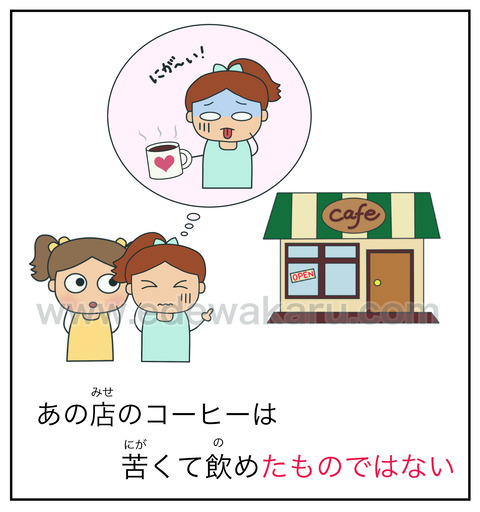
①あそこのコーヒーは苦くて飲め
たもんじゃない
②こんな辛いカレー、食べられ
たもんじゃない
③古本なんて汚くて読めた
もんじゃない
There are many sentence patterns containing “もの” (review: the “もの” series), so do your best to learn to distinguish them. 😉
In context 3 examples
あの店のコーヒーは苦くて飲めたものではない
→あの店のコーヒーは苦くて絶対に飲めないThe coffee at that shop is so bitter that it’s absolutely undrinkable. →The coffee at that shop is so bitter that I absolutely can’t drink it.
こんな辛いカレー、食べられたものではない
→こんなに辛いカレーは絶対に食べられないThis curry is so spicy that it’s absolutely inedible. →This curry is so spicy that I absolutely can’t eat it.
古本なんて汚くて読めたものではない
→古本なんて汚くて絶対に読めないUsed books are so dirty that they’re absolutely unreadable. →Used books are so dirty that I absolutely can’t read them.
Read the original source text
Meaning
絶対〜できない
〜するのは不可能だ
How to use it
動詞[可能形のた形]+ものではない
Explanation
「〜たものではない」は可能形・可能表現(できる・わかるなど)の[た形]について「絶対に〜できない」という意味を表す文型です
😊これはマイナスのことにしか使われず、「〜するのは不可能だ」と
否定の気持ちを強調するのに使用されます
😀
【補足説明】
ほとんどの場合話し言葉で使われる文型で、友達や家族との会話では
「〜もんじゃない」
と口語形が使われることもあります😮
[例]
①あそこのコーヒーは苦くて飲め
たもんじゃない
②こんな辛いカレー、食べられ
たもんじゃない
③古本なんて汚くて読めた
もんじゃない
「もの」がつく文型(復習:「もの」シリーズ)はたくさんありますので、区別して覚えられるようにがんばってくださいね😉
日本語NET JLPT文法解説まとめ
Meaning
Far too ~ to do; absolutely cannot ~
How to use it
V(た-form) + ものではない
Explanation
“cannot possibly ~.”
Expresses a strong negative feeling that something is impossible.
The casual way of saying it is 「〜たもんじゃない」.
In context 4 examples
こんな料理、お客さんに出せたもんじゃないよ。もっと練習しなさい。
This kind of food is no fit to serve to customers. Practice more.
このジュースは健康に良いようで、最近人気があるが、酸っぱすぎて飲めたものではない。
This juice seems healthy and has been popular lately, but it's far too sour to drink.
舞台俳優志望だと言うから、見てみたものの、演技は相当ひどく、正直見れたものではない。
He said he wanted to be a stage actor, so I watched him, but his acting was really terrible—honestly, it was unwatchable.
海外旅行中に強盗に財布やらパスポートやら全部盗られて、どうしようもない状況だったけど、親切な人が助けてくれたんだ。本当、あの時は世の中捨てたもんじゃないなあと思ったよ。
While I was traveling abroad, robbers stole everything, including my wallet and passport, and I was in a desperate situation, but a kind person helped me. Honestly, at that time I thought, “The world isn't such a bad place after all.”
Read the original source text
Meaning
とても〜できない
How to use it
V(タ形) + ものではない
Explanation
"cannot possibly ~."
Expresses a strong negative feeling that something is impossible.
「カジュアル」な言い方は「〜たもんじゃない」
毎日のんびり日本語教師
How to use it
Verb potential form, ta-form + ものではない
Potential verb, ta-form + ものではない
Explanation
This grammar emphasizes that something is impossible. Expressions such as “到底” (“by any means”) may accompany it.
The colloquial form is “~たもんじゃない.”
It is used when expressing a negative evaluation of something.
Notes
Similar grammar: “【N2 Grammar】~ものではない”
Similar grammar: “【N0 Grammar】~たものでもない”
Similar grammar: “【N0 Grammar】~ないものでもない”
In context 9 examples
文才がないので、小説なんて書けたものではない。
I have no talent for writing, so there's no way I could write a novel.
主演を務めた俳優の演技がひどすぎて、この映画は観れたもんじゃない。
The lead actor's performance was so awful that this movie is unwatchable.
このヨーグルト腐ってるのか、酸っぱくて食べられたものではない。
Maybe this yogurt has gone bad; it's so sour that it's impossible to eat.
初めて飲んだビールはとても苦くて到底飲めたものではなかった。
The first beer I ever drank was so bitter that I couldn't possibly drink it.
ここには無料のWi-Fiがあるけど、回線遅すぎて使えたもんじゃない。
There's free Wi-Fi here, but the connection is so slow that it's unusable.
私も良く夜更かしをするので、人に夜更かしするなとは言えたものではない。
I often stay up late too, so I have no room to tell other people not to.
この辺りの夏は暑すぎて、暑がりは住めたものではない。
Summers around here are so hot that anyone who gets hot easily couldn't possibly live here.
ここはうるさすぎて、集中なんかできたものではない。
It's so noisy here that there's no way I can concentrate.
彼の技術はとてもじゃないが真似できたものではない。
There's no way anyone could imitate his technique.
Read the original source text
How to use it
動可能形のた形+ものではない
可能系動詞のた形+ものではない
Explanation
不可能であることを強調する文法です。「到底」などが呼応することがあります。
口語は「~たもんじゃない」です。
物事に対するマイナスの評価をするときに用いられます。
Notes
似ている文法「【N2文法】~ものではない」
似ている文法「【N0文法】~たものでもない」
似ている文法「【N0文法】~ないものでもない」