絵でわかる日本語
Meaning
Because 〜 / since 〜
How to use it
Verb / adjective / noun [plain form] + もの
* The present affirmative form of な-adjectives and nouns is “ーだもの” (Examples: きれいだもの・学生だもの)
Verb / adjective / noun [plain form] + んだもの
* The present affirmative form of な-adjectives and nouns is “ーなんだもの” (Examples: きれいなんだもの・学生なんだもの)
Explanation
“〜もの” and “〜んだもの” are sentence patterns that express [cause / reason] and mean “〜から・〜ので.” In general, “〜もの・〜んだもの” is used by women. “〜もん” and “〜んだもん” are colloquial forms used by both men and women, and are often used by children too. They are used in conversations with friends and family. “〜もの・〜んだもの” and “〜もん・〜んだもん” are often used together with “だって” or “なんで.”
There are many sentence patterns with “もの,” so review them 😉
[List of patterns that include “もの”]
In context 6 examples
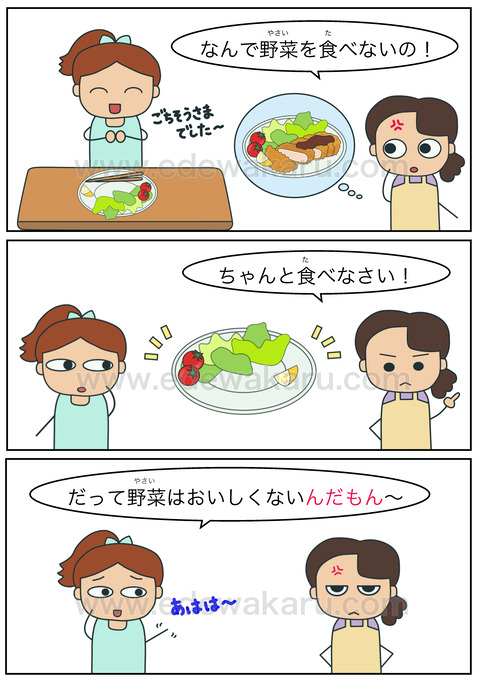
母:なんで野菜を食べないの!?ちゃんと食べなさい娘:だっておいしくないんだもん
Mother: Why aren’t you eating your vegetables?! Eat them properly. Daughter: But they don’t taste good!
A:どうして遅刻したの?B:電車が遅れていたんだもの
A: Why were you late? B: Because the train was delayed.
彼氏:あの映画を見に行こうよ!彼女:嫌よ。だって、こわい映画は嫌いだもの
Boyfriend: Let’s go see that movie! Girlfriend: No. Because I don’t like scary movies.
A:えっ、そんなにたくさん買ったの?B:うん。すごく安かったんだもの
A: Huh, you bought that much? B: Yeah. Because it was really cheap.
A:ラーメンを3杯も食べたの!?B:だってお腹がぺこぺこだったんだもん
A: You ate three bowls of ramen?! B: But I was starving!
A:なんで食べないの?B:だって、このカレーは辛すぎるもん
A: Why aren’t you eating? B: But this curry is too spicy.
Read the original source text
Meaning
〜ので ・〜から
How to use it
動詞・形容詞・名詞[普通形]+もの
*な形容詞・名詞の現在肯定形は「ーだもの」(例:きれいだもの・学生だもの)
動詞・形容詞・名詞[普通形]+んだもの
*な形容詞・名詞の現在肯定形は「ーなんだもの」(例:きれいなんだもの・学生なんだもの)
Explanation
「〜もの」「〜んだもの」は[原因・理由]を表す文型で、「〜から・〜ので」という意味です。一般的に「〜もの・〜んだもの」は、女性が使用します。「
〜もん」「
〜んだもん」は話し言葉で男性にも女性も使われ、子供もよく使います。 友達や家族との会話で使われます。「〜もの・〜んだもの」「〜もん・〜んだもん」は、「
だって」や「
なんで」とよく一緒に使われます。
「もの」がつく文型は、たくさんありますので復習しておきましょう😉
【「もの」がつく文型リスト】
NINJAL 日本語文型データベース
Meaning
This is used to give a reason for something from a personal point of view. It is often used to assert that something is justified because one cannot change the situation and there is nothing to be done about it. It is also used to express empathy by giving a reason that supports what the other person has said.
This is the phonetically changed form of 「〜もの」.
How to use it
Ⅴ普通形+もん
i-A普通形+もん
na-A普通形+もん
N普通形+もん
その他
Notes
It is often used at the end of a sentence in the form 「〜もん。」. Usually, it gives a reason for what was said in the preceding sentence. It can also be used not at the end of a sentence, with a claim based on 「〜」 following 「〜もん、」.
It is also often used with 「〜んだ」 attached, in the form 「〜んだもん」.
「〜もんね」 is often used to give a reason expressing empathy with what the other person has said.
Young people often use it.
In context 24 examples
漢字なんか書けなくてもいいよね。スマホが変換してくれるもん。
It's okay if you can't write kanji and such. Your smartphone converts it for you, after all.
この靴、もう捨てちゃおうかな。もう履かないもん。
Maybe I'll just throw these shoes away. I won't wear them anymore, after all.
「バイトして、このタブレット買ったんだ」「ああ、前から欲しいって言ってたもんね」
“I worked part-time and bought this tablet.” “Oh, you said you've wanted one for a long time.”
「明日、漢字のテストないよね」「ないよ。だって、先生何も言わなかったもん」
“There isn't a kanji test tomorrow, right?” “No. The teacher didn't say anything, after all.”
「できるなら外に出たくないよね」「ほんと。毎日暑いもんね」
“If we could, we wouldn't want to go outside, right?” “Seriously. It's hot every day, after all.”
「企画部の藤田さんは人気者だよね」「だって、話がうまくて面白いもん」
“Fujita from the Planning Department is popular, isn't she?” “Well, she's good at talking and funny, after all.”
母「こら、健、真里に謝りなさい」健「嫌だ。だって僕、悪くないもん」
Mother: “Hey, Ken, apologize to Mari.” Ken: “No. I won't, because I didn't do anything wrong.”
「あのジェットコースター、また乗りたい?」「もちろん。スリルがあってすごかったもん」
“Do you want to ride that roller coaster again?” “Of course. It was thrilling and amazing, after all.”
「このお寿司、わさびが付いているけど大丈夫だった?」「うん、そんなに辛くなかったもん」
“This sushi has wasabi on it. Were you okay with that?” “Yeah, it wasn't that spicy, after all.”
「美大の合格を目指してデッサンの練習してるんだね」「そうだよ。なんと言っても実技が重要だもん」
“You're practicing drawing to get into art school, aren't you?” “That's right. Above all, the practical exam is important.”
「ゆかりはいい成績じゃなかったみたい」「そうだろうな。レポートを読ませてもらったけど、あんまり論理的じゃなかったもん」
“It seems Yukari didn't get good grades.” “I guess not. I got to read her report, and it wasn't very logical, after all.”
娘「この俳優、素敵だね」母「そうでしょう。若い頃から落ち着いてて知的だったもん」
Daughter: “This actor is wonderful.” Mother: “Isn't he? He was calm and intelligent even when he was young.”
「お父さんは好きじゃない。昔からお母さんには優しかったけど、子どもに対しては寛大じゃなかったもん」
“I don't like my father. He's always been kind to my mother, but he wasn't understanding toward his children.”
「レイナちゃんは英語が上手なんだね」「だって、パパがアメリカ人だもん」
“Reina is good at English, isn't she?” “Well, her dad is American, after all.”
夫「ねえ、靴下どこ?」妻「知りませんよ。私、あなたのお母さんじゃないもん」
Husband: “Hey, where are my socks?” Wife: “How should I know? I'm not your mother, after all.”
「もう、宿題できたの?」「うん、簡単な問題だったもん」
“Are you done with your homework already?” “Yeah, the problems were easy, after all.”
「昨日は台風の影響ですごい風だったね。会社行けた?」「行けたよ。だって電車は運休じゃなかったもん」
“The wind was really strong yesterday because of the typhoon. Were you able to get to work?” “Yeah. The trains weren't suspended, after all.”
「ママが初めて海外に行ったときは大変だったんでしょう?」「そうだよ。今みたいにインターネットでいろんな情報が手に入る時代じゃなかったもん」
“It must have been hard when you first went abroad, Mom?” “It was. It wasn't an era when you could get all kinds of information on the internet like you can now.”
母「まだ、起きてるの、早く寝なさい!」子「だって、パパがもうすぐ帰ってくるんだもん」
Mother: “You're still awake? Go to bed early!” Child: “But Dad will be home soon.”
親「またけんかしてる。だめでしょ!」子「だって、お兄ちゃんが僕のおもちゃ、取ったんだもん」
Parent: “You're fighting again. Cut it out!” Child: “But my big brother took my toy.”
親「今日も学校、休むの?」子「だって、体調が悪いんだもん」
Parent: “Are you skipping school again today?” Child: “But I don't feel well.”
先生「どうして、席替わったの?」子ども「だって、隣のリョウ君がうるさかったんだもん」
Teacher: “Why did you change seats?” Child: “Because Ryo-kun, who was sitting next to me, was noisy.”
「ねえ、映画でも見に行こうよ。家にいても退屈なんだもん」「わかった。午後から出かけよう」
“Hey, let's go see a movie or something. I'm bored at home.” “Okay. Let's go out this afternoon.”
母「何してるの? 早くご飯食べなさい」子「だって、私の好きなおかずじゃないんだもん」
Mother: “What are you doing? Hurry up and eat.” Child: “But it's not one of my favorite dishes.”
Read the original source text
Meaning
個人的な観点で物事の理由づけを言うときに使います。自分では状況を変えられず、しかたがないという意味で正当性を主張するときに使うことが多いです。また、相手の発言を支える理由づけを示すことで共感を表すときにも使います。
「〜もの」が音声的に変化した形です。
How to use it
Ⅴ普通形+もん
i-A普通形+もん
na-A普通形+もん
N普通形+もん
その他
Notes
「〜もん。」の形で文末に使うことが多いです。ふつう「〜もん。」の前の文のことについての理由づけを述べます。また、文末に使うのではなく、「〜もん、」の後に、「〜」を理由とする主張を述べることもあります。
「〜んだ」をつけて「〜んだもん」の形でもよく使います。
相手の話に共感する理由づけを示すときは「〜もんね」をよく使います。
若い人がよく使います。