AIUEO JLPT Grammar
Meaning
This sentence pattern indicates that actions or thoughts are carried out in accordance with standards, rules, or circumstances. It is used to show that behavior is aligned with specific criteria.
How to use it
Noun + に即して; noun + に即した; noun + に則して; noun + に則した
In context 5 examples
現実に即して計画を立てるべきだ。
We should make plans based on the reality.
法律に則して、すべての手続きが行われます。
All procedures will be carried out in accordance with the law.
規則に則した行動を取らなければならない。
We must act in accordance with the rules.
学校の規則に則し、罰則が決定される。
The penalties will be decided in accordance with the school’s rules.
この状況に即した適切な対応が必要だ。
Appropriate action based on this situation is necessary.
Read the original source text
Meaning
This sentence pattern indicates that actions or thoughts are carried out in accordance with standards, rules, or circumstances. It is used to show that behavior is aligned with specific criteria.
How to use it
名詞に+即して名詞に+即した名詞に+則して名詞に+則した
Explanation · 日本語
この文型は、何かが基準やルール、または状況に従って行われることを表す表現で、行動や考え方が特定の基準に合わせて実行されることを示すときに使われます。
文法
Meaning
In accordance with ~ / following ~ / using ~ as a standard
Expresses that the preceding word serves as the standard.
How to use it
N + に即して
N + に則して
Notes
[Commonly used words]
Facts, reality, actual circumstances, situation, rules
When attached to a situation, experience, etc., 即して is used; when attached to laws, rules, etc., 則して is used.
In context 4 examples
最近は事実に即した報道をしていないマスメディアが増えてきたように思う。
I feel that the number of mass media outlets that don't report in line with the facts has been increasing lately.
実際に即した改善案を提示していただけないと、現場はますます混乱する一方だ。
Unless you present improvement proposals that reflect the actual situation, things on the ground will only become more and more chaotic.
学校の規則に則して、髪は黒にしなければならない。
In accordance with school rules, our hair must be black.
車に乗る人は当然、交通ルールに則して運転しなければならないわけだが、一時停止を忘れたり、スピード違反をしたり、ルールを守らない人が多い。
People who drive, of course, must drive in accordance with traffic rules, but many people forget to stop at stop signs, speed, or otherwise fail to follow the rules.
Read the original source text
Meaning
〜とおりに / 〜に従って / 〜を基準に 前に来る語が基準となるということを表す。
How to use it
N + に即して
N + に則して
Notes
[よく使われる語]
事実、現実、実際、状況、規則
状況・経験などに付く場合は「即して」、法律・規則などに付く場合は「則して」となる
Bunpro Grammar Reference
Meaning
In line with, Based on, In accordance with
How to use it
Noun + に即し(1)(て)
Noun + に即した(1) + Noun
(1) に則した
Nuance
A formal construction, used when something in accordance with (A). In correspondence with (A), (B).
Explanation
に即して is a formal grammar structure which is used to express that something is being done for the purpose of handling a matter in the best possible way. It is a combination of に, and the する-verb 即する 'in accordance with (A)', ' in line with (A)' in its て-form. Occasionally, に則して 'in following with' will be used instead.
This structure will be used before nouns, or may be used when one noun is directly modifying another. In the case of the latter, に即した will be used instead of に即して.
会社のルールに即して、副業をしてはいけない。
In line with the company's rules, you may not work a second job.
あの監督はちゃんと事実に即して映画を作るから、映画を見るだけでいろいろなことが学べる。
That director makes his films in accordance with the facts, so you can learn a lot just by watching his films.
法律に則した勤務時間は週40時間にも関わらず、あの会社は社員に週70時間働かせている。
Work hours in line with the law is 40 hours a week, but that company makes its worker work 70 hours a week.
外国人であろうと、日本にいる限り、日本の法律に則した罰が与えられます。
No matter if you are a foreigner, as long as you are in Japan, you will be punished in line with Japanese law.
Caution
に即して is used when things are being done based on circumstances or situations, while に沿って tends to be used when something is being done in accordance with laws, policies, or standards. There are situations where に沿って will be incorrect, so に即して is often used in both cases in recent years.
この計画は現実に則していません。
This plan does not follow with reality. (Unnatural Japanese)
In context 18 examples
- 映画は実情に即して制作されたものだ。
The movie was made in line with actual circumstances.
- 法律に則した勤務時間は週40時間にも関わらず、あの会社は社員に週70時間働かせている。
Work hours in line with the law is 40 hours a week, but that company makes its worker work 70 hours a week.
- 会社のルールに即して、副業をしてはいけない。
In line with the company's rules, you may not work a second job.
- あの監督はちゃんと事実に即して映画を作るから、映画を見るだけでいろいろなことが学べる。
That director makes his films in accordance with the facts, so you can learn a lot just by watching his films.
- 外国人であろうと、日本にいる限り、日本の法律に則した罰が与えられます。
No matter if you are a foreigner, as long as you are in Japan, you will be punished in line with Japanese law.
- 経済状況に即して課税を調整する必要がある。
There is a need to adjust taxes in line with the economic condition.
- 役職に関わらず、ルールに即して平等に罰せられるべきだ。
Regardless of position, punishment ought to be given equally, in line with the rules.
- 現実に即して撮られたホラー系のドキュメンタリーほど怖いものはありません。
There is nothing scarier than horror documentaries that are shot based on true events.
- McRonald社とSFC(エスエフシー)社との抗争は現地の法律に即して処理される。
The dispute between McRonald and SFC will be handled in line with local law.
- 請願書は方針に則して担当大臣に提出しなければならない。
The petition must be submitted to the minister in charge, in line with the policy.
- 古い慣習に縛られずに,時代に即した法律を制定すべきである。
The law that is in line with the time should be established without being bound to old-fashioned customs.
- 会社方針に則した費用補償は30日以内にお支払いいたします。
We will pay cost compensation that is in line with company policy within 30 days.
- 今の時代に即して会社の方針を定めないと、社会から取り残されてしまうだろう。
If we don’t determine the company policies in line with the current generation, I dare say we’ll be left behind by society.
- 学校の規則に即して毎日同じ髪型、同じ制服で登校していた頃には戻りたくありません。
I don’t want to go back to the time where I had to go to school with the same uniform and the same hair every day, in line with the school regulations.
- カーナビ:「ここで音声によるガイドは終了します。ここからも交通ルールに即して運転をして下さい。」
Car navigation: ‘Voice guidance will now stop. Please continue to drive in accordance with the traffic rules.’
- 事実に即して報道するのがマスコミの仕事なのに、その会社が流す情報ときたらデタラメばっかりだ。
Despite delivering information in line with the truth being the job of mass media, that damned information that that company lets loose is nothing but garbage.
- 夢物語を語るのは確かに楽しいけどさ、もっと現実に即してあらゆる事を考えないと生きていけないよ?
Speaking about wild dreams is indeed fun, but if you don’t think about everything more in line with reality, you won’t be able to live, you know?
- この計画は現実に則していません。
This plan does not follow with reality. (Unnatural Japanese)
どんなときどう使う 日本語表現文型辞典
Meaning
in conformance with
How to use it
N + に即してW
Explanation
~に従って
1)そのことが基準になるという意味。事実や、規範を表す名詞につく。
2)後に名詞が来る場合は ❸ のように「に即したN」という形になる。
2)When followed by a noun, becomes に即した N, as in sentence ❸ .
1)Appends to nouns expressing adherence to facts or standards to express conformance to certain criteria.
In context 3 examples
試験中の不正行為は、校則に即して処理する。
Cheating during exams will be dealt with in accordance with the school rules.
大会の開会式はスケジュール表に即して1分の狂いもなく行われた。
The opening ceremony of the tournament was held according to the schedule, without being a minute off.
非常事態でも、人道に即した行動が取れるようになりたい。
Even in an emergency, I want to be able to act in accordance with humanitarian principles.
Read the original source text
Meaning
in conformance with
How to use it
N+に即してW
Explanation
~に従って
1)そのことが基準になるという意味。事実や、規範を表す名詞につく。
2)後に名詞が来る場合は ❸ のように「に即したN」という形になる。
2)When followed by a noun, becomes に即した N, as in sentence ❸ .
1)Appends to nouns expressing adherence to facts or standards to express conformance to certain criteria.
絵でわかる日本語
Meaning
〜according to; 〜in line with
How to use it
Noun [dictionary form] + に即して・〜に則して
Noun [dictionary form] + に即した・に則した + noun
Explanation
“〜に即して・〜に則して” is a grammar pattern meaning “according to” or “in line with.” When talking about facts or experience, use “〜に即して”; when referring to laws or regulations, use “〜に則して.” When used with a noun, the forms are:
“〜に即した + noun” and “〜に則した + noun.”
[Example]
We should adopt a way of thinking that is
in keeping with the times.
Let’s review some grammar patterns similar to “〜に即して・〜に則して” 😊
[Related articles]
In context 4 examples
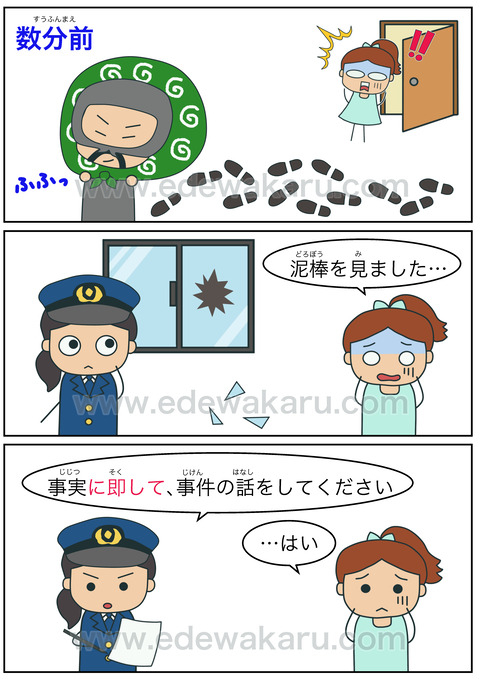
警察:事実に即して、事件の話をしてください
→事実の通りに、事件の話をしてくださいPolice officer: Tell us about the incident in accordance with the facts. →Tell us about the incident as it happened.
時代に即して、習慣や考え方を変えていくべきだと思う
→時代に合わせて、習慣や考え方を変えていくべきだと思うI think we should change our customs and ways of thinking to keep up with the times. →I think we should change our customs and ways of thinking to suit the times.
経験に即して言うと、留学した意味はすごく大きいと思う
→経験した通りに言うと、留学した意味はすごく大きいと思うSpeaking from experience, I think studying abroad was very meaningful. →Speaking as things happened, I think studying abroad was very meaningful.
学校の規則に則して、決められた制服を着なければいけない
→学校の規則通りに、決められた制服を着なければいけないIn accordance with school regulations, we have to wear the designated uniform. →We have to wear the designated uniform according to school regulations.
Read the original source text
Meaning
〜の通りに
〜に合わせて
How to use it
名詞[辞書形]+に即して・〜に則して
名詞[辞書形]+に即した・に則した+名詞
Explanation
「〜に即して・〜に則して」は「〜の通りに」「〜に合わせて」という意味の文型です。事実や経験について言う時は「〜に即して」になり、法律や規則に関することに使う場合は「〜に則して」になります。名詞と使用する場合は
「〜に即した+名詞」「〜に則した+名詞」
になります。
[例]
時代
に即した
考え方をするべきだ
「〜に即して・〜に則して」に似ている文型を復習しておきましょう😊
【関連記事】
くらべてわかる日本語表現文型辞典
Meaning
B is based on A and takes it into account.
How to use it
Aに即してB (Aに即したB)
[Noun – ∅] に即して
Explanation
【Contrast 1】
“AにそってB” (Meaning 2, p. 243)
In context 4 examples
阪神大震災の記録に即して、地震対策のマニュアルが作成された。
A manual for earthquake preparedness was created based on the records of the Great Hanshin Earthquake.
現状に即した予算編成に切り替えるべきだ。
We should switch to budget planning based on the current situation.
この問題を自分の身に即して考えてみた。
I tried considering this issue in terms of my own situation.
本文の内容に即したタイトルがついていればわかりやすい。
It would be easier to understand if it had a title that reflected the contents of the main text.
Read the original source text
Meaning
Aを踏まえて、それに合わせる形でB。
How to use it
Aに即してB(Aに即したB)
[名詞-∅]に即して
Explanation
【対比1】
「AにそってB」(意味2 P.243)
日本語NET JLPT文法解説まとめ
Meaning
“As ~ says / in accordance with ~ / based on ~”
Indicates that the preceding word serves as a standard.
How to use it
N + に即して
N + に則して
Explanation
“In accordance with / based on / in line with.”
Used to indicate that something is in accordance with, or based on, a particular standard, principle, or guideline.
When attached to a situation or experience, use 「即して」; when attached to laws or rules, use 「則して」.
In context 4 examples
最近は事実に即した報道をしていないマスメディアが増えてきたように思う。
I feel that the number of mass media outlets that don't report in line with the facts has been increasing lately.
実際に即した改善案を提示していただけないと、現場はますます混乱する一方だ。
Unless you present improvement proposals that reflect the actual situation, things on the ground will only become more and more chaotic.
学校の規則に則して、髪は黒にしなければならない。
In accordance with school rules, our hair must be black.
車に乗る人は当然、交通ルールに則して運転しなければならないわけだが、一時停止を忘れたり、スピード違反をしたり、ルールを守らない人が多い。
People who drive, of course, must drive in accordance with traffic rules, but many people forget to stop at stop signs, speed, or otherwise fail to follow the rules.
Read the original source text
Meaning
"〜とおりに / 〜に従って / 〜を基準に "
前に来る語が基準となるということを表す。
How to use it
N + に即して
N + に則して
Explanation
"in accordance with / based on / in line with."
Used to indicate that something is in accordance with, or based on, a particular standard, principle, or guideline.
状況・経験などに付く場合は「即して」、法律・規則などに付く場合は「則して」となる
毎日のんびり日本語教師
How to use it
Noun + に即して
Noun + に即した + Noun
Explanation
Indicates the basis or standard for an action.
Attaches to nouns that indicate a standard, such as a situation, fact, reality, experience, or rule.
It carries the nuance of referring to something exactly as it is, without making any changes.
It derives from the verb 「即する」.
Notes
Reference-based grammar
In context 12 examples
現実に即した政策が実行されることを期待する。(期待实行实事求是的政策。)
I hope that policies based on reality will be implemented. (I hope that realistic policies will be implemented.)
新聞・ニュース等各種メディアは事実に即して報道しなければならない。
Newspapers, news programs, and other media must report in accordance with the facts.
実状に即して考えよう。
Let's think in light of the actual situation.
このドラマはしっかりと現実に即して作られている。
This drama is made firmly based on reality.
時代は変わってきているのだから、法律も習慣も考え方も、その時代に即したものに変えていくべきだろう。
Since the times are changing, laws, customs, and ways of thinking should also be changed to suit the times.
各自治体ごとに課題は異なるため、その実態に即した戦略が必要である。
Since each local government faces different challenges, strategies suited to the actual conditions are necessary.
ただ発展させればいいというものではなく、その地域に即した発展を模索しなければならない。
It's not enough just to promote development; we must seek development suited to that region.
ここでは宗教の多様性に配慮し、各文化に即した料理を提供している。
Here, we take religious diversity into consideration and serve food suited to each culture.
現実に即した議論をするためには、正確な情報は欠かせない。
Accurate information is essential for having a discussion grounded in reality.
サイトを作る、ゲームを作るなど、やりたいことがあるならそれに即したプログラミング言語を学ぶ必要がある。
If you have something you want to do, such as build a website or make a game, you need to learn a programming language suited to it.
このやり方は今の時代に即していない。
This approach is not suited to the times we live in.
法律は時代に即して変えていくべきだ。
Laws should be changed in keeping with the times.
Read the original source text
How to use it
名詞+に即して
名詞+に即した+名詞
Explanation
行動の根拠、行動の基準となるものを表します。
状況、事実、現実、経験、規則などの基準を表す名詞に接続します。
そのままそっくり手を加えずに参照するというニュアンスを持ちます。
語源は動詞「即する」です。
Notes
参照系の文法
NINJAL 日本語文型データベース
Usage 1
Meaning
Used when you want to say that you do something in accordance with ~ or closely align it with ~.
How to use it
Nに即して
Notes
“~” is preceded by a word referring to an unchanging truth or norm, such as “facts,” “current conditions,” “actual circumstances,” “humanity,” “law,” or “standards.” After “~に即して・~に則して,” a sentence describing handling something in a way that aligns with “~” follows.
It is generally written as “~に即して,” but when “~” refers to a law, standard, rule, or the like, it is written as “~に則して.”
In context 4 examples
この歴史小説では、登場人物の性格が史実に即して細かく描写されている。
In this historical novel, the characters’ personalities are depicted in detail based on historical facts.
医師は患者の病態に即して、可能な限り有効な治療法を考える必要がある。
Doctors need to consider the most effective treatment possible in accordance with the patient’s medical condition.
人手不足の昨今、かつて24時間営業が当たり前だったコンビニも、実情に即して営業時間を短縮するところが増えている。
With labor shortages these days, more convenience stores—which once routinely operated 24 hours a day—are shortening their hours to reflect actual circumstances.
企業は、勤務条件を法律に則して定めなければならない。
Companies must establish working conditions in accordance with the law.
Read the original source text
Meaning
~にしたがって、または~にしっかり合わせて、何かをすると言いたいときに使います。
How to use it
Nに即して
Notes
「~」には「事実・現状・実情・人道・法律・規範」など、揺らがない真実や規範を意味する言葉がきます。「〜に即して・〜に則して」の後には、「~」に合わせた処理をするという意味の文がきます。
一般的には「~に即して」と書きますが、「~」が法律や規範、規則などの場合、「~に則して」と書きます。
Usage 2
Meaning
Used when you want to say that you do something in accordance with ~ or closely align it with ~.
How to use it
Nに即し
Notes
“~” is preceded by a word referring to an unchanging truth or norm, such as “facts,” “current conditions,” “actual circumstances,” “humanity,” “law,” or “standards.” After “〜に即し・〜に則し,” a sentence describing handling something in a way that aligns with “~” follows.
It is generally written as “~に即し,” but when “~” refers to a law, standard, rule, or the like, it is written as “~に則し.”
In context 5 examples
今後、介護福祉事業所は、利用者のニーズに即し、様々な形のサービスを提供するようになるだろう。
Going forward, care and welfare providers will likely offer services in a variety of forms tailored to users’ needs.
自治体は、魅力ある農業を展開するため、地域の実態に即し、独自の地産地消のシステムを考えていく必要がある。
To develop attractive agriculture, municipalities need to devise their own local production for local consumption systems based on the actual conditions in their regions.
この哲学書の翻訳は、原文に即し忠実に訳そうとするあまり、かえって分かりにくくなってしまっている。
This translation of the philosophy book has become harder to understand because the translator tried so hard to translate faithfully in accordance with the original text.
本研究は、現在における若者の職業意識の実態を、データに即し明らかにすることを目的とする。
The aim of this study is to clarify the actual state of young people’s attitudes toward work today based on data.
自転車で違反行為を行った者も、道路交通法に則し処分されることとなった。
People who commit traffic violations on bicycles will also be subject to penalties in accordance with the Road Traffic Act.
Read the original source text
Meaning
~にしたがって、または~にしっかり合わせて、何かをすると言いたいときに使います。
How to use it
Nに即し
Notes
「~」には「事実・現状・実情・人道・法律・規範」など、揺らがない真実や規範を意味する言葉がきます。「〜に即し・〜に則し」の後には、「~」に合わせた処理をするという意味の文がきます。
一般的には「~に即し」と書きますが、「~」が法律や規範、規則などの場合、「~に則し」と書きます。
IMABI
Based on
Read this IMABI lesson ↗Explanation
Based on: に基づいて、を踏まえて, をもとにして, に沿って, に即して, & に則って
These phrases are definitely very similar to each other, but as you will see during the compare and contrast sections of this lesson, there are important differences to keep in mind.
~に基づいて
~に基づいて means “based on.” Its attribute form may either be ~に基づいての or ~に基づいた. Broadly speaking, there are two main usages of Xに基づいてY. The first is “without deterring from a standard/criterion/norm/rule/law X, one carries out/executes an action Y.” The other, which is found primarily in the written language, is “having A as a basis/foundation/modal/example/pattern/reference, one does/makes a decision B.”
1. 事実に基づいた記述きじゅつをする。
Describe on the basis of reality.
2. 彼女の議論は確かに証拠しょうこに基もとづいていなかった。
Her argument was certainly not on the basis of evidence.
3. 明らかなことに基づいた議論の余地よちのない事実。
Unarguable facts based on obvious things.
4. このマニュアルに基づいて操作します。
I will operate it based on this manual.
5. 規則に基づいて処理する。
To process according to regulations.
6. さっきの例文に基づいた、もっと複雑なものです。
These are more complicated ones based off of the previous example sentences.
7. 証拠に基づいて、加害者かがいしゃに死刑しけいを言い渡わたした。
In line with the evidence, the assailant was sentenced to death.
Variant Note: ~に基づいて may also be ~に基づき in stiffer writing.
Grammar Note: For the attribute form, ~に基づいての must only be used when what it precedes is a standard of some sort. If it is not, you must use ~に基づいた instead.
を踏まえて
The 一段 verb 踏まえる means “to be based on”. So, ~を踏まえて means “on the basis of” just like ~に基づいて. It can also be seen as ~を踏まえ in the written language. Its attribute form may either be ~を踏まえての or ~を踏まえた. As its original literal meaning is “to tread on” in a defensive posture, it is used after words that can show a basis/foundation/precedent for something. Again, it cannot follow material for reference as a standard. Rather, it must follow an extant basis. This pattern is usually seen in the written language and finds itself in news reports all the time.
8. 自分の経験を踏まえてこういう。
To say such based on one’s own experience.
9. これまでの状況を踏まえて得た最終結論です。
This is the last argument gotten based on the conditions up to now.
10. 報告を{踏まえた・踏まえての}処理
Processing based on the report
Translation Note: 踏まえる may also mean “to tread”.
11. 両足で大地を{踏まえて・踏んで}立って!
Tread on the ground with both your legs and stand!
~をもとにして
~をもとにして is used to show that one bases off of the good qualities of something. It does not necessarily have to be 100% congruent with the full truth in the circumstances. It shows willful change, and it is usually shortened in the spoken language to ~をもとに. When this pattern happens to be used as an attribute, it becomes ~をもとにした.
12. 私は親譲おやゆずりの財産をもとにして富とみを作りました。
I built my wealth on the fortune from my father.
13. 嘘うそをもとにして行おこなう。
To act upon a lie.
14. 事実を基にして書かれた劇だ。
It is a play written on the basis of the truth.
漢字 Note: Although this pattern is used both in the spoken and written language, when もと is written in 漢字, you have the options 基, 本, 素, 原, 源, 元, and 下. Thus, the meaning of this expression can be further refined. The first refers to a standard. The second refers to the foundation of something. The third refers to the subject matter. The fourth refers to raw materials. The fifth refers to a source. The sixth refers to the original way. The seventh refers to being under an influence. However, most natives cannot distinguish this well, and this is only knowledge relevant for when reading through literature.
~に沿って & More
~に沿って
~に沿って is used in a physical or cause and effect sense. It can also be seen as ~に沿い is stiff writing, but even here it is considerably rare. The attribute forms ~に沿った and ~に沿っての are slightly different. The former can be used when A fits nicely with B, but there can be some deviance. However, there can be no such deviance with the latter.
15. 時勢じせいに沿って生きる。
To live in consonance of the times.
16. 土手に沿って、苔こけが生えている。
Moss is growing along the embankment.
17. 事実に沿って、話しをしてくださいますか。
Could you please talk along the facts (of the case)?
18. 湖に{〇 沿った・X 沿っての}公園を歩きました。
I walked through the park that’s alongside the lake.
19. 事業計画に{沿った・沿っての}実施状況じっしじょうきょう
The status of implementation along the business plan
20. 僕は川に沿って歩いた。
I walked along the river.
Variant Note: ~に沿って may be replaced by the suffixes ~沿ぞい and ~伝づたい in the physical sense.
21. 軒のきづたいに倉庫そうこの裏に廻って行った。
Along the eaves, I went around the back of the storehouse.
22. 川伝いに走り回る。
To run around along the river.
23. 湖畔こはん沿いの道路を歩く。
To walk through the street alongside the lake shore.
24. 流れに沿うてやがて広野に出ると、頂上ちょうじょうは面白く切り刻きざんだようで、そこからゆるやかに美しい斜線しゃせんが遠い裾すそまで伸びている山の端はに月が色づいた。野末のずえにただ一つの眺めである、その山の全まったき姿を、淡い夕映えの空がくっきりと濃深縹色ふかはなだいろに描き出した。
Along the stream, when we at last entered the wide, the moon changed colors in the edge of the mountain, which had a gently beautiful slant with the peak interestingly cutting it that stretched to the far base of the mountain. The light sunset sky sharply drew the perfect view of the mountain for the single view at the corner of the field a light yet deep indigo.
From 雪国 by 川端康成.
漢字 Note: The spellings 添う・副う exist. The first is seen with the sense of “addition” and the latter is seen with the sense of “expectation/satisfaction”.
25. 身に添った悲しみ
The sadness on oneself
26. 花が期待に副って見事に咲いたよ。
The flowers bloomed splendidly to my expectations.
~に即して
~に即して is reserved to writing and often very stiff. If used in the spoken language, it is very formal or official sounding. It is frequently used to show that something is based on/along things. In even more formal writing, it can be seen as ~に即し.
27. 時代に即した教育
Education according to the times
28. 事実に即したドラマ
A drama in accordance with the facts
29. 法律に即した判断
A decision in accordance with the law
30. 理念に即した行動
Actions in accordance to an ideal
Spelling Note: As for spelling そくして, when the situation is based off of a given fact or observation you use 即して. However, if the situation is based on rules you use 則して, following the meanings of the 漢字 in question. There is a tendency to only use the former.
31. 前例に則して処理する。
To process according to precedent.
Attribute Note: The attribute forms available depends on the spelling. If 即して, you can only use に即した. If 則して, you can use either ~に則しての or ~に則した. Although with ~に即して one can’t feel any sense of excess or deviance, with ~に則して you can. Thus, the differences in possible attribute forms arise. It’s opposite to that of ~に沿って’s attribute forms, so be careful.
~にのっとって
~に則って is from the て形 of 則る, which is used to show that one protects some sort of tradition/rule set up in the past. This part of the meaning comes from an old verb のる in combination with 採る. This のり can still be found in many words written as 法: 御法 (humble law), 内法 (inside measure), etc. This is why 則る can also, but rarely, be seen written as 法る. It is no surprise that these two concepts are found in the word 法則 (law; rule).
Whether this pattern is used in the spoken language or not is debatable, but it is very literary/rather stiff written speech modal. It can be used in official situations and in technical terms in relation to rules/costumes. It can also be seen as ~に則り, and the attribute form can be seen as ~に則っての or ~に則った without any restriction.
32. 遺言状に則って、遺産相続がなされます。
Inheritance will be carried out according to the will.
33. 憲法に則り、最高裁判所の判断が示される。
The Supreme Court’s decision will be presented in accordance with the Constitution.
34. 仕来りに{則った・則っての}儀式
A ceremony that is in accordance with tradition
Points of Confusion
Although this section is not meant to exhaustively nitpick things, by the end of this section you will certainly have a better understanding of the differences between these phrases taught. Note that only those that truly seem synonymous will be addressed here.
35a. これまでの経験に基づいて、これからも頑張りたいと思う。X
35b. これまでの経験を元にして、これからも頑張りたいと思う。〇
If you paid any attention to the kind of words and situations above with ~に基づいて, you should have noticed that they are all in the same vein in regards to the basis of something in regards to fact or circumstances. The problem with the first sentence, though, will lead us into a serious issue: what are the differences between ~に基づいて, ~をもとにして, ~に沿って, ~に即して, and ~に則って.
1. ~に基づいて, ~に基いて being a less common spelling, shows that an action or circumstance is taking place based on fundamentals, matter at hand, or in combination with some sort of proof.
36. 判決に{基づいて・基づき}、刑が執行される。
The verdict will be carried out according to the punishment.
37. 人は法に基づいて裁かれる。
People are judged according/based on the law.
Usage Note: This pattern is often used after words like 事実, 証拠, 経験, 規則, 情報, etc. Words that often follow this pattern include 判断する, 行動する, 決める, 作る, 裁く, 言い渡す, 下す, 等.
2. ~をもとにして, on the other hand, shows a meaning of “basing on fundamentals or matter at hand, while one capitalizes/utilizes on it or while one utilizes a certain part…”. The orientation of the expressions, thus, are quite different.
38. 資料を基にする。
To base it on the materials.
39. 人の噂をもとにして判断してはいけないよ。
I mustn’t judge something based on people’s rumors!
40. これまでの経験をもとにして、頑張りたいと思う。
I wish to try hard based on my experience up to now.
Usage Note: This pattern is often used after words like データ, 情報, 事件, 話, 噂, 等. Words that often follow this pattern include 頑張る, 書く, 作る, 対処する, 等.
3. ~に沿って, like the above two, all share the feature of being based on the matter at hand or fundamentals of something, but the peculiar part about this is that the meaning of “without there being a physical distance” is included.
41. 道に沿って花が植えられている。
Flowers are planted along the street.
42. 塀にそって進んでくれ。(Vulgar command)
Move forward along the wall!
43. 川に沿って歩きなさい。
Walk along the river.
44. 私の考えにそってやってほしい。
I would like for it to be done along my ideas.
Usage Note: This pattern is often used after words like 道路, 道, 川, 壁, 歩道, 考え, 意向, 等. Words that often follow this pattern include 行く, 歩く, する, やる, 進む, 等.
Without getting into the other two remaining patterns, there are still times when all three structures appear to work. However, there will always be nuance differences based on the lines outlined above.
45. 事実{に基づいて・をもとにして・にそって}作ってある。
It was created and based on facts.
Nuances differences still exist. The first sounds purely factual. The second sounds like it was based on fact but not entirely. The third sounds like it was closely aligned with the facts. In more complex sentences, these differences can be large enough for ungrammaticality calls if violated.
46. 取材{〇 に基づいて・〇 をもとにして・X にそって}書かれている。
It is written based on collected data.
Grammar Note: ~にそって is bad because collected data could be conflicting. If this were known not to be the case, the unnaturalness would go away. Contextual environment and what kind of word(s) you’re using a pattern with help you put things together within grammatical restrictions.
47. その図面{〇 に基づいて・X をもと(にして)・X にそって}、配線工事をお願いします。
Please do the wiring work according to the blueprint.
48. この判例{に基づいて・をもと(にして)}裁判での闘い方を考えてみよう。
Let’s try to consider the ways of fighting in the trial based on this judicial precedent.
49. 高校で得た経験に基づいて頑張りたい。X → をもとにして
I will try hard based on experience I got from high school.
50. 過去の経験に基づいて判断した。〇
I judged based on past experience.
~に即して・に則って
Besides getting the reading wrong for the last one, which is ~にのっとって, the latter is often attached to words concerning standards/norms. Experiences are personal, so using it with such expressions would be unnatural. On the other hand, ~に即して also has the same meaning of “being based on/following”, just not with the particular restraint as ~に則って. If the spelling of the first is changed to ~に則して, it can have a meaning of showing something is done along rules/laws.
51. 伝統に{則って・即して・基づいて}行われている。
It is being done according to tradition.
52. 不法入国者は法律に則して強制送還される。
Illegal immigrants will be forcefully repatriated according to the law.
In context 56 examples
事実に基づいた記述きじゅつをする。
Describe on the basis of reality.
彼女の議論は確かに証拠しょうこに基もとづいていなかった。
Her argument was certainly not on the basis of evidence.
明らかなことに基づいた議論の余地よちのない事実。
Unarguable facts based on obvious things.
このマニュアルに基づいて操作します。
I will operate it based on this manual.
規則に基づいて処理する。
To process according to regulations.
さっきの例文に基づいた、もっと複雑なものです。
These are more complicated ones based off of the previous example sentences.
証拠に基づいて、加害者かがいしゃに死刑しけいを言い渡わたした。
In line with the evidence, the assailant was sentenced to death.
自分の経験を踏まえてこういう。
To say such based on one’s own experience.
これまでの状況を踏まえて得た最終結論です。
This is the last argument gotten based on the conditions up to now.
報告を{踏まえた・踏まえての}処理
Processing based on the report
両足で大地を{踏まえて・踏んで}立って!
Tread on the ground with both your legs and stand!
私は親譲おやゆずりの財産をもとにして富とみを作りました。
I built my wealth on the fortune from my father.
嘘うそをもとにして行おこなう。
To act upon a lie.
事実を基にして書かれた劇だ。
It is a play written on the basis of the truth.
時勢じせいに沿って生きる。
To live in consonance of the times.
土手に沿って、苔こけが生えている。
Moss is growing along the embankment.
事実に沿って、話しをしてくださいますか。
Could you please talk along the facts (of the case)?
湖に{〇 沿った・X 沿っての}公園を歩きました。
I walked through the park that’s alongside the lake.
事業計画に{沿った・沿っての}実施状況じっしじょうきょう
The status of implementation along the business plan
僕は川に沿って歩いた。
I walked along the river.
軒のきづたいに倉庫そうこの裏に廻って行った。
Along the eaves, I went around the back of the storehouse.
川伝いに走り回る。
To run around along the river.
湖畔こはん沿いの道路を歩く。
To walk through the street alongside the lake shore.
流れに沿うてやがて広野に出ると、頂上ちょうじょうは面白く切り刻きざんだようで、そこからゆるやかに美しい斜線しゃせんが遠い裾すそまで伸びている山の端はに月が色づいた。野末のずえにただ一つの眺めである、その山の全まったき姿を、淡い夕映えの空がくっきりと濃深縹色ふかはなだいろに描き出した。
Along the stream, when we at last entered the wide, the moon changed colors in the edge of the mountain, which had a gently beautiful slant with the peak interestingly cutting it that stretched to the far base of the mountain. The light sunset sky sharply drew the perfect view of the mountain for the single view at the corner of the field a light yet deep indigo.
身に添った悲しみ
The sadness on oneself
花が期待に副って見事に咲いたよ。
The flowers bloomed splendidly to my expectations.
時代に即した教育
Education according to the times
事実に即したドラマ
A drama in accordance with the facts
法律に即した判断
A decision in accordance with the law
理念に即した行動
Actions in accordance to an ideal
前例に則して処理する。
To process according to precedent.
遺言状に則って、遺産相続がなされます。
Inheritance will be carried out according to the will.
憲法に則り、最高裁判所の判断が示される。
The Supreme Court’s decision will be presented in accordance with the Constitution.
仕来りに{則った・則っての}儀式
A ceremony that is in accordance with tradition
これまでの経験に基づいて、これからも頑張りたいと思う。X
Based on my experience so far, I want to keep doing my best from now on. X
これまでの経験を元にして、これからも頑張りたいと思う。〇
Taking my experience so far as a basis, I want to keep doing my best from now on. 〇
~に基づいて, ~に基いて being a less common spelling, shows that an action or circumstance is taking place based on fundamentals, matter at hand, or in combination with some sort of proof.
The verdict will be carried out according to the punishment.
判決に{基づいて・基づき}、刑が執行される。
The verdict will be carried out according to the punishment.
人は法に基づいて裁かれる。
People are judged according/based on the law.
~をもとにして, on the other hand, shows a meaning of “basing on fundamentals or matter at hand, while one capitalizes/utilizes on it or while one utilizes a certain part…”. The orientation of the expressions, thus, are quite different.
To base it on the materials.
資料を基にする。
To base it on the materials.
人の噂をもとにして判断してはいけないよ。
I mustn’t judge something based on people’s rumors!
これまでの経験をもとにして、頑張りたいと思う。
I wish to try hard based on my experience up to now.
~に沿って, like the above two, all share the feature of being based on the matter at hand or fundamentals of something, but the peculiar part about this is that the meaning of “without there being a physical distance” is included.
Flowers are planted along the street.
道に沿って花が植えられている。
Flowers are planted along the street.
塀にそって進んでくれ。(Vulgar command)
Move forward along the wall!
川に沿って歩きなさい。
Walk along the river.
私の考えにそってやってほしい。
I would like for it to be done along my ideas.
事実{に基づいて・をもとにして・にそって}作ってある。
It was created and based on facts.
取材{〇 に基づいて・〇 をもとにして・X にそって}書かれている。
It is written based on collected data.
その図面{〇 に基づいて・X をもと(にして)・X にそって}、配線工事をお願いします。
Please do the wiring work according to the blueprint.
この判例{に基づいて・をもと(にして)}裁判での闘い方を考えてみよう。
Let’s try to consider the ways of fighting in the trial based on this judicial precedent.
高校で得た経験に基づいて頑張りたい。X → をもとにして
I will try hard based on experience I got from high school.
過去の経験に基づいて判断した。〇
I judged based on past experience.
伝統に{則って・即して・基づいて}行われている。
It is being done according to tradition.
不法入国者は法律に則して強制送還される。
Illegal immigrants will be forcefully repatriated according to the law.
Read the original source text
Explanation
Based on: に基づいて、を踏まえて, をもとにして, に沿って, に即して, & に則って
These phrases are definitely very similar to each other, but as you will see during the compare and contrast sections of this lesson, there are important differences to keep in mind.
~に基づいて
~に基づいて means “based on.” Its attribute form may either be ~に基づいての or ~に基づいた. Broadly speaking, there are two main usages of Xに基づいてY. The first is “without deterring from a standard/criterion/norm/rule/law X, one carries out/executes an action Y.” The other, which is found primarily in the written language, is “having A as a basis/foundation/modal/example/pattern/reference, one does/makes a decision B.”
1. 事実に基づいた記述きじゅつをする。
Describe on the basis of reality.
2. 彼女の議論は確かに証拠しょうこに基もとづいていなかった。
Her argument was certainly not on the basis of evidence.
3. 明らかなことに基づいた議論の余地よちのない事実。
Unarguable facts based on obvious things.
4. このマニュアルに基づいて操作します。
I will operate it based on this manual.
5. 規則に基づいて処理する。
To process according to regulations.
6. さっきの例文に基づいた、もっと複雑なものです。
These are more complicated ones based off of the previous example sentences.
7. 証拠に基づいて、加害者かがいしゃに死刑しけいを言い渡わたした。
In line with the evidence, the assailant was sentenced to death.
Variant Note: ~に基づいて may also be ~に基づき in stiffer writing.
Grammar Note: For the attribute form, ~に基づいての must only be used when what it precedes is a standard of some sort. If it is not, you must use ~に基づいた instead.
を踏まえて
The 一段 verb 踏まえる means “to be based on”. So, ~を踏まえて means “on the basis of” just like ~に基づいて. It can also be seen as ~を踏まえ in the written language. Its attribute form may either be ~を踏まえての or ~を踏まえた. As its original literal meaning is “to tread on” in a defensive posture, it is used after words that can show a basis/foundation/precedent for something. Again, it cannot follow material for reference as a standard. Rather, it must follow an extant basis. This pattern is usually seen in the written language and finds itself in news reports all the time.
8. 自分の経験を踏まえてこういう。
To say such based on one’s own experience.
9. これまでの状況を踏まえて得た最終結論です。
This is the last argument gotten based on the conditions up to now.
10. 報告を{踏まえた・踏まえての}処理
Processing based on the report
Translation Note: 踏まえる may also mean “to tread”.
11. 両足で大地を{踏まえて・踏んで}立って!
Tread on the ground with both your legs and stand!
~をもとにして
~をもとにして is used to show that one bases off of the good qualities of something. It does not necessarily have to be 100% congruent with the full truth in the circumstances. It shows willful change, and it is usually shortened in the spoken language to ~をもとに. When this pattern happens to be used as an attribute, it becomes ~をもとにした.
12. 私は親譲おやゆずりの財産をもとにして富とみを作りました。
I built my wealth on the fortune from my father.
13. 嘘うそをもとにして行おこなう。
To act upon a lie.
14. 事実を基にして書かれた劇だ。
It is a play written on the basis of the truth.
漢字 Note: Although this pattern is used both in the spoken and written language, when もと is written in 漢字, you have the options 基, 本, 素, 原, 源, 元, and 下. Thus, the meaning of this expression can be further refined. The first refers to a standard. The second refers to the foundation of something. The third refers to the subject matter. The fourth refers to raw materials. The fifth refers to a source. The sixth refers to the original way. The seventh refers to being under an influence. However, most natives cannot distinguish this well, and this is only knowledge relevant for when reading through literature.
~に沿って & More
~に沿って
~に沿って is used in a physical or cause and effect sense. It can also be seen as ~に沿い is stiff writing, but even here it is considerably rare. The attribute forms ~に沿った and ~に沿っての are slightly different. The former can be used when A fits nicely with B, but there can be some deviance. However, there can be no such deviance with the latter.
15. 時勢じせいに沿って生きる。
To live in consonance of the times.
16. 土手に沿って、苔こけが生えている。
Moss is growing along the embankment.
17. 事実に沿って、話しをしてくださいますか。
Could you please talk along the facts (of the case)?
18. 湖に{〇 沿った・X 沿っての}公園を歩きました。
I walked through the park that’s alongside the lake.
19. 事業計画に{沿った・沿っての}実施状況じっしじょうきょう
The status of implementation along the business plan
20. 僕は川に沿って歩いた。
I walked along the river.
Variant Note: ~に沿って may be replaced by the suffixes ~沿ぞい and ~伝づたい in the physical sense.
21. 軒のきづたいに倉庫そうこの裏に廻って行った。
Along the eaves, I went around the back of the storehouse.
22. 川伝いに走り回る。
To run around along the river.
23. 湖畔こはん沿いの道路を歩く。
To walk through the street alongside the lake shore.
24. 流れに沿うてやがて広野に出ると、頂上ちょうじょうは面白く切り刻きざんだようで、そこからゆるやかに美しい斜線しゃせんが遠い裾すそまで伸びている山の端はに月が色づいた。野末のずえにただ一つの眺めである、その山の全まったき姿を、淡い夕映えの空がくっきりと濃深縹色ふかはなだいろに描き出した。
Along the stream, when we at last entered the wide, the moon changed colors in the edge of the mountain, which had a gently beautiful slant with the peak interestingly cutting it that stretched to the far base of the mountain. The light sunset sky sharply drew the perfect view of the mountain for the single view at the corner of the field a light yet deep indigo.
From 雪国 by 川端康成.
漢字 Note: The spellings 添う・副う exist. The first is seen with the sense of “addition” and the latter is seen with the sense of “expectation/satisfaction”.
25. 身に添った悲しみ
The sadness on oneself
26. 花が期待に副って見事に咲いたよ。
The flowers bloomed splendidly to my expectations.
~に即して
~に即して is reserved to writing and often very stiff. If used in the spoken language, it is very formal or official sounding. It is frequently used to show that something is based on/along things. In even more formal writing, it can be seen as ~に即し.
27. 時代に即した教育
Education according to the times
28. 事実に即したドラマ
A drama in accordance with the facts
29. 法律に即した判断
A decision in accordance with the law
30. 理念に即した行動
Actions in accordance to an ideal
Spelling Note: As for spelling そくして, when the situation is based off of a given fact or observation you use 即して. However, if the situation is based on rules you use 則して, following the meanings of the 漢字 in question. There is a tendency to only use the former.
31. 前例に則して処理する。
To process according to precedent.
Attribute Note: The attribute forms available depends on the spelling. If 即して, you can only use に即した. If 則して, you can use either ~に則しての or ~に則した. Although with ~に即して one can’t feel any sense of excess or deviance, with ~に則して you can. Thus, the differences in possible attribute forms arise. It’s opposite to that of ~に沿って’s attribute forms, so be careful.
~にのっとって
~に則って is from the て形 of 則る, which is used to show that one protects some sort of tradition/rule set up in the past. This part of the meaning comes from an old verb のる in combination with 採る. This のり can still be found in many words written as 法: 御法 (humble law), 内法 (inside measure), etc. This is why 則る can also, but rarely, be seen written as 法る. It is no surprise that these two concepts are found in the word 法則 (law; rule).
Whether this pattern is used in the spoken language or not is debatable, but it is very literary/rather stiff written speech modal. It can be used in official situations and in technical terms in relation to rules/costumes. It can also be seen as ~に則り, and the attribute form can be seen as ~に則っての or ~に則った without any restriction.
32. 遺言状に則って、遺産相続がなされます。
Inheritance will be carried out according to the will.
33. 憲法に則り、最高裁判所の判断が示される。
The Supreme Court’s decision will be presented in accordance with the Constitution.
34. 仕来りに{則った・則っての}儀式
A ceremony that is in accordance with tradition
Points of Confusion
Although this section is not meant to exhaustively nitpick things, by the end of this section you will certainly have a better understanding of the differences between these phrases taught. Note that only those that truly seem synonymous will be addressed here.
35a. これまでの経験に基づいて、これからも頑張りたいと思う。X
35b. これまでの経験を元にして、これからも頑張りたいと思う。〇
If you paid any attention to the kind of words and situations above with ~に基づいて, you should have noticed that they are all in the same vein in regards to the basis of something in regards to fact or circumstances. The problem with the first sentence, though, will lead us into a serious issue: what are the differences between ~に基づいて, ~をもとにして, ~に沿って, ~に即して, and ~に則って.
1. ~に基づいて, ~に基いて being a less common spelling, shows that an action or circumstance is taking place based on fundamentals, matter at hand, or in combination with some sort of proof.
36. 判決に{基づいて・基づき}、刑が執行される。
The verdict will be carried out according to the punishment.
37. 人は法に基づいて裁かれる。
People are judged according/based on the law.
Usage Note: This pattern is often used after words like 事実, 証拠, 経験, 規則, 情報, etc. Words that often follow this pattern include 判断する, 行動する, 決める, 作る, 裁く, 言い渡す, 下す, 等.
2. ~をもとにして, on the other hand, shows a meaning of “basing on fundamentals or matter at hand, while one capitalizes/utilizes on it or while one utilizes a certain part…”. The orientation of the expressions, thus, are quite different.
38. 資料を基にする。
To base it on the materials.
39. 人の噂をもとにして判断してはいけないよ。
I mustn’t judge something based on people’s rumors!
40. これまでの経験をもとにして、頑張りたいと思う。
I wish to try hard based on my experience up to now.
Usage Note: This pattern is often used after words like データ, 情報, 事件, 話, 噂, 等. Words that often follow this pattern include 頑張る, 書く, 作る, 対処する, 等.
3. ~に沿って, like the above two, all share the feature of being based on the matter at hand or fundamentals of something, but the peculiar part about this is that the meaning of “without there being a physical distance” is included.
41. 道に沿って花が植えられている。
Flowers are planted along the street.
42. 塀にそって進んでくれ。(Vulgar command)
Move forward along the wall!
43. 川に沿って歩きなさい。
Walk along the river.
44. 私の考えにそってやってほしい。
I would like for it to be done along my ideas.
Usage Note: This pattern is often used after words like 道路, 道, 川, 壁, 歩道, 考え, 意向, 等. Words that often follow this pattern include 行く, 歩く, する, やる, 進む, 等.
Without getting into the other two remaining patterns, there are still times when all three structures appear to work. However, there will always be nuance differences based on the lines outlined above.
45. 事実{に基づいて・をもとにして・にそって}作ってある。
It was created and based on facts.
Nuances differences still exist. The first sounds purely factual. The second sounds like it was based on fact but not entirely. The third sounds like it was closely aligned with the facts. In more complex sentences, these differences can be large enough for ungrammaticality calls if violated.
46. 取材{〇 に基づいて・〇 をもとにして・X にそって}書かれている。
It is written based on collected data.
Grammar Note: ~にそって is bad because collected data could be conflicting. If this were known not to be the case, the unnaturalness would go away. Contextual environment and what kind of word(s) you’re using a pattern with help you put things together within grammatical restrictions.
47. その図面{〇 に基づいて・X をもと(にして)・X にそって}、配線工事をお願いします。
Please do the wiring work according to the blueprint.
48. この判例{に基づいて・をもと(にして)}裁判での闘い方を考えてみよう。
Let’s try to consider the ways of fighting in the trial based on this judicial precedent.
49. 高校で得た経験に基づいて頑張りたい。X → をもとにして
I will try hard based on experience I got from high school.
50. 過去の経験に基づいて判断した。〇
I judged based on past experience.
~に即して・に則って
Besides getting the reading wrong for the last one, which is ~にのっとって, the latter is often attached to words concerning standards/norms. Experiences are personal, so using it with such expressions would be unnatural. On the other hand, ~に即して also has the same meaning of “being based on/following”, just not with the particular restraint as ~に則って. If the spelling of the first is changed to ~に則して, it can have a meaning of showing something is done along rules/laws.
51. 伝統に{則って・即して・基づいて}行われている。
It is being done according to tradition.
52. 不法入国者は法律に則して強制送還される。
Illegal immigrants will be forcefully repatriated according to the law.