絵でわかる日本語
Meaning
I should have done〜, but I didn’t
I should have done〜
How to use it
Verb [ば-form] + よかった
Explanation
“〜ばよかった” is a sentence pattern that means “I should have done ~, but I didn’t” or “I ought to have done ~.” It is used with a feeling of regret, as in “I didn’t do something I should have done.”
😮It is used for things that were not actually done.
(Review: 〜べきだ)
(Review: 〜を込めて・〜を込めた)
[Examples]
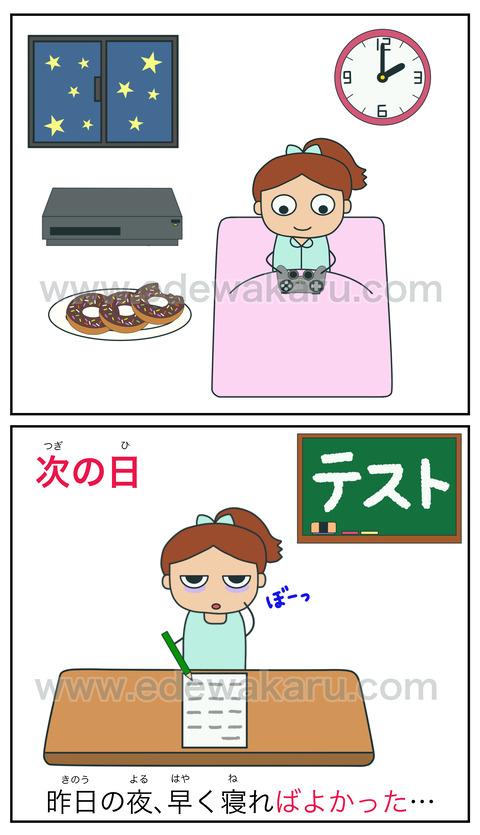
① I should have gone to bed early last night…
→ I’m sleepy because I didn’t go to bed early last night, even though I should have.
② I should have eaten breakfast before coming.
→ I’m hungry because I didn’t eat breakfast before coming, even though I should have.
Also, “〜ばよかった” can be changed to “〜たらよかった.”
😊
[Examples]
① I should have gone to bed early last night…
= I should have gone to bed early last night…
② I should have eaten breakfast before coming.
= I should have eaten breakfast before coming.
“〜ばよかった” and “〜たらよかった” are patterns used very frequently in conversation. There are also several patterns in the “よかった” series, so learn them together 😉
(Review: 〜てよかった)
In context 4 examples
昨日の夜、早く寝ればよかった…
→昨日の夜、早く寝たほうがよかったのに寝なかったI should have gone to bed early last night… → I should have gone to bed early last night, but I didn’t.
朝ごはんを食べてくればよかった
→朝ごはんを食べてきたほうがよかったのに食べてこなかったI should have eaten breakfast before coming. → I should have eaten breakfast before coming, but I didn’t.
もっと勉強しとけばよかった
→もっと勉強しといたほうがよかったのにしなかった(復習:〜とく・〜どく)I should have studied more. → I should have studied more, but I didn’t. (Review: 〜とく・〜どく)
お母さんに相談すればよかった
→お母さんに相談したほうがよかったのにしなかった(復習:相談する・相談にのる)I should have talked to my mother about it. → I should have talked to my mother about it, but I didn’t. (Review: 相談する・相談にのる)
Read the original source text
Meaning
〜したほうがよかったのに〜しなかった
〜するべきだった
How to use it
動詞[ば形]+よかった
Explanation
「〜ばよかった」は「〜したほうがよかったのに〜しなかった」「〜するべきだった」という意味を表す文型です。「〜したほうがよかったことをしなかった」というように、
後悔する気持を込めて使われます
😮実際にはしなかったことに使います。
(復習:〜べきだ)
(復習:〜を込めて・〜を込めた)
[例]
①昨日の夜、早く寝れ
ばよかった
…
→早く寝たほうがよかったのに寝なかったから、眠い
②朝ごはんを食べてくれ
ばよかった
→朝ごはんを食べてくるべきだったのに食べなかったから、お腹がすいている
また
「〜ばよかった」は「〜たらよかった」にチェンジすることができます
😊
[例]
①昨日の夜、早く寝れ
ばよかった
…
=昨日の夜、早く寝
たらよかった
…
②朝ごはんを食べてくれ
ばよかった
=朝ごはんを食べてき
たらよかった
「〜ばよかった」「〜たらよかった」は、会話でもとてもよく使う文型です。また「よかった」シリーズはいくつかありますので、まとめて覚えておきましょう😉
(復習:〜てよかった)