AIUEO JLPT Grammar
Meaning
This sentence pattern emphasizes the necessity or inevitability of a particular result, indicating that it occurred naturally or as a logical outcome rather than by chance. It is commonly used to discuss positive results or successes but can also describe negative situations.
How to use it
Verb dictionary form + べく + して
In context 5 examples
彼は練習を重ね、勝つべくして勝ったのだ。
He practiced hard, so it was only natural that he won.
事故は起こるべくして起こったのだ。
The accident happened as it was bound to happen.
彼は準備不足で、負けるべくして負けた。
He wasn’t prepared, so it was inevitable that he lost.
問題が長年放置され、破綻するべくして破綻した。
The problem was neglected for years, so the collapse was inevitable.
彼の成功は偶然ではなく、努力した結果、成功するべくして成功したのだ。
His success was not by chance; it was the result of his hard work and was bound to happen.
Read the original source text
Meaning
This sentence pattern emphasizes the necessity or inevitability of a particular result, indicating that it occurred naturally or as a logical outcome rather than by chance. It is commonly used to discuss positive results or successes but can also describe negative situations.
How to use it
動詞辞書形+べく+して
Explanation · 日本語
この文型は、ある結果が起こるべきだった理由や必然性を強調するときに使われます。つまり、その結果は偶然ではなく、当然の流れでそうなったことを示します。主にポジティブな結果や成功について述べるときに使われることが多いですが、ネガティブな状況でも使用されることがあります。
Bunpro Grammar Reference
Meaning
As expected, Meant to, Supposed to, Destined to, Sure to
How to use it
(Intransitive) Verb[る]+ べくして + (Intransitive) Verb[る](1)
Verb[られる][る]+ べくして + Verb[られる][る](1)
(1)Verb[られる][た]
Nuance
A formal expression, showing that (A) is as expected, or destined to be. Going off that (A) ought to be the case, (A) happened.
Explanation
べくして is a combination of the conjunctive form of the classical auxiliary verb べし, べく, and the conjunctive particle して, which shows a situation from which a logical determination can be made, or will be a natural course of action. べく itself indicates the word that it is attached to as a 'purpose' or 'end goal'. べくして is often translated simply as 'as expected of (A), (B)', or 'as was supposed to (A), (B)'. (A) and (B) will be the same verb repeated.
彼女らはここ2年間毎日文句を言わずにトレーニングしてきたから、大会で勝つべくして勝ったんだ。
These girls have trained every day for the last two years without complaint, so as expected they won the competition.
役所には何回もここに止まれの標識を設置するように訴えたが対応してくれなかったので、この事故は起こるべくして起こった。
We have asked the city office multiple times to install a stop sign here, but they never listened to us, so this accident was expected.
最近、彼女とは出会うべくして出会ったと感じることが多い。
Recently, I have been feeling that we were destined to meet.
The literal meaning of 'as determined with the purpose of (A)' may also be used if it helps to remember the nuance. This expression is quite formal, so will rarely be heard in daily speech.
Fun Fact
As mentioned in other grammar patterns that contain variations of べく such as べき and べし, this structure derives from the kanji 可, which is usually translated as 'permissible' or 'allowed'. All 可 really indicates is a situation that does not currently exist, but is certain to come about as a part of the most logical course of events.
In context 15 examples
- タイトル:「俺の青春ラブコメはまちがいになるべくしてなった。」
Title: 'As expected, my romantic youth comedy was a blunder.' (meant to・supposed to・destined to)
- 彼女らはここ2年間毎日文句を言わずにトレーニングしてきたから、大会で勝つべくして勝ったんだ。
These girls have trained every day for the last two years without complaint, so as expected they won the competition.
- 役所には何回もここに止まれの標識を設置するように訴えたが対応してくれなかったので、この事故は起こるべくして起こった。
We have asked the city office multiple times to install a stop sign here, but they never listened to us, so this accident was expected.
- 最近、彼女とは出会うべくして出会ったと感じることが多い。
Recently, I have been feeling that we were destined to meet.
- 壊れた一時停止標識を放置した結果、起こるべくして起こった交通事故だ。
As expected, the result of neglecting a broken stop sign was a traffic accident. (meant to・supposed to・destined to)
- 「これらの二人は、専門分野も年齢も共に近いゆえに出会うべくして出会ったと言えるだろう。」
As expected, one can say that these two met because they both shared fields of expertise and were close in age. (meant to・supposed to・destined to)
- 不景気か否かにかかわらず、高品質で適正価格の商品は売れるべくして売れている。
Regardless of whether there is a recession or not, products of good quality and reasonable price are sure to sell. (meant to・supposed to・expected to)
- 好景気が遅かれ早かれ終わるのは経済学者にとって当然のことであったし、そうなるべくしてなった。
To the economists, it was only natural that prosperity will end sooner or later, and, as expected, that's what happened. (meant to・supposed to・destined to)
- 今回、ユーザーさんはJLPT(ジェイエルピーティー) N1に合格すべくして合格した。なぜなら、毎日のように勉強したからだ。
User-san passed the JLPT N1 exam, as expected. It is because they studied hard enough every day. (meant to・supposed to・destined to)
- 全ての人が生まれるべくして生まれたと言う人がいるが、では私はなぜ生まれたのだろうか…。
There are people that say everyone that is born as supposed to be, but I wonder why I was born…
- 今回のプレゼンの準備にはそれほど時間をかけなかったし、この失敗は起こるべくして起きました。
Because I didn't put much time into preparing this presentation, as expected it was a failure.
- その社員の自殺は起こるべくして起こった。なぜなら誰もが会社の環境が劣悪だと知っていたからだ。
That employee was sure to take his own life. It's because everybody knew that that company's work environment was inadequate.
- 毎日喧嘩ばかりで落ち着いて話し合いをする事が出来なかった二人だ。彼らは別れるべくして別れたんだよ。
They were a couple that fought every day and could not calmly talk with each other. They were destined to break up.
- 私の息子は寝る間も惜しんで毎日必死に勉強した結果、受験に合格するべくして合格しました。
As a result of my son studying furiously every day without sparing any time for sleep, he passed his exams as expected.
- 今の彼氏の事を知るほど、そして共通点を見つけるほど、私達は出会うべくして出会ったのだと思う。
As far as I know my current boyfriend, and mutual points that I have found, I think that we were destined to meet.
DoJG 日本語文法辞典(全集)
Meaning
Exactly as expected
How to use it
V1informal nonpast | べくしてV2 (where V1=V2) | Exception: する→{す/する}べくして |
| 起こるべくして起こる | Something occurred as expected |
| 成功す(る) べくして成功する | Something/someone succeeds exactly as expected |
Explanation
A phrase used when something occurs/occured exactly as expected
In context 7 examples
第二次世界大戦は起こるべくして起こった。
World War II occurred, exactly as expected.
彼は大統領になるべくしてなった。
He became president, exactly as expected.
真知子は高校の時から成績が抜群によく、東大に入るべくして入ったという感じである。
Machiko distinguished herself as an excellent academic achiever in her high school days. As expected, she got into the University of Tokyo.
二人は性格、趣味、学歴がすべて一致している。二人は結婚するべくして結婚したのだ。
Their personalities, hobbies and academic backgrounds match. Just as (we) expected, those two got married.
ゆみの運転はいつも荒っぽいし、エンジンもブレーキも調子が悪かった。事故は起こるべくして起こった。
Yumi's driving was always wild, and her car's engine and brakes weren't in good condition. An accident occurred, exactly as expected.
あの会社は経営がずさんだったから倒産するべくして倒産したのだ。
The management of the company has been so careless that it went bankrupt, exactly as expected.
私は自宅が海のすぐ近くのため、釣り好きになるべくしてなったと言っていいでしょう。
You could say that I became fond of fishing, exactly as expected, because my home is so close to the ocean.
絵でわかる日本語
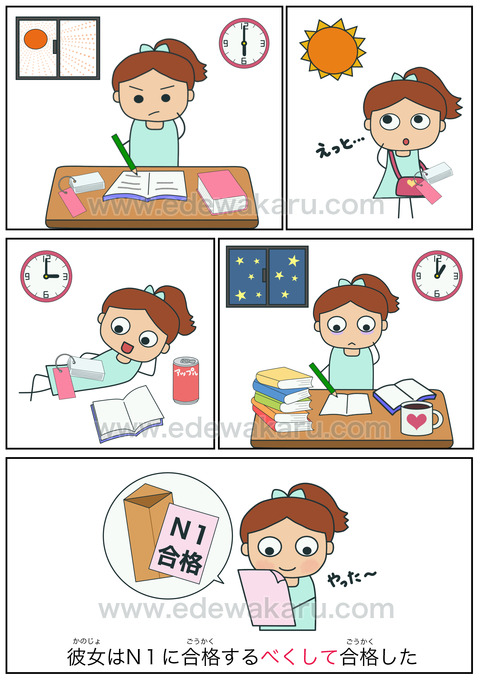
Meaning
It came about as the inevitable result.
How to use it
Verb [dictionary form] + べくして
Explanation
“〜べくして” is a sentence pattern meaning “it came about as the inevitable result.” In most cases, the same verb is used in “AべくしてAした,” meaning “What you expected would naturally happen actually happened.”
[Examples]
① She passed the N1, just as she was bound to.
[Expectation] She would pass.
→I thought she would surely pass. And she actually did.
② He practiced hard every day. He won the match, as he was bound to.
[Expectation] He would win the match.
→I thought he would win because he worked so hard. And he actually won.
③ A: I heard there was a serious accident at that intersection.
B: I thought it was dangerous there because there’s no traffic light.
A: That accident was bound to happen…
[Expectation] An accident would happen someday.
→I thought an accident would happen someday. And it actually did.
④ He and I were destined to meet.
[Expectation] He was the one for me, so I thought we would meet somewhere someday.
→I actually met the man I’m connected to by the red thread of fate.
Also, with する, both “〜するべくして” and “〜すべくして” can be used 😊
[Example]
She passed the N1, just as she was bound to.
=She passed the N1, just as she was bound to.
“〜べくして” is very formal, so in most cases it is used as written language.
[Patterns containing “べき”]
〜べからず・〜べからざる
〜べきだ
〜べきだった・〜べきではなかった
〜べく
〜べくして
〜べくもない
〜べし
In context 4 examples
彼女はN1に合格するべくして合格した
She passed the N1, just as she was bound to.
彼は毎日がんばって練習していた。試合には勝つべくして勝ったんだよ
He practiced hard every day. He won the match, as he was bound to.
A:あの交差点で大きな事故があったそうだよB:あそこには信号がなくて危ないと思っていたんだA:あの事故は起こるべくして起こってしまったんだね…(復習:〜そうだ(伝聞))(復習:〜てしまう(完了))(復習:〜てしまう(残念・後悔))
A: I heard there was a serious accident at that intersection. B: I thought it was dangerous there because there’s no traffic light. A: That accident was bound to happen… (Review: 〜そうだ [hearsay]) (Review: 〜てしまう [completion]) (Review: 〜てしまう [regret])
私と彼は出会うべくして出会ったの。だって運命の赤い糸で結ばれているんだもの(復習:「赤い糸」って何?)(復習:だって〜)(復習:〜もの・〜んだもの)
He and I were destined to meet. It’s because we’re connected by the red thread of fate, after all. (Review: What is “the red thread”?) (Review: だって〜) (Review: 〜もの・〜んだもの)
Read the original source text
Meaning
当然の結果として〜になった
How to use it
動詞[辞書形]+べくして
Explanation
「〜べくして」は「当然の結果として〜になった」という意味を表す文型です。ほとんどの場合、「AべくしてAした」というように「A」には同じ動詞入り、
「当然Aになるだろうと予想していたことが実際に起こった」
という意味で使われます。
[例]
①彼女はN1に合格する
べくして
合格した
【予想】合格するだろう
→きっと合格するだろうと思っていた。そして実際に合格した
②彼は毎日がんばって練習していた。試合には勝つ
べくして
勝ったんだよ
【予想】試合に勝つだろう
→がんばっていたから勝つと思っていた。そして実際に彼は試合に勝った
③A:あの交差点で大きな事故があったそうだよ
B:あそこには信号がなくて危ないと思っていたんだ
A:あの事故は起こる
べくして
起こってしまったんだね…
【予想】いつか事故が起こるだろう
→いつか事故が起こると思っていた。そして実際に事故が起こってしまった
④私と彼は出会う
べくして
出会ったの
【予想】彼は運命の人だからいつかどこかで出会うだろう
→赤い糸で結ばれている彼に実際に出会った
また「する」の場合は「〜するべくして」「〜すべくして」の両方を使うことができます😊
[例]
彼女はN1に合格する
べくして
合格した
=彼女はN1に合格す
べくして
合格した
「〜べくして」はとてもかたい言い方ですので、ほとんどの場合は
書き言葉
として使われます。
【「べき」がつく文型】
〜べからず・〜べからざる
〜べきだ
〜べきだった・〜べきではなかった
〜べく
〜べくして
〜べくもない
〜べし
毎日のんびり日本語教師
How to use it
Verb dictionary form + べくして + verb
Explanation
Expresses the inevitability of a predicted event occurring.
The same verb is used twice. The first occurrence is in dictionary form, and the second is often in the past tense.
Notes
Nothing in particular.
In context 10 examples
彼とは出会うべくして出会った気がする。(觉得应该和他相遇才遇到的。)
I feel that he and I were destined to meet. (觉得应该和他相遇才遇到的。)
チャンスを掴める人は、掴むべくして掴んでいる。
People who can seize opportunities seize them because they were meant to.
これは無秩序な状態が招いた、起こるべくして起こった惨事だ。
This is a tragedy brought about by a state of disorder, one that was bound to happen.
勝者は勝つべくして勝ち、敗者は負けるべくして負ける。
Winners win as they were destined to, and losers lose as they were destined to.
今回は練習不足がたたり、負けるべくして負けたのだと思う。
I think we lost this time because we were bound to, given how inadequate our practice was.
全ての人は生まれるべくして生まれたのだ。
Everyone was born because they were meant to be born.
監督は無策で根性論。今日の試合は負けるべくして負けたんだ。
The coach had no strategy and relied on grit. We lost today’s match because we were bound to.
私たちは会うべき時に、会うべき人に、会うべくして会う。
We meet the people we are meant to meet, when we are meant to meet them.
二人は別れるべくして別れた。
The two of them broke up because they were bound to.
あの人はたまたま選ばれた天才ではなく、選ばれるべくして選ばれた天才だ。
That person isn’t a genius who was chosen by chance; they are a genius who was chosen because they were meant to be.
Read the original source text
How to use it
動辞形+べくして+動詞
Explanation
予想された事態が発生したことの必然性を表します。
同じ動詞を2度使います。前項は辞書形で、後ろは過去形が来ることが多いです。
Notes
特になし
IMABI
Phrases Made w/ the Bases of ~べきだ
Read this IMABI lesson ↗Explanation
Phrases Made w/ the Bases of ~べきだ: ~べくもない, ~べからず・ざる, ~べく, ~べくして, & ~べし
Back in our first lesson on ~べきだ, we learned how it is an auxiliary verb pertaining to “obligation” but that its scope of use has been diminished substantially in Modern Japanese. Nonetheless, the auxiliary still holds on, with most of its bases still functional despite having become archaic.
In this lesson, we will go over various advanced grammar points which are derived from its other bases, and in doing so, we will view these other bases as being derived from ~べきだ’s predecessor ~べし.
The Extant Bases of ~べし
The auxiliary “verb/adjective” ~べきだ is etymologically1 better viewed as an “auxiliary adjective,” as it is merely slightly corrupted by the addition of the copula verb to its 連体形. While this did give rise to its new, modern 終止形 of ~べきだ, it also rendered certain other bases obsolete, notably its /-kari/ 連用形 and its 已然形, whose functionalities have been taken over by the copula built into ~べきだ.
Nonetheless, this lesson will be more so an introduction to ~べし as it pertains to Modern Japanese than it is a second installment of ~べきだ. As such, without further ado, the bases of ~べし are as follows:
未然形連用形終止形連体形已然形命令形
べから-べく-
(べかり-)べしべき-・
(べかる-) (べけれ- ) 〇
Orthography Note: ~べし can rarely be seen written in kanji as 可し.
While the modern ~べきだ heavily emphasizes duty and what is deemed appropriate, in the past, these usages all stimmed for an overarching notion of latent potential as well as natural course of events, with agency or the lack thereof among other factors dictating the exact nuance of the auxiliary. The loss of nuances attached to latent potential (潜勢), nuances which we will soon touch upon in their individual environments, is likely attributed to the inclusion of the declarative copula だ into the structure.
~べからず・べからざる
The 未然形 of ~べし, べから-, is heavily used in Modern Japanese with the classical negative auxiliary verb ~ず in the context of to-the-point negative imperatives. While not so common in the spoken language, this pattern is great for signage. Think “DO NOT TOUCH” or “KEEP OFF THE GRASS” as perfect environments for this grammar to be employed.
1. 触るべからず!
DO NOT TOUCH!
2. 芝に入るべからず!
KEEP OFF THE GRASS!
3. この橋、渡るべからず
DO NOT CROSS THIS BRIDGE!
4. 関係者以外、敷地内に入るべからず
NO UNAUTHORIZED PERSONS ARE ALLOWED TO ENTER THE PREMISES
5. 働かざる者は食うべからず
Those who do not work shall not eat
The auxiliary ~べし largely revolves around the notion of obligation, which is also anchored in place by the notion of “latent potential.” The things that ought to be the case are the things that one naturally can and should do. As it pertains to negative structures, we see that while still quite archaic, ~べからず can still be used to mean ~することができない, with a heavy emphasis on it naturally being the case that the agent cannot perform X. Moreover, this lack of “latent potential” is more likely to be seen as ~べからざる with X directly modifying a nominal phrase. Note that ざる‐ is simply the 連体形 of the auxiliary ~ず.
6. 予測すべからざる事態
A situation that one cannot predict
7. 許すべからざる罪
An unforgivable sin/crime
8. 現代社会では、スマホやインターネットなどは欠くべからざる存在となっている。
In the modern age, things such as smartphones and the Internet have become indispensable things (in our lives).
9. 遼平君は、我がチームには、欠くべからざる一員である。
Ryohei-kun is an integral member of our team.
10. 羽はねなければ空をも飛ぶべからず。
If one has no wings, one cannot fly through the skies.
Another pattern utilizing ~べからず worth noting is ~ざるべからず, which is akin to the modern ~なければならない to indicate obligation via a double negative construction. Of the two, ~ざるべからず places even heavier emphasis on the duty bore by the agent.
11. 天皇てんのうを重おもんぜざるべからず。
One must honor the emperor.
~べくもない
~べくもない is a combination of the /ku/-type 連用形 of ~べし followed by the adverbial particle も and the negative auxiliary ~ない. Together, the structure translates to “there is no way/it is possible” even if there is intention to make it happen. While we view the modern ~べきだ as pertaining solely to “obligation,” several other usages existed for its predecessor ~べし which have since fallen out of use. Of these, the indication of “potential,” albeit always with negative forms, was one of those now obsolete meanings. Granted, this sense of “potential” does derive from the underlining meaning of “obligation/strong resolve/appropriateness,” with negation facilitating the inability for said impetus to be set in motion.
12. 将来、東京大学の教授になろうなんて望むべくもない。
There’s no way that I could ever become something like a Tokyo University professor in the future.
13. そう聞いても、ザイダさんには想像するべくもない光景だった。
Though Zaida-san was hearing about it, the scene was one that she couldn’t have ever imagined.
14. セスは遼平を死ぬほど愛している、これは疑うべくもない。
Seth loves Ryohei to death; there is no doubt about that.
The closest structure to ~べくもない would be ~できるはずがない, which focuses on there being no means, whereas with ~べくもない, the focus would be on there being no chance of that resolve or circumstance ever coming to pass in a very emotionally charged fashion. One other major difference, however, is that ~べくもない can also be paired with non-volitional verbs to indicate the zero chance of something ever occurring.
15. 季節の推移はやむべくもない。
The changing of the seasons is inevitable.
~べく
The /ku/-type 連用形 of ~べし, ~べく attaches to verbs of volition, which serves as the initiative that the speaker feels determined/obligated to pursuit, with the predicate Y that follows being the means. As such, ~べく is quite similar to ~ために but with added emphasis on duty.
16. 早く帰るべく、準備じゅんびをし始めた。
I’ve become to make preparations so that I may get home early.
17. 我々は、将来を担うべく努力することを誓います。
We vow to endeavor to bear the future.
18. 国民を守るべく、研鑽を欠かさない。
(He) never falls short of improving (himself) so that (he) may protect (his) citizenry.
19. 作文嫌いを克服すべく、毎日、セス先生が掲げてきた「The Document Challenge」に挑むことにしています。
So that I may overcome my dislike of writing, I have decided to take on “The Document Challenge” which Seth-sensei has touted up to this point.
20. 筆者は最近、社長になるべく日夜努力を重ねている。
I (the person writing to you) have been recently working day and night to become a company president.
One set phrase which utilizes ~べく that is of considerable importance in formal settings, is the word しかるべく which roughly translates to “as one sees fit.” It combines しかり―a contraction of しかあり meaning “absolutely the case”―and ~べく.
21. しかるべく対応いたします。
I shall handle the matter as is appropriate.
~べくして
Utilizing the conjunctive particle して, ~べくして is most often used to indicate the necessity behind something that is predicted by the speaker to happen having happened. Incidentally, in this construction, the verb that precedes ~べくして will also be the same verb that follows it, leading to a translation for ~べくして of “it’s only natural that.” This meaning of a “natural course of events” is inherently tied to the latent potential hinted at in other structures (like in ~べくもない in the negative).
While this structure is largely used with intransitive verbs, the commonality behind all examples of this pattern does not lie in transitivity but rather in how “volition” does not play a part in the action occurring.
22. これは勝つべくして勝った試合です。
As for what you see here, this match was one that we were naturally going to win.
23. チャンスを掴める人は、掴むべくして掴んでいる。
Those who snag chances are those who naturally grab them (as they come along).
24. 起こるべくして起こった出来事だ。
What occurred is what would have naturally taken place.
25. 負けるべくして負けた。
It’s only natural that (we) lost.
Though not nearly as common and not touched on at all in the JLPT N1, ~べくして does have a rarely seen 逆接 nuance of “even if one can do X, (outcome Y is unfeasible).” This can also be adapted in a way so that the verb standing in as Y is marked by a negative form of ~べし to capitalize on this unfeasibility, which in the case of Ex. is to indicate a negative command of the vein of “should not.”
26. その教科書を読むべくして理解しがたい。
Even if you can read the textbook, it is difficult to understand.
27. この説せつは言うべくして行うべからず。
Even if you can say the theory, you shouldn’t carry it out.
~べし
Though clearly archaic, from the sense of obligation, the 終止形 ~べし may also indicate a forceful command related to duty. It is the affirmative rendition of ~べからず mentioned earlier.
28. 辞職すべし。
You should resign!
29. 培った力を存分に発揮すべし!
You must make full use of the strength/skills you’ve nurtured!
~ざるべし
When ~べし follows the negative auxiliary verb ~ず, ~べし follows its 連体形2, and in this context, ~べし simply denotes the meaning of “absolute certainty” that the predicates is NOT the case, as it is being paired with the negative.
30. この人々の深き志は、この海にも劣らざるべし。
The deep kindness of those here surely outmatches that of this sea (in its depth).
From the 『土佐日記』.
~べし is believed to be derived from the adjective 宜(うべ)し, with a likely meaning of “to be certain.” ↩︎
The 連体形 is employed instead of the 終止形 with ラ変-type conjugations. ↩︎
In context 30 examples
触るべからず!
DO NOT TOUCH!
芝に入るべからず!
KEEP OFF THE GRASS!
この橋、渡るべからず
DO NOT CROSS THIS BRIDGE!
関係者以外、敷地内に入るべからず
NO UNAUTHORIZED PERSONS ARE ALLOWED TO ENTER THE PREMISES
働かざる者は食うべからず
Those who do not work shall not eat
予測すべからざる事態
A situation that one cannot predict
許すべからざる罪
An unforgivable sin/crime
現代社会では、スマホやインターネットなどは欠くべからざる存在となっている。
In the modern age, things such as smartphones and the Internet have become indispensable things (in our lives).
遼平君は、我がチームには、欠くべからざる一員である。
Ryohei-kun is an integral member of our team.
羽はねなければ空をも飛ぶべからず。
If one has no wings, one cannot fly through the skies.
天皇てんのうを重おもんぜざるべからず。
One must honor the emperor.
将来、東京大学の教授になろうなんて望むべくもない。
There’s no way that I could ever become something like a Tokyo University professor in the future.
そう聞いても、ザイダさんには想像するべくもない光景だった。
Though Zaida-san was hearing about it, the scene was one that she couldn’t have ever imagined.
セスは遼平を死ぬほど愛している、これは疑うべくもない。
Seth loves Ryohei to death; there is no doubt about that.
季節の推移はやむべくもない。
The changing of the seasons is inevitable.
早く帰るべく、準備じゅんびをし始めた。
I’ve become to make preparations so that I may get home early.
我々は、将来を担うべく努力することを誓います。
We vow to endeavor to bear the future.
国民を守るべく、研鑽を欠かさない。
(He) never falls short of improving (himself) so that (he) may protect (his) citizenry.
作文嫌いを克服すべく、毎日、セス先生が掲げてきた「The Document Challenge」に挑むことにしています。
So that I may overcome my dislike of writing, I have decided to take on “The Document Challenge” which Seth-sensei has touted up to this point.
筆者は最近、社長になるべく日夜努力を重ねている。
I (the person writing to you) have been recently working day and night to become a company president.
しかるべく対応いたします。
I shall handle the matter as is appropriate.
これは勝つべくして勝った試合です。
As for what you see here, this match was one that we were naturally going to win.
チャンスを掴める人は、掴むべくして掴んでいる。
Those who snag chances are those who naturally grab them (as they come along).
起こるべくして起こった出来事だ。
What occurred is what would have naturally taken place.
負けるべくして負けた。
It’s only natural that (we) lost.
その教科書を読むべくして理解しがたい。
Even if you can read the textbook, it is difficult to understand.
この説せつは言うべくして行うべからず。
Even if you can say the theory, you shouldn’t carry it out.
辞職すべし。
You should resign!
培った力を存分に発揮すべし!
You must make full use of the strength/skills you’ve nurtured!
この人々の深き志は、この海にも劣らざるべし。
The deep kindness of those here surely outmatches that of this sea (in its depth).