絵でわかる日本語
Meaning
〜without it being a problem
〜become unnecessary
〜without needing to〜
How to use it
Verb [ない-form] + ないですむ
Verb [ない-form] + ずにすむ
Noun [dictionary form] + なしですむ
Explanation
“〜ないですむ,” “〜ずにすむ,” and “〜なしですむ” are sentence patterns meaning “〜without it being a problem,” “〜become unnecessary,” or “〜without needing to〜.”
In most cases, they are used when you want to say that you no longer have to do something bad, unpleasant, or troublesome. 😮
(Review: 〜くさい)
Remember that for verbs, there are two forms: “〜ないですむ” and “〜ずにすむ.”
😀
[Examples]
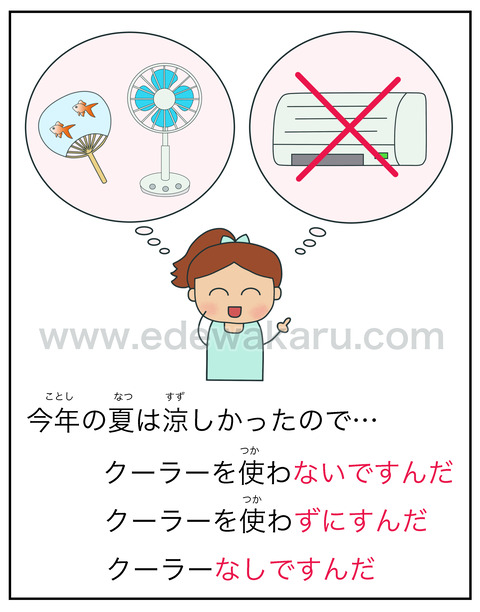
Because this summer was cool, I got by without using the air conditioner.
= Because this summer was cool, I got by without using the air conditioner.
Be careful: when used with a noun, the form is “〜なしですんだ.” 😨
[Examples]
❌ Because this summer was cool, I got by without an air conditioner.
⭕️ Because this summer was cool, I got by without an air conditioner.
Remember that when written in kanji, “〜ないですむ,” “〜ずにすむ,” and “〜なしですむ” are written
“〜ないで済む,” “〜ずに済む,” and “〜なしで済む.”
😀
In context 5 examples
今年の夏は涼しかったので、クーラーを使わないですんだ
→今年の夏は涼しかったので、クーラーを使わなくても問題はなかったBecause this summer was cool, I got by without using the air conditioner. → Because this summer was cool, not using the air conditioner wasn’t a problem.
今年の夏は涼しかったので、クーラーなしですんだ
→今年の夏は涼しかったので、クーラーがなくても問題はなかったBecause this summer was cool, I got by without an air conditioner. → Because this summer was cool, not having an air conditioner wasn’t a problem.
遅刻をしたが、怒られないですんだ
→遅刻をしたが、怒られなかったI was late, but I got away without being scolded. → I was late, but I wasn’t scolded.
すぐに電車が来たので、待たないですんだ
→すぐに電車が来たので、待たなくてもよかったThe train came right away, so I didn’t have to wait. → The train came right away, so I didn’t have to wait.
日本に友達がいるので、ホテルに泊まらないですんだ
→日本に友達がいるので、ホテルに泊まらなくてもOKだったI have a friend in Japan, so I got by without staying at a hotel. → I have a friend in Japan, so staying at a hotel wasn’t necessary.
Read the original source text
Meaning
〜なくても問題はない
〜なくてもよくなる
〜なくてもOKだ
How to use it
動詞[ない形]+ないですむ
動詞[ない形]+ずにすむ
名詞[辞書形]+なしですむ
Explanation
「〜ないですむ」「〜ずにすむ」「〜なしですむ」は「〜なくても問題はない」「〜なくてもよくなる」「〜なくてもOKだ」という意味を表す文型です。
ほとんどの場合、
よくないことや嫌なこと、面倒くさいことをしなくてもよくなったと言いたい時
に使われます😮
(復習:〜くさい)
動詞の場合は
「〜ないですむ」と「〜ずにすむ」
の2つの形があると覚えておきましょう😀
[例]
今年の夏は涼しかったので、クーラーを使わ
ないですんだ
=今年の夏は涼しかったので、クーラーを使わ
ずにすんだ
名詞に使う場合は、「〜なしですんだ」になりますので注意しましょう😨
[例]
❌今年の夏は涼しかったので、クーラー
ないですんだ
⭕️今年の夏は涼しかったので、クーラー
なしですんだ
「〜ないですむ」「〜ずにすむ」「〜なしですむ」は漢字で書くと
「〜ないで済む」「〜ずに済む」「〜なしで済む」
と書くと覚えておきましょう😀