どんなときどう使う 日本語表現文型辞典
Meaning
not necessarily; not always true that
How to use it
〔plain form〕+とはかぎらない
Explanation
~ということがいつも本当だとは言えない
「…ということが必ず、いつも本当であるとは言えない、ときには例外もある」と言いたいときの文型。いつも・全部・だれでも・必ずしも、などの副詞といっしょに使われることが多い。また、 ❷ のように「~からといって」などの言葉に導かれることが多い。
Something isn't always or necessarily true, but are exceptions. Often used with adverbs such as いつも, 全部, だれでも, or 必ずしも. Also often introduced by からといって, as in sentence ❷ .
In context 4 examples
天気予報がいつも当たるとはかぎらない。ときにははずれることもある。
The weather forecast isn’t always right. Sometimes it’s wrong.
話題の映画だからといって、かならずしもおもしろいとはかぎらない。
Just because a movie is talked about doesn’t necessarily mean it’s interesting.
新聞に書いてあることがいつも真実(だ)とはかぎらない。
What is written in the newspaper is not always true.
事故が起きないとはかぎらないから、高い山に登るときはしっかり準備をした方がいい。
An accident could happen, so you should prepare thoroughly when climbing a high mountain.
Read the original source text
Meaning
not necessarily; not always true that
How to use it
〔普通形〕+とはかぎらない
Explanation
~ということがいつも本当だとは言えない
「…ということが必ず、いつも本当であるとは言えない、ときには例外もある」と言いたいときの文型。いつも・全部・だれでも・必ずしも、などの副詞といっしょに使われることが多い。また、 ❷ のように「~からといって」などの言葉に導かれることが多い。
Something isn't always or necessarily true, but are exceptions. Often used with adverbs such as いつも, 全部, だれでも, or 必ずしも. Also often introduced by からといって, as in sentence ❷ .
日本語文型辞典
Meaning
Basic information
N/Na/A/V とはかぎらない
Explanation: Means “it is not always true that ….” Used to say that there are exceptions to something generally accepted as true.
Examples: ① Not all Japanese teachers are Japanese. ② Not every novel by a famous writer is necessarily interesting. ③ Just because he's Superman doesn't mean he can do everything. ④ The food here isn't always delicious, you know. ⑤ Just because you have fully recovered doesn't mean the illness won't recur, so it's best to be careful.
Read the original source text
Meaning
基本情報N/Na/A/V とはかぎらない説明「…ということがいつも正しいとは言えない」という意味を表す。一般的に正しいと認められることがらについて、例外もあると言うのに使う。例文① 日本語を教えているのは日本人とはかぎらない。② 有名な作家の小説ならどれでもおもしろいとはかぎらない。③ スーパーマンだからって、何でもできるとはかぎらないよ。④ ここのお料理もいつもおいしいとはかぎらないんですよ。⑤ 完治したからといって再発しないとはかぎらないのだから、気を付けるにこしたことはない。
日本語文型辞典 英語版
Meaning
【とはかぎらない】[N/Na/A/V とはかぎらない]
Means “it is not always the case that....” Implies that there is an exception to a situation or state of affairs generally considered to be true.
In context 5 examples
日本語を教えているのは日本人とはかぎらない。
Not all Japanese language teachers are Japanese.
有名な作家の小説ならどれでもおもしろいとはかぎらない。
It doesn’t always follow that every novel written by a famous author is interesting.
スーパーマンだからって、何でもできるとはかぎらないよ。
Just because he’s Superman doesn’t mean he can do anything.
ここのお料理もいつもおいしいとはかぎらないんですよ。
There’s no guarantee that the food here is always good, either.
完治したからといって再発しないとはかぎらないのだから、気を付けるにこしたことはない。
Even though you’ve made a complete recovery, there’s no guarantee that your illness won’t flare up again, so you can’t be too careful.
くらべてわかる日本語表現文型辞典
Meaning
Meaning 1: In a situation where everyone thinks A is the case, speak while allowing for the possibility that A may not be the case.
Meaning 2: In the form “Aないとはかぎらない.” The probability is low, but A is possible. A may be the case.
How to use it
Aとはかぎらない (Aないとはかぎらない/Aないともかぎらない)
Connection 1:
[Verb] とはかぎらない
[i-adjective—plain form] とはかぎらない
[na-adjective—だ/である/だった/ではない] とはかぎらない
[Noun—∅/である/ではない/だ/だった] とはかぎらない
Connection 2:
[Verb—ない form] ないとはかぎらない
In context 8 examples
天気予報は雨だと言っていたが、降るとはかぎらないから洗濯しよう。
The forecast said it would rain, but it won’t necessarily rain, so I’ll do the laundry.
バーゲン商品がみんなお買い得とはかぎらない。
Bargain items aren’t necessarily all good deals.
一流レストランの食事が必ずしもおいしいとはかぎりませんよ。
Food at a first-class restaurant isn’t necessarily delicious, you know.
金持ちが必ずしも幸せだとはかぎらない。
Rich people aren’t necessarily happy.
今は晴れていても昼から雨が降らないとはかぎらないから、傘を持っていこう。
Even though it’s sunny now, it might still rain this afternoon, so I’ll take an umbrella.
健康な人でも、病気にならないともかぎらないから保険に入っておけ。
Even healthy people may get sick, so make sure you have insurance.
環境破壊によって、全人類が滅びてしまわないともかぎらない。
Environmental destruction could possibly lead to the extinction of all humanity.
また大地震が起こらないともかぎらないから、備えは常にしておこう。
Another major earthquake could happen, so let’s always be prepared.
Read the original source text
Meaning
意味1:みんながAだと思っている状況の中でA(では)ないかもしれないと、Aではないことを想定して話す。
意味2:「Aないとはかぎらない」の形で。低い確率ではあるが、Aの可能性がある。Aかもしれない。
How to use it
Aとはかぎらない(Aないとはかぎらない/Aないともかぎらない)
接続1:
[動詞]とはかぎらない
[イ形-普]とはかぎらない
[ナ形-だ/である/だった/ではない]とはかぎらない
[名詞-∅/である/ではない/だ/だった]とはかぎらない
接続2:
[動詞-ない形]ないとはかぎらない
IMABI
Limit
Read this IMABI lesson ↗Explanation
Limit: ~限り, ~を限りに, ~限りでは, ~に限って, ~に限らない, & ~とは限らない
限り is a rather complicated noun. Although it means “limit” and understanding it is no problem for most students, similar looking structures with it cause problems.
限り
~かぎり shows up in a lot of expressions, but what comes before it must be taken into account. Although particles may be a pain to get used to, you should still love them.
1. ~かぎり: This shows a parameter of a certain condition. Before ~かぎり, you may see nouns, adjectives, and verbs.
1. 保証ほしょうの限りではない。
It is not in the warranty.
2. 目の届とどく限り、晴れ渡わたっている。
The sky is clear as far as the eye can see.
3. 可能な限り、薬を飲まないようにしています。
I’m trying as best I can to not take the medicine.
4. できる限りのことをするのも無理なのだ。
Doing as much as possible is also no good.
5. 法律ほうりつの及およぶ限り厳密げんみつに処しょすべきだ。
It should be strictly dealt with to the full extent of the law.
6. 今年も能力の限り、お役に立てるよう働くことを誓ちかいます。
I vow to work to be of benefit [to X] to the best of my ability this year as well.
7. 外は豪雪ごうせつでも、部屋のなかにいるかぎりは真夏日まなつびのようだ。
Even if there is heavy snowfall outside, for as long as you’re inside the room, it’s like a hot summer day.
読み物: A Passage from 心 by 夏目漱石
8. 次の日私は先生の後あとにつづいて海へ飛び込こんだ。そうして先生といっしょの方角ほうがくに泳いで行った。二丁ちょうほど沖おきへ出ると、先生は後ろを振ふり返って私に話し掛かけた。広い蒼あおい海の表面に浮ういているものは、その近所に私ら二人より外ほかになかった。そうして強い太陽の光が、眼めの届く限り水と山とを照らしていた。私は自由と歓喜かんきに充みちた筋肉を動かして海の中で躍おどり狂くるった。先生はまたぱたりと手足の運動を已やめて仰向あおむけになったまま浪なみの上に寝た。私もその真似まねをした。青空の色がぎらぎらと眼を射いるように痛烈つうれつな色を私の顔に投なげ付つけた。「愉快ゆかいですね」と私は大きな声を出した。
漢字 Notes:
1. 蒼い is a very literary spelling for blue. And, you may also encounter 碧い in similar contexts. 蒼い is a rather dull “blue”, and it is often used in contexts where one “is blue in the face”. 碧い is used when “blue” may have anywhere from a light to dark green hue to it.
2. ~掛ける is usually spelled as ~かける in everyday writing.
3. Rather than using 満ちる, 充ちる has the added nuance of inundation. 満ちる is over all the most important spelling due to the fact that 充 does not have the reading み(ちる) listed in the 常用漢字表.
4. 躍る differs from 踊る in the sense that the latter is “dance” in a rhythmic sense whereas the former is just jumping up and down.
5. 已む specifically describes a phenomenon, action, or condition that has continued for some time stopping completely. It is generally replaced with 止む except in literal situations like this when the writer wishes to make this nuance clear.
6. 浪 specifically refers to ripples in water or water rising up.
The next day, I followed Sensei into the ocean. I then swam in the same direction as him. After going over a hundred meters offshore, Sensei turned around to talk to me. It was only us floating atop the surface of the wide, blue sea. The strong sunlight made the water and mountains glow for as far as one could see. I madly danced around in the waves with my muscles full of joy and freedom. Sensei, again, suddenly froze his arms and legs and lay flat on his back asleep on the waves, and so I mimicked him. The blue sky cast a scathing light into my eyes as if to pierce them out. “How pleasant!”, I yelled out.
Questions:
1. Find an example where a Japanese item is naturalized for the English translation.
2. Why might liberties in translation be needed with this passage?
~ない限り, which is an application of above, can be translated as “until” in contexts like below.
9. 君が考えを改あらためないかぎり、うまくいかない。
Until you rethink yourself, things won’t go well.
10. あいつは、あまりにも疲れていないかぎり、夜遅くまでIMABIを編集へんしゅうするそうだ。
That guy seems to edit IMABI up into the night unless he’s too tired.
11. 汚水おすいを飲まないかぎり大丈夫ですよ。
So long as you don’t drink filthy water, you should be fine.
After adjectives at the end of a sentence, ~かぎりだ shows the speaker’s emotions with what is being said not being simply about the nature of things, but the matter at hand doesn’t extend beyond a certain limit.
12. 誰からも連絡がなく、寂さびしいかぎりだ。
It’s just very lonely that I don’t get contact from anyone.
Another thing that this form can do that the two below cannot is be followed with a volitional expression.
13. 生きている限り歌おう。
I’ll sing until I die.
As a suffix after temporal phrases in the form of ~かぎりで, it express deadline.
14. 来月末限りで辞任するつもりだ。
I plan to resign at the end of next month.
2. ~を限りに, when used with time phrases, explicitly states when will be the last time that one does something. With non-temporal phrases, it shows some sort of physical limitation.
15. 彼は声の限りに叫さけんだ。
He screamed to the top of list lungs.
16. 今日を限りに酒は飲みません。
I will not drink alcohol from this day forward!
17. これを限りにお前とは縁えんを切る。
From here on I break my ties with you.
18. 今年の年末を限りに期限が切れる。
The term/period/deadline will expire at the end of this year.
3. ~限りでは: Verbs of cognition such as 知る, 見る, 聞く, 読む, etc. come before, and the following clause deals with a judgment. In totality, this construction means “as far as…”.
19. 知られる限りでは依然行方不明いぜんゆくえふめい。 (Headline)
[X] is/are still missing as far as is known.
20. 私の知っている限りでは、彼はそんなことをする人ではありません。
As far as I know, he is not the kind of person to do something like that.
4. ~に限って: This raises a time, person, or thing to mean “insofar/unless”. This is used a lot with とき.
21. あたしが出かけるときにかぎって、雨が降るのよ。(女性語)
It doesn’t rain unless I go out [somewhere].
22. 我わが社しゃの社員に限って、そのような不正はするはずがない。
Insofar as our company’s workers, we have no reason to do such illegality.
23. 読みたいときに限って、アクセスできない。
I can’t access it insofar as to when I want to read it.
As one would expect, this phrase has a negative form, ~に限らない. This means that something is not yet decided. Of course, in formal/written situations, you can see it as ~に限らず.
24. 怠なまけたがるのは、子供に限ったことじゃない。
Wanting to slack off is not limited to just kids.
25. 対象はアメリカ人に限りません。
Our target is not limited to Americans.
26. 韓国語を勉強している学生は、東アジア専攻に限りません。
Students who study Korean are not limited to East Asian majors.
5. ~とは限らない may resemble ~に限らない, and the best of students mix them up. However, because of the particle と, no part of speech limitations exists. ~とは限らない means “not necessarily”. This phrase is frequently used to speak against stereotypes.
27. 日本人がみんな勉強ばかりしているとは限らない。
It’s not necessarily the case that all Japanese people do nothing but study.
28. アメリカ人は、必ずしも日本人より背が高いとは限らない。
Americans are not necessarily taller than Japanese people.
29. テキサスの人がみんな必ずバーベキューばかり食べるとは限らない。
All Texans don’t necessarily eat just barbecue.
30. 念ねんを入れたからっていい仕上しあがりになるとは限らない。
Because we paid attention to detail, it’s (now) a good finish.
In context 41 examples
~かぎり: This shows a parameter of a certain condition. Before ~かぎり, you may see nouns, adjectives, and verbs.
It is not in the warranty.
保証ほしょうの限りではない。
It is not in the warranty.
目の届とどく限り、晴れ渡わたっている。
The sky is clear as far as the eye can see.
可能な限り、薬を飲まないようにしています。
I’m trying as best I can to not take the medicine.
できる限りのことをするのも無理なのだ。
Doing as much as possible is also no good.
法律ほうりつの及およぶ限り厳密げんみつに処しょすべきだ。
It should be strictly dealt with to the full extent of the law.
今年も能力の限り、お役に立てるよう働くことを誓ちかいます。
I vow to work to be of benefit [to X] to the best of my ability this year as well.
外は豪雪ごうせつでも、部屋のなかにいるかぎりは真夏日まなつびのようだ。
Even if there is heavy snowfall outside, for as long as you’re inside the room, it’s like a hot summer day.
次の日私は先生の後あとにつづいて海へ飛び込こんだ。そうして先生といっしょの方角ほうがくに泳いで行った。二丁ちょうほど沖おきへ出ると、先生は後ろを振ふり返って私に話し掛かけた。広い蒼あおい海の表面に浮ういているものは、その近所に私ら二人より外ほかになかった。そうして強い太陽の光が、眼めの届く限り水と山とを照らしていた。私は自由と歓喜かんきに充みちた筋肉を動かして海の中で躍おどり狂くるった。先生はまたぱたりと手足の運動を已やめて仰向あおむけになったまま浪なみの上に寝た。私もその真似まねをした。青空の色がぎらぎらと眼を射いるように痛烈つうれつな色を私の顔に投なげ付つけた。「愉快ゆかいですね」と私は大きな声を出した。
The next day, I followed behind the teacher and plunged into the sea. Then I swam in the same direction as he did. After we had gone about two chō offshore, the teacher looked back and spoke to me. On the broad, blue surface of the sea, there was no one nearby besides the two of us. The strong sunlight shone on the water and the mountains as far as the eye could see. I moved my muscles, filled with freedom and delight, and leaped about wildly in the sea. The teacher suddenly stopped moving his arms and legs again and lay on his back on the waves. I imitated him. The color of the blue sky was so dazzling and intense that it seemed to shoot painfully into my eyes and onto my face. “It’s delightful, isn’t it?” I called out loudly.
蒼い is a very literary spelling for blue. And, you may also encounter 碧い in similar contexts. 蒼い is a rather dull “blue”, and it is often used in contexts where one “is blue in the face”. 碧い is used when “blue” may have anywhere from a light to dark green hue to it.
The next day, I followed Sensei into the ocean. I then swam in the same direction as him. After going over a hundred meters offshore, Sensei turned around to talk to me. It was only us floating atop the surface of the wide, blue sea. The strong sunlight made the water and mountains glow for as far as one could see. I madly danced around in the waves with my muscles full of joy and freedom. Sensei, again, suddenly froze his arms and legs and lay flat on his back asleep on the waves, and so I mimicked him. The blue sky cast a scathing light into my eyes as if to pierce them out. “How pleasant!”, I yelled out.
~掛ける is usually spelled as ~かける in everyday writing.
The next day, I followed Sensei into the ocean. I then swam in the same direction as him. After going over a hundred meters offshore, Sensei turned around to talk to me. It was only us floating atop the surface of the wide, blue sea. The strong sunlight made the water and mountains glow for as far as one could see. I madly danced around in the waves with my muscles full of joy and freedom. Sensei, again, suddenly froze his arms and legs and lay flat on his back asleep on the waves, and so I mimicked him. The blue sky cast a scathing light into my eyes as if to pierce them out. “How pleasant!”, I yelled out.
Rather than using 満ちる, 充ちる has the added nuance of inundation. 満ちる is over all the most important spelling due to the fact that 充 does not have the reading み(ちる) listed in the 常用漢字表.
The next day, I followed Sensei into the ocean. I then swam in the same direction as him. After going over a hundred meters offshore, Sensei turned around to talk to me. It was only us floating atop the surface of the wide, blue sea. The strong sunlight made the water and mountains glow for as far as one could see. I madly danced around in the waves with my muscles full of joy and freedom. Sensei, again, suddenly froze his arms and legs and lay flat on his back asleep on the waves, and so I mimicked him. The blue sky cast a scathing light into my eyes as if to pierce them out. “How pleasant!”, I yelled out.
躍る differs from 踊る in the sense that the latter is “dance” in a rhythmic sense whereas the former is just jumping up and down.
The next day, I followed Sensei into the ocean. I then swam in the same direction as him. After going over a hundred meters offshore, Sensei turned around to talk to me. It was only us floating atop the surface of the wide, blue sea. The strong sunlight made the water and mountains glow for as far as one could see. I madly danced around in the waves with my muscles full of joy and freedom. Sensei, again, suddenly froze his arms and legs and lay flat on his back asleep on the waves, and so I mimicked him. The blue sky cast a scathing light into my eyes as if to pierce them out. “How pleasant!”, I yelled out.
已む specifically describes a phenomenon, action, or condition that has continued for some time stopping completely. It is generally replaced with 止む except in literal situations like this when the writer wishes to make this nuance clear.
The next day, I followed Sensei into the ocean. I then swam in the same direction as him. After going over a hundred meters offshore, Sensei turned around to talk to me. It was only us floating atop the surface of the wide, blue sea. The strong sunlight made the water and mountains glow for as far as one could see. I madly danced around in the waves with my muscles full of joy and freedom. Sensei, again, suddenly froze his arms and legs and lay flat on his back asleep on the waves, and so I mimicked him. The blue sky cast a scathing light into my eyes as if to pierce them out. “How pleasant!”, I yelled out.
浪 specifically refers to ripples in water or water rising up.
The next day, I followed Sensei into the ocean. I then swam in the same direction as him. After going over a hundred meters offshore, Sensei turned around to talk to me. It was only us floating atop the surface of the wide, blue sea. The strong sunlight made the water and mountains glow for as far as one could see. I madly danced around in the waves with my muscles full of joy and freedom. Sensei, again, suddenly froze his arms and legs and lay flat on his back asleep on the waves, and so I mimicked him. The blue sky cast a scathing light into my eyes as if to pierce them out. “How pleasant!”, I yelled out.
君が考えを改あらためないかぎり、うまくいかない。
Until you rethink yourself, things won’t go well.
あいつは、あまりにも疲れていないかぎり、夜遅くまでIMABIを編集へんしゅうするそうだ。
That guy seems to edit IMABI up into the night unless he’s too tired.
汚水おすいを飲まないかぎり大丈夫ですよ。
So long as you don’t drink filthy water, you should be fine.
誰からも連絡がなく、寂さびしいかぎりだ。
It’s just very lonely that I don’t get contact from anyone.
生きている限り歌おう。
I’ll sing until I die.
来月末限りで辞任するつもりだ。
I plan to resign at the end of next month.
~を限りに, when used with time phrases, explicitly states when will be the last time that one does something. With non-temporal phrases, it shows some sort of physical limitation.
He screamed to the top of list lungs.
彼は声の限りに叫さけんだ。
He screamed to the top of list lungs.
今日を限りに酒は飲みません。
I will not drink alcohol from this day forward!
これを限りにお前とは縁えんを切る。
From here on I break my ties with you.
今年の年末を限りに期限が切れる。
The term/period/deadline will expire at the end of this year.
~限りでは: Verbs of cognition such as 知る, 見る, 聞く, 読む, etc. come before, and the following clause deals with a judgment. In totality, this construction means “as far as…”.
[X] is/are still missing as far as is known.
知られる限りでは依然行方不明いぜんゆくえふめい。 (Headline)
[X] is/are still missing as far as is known.
私の知っている限りでは、彼はそんなことをする人ではありません。
As far as I know, he is not the kind of person to do something like that.
~に限って: This raises a time, person, or thing to mean “insofar/unless”. This is used a lot with とき.
It doesn’t rain unless I go out [somewhere].
あたしが出かけるときにかぎって、雨が降るのよ。(女性語)
It doesn’t rain unless I go out [somewhere].
我わが社しゃの社員に限って、そのような不正はするはずがない。
Insofar as our company’s workers, we have no reason to do such illegality.
読みたいときに限って、アクセスできない。
I can’t access it insofar as to when I want to read it.
怠なまけたがるのは、子供に限ったことじゃない。
Wanting to slack off is not limited to just kids.
対象はアメリカ人に限りません。
Our target is not limited to Americans.
韓国語を勉強している学生は、東アジア専攻に限りません。
Students who study Korean are not limited to East Asian majors.
~とは限らない may resemble ~に限らない, and the best of students mix them up. However, because of the particle と, no part of speech limitations exists. ~とは限らない means “not necessarily”. This phrase is frequently used to speak against stereotypes.
It’s not necessarily the case that all Japanese people do nothing but study.
日本人がみんな勉強ばかりしているとは限らない。
It’s not necessarily the case that all Japanese people do nothing but study.
アメリカ人は、必ずしも日本人より背が高いとは限らない。
Americans are not necessarily taller than Japanese people.
テキサスの人がみんな必ずバーベキューばかり食べるとは限らない。
All Texans don’t necessarily eat just barbecue.
念ねんを入れたからっていい仕上しあがりになるとは限らない。
Because we paid attention to detail, it’s (now) a good finish.
Read the original source text
Explanation
Limit: ~限り, ~を限りに, ~限りでは, ~に限って, ~に限らない, & ~とは限らない
限り is a rather complicated noun. Although it means “limit” and understanding it is no problem for most students, similar looking structures with it cause problems.
限り
~かぎり shows up in a lot of expressions, but what comes before it must be taken into account. Although particles may be a pain to get used to, you should still love them.
1. ~かぎり: This shows a parameter of a certain condition. Before ~かぎり, you may see nouns, adjectives, and verbs.
1. 保証ほしょうの限りではない。
It is not in the warranty.
2. 目の届とどく限り、晴れ渡わたっている。
The sky is clear as far as the eye can see.
3. 可能な限り、薬を飲まないようにしています。
I’m trying as best I can to not take the medicine.
4. できる限りのことをするのも無理なのだ。
Doing as much as possible is also no good.
5. 法律ほうりつの及およぶ限り厳密げんみつに処しょすべきだ。
It should be strictly dealt with to the full extent of the law.
6. 今年も能力の限り、お役に立てるよう働くことを誓ちかいます。
I vow to work to be of benefit [to X] to the best of my ability this year as well.
7. 外は豪雪ごうせつでも、部屋のなかにいるかぎりは真夏日まなつびのようだ。
Even if there is heavy snowfall outside, for as long as you’re inside the room, it’s like a hot summer day.
読み物: A Passage from 心 by 夏目漱石
8. 次の日私は先生の後あとにつづいて海へ飛び込こんだ。そうして先生といっしょの方角ほうがくに泳いで行った。二丁ちょうほど沖おきへ出ると、先生は後ろを振ふり返って私に話し掛かけた。広い蒼あおい海の表面に浮ういているものは、その近所に私ら二人より外ほかになかった。そうして強い太陽の光が、眼めの届く限り水と山とを照らしていた。私は自由と歓喜かんきに充みちた筋肉を動かして海の中で躍おどり狂くるった。先生はまたぱたりと手足の運動を已やめて仰向あおむけになったまま浪なみの上に寝た。私もその真似まねをした。青空の色がぎらぎらと眼を射いるように痛烈つうれつな色を私の顔に投なげ付つけた。「愉快ゆかいですね」と私は大きな声を出した。
漢字 Notes:
1. 蒼い is a very literary spelling for blue. And, you may also encounter 碧い in similar contexts. 蒼い is a rather dull “blue”, and it is often used in contexts where one “is blue in the face”. 碧い is used when “blue” may have anywhere from a light to dark green hue to it.
2. ~掛ける is usually spelled as ~かける in everyday writing.
3. Rather than using 満ちる, 充ちる has the added nuance of inundation. 満ちる is over all the most important spelling due to the fact that 充 does not have the reading み(ちる) listed in the 常用漢字表.
4. 躍る differs from 踊る in the sense that the latter is “dance” in a rhythmic sense whereas the former is just jumping up and down.
5. 已む specifically describes a phenomenon, action, or condition that has continued for some time stopping completely. It is generally replaced with 止む except in literal situations like this when the writer wishes to make this nuance clear.
6. 浪 specifically refers to ripples in water or water rising up.
The next day, I followed Sensei into the ocean. I then swam in the same direction as him. After going over a hundred meters offshore, Sensei turned around to talk to me. It was only us floating atop the surface of the wide, blue sea. The strong sunlight made the water and mountains glow for as far as one could see. I madly danced around in the waves with my muscles full of joy and freedom. Sensei, again, suddenly froze his arms and legs and lay flat on his back asleep on the waves, and so I mimicked him. The blue sky cast a scathing light into my eyes as if to pierce them out. “How pleasant!”, I yelled out.
Questions:
1. Find an example where a Japanese item is naturalized for the English translation.
2. Why might liberties in translation be needed with this passage?
~ない限り, which is an application of above, can be translated as “until” in contexts like below.
9. 君が考えを改あらためないかぎり、うまくいかない。
Until you rethink yourself, things won’t go well.
10. あいつは、あまりにも疲れていないかぎり、夜遅くまでIMABIを編集へんしゅうするそうだ。
That guy seems to edit IMABI up into the night unless he’s too tired.
11. 汚水おすいを飲まないかぎり大丈夫ですよ。
So long as you don’t drink filthy water, you should be fine.
After adjectives at the end of a sentence, ~かぎりだ shows the speaker’s emotions with what is being said not being simply about the nature of things, but the matter at hand doesn’t extend beyond a certain limit.
12. 誰からも連絡がなく、寂さびしいかぎりだ。
It’s just very lonely that I don’t get contact from anyone.
Another thing that this form can do that the two below cannot is be followed with a volitional expression.
13. 生きている限り歌おう。
I’ll sing until I die.
As a suffix after temporal phrases in the form of ~かぎりで, it express deadline.
14. 来月末限りで辞任するつもりだ。
I plan to resign at the end of next month.
2. ~を限りに, when used with time phrases, explicitly states when will be the last time that one does something. With non-temporal phrases, it shows some sort of physical limitation.
15. 彼は声の限りに叫さけんだ。
He screamed to the top of list lungs.
16. 今日を限りに酒は飲みません。
I will not drink alcohol from this day forward!
17. これを限りにお前とは縁えんを切る。
From here on I break my ties with you.
18. 今年の年末を限りに期限が切れる。
The term/period/deadline will expire at the end of this year.
3. ~限りでは: Verbs of cognition such as 知る, 見る, 聞く, 読む, etc. come before, and the following clause deals with a judgment. In totality, this construction means “as far as…”.
19. 知られる限りでは依然行方不明いぜんゆくえふめい。 (Headline)
[X] is/are still missing as far as is known.
20. 私の知っている限りでは、彼はそんなことをする人ではありません。
As far as I know, he is not the kind of person to do something like that.
4. ~に限って: This raises a time, person, or thing to mean “insofar/unless”. This is used a lot with とき.
21. あたしが出かけるときにかぎって、雨が降るのよ。(女性語)
It doesn’t rain unless I go out [somewhere].
22. 我わが社しゃの社員に限って、そのような不正はするはずがない。
Insofar as our company’s workers, we have no reason to do such illegality.
23. 読みたいときに限って、アクセスできない。
I can’t access it insofar as to when I want to read it.
As one would expect, this phrase has a negative form, ~に限らない. This means that something is not yet decided. Of course, in formal/written situations, you can see it as ~に限らず.
24. 怠なまけたがるのは、子供に限ったことじゃない。
Wanting to slack off is not limited to just kids.
25. 対象はアメリカ人に限りません。
Our target is not limited to Americans.
26. 韓国語を勉強している学生は、東アジア専攻に限りません。
Students who study Korean are not limited to East Asian majors.
5. ~とは限らない may resemble ~に限らない, and the best of students mix them up. However, because of the particle と, no part of speech limitations exists. ~とは限らない means “not necessarily”. This phrase is frequently used to speak against stereotypes.
27. 日本人がみんな勉強ばかりしているとは限らない。
It’s not necessarily the case that all Japanese people do nothing but study.
28. アメリカ人は、必ずしも日本人より背が高いとは限らない。
Americans are not necessarily taller than Japanese people.
29. テキサスの人がみんな必ずバーベキューばかり食べるとは限らない。
All Texans don’t necessarily eat just barbecue.
30. 念ねんを入れたからっていい仕上しあがりになるとは限らない。
Because we paid attention to detail, it’s (now) a good finish.
DoJG 日本語文法辞典(全集)
Meaning
Not always; not necessarily
How to use it
Sinformal | とは限らない | |
| よくなるとは限らない | Someone will not necessarily get well |
Explanation
A phrase which expresses the idea "not necessarily".
In context 15 examples
体の弱い人が早く死ぬとは限らない。
Frail people do not necessarily die young.
高い物がいつも・必ずしも安い物よりいいとは限らない。
Expensive things are not always / necessarily better than inexpensive ones.
日本に長く住んでいるから(と言って)日本語が上手だとは限らない。
It is not necessarily the case that people are good at Japanese because they have lived in Japan a long time.
日本に行っても日本語が上手になるとは限らない。
You will not necessarily become good at Japanese even if you go to Japan.
お金があれば幸福になれるとは限らない。
You will not (literally: cannot) necessarily be happy if you have money.
漫画が子供の教育にとって有害だとは限らない。
Comics are not necessarily harmful to children's education.
日本人の使う日本語がいつも正しいとは限らない。
The Japanese used by Japanese people is not always correct.
スポーツ選手が必ずしも健康だとは限らない。
Athletes are not necessarily healthy.
技術の進歩が必ずしも我々に繁栄をもたらすとは限らない。
Progress in technology does not necessarily bring us prosperity.
先生がそう言ったからと言ってそれが正しいとは限らない。
It is not necessarily correct just because the teacher said so.
薬を飲んだからと言ってよくなるとは限らない。
You do not necessarily get better because you take medicine.
頭がよくても人生に成功するとは限らない。
You do not necessarily succeed in your life even if you are smart.
実力があっても失業しないとは限らない。
It is not necessarily true that you won't lose your job even if you have ability.
悪い家庭環境に育てば必ず悪い子供になるとは限らない。
It is not necessarily true that children become bad if they grow up in a bad family environment.
時間が沢山あればいい論文が書けるとは限らない。
It is not necessarily true that you can write a good paper if you have a lot of time.
絵でわかる日本語
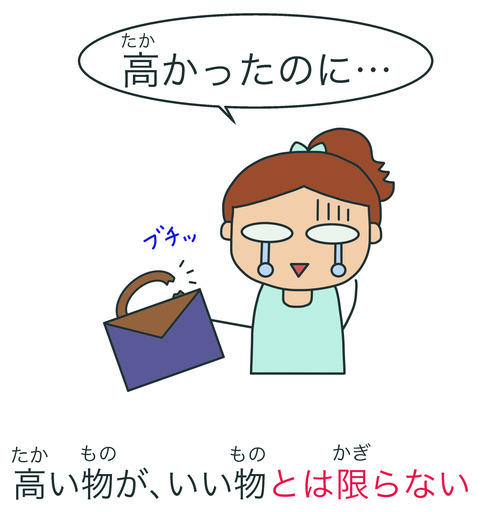
Meaning
It can generally be said that 〜, but there are exceptions
How to use it
Verb / adjective / noun [plain form] + とは限らない
* The present affirmative form of な-adjectives and nouns is “ーだとは限らない” (sometimes “だ” is omitted)
(Examples: きれいだとは限らない・学生だとは限らない)
Explanation
“〜とは限らない” means “It can generally be said that 〜, but there are exceptions.” It is used when you want to say that something thought to be generally true has cases (exceptions) where it is not so. It is not an absolute statement; it means “not everything is 〜.” 😊 It is often used with words such as “必ずしも,” “いつも,” and “どこでも.”
[Adverbs commonly used with it]
必ずしも
〜とは限らない
いつも
〜とは限らない
どこでも
〜とは限らない
誰でも
〜とは限らない
いつでも
〜とは限らない
全て
〜とは限らない
[For intermediate to advanced learners]
In many cases, “〜とは限らない” and “〜とは言えない” can be used interchangeably 😄 However, be careful: it cannot be used with words expressing strong certainty, such as “決して” or “絶対.”
⭕️ Expensive things are not necessarily good.
⭕️ You can’t say that expensive things are always good.
❌ Expensive things are by no means necessarily good.
⭕️ You can’t say that expensive things are good, by any means.
There are still many more patterns in the “限る” series, so keep working to memorize them 😆
[The “限る” series]
〜限り (limit)
〜限り
〜限りだ
〜限りで・N限りのN (limitation)
〜限りでは (scope)
限りなく〜に近い
〜とは限らない
〜ない限り
〜に限ったことではない
〜に限らず (〜も)
〜に限る
〜を限りに
In context 4 examples
高いものが、全部いいものだとは限らない
→高いものはいいものが多いが、全部がいいものではなく、悪いものもあるNot all expensive things are good. →Many expensive things are good, but not all are; some are bad.
モデルは背が高いとは限らない
→モデルは背が高い人が多いが、中には背が低い人もいるModels are not necessarily tall. →Many models are tall, but some are short.
お金持ちがみんな幸せだとは限らない
→お金持ちは幸せな人が多いが、(お金持ちの中には)幸せではない人もいるRich people are not all happy. →Many rich people are happy, but some (among the rich) are not.
日本語を教えているのは全て日本人だとは限らない
→日本語を教えているのは日本人の先生が多いが、日本人ではない先生もいるNot all people who teach Japanese are Japanese. →Many Japanese teachers teach Japanese, but some teachers are not Japanese.
Read the original source text
Meaning
ほとんど〜と言えるが、例外もある
How to use it
動詞・形容詞・名詞[普通形]+とは限らない
*な形容詞・名詞の現在肯定形は「ーだとは限らない」となる(「だ」が省略されることもある)
(例:きれいだとは限らない・学生だとは限らない)
Explanation
「〜とは限らない」は
「ほとんど〜と言えるが、例外もある」
という意味で、一般的には正しいと思われていることに対し、そうではない場合(例外)があると言いたい時に使われます。断定的な言い方ではなく「全部が〜ではない」という意味ですね😊「必ずしも」「いつも」「どこでも」などとよく使われます。
[
一緒によく使う副詞
]
必ずしも
〜とは限らない
いつも
〜とは限らない
どこでも
〜とは限らない
誰でも
〜とは限らない
いつでも
〜とは限らない
全て
〜とは限らない
【中級〜上級レベルの人へ】
「〜とは限らない」と「〜とは言えない」は多くの場合、言い換えることが可能です😄ですが
「決して」や「絶対」のように強い断定を表す単語とは一緒に使うことができませんので気をつけてください。
⭕️高いものが
必ずしも
いいものだとは限らない
⭕️高いものが
必ずしも
いいものだとは言えない
❌高いものが決していいものだとは限らない
⭕️高いものが決していいものだとは言えない
「限る」シリーズもまだまだありますのでがんばって覚えてくださいね😆
【「限る」シリーズ】
〜限り(限界)
〜限り
〜限りだ
〜限りで・N限りのN(限定)
〜限りでは(範囲)
限りなく〜に近い
〜とは限らない
〜ない限り
〜に限ったことではない
〜に限らず(〜も)
〜に限る
〜を限りに