日本語文型辞典
Meaning
Basic information
This is formed by attaching 「かな」, which expresses the speaker’s uncertainty, to the negative form of an inflected word. It is used both for self-questioning and for asking someone else. Unlike 「かしら」, it can be used by both men and women, but it is not polite, so when asking a listener directly, it is limited to people who are close to each other.
When following the negative form of a verb expressing an action, change, or existence, or the negative form of 「V-れる」 expressing potential, it expresses the speaker’s hope or wish that “it would be nice if that were so” or “I want that to happen.”
Attached to a predicate’s negative form, it expresses conjecture—“perhaps that might be so”—without much certainty, or concern and worry, as in “I have that feeling” or “I’m worried about that.” When used as a monologue, it is self-questioning; when used with another person, it asks for their judgment, as in “Don’t you think so?”
How to use it
…かな(あ)【wish】V-ない/V-れないかなあ
V-てくれないかなあ
…かな(あ)【conjecture・concern】
N/Na ではないかなあ
A-くないかなあ
V-ないかなあ
In context 9 examples
早く夏休みにならないかなあ。
I wish summer vacation would come soon.
今夜いい夢が見られないかな。
I wonder if I’ll have a good dream tonight.
息子が一流大学に入ってくれないかな。
I wish my son would get into a top university.
あの人、森田さんの奥さんじゃないかな。
I wonder if that person is Mr. Morita’s wife.
彼だったら大丈夫じゃないかな。
He should be all right, don’t you think?
こっちのほうが、よくないか。
Wouldn’t this one be better?
子供にはちょっと難しすぎないかな。
I wonder if it’s a little too difficult for a child.
この靴、ちょっと小さくないかな。
I wonder if these shoes are a little too small.
あんなことを言って、彼女怒っていないかな。
I wonder if she’s angry after I said something like that.
Read the original source text
Meaning
基本情報説明活用語の否定形に話し手の不確かな気持ちを表す「かな」がついたもの。自問と相手への質問のどちらにも用いられる。「かしら」とは異なり男女どちらでも使用できるが、丁寧な言い方ではないので、直接聞き手に対して質問するような場合は親しい間柄に限られる。
動作や変化や存在を表す動詞や可能を表す「V-れる」の否定形を受けて、「そうだといい」「そうなってほしい」という話し手の希望・願望を表す。
述語の否定形に付いて、十分に確信はないが「ひょっとするとそうかもしれない」という推測や、「そんな心配がある/そんな気がする」という懸念・心配の気持ちを表す。独り言の場合は自問の表現になるが、相手がいる場合には、「そう思いませんか」と相手の判断を問う表現になる。
How to use it
…かな(あ)【願望】V-ない/V-れないかなあ
V-てくれないかなあ
…かな(あ)【推測・懸念】
N/Na ではないかなあ
A-くないかなあ
V-ないかなあ
絵でわかる日本語
Meaning
I hope it becomes …
I hope it is …
How to use it
Verb[ない-form]+ないかな
Verb[potential form]+ないかしら
Verb[て-form]+てくれないかな
Explanation
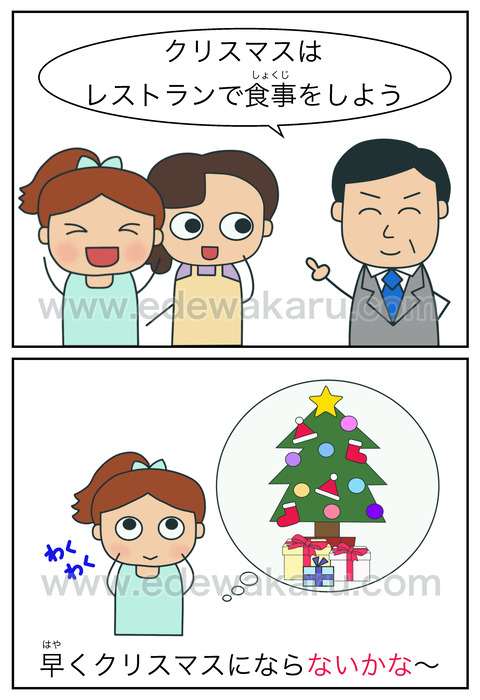
“〜ないかな” is a sentence pattern expressing “I hope it becomes …” or “I hope it is ….” It expresses the speaker’s hopes or wishes, and is used in conversations with friends or family, as well as in soliloquies. 😊 “〜ないかな” can also be changed to “〜ないかしら,” but men cannot use “〜ないかしら,” so be careful. 😖
[Example]
早くクリスマスになら
ないかな
=早くクリスマスになら
ないかしら
“〜ないかな” and “〜ないかしら” are used very often in conversation. Make sure to review “〜かな・〜かしら” as well. 😉
In context 5 examples
早くクリスマスにならないかな〜
→早くクリスマスになって欲しいな〜I hope Christmas comes soon… →I hope it becomes Christmas soon…
今年こそN1に合格しないかな
→今年こそN1に合格するといいなI hope I pass N1 this year, for sure. →I hope I pass N1 this year.
明日は晴れないかな
→明日は晴れだといいなI hope it’s sunny tomorrow. →I hope the weather is sunny tomorrow.
A:ダイエットをしているの?B:うん。早くやせないかな…
→早くやせるといいな…A: Are you dieting? B: Yeah. I wish I could lose weight soon… →I hope I lose weight soon…
今日のパーティーに山田くんも来ないかな
→今日のパーティーに山田くんも来るといいなI hope Yamada comes to today’s party too. →I hope Yamada comes to today’s party too.
Read the original source text
Meaning
〜になって欲しいな
〜だといいな
How to use it
動詞[ない形]+ないかな
動詞[可能形]+ないかしら
動詞[て形]+てくれないかな
Explanation
「〜ないかな」は「〜になって欲しい」「〜だといいな」という意味を表す文型です。話者の希望や願望を表す表現で、友達や家族との会話や独り言として使われます😊また
「〜ないかな」は「〜ないかしら」にチェンジすることができます
が、「〜ないかしら」は男性は使えませんので気をつけてください😖
[例]
早くクリスマスになら
ないかな
=早くクリスマスになら
ないかしら
「〜ないかな」「〜ないかしら」は会話でとてもよく使います。「〜かな・〜かしら」の復習もしっかりとしておきましょう😉
毎日のんびり日本語教師
Usage 1
Read this source entry ↗How to use it
Verb negative form + ないかな / ないかしら
Verb て-form + くれないかな / くれないかしら
Verb て-form + もらえないかな / もらえないかしら
Explanation
Expresses the speaker’s wish or hope.
It conveys a desire for things to turn out as hoped.
It can also be used as a remark to oneself.
When used toward another person, it becomes a request or a mild command.
「~かな」 can be used by both men and women, while 「~かしら」 is feminine speech.
A related pattern expressing a wish is 「【N1文法】~ないものか/ないものだろうか」, which is mainly used when the desired outcome is difficult to achieve.
By contrast, 「~かな/かしら」 can also be used when the situation is not particularly urgent.
Notes
Similar grammar: 「【N1文法】~ないものか/ないものだろうか」
Related grammar: 「【N3文法】~ないかな/ないかしら (speculation / concern)」
In context 9 examples
学生時代に戻れないかなあ。(多希望回到学生时代啊。)
I wish I could go back to my student days.
なんか面白いことないかな。
I wonder if there’s anything fun to do.
何か良いアイディアないかなあ。
I wonder if there are any good ideas.
ごめん、教科書忘れたから貸してもらえないかな。
Sorry, I forgot my textbook. Could I borrow yours?
彼氏欲しい! イケメン空から降って来ないかなあ。(想要男朋友!多希望帅哥会从天而降啊。)
I want a boyfriend! I wish a handsome guy would fall from the sky.
そこの二人、もう少し静かにしてもらえないかな?
You two over there, could you be a little quieter?
早く痛みが取れないかなあ。(多希望能快点消除疼痛啊。)
I wish the pain would go away soon.
猫ちゃん車の下から出てきてくれないかなあ。
Kitty, could you come out from under the car?
ちょっと最近白髪が目立ってきて、おすすめの白髪染めとかないかしら。
I’ve noticed a lot more gray hair lately. I wonder if there are any recommended products for dyeing gray hair.
Read the original source text
How to use it
動ない形+ないかな/ないかしら
動て形+くれないかな/くれないかしら
動て形+もらえないかな/もらえないかしら
Explanation
話し手の願望や希望を表します。
事態が望んだ方向に転がっていくことを望む気持ちが含まれます。
独り言としても使えます。
他人に対して使うとお願い、軽い命令になります。
「~かな」は男女ともに用いることができますが、「~かしら」は女性語です。
同じく願望を表す文法に「【N1文法】~ないものか/ないものだろうか」がありますが、こちらは主に実現が困難である状況下で用いられます。
「~かな/かしら」はそれほど事態が緊迫していない状況下でも用いることができる点で異なります。
Notes
似ている文法「【N1文法】~ないものか/ないものだろうか」
関連文法「【N3文法】~ないかな/ないかしら(推測/懸念)」
Usage 2
Read this source entry ↗How to use it
Noun + では / じゃ + ないかな / ないかしら
な-adjective stem + では / じゃ + ないかな / ないかしら
い-adjective stem + くないかな / くないかしら
Verb negative form + ないかな / ないかしら
Explanation
Expresses speculation or concern when the speaker is not fully certain.
When used to pose a question to the listener, it asks for the listener’s judgment or confirmation.
「~ないかな」 can be used by both men and women, while 「~ないかしら」 is feminine speech.
Notes
Related grammar: 「【N3文法】~ないかな/てくれないかな/てもらえないかな/ないかしら (wish)」
In context 8 examples
彼と連絡取ったのは10年ぶりくらいじゃないかな。(和他联系大概是10年前的事了吧。)
It must have been about ten years since I last contacted him, don’t you think?
睡眠時間を削って勉強しても良いことはないんじゃないかな。
I don’t think anything good comes from studying by cutting back on sleep.
性格わざわざ変える必要はないんじゃないかな。それは君の個性だと思うよ。
I don’t think you need to go out of your way to change your personality. I think that’s part of who you are.
君は十分頑張ってるよ。たまには休んでもいいんじゃないかな。
You’re doing your best. I think it’s okay to take a break once in a while.
誰だって、好きな人のことを幸せにしたいって思ってるんじゃないかな。
I think everyone wants to make the person they love happy.
明日休みだから会えないかな?(明天休息所以不能见面吗?)
Since tomorrow’s a day off, could we meet?
将来何をやりたいかより、今何ができるかのほうが重要じゃないかな。
I think what you can do now is more important than what you want to do in the future.
そろそろ寝たほうがいいんじゃないかしら?(差不多该睡了吧?)
I suppose it’s about time we went to bed, don’t you think?
Read the original source text
How to use it
名詞+では/じゃ+ないかな/ないかしら
ナ形語幹+では/じゃ+ないかな/ないかしら
イ形語幹+くないかな/くないかしら
動ない形+ないかな/ないかしら
Explanation
十分な確信がない状態での推測、懸念を表します。
相手に問いかけるように用いる場合は、相手の判断を仰いだり、確認するような意味になります。
「~ないかな」は男女ともに用いることができますが、「~ないかしら」は女性語です。
Notes
関連文法「【N3文法】~ないかな/てくれないかな/てもらえないかな/ないかしら(願望)」
日本語文型辞典 英語版
Meaning
【ないかな】...ないかな consists of the negative form of an inflected word combined with かな, which expresses uncertainty on the part of the speaker. It is used for both self-addressed questions and questions addressed to others. Unlike かしら, ないかな can be used by both male and female speakers. However, since this expression is not polite language, when it is used to address others it should be used only with interlocutors who have a close relationship to the speaker.
When ないかな takes the negative form of a verb referring to an action, a change of state, or existence, or the negative form of the potential V-れる, it means “I hope so” or “I wish it would happen.” Expresses the speaker’s hope, wish, or desire.
When used with the negative form of a predicate, ...かな(あ) expresses a conjecture, like “I’m not completely sure, but it just might be so,” or a feeling of anxiety or concern, like “I’m concerned/I have the sense that....” If the speaker is talking to him/herself, ...かな(あ) functions as a self-addressed question, but if this expression is addressed to a listener, it means “don’t you think so?” and functions as an inquiry regarding the listener’s judgment.
How to use it
1. ...かな(あ)〈wish, desire〉[V-ない/V-れない かなあ][V-てくれないかなあ]
2. ...かな(あ)〈conjecture, concern〉[N/Na ではないかなあ][A-くないかなあ][V-ないかなあ]
In context 9 examples
早く夏休みにならないかなあ。
I can’t wait for summer vacation.
今夜いい夢が見られないかな。
I hope I’ll have a good dream tonight.
息子が一流大学に入ってくれないかな。
I wish my son would enter a top-class university.
あの人、森田さんの奥さんじゃないかな。
I wonder if that person isn’t Morita-san’s wife.
彼だったら大丈夫じゃないかな。
If it’s him, I guess he’ll be fine with it.
こっちのほうがよくないか。
Isn’t it better this way?
子供にはちょっと難しすぎないかな。
Isn’t this a little bit too difficult for a child?
この靴、ちょっと小さくないかな。
I wonder if these shoes aren’t a bit small.
あんなことを言って、彼女怒っていないかな。
I wonder if she’s upset because I said such a thing to her.
AIUEO JLPT Grammar
Meaning
This sentence pattern is used when the speaker expresses a wish or expectation for something to happen, while implying that the realization of this expectation is uncertain. Depending on how it is used, it can also convey a sense of modest hope or expectation.
How to use it
Verb ない-form + かな
In context 5 examples
早く雨がやまないかな。
I hope the rain stops soon.
明日のテスト、うまくいかないかな。
I hope tomorrow’s test goes well.
宿題が少なくならないかな。
I wish there were less homework.
彼女から連絡が来ないかな。
I hope she contacts me.
彼がもう一度会いに来てくれないかな。
I wonder if he’ll come to see me again.
Read the original source text
Meaning
This sentence pattern is used when the speaker expresses a wish or expectation for something to happen, while implying that the realization of this expectation is uncertain. Depending on how it is used, it can also convey a sense of modest hope or expectation.
How to use it
動詞ない形+かな
Explanation · 日本語
この文型は、話し手が何かが起こってほしい、またはそうなってほしいという希望や期待を表す表現です。この表現は、何かが実現することを期待しつつ、その実現が不確かであるというニュアンスを含みます。使い方によっては、やや控えめに何かを期待していることを示すこともあります。