くらべてわかる日本語表現文型辞典
Meaning
Meaning 1: A is the cause or means by which result or state B came about.
Meaning 2: A is the source of information, evidence, or basis for B.
Meaning 3: A indicates the agent in a passive sentence. A is the source of action or state B.
Meaning 4: For each A, B. The situation or state differs depending on A.
How to use it
A ni yotte B (A ni yoru to B / A ni yoreba B / A ni yotte wa B / A ni yoru B)
[Verb] + koto + ni yotte
[Noun - ∅] ni yotte
Explanation
【Contrast 2】
“A ni motozuite B” (Meaning 1, p. 263)
“A tokoro ni yoru to B” (Meaning 1, p. 172)
【Contrast 4】
“A ni oujite B” (Meaning 1, p. 217)
In context 16 examples
人間は努力することによって、成長するのだ。
People grow through making an effort.
駅前の商店は大型店進出によって、経営不振に追い込まれた。
The shops in front of the station were driven into financial difficulties by the entry of large-scale stores.
彼女は長男を戦争によって失い、次男を病気により死なせてしまった。
She lost her eldest son in the war and, because of illness, her second son died.
遺影は故人の愛した花によって飾られていた。
The portrait of the deceased was decorated with flowers that they had loved.
私は事故のニュースを新聞によって知りました。
I learned about the accident in the newspaper.
彼の証言によれば、その時、警報機は鳴っていなかったようだ。
According to his testimony, it seems that the alarm did not go off at that time.
天気予報によると、今週1週間は晴天が続くそうだ。
According to the weather forecast, clear skies are expected to continue throughout this week.
校則によってマイカー通学が禁止されているのだから仕方がない。
Since commuting by private car is prohibited by school rules, there is nothing we can do about it.
この本は夏目漱石によって書かれた。
This book was written by Natsume Soseki.
アメリカ大陸はコロンブスによって発見された。
The American continent was discovered by Columbus.
犯人はその場に居合わせた警官によって逮捕された。
The criminal was arrested by a police officer who happened to be at the scene.
文明は人によって作られ、人によって破壊されるのだ。
Civilization is created by people and destroyed by people.
あいさつの仕方は国によって違っている。
The way people greet one another differs from country to country.
彼は相手によって態度を変える。
He changes his attitude depending on who he is dealing with.
日本語は男女による表現の違いがある。
Japanese has differences in expression depending on gender.
値段によっては買わないこともない。
Depending on the price, I might buy it.
Read the original source text
Meaning
意味1:AはBという結果や状態になった原因・手段。
意味2:AはBの情報源・根拠・もとになるもの。
意味3:Aは受身文の行為者を表す。AはBという行為・状態の発生源である。
意味4:それぞれのAでB。A次第で状況や様子に違いが表れる。
How to use it
AによってB(AによるとB/AによればB/AによってはB/AによるB)
[動詞]+こと+によって
[名詞-∅]によって
Explanation
【対比2】
「Aに基づいてB」(意味1 P.263)
「AところによるとB」(意味1 P.172)
【対比4】
「Aに応じてB」(意味1 P.217)
DoJG 日本語文法辞典(全集)
Meaning
According to; due to; owing to; because of; depending on; from ~ to; by means of; on the basis of; with; by
How to use it
(i) Noun | によって | |
| 政府によって | By the government |
(ii) {V/Adjective い}informal | かどうかに{よって/より} | |
| {来る/来た}かどうかに{よって/より} | Depending on whether someone comes/came or not |
| {面白い/面白かった}かどうかに{よって/より} | Depending on whether something is/was interesting or not |
(iii) {Adjective な stem/Noun} | {Ø/だった}かどうかに{よって/より} | |
| {静か/静かだった}かどうかに{よって/より} | Depending on whether something is/was quiet or not |
(iv) Embedded Wh-Question | に{よって/より} | |
| 何を食べたかに{よって/より} | Depending on what someone ate |
| 誰が来るかに{よって/より} | Depending on who comes |
Explanation
によって/より A particle that indicates means, cause, agent of passive sentence, or dependency on a situation.
In context 16 examples
漢和辞典によって知らない漢字を調べる。
We examine unknown kanji with a Chinese character dictionary.
先生によって、勿論、教え方が違います。
Teaching methods are, of course, different, depending on the teacher.
戦争によって父を亡くした。
We lost our father, owing to the war.
この研究所は文部省によって設立された。
This research institute was established by the Ministry of Education.
奨学金がもらえるかどうかによって大学入学を決めます。
I will decide my entrance to college, depending on whether I can get a scholarship or not.
何を食べるかによって健康状態は変わる。
Our health condition changes according to what we eat.
我々は本を読むことによって視野を広げることが出来る。
We can expand our horizons by reading books.
この頃は宇宙中継によって世界のニュースをテレビで見ることが出来る。
These days we can watch world news on TV via satellite live broadcasting.
その老人達はわずかの貯金によって生活している。
The old people are living on little savings.
その問題は話し合いによって解決出来るはずだ。
We should be able to solve that problem by means of negotiation.
人によって、年のとり方が違う。
Depending on the person, the aging process differs.
僕はその日の気分によって、違う音楽を聞きます。
Depending on the day's mood, I listen to different music.
定年は会社によって違う。
Retirement ages vary from company to company.
その青年は麻薬によって青春時代を失ってしまった。
The young man lost his adolescence because of drugs.
彼は難病によって再起不能になった。
He became unable to come back because of the difficult disease.
この絵はピカソによって描かれた。
This picture was painted by Picasso.
日本語文型辞典
Meaning
Follows a noun and means “with that as the cause.” It is followed by an expression of a result.
Indicates the agent of an action in a passive sentence. It is the same as 「Xに」 in 「XにYされる」, but when the verb 「Y」 expresses creating something, as in 「設計する」, 「作る」, or 「書く」, 「に」 cannot be used, and 「によって」 is used instead. Also, when what is interpreted as the cause is something like 「洪水」 or 「敵の反撃」 in ② and ③, it can be replaced with 「で」.
Means “using that as a means” or “by that method.”
Attaches to a noun or to the form 「疑問詞…か」 and means “taking that as one’s basis” or “on the grounds of that.” In ⑤ and ⑥, it is a fixed idiom meaning “as usual.”
Means “depending on the various cases among them.” Example ⑤ is a fixed idiom with the same meaning as 「場合によって」.
How to use it
Nによって [cause]
Nによって [agent in a passive sentence]
Nによって [means]
Nによって [basis]
Nによって [case]
In context 26 examples
私の不注意な発言によって、彼を傷つけてしまった。
I ended up hurting him with my careless remark.
踏切事故によって、電車は3時間も遅れました。
Because of an accident at a railway crossing, the train was delayed by as much as three hours.
ほとんどの会社は不況によって経営が悪化した。
The management of most companies worsened because of the recession.
この建物は有名な建築家によって設計された。
This building was designed by a famous architect.
その村の家の多くは洪水によって押し流された。
Many of the houses in that village were swept away by the flood.
敵の反撃によって苦しめられた。
They were tormented by the enemy’s counterattack.
これらの聖典はヨーロッパからの宣教師たちによってもたらされた。
These scriptures were brought by missionaries from Europe.
3年生の児童たちによって校庭に立派な人文字が描かれた。
A splendid human formation was made in the schoolyard by the third-grade pupils.
この奇抜なファッションは新しいものを好む若者たちによってただちに受け入れられた。
This unconventional fashion was immediately embraced by young people who like new things.
(例) 洪水で押し流された。
(Example) It was swept away by the flood.
この資料によって多くの事実が明らかになった。
Many facts were brought to light by this material.
給料をカットすることによって、不況を乗り切ろうとしている。
They are trying to weather the recession by cutting salaries.
交通網の整備によって、遠距離通勤が可能になった。
Improved transport networks made long-distance commuting possible.
コンピュータによって大量の文書管理が可能になった。
Computers made it possible to manage large volumes of documents.
インターネットによって世界中の情報がいとも簡単に手に入るようになった。
The internet has made information from all over the world readily accessible.
この資料によっていままで不明だった多くの点が明らかになった。
This material clarified many points that had been unclear until now.
行くか行かないかは、あしたの天気によって決めよう。
Let’s decide whether to go or not based on tomorrow’s weather.
先生の御指導によってこの作品を完成させることができました。
I was able to complete this work thanks to my teacher’s guidance.
試験の成績よりも通常の授業でどれだけ活躍したかによって成績をつけようと思う。
I think I’ll grade students based on how much they contributed in regular classes rather than on their exam results.
恒例によって会議の後に夕食会を設けることにした。
In keeping with tradition, we decided to hold a dinner after the meeting.
例によって彼らは夜遅くまで議論を続けた。
As usual, they continued their discussion until late at night.
人によって考え方が違う。
People think differently.
明日は所によって雨が降るそうだ。
Apparently, it will rain in some areas tomorrow.
時と場合によって、考え方を変えなければならないこともある。
Depending on the time and circumstances, there are times when we have to change how we think.
場合によってはこの契約を破棄しなければならないかもしれない。
Depending on the circumstances, we may have to cancel this contract.
事と次第によっては、裁判に訴えなければならない。
Depending on how things turn out, we may have to take the matter to court.
Read the original source text
Meaning
名詞を受けて、「それが原因となって」の意味を表す。後ろには結果を表す表現が続く。
受身文の動作主を表す。「XにYされる」の「Xに」と同じだが、「Y」の動詞が「設計する」「作る」「書く」のように何かを生み出すことを表すものであるときは「に」は使えず「によって」を用いる。また、②③の「洪水」「敵の反撃」のように原因と解釈されるもののときは、「で」で言いかえることができる。
「それを手段として」「その方法を用いて」の意味を表す。
名詞や「疑問詞…か」の形に付いて、「それをよりどころとして」「それを根拠として」という意味を表す。⑤⑥は慣用句として固定された表現で「いつものように」という意味。
「そのうちのいろいろな場合に応じて」という意味を表す。⑤は慣用句で「場合によって」と同じ意味。
How to use it
Nによって【原因】
Nによって【受身文の動作主】
Nによって【手段】
Nによって【よりところ】
Nによって【場合】
絵でわかる日本語
Usage 1
Read this source entry ↗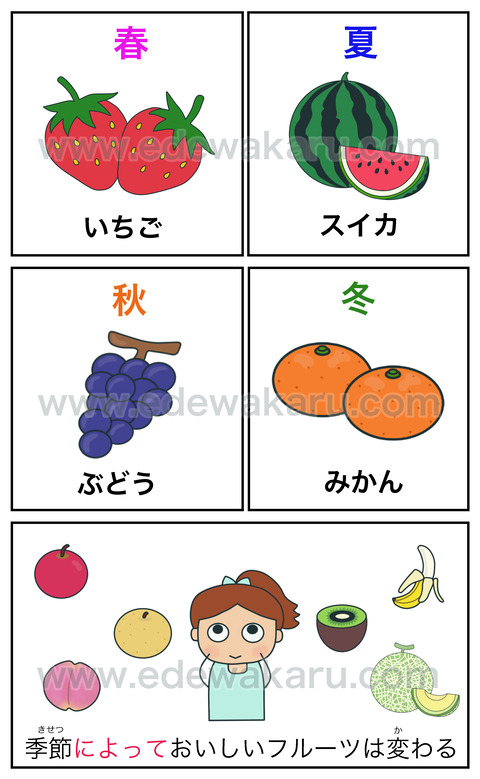
Meaning
when 〜 changes, 〜 changes too
each is different
How to use it
Noun + によって
Explanation
“〜によって” has various meanings, but this time it means “when 〜 changes, 〜 changes too” or “each is different.”
It is used when you want to say that the content and so on differs depending on the 【scene】, 【situation】, 【circumstances】, 【place】, or 【person】. 😊
[Examples]
① The delicious fruits change with the seasons.
“Spring”
→
strawberries
“Summer”
→
watermelon
“Autumn”
→
grapes
“Winter”
→
mandarins
② Languages differ from country to country.
“Japan”
→
Japanese
“America・England”
→ English
“Canada” → English・French
“Taiwan”
→ Chinese・Taiwanese
“China” → Chinese
“Vietnam”
→
Vietnamese
“Korea”
→
Korean
“Russia”
→ Russian
“Brazil” →
Portuguese
[Additional explanation]
A formal way of saying “〜によって” is “〜により.” The usage and meaning are the same, so remember it. 😀 Use “〜によって” in everyday conversation. 😉
[Examples]
The delicious fruits change with the seasons.
Languages differ from country to country.
“〜によって” has many other meanings, such as 【cause/reason】, 【means】, 【agent in a passive sentence】, and 【basis/grounds】, so make sure to understand and distinguish each one. 😊
In context 5 examples
季節によっておいしいフルーツは変わる
→季節が変わると、おいしいフルーツも変わるThe delicious fruits change depending on the season. → When the season changes, the delicious fruits change too.
国によって言語が違う
→国それぞれで言語が違うLanguages differ depending on the country. → Languages differ from country to country.
サイズによって値段が変わる
→サイズが変わると、値段も変わるPrices change depending on the size. → When the size changes, the price changes too.
人によって好きな食べ物が違う
→人それぞれ好きな食べ物が違うPeople have different favorite foods. → Each person likes different foods.
学校によって、校則が違う
→学校それぞれで校則が違うSchool rules differ from school to school. → School rules are different at each school.
Read the original source text
Meaning
〜が変わると〜も変わる
それぞれ違う
How to use it
名詞+によって
Explanation
「〜によって」にはいろんな意味がありますが、
今回の「〜によって」は「〜が変わると〜も変わる」「それぞれ違う」という意味を表すものです。
これは【場面】【状況】【場合】【場所】【人】などが変わると、内容などもそれぞれ変わると言いたい時に使います😊
[例]
①季節によっておいしいフルーツは変わる
「春」
→
いちご
「夏」
→
スイカ
「秋」
→
ぶどう
「冬」
→
みかん
②国
によって
言語が違う
「日本」
→
日本語
「アメリカ・イギリス」
→英語
「カナダ」→英語・フランス語
「台湾」
→中国語・台湾語
「中国」→中国語
「ベトナム」
→
ベトナム語
「韓国」
→
韓国語
「ロシア」
→ロシア語
「ブラジル」→
ポルトガル語
【補足説明】
「〜によって」のかたい言い方は「〜により」です。使い方も意味も同じですので、覚えておきましょう😀日常会話(にちじょうかいわ)では「〜によって」を使うようにしましょう😉
[例]
季節によりおいしいフルーツは変わる
国
により
言語が違う
「〜によって」には
【原因・理由】【手段】【受け身の動作主】【よりどころ・根拠】
など、他にもたくさん意味がありますので、それぞれ区別して理解しておきましょう😊
Usage 2
Read this source entry ↗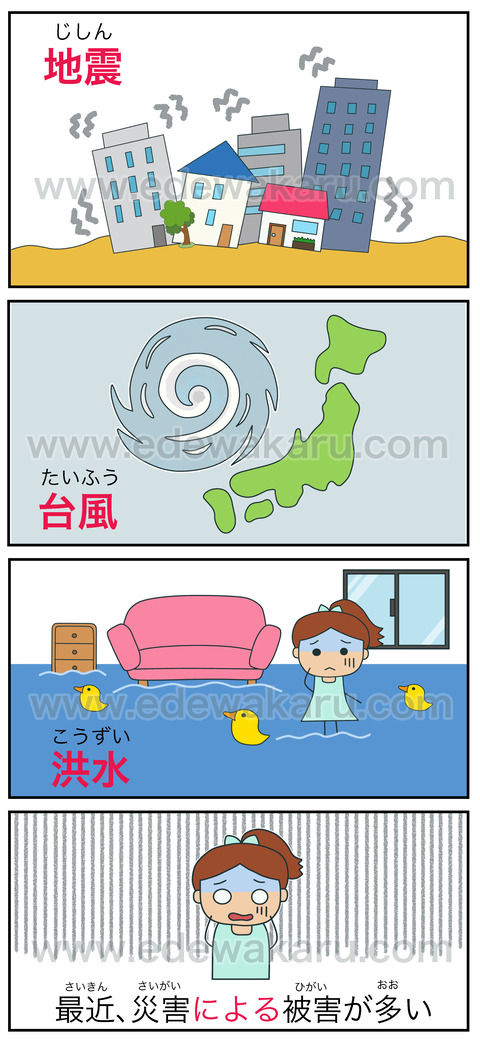
Meaning
due to 〜
caused by 〜
How to use it
Noun [dictionary form] + によって
Noun [dictionary form] + による + noun
Explanation
“〜によって” is a sentence pattern meaning “due to 〜” or “because of 〜.” What follows “〜によって” is an expression showing a result. As in examples ① and ④, when a noun follows, the form is “〜による + noun.” 😊
Remember “〜によって = due to 〜” and “〜による = caused by 〜.”
Also, “〜により” is a formal version of “〜によって,” and means the same thing. 😮
[Examples]
The train was delayed due to heavy rain.
= The train was delayed due to heavy rain.
As many as ten people were injured due to the accident.
= As many as ten people were injured due to the accident.
“〜によって” has many meanings, so make sure to distinguish and learn them. 😀
[Patterns using “〜によって”]
① cause/reason
② means/method
(Review: 〜によって (means))
③ distinction/circumstances
(Review: 〜によって (distinction))
④ agent in a passive sentence
⑤ basis/grounds
In context 4 examples
最近、災害による被害が多い
→最近、災害が原因の被害が多いRecently, there has been a lot of damage caused by disasters. → Recently, there has been a lot of disaster-related damage.
大雨によって、電車が遅れた
→大雨が原因で、電車が遅れたThe train was delayed due to heavy rain. → The train was delayed because of heavy rain.
事故によって、10人もケガをした(復習:〜も)
→事故が原因で、10人もケガをしたAs many as ten people were injured in the accident. (Review: 〜も) → As many as ten people were injured because of the accident.
先程の地震による津波の心配はないということです
→先程の地震が原因の津波の心配はないということです(復習:〜ということだ)*日本で地震があった場合にニュースなどでよく使われる表現です。日本に住んでいる人は覚えておくといいと思います😉There is no concern about a tsunami caused by the earthquake that just occurred. → There is no concern about a tsunami caused by the earthquake that just occurred. (Review: 〜ということだ) *This is an expression often used in news reports when an earthquake occurs in Japan. If you live in Japan, it’s useful to learn. 😉
Read the original source text
Meaning
〜が原因で
How to use it
名詞[辞書形]+によって
名詞[辞書形]+による+名詞
Explanation
「〜によって」は「〜が原因・理由で」という意味を表す文型です。「〜によって」の後ろには結果を表す表現がきます。例文①④のように、
後ろに名詞がくる場合は「〜による+名詞」という形になります
😊
「〜によって=〜が原因で」「〜による=〜が原因の」と覚えましょう。
また
「〜により」は「〜によって」のかたい言い方で、意味は同じです
😮
[例]
大雨
によって、電車が遅れた
=大雨
により、電車が遅れた
事故
によって、10人もケガをした
=事故
により、10人もケガをした
「〜によって」にはたくさん意味がありますので、しっかりと区別して覚えておきましょう😀
[「〜によって」を使う文型]
①原因・理由
②手段・方法
(復習:〜によって(手段))
③区別・場合
(復習:〜によって(区別))
④受身文の動作主
⑤根拠
Usage 3
Read this source entry ↗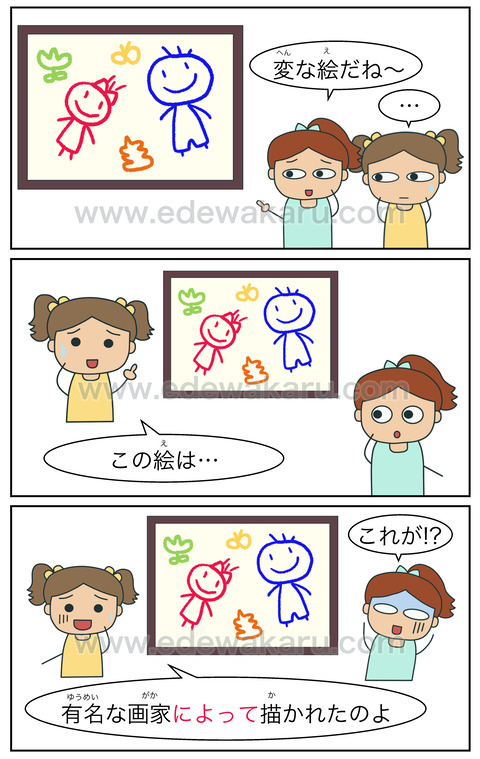
Meaning
To be … by …
How to use it
Noun [dictionary form] + によって〜される
Explanation
“〜によって” is a sentence pattern that indicates the agent of an action in a passive sentence. In “Aによって,” “A” is the person who performs the action. The following part takes the passive form, as in “〜される,” but it does not convey a feeling of [harm] or [inconvenience]. 😮
I think it’s useful to learn it in the form “〜によって〜される.” This pattern is used when talking about historical events or explaining things that already exist, so using it in conversation sounds a little formal.
(Review: 〜上)
[For those who want a little more detail]
The “〜に” in “〜に〜される,” which you learned at the beginner level, also indicates the agent of an action, but use “〜によって” when you want to say that something was created.
I think it’s useful to remember some verbs that are used with “〜によって.” 😉
[Verbs often used with “〜によって〜される”]
・書く
・描く
・作る
・作成する
・デザインする
・設計する
・生み出す, etc.
The sentence pattern “〜によって” has many meanings, so be sure to distinguish them and remember them well. 😀
(Review: 〜によって (distinction))
(Review: 〜によって (cause))
(Review: 〜によって (means))
In context 4 examples
この絵は有名な画家によって描かれたのよ
→この絵は有名な画家が描いたのよThis painting was painted by a famous artist. → A famous artist painted this picture.
このバッグは人気歌手によってデザインされた
→このバッグは人気歌手がデザインしたThis bag was designed by a popular singer. → A popular singer designed this bag.
アメリカ大陸は、コロンブスによって発見された
→アメリカ大陸は、コロンブスが発見したThe American continent was discovered by Columbus. → Columbus discovered the American continent.
あの商品は日本人によって開発されたということだ
→あの商品は日本人が開発したということだ(復習:〜ということだ)That product was apparently developed by a Japanese person. → That product was apparently developed by a Japanese person. (Review: 〜ということだ)
Read the original source text
Meaning
〜に〜される
How to use it
名詞[辞書形]+によって〜される
Explanation
「〜によって」は受身文の動作主を表す文型です。「Aによって」の「A」が動作をする人です。後ろは「〜される」というように受身文になりますが
【被害】【迷惑】の気持ちは入りません
😮
「〜によって〜される」
という形で覚えておくといいと思います😊「〜によって〜される」は歴史上で起きたことや、すでにあるものを説明したりする時に使う文型ですので、
会話で使用すると少しかたい感じになります。
(復習:〜上)
【余裕のある人へ】
初級で勉強した「〜に〜される」の「〜に」も動作主を表しますが、
「何かを作り出す」と言いたい時には「〜によって」を使うようにしましょう。
「〜によって」に使われる動詞をいくつか覚えておくといいと思います😉
[「〜によって〜される」によく使われる動詞]
・書く
・描く
・作る
・作成する
・デザインする
・設計する
・生み出す など
「〜によって」という文型にはたくさん意味がありますので、しっかりと区別をして覚えておきましょう😀
(復習:〜によって(区別))
(復習:〜によって(原因))
(復習:〜によって(手段))
Usage 4
Read this source entry ↗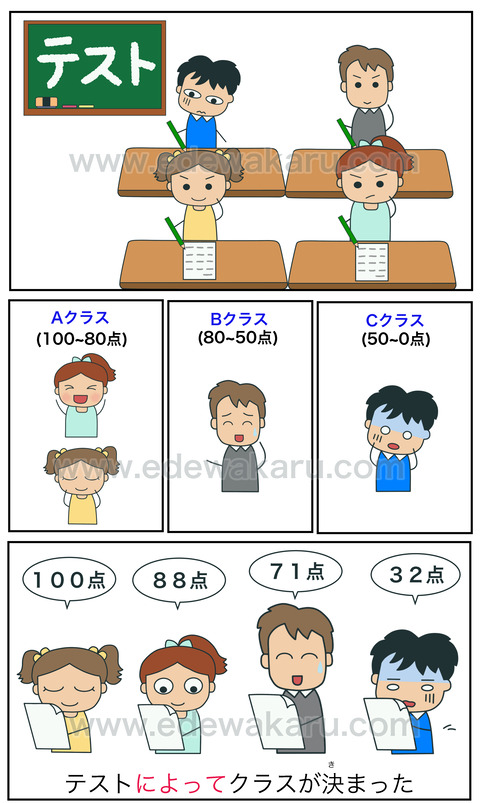
Meaning
by means of 〜 (means/method)
using the method of 〜
How to use it
Noun [dictionary form] + によって
Explanation
This time, “〜によって” expresses 【means】. It is used to mean “using the method of 〜.” 😀 When a noun follows, the form is “〜による + noun.”
[Example]
Travel by train is fast and convenient.
Also, “〜により” is the formal version of “〜によって.”
The meaning and usage are the same. 😊
[Examples]
① The class was decided by a test.
= The class was decided by a test.
② You can learn about world news through the internet.
= You can learn about world news through the internet.
Learn this 【means/method】 use of “〜によって” together with the 【distinction/circumstances】 use. 😊 (Review: 〜によって (distinction)) If you’re taking a test, try to read the sentence and determine whether it expresses 【means】 or 【distinction】. 😉 (Review: “テストをする” and “テストを受ける”)
In context 5 examples
テストによってクラスが決まった
→テストの結果でクラスが決まったThe class was decided by the test. → The class was decided based on the test results.
インターネットによって、世界のニュースを知ることができる
→インターネットを使って、世界のニュースを知ることができる(復習:「新聞」と「ニュース」の使い分け)You can learn about world news through the internet. → You can learn about world news using the internet. (Review: how to distinguish “newspaper” and “news”)
ドラマを見ることによってリスニング力を上げる
→ドラマを見ることでリスニング力を上げるWatching dramas improves listening ability. → Watching dramas can improve listening ability.
予習・復習によって日本語が上達した
→予習・復習することで日本語が上達したJapanese improved through preparation and review. → Japanese improved by preparing and reviewing.
早寝早起き(はやねはやおき)によって健康になった
→早寝早起きすることで健康になったI became healthy through going to bed and getting up early. → I became healthy by going to bed and getting up early.
Read the original source text
Meaning
〜で(手段・方法)
〜の方法を使って
How to use it
名詞[辞書形]+によって
Explanation
今回の「〜によって」は【手段】を表すものです。「〜の方法を使って」という意味で使います😀後ろに名詞がくる場合は「〜による+名詞」になります。
[例]
電車
による
移動は早くて便利だ
また、
「〜によって」のかたい言い方は「〜により」です。
意味や使い方は同じです😊
[例]
①テスト
によって
クラスが決まった
=テスト
により
クラスが決まった
②インターネット
によって
世界のニュースを知ることができる
=インターネット
により
世界のニュースを知ることができる
今回の【手段・方法】の「〜によって」と【区別・場合】の「〜によって」は一緒に覚えておきましょう😊(復習:〜によって(区別))テストを受ける人は文章を読んで、【手段】なのか【区別】なのかを判断できるようにがんばってくださいね😉(復習:「テストをする」「テストを受ける」)
どんなときどう使う 日本語表現文型辞典
Usage 1
Meaning
by
How to use it
N + によって
Explanation
によって〈受け身の動作主〉
~に
1)受け身文において、受け身動詞の動作の主体を表す。
2)受け身文の動作主は普通は「に」によって表されるが、生物以外のものが主語になる受け身文で、その動作主に焦点を当てたい場合などには「によって」が使われることが多い。
2)Subjects of passive verbs are usually denoted by particle に, but in sentences in which subjects are not living,によって is often used where focus is on agent of action.
1)Subject of action of passive verb in a passive sentence.
In context 4 examples
「リア王」はシェークスピアによって書かれた三大悲劇の一つです。
King Lear is one of Shakespeare’s three great tragedies.
このボランティア活動はある宗教団体によって運営されている。
This volunteer activity is run by a certain religious organization.
地震予知の研究はアメリカ、中国、日本などの専門家によって進められてきた。
Research into earthquake prediction has been carried out by experts from the United States, China, Japan, and other countries.
この伝統文化は、この地方の人々によって受け継がれてきた。
This traditional culture has been passed down by the people of this region.
Read the original source text
Meaning
by
How to use it
N+によって
Explanation
によって〈受け身の動作主〉
~に
1)受け身文において、受け身動詞の動作の主体を表す。
2)受け身文の動作主は普通は「に」によって表されるが、生物以外のものが主語になる受け身文で、その動作主に焦点を当てたい場合などには「によって」が使われることが多い。
2)Subjects of passive verbs are usually denoted by particle に, but in sentences in which subjects are not living,によって is often used where focus is on agent of action.
1)Subject of action of passive verb in a passive sentence.
Usage 2
Meaning
through; by
How to use it
N + によって
Explanation
によって〈手段・方法〉
~で
1)あることをする手段や方法を言いたいときに使う。
2)身近な道具や手段には使われない。
◆ × じゃ、この書類をファクスによって送ってください。→◯じゃ、この書類をファクスで送ってください。
3)後に名詞が来るときは ❺ のように「によるN」という形になる。
◆ × じゃ、この書類をファクスによって送ってください。→◯じゃ、この書類をファクスで送ってください。
3)When followed by a noun, becomes による N, as in sentence ❺ .
1)Describes methods or means.
2)Not used for familiar tools or means.
In context 5 examples
その問題は話し合いによって解決できると思います。
I think that problem can be solved through discussion.
アンケート調査によって学生たちの希望や不満を知る。
We learn about students’ hopes and complaints through a questionnaire survey.
ボランティア活動に参加することによって自分自身も多くのことを学んだ。
By taking part in volunteer activities, I learned a great deal myself.
彼は両親の死後、叔父の援助と励ましにより、自分の目指す道に進むことができた。
After his parents died, he was able to pursue the path he wanted, thanks to his uncle’s support and encouragement.
山田さんの仲介による商談は結局、うまくいかなかった。
The business negotiations mediated by Mr. Yamada ultimately did not go well.
Read the original source text
Meaning
through; by
How to use it
N+によって
Explanation
によって〈手段・方法〉
~で
1)あることをする手段や方法を言いたいときに使う。
2)身近な道具や手段には使われない。
◆ × じゃ、この書類をファクスによって送ってください。→◯じゃ、この書類をファクスで送ってください。
3)後に名詞が来るときは ❺ のように「によるN」という形になる。
◆ × じゃ、この書類をファクスによって送ってください。→◯じゃ、この書類をファクスで送ってください。
3)When followed by a noun, becomes による N, as in sentence ❺ .
1)Describes methods or means.
2)Not used for familiar tools or means.
Usage 3
Meaning
depending on
How to use it
N + によって
Explanation
によって〈対応〉
それぞれの~に対応して
1)さまざまな種類や可能性を表す名詞につながり、それぞれに対応して後の事柄もそれぞれに違うことを表す。後には、「いろいろある・違う」など、一定ではないという意味を表す文が来る。
2)後に名詞が来るときは ❹ のように「によるN」という形になる。
2)When followed by a noun becomes による N, as in sentence ❹ .
1)Links to nouns expressing many categories or possibilities; explains that everything following pattern differs from each other. In succeeding phrase, what is conveyed is difference, variety, and inconsistency.
In context 4 examples
とれたみかんを大きさによって三つに分け、それぞれの箱に入れてください。
Divide the harvested mandarins into three groups according to size, and put each group in its own box.
ホテルの窓からは、その日の天候によって富士山が見えたり見えなかったりです。
From the hotel window, Mount Fuji is sometimes visible and sometimes not, depending on the weather that day.
人により考え方はいろいろだ。
People have different ways of thinking.
季節による風景の変化は、人の感性を豊かにする。
Changes in scenery with the seasons enrich people’s sensibilities.
Read the original source text
Meaning
depending on
How to use it
N+によって
Explanation
によって〈対応〉
それぞれの~に対応して
1)さまざまな種類や可能性を表す名詞につながり、それぞれに対応して後の事柄もそれぞれに違うことを表す。後には、「いろいろある・違う」など、一定ではないという意味を表す文が来る。
2)後に名詞が来るときは ❹ のように「によるN」という形になる。
2)When followed by a noun becomes による N, as in sentence ❹ .
1)Links to nouns expressing many categories or possibilities; explains that everything following pattern differs from each other. In succeeding phrase, what is conveyed is difference, variety, and inconsistency.
Usage 4
Meaning
because of; owing to
How to use it
N + によって
Explanation
によって〈原因・理由〉
~が原因で
1)「~によって、…」の形で「~が原因で、…の結果になった」と言うときに用いる。
2)後に名詞が来るときは ❸ のように「によるN」という形になる。
2)When followed by a noun becomes による N, as in sentence ❸ .
1)Some outcome is result of a cause.
In context 3 examples
ABC店は一昨年からの不景気によって、ついに店を閉めることとなった。
Because of the recession that began the year before last, ABC Store has finally had to close.
女性の社会進出が進んだことにより、女性の社会的地位もだんだん向上してきた。
As women have made greater inroads into society, their social status has gradually improved.
今回の地震による死者は100人以上になるようだ。
The number of deaths caused by this earthquake is expected to exceed 100.
Read the original source text
Meaning
because of; owing to
How to use it
N+によって
Explanation
によって〈原因・理由〉
~が原因で
1)「~によって、…」の形で「~が原因で、…の結果になった」と言うときに用いる。
2)後に名詞が来るときは ❸ のように「によるN」という形になる。
2)When followed by a noun becomes による N, as in sentence ❸ .
1)Some outcome is result of a cause.
日本語NET JLPT文法解説まとめ
Usage 1
Read this source entry ↗Meaning
Because of …
How to use it
N + によって
Explanation
because of / owing to / due to
The expression 「〜により」 is also used, but it is somewhat more formal than 「〜によって」.
In context 13 examples
人身事故の影響によって、電車が遅れている。
The train is delayed because of an accident involving personal injury.
台風の影響により、搭乗予定の飛行機が欠航になった。
Because of the typhoon, the flight I was scheduled to take was canceled.
関東地方で発生した地震により、多くの人が犠牲になった。
Many people were killed by an earthquake that occurred in the Kanto region.
インフレにより、商品の値段が上がっている。
Prices are rising because of inflation.
不景気の影響により、物を買う人が減ってきた。
The number of people buying things has been decreasing because of the recession.
日本では昔よりも、いじめによる自殺者数が増えている。
In Japan, the number of suicides caused by bullying has increased compared with the past.
大地震の後の津波によって、多くの人が亡くなった。
Many people died in the tsunami following the major earthquake.
火事によって、伝統的なお寺が全て燃えてしまった。
All the traditional temples burned down in the fire.
スマホの普及によって、手紙や年賀状を書く人が減った。
As smartphones became widespread, fewer people began writing letters and New Year’s cards.
事故による犠牲者は、10人となりました。
The number of victims of the accident came to ten.
私のTwitterの書き込みにより、多くの人を傷つけてしまった。
My posts on Twitter ended up hurting many people.
地球温暖化により、様々な問題が起きている。
Various problems are occurring because of global warming.
ドーピングが発覚したことにより、彼の金メダルは剥奪された。
After his doping was discovered, his gold medal was taken away.
Read the original source text
Meaning
〜が原因で。
How to use it
N + によって
Explanation
because of / owing to / due to
「〜により」という言い方もあるが、「〜によって」よりもやや硬い表現である。
Usage 2
Read this source entry ↗Meaning
When “…” changes, the latter part changes too.
How to use it
N + によって
Explanation
depending on
In context 10 examples
文化は国によって異なる。
Culture differs from country to country.
物価は国によって異なる。
Prices differ from country to country.
好みは人によって違う。
Preferences differ from person to person.
人によって感じ方は違うものだ。
People feel things differently.
こちらのレストランでは曜日によってメニューが違います。
The menu at this restaurant varies by day of the week.
荷物の配達料は重さや大きさによって異なる。
Delivery fees vary depending on the weight and size of the package.
天気によって、見える景色が異なる。
The scenery you can see varies depending on the weather.
話す相手によって、きちんと言葉の使い方を変えないと、相手を不快な気持ちにさせてしまうかもしれない。
You need to adjust your word choice appropriately depending on whom you’re speaking to, or you may make them uncomfortable.
ここは時間帯によって、混雑状況が異なります。
The level of crowding here varies by time of day.
この会社では仕事の成果によって、給料が変わる。
At this company, salaries vary according to work performance.
Read the original source text
Meaning
「〜」が変わると、後件も変わる。
How to use it
N + によって
Explanation
depending on
Usage 3
Read this source entry ↗Meaning
“To do something by means or method of N.”
Expresses a means or method.
Used in written language.
Can be replaced with “〜で.”
It is not used when simply stating the choice of a means.
× Every day, I go to school by bicycle.
× I eat rice with chopsticks.
● Examples of words that can come in the N position:
Internet, email, method, marriage, recycling, dialogue, education, request, technology, system, etc.
Explanation
“to do 〜 by means or method of 'Noun'”
Used to refer to a means or method.
Usually used in writing.
It can be replaced with '〜で.'
① The expression “〜により” is also used, but it is somewhat more formal than “〜によって.”
② When followed by a noun, it becomes “〜によるN.”
① There is also the expression "〜により," which is slightly more formal than "〜によって."
② When followed by a noun, it becomes "〜によるN."
In context 11 examples
テストの結果によって、クラスが決まる。
The class is determined by the test results.
毎日、早く起きることによって、体の調子がよくなってきた。
By getting up early every day, my physical condition has improved.
その問題は話し合いによって、解決できると思う。
I think that problem can be solved through discussion.
インターネットによって、色々なビジネスができる。
The internet makes it possible to run various kinds of businesses.
インターネットによって、どこでも映画が見られる。
Thanks to the internet, you can watch movies anywhere.
アンケート調査によって、社員が何に不満を感じているのか知ることができた。
Through a questionnaire survey, we were able to find out what the employees were dissatisfied with.
毎日習ったことをすぐに復習することによって、日本語が上達します。
Your Japanese will improve by reviewing right away what you learned each day.
私は毎朝早く起きることによって、ゆっくり朝食を食べる時間や新聞を読む時間を作っています。
By getting up early every morning, I make time to eat breakfast at a leisurely pace and read the newspaper.
未成年者の飲酒や喫煙は法律によって、禁止されています。
Drinking and smoking by minors are prohibited by law.
スマホによって、決済までできる時代になった。
We’ve entered an age when you can even make payments with a smartphone.
ボランティアに参加することによって、たくさんのことを学ぶことができた。
By taking part in volunteer activities, I was able to learn a lot.
Read the original source text
Meaning
"Nという手段や方法で〜する"
手段・方法を表す。
書き言葉として使われる。
「〜で」で置き換えが可能。
単に手段の選択を表す場合には使わない。
×毎日、自転車によって学校へ行く。
×箸でご飯を食べます。
●Nにくる言葉の例
インターネット、メール、方法、結婚、リサイクル、対話、教育、リクエスト、技術、システムなど。
Explanation
"to do 〜 by means or method of 'Noun'"
Used to refer to a means or method.
Usually used in writing.
It can be replaced with '〜で.'
①「〜により」という言い方もあるが、「〜によって」よりもやや硬い表現である。
② 後ろに名詞が来る場合は「〜によるN」となる。
① There is also the expression "〜により," which is slightly more formal than "〜によって."
② When followed by a noun, it becomes "〜によるN."
毎日のんびり日本語教師
Meaning
① Basis
② Means
③ Cause
④ Passive (the agent of a passive sentence)
⑤ Different results in different situations
⑥ Subject of an action
How to use it
Noun+によって/によっては/により/による
Explanation
There are six meanings.
① Basis
② Means
It can be replaced with the case-marking particle 「で」, which indicates means, but 「~よって」 cannot be used for things of the kind used in everyday life. In such cases, use 「で」.
(Example) ◯電車で会社に行く。 (I go to work by train.)
✕電車によって会社に行く。 (I go to work by train.)
③ Cause
The first part states an objective cause, and the second part states some event that occurred because of that cause. This is a written expression.
④ Passive (the agent of a passive sentence)
It indicates the agent in a passive sentence. It is often used to state historical facts or established facts objectively.
⑤ Different results in different situations
It expresses that different situations lead to different results. In many cases, 「違う」 or 「異なる」 appears in the second part. 「~によっては」 is used only with this meaning.
⑥ Subject of an action
Notes
The 「よる」 series
【N3 Grammar】~によって/によっては/により/による
【N3 Grammar】~によらず
【N3 Grammar】~によると/によれば/の話では
In context 18 examples
テストの結果によって、成績を決める。
The grades are determined based on the test results.
未成年の喫煙は法律によって禁じられている。(根据法律禁止未成年人吸烟。)
Smoking by minors is prohibited by law. (The law prohibits minors from smoking.)
行くかどうかは、明日の天気によって決めるつもりだ。(去不去要看明天的天气再决定。)
I plan to decide whether to go based on tomorrow's weather. (I'll decide whether to go depending on tomorrow's weather.)
地域の安全はそこに住む人々の協力によって保たれている。
The safety of the area is maintained through the cooperation of the people who live there.
インターネットによって、世界中のニュースを知ることができるようになった。
The internet has made it possible to learn about news from all over the world.
職場環境を改善することによって、従業員満足度を高める。
Improve employee satisfaction by improving the work environment.
事故によって片足を失ってしまった。(因为事故失去了一只脚。)
I lost one foot in an accident. (I lost one foot because of an accident.)
今回の大雨により孤立した地域があるらしい。
Apparently, some areas have been cut off by the heavy rain this time.
不況によって多くの会社が倒産している。
Many companies are going bankrupt because of the recession.
2012年、CERNによってヒッグス粒子とみられる粒子が発見された。(2012年,CERN发现了被认为是希格斯粒子的粒子。)
In 2012, a particle believed to be the Higgs boson was discovered by CERN. (In 2012, CERN discovered a particle believed to be the Higgs boson.)
金閣寺は足利義満によって建てられた。
Kinkaku-ji was built by Ashikaga Yoshimitsu.
壁が何者かによって壊された。
The wall was broken by someone.
人によって考え方は違う。(想法因人而异。)
People's ways of thinking differ from person to person. (People's ways of thinking vary from person to person.)
天気予報によると、所によっては大雨になるそうだ。
According to the weather forecast, some places are expected to get heavy rain.
場合によっては強硬策をとらなくてはならなくなる。
Depending on the circumstances, we may have to take forceful measures.
校長先生による特別講義が行われた。
A special lecture by the principal was held.
上司からのパワハラによる苦痛は、うつ病にかかってしまうリスクを引き起こす。
The distress caused by workplace harassment from a superior can lead to a risk of developing depression.
A国は空軍によるミサイル攻撃を否定している。(A国否认了空军的导弹攻击。)
Country A denies carrying out a missile attack by its air force. (Country A denied the air force's missile attack.)
Read the original source text
Meaning
①根拠
②手段
③原因
④受身(受身文の動作主)
⑤異なる状況で異なる結果
⑥動作の主体
How to use it
名詞+によって/によっては/により/による
Explanation
意味は6つあります。
①根拠
②手段
手段を表す格助詞「で」に置き換えることができますが、日常生活で使うようなものに対して「~よって」を使うことはできません。そのような場合は「で」を使います。
(例)◯電車で会社に行く。
✕電車によって会社に行く。
③原因
前項で客観的な原因を述べ、後項ではその原因によって発生した何らかの出来事を述べます。書き言葉です。
④受身(受身文の動作主)
受身文における動作主を表します。歴史上の事実や規定事実を客観的に伝えるときによく用います。
⑤異なる状況で異なる結果
状況が異なると、結果も異なることを表します。多くの場合、後項には「違う」「異なる」が呼応します。「~によっては」はこの意味の時にだけ使われます。
⑥動作の主体
Notes
「よる」シリーズ
【N3文法】~によって/によっては/により/による
【N3文法】~によらず
【N3文法】~によると/によれば/の話では
日本語文型辞典 英語版
Meaning
Placed after a noun and means “that (= the noun) is the cause of something.” Followed by an expression that indicates a result.
Expresses the agent in a passive sentence. Nによって is the same as Xに in the pattern XにYされる. However, when the verb Y expresses the production of something, like 設計する (design), 作る (make) or 書く (write), によって must be used instead of に. Also, when the preceding noun is a thing that is understood to be a cause, like 洪水 (flood) and 敵の反撃 (the enemy’s counterattack) in
(2)
and
(3)
, によって can be replaced by で.
(例)洪水で押し流された。
They were washed away by the flood.
Means “by means of something” or “by using some method.”
Attaches to a noun or an interrogative expression followed by か and means “on the grounds of something,” “on the basis of something.” Examples
(5)
and
(6)
are idiomatic expressions that mean “as usual, as always.”
Means “according to various cases of the thing in question.”
(5)
is an idiomatic expression that means the same as 場合によって (depending on the circumstances/situation).
How to use it
1. Nによって〈cause〉
2. Nによって〈agent in a passive sentence〉
3. Nによって〈means〉
4. Nによって〈basis〉
5. Nによって〈individual case〉
In context 25 examples
私の不注意な発言によって、彼を傷つけてしまった。
I hurt him with my thoughtless comment.
踏切事故によって、電車は3時間も遅れました。
An accident at the railroad crossing delayed the train for three whole hours.
ほとんどの会社は不況によって経営が悪化した。
The business activity of almost all companies has deteriorated because of the recession.
この建物は有名な建築家によって設計された。
This building was designed by a famous architect.
その村の家の多くは洪水によって押し流された。
Many of the houses in the village were washed away by the flood.
敵の反撃によって苦しめられた。
We were tormented by the enemy’s counterattack.
これらの聖典はヨーロッパからの宣教師たちによってもたらされた。
These sacred books were brought by missionaries from Europe.
3年生の児童たちによって校庭に立派な人文字が描かれた。
A splendid living Chinese character was formed by the third-grade students in the schoolyard.
この奇抜なファッションは新しいものを好む若者たちによってただちに受け入れられた。
This bizarre fashion was instantly accepted by young people who like something new.
この資料によって多くの事実が明らかになった。
Many facts have been revealed by this data.
給料をカットすることによって、不況を乗り切ろうとしている。
They are trying to pull through the recession by reducing wages.
交通網の整備によって、遠距離通勤が可能になった。
Long-distance commuting has been made possible by improvement of the transportation network.
コンピュータによって大量の文書管理が可能になった。
Computers have made it possible to manage large quantities of documents.
インターネットによって世界中の情報がいとも簡単に手に入るようになった。
The internet has made it possible to obtain information from all over the world with no trouble at all.
この資料によっていままで不明だった多くの点が明らかになった。
Based on this data, many things that were previously unknown have been brought to light.
行くか行かないかは、あしたの天気によって決めよう。
Let’s decide whether or not to go based on the weather tomorrow.
先生の御指導によってこの作品を完成させることができました。
Thanks to the teacher’s supervision, I was able to complete this work.
試験の成績よりも通常の授業でどれだけ活躍したかによって成績をつけようと思う。
I’m planning to grade you based on your classroom performance rather than your exam marks.
恒例によって会議の後に夕食会を設けることにした。
As is customary, we’ve decided to have a dinner party after the meeting.
例によって彼らは夜遅くまで議論を続けた。
As usual, they went on with their discussion until late at night.
人によって考え方が違う。
Ways of thinking differ from person to person.
明日は所によって雨が降るそうだ。
I hear it’s going to rain in some areas tomorrow.
時と場合によって、考え方を変えなければならないこともある。
Sometimes we have to change our way of thinking, depending on the time and situation.
場合によってはこの契約を破棄しなければならないかもしれない。
Depending on the circumstances, I may have to cancel this agreement.
事と次第によっては、裁判に訴えなければならない。
Depending on what happens, I may have to take the matter to court.
Bunpro Grammar Reference
Meaning
By means of, According to, Depending on, Because of, Due to
How to use it
Noun + によって
Noun + により
Nuance
A semi-formal expression that highlights information that is according to (A), or stems from (A).
Explanation
によって, による, and により are all different versions of the same expression, that can basically be translated as 'according to (A)', or 'depending on (A)'. This uses the same よる as seen in the grammar pattern によると. They will be used in the following way:
によって - Generally used before a comma (although not always). Acts as the separation point between the (A) and (B) parts of a sentence. Made up of the case marking particle に, and the う - Verb よる in its て form.
による - Generally used at the end of a sentence, to highlight that the previous statement depends on (A).
により - Almost always used before a comma. Acts as the separation point between the (A) and (B) parts of a sentence. Made up of the case marking particle に, and the う - Verb よる in its conjunctive form.
To use any of these constructions, attach them to the end of a noun that you want to express as being the 'dependent' thing.
地域によって、ゴミ出しルールが違う。
Depending on the area, the rules for throwing out garbage are different.
行けるか行けないかは休みが取れるか取れないかによる。
Whether I can go or not depends on if I can take a day off.
ベンおじさんは強盗により、命を奪われた。
Uncle Ben's life was taken by a robber.
Caution
による may also sometimes be followed by a noun. In these cases, it will become a verb modified noun, and highlight that (B) resulted from (A).
このミスはヒューマンエラーによるものです。
This mistake is caused by human error.
この地震による津波の心配はありません。
There is no need to worry about a tsunami brought about from this earthquake.
Fun Fact
Although よる is almost always written in hiragana, there are several different kanji that use this reading. They all share similar meanings. Learn more about this in the によると grammar point.
In context 17 examples
- その車の値段によって、決めます。
I will choose depending on the price of that car.
- 地域によって、ゴミ出しルールが違う。
Depending on the area, the rules for throwing out garbage are different.
- 行けるか行けないかは休みが取れるか取れないかによる。
Whether I can go or not depends on if I can take a day off.
- ベンおじさんは強盗により、命を奪われた。
Uncle Ben's life was taken by a robber.
- 国によって、いろいろな伝統があります。
There are a variety of traditions depending on the country.
- 調査によって新たな事実が明らかになった。
Through investigation, a new truth was discovered. (by means of)
- 納豆が好きかどうかは人による。
It depends on the person whether they like natto or not.
- 話し合いによって決まったのだから、文句言わないで。
Our decision was made through discussion, so don't complain.
- 何色を選ぶかは好みによる。
It depends on a person's preference what color they choose.
- アメリカでは州によって法律が違う。
In America, laws differ depending on the state.
- 季節によって体調も変化するから大変だ。
It's rough because my physical condition changes depending on the season.
- あきば・いつきさんは火事によってすべての資産を失った。
Ms. Itsuki Akiba lost all her assets due to the fire.
- なんでも力によって解決するのは横暴すぎると思います。
I think it's too violent to solve everything through force.
- 動かない生活により、人々は以前より心疾患にかかりやすくなってしまった。
Due to sedentary lifestyles, people became more prone than before to suffer from heart diseases.
- カーテンによって仕切られたところが僕の部屋だ。
The section which is divided by the curtain is my room. (By means of)
- このミスはヒューマンエラーによるものです。
This mistake is caused by human error.
- この地震による津波の心配はありません。
There is no need to worry about a tsunami brought about from this earthquake.
Read the original source text
Meaning
By means of, According to, Depending on, Because of, Due to
How to use it
Noun + によって
Noun + により
Nuance
A semi-formal expression that highlights information that is according to (A), or stems from (A).
Explanation
によって, による, and により are all different versions of the same expression, that can basically be translated as 'according to (A)', or 'depending on (A)'. This uses the same よる as seen in the grammar pattern によると. They will be used in the following way:
によって - Generally used before a comma (although not always). Acts as the separation point between the (A) and (B) parts of a sentence. Made up of the case marking particle に, and the う - Verb よる in its て form.
による - Generally used at the end of a sentence, to highlight that the previous statement depends on (A).
により - Almost always used before a comma. Acts as the separation point between the (A) and (B) parts of a sentence. Made up of the case marking particle に, and the う - Verb よる in its conjunctive form.
To use any of these constructions, attach them to the end of a noun that you want to express as being the 'dependent' thing.
地域によって、ゴミ出しルールが違う。
Depending on the area, the rules for throwing out garbage are different.
行けるか行けないかは休みが取れるか取れないかによる。
Whether I can go or not depends on if I can take a day off.
ベンおじさんは強盗により、命を奪われた。
Uncle Ben's life was taken by a robber.
Caution
による may also sometimes be followed by a noun. In these cases, it will become a verb modified noun, and highlight that (B) resulted from (A).
このミスはヒューマンエラーによるものです。
This mistake is caused by human error.
この地震による津波の心配はありません。
There is no need to worry about a tsunami brought about from this earthquake.
Fun Fact
Although よる is almost always written in hiragana, there are several different kanji that use this reading. They all share similar meanings. Learn more about this in the によると grammar point.
Nuance · 日本語
(A)から聞いた、又は(A)から来た話だということを少し丁寧に表す表現。
Explanation · 日本語
「によって」「による」「により」は、「(A) が原因・理由で (B) になるとき」や、「(A) に影響を受けて (B) が変わるとき」に使われる文法です。この「よる」は、先に学んだ「によると」に使われている動詞と同じです。以下、使い方を見てみましょう。
「によって」は、主に文の (A) と (B) が 分かれるところで使われます。うしろに読点「、」が 置かれることも多いです。「に」は 格助詞、「よって」は 五段動詞「よる」の テ形です。
「による」は、主に文の 終わりに 使われます。何かが (A) の内容に影響を受けて変わることを 表します。
「により」も、文の (A) と (B) が 分かれるところで使われます。読点「、」と一緒に 使われることがほとんどです。これは格助詞の「に」と、五段動詞「よる」の 連用形でできていて、「によって」よりも丁寧な言い方です。
この文法は、原因や理由を指す名詞のうしろに付けて使います。
地域によって、ゴミ出しルールが違う。
Depending on the area, the rules for throwing out garbage are different.
行けるか行けないかは休みが取れるか取れないかによる。
Whether I can go or not depends on if I can take a day off.
ベンおじさんは強盗により、命を奪われた。
Uncle Ben's life was taken by a robber.
注意点
「による」は、すぐうしろに置いた名詞を修飾することができます。このとき、「(A) による (B)」の形で、(A) が原因で (B) が起こることを表します。
このミスはヒューマンエラーによるものです。
This mistake is caused by human error.
この地震による津波の心配はありません。
There is no need to worry about a tsunami brought about from this earthquake.
豆知識
ほとんどの場合、「よる」はひらがなで書かれますが、「よる」に使える漢字はいくつかあります。どれも基本の意味は同じですが、ニュアンスに少し違いがあります。詳しい説明は「によると」のページにあります。
文法
Usage 1
Meaning
“Do something by means of N”
Indicates a means or method.
Used in written language.
Can be replaced by 「〜で」.
It is not used when simply indicating the choice of a means.
×Every day, I go to school by bicycle.
×I eat rice with chopsticks.
●Examples of words used as N
Internet, email, method, marriage, recycling, dialogue, education, request, technology, system, etc.
Notes
・「〜により」 is also used, but it is a somewhat stiffer expression than 「〜によって」.
・When followed by a noun, it becomes 「〜によるN」.
In context 11 examples
テストの結果によって、クラスが決まる。
The class is determined by the test results.
毎日、早く起きることによって、体の調子がよくなってきた。
By getting up early every day, my physical condition has improved.
その問題は話し合いによって、解決できると思う。
I think that problem can be solved through discussion.
インターネットによって、色々なビジネスができる。
The internet makes it possible to run various kinds of businesses.
インターネットによって、どこでも映画が見られる。
Thanks to the internet, you can watch movies anywhere.
アンケート調査によって、社員が何に不満を感じているのか知ることができた。
Through a questionnaire survey, we were able to find out what the employees were dissatisfied with.
毎日習ったことをすぐに復習することによって、日本語が上達します。
Your Japanese will improve by reviewing right away what you learned each day.
私は毎朝早く起きることによって、ゆっくり朝食を食べる時間や新聞を読む時間を作っています。
By getting up early every morning, I make time to eat breakfast at a leisurely pace and read the newspaper.
未成年者の飲酒や喫煙は法律によって、禁止されています。
Drinking and smoking by minors are prohibited by law.
スマホによって、決済までできる時代になった。
We’ve entered an age when you can even make payments with a smartphone.
ボランティアに参加することによって、たくさんのことを学ぶことができた。
By taking part in volunteer activities, I was able to learn a lot.
Read the original source text
Meaning
"Nという手段や方法で〜する"
手段・方法を表す。
書き言葉として使われる。
「〜で」で置き換えが可能。
単に手段の選択を表す場合には使わない。
×毎日、自転車によって学校へ行く。
×箸によってご飯を食べます。
●Nにくる言葉の例
インターネット、メール、方法、結婚、リサイクル、対話、教育、リクエスト、技術、システムなど。
Notes
・「〜により」という言い方もあるが、「〜によって」よりもやや硬い表現である。
・後ろに名詞が来る場合は「〜によるN」となる。
Usage 2
Meaning
It is not used when simply indicating the choice of a means.
×Every day, I go to school by bicycle.
×I eat rice with chopsticks.
In context 2 examples
毎日、自転車によって学校に通っている。
I commute to school by bicycle every day.
メールによって、友達に連絡することが多い。
I often contact my friends by email.
Read the original source text
Meaning
単に手段の選択を表す場合には使わない。
×毎日、自転車によって学校へ行く。
×箸によってご飯を食べます。
Usage 3
Meaning
When “…” changes, the latter part changes too.
How to use it
N + によって
In context 10 examples
文化は国によって異なる。
Culture differs from country to country.
物価は国によって異なる。
Prices differ from country to country.
好みは人によって違う。
Preferences differ from person to person.
人によって感じ方は違うものだ。
People feel things differently.
こちらのレストランでは曜日によってメニューが違います。
The menu at this restaurant varies by day of the week.
荷物の配達料は重さや大きさによって異なる。
Delivery fees vary depending on the weight and size of the package.
天気によって、見える景色が異なる。
The scenery you can see varies depending on the weather.
話す相手によって、きちんと言葉の使い方を変えないと、相手を不快な気持ちにさせてしまうかもしれない。
You need to adjust your word choice appropriately depending on whom you’re speaking to, or you may make them uncomfortable.
ここは時間帯によって、混雑状況が異なります。
The level of crowding here varies by time of day.
この会社では仕事の成果によって、給料が変わる。
At this company, salaries vary according to work performance.
Read the original source text
Meaning
「〜」が変わると、後件も変わる。
How to use it
N + によって
Usage 4
Meaning
Because of …
How to use it
N + によって
Notes
「〜により」 is also used, but it is a somewhat stiffer expression than 「〜によって」.
In context 13 examples
人身事故の影響によって、電車が遅れている。
The train is delayed because of an accident involving personal injury.
台風の影響により、搭乗予定の飛行機が欠航になった。
Because of the typhoon, the flight I was scheduled to take was canceled.
関東地方で発生した地震により、多くの人が犠牲になった。
Many people were killed by an earthquake that occurred in the Kanto region.
インフレにより、商品の値段が上がっている。
Prices are rising because of inflation.
不景気の影響により、物を買う人が減ってきた。
The number of people buying things has been decreasing because of the recession.
日本では昔よりも、いじめによる自殺者数が増えている。
In Japan, the number of suicides caused by bullying has increased compared with the past.
大地震の後の津波によって、多くの人が亡くなった。
Many people died in the tsunami following the major earthquake.
火事によって、伝統的なお寺が全て燃えてしまった。
All the traditional temples burned down in the fire.
スマホの普及によって、手紙や年賀状を書く人が減った。
As smartphones became widespread, fewer people began writing letters and New Year’s cards.
事故による犠牲者は、10人となりました。
The number of victims of the accident came to ten.
私のTwitterの書き込みにより、多くの人を傷つけてしまった。
My posts on Twitter ended up hurting many people.
地球温暖化により、様々な問題が起きている。
Various problems are occurring because of global warming.
ドーピングが発覚したことにより、彼の金メダルは剥奪された。
After his doping was discovered, his gold medal was taken away.
Read the original source text
Meaning
〜が原因で。
How to use it
N + によって
Notes
「〜により」という言い方もあるが、「〜によって」よりもやや硬い表現である。
IMABI
~によって
Read this IMABI lesson ↗Explanation
~によって
When we learned about the agent marker に, we learned how several functions of に are interrelated. From its basic definition of showing where something exists, に by extension marks the existence of an agent. As we learned in that lesson and the lessons that followed, に marks the agent of stative-transitive, passive sentences, and causative predicates.
At the conclusion of our discussion on how に functions as an agent, we learned that に can in fact follow verbal expressions. By doing so, the verb becomes grammatically nominalized, but because the resultant noun is still verbal in nature, the “agent” becomes interpreted as a reason/purpose/cause for the main predicate of the sentence. Thus, the purpose-marker is born.
In Lesson 115, we briefly discussed how ~によって can be used to mark the agent. This is the combination of the agent-marker に and よる, which has various nuances including “to be caused by/to depend on/to be based on.” At its basic understanding, it helps fully establish that something is an agent, especially when other usages of に are present.
~によって・により
1. 原因 (Cause)・理由 (Reason): The first usage of ~によって is to objectively and indifferently present cause/reason. This speech pattern, thus, is not used so much in general conversation due to its lack of emotion. It is, however, perfectly appropriate for speaking in a technical manner.
In English, this usage translates as “due to.” Whenever it is used to directly modify a noun, you use ~による (Exs. 3-6).
Spelling Note: The Kanji spelling for this nuance is に因って.
1. 踏切ふみきりでの大おおきな衝突事故しょうとつじこによって、運行うんこうに20にじゅう時間じかんの遅おくれが出でた。
Due to a large collision at the railroad crossing, a 20-hour delay came out in operations.
2. このビルは大地震おおじしん{によって・で}ばらばらに破壊はかいされた。
This building was destroyed to pieces [by/in] the big earthquake.
3. 過失かしつによる人身事故じんしんじこ
Traffic accident caused by a blunder
4. 大地震おおじしんによる家屋倒壊かおくとうかいは、すでに一万戸いちまんこを超こえているといわれる。
It’s said that the number of homes that collapsed due to the big earthquake has already surpassed 10,000 homes.
5. 福島原発事故ふくしまげんぱつじこによる放射能環境汚染ほうしゃのうかんきょうおせん
Environmental radioactivity pollution caused by the Fukushima Nuclear Accident
6. 牛うしインフルエンザによる死亡者しぼうしゃが続出ぞくしゅつしています。
Deaths are occurring one after another due to cow influenza.
2. 手段 (Method): によって can also be used in the sense of “by” to express method. This usage has considerable overlap with the particle で, but because によって deals heavily in showing agents of happenstance, when method is being used in a way that is not a speaker literally using a tool/method, then only によって would be appropriate.
When modifying nouns directly with this meaning, ~によって takes either the form ~による or ~によっての.
7. インターネットにより世界せかいのニュースを知しる。
To know the world news by the Internet.
8. インターネット{によって・で}、人間にんげんは居いながらにして、世界せかいを概観がいかんできる。
Through/with the internet, people can stay seated as they can survey the world.
9. 投票とうひょう{によって・で}決きめよう。
Let’s decide by vote.
10. 大抵たいていの成功せいこうは不断ふだんの努力どりょくによって得えられる。
Most success is gained by ceaseless effort.
~によって VS ~を通じて・通して
There is some interchangeability between ~によって, ~を通じて, and ~を通して with Usage 2. ~によって places emphasis on the connection between the method and effect/result, which is in line with how the agent-maker に behaves. The latter two phrases, on the other hand, place emphasis on the process.
12. インターネット{によって・を通つうじて・を通とおして}、アルバムを販売はんばいする。
To sell albums by/via/through the Internet.
13. 選挙せんきょ{〇 によって・X を通つうじて・X を通とおして}委員長いいんちょうになる。
To become the committee chairman by election.
3. 受身の動作主 (Agent of a Passive Structure): As we have already learned about, ~によって can be used with the passive form of a verb to show the agent (doer). If a sentence with a receiver (indirect object) is passivized, the agent must be marked by ~によって. Additionally, ~による is the only acceptable attribute form for this usage.
14. 田中たなかさん{〇 によって・X に}岡田おかださんに手紙てがみが送られました。
A letter was sent to Mr. Okada by Mr. Tanaka.
15. その仕事しごとは加藤かとうさんによってなされました。
The work was done by Mr. Kato.
16. ライトアップ{によって・で}夢幻的むげんてきな光景こうけいが生うみ出だされた。
A dreamy scenery was created by/with a light-up.
17. 松本清張まつもとせいちょうによる小説しょうせつ
A novel by Matsumoto Seichō
4. 根拠 (Proof)・拠り所 (Basis): Following a rule/law/example/precedent/previous example/etc., it is used a lot to clearly show proof/basis. In this usage, ~による is the only acceptable attribute form. This should only be used when something clear is understood. It should not be used for mere hearsay.
18. 証言しょうげんによる真実しんじつ
Truth according to testimony
19. 前例ぜんれい{による・に基もとづく}判決はんけつが下くだされることになる。
A judgment is to be made based on precedent.
5. 場合 (Circumstance)・相応変化 (Reasonable Change): This usage is perhaps the most common in the spoken language, equating to “depending on…” Both ~による and ~によっての are correct attribute forms, although the latter is more common in the spoken language.
20. 天候てんこうによっては中止ちゅうしもありえるでしょう。
Depending on the weather conditions, (the match) may possibly be canceled.
21. 時ときと場合ばあいに{よっての・よる}対処たいしょ
Approach which depends on the time and circumstance
22. お金かねによって、人ひとは変かわるものです。
People change depending on money.
23. この仕事しごとは販売数はんばいすうによって給料きゅうりょうが変かわります。
As for this job, one’s salary changes depending on sales.
24. 板前長いたまえちょうの腕うでによって、寿司すしの味あじの良よし悪しが左右さゆうされます。
The quality of the flavor of sushi is dependent on the skill of the chef.
25. 含ふくまれる材料ざいりょうによって、いろいろな味あじのラーメンがあります。
There are many flavors of ramen based on the ingredients put in it.
26. 人ひとによって考かんがえが違ちがいます。
Opinions vary from person to person.
27. 挨拶言葉あいさつことばはその日ひの天気てんきによっていろいろ言いえばよい。
It’s best to say that there are various greetings based on the weather of the day.
28. 曜日ようびによって授業じゅぎょうが変かわります。
Classes change depending on the day of the week.
29. 人ひとによって好すきなものと嫌きらいなものは異ことなります。
One’s likes and dislikes differ from person to person.
30. 「でも、すごいのよ。二階にかいの人ひとが歩あるくと、天井てんじょうがみしみしって鳴なるの。窓枠まどわくも木きだし、風向かざむきによってはかたかた鳴なって、すきま風かぜが入はいってくるみたい。ドアなんか、鍵なんかなくても体当たりすれば開きそうよ」
“But, it’s dreadful! When the people on the second-floor walk, the ceiling creaks. The window frame is made of wood, which makes it clatter in the wind, and it’s like a draft is coming in. The door, it seems like it’ll open if you charge at it even if there wasn’t a lock.”From 冷たい誘惑 by 乃南アサ.
その仕事は加藤かとうさんによってなされました。
The work was done by Mr. Kato.
~によらず
~ず is an old negative auxiliary, and when it is paired with ~による, the resulting phrase gives a meaning of “in any situation everything/despite/regardless”.
31. 何事なにごとによらず注意ちゅういが肝心かんじんだ。
No matter what, attention is crucial.
32. 誰だれによらず人ひとの不始末ふしまつの尻拭しりぬぐいなどしたくはないよ。
No matter who it is, I don’t want to reap the harvests off other people’s misconduct.
~によると・によったら・によれば
~によると
Also seen as ~によりますと in extremely polite/formal speech, the most common usage of this is to mean “according to”.
33. 新聞しんぶんによると台風たいふうが接近中せっきんちゅうだった。
According to the newspaper, the typhoon was approaching.
34. (天気てんき)予報よほうによりますと、明日あしたは晴はれるそうです。
According to the weather report, it’ll clear up tomorrow.
35. ニュースによると、朝あさは晴はれだそうだ。
According to the news, morning will be clear skies.
36. 電灯でんとうの発明はつめいはエジソンによるとされている。
The invention of electric light is credited to Edison.
~によれば
A more direct and personal means of saying “according to” is ~によれば.
37.
お母かあさま方がたのために
古事記こじき、日本書紀にほんしょき(記紀きき)によれば、 伊弉諾尊いざなぎのみこと(男神だんしん)、伊弉冉尊いざなみみこと(女神めがみ)二柱ふたはしらの大神おおがみによる国生くにうみの神話しんわは、日本にほんの国土誕生物語こくどたんじょうものがたりです。私わたしたち日本人にほんじんの祖先そせんは、日本にほんの国土こくどは神様かみさまがお生うみになり、住すみやすく良よい国くにに作つくりあげられたものと信しんじていました。ですから、日本にほんの国土こくどに住すむ日本人にほんじんは、すべて神様かみさまの子ことしてかたく結むすばれている意識いしきが非常に強かったのです。
For Mothers
According to the Kojiki and Nihon Shoki (Kiki), the tale of the birth of our nation by the two-great kami Izanagi (male kami) and Izanami (female kami), is the creation story of Japan. Our Japanese ancestors that the kami created the Japanese land to make a great and easy to live country. That is why Japanese people living in the land of Japan felt a strong and tight binding connection to the land as all being children of the kami.
Citation Note: From かみさまのおはなし.
~によったら
~によったら would directly translate as “if it were according to.” It is most common in the set phrase ことによったら, meaning “perhaps.”
38. {ことによると・ことによったら}列車れっしゃが停止ていしするかもしれません。
Perhaps the train might halt.
In context 41 examples
原因 (Cause)・理由 (Reason): The first usage of ~によって is to objectively and indifferently present cause/reason. This speech pattern, thus, is not used so much in general conversation due to its lack of emotion. It is, however, perfectly appropriate for speaking in a technical manner.
原因 (cause)・理由 (reason): The first use of ~によって is to present a cause or reason objectively and impartially. Because this speech pattern lacks emotion, it is not used much in general conversation. It is, however, perfectly appropriate for speaking in a technical manner.
踏切ふみきりでの大おおきな衝突事故しょうとつじこによって、運行うんこうに20にじゅう時間じかんの遅おくれが出でた。
Due to a large collision at the railroad crossing, a 20-hour delay came out in operations.
このビルは大地震おおじしん{によって・で}ばらばらに破壊はかいされた。
This building was destroyed to pieces [by/in] the big earthquake.
過失かしつによる人身事故じんしんじこ
Traffic accident caused by a blunder
大地震おおじしんによる家屋倒壊かおくとうかいは、すでに一万戸いちまんこを超こえているといわれる。
It’s said that the number of homes that collapsed due to the big earthquake has already surpassed 10,000 homes.
福島原発事故ふくしまげんぱつじこによる放射能環境汚染ほうしゃのうかんきょうおせん
Environmental radioactivity pollution caused by the Fukushima Nuclear Accident
牛うしインフルエンザによる死亡者しぼうしゃが続出ぞくしゅつしています。
Deaths are occurring one after another due to cow influenza.
手段 (Method): によって can also be used in the sense of “by” to express method. This usage has considerable overlap with the particle で, but because によって deals heavily in showing agents of happenstance, when method is being used in a way that is not a speaker literally using a tool/method, then only によって would be appropriate.
手段 (method): によって can also mean “by” and express a method. This use overlaps considerably with the particle で, but because によって is often used to show agents of happenstance, only によって is appropriate when the method does not involve the speaker literally using a tool or method.
インターネットにより世界せかいのニュースを知しる。
To know the world news by the Internet.
インターネット{によって・で}、人間にんげんは居いながらにして、世界せかいを概観がいかんできる。
Through/with the internet, people can stay seated as they can survey the world.
投票とうひょう{によって・で}決きめよう。
Let’s decide by vote.
大抵たいていの成功せいこうは不断ふだんの努力どりょくによって得えられる。
Most success is gained by ceaseless effort.
インターネット{によって・を通つうじて・を通とおして}、アルバムを販売はんばいする。
To sell albums by/via/through the Internet.
選挙せんきょ{〇 によって・X を通つうじて・X を通とおして}委員長いいんちょうになる。
To become the committee chairman by election.
受身の動作主 (Agent of a Passive Structure): As we have already learned about, ~によって can be used with the passive form of a verb to show the agent (doer). If a sentence with a receiver (indirect object) is passivized, the agent must be marked by ~によって. Additionally, ~による is the only acceptable attribute form for this usage.
A letter was sent to Mr. Okada by Mr. Tanaka.
田中たなかさん{〇 によって・X に}岡田おかださんに手紙てがみが送られました。
A letter was sent to Mr. Okada by Mr. Tanaka.
その仕事しごとは加藤かとうさんによってなされました。
The work was done by Mr. Kato.
ライトアップ{によって・で}夢幻的むげんてきな光景こうけいが生うみ出だされた。
A dreamy scenery was created by/with a light-up.
松本清張まつもとせいちょうによる小説しょうせつ
A novel by Matsumoto Seichō
根拠 (Proof)・拠り所 (Basis): Following a rule/law/example/precedent/previous example/etc., it is used a lot to clearly show proof/basis. In this usage, ~による is the only acceptable attribute form. This should only be used when something clear is understood. It should not be used for mere hearsay.
Truth according to testimony
証言しょうげんによる真実しんじつ
Truth according to testimony
前例ぜんれい{による・に基もとづく}判決はんけつが下くだされることになる。
A judgment is to be made based on precedent.
場合 (Circumstance)・相応変化 (Reasonable Change): This usage is perhaps the most common in the spoken language, equating to “depending on…” Both ~による and ~によっての are correct attribute forms, although the latter is more common in the spoken language.
Depending on the weather conditions, (the match) may possibly be canceled.
天候てんこうによっては中止ちゅうしもありえるでしょう。
Depending on the weather conditions, (the match) may possibly be canceled.
時ときと場合ばあいに{よっての・よる}対処たいしょ
Approach which depends on the time and circumstance
お金かねによって、人ひとは変かわるものです。
People change depending on money.
この仕事しごとは販売数はんばいすうによって給料きゅうりょうが変かわります。
As for this job, one’s salary changes depending on sales.
板前長いたまえちょうの腕うでによって、寿司すしの味あじの良よし悪しが左右さゆうされます。
The quality of the flavor of sushi is dependent on the skill of the chef.
含ふくまれる材料ざいりょうによって、いろいろな味あじのラーメンがあります。
There are many flavors of ramen based on the ingredients put in it.
人ひとによって考かんがえが違ちがいます。
Opinions vary from person to person.
挨拶言葉あいさつことばはその日ひの天気てんきによっていろいろ言いえばよい。
It’s best to say that there are various greetings based on the weather of the day.
曜日ようびによって授業じゅぎょうが変かわります。
Classes change depending on the day of the week.
人ひとによって好すきなものと嫌きらいなものは異ことなります。
One’s likes and dislikes differ from person to person.
「でも、すごいのよ。二階にかいの人ひとが歩あるくと、天井てんじょうがみしみしって鳴なるの。窓枠まどわくも木きだし、風向かざむきによってはかたかた鳴なって、すきま風かぜが入はいってくるみたい。ドアなんか、鍵なんかなくても体当たりすれば開きそうよ」
“But it’s amazing. When someone walks around upstairs, the ceiling creaks. The window frames are wooden, too, and depending on the wind direction they rattle; it seems like drafts come in through the gaps. Even the doors look like they’d open if you charged into them, even without a lock.”
何事なにごとによらず注意ちゅういが肝心かんじんだ。
No matter what, attention is crucial.
誰だれによらず人ひとの不始末ふしまつの尻拭しりぬぐいなどしたくはないよ。
No matter who it is, I don’t want to reap the harvests off other people’s misconduct.
新聞しんぶんによると台風たいふうが接近中せっきんちゅうだった。
According to the newspaper, the typhoon was approaching.
(天気てんき)予報よほうによりますと、明日あしたは晴はれるそうです。
According to the weather report, it’ll clear up tomorrow.
ニュースによると、朝あさは晴はれだそうだ。
According to the news, morning will be clear skies.
電灯でんとうの発明はつめいはエジソンによるとされている。
The invention of electric light is credited to Edison.
{ことによると・ことによったら}列車れっしゃが停止ていしするかもしれません。
Perhaps the train might halt.
Read the original source text
Explanation
~によって
When we learned about the agent marker に, we learned how several functions of に are interrelated. From its basic definition of showing where something exists, に by extension marks the existence of an agent. As we learned in that lesson and the lessons that followed, に marks the agent of stative-transitive, passive sentences, and causative predicates.
At the conclusion of our discussion on how に functions as an agent, we learned that に can in fact follow verbal expressions. By doing so, the verb becomes grammatically nominalized, but because the resultant noun is still verbal in nature, the “agent” becomes interpreted as a reason/purpose/cause for the main predicate of the sentence. Thus, the purpose-marker is born.
In Lesson 115, we briefly discussed how ~によって can be used to mark the agent. This is the combination of the agent-marker に and よる, which has various nuances including “to be caused by/to depend on/to be based on.” At its basic understanding, it helps fully establish that something is an agent, especially when other usages of に are present.
~によって・により
1. 原因 (Cause)・理由 (Reason): The first usage of ~によって is to objectively and indifferently present cause/reason. This speech pattern, thus, is not used so much in general conversation due to its lack of emotion. It is, however, perfectly appropriate for speaking in a technical manner.
In English, this usage translates as “due to.” Whenever it is used to directly modify a noun, you use ~による (Exs. 3-6).
Spelling Note: The Kanji spelling for this nuance is に因って.
1. 踏切ふみきりでの大おおきな衝突事故しょうとつじこによって、運行うんこうに20にじゅう時間じかんの遅おくれが出でた。
Due to a large collision at the railroad crossing, a 20-hour delay came out in operations.
2. このビルは大地震おおじしん{によって・で}ばらばらに破壊はかいされた。
This building was destroyed to pieces [by/in] the big earthquake.
3. 過失かしつによる人身事故じんしんじこ
Traffic accident caused by a blunder
4. 大地震おおじしんによる家屋倒壊かおくとうかいは、すでに一万戸いちまんこを超こえているといわれる。
It’s said that the number of homes that collapsed due to the big earthquake has already surpassed 10,000 homes.
5. 福島原発事故ふくしまげんぱつじこによる放射能環境汚染ほうしゃのうかんきょうおせん
Environmental radioactivity pollution caused by the Fukushima Nuclear Accident
6. 牛うしインフルエンザによる死亡者しぼうしゃが続出ぞくしゅつしています。
Deaths are occurring one after another due to cow influenza.
2. 手段 (Method): によって can also be used in the sense of “by” to express method. This usage has considerable overlap with the particle で, but because によって deals heavily in showing agents of happenstance, when method is being used in a way that is not a speaker literally using a tool/method, then only によって would be appropriate.
When modifying nouns directly with this meaning, ~によって takes either the form ~による or ~によっての.
7. インターネットにより世界せかいのニュースを知しる。
To know the world news by the Internet.
8. インターネット{によって・で}、人間にんげんは居いながらにして、世界せかいを概観がいかんできる。
Through/with the internet, people can stay seated as they can survey the world.
9. 投票とうひょう{によって・で}決きめよう。
Let’s decide by vote.
10. 大抵たいていの成功せいこうは不断ふだんの努力どりょくによって得えられる。
Most success is gained by ceaseless effort.
~によって VS ~を通じて・通して
There is some interchangeability between ~によって, ~を通じて, and ~を通して with Usage 2. ~によって places emphasis on the connection between the method and effect/result, which is in line with how the agent-maker に behaves. The latter two phrases, on the other hand, place emphasis on the process.
12. インターネット{によって・を通つうじて・を通とおして}、アルバムを販売はんばいする。
To sell albums by/via/through the Internet.
13. 選挙せんきょ{〇 によって・X を通つうじて・X を通とおして}委員長いいんちょうになる。
To become the committee chairman by election.
3. 受身の動作主 (Agent of a Passive Structure): As we have already learned about, ~によって can be used with the passive form of a verb to show the agent (doer). If a sentence with a receiver (indirect object) is passivized, the agent must be marked by ~によって. Additionally, ~による is the only acceptable attribute form for this usage.
14. 田中たなかさん{〇 によって・X に}岡田おかださんに手紙てがみが送られました。
A letter was sent to Mr. Okada by Mr. Tanaka.
15. その仕事しごとは加藤かとうさんによってなされました。
The work was done by Mr. Kato.
16. ライトアップ{によって・で}夢幻的むげんてきな光景こうけいが生うみ出だされた。
A dreamy scenery was created by/with a light-up.
17. 松本清張まつもとせいちょうによる小説しょうせつ
A novel by Matsumoto Seichō
4. 根拠 (Proof)・拠り所 (Basis): Following a rule/law/example/precedent/previous example/etc., it is used a lot to clearly show proof/basis. In this usage, ~による is the only acceptable attribute form. This should only be used when something clear is understood. It should not be used for mere hearsay.
18. 証言しょうげんによる真実しんじつ
Truth according to testimony
19. 前例ぜんれい{による・に基もとづく}判決はんけつが下くだされることになる。
A judgment is to be made based on precedent.
5. 場合 (Circumstance)・相応変化 (Reasonable Change): This usage is perhaps the most common in the spoken language, equating to “depending on…” Both ~による and ~によっての are correct attribute forms, although the latter is more common in the spoken language.
20. 天候てんこうによっては中止ちゅうしもありえるでしょう。
Depending on the weather conditions, (the match) may possibly be canceled.
21. 時ときと場合ばあいに{よっての・よる}対処たいしょ
Approach which depends on the time and circumstance
22. お金かねによって、人ひとは変かわるものです。
People change depending on money.
23. この仕事しごとは販売数はんばいすうによって給料きゅうりょうが変かわります。
As for this job, one’s salary changes depending on sales.
24. 板前長いたまえちょうの腕うでによって、寿司すしの味あじの良よし悪しが左右さゆうされます。
The quality of the flavor of sushi is dependent on the skill of the chef.
25. 含ふくまれる材料ざいりょうによって、いろいろな味あじのラーメンがあります。
There are many flavors of ramen based on the ingredients put in it.
26. 人ひとによって考かんがえが違ちがいます。
Opinions vary from person to person.
27. 挨拶言葉あいさつことばはその日ひの天気てんきによっていろいろ言いえばよい。
It’s best to say that there are various greetings based on the weather of the day.
28. 曜日ようびによって授業じゅぎょうが変かわります。
Classes change depending on the day of the week.
29. 人ひとによって好すきなものと嫌きらいなものは異ことなります。
One’s likes and dislikes differ from person to person.
30. 「でも、すごいのよ。二階にかいの人ひとが歩あるくと、天井てんじょうがみしみしって鳴なるの。窓枠まどわくも木きだし、風向かざむきによってはかたかた鳴なって、すきま風かぜが入はいってくるみたい。ドアなんか、鍵なんかなくても体当たりすれば開きそうよ」
“But, it’s dreadful! When the people on the second-floor walk, the ceiling creaks. The window frame is made of wood, which makes it clatter in the wind, and it’s like a draft is coming in. The door, it seems like it’ll open if you charge at it even if there wasn’t a lock.”From 冷たい誘惑 by 乃南アサ.
その仕事は加藤かとうさんによってなされました。
The work was done by Mr. Kato.
~によらず
~ず is an old negative auxiliary, and when it is paired with ~による, the resulting phrase gives a meaning of “in any situation everything/despite/regardless”.
31. 何事なにごとによらず注意ちゅういが肝心かんじんだ。
No matter what, attention is crucial.
32. 誰だれによらず人ひとの不始末ふしまつの尻拭しりぬぐいなどしたくはないよ。
No matter who it is, I don’t want to reap the harvests off other people’s misconduct.
~によると・によったら・によれば
~によると
Also seen as ~によりますと in extremely polite/formal speech, the most common usage of this is to mean “according to”.
33. 新聞しんぶんによると台風たいふうが接近中せっきんちゅうだった。
According to the newspaper, the typhoon was approaching.
34. (天気てんき)予報よほうによりますと、明日あしたは晴はれるそうです。
According to the weather report, it’ll clear up tomorrow.
35. ニュースによると、朝あさは晴はれだそうだ。
According to the news, morning will be clear skies.
36. 電灯でんとうの発明はつめいはエジソンによるとされている。
The invention of electric light is credited to Edison.
~によれば
A more direct and personal means of saying “according to” is ~によれば.
37.
お母かあさま方がたのために
古事記こじき、日本書紀にほんしょき(記紀きき)によれば、 伊弉諾尊いざなぎのみこと(男神だんしん)、伊弉冉尊いざなみみこと(女神めがみ)二柱ふたはしらの大神おおがみによる国生くにうみの神話しんわは、日本にほんの国土誕生物語こくどたんじょうものがたりです。私わたしたち日本人にほんじんの祖先そせんは、日本にほんの国土こくどは神様かみさまがお生うみになり、住すみやすく良よい国くにに作つくりあげられたものと信しんじていました。ですから、日本にほんの国土こくどに住すむ日本人にほんじんは、すべて神様かみさまの子ことしてかたく結むすばれている意識いしきが非常に強かったのです。
For Mothers
According to the Kojiki and Nihon Shoki (Kiki), the tale of the birth of our nation by the two-great kami Izanagi (male kami) and Izanami (female kami), is the creation story of Japan. Our Japanese ancestors that the kami created the Japanese land to make a great and easy to live country. That is why Japanese people living in the land of Japan felt a strong and tight binding connection to the land as all being children of the kami.
Citation Note: From かみさまのおはなし.
~によったら
~によったら would directly translate as “if it were according to.” It is most common in the set phrase ことによったら, meaning “perhaps.”
38. {ことによると・ことによったら}列車れっしゃが停止ていしするかもしれません。
Perhaps the train might halt.
NINJAL 日本語文型データベース
Usage 1
Meaning
[1] Used when referring to an event that caused a particular result, or was the reason for it.
[2] Expresses a means or method.
How to use it
Nによって
Notes
[1] A sentence expressing a result follows 「〜によって」. It cannot be followed by a sentence expressing the speaker’s hope or intention, or by a sentence urging the listener to do something.
[2] 「~」 is a word expressing a matter or action that serves as a means or method, rather than an everyday tool. The clause after 「〜によって」 describes an event or action accomplished by the means or method expressed by 「~」.
In context 11 examples
今回の地震によって、多数の犠牲者が出た。
Many people died in this earthquake.
大雪によって、新幹線が運休となっている。まだ運転再開の見通しは立っていない。
Due to heavy snowfall, the Shinkansen is out of service. There is still no prospect of service resuming.
インターネットの普及によって、どこにいてもオンタイムで世界中の人たちとコミュニケーションができるようになった。
The spread of the internet has made it possible to communicate with people around the world in real time, wherever you are.
運転免許を返納する高齢者が増えたことによって、交通事故全体に占める高齢ドライバーの事故の割合は減っている。
As more elderly people have surrendered their driver’s licenses, the proportion of traffic accidents overall involving older drivers has fallen.
経済低迷の長期化によって、国は厳しい財政状況にあり、公的年金制度の存続を危ぶむ国民も増えている。
The prolonged economic slump has left the country in a difficult fiscal situation, and more citizens are concerned about the survival of the public pension system.
新しいソフトウェアの導入によって作業の効率が大幅に向上した。
The introduction of new software greatly improved work efficiency.
翻訳アプリによって、外国語の文章を簡単に理解できるようになった。
Translation apps have made it possible to understand foreign-language texts easily.
環境保護活動によって絶滅の危機にあった動物たちが救われた。
Animals that were at risk of extinction were saved through environmental protection activities.
高齢者の介護は、公的支援によって個人の負担を軽減したほうがいいと思う。
I think the burden on individuals of caring for older people should be reduced through public support.
実際のところ、どのような対策によって地球温暖化を食い止められるのだろうか。
In reality, what measures might stop global warming?
退院後、朝夕30分のウォーキングをすることによって、私は次第に体力をつけていくことができた。
After leaving the hospital, I gradually built up my stamina by walking for 30 minutes every morning and evening.
Read the original source text
Meaning
[1] ある結果を引き起こした原因・理由となる出来事を言いたいときに使います。
[2] 手段・方法を表します。
How to use it
Nによって
Notes
[1] 「〜によって」の後には、結果を表す文がきます。話し手の希望・意向を表す文や相手への働きかけの文はきません。
[2] 「~」には、日常的な道具ではなく、手段・方法となる事柄や行為などを表す言葉がきます。「〜によって」の後には、「~」という手段・方法で成立する出来事や行為を表す文がきます。
Usage 2
Meaning
Used to say that if one thing differs, other things change, are changed, or differ accordingly.
How to use it
Nによって
Notes
「~」 is a word expressing something that varies or differs, such as 「日・値段・人・種類・程度」. The clause after 「〜によって」 indicates that there are various possibilities.
In context 5 examples
ワインは値段によって味も香りもまったく違う。
Wine’s taste and aroma differ completely depending on its price.
今週は、日によって寒暖差が大きいので、コートを着たり着なかったりしている。
Temperatures vary greatly from day to day this week, so sometimes I wear a coat and sometimes I don’t.
収穫されたみかんは大きさによって大・中・小の3種類に分別される。
The harvested mandarins are sorted into three sizes—large, medium, and small.
うちの電気料金は月によってかなり差がある。1月、2月は5月、10月の3倍ぐらいだ。
Our electricity bill varies considerably from month to month. In January and February, it is about three times what it is in May and October.
日本語の敬語は複雑だ。相手によっていろいろ使い分けなければならない。
Japanese honorific language is complex. You have to use different forms depending on whom you are speaking to.
Read the original source text
Meaning
~が違えば、それに対応して他のことも変わる・変える・違うと言いたいときに使います。
How to use it
Nによって
Notes
「~」には、「日・値段・人・種類・程度」など、幅や違いがあるものを表す言葉がきます。「〜によって」の後には、さまざまな可能性があることを意味する文がきます。