DoJG 日本語文法辞典(全集)
Meaning
I would say ~; ~ is how I’d put it
How to use it
(i) {V/Adjectiveい}informal | といったところだ。 | |
| やっと終わったといったところだ。 | I’d say that it’s finally over |
| 良くもなく悪くもないといったところだ。 | I’d say that it is neither good nor bad |
(ii) {Noun/Adjectiveなstem} | といったところだ。 | |
| 典型的な日本人といったところだ。 | I’d say that he/she is a typical Japanese |
| 不健康といったところだ。 | I’d say that someone is unhealthy |
(iii) {Adverb/Interjection} | といったところだ。 | |
| もうちょっとといったところだ。 | I’d say that it will be done very soon |
| まあまあといったところだ。 | I’d say that something is so-so |
Explanation
A phrase the speaker/writer uses to explain something in a brief/rough manner.
In context 8 examples
9月になって猛暑も一段落といったところです。
I'd say the searing heat levelled off in September.
ここは山というよりは、小高い丘といったところだ。
I'd say that this is more of a (small) hill than a mountain.
ホテルの部屋の広さはまあまあといったところでした。
I'd say that the space in the hotel room was so-so.
この大学の学部生と院生は合わせて6、000人といったところだ。
Together, the number of undergraduates and graduates at this college is about 6,000.
ヤンキースとレッドソックスはほぼ互角といったところだ。
I'd say that the Yankees and the Red Sox are even.
たった1年間の経験だけでは、図書館「達人」と呼ばれるには、まだまだといったところです。
With only one year of experience, I'd say I have a long way to go before people call me a library expert.
英語の""Sorry""は日本語の「すみません」よりも「謝罪」の意味合いが強い。いわゆる「ごめんなさい」「申し訳ありません」といったところだ。
"Sorry" in English is more of an apology than the Japanese "sumimasen." I would say that it corresponds to "gomennasai" or "moushiwake arimasen."
この小説の主人公の男の性格を一言で表すとすれば、「自分には厳しいけれど、人にはとても優しい」といったところです。
If I were to describe the personality of this novel's main character in short (literally: in a word), I would say he is very hard on himself but very kind to others.
絵でわかる日本語
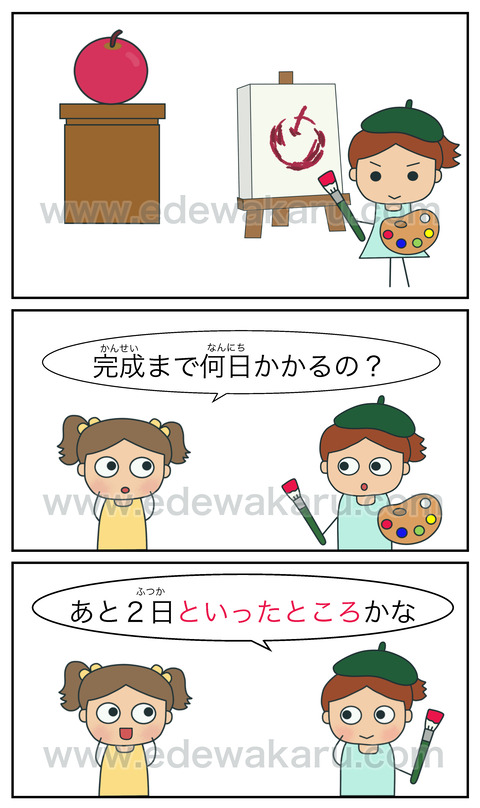
Meaning
about ~
roughly ~
that’s about how it is
How to use it
Verb・adjective・noun [plain form] +といったところだ
Verb・adjective・noun [plain form] +というところだ
Explanation
「〜といったところだ」 is a sentence pattern meaning “about ~” or “that’s about how it is,” and is used to describe the situation at that time. When preceded by a quantity, it means “at most about ~” or “no longer than about ~,” indicating that the amount or degree does not exceed that figure 😀
[Examples]
① It will take about two more days to finish.
→At most, it will take about
two days
to finish.
(It won’t take more than two days.)
② That car is about three million yen.
→At most, that car is about
three million yen.
(It won’t cost more than three million yen.)
「〜といったところだ」 can also be changed to 「〜というところだ」 😃 The usage and meaning are the same.
[Examples]
① It will take about two more days to finish.
=It will take about two more days to finish.
② That car is about three million yen.
=That car is about three million yen.
【For those with time】
Colloquial forms can also be used, such as 「〜という=〜って」 (colloquial form) and 「〜ところ=〜とこ」 (colloquial form) 😄
(Review: 〜って) (Review: 〜とこ)
[Examples]
① It will take about two more days to finish.
=It’ll take about two more days.
② That car is about three million yen.
=That car is about three million yen.
「〜といったところだ」 and 「〜というところだ」 are N1 patterns, but they are also often used in conversation, so be sure to learn them carefully 😉
【The 「ところ」 series】
〜たところ〜た
〜たところで〜ない
〜ていたところだ
〜といったところだ・〜というところだ
〜ところ(Nのところ)
〜ところだ(V辞書形+ところだ)
〜ところだ(ている+ところだ)
〜ところだ(Vた+ところだ)
〜ところまで来る
In context 5 examples
A:完成まで何日かかるの?B:あと2日といったところかな
→だいたいあと2日くらいかな(復習:〜かな・〜かしら(文法))(復習:〜かな・〜かしら(口語形))A: How many days will it take to finish? B: About two more days, I guess. →About two more days, I guess (Review: 〜かな・〜かしら (grammar)) (Review: 〜かな・〜かしら (colloquial forms))
あの車は300万円といったところだろう
→あの車はだいたい300万円くらいだろうThat car is probably about three million yen. →That car is probably around three million yen.
A:社長の話は長いね…B:あと40分くらいで終わるといったところだな
→だいたいあと40分くらいで終わるという感じだなA: The president’s speech is long… B: It’ll probably be over in about another 40 minutes. →I’d say it’ll probably be over in about another 40 minutes.
客:おすすめは何ですか?店員:プリンやドーナツといったところですね
→プリンやドーナツという感じですねCustomer: What do you recommend? Clerk: Things like pudding and doughnuts. →Something like pudding or doughnuts.
A:最近体調はどう?B:まあまあといったところだよ
→まあまあという感じだよA: How have you been feeling lately? B: I’d say so-so. →I’d say so-so.
Read the original source text
Meaning
だいたい〜くらいだ
〜という感じだ
How to use it
動詞・形容詞・名詞[普通形]+といったところだ
動詞・形容詞・名詞[普通形]+というところだ
Explanation
「〜といったところだ」は「だいたい〜くらいだ」「〜という感じだ」という意味で、その時の状況を表す時に使われる文型です。前に数量詞がくる場合は「一番高くても〜くらいだ」「一番長くても〜くらいだ」というように、それ以上の程度ではないという意味で使われます😀
[例]
①完成まであと2日
といったところだ
→完成まで、一番長くかかっても
2日
くらいだ
(2日以上はかからない)
②あの車は300万円
といったところだ
→あの車は
一番高くても
300万円
くらいだ
(300万円以上はしない)
また
「〜といったところだ」は「〜というところだ」にチェンジできます
😃使い方も意味も同じです。
[例]
①完成まであと2日
といったところだ
=完成まであと2日というところだ
②あの車は300万円
といったところだ
=あの車は300万円というところだ
【余裕のある人へ】
「〜という=〜って(口語形)」「〜ところ=〜とこ(口語形)」というように、口語形を使うことも可能です
😄
(復習:〜って)(復習:〜とこ)
[例]
①完成まであと2日
といったところだ
=完成まであと2日
ってとこだ
②あの車は300万円
といったところだ
=あの車は300万円
ってとこだ
「〜といったところだ」「〜というところだ」はN1の文型ですが、会話でもよく使いますのでしっかりと覚えておきましょう😉
【「ところ」シリーズ】
〜たところ〜た
〜たところで〜ない
〜ていたところだ
〜といったところだ・〜というところだ
〜ところ(Nのところ)
〜ところだ(V辞書形+ところだ)
〜ところだ(ている+ところだ)
〜ところだ(Vた+ところだ)
〜ところまで来る
IMABI
Defining Parameter
Read this IMABI lesson ↗Explanation
Defining Parameter: ~を始め(として), ~を皮切りに(して), ~に至るまで, ~をもって, & ~といったところだ
Defining the beginning and limitation of a parameter is something that people do all the time. These phrases, although not an exhaustive list of phrases in Japanese that fit this description, will allow you to become even more sophisticated in how you can articulate yourself in this regard.
~を始め(として)
As you should know, 始める means “to start”. をはじめ = “starting with”. It may also be expanded to をはじめとして, which is a bit more poignant.
1. 社長を始め、社員一同です。
Starting with the company president, all employees are present.
2. 日本の会社を始めとして、沢山の企業が業績悪化しています。
Starting with Japanese companies, a lot of businesses are in a downturn.
3. 彼は中国語を始め、日本語と韓国語にも堪能ですよ。
Starting with Chinese, he is also proficient in Japanese and Korean.
4. 春になると、桜をはじめとして、いろんな花が咲きます。
When it becomes spring, starting with cherry blossoms, various flowers blossom.
~を皮切りに(して)
皮切 かわきり means the “outset of things” and is used in the speech modal を皮切りに(して)・を皮切りとして to show that starting with X, you do something in succession. This pattern shouldn’t really be used with natural phenomena or bad things. What follows should be similar in nature, and it is especially used in situations where you want to clearly state such a chain of events.
5. 冗談じょうだんを皮切りに演説をする。
To give a speech by starting out with a joke.
6. 公演を皮切りに各地かくちで演奏会えんそうかいを開きました。
They opened up concerts in various/every place(s) as the start out of their public performance.
7. 今月6日の東京公演を皮切りにして、全国ツアーを予定しております。
We are planning to do a nationwide tour starting with a Tokyo performance on the sixth of this month.
8. 塩川さんの発言を皮切りにして、みんなが次々に意見を言った。
Starting with Shiokawa’s remarks, everyone said their opinions one after another.
9. カリフォルニアへの旅行を皮切りとして、国外をあちこち旅行しています。
Starting with a trip to California, I’m traveling all over outside the country.
~に至るまで
~に至るまで shows that a certain matter’s extent reaches a surprising state. As you will see in the examples, this speech modal attaches to nouns.
Examples
10. 今度の出張のスケジュール表ひょうは綿密めんみつすぎる!起床時間から飛行機内の食事開始時間に至るまで書いてあるよ。
This business trip’s schedule is too detailed! It has written on it the time from when we wake up to the time we start eating in the plane.
11. 畑中先生には卒業後の進路はもちろん、恋愛れんあいの悩なやみに至るまで何でも相談している。
My path after graduation is one thing, but I’m also consulting about everything to even love problems with Hatanaka Sensei.
12. 外国で暮らすことになったので、ベッドから台所用品だいどころようひんに至るまでみんなリサイクルショップに売った。
As it’s been decided that I live abroad, I sold everything from my bed to kitchen utensils to the recycling shop.
13. 今に至るまで作られている。
Even until now they are being made.
14. 頭から足先に至るまでのほぼ全身がびしょ濡ぬれだよ。
Basically my entire body is soaked from head to toe.
15. その大都市の学校はもちろんのこと、小さな分校に至るまで、統一されたカリキュラムで教育が行われている。
Of course, as far as that big city’s schools, education is done with a unified curriculum to even the smallest campus.
16. 彼は頭の上から爪先つまさきに至るまで全身泥まみれになった。
His entire body became covered in mud from the top of his head to his tiptoes.
Usage Note: This construction is not used in reference to animals. It is always used with something concerning humans.
More About 至る
至る means “to reach…”. It may follow the 連体形 or stem of する to show that something has finally reached a certain condition. ~に至って(は) and に至ると focus on something as the topic by raising an extreme example. Lastly, 至って as an adverb means “very” or “extremely”.
17. 中国語はもちろん、英語に至ってはからきしだめだよ。
Not to mention Chinese, reaching English is completely hopeless.
18. 年老いたとはいえ、至って健康です。
Although he has aged, he is extremely healthy.
19. 実施じっしするに至った状況を説明します。
I’ll explain the situation that’s led to this being implemented.
~をもって
Though only the first usage relates to the topic of this lesson, as this phrase has other important usages to know about, they will also be discussed at this time.
1. ~をもって marks the end of things, and is not used in daily conversation and it is very formal and official-like.
20. 本日の営業は10時をもって閉店致します。
Today’s business will close at 10 o’ clock.
21. 当店は10月末日をもちまして閉店させていただきました。長い間のご利用ありがとうございました。
This store will close at the end of October. Thank you for your long use (of our store).
22. 以上をもちまして本日の演説大会は終了いたします。
With this being the end, today’s speech convention is concluded.
23. 今期をもって私は退職するつもりでございます。
At the end of this term, I plan to retire.
24. 展覧会てんらんかいはこの時点を以って閉会とします。
We have decided to close this exhibition with/at this occasion.
It can also show a basis for something or object of judgment.
25. 一事いちじを以って人を判断するなかれ。(Archaic)
Do not judge a man by one action.
26. やつを以って嚆矢こうしとす。(Set phrase; archaism)
To hit the enemy as the aim with an arrow to signal the start of the battle.
27. 非人ひにんをもって任にんじるは悪し。(Archaic; classical)
It is bad to pose as a hinin.
Historical Note: A 非人 was a person of the lowest rank of society.
2. In でもって meaning “furthermore”. This is still used in formal writing.
28. 美人で以って頭も良い女
A woman who is a beautiful person, and furthermore smart
3. In まったくもって, a stronger version of まったく. Although more literary, it’s still possible to hear it used in the spoken language.
29. 宮城県は全くもって困った地方だね。
Miyagi Prefecture is a completely troubled region, isn’t it?
4. Older usages of this include being used as a conjunction to mean “thereupon” and as an equivalent to the case particle で to show means of action.
30. 以って瞑めいすべし。
Thereupon you should sleep.
31. 手紙を以って皇帝こうていを通達つうたつす。
To notify the Emperor with a letter.
~といったところだ
~といったところだ is used to say that at the most, something isn’t that high. It can be after nouns or verbs. It should only be used with phrases that concern a low number/amount.
41. せいぜい1泊で温泉に行くといったところでしょうか。
How about at the most going to an onsen for a night?
42. 私の睡眠すいみん時間は4時間といったところです。
My sleeping time is just at most four hours.
In context 37 examples
社長を始め、社員一同です。
Starting with the company president, all employees are present.
日本の会社を始めとして、沢山の企業が業績悪化しています。
Starting with Japanese companies, a lot of businesses are in a downturn.
彼は中国語を始め、日本語と韓国語にも堪能ですよ。
Starting with Chinese, he is also proficient in Japanese and Korean.
春になると、桜をはじめとして、いろんな花が咲きます。
When it becomes spring, starting with cherry blossoms, various flowers blossom.
冗談じょうだんを皮切りに演説をする。
To give a speech by starting out with a joke.
公演を皮切りに各地かくちで演奏会えんそうかいを開きました。
They opened up concerts in various/every place(s) as the start out of their public performance.
今月6日の東京公演を皮切りにして、全国ツアーを予定しております。
We are planning to do a nationwide tour starting with a Tokyo performance on the sixth of this month.
塩川さんの発言を皮切りにして、みんなが次々に意見を言った。
Starting with Shiokawa’s remarks, everyone said their opinions one after another.
カリフォルニアへの旅行を皮切りとして、国外をあちこち旅行しています。
Starting with a trip to California, I’m traveling all over outside the country.
今度の出張のスケジュール表ひょうは綿密めんみつすぎる!起床時間から飛行機内の食事開始時間に至るまで書いてあるよ。
This business trip’s schedule is too detailed! It has written on it the time from when we wake up to the time we start eating in the plane.
畑中先生には卒業後の進路はもちろん、恋愛れんあいの悩なやみに至るまで何でも相談している。
My path after graduation is one thing, but I’m also consulting about everything to even love problems with Hatanaka Sensei.
外国で暮らすことになったので、ベッドから台所用品だいどころようひんに至るまでみんなリサイクルショップに売った。
As it’s been decided that I live abroad, I sold everything from my bed to kitchen utensils to the recycling shop.
今に至るまで作られている。
Even until now they are being made.
頭から足先に至るまでのほぼ全身がびしょ濡ぬれだよ。
Basically my entire body is soaked from head to toe.
その大都市の学校はもちろんのこと、小さな分校に至るまで、統一されたカリキュラムで教育が行われている。
Of course, as far as that big city’s schools, education is done with a unified curriculum to even the smallest campus.
彼は頭の上から爪先つまさきに至るまで全身泥まみれになった。
His entire body became covered in mud from the top of his head to his tiptoes.
中国語はもちろん、英語に至ってはからきしだめだよ。
Not to mention Chinese, reaching English is completely hopeless.
年老いたとはいえ、至って健康です。
Although he has aged, he is extremely healthy.
実施じっしするに至った状況を説明します。
I’ll explain the situation that’s led to this being implemented.
~をもって marks the end of things, and is not used in daily conversation and it is very formal and official-like.
Today’s business will close at 10 o’ clock.
本日の営業は10時をもって閉店致します。
Today’s business will close at 10 o’ clock.
当店は10月末日をもちまして閉店させていただきました。長い間のご利用ありがとうございました。
This store will close at the end of October. Thank you for your long use (of our store).
以上をもちまして本日の演説大会は終了いたします。
With this being the end, today’s speech convention is concluded.
今期をもって私は退職するつもりでございます。
At the end of this term, I plan to retire.
展覧会てんらんかいはこの時点を以って閉会とします。
We have decided to close this exhibition with/at this occasion.
一事いちじを以って人を判断するなかれ。(Archaic)
Do not judge a man by one action.
やつを以って嚆矢こうしとす。(Set phrase; archaism)
To hit the enemy as the aim with an arrow to signal the start of the battle.
非人ひにんをもって任にんじるは悪し。(Archaic; classical)
It is bad to pose as a hinin.
In でもって meaning “furthermore”. This is still used in formal writing.
A woman who is a beautiful person, and furthermore smart
美人で以って頭も良い女
A woman who is a beautiful person, and furthermore smart
In まったくもって, a stronger version of まったく. Although more literary, it’s still possible to hear it used in the spoken language.
Miyagi Prefecture is a completely troubled region, isn’t it?
宮城県は全くもって困った地方だね。
Miyagi Prefecture is a completely troubled region, isn’t it?
Older usages of this include being used as a conjunction to mean “thereupon” and as an equivalent to the case particle で to show means of action.
Thereupon you should sleep.
以って瞑めいすべし。
Thereupon you should sleep.
手紙を以って皇帝こうていを通達つうたつす。
To notify the Emperor with a letter.
せいぜい1泊で温泉に行くといったところでしょうか。
How about at the most going to an onsen for a night?
私の睡眠すいみん時間は4時間といったところです。
My sleeping time is just at most four hours.
毎日のんびり日本語教師
How to use it
Numeral (+ counter) + といったところだ/というところだ/ってところだ
Verb dictionary form + といったところだ/というところだ/ってところだ
Explanation
When this is attached to a word expressing a quantity, it indicates a boundary or estimate within a certain range.
This sentence pattern foregrounds the speaker's subjective judgment or evaluation.
Notes
Nothing in particular.
In context 8 examples
明日の気温は12度から20度といったところです。(明天的气温大概是12度到20度。)
Tomorrow's temperature will be somewhere between 12 and 20 degrees.
ここから目的地までは車で1時間といったところでしょう。
It'll take about an hour by car to get from here to the destination.
見た感じ、あの人はもうすぐ40歳といったところだろうか。
Judging by how they look, I wonder if that person is nearly 40.
来場者数はおよそ1万人といったところです。
The number of visitors is about 10,000.
発車まで5分といったところだ。急げばまだ間に合う。
There are about five minutes until departure. If you hurry, you'll still make it.
残る座席は3席というところだ。
There are about three seats left.
この薬が効き始めるのは服用後6~8時間後ってところだ。
This medicine takes about six to eight hours after taking it to start working.
写真の頭身から推測すると、彼は身長155~160cmといったところだろう。用法② 例示・
Judging from the head-to-body ratio in the photo, I'd say he's around 155–160 cm tall. Usage ② Giving examples・
Read the original source text
How to use it
数詞(+助数詞)+といったところだ/というところだ/ってところだ
動辞形+といったところだ/というところだ/ってところだ
Explanation
数量を表す語に接続して、ある範囲内における境界線や目算を表します。
話者の主観的な判断、評価が前面に表れる文型です。
Notes
特になし