AIUEO JLPT Grammar
Meaning
「こそ」is used to emphasize a specific item or situation, indicating that it is particularly important or central.
How to use it
Noun + こそ
In context 5 examples
今度こそ試験に合格したい。
This time, I really want to pass the exam.
これこそが私の探していたものです。
This is exactly what I was looking for.
今こそ行動すべき時です。
Now is the time to take action.
彼こそが真の勇者だ。
He is the real hero.
努力こそが成功の鍵です。
Effort is the key to success.
Read the original source text
Meaning
「こそ」is used to emphasize a specific item or situation, indicating that it is particularly important or central.
How to use it
名詞+こそ
Explanation · 日本語
「こそ」は、特定の事柄を強調するために使われる助詞で、他のものではなく、その特定のものが重要であることを示します。
文法
Meaning
Expresses emphasis.
Used with a positive meaning. (It is not used to emphasize a negative meaning.)
How to use it
N + こそ
V (dictionary form) + ことこそ
Plain form + からこそ
In context 10 examples
今年こそJLPTに受かりたい。
This year, more than ever, I want to pass the JLPT.
来年の冬こそ、スキーに行こう!
Next winter, let's go skiing for sure!
この本こそ私が探していた本です。ついに見つけました。
This is the very book I was looking for. I finally found it.
健康こそが、私の一番の財産だ。
Health is my greatest asset.
彼こそこの会社にふさわしい人だ。
He is the very person suited to this company.
毎日続けてジョギングをすることこそ、ダイエットの秘訣だ。
Keeping up a daily jogging routine is the key to losing weight.
寝ることこそ、ストレス解消法だ。
Sleeping is what relieves stress.
暗記ではなく、考える力を身につけることこそ学校や塾で学ぶ価値がある。
It is learning how to think, rather than memorizing, that is worthwhile at school and cram school.
忙しいからこそ、家族との時間を大切にしたい。
Precisely because I'm busy, I want to cherish the time I spend with my family.
留学したからこそ、日本の良さがわかるようになった。
It was precisely because I studied abroad that I came to understand what is good about Japan.
Read the original source text
Meaning
強調を表す。
プラスの意味で使われる。(マイナスの意味を強調する使い方はしない。)
How to use it
N + こそ
V(辞)+ ことこそ
普通形 + からこそ
Bunpro Grammar Reference
Meaning
For sure, For certain, Even more so, Underlined or bolded text
How to use it
Noun + こそ
Nuance
An expression that shows (A) as being moreso something, in a similar way to capitalization of a word in English.
Explanation
こそ is an adverbial particle in Japanese that primarily replaces either を or が. Its main role is to highlight the preceding noun (or noun phrase) as being the most important piece of information in relation to the rest of the sentence. In English, this is an effect that is primarily achieved through things like bold text, underlining, or emphasizing a particular word in speech. If we were to make a direct comparison to an English statement, then things like 'precisely because it's (A)', or 'rather it is due to (A)', are quite similar to こそ's function.
こそ can be used directly after any noun that would usually take the を, or が particles, so long as that particular piece of information needs to be emphasized.
この曲こそ俺がずーっと探していた曲だ!やっと曲名が分かった。
This song is exactly the song I have been searching for! I finally figured out the title.
今度こそ勝つぞ!
I will win for sure next time!
Caution
Although こそ is able to replace が or は, the nuance will usually come across as more similar to が, due to the fact that が puts emphasis on a specific point, while は nominates general topics. To make things easier, the three particles can be thought of in the following way:
は- Weakly highlights specific information.
が- Strongly highlights specific information.
こそ- Very strongly highlights specific information.
Fun Fact
こそ is often used after names or pronouns, as a way to reply to thanks/apologies. In these situations, it expresses that the speaker feels equally (or more) obliged to say what was just said to them by someone else.
いえいえ、私こそありがとうございます。
No no no no, I am the one that should be thankful.
In context 15 examples
- あなたこそリーダーにふさわしい!
You are fitting to be the leader!
- この曲こそ俺がずーっと探していた曲だ!やっと曲名が分かった。
This song is exactly the song I have been searching for! I finally figured out the title.
- 今度こそ勝つぞ!
I will win for sure next time!
- 今度こそ達成してみせる!
I will achieve (it) this time!
- 誰かが「愛こそすべてだ」って言っていました。
Someone once said that 'love is everything'.
- 困った時こその友達じゃないか。
Without a doubt, friends help when you are in trouble, don't they?
- そんな時こそ僕の出番だ!
That is the time I will make my debut!
- それでこそ僕の選んだ妻だ。
That's exactly the wife I have chosen.
- それこそ僕に与えられた使命だと思っています。
I believe that, indeed, is the mission that was given to me.
- 今日こそ十分に睡眠を取りたい。
I want to finally get enough sleep today.
- こちらこそいつもお世話になっております。
It is I that should say: thank you for always taking care of me.
- いえいえ、謝らないでください!私こそ悪いことをしてしまいました。
No, no! Please do not apologize. It was (for sure) me that was in the wrong.
- 辛い時こそ、大切なことを学べるチャンスだ。
Difficult times are chances to learn something important.
- 一人でも手助けをすることができたら、それこそ最高の気持ちになる。
Even if we can only help one person, that (for sure) is the best feeling.
- いえいえ、私こそありがとうございます。
No no no no, I am the one that should be thankful.
Read the original source text
Meaning
For sure, For certain, Even more so, Underlined or bolded text
How to use it
Noun + こそ
Nuance
An expression that shows (A) as being moreso something, in a similar way to capitalization of a word in English.
Explanation
こそ is an adverbial particle in Japanese that primarily replaces either を or が. Its main role is to highlight the preceding noun (or noun phrase) as being the most important piece of information in relation to the rest of the sentence. In English, this is an effect that is primarily achieved through things like bold text, underlining, or emphasizing a particular word in speech. If we were to make a direct comparison to an English statement, then things like 'precisely because it's (A)', or 'rather it is due to (A)', are quite similar to こそ's function.
こそ can be used directly after any noun that would usually take the を, or が particles, so long as that particular piece of information needs to be emphasized.
この曲こそ俺がずーっと探していた曲だ!やっと曲名が分かった。
This song is exactly the song I have been searching for! I finally figured out the title.
今度こそ勝つぞ!
I will win for sure next time!
Caution
Although こそ is able to replace が or は, the nuance will usually come across as more similar to が, due to the fact that が puts emphasis on a specific point, while は nominates general topics. To make things easier, the three particles can be thought of in the following way:
は- Weakly highlights specific information.
が- Strongly highlights specific information.
こそ- Very strongly highlights specific information.
Fun Fact
こそ is often used after names or pronouns, as a way to reply to thanks/apologies. In these situations, it expresses that the speaker feels equally (or more) obliged to say what was just said to them by someone else.
いえいえ、私こそありがとうございます。
No no no no, I am the one that should be thankful.
Nuance · 日本語
(A)がさらに何かであるということを示す表現。英語で単語を大文字で表すのと似ている。
Explanation · 日本語
「こそ」は、「を」や「が」に置き換えて使われる副助詞です。主な働きは、文の中で、前に置かれた名詞(または名詞句)を強く目立たせることです。
「こそ」は、「を」や「が」が付く名詞のあとに使われます。その名詞が、文の中で特に強く伝えたい情報であるときに使います。
この曲こそ俺がずーっと探していた曲だ!やっと曲名が分かった。
This song is exactly the song I have been searching for! I finally figured out the title.
今度こそ勝つぞ!
I will win for sure next time!
注意点
「こそ」は、「が」や「は」に置き換えることができますが、ニュアンスは「が」に近いことが多いです。これは、「が」は特定の情報を強調しますが、「は」は話題を広く示す働きを持つためです。理解しやすくなるように、三つの助詞の違いを次のように考えてみましょう。
は - 特定の情報を弱く表す。
が - 特定の情報を強く表す。
こそ - 特定の情報をとても強く表す。
豆知識
「こそ」には、名前などの固有名詞のあとに使う使い方もあります。これは、ほかの人からお礼を言われたり、謝られたりしたときに、話し手が自分も同じように(または、それよりももっと強く)感じていると言いたいときに使われます。
いえいえ、私こそありがとうございます。
No no no no, I am the one that should be thankful.
DoJG 日本語文法辞典(全集)
Meaning
The very ~; it is ~; that ~; only (when, after, because, etc.); in particular; precisely; definitely; [an italicized or underlined word]
How to use it
(i) Noun (particle) | こそ | |
| この人こそ | This man in particular |
| 彼にこそ | To him in particular |
(ii) Vて | こそ | |
| ここへ来てこそ | Only when/after someone comes here |
(iii) Sinformal | こそ | |
| 知らないからこそ | Only because someone doesn’t know |
Explanation
A particle which emphasizes a word, phrase, or clause.
In context 11 examples
これこそ我々が探し求めていたものだ。
This is the very thing that we've been looking for.
A:どうもすみませんでした。 B:いいえ、こちらこそすみませんでした。
A: I'm very sorry. B: No, it's me who should say that (literally: be sorry).
一人でやってこそ勉強になるのだ。
You can learn something only when you do it by yourself.
君が正直に話してくれたからこそ問題は最小で済んだんだ。
We could minimize the problem only because you explained (literally: told) it to us honestly.
A: 一体一週間も何をしていたんだ。 B: そう言う君こそ何をしていたんだ。
A: What on earth were you doing for a whole week? B: You say that but what were you doing?
こんな時(に)こそ全員で力を合わせて問題を解決しなければならない。
On this kind of occasion, in particular, we all have to cooperate in order to solve the problem.
今年こそこの試験に通ってみせる。
I will pass this exam definitely this year.
それでこそ我々のリーダーだ。
That is precisely the kind of behaviour we expect from our leader.
ここにいてこそいい仕事も見つかるのだ。
You can find a good job only by being here.
親友だからこそこんなことまで君に言うんだよ。
It's because you are my friend that I can tell you (even) such a thing.
出来ないからこそ人より余計に練習しなければならないのだ。
It’s precisely because you can’t do it that you have to practice more than others do.
どんなときどう使う 日本語表現文型辞典
Meaning
it is (this time; me; it; etc.) that…
How to use it
N (+particle)+こそ (precisely; especially)
Explanation
1)大切なことを、「ほかのことでなく、これなのだ」と区別して強調したいときに使う。
2)マイナスの意味を強調する使い方はしない。
◆ × 丸暗記こそやりたくない。
1)Emphasizes difference between something important and other factors.
2)Not used to emphasize demerits.
In context 3 examples
今年こそ大学に入れるよう、勉強します。
I'll study so that I can get into university this year for sure.
A:子どもがいつもお世話になっております。B:こちらこそ。
A: Thank you for always taking such good care of my child. B: The same goes for us.
知識の量を増やすのではなく、考える訓練をすることにこそ学校で学ぶ価値がある。
The value of learning at school lies precisely in training yourself to think, rather than increasing the amount of knowledge you have.
Read the original source text
Meaning
it is (this time; me; it; etc.) that…
How to use it
N(+助詞)+こそ
Explanation
1)大切なことを、「ほかのことでなく、これなのだ」と区別して強調したいときに使う。
2)マイナスの意味を強調する使い方はしない。
◆ × 丸暗記こそやりたくない。
1)Emphasizes difference between something important and other factors.
2)Not used to emphasize demerits.
絵でわかる日本語
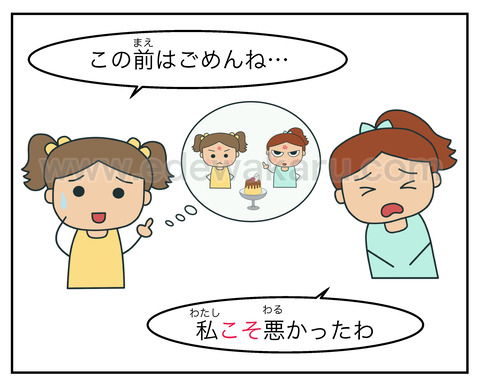
Meaning
(Emphasis) A is … / A is precisely …
How to use it
Noun [dictionary form] + こそ
これ・それ・あれ + こそ
Explanation
「Aこそ」emphasizes A, as in “A is …” or “A is precisely ….” Therefore, it can be replaced with 「は」or「が」when they express emphasis 😊
This is the simplest grammar pattern among those that use 「こそ」. There are many patterns in the 「こそ」series, such as 「〜ばこそ」「〜こそ…が」「〜からこそ」「〜こそすれ」「〜こそするが」, but first, learn this 「こそ」😉
In context 4 examples
A:この前はごめんね…B:私こそ悪かったわ。ごめんね→私が悪かったわ。ごめんね
A: I’m sorry about the other day… B: I was the one at fault. I’m sorry. →I was at fault. I’m sorry.
今年こそN1に合格するぞ!
→今年は絶対にN1に合格するぞ!This year, I’m definitely going to pass the N1! →I’m absolutely going to pass the N1 this year!
これこそ私が欲しかったバッグだわ
→これは正に私が欲しかったバッグだわThis is exactly the bag I wanted. →This is precisely the bag I wanted.
彼女こそ理想の女性だ
→彼女は正に理想の女性だShe is the very woman of my dreams. →She is precisely the ideal woman.
Read the original source text
Meaning
(強調)〜が〜だ / 正に〜だ
How to use it
名詞[辞書形]+こそ
これ・それ・あれ+こそ
Explanation
「Aこそ」は「Aが〜だ」「Aが正に〜だ」というように「A」を強調するものです。ですから、強調を表す「は」や「が」に書き換えることができます😊
「こそ」を使う文法の中で1番シンプルなものですね。「〜ばこそ」や「〜こそ…が」「〜からこそ」「〜こそすれ」「〜こそするが」など、「こそ」シリーズはたくさんありますが、まずはこの「こそ」を覚えてしまいましょう😉
日本語文型辞典
Meaning
Emphasizes something, conveying the meaning “this, and nothing else.”
Used in the form Xこそあれ/Xこそすれ、Yではない to strongly assert that the fact is X and definitely not Y. This usage mentions the contrasting fact X to strongly highlight the assertion that it is not Y. This is characteristic of written language. ③ can also be phrased as 火種にこそなれ.
Used in the form XはYこそ… to acknowledge that X is indeed Y…, while stating that there is also a situation that opposes that. Concessive conjunctions such as …が and …けれども are used. This is characteristic of written language.
⇾それでこそ
⇾からこそ
⇾だからこそ
⇾てこそ
⇾ばこそ
How to use it
Nこそ
…こそ あれ/すれ
Nこそすれ
Naでこそあれ
R-こそすれ
…こそ…が
Nこそ…が
Naでこそあるが
R-こそするが
…からでこそ
…からこそ
…だからこそ
…てこそ
…ばこそ
In context 13 examples
A:よろしくお願いします。
B:こちらこそよろしく。A: Thank you in advance. B: The pleasure is mine.
ことしこそ『源氏物語』を終わりまで読むぞ。
This year, I’m definitely going to read The Tale of Genji all the way to the end.
いまでこそ、こうやって笑って話せるが、あの時はほんとうにどうしようかと思ったよ。
Even now, I can laugh and talk about it like this, but back then I really didn’t know what to do.
そうか。彼はひきうけてくれたのか。それでこそわれわれが見こんだとおりの人物だ?
I see. So he agreed to take it on. That’s exactly the kind of person we thought he was?
A:やはり私は文学部に進みたいと思います。
B:そうか。それこそ、なくなったきみのお父さんものぞんでいたことだ。A: I still think I want to study in the Faculty of Literature. B: I see. That’s exactly what your late father wanted, too.
あなたのその言い方は、皮肉でこそあれ、けっしてユーモアとは言えない。
What you said is sarcasm, to be sure, but it can hardly be called humor.
あなたをうらんでいるですって?感謝(し)こそすれ、私があなたをうらむ理由があるわけがないでしょう。
You say I resent you? I can only be grateful to you; there’s no way I could have any reason to resent you.
政府のその決定は、両国間の新たな緊張の火種になりこそすれ、およそ賢明な選択とは言いがたいものである。
That government decision is more likely to become a source of new tensions between the two countries than to be a wise choice.
この靴は、デザインこそ古いが、とても歩きやすい。
These shoes are old-fashioned in design, but very comfortable to walk in.
書きこそしたが、彼のレポートはひどいものだった。
He did write it, but his report was terrible.
彼はいちおう会長でこそあるが、実権はまったくない。
He may nominally be the chairperson, but he has no real power at all.
あの学生は宿題こそいつもきちんと提出するけれども、試験をしてみると何もわかっていないことがわかる。
That student always turns in the homework properly, but when you give them a test, you find they don’t understand anything.
その作家は、ベストセラーこそないけれども、ある一群の読者たちにささえられて、一作一作着実に害いてきた。
That writer may not have any bestsellers, but, supported by a certain group of readers, they have steadily written one work after another.
Read the original source text
Meaning
あるものごとを強調して、ほかでもなくこれなのだ、という意味を持たせる。
「Xこそあれ/Xこそすれ、Yではない」の形で事実はXであって、決してYではないと強く主張するのに用いる。Yでないと言う主張を強くきわだたせるために、それとは対照的なXであることに触れる用法。書きことば的表現。③は「火種にこそなれ」と言うこともできる。
「XはYこそ…」と述べることによって、Xについて「Y…」であることは一応認めた上で、さらにそれとは対立する事態があることを述べるのに用いられる。「…が」「…けれども」などの逆接の接続詞が使用される。書きことば的表現。
⇾それでこそ
⇾からこそ
⇾だからこそ
⇾てこそ
⇾ばこそ
How to use it
Nこそ
…こそ あれ/すれ
Nこそすれ
Naでこそあれ
R-こそすれ
…こそ…が
Nこそ…が
Naでこそあるが
R-こそするが
…からでこそ
…からこそ
…だからこそ
…てこそ
…ばこそ
日本語文型辞典 英語版
Meaning
B:こちらこそよろしく。
The pleasure is all mine.
B:そうか。それこそ、亡くなったきみのお父さんものぞんでいたことだ。
I see. That’s exactly what your late father had hoped for.
Emphasizes a certain thing, giving it the meaning “it is this and nothing else.”
This pattern takes the form Xこそあれ/Xこそすれ, Yではない and is used to assert that the fact is X and not, under any circumstances, Y. In order to emphasize strongly the assertion of not-Y, this usage also presents X, which contrasts Y. Used mostly in written language.
(3)
can be rephrased as 「火種にこそなれ」 (“become the cause of a conflict/dispute”).
By stating XはYこそAだが、Z, the speaker first acknowledges that, as for X, “Y is A” is true to a certain extent. Then, states that there is a situation Z that contrasts “Y is A.”
How to use it
1. Nこそ
2. ...こそ あれ/すれ[Nこそすれ][Na でこそあれ][R-こそすれ]
3. ...こそ...が[Nこそ...が][Na でこそあるが][R-こそするが]
4. ...からでこそ→
5. ...からこそ→
6. ...だからこそ→
7. ...てこそ→
8. ...ばこそ→
In context 13 examples
A:よろしくお願いします。
Thank you for your help.
ことしこそ『源氏物語』を終わりまで読むぞ。
This year, I’m determined to read The Tale of Genji to the end!
いまでこそ、こうやって笑って話せるが、あの時はほんとうにどうしようかと思ったよ。
Now I can smile when I talk about it, but at that time I really didn’t know what to do.
そうか。彼はひきうけてくれたのか。それでこそわれわれが見こんだとおりの人物だ。
I see. He agreed to do it, did he. That means he’s exactly the person we expected him to be.
A:やはり私は文学部に進みたいと思います。
As you might have expected, I would like to get into the Department of Literature.
あなたのその言い方は、皮肉でこそあれ、けっしてユーモアとは言えない。
The way you say it, it sounds ironic but never humorous.
あなたをうらんでいるですって? 感謝(し)こそすれ、私があなたをうらむ理由があるわけがないでしょう。
I have a grudge against you? On the contrary, I should be thankful to you—there is absolutely no reason for me to have a grudge against you!
政府のその決定は、両国間の新たな緊張の火種になりこそすれ、およそ賢明な選択とは言いがたいものである。
That decision by the government will only sow new seeds of tension between the two countries, and on the whole it is hard to say that it is a sensible choice.
この靴は、デザインこそ古いが、とても歩きやすい。
The design of these shoes is old, but they are very good for walking.
書きこそしたが、彼のレポートはひどいものだった。
He did write up the paper, but it was an awful piece of work.
彼はいちおう会長でこそあるが、実権はまったくない。
Although he has the title of president, he doesn’t hold any real power.
あの学生は宿題こそいつもきちんと提出するけれども、試験をしてみると何もわかっていないことがわかる。
Although that student always submits his assignments on time, when I give an exam it becomes clear that he understands nothing.
その作家は、ベストセラーこそないけれども、ある一群の読者たちにささえられて、一作一作着実に書いてきた。
Although that writer doesn’t have any bestsellers, she is supported by a certain group of readers and has steadily produced one book at a time.
Read the original source text
Meaning
B:こちらこそよろしく。
The pleasure is all mine.
B:そうか。それこそ、亡くなったきみのお父さんものぞんでいたことだ。
I see. That’s exactly what your late father had hoped for.
Emphasizes a certain thing, giving it the meaning “it is this and nothing else.”
This pattern takes the form Xこそあれ/Xこそすれ, Yではない and is used to assert that the fact is X and not, under any circumstances, Y. In order to emphasize strongly the assertion of not-Y, this usage also presents X, which contrasts Y. Used mostly in written language.
(3)
can be rephrased as 「火種にこそなれ」 (“become the cause of a conflict/dispute”).
By stating XはYこそAだが、Z, the speaker first acknowledges that, as for X, “Y is A” is true to a certain extent. Then, states that there is a situation Z that contrasts “Y is A.”
How to use it
1. Nこそ
2. ...こそ あれ/すれ[Nこそすれ][Na でこそあれ][R-こそすれ]
3. ...こそ...が[Nこそ...が][Na でこそあるが][R-こそするが]
4. ...からでこそ→
5. ...からこそ→
6. ...だからこそ→
7. ...てこそ→
8. ...ばこそ→
くらべてわかる日本語表現文型辞典
Meaning
Meaning 1: Used to single out and strongly emphasize A as what B is.
Meaning 2: In the form “AてこそB.” It expresses the speaker’s values or judgment that doing A is what makes B. A is the condition for B to hold. A is necessary for B.
Meaning 3: In the form “A(ていれ)ばこそB.” It strongly emphasizes A by saying that B is because the situation is A.
Meaning 4: In the form “Aこそなれ/すれ/あれBない.” The listener thinks something is B, but the speaker thinks that it is actually A, the opposite of B.
Meaning 5: In the form “AからこそB.” A is strongly stated as the reason, and the expression means therefore B.
How to use it
AこそB (AばこそB / Aこそすれ (なれ・あれ) Bない / AからこそB / AてこそB / AにこそB / AことこそB)
Connection 1:
[Verb] + こと + こそ
[Noun—∅ / particle] こそ
Connection 2:
[Verb—て-form] こそ
Connection 3:
[Verb—ば-form] こそ
[Verb—て-form] いればこそ
Connection 4:
[Verb—ます form] こそすれ
[な-adjective—に] こそなれ / すれ
[Noun—∅] こそあれ
Connection 5:
[Verb] からこそ
[い-adjective—plain form] からこそ
[な-adjective—だ / である / だった / ではない] からこそ
[Noun—だ] からこそ
Explanation
【Comparison 1】
“AこそB(AてこそB)” (Meaning 2, p. 82)
【Comparison 2】
“AこそB(AことこそB)” (Meaning 1, p. 82)
“AことこそB” singles out and strongly emphasizes A as B, while “AてこそB” expresses the speaker’s values or judgment that doing A makes something B.
○正直に話すことこそ大切だ。
○正直に話してこそ許される。
“AこそB(AからこそB)” (Meaning 5, p. 83)
【Comparison 3】
“AこそB(AからこそB)” (Meaning 5, p. 84)
It can be substituted for “AからこそB.” The reverse is not possible.
【Comparison 5】
“AこそB(AてこそB)” (Meaning 2, p. 82)
When A in “AからこそB” is in the dictionary form, it can be replaced with “AてこそB.”
○本物に触れてこそ、価値がわかる。
○本物に触れるからこそ、価値がわかる。
With “AてこそB,” B is the condition for A to hold. But “AからこそB” strongly states the reason, so it can only replace it in a sentence where A is the sole reason for B.
○喧嘩をすることも必要だ。殴られてこそ、人の痛みがわかるようになるのだ。
×喧嘩をすることも必要だ。殴られるからこそ、人の痛みがわかるようになるのだ。
“AこそB(AばこそB)” (Meaning 3, p. 83)
“AゆえB” (Meaning 2, p. 315)
In context 20 examples
私の方こそ、お世話になりました。
I’m the one who should be thanking you.
今だからこそ言えるのですが、一時は命の危険さえあったんです。
It’s only because it’s now that I can say this, but at one point my life was even in danger.
この本は、独身女性にこそ読んでほしいのです。
This is a book I especially want single women to read.
どんなに苦しくても、がんばって生きていくことこそ美しいのだ。
No matter how hard things get, persevering and living on is what is beautiful.
お金は使ってこそ価値があるのだ。
Money only has value when you spend it.
マスコミの横暴は、取材されてこそわかるものだ。
You only understand the media’s abuse of power when you’ve been reported on yourself.
人の何倍も練習してこそ、世界的なアスリートになれるのだ。
Only by practicing many times more than others can you become a world-class athlete.
高級品を身につけるだけでなく、言葉遣い、身のこなしすべてに気をつけてこそセレブといえる。
You can be called a celebrity only if you pay attention not just to wearing luxury goods, but also to your choice of words and every aspect of your behavior.
あなたのことを心配すればこそ、こうやって小言を言ってるのよ。
It’s precisely because I worry about you that I nag you like this.
信じていればこそ、君にこの仕事をやってもらいたいんだ。
It’s precisely because I trust you that I want you to do this job.
彼を愛していればこそ苦労にも耐えられるのです。
It is precisely because I love him that I can endure hardship.
社員が日々働いていればこそ、社長は将来への展望を持つことができるのだ。
It is precisely because the employees work every day that the president can have a vision for the future.
この薬を飲んだら痩せこそすれ、健康にいいことはなにもない。
If you take this medicine, you’ll only lose weight; it has nothing else that’s good for your health.
こんな生活を続けていれば、不幸にこそなれ、幸せになることはない。
If you keep living like this, you’ll only become unhappy; you won’t become happy.
教えてあげたんだから感謝されこそすれ文句を言われる筋合いはない。
I taught you, so you have no grounds to complain; you should be thanking me.
自分の好きな研究だったから、喜びこそあれ辛いことは何もなかった。
It was research I loved, so there was nothing but joy and no hardship at all.
君が来たからこそ、みんなが喜んだんじゃないか。
It was because you came that everyone was happy, wasn’t it?
ぼくはあの大学に入りたいからこそ、一生懸命勉強しているんです。
It is precisely because I want to get into that university that I’m studying so hard.
かたいものを何回も嚙むからこそ、顎は鍛えられるのだ。
It is precisely by chewing hard foods many times that the jaw gets strengthened.
彼は自由業だからこそ、平日に旅行にいけるのだ。
It is precisely because he is self-employed that he can travel on weekdays.
Read the original source text
Meaning
意味1:BであるのはAと、Aを取り立てて強く言うときに使う。
意味2:「AてこそB」の形で。AをすることによってBだという話し手の価値観・判断を述べる。Bが成立する条件がAだ。BのためにはAが必要だ。
意味3:「A(ていれ)ばこそB」の形で。Aという状態だからBだと、Aを強く言う。
意味4:「Aこそなれ/すれ/あれBない」の形で。聞き手はBだと思っているが、話し手はBではなく逆のAだと思っている。
意味5:「AからこそB」の形で。理由Aを強く述べ、だからBという表現。
How to use it
AこそB(AばこそB/Aこそすれ(なれ・あれ)Bない/AからこそB/AてこそB/AにこそB/AことこそB)
接続1:
[動詞]+こと+こそ
[名詞-∅/助詞]こそ
接続2:
[動詞-て形]こそ
接続3:
[動詞バ形]こそ
[動詞-て形]いればこそ
接続4:
[動詞-ます形]こそすれ
[ナ形-に]こそなれ/すれ
[名詞-∅]こそあれ
接続5:
[動詞]からこそ
[イ形-普]からこそ
[ナ形-だ/である/だった/ではない]からこそ
[名詞-だ]からこそ
Explanation
【対比1】
「AこそB(AてこそB)」(意味2 P.82)
【対比2】
「AこそB(AことこそB)」(意味1 P.82)
「AことこそB」はAがBだとAを取り立て強く言う表現で、「AてこそB」はAをすることでBと話し手の価値観・判断を述べる表現である。
○正直に話すことこそ大切だ。
○正直に話してこそ許される。
「AこそB(AからこそB)」(意味5 P.83)
【対比3】
「AこそB(AからこそB)」(意味5 P.84)
「AからこそB」とは置き換え可能。逆は不可。
【対比5】
「AこそB(AてこそB)」(意味2 P.82)
「AからこそB」のAがル形の場合、「AてこそB」と置き換え可能。
○本物に触れてこそ、価値がわかる。
○本物に触れるからこそ、価値がわかる。
「AてこそB」のBはAが成立する条件であるが、「AからこそB」は理由を強く述べる表現のため、AがBの唯一の理由である文でしか置き換えられない。
○喧嘩をすることも必要だ。殴られてこそ、人の痛みがわかるようになるのだ。
×喧嘩をすることも必要だ。殴られるからこそ、人の痛みがわかるようになるのだ。
「AこそB(AばこそB)」(意味3 P.83)
「AゆえB」(意味2 P.315)
日本語NET JLPT文法解説まとめ
Meaning
Expresses emphasis.
Used with a positive meaning. (It is not used to emphasize a negative meaning.)
How to use it
N + こそ
V (dictionary form) + ことこそ
Plain form + からこそ
Explanation
Expresses emphasis.
It is that....
In context 10 examples
今年こそJLPTに受かりたい。
This year, more than ever, I want to pass the JLPT.
来年の冬こそ、スキーに行こう!
Next winter, let's go skiing for sure!
この本こそ私が探していた本です。ついに見つけました。
This is the very book I was looking for. I finally found it.
健康こそが、私の一番の財産だ。
Health is my greatest asset.
彼こそこの会社にふさわしい人だ。
He is the very person suited to this company.
毎日続けてジョギングをすることこそ、ダイエットの秘訣だ。
Keeping up a daily jogging routine is the key to losing weight.
寝ることこそ、ストレス解消法だ。
Sleeping is what relieves stress.
暗記ではなく、考える力を身につけることこそ学校や塾で学ぶ価値がある。
It is learning how to think, rather than memorizing, that is worthwhile at school and cram school.
忙しいからこそ、家族との時間を大切にしたい。
Precisely because I'm busy, I want to cherish the time I spend with my family.
留学したからこそ、日本の良さがわかるようになった。
It was precisely because I studied abroad that I came to understand what is good about Japan.
Read the original source text
Meaning
強調を表す。
プラスの意味で使われる。(マイナスの意味を強調する使い方はしない。)
How to use it
N + こそ
V(辞)+ ことこそ
普通形 + からこそ
Explanation
Expresses emphasis.
It is that....
IMABI
The Particle こそ
Read this IMABI lesson ↗Explanation
The Particle こそ
こそ is a rather straightforward particle to understand, but its usage is a little tricky.
The Fundamentals of こそ
The first instances of こそ students learn about are set phrases like こちらこそ (likewise), 今度こそ (surely next time), and 今年こそ (surely next year). However, even these set phrases can get messed up.
1a. 今年こそ危機に瀕する言語の重要性が分かるようになりました。 X
1b. 今年になってはじめて危機に瀕する言語の重要性が分かるようになりました。〇
I’ve finally understood for the first time this year the importance of endangered languages.
2a. 彼こその努力すれば、東大に行けるでしょう。X
2b. 彼ほどの努力をすれば、東大に行けるでしょう。〇
If you strive like him, you’ll be able to go to Tokyo University.
こそ strongly emphasizes what precedes it similarly to the words “certainly” and “indeed.” It can be seen after nouns (especially those concerning people), time phrases, Verb+て, and the 連用形 of verbs.
3. 企業家精神こそ最もリスクが小さな道である。
The entrepreneurial spirit is certainly the least risky road to take.
4. 物腰こそ慇懃いんぎんだが、根は黒い。
His demeanor is indeed courteous, but his true nature is mean.
5. 明日こそ鳥は羽ばたく。
The birds will certainly flap tomorrow.
6. 今こそ始めましょう。
Let’s get started now!
7. 今度こそうまくいきますよう!
You’ll certainly do better next time!
8. まさかの時の友こそ真の友。
A friend in need is a friend indeed.
9. 今年こそ日本へ行ってみよう。
This year, indeed, let’s try going to Japan.
10. このひどい子宮から逃げようと失敗したが、今度こそこの地獄を切り抜けて自由を手に入れよう!
I failed in trying to escape this damned uterus, but next time I will definitely come clear out of this hell and attain freedom!
Sentence Note: Someone like Stewie from Family Guy would say something like this.
11. 健全な国民が存在してこそ国家が成り立つ。
A nation is born with the existence of a healthy citizen body.
12. 喜びこそすれ、怒ることはない。
There’s nothing to be angry about when you’re joyous.
Grammar Note: ~こそすれ・こそなれ・こそであれ involve the 已然形 of the verbal element that follow こそ.
13. 褒めこそすれ、非難することはない。
She does speak highly (of others), but she never criticizes.
13. 愚かな女でこそあれ、良妻賢母だなんて、とんでもない。
So long as the woman is a fool, “good wife, wise mother” means nothing.
14. 毒にこそなれ薬にはならない。
Do more harm than good.
Word Note: When you take out こそ in にこそなれ, you get the archaic copula なり.
Because こそ is so emphatic, sentences with it often end in ~だ, ~(よ)う, ~べきだ, etc. It is used a lot, but it is more common in the written language. Reasons for this include sentences like the last where traditional grammar holds on. In the spoken language, it tends to be used in statements by politicians and what not, and a few of the sentences above could definitely be used as slogans.
The particle こそ can also be paired before or after を, but this is optional and quite uncommon. It may also be paired with the particles に, へ, で, と, から, in which case it will always be preceded by these particles.
15. 山田氏{(を)こそ・こそ(を)}知事に推薦したい。
We want to recommend Mr. Yamada to the governor.
16. 日本にこそおいしい食べ物がありますよ。
There is indeed delicious food in Japan.
17. 今でこそ、嘘がつけるが、あのときは、どうもつけなかった。
Now I can absolutely lie, but at that time, I couldn’t whatsoever.
Unlike using が, which sounds like the speaker is picking one thing as the focus, こそ emphasizes this “focus” as the sole thing fit for the situation. It is often used in sentences where one quality is highlighted in the first clause with こそ, but then it gets negated. When this gets flipped around, the second clause with こそ shows what’s actually the case.
18. 「オバマ大統領の支持率が低いですね。」「いえ、違いますよ。支持率こそ伸び悩んでいますが、何かやってくれそうですよ。」
“President Obama’s approval rating is low, isn’t it?” No, you’re wrong. Though his approval rating may very well be lagging behind, he seems like he’s going to do something for us”.
19. お金は悪の元とは言うが、お金の金銭欲こそ悪の元である。
They say money is the root of evil, but it’s the lust for money that is the root of evil.
Using ~こそが instead of ~こそ can’t be easily explained. If a noun phrase being modified by こそ is the subject of the sentence, grammatically speaking, there is nothing wrong with using ~こそが. If the particle is dropped, it may be because other things in your sentence are just off for the tone to work.
20. 去勢と卵巣除去こそが犬の数の急増を防ぐのです。猫の場合は、毒を加えたミルクで十分なはずでしょう。
Spaying and neutering will definitely prevent the rapid increase of the dog population. As for cats, poison laced milk should do it.
~からこそ & ~ばこそ
“A+からこそ+B” and “A+ばこそ+B” are mostly interchangeable, translating roughly as “indeed it is because.” Both are used when the speaker compares the situation with past experience or knowledge and can’t think of anything but reason A for result B. A statement of reason, with the addition of こそ, becomes a declaration of what the speaker perceives to be fact.
21. だからこそ、強い日本を作るために、憲法をなおそう!
Precisely because of this, in order to create a strong Japan, let us fix the constitution!
22. あなたのことを思って{いるから・いれば}こそ、こう言うのです。It’s precisely because I’m thinking about you that I say this.
23. たとえ過去に犯罪を犯したとしても、人のために全力を{尽くすから・尽くせば}こそ、神様に報われるのです。
Even if you’ve committed a crime in the past, it is precisely because you are giving your all to the better of people that you will be rewarded by God.
24. 愛して{いるから・いれば}こそ、別れなければならないのです。
It is exactly because I love you that we must separate.
25. 気が{短いからこそ・短ければこそ}、喧嘩してはなりません。
It is precisely because of your short temper that you mustn’t get into an argument.
26. 充実した毎日を送れるのは、心身が健康{だから(こそ)・であればこそ}だ。
The reason why I am able to live fulfilled each day is the fact that my mind and body are healthy.
27. その発想があったからこそ、道子は同棲生活をとりあえず清算して山岳拠点に身を投ずることができた。
It was precisely because Michiko had that conception that she was for now able to throw herself to the base in the mountains and end her cohabitation lifestyle.
From 光の雨 by 立松和平.
Word Note: 身を投ずる = 身を投じる.
Grammar Note: ~ばこそ has become more literary, and it is usually not used by the younger generations. Inverting the sentences can cause grammatical problems. When ~からこそだ ends the sentence, it is often the case that こそ just gets dropped. Sometimes, keeping it can make the sentence sound unnatural, especially in the spoken language.
Examples with the format A{から・ば}こそB can be reworded to BのはA{から・ば}こそだ if the context is resultative, but in contradictory contexts, this is not possible. However, when you can reword to BのはAからこそだ, it is because A is expressing a positive cause/reason. Negative situations don’t go.
~ばこそ: 一般条件
~ばこそ may be used in showing a general condition. This is simply based on the fact that you are using the conditional particle ば in the pattern. As stated above, the context does not involve contradictory clauses. ば functions as a general condition, and the situation is in regards to knowledge, morals, or logic of some sort. The pattern becomes unnatural when the situation is already a defined condition of the past.
28. 政府のことを{思ったからこそ 〇・思えばからこそX}、腹を立てたんじゃないか。
It’s surely because you thought about the government that you got mad, no?
29. 政府のことを思えばこそ、腹を立てることも多い。
Of course, when you think about the government, you often get mad.
30. 親友の友だちが励まして{くれるから・くれればこそ}、挫折せずに生きていけるんだ。
Because I certainly have a true friend to encourage me on, I can live on without setbacks.
“A+{から・ば}こそ+B” are used to express personal declaration, but when one is making a statement about objective fact regarding the laws of nature, then they become unnatural.
31. 本当に信じていればこそ、こうして頼んでいるのです。
Because I truly believe in you, I am asking you this.
32. 岡田さんのことを思うからこそ、本当のことを言うべきでしょう?
Because I truly think about Okada-san, should I tell him/her the truth?
33a. 火星にも引力が{あるからこそ・あればこそ}、物体は地表へと落下する。X
33b. 火星にも引力があるから、物体は地表へ(と)落下する。〇
Since there is also gravity on Mars, objects will fall to the surface.
34. 表題作の「光と影」も、まさに医家でなければもてない眼差しと、作家でなければ見抜くことができない眼差しがあったればこそと、私は確信している。
Along with the title work “Light and Shadow”, I’m confident that he had the eye that only a doctor could have and the eye with which he could see through things being a novelist.
From 光と影 by 渡辺淳一 in the 解説 by 小松伸六.
Grammar Note: あったれば = あれば.
~てこそ
AてこそB is used when the speaker is evaluating or persuading the listener based on experience/social wisdom/morals/ethics and a positive B coming about. Because there is a condition A, a positive B naturally/necessarily comes about. B must be some noun (of condition), adjective, potential or passive phrase, all of which are non-volitional. B can’t be a phrase that shows the speaker’s/your volition.
35. 見知らぬ人を快く歓迎してこそ、誰にも熱く歓迎されるのです。
As you cheerfully welcome strangers, you will be warmly welcomed by anyone.
36. 身を捨ててこそ浮ぶ瀬もあれ。(Set Phrase)
Literally: Just as throw your own self away, there are also rapids for your body to float in.
Risk all and gain all.
37. この山中に暮らしをしてこそ、完璧に平等な理想の社会を築くことができるのではないか。人間らしい叫び声を上げることができてこそ、革命家たり得るはずなのだ。
Isn’t it not possible to build a perfectly impartial society by living within the mountains? It should be possible to become a revolutionist by simply giving a human shout.
From 光の雨 by 立松和平.
38. 原因があり条件があってこそ現象としてとらえられるのだが、条件は刻一刻と変化する。
One can grasp things as phenomena so long as there is a cause and condition, but conditions change moment by moment.
From 光の雨 by 立松和平.
Grammar Note: たり得る is a combination of たり (a classical copula) and ~得る (showing potential). It is equivalent to であることができる。
All instances of ~てこそ may be replaced with ~てはじめて, but this doesn’t mean that ~てはじめて is always interchangeable with ~てこそ. Just like ~ばこそ, ~てこそ cannot be used with some past or individual event with a defined condition.
39. 君と会ってはじめて本当の愛の意味が分かった気がする。
Since meeting you, I feel like I’ve understood the meaning of true love for the first time.
AてこそB is interchangeable with A{から・ば}こそB whenever the situation is a defined, resultative condition, the likes of which are seen with から・ので. However, if the situation is hypothetical, you should use ~てからこそ・ばこそ. If it is a situation that could be defined as hypothetical but not necessarily, paraphrasing ~てこそ out with ~てからこそ, ~ばこそ, ~ば, or ~から would be fine.
40a. 全力を尽く{してこそ・せばこそ・してはじめて}、神様に報われるのです。〇
40b. 全力を尽くせば、神様に報われるのです。X
It is precisely because of you giving your all that you will be rewarded by God.
41a. 人々がこの地球を守ってこそ、人類はサバイバルが可能だ。〇
41b. 人々がこの地球を{守ってからこそ・守ればこそ}、人類はサバイバルが可能だ。〇41c. 人々がこの地球を守るから、人類はサバイバルが可能だ。X/△
So long as people protect this earth, humanity has the potential to survive.
42. 一生懸命{頑張ってこそ・頑張るからこそ・頑張ればこそ・頑張るから・頑張れば}、成功するのだ。
You’ll succeed if I try all my might. Of course, by now you should realize that there are minor nuance changes in switching between the options, but at least you know what a situation looks like in which all are fine.
In context 48 examples
今年こそ危機に瀕する言語の重要性が分かるようになりました。 X
I’ve finally understood for the first time this year the importance of endangered languages.
今年になってはじめて危機に瀕する言語の重要性が分かるようになりました。〇
I’ve finally understood for the first time this year the importance of endangered languages.
彼こその努力すれば、東大に行けるでしょう。X
If you strive like him, you’ll be able to go to Tokyo University.
彼ほどの努力をすれば、東大に行けるでしょう。〇
If you strive like him, you’ll be able to go to Tokyo University.
企業家精神こそ最もリスクが小さな道である。
The entrepreneurial spirit is certainly the least risky road to take.
物腰こそ慇懃いんぎんだが、根は黒い。
His demeanor is indeed courteous, but his true nature is mean.
明日こそ鳥は羽ばたく。
The birds will certainly flap tomorrow.
今こそ始めましょう。
Let’s get started now!
今度こそうまくいきますよう!
You’ll certainly do better next time!
まさかの時の友こそ真の友。
A friend in need is a friend indeed.
今年こそ日本へ行ってみよう。
This year, indeed, let’s try going to Japan.
このひどい子宮から逃げようと失敗したが、今度こそこの地獄を切り抜けて自由を手に入れよう!
I failed in trying to escape this damned uterus, but next time I will definitely come clear out of this hell and attain freedom!
健全な国民が存在してこそ国家が成り立つ。
A nation is born with the existence of a healthy citizen body.
喜びこそすれ、怒ることはない。
There’s nothing to be angry about when you’re joyous.
褒めこそすれ、非難することはない。
She does speak highly (of others), but she never criticizes.
愚かな女でこそあれ、良妻賢母だなんて、とんでもない。
So long as the woman is a fool, “good wife, wise mother” means nothing.
毒にこそなれ薬にはならない。
Do more harm than good.
山田氏{(を)こそ・こそ(を)}知事に推薦したい。
We want to recommend Mr. Yamada to the governor.
日本にこそおいしい食べ物がありますよ。
There is indeed delicious food in Japan.
今でこそ、嘘がつけるが、あのときは、どうもつけなかった。
Now I can absolutely lie, but at that time, I couldn’t whatsoever.
「オバマ大統領の支持率が低いですね。」「いえ、違いますよ。支持率こそ伸び悩んでいますが、何かやってくれそうですよ。」
“President Obama’s approval rating is low, isn’t it?” No, you’re wrong. Though his approval rating may very well be lagging behind, he seems like he’s going to do something for us”.
お金は悪の元とは言うが、お金の金銭欲こそ悪の元である。
They say money is the root of evil, but it’s the lust for money that is the root of evil.
去勢と卵巣除去こそが犬の数の急増を防ぐのです。猫の場合は、毒を加えたミルクで十分なはずでしょう。
Spaying and neutering will definitely prevent the rapid increase of the dog population. As for cats, poison laced milk should do it.
だからこそ、強い日本を作るために、憲法をなおそう!
Precisely because of this, in order to create a strong Japan, let us fix the constitution!
あなたのことを思って{いるから・いれば}こそ、こう言うのです。It’s precisely because I’m thinking about you that I say this.
Even if you’ve committed a crime in the past, it is precisely because you are giving your all to the better of people that you will be rewarded by God.
たとえ過去に犯罪を犯したとしても、人のために全力を{尽くすから・尽くせば}こそ、神様に報われるのです。
Even if you’ve committed a crime in the past, it is precisely because you are giving your all to the better of people that you will be rewarded by God.
愛して{いるから・いれば}こそ、別れなければならないのです。
It is exactly because I love you that we must separate.
気が{短いからこそ・短ければこそ}、喧嘩してはなりません。
It is precisely because of your short temper that you mustn’t get into an argument.
充実した毎日を送れるのは、心身が健康{だから(こそ)・であればこそ}だ。
The reason why I am able to live fulfilled each day is the fact that my mind and body are healthy.
その発想があったからこそ、道子は同棲生活をとりあえず清算して山岳拠点に身を投ずることができた。
It was precisely because Michiko had that conception that she was for now able to throw herself to the base in the mountains and end her cohabitation lifestyle.
政府のことを{思ったからこそ 〇・思えばからこそX}、腹を立てたんじゃないか。
It’s surely because you thought about the government that you got mad, no?
政府のことを思えばこそ、腹を立てることも多い。
Of course, when you think about the government, you often get mad.
親友の友だちが励まして{くれるから・くれればこそ}、挫折せずに生きていけるんだ。
Because I certainly have a true friend to encourage me on, I can live on without setbacks.
本当に信じていればこそ、こうして頼んでいるのです。
Because I truly believe in you, I am asking you this.
岡田さんのことを思うからこそ、本当のことを言うべきでしょう?
Because I truly think about Okada-san, should I tell him/her the truth?
火星にも引力が{あるからこそ・あればこそ}、物体は地表へと落下する。X
Since there is also gravity on Mars, objects will fall to the surface.
火星にも引力があるから、物体は地表へ(と)落下する。〇
Since there is also gravity on Mars, objects will fall to the surface.
表題作の「光と影」も、まさに医家でなければもてない眼差しと、作家でなければ見抜くことができない眼差しがあったればこそと、私は確信している。
Along with the title work “Light and Shadow”, I’m confident that he had the eye that only a doctor could have and the eye with which he could see through things being a novelist.
見知らぬ人を快く歓迎してこそ、誰にも熱く歓迎されるのです。
As you cheerfully welcome strangers, you will be warmly welcomed by anyone.
身を捨ててこそ浮ぶ瀬もあれ。(Set Phrase)
Literally: Just as throw your own self away, there are also rapids for your body to float in.
この山中に暮らしをしてこそ、完璧に平等な理想の社会を築くことができるのではないか。人間らしい叫び声を上げることができてこそ、革命家たり得るはずなのだ。
Isn’t it not possible to build a perfectly impartial society by living within the mountains? It should be possible to become a revolutionist by simply giving a human shout.
原因があり条件があってこそ現象としてとらえられるのだが、条件は刻一刻と変化する。
One can grasp things as phenomena so long as there is a cause and condition, but conditions change moment by moment.
君と会ってはじめて本当の愛の意味が分かった気がする。
Since meeting you, I feel like I’ve understood the meaning of true love for the first time.
全力を尽く{してこそ・せばこそ・してはじめて}、神様に報われるのです。〇
It is precisely because of you giving your all that you will be rewarded by God.
全力を尽くせば、神様に報われるのです。X
It is precisely because of you giving your all that you will be rewarded by God.
人々がこの地球を守ってこそ、人類はサバイバルが可能だ。〇
So long as people protect this earth, humanity has the potential to survive.
人々がこの地球を{守ってからこそ・守ればこそ}、人類はサバイバルが可能だ。〇41c. 人々がこの地球を守るから、人類はサバイバルが可能だ。X/△
So long as people protect this earth, humanity has the potential to survive.
一生懸命{頑張ってこそ・頑張るからこそ・頑張ればこそ・頑張るから・頑張れば}、成功するのだ。
You’ll succeed if I try all my might. Of course, by now you should realize that there are minor nuance changes in switching between the options, but at least you know what a situation looks like in which all are fine.
Bound Particles
Read this IMABI lesson ↗Explanation
第031課: Bound Particles
Bound particles (係助詞) might as well be called emphatic particles. Most of them have become adverbial and or final particles. Their functions range from emphatic to interrogative usages, and this is often determined by careful attention to context.
Bound particles require that the final verb phrase in their clause to be in a particular form. Most require the final verb phrase to be in the 連体形 because, as we’ve seen, that can make verbs function as nominalized phrases in Classical Japanese.
Though the particles discussed in this lesson may not be exhaustive in accounting for all such particles in Classical Japanese, it will enable you to have a decent understanding of the some times very complex grammar rules that go with them.
The particles to be discussed are the following:
Particle The Fixed Base Function(s) Final Usages?
は 終止形 Topic Marker Yes
も 終止形 Parallel listing Yes
や(は) 連体形 Doubt/question Yes
か(は) 連体形 Doubt/question Yes
ぞ 連体形 Emphasis Yes
なむ・なん 連体形 Emphasis Yes
こそ 已然形 Strong emphasis Yes
Grammar Note: These particles have such a strong role in binding sentences in a certain form that even in their absence, when other elements that would be used in concert with them are showing doubt or a rhetorical question, as is an important usage for particles like ぞ, なむ, や, and か, the sentence may still be seen bound in the 連体形. No wonder the 終止形 and 連体形 merged.
は
The particle は is as you should certainly know is extremely important in Modern Japanese. However, there was a point in time where it was not used, and it has taken centuries for the がVSは rivalry to get to its present form. In fact, the thing that rivaled は, which shows known information, was も, which could present new information. Where did this particle come from? It likely has origin with the particle ば, but it is certain that by the 平安時代 its usages had become greatly varied and increasingly more complex.
So, we know that it marks the topic. This topic is emphasized and often made distinct from other things, which is why we still often translate it into English with “as for”. This topic is what the explanation/predicate is going to be about. It can be used with parallel items to show comparison and or contrast. Of course, it still has the role of highlighting the negative.
As you saw from above, it can also be used with other bound particles, and it can also be used as a final particle. That’s right. Although modern orthography changes doesn’t make this obvious, the adverbial は and final particle わ of Modern Japanese are from the same thing. When it comes at the end, the verb has to go to the 連体形,which is the common trait for bound particles.
Grammar Note: Remember from previous lessons that は can attach to an adjective 連用形 or -ず to create a hypothetical situation, and ず+は often makes ず(ん)ば. Also remember that を+は = をば.
Examples
1. 古京はすでに荒れて、新都はいまだ成らず。
The old capital has already been ravaged, and the new capital has still not been materialized.
From the 方丈記.
2. 人妻尓 言者誰事 酢衣乃 此紐解跡 言者孰言 (原文)
人妻に言ふは誰たが言ことさ衣のこの紐解けと言ふは誰が言
Who calls for me, a married woman? Who says I untie the cords of my cloth and sleep together?
From the 万葉集.
3. 其願空しかるべくは、道にて死ぬべし。
If such a request proves hopeless, I shall die en route!
From the 平家物語.
4. なにもなにも小さきものはみなうつくし。
Of everything small things are particularly adorable.
From the 枕草子.
5. まろ格子上かうしげずば道なくてげにえ入いり来ざらまし。
If I hadn’t raised the lattice, there would’ve been no path and I would have not been able to come.
From the 源氏物語.
6. 法師ばかり羨ましからぬものはあらじ。
There is probably no less enviable than a monk.
From the 徒然草.
7. 火に焼かむに焼けずはこそ真まことならめ
When we try to burn it by fire and it cannot burn, it’s definitely the real thing.
From the 竹取物語.
8. かの花は失せにけるは。
That flower has ended up disappearing!
From the 枕草子.
9. とまらしなよもの時雨のふるさとゝなりにしならの霜のくちはゝ (原文)
とまらじな四方の時雨の古郷となりにしならの霜の朽ち葉は
It won’t stop. In Nara the showers pour every which way, and the oak leaves fall and rot in the dew.
From the 院百首.
Word Note: [降る里 and 古里] and [奈良 and 楢] are overlapped together respectively.
10. 古里となりにし奈良の都にも色はかはらず花は咲きけり。
Even in the old capital Nara, without change in color, the flowers had bloomed.
From the 古今和歌集.
11. 悪所に落ちては死にたからず。
We don’t want to die falling into a bad spot.
From the 平家物語.
12. 居明而 君乎者将待 奴婆珠能吾黒髪尓 霜者零騰文 (原文)
居明かして君をば待たむ烏珠ぬばたまの吾が黒髪に霜は降るとも
I will wait as is till dawn, no matter if the dew falls into my black hair.
From the 万葉集.
Base Note: Although we say that it is paired with the 終止形, there are sentences with it that are in the 命令形, where it is cut off in the 連用形, or ends in a nominal (体言止め). This is all still the case in Modern Japanese.
も
The particle も is like “too/also” and can show listing of things that are new information. Or, it shows that what it follows is not limited in the situation to it alone. In being such, も can be seen in adverbial phrases showing an outer limit or minimal desire, which it still does today.
13. 山川 水陰生 山草 不止妹 所念鴨 (原文)
山河の水陰みかげに生ふる山菅やますげの止やまずも妹がおもほゆるかも
Like the mountain sedge growing on the waterside in the mountain, I think of you nonstop.
From the 万葉集.
14. 限りなく遠くも来にけるかな。
How far we have come endlessly!
From the 伊勢物語.
15. 熟田津尓 船乗世武登 月待者 潮毛可奈比沼 今者許藝乞菜 (原文)
熟田津に船乗りせむと月待てば潮もかなひぬ、今は漕ぎ出でな
The tide too has improved while I waited for the moon while boarding in Nikita Harbor. I now sail!
From the 万葉集.
16. 長き御世にもあらなん
May (she) have long life!
From the 源氏物語.
17. 月だにも雲のいづくに夏の夜のやみはあやなし曙の空。
Even the moon somewhere in the clouds colors the darkness of the summer night–daybreak.
From 順徳院.
18. 京極の屋の南むきに、今も二本侍るめり。
There are apparently two trees still on the south side of the Kyogoku residence.
From the 徒然草.
19. 花ちれる水のまにまにとめくれば山には春もなくなりにけり。
When the flowers scattered afloat the river, spring ended went away in the mountains.
From the 古今和歌集.
も can be very emotive, and it was used as a final particle in the 奈良時代.
20. 冨等登藝須 奈保毛奈賀那牟 母等都比等 可氣都々母等奈 安乎祢之奈久母 (原文)
霍公鳥 なほも鳴かなむ 本つ人 かけつつもとな 吾を音し泣くも
Oh cuckoo cry still; I think of the person passed away and in that vestige I cry and weep.
From the 万葉集.
21. 樂浪乃 國都美神乃 浦佐備而 荒有京 見者悲毛 (原文)
楽浪の 国つ御神の うらさびて 荒れたる都 見れば悲しも
The heart of the kami of Sasanami has withered, and the ravaged capital ruins are sad to behold.
From the 万葉集.
When in もぞ and もこそ, it can show that something can’t be–するといけない.
22. 烏などもこそ、見つくれ。
It must not be that something like a crow would find it.
From the 源氏物語.
23. 玉の緒よ 絶えなば絶えね ながらへば 忍ぶることの 弱りもぞする。
If this life shall cease, may it cease. If I live on like this, my secret love will be known to all.
From the 新古今和歌集.
や(は)
や(は) can show doubt and (rhetorical) question. When in the middle of a sentence it no doubts binds the final verb in the 連体形. However, as will be evident in the examples, the 終止形 can indeed be used when や is in the final position of a clause.
24. 龍田河もみぢみだれて流るめり渡らば錦なかや絶えなむ
The Tatsuda River seems to flow with colored leaves. If I cross, the brocade may be severed in half.
From the 古今和歌集.
25. 忘哉 語 意遣 雖過不過 猶戀
忘るやと物語りして心遣り過ぐせど過ぎずなほ恋ひにけり
Wondering if I would forget, I avert my mind with gossip, but I still can’t go by my love (for you).
From the 万葉集.
26. 冬ながら空より花の散りくるは雲のあなたは春にやあるらむ。
As for flowers falling from the sky while it’s winter, does that mean spring is beyond the clouds?
From the 古今和歌集.
27. 宵のまに身を投げはつる夏虫は燃えてや人に逢ふと聞きけむ。
I wonder if the summer bugs that burned in the night heard they could meet their loved ones by throwing themselves into the flames?
From the 伊勢物語.
28. 秋の田の穂の上を照らす稲妻の光の間にも我や忘るる。
I will not forget you even when lightning brightens the tops of the ears of rice in the autumn field.
From the 古今和歌集.
29. さくら花春くははれる年だにも人の心に飽かれやはせぬ。
Cherry blossom, even in years when spring is long, would you scatter without having satisfied man? Bloom to your heart’s desire!
From the 古今和歌集.
Grammar Note: やは…~ぬ = Why don’t you… (showing want of the speaker as well)
30. 光やあると見るに、蛍ばかりの光だになし。
When she looked wondering if there were light, there wasn’t even the light of a firefly.
From the 竹取物語.
31. 古 人尓和礼有哉 樂浪乃 故京乎 見者悲寸 (原文)
古の 人に我れあれや 楽浪の 古き都を 見れば悲しき
Aren’t I not a person of the old; when I look at the old capital of Sasanami, I’m sad without reason.
From the 万葉集.
Grammar Note: や can also be after 已然形 to show a rhetorical question directed at oneself.
32. うちはへて春はさばかりのどけきを花の心や何いそぐらむ
Although spring is calm like this every day, why do the hearts of the flowers hurry and try to scatter?
From the 後撰和歌集.
Word Note: うちはえて comes from a verb with the meaning of stringing along a rope and is used here adverbially to express continuing to be so.
33. 多知之奈布 伎美我須我多乎 和須礼受波 与能可藝里尓夜 故非和多里奈無 (原文)
立ちしなふ君が姿を忘れずは世の限りにや恋い渡りなむ。
Without forgetting your great appearance will certainly go on loving you all my life.
From the 万葉集.
Grammar Note: This なむ is the 未然形 of the auxiliary ~ぬ + the volitional auxiliary ~む.
34. 保等登藝須 許々尓知可久乎 伎奈伎弖余 須疑奈<无>能知尓 之流志安良米夜母 (原文)
霍公鳥 ここに近くを 来鳴きてよ 過ぎなむ後に 験あらめやも
Cuckoo come cry closer. Now that after you pass by, is this not an omen?
From the 万葉集.
Grammar Note: ~めやも is a combination of the auxiliary ~む, which shows conjecture in this pattern, and the bound particles や and も. The pattern is used to rhetorically bring up conjecture or well with an added sense of exclamation and is equivalent to ~だろうか、いや、そんなことはないなあ.
Variant Note: This can be seen as やも in the 奈良時代.
35. 士也母 空応有 萬代尓 語続可 名者不立之而 (原文)
士やも 空しかるべき 万代に 語り継ぐべき 名は立てずして
Should a man end in vain? Without his name passed down for generations?
From the 万葉集.
Warning Note: Do not confuse this with the interjectory particle や.
か(は)
The bound particle か(は) may also show doubt and (rhetorical) question. かは was also originally かも in the 奈良時代. When in the middle or at the end of a sentence, it requires that the final verb be in the 連体形.
36. 幾世へてのちか忘れむ散りぬべき野辺の秋萩みがく月夜を
Will you forget years later? (Show) the moonlit night upon the autumn clover covered field.
From the 後撰和歌集.
37. いづれの山か天に近き。
Which mountain is closest to the heavens?
From the 竹取物語.
38. 何をか奉らむ。
What shall I give you?
From the 更級日記.
39. 安之我良乃 夜敝也麻故要弖 伊麻之奈波 多礼乎可伎美等 弥都々志努波牟 (原文)
足柄の 八重山越えて いましなば 誰れをか君と 見つつ偲はむ
When you pass over the eight folds of mountains in Ashigara, who will we look at to remember you?
From the 万葉集.
40. くひなのたたくなど、心細からぬかは。
At such times when the marsh hen knocks, are people free of uncertainty?
From the 徒然草.
41. 何事ぞや。童べと、腹だち給へるか。
What happened? Did you quarrel with the children?
From the 源氏物語.
ぞ
The particle ぞ is quite emphatic as it is in Modern Japanese and originally started out as そ. It often shows anxiety and when it is at the end of a sentence, depending on the context, it can either show a strong declaration or a strong question. It is often at the end of a sentence preceded by the citation particle と with a verb such as 言ふ implying that the said verb is there in the 連体形 as it would otherwise stipulate given that it is a bound particle.
Particle Note: ぞ frequently follows case, adverbial, and conjunctive particles to emphasize their roles.
Examples
42. 人はいさ心もしらずふるさとは花ぞ昔の香ににほひける
You know not the feelings of others, but at home, the flowers smell the same as in the past.
From the 古今和歌集.
43. みな鎧の袖をぞぬらしける。
Everyone wet the sleeves of their armor!
From the 平家物語.
44. なく雁のねをのみぞ聞くをぐら山霧たちはるる時しなければ
All I hear are the cries of geese! That’s because the mist never clears at Mount Ogura.
From the 新古今和歌集.
45. 吉野なる夏実の川の川淀に鴨ぞ鳴くなる山影にして
In the pool of the Natsumi River in Yoshino, the ducks are singing hidden in the mountain’s shadow.
From the 万葉集.
46. 門よくさしてよ。雨もぞ降る。
Close the gate well! It might rain!
From the 徒然草.
47. 見る人もなき山里の桜花ほかの散りなむのちぞ咲かまし。
Cherry blossoms, in the mountain village with no one to see you, if you could bloom after all else has, that would be good…
From the 古今和歌集.
48. 人所見 表結 人不見 裏紐開 戀日太 (原文)
人に見ゆる上は結びて人に見えぬ下紐したひも開けて恋こふる日ぞ多き
Doing the cord of the coat that people can see but opening the cord of the underclothes that people can’t see, the days that I long are many!
From the 万葉集.
49. あれは、何ものぞ。
Who is that?
From the 平家物語.
50. 川霧のふもとをこめて立ちぬれば空にぞ秋の山は見えける。
Since the river midst has shrouded the base, the mountain of autumn appeared to float in the sky.
From 宇治拾遺物語.
51. 飼ひける犬の、暗けれど主を知りて飛び付きたりけるとぞ。
They say that the dog that he had raised, though it was dark, knew his master jumped on him.
From the 徒然草.
52. 恋しとはたが名づけけむことならむ死ぬとぞただに言ふべかりける。
“Longing” is surely a word someone named. “To ie”, though, should have never been coined.
From the 古今和歌集.
Historical Note: ぞ actually started out as a final particle but acquired bound particle usages in becoming more emphatic.
なむ・なん
The particle なむ・なん shows emphasis and like ぞ it can be after the citation と with a verb in the 連体形 abbreviated such as 言ふ. The particle first started out in the form なも. It quickly became associated with casual speech and was frequently used in dialogues and stories.
53. 橋を八つわたせるによりてなむ八橋といひける。
It is exactly because they laid eight bridges that they call it Eight Bridges.
From the 伊勢物語.
54. 物なん心ぼそくおぼゆる。
Everything seems so depressing.
From the 竹取物語.
55. もののあはれも知らずなりゆくなん、浅ましき。
Sure enough, one becomes no longer aware of the pathos of things. How base!
From the 徒然草.
56. ただ今なむ、聞きつけ侍る。
I heard about it just now!
From the 源氏物語.
Particle Note: Although the bound particle なむ is rarely seen at the end of a sentence, when it is, it should not be confused with the desiderative final particle なむ, which means “I wish that…” and attaches to the 未然形. Perhaps it is this exact confusion that resulted in it rarely being at the end. When no verb is at the end of a sentence, though, it appears. After all, the source of confusion, connecting to a verb, is deleted.
57. 舞人を宿せる仮屋より出で来たりけるとなん。
Sure enough, it’s said that (the fire) came from the temporary dwelling housing the dancers.
From the 方丈記.
こそ
こそ creates strong emphasis and when in the middle of the sentence it binds the end into the 已然形. It’s often at the end of a sentence, but it is normally not directly preceded by a verb, so the form that is preceded by it is determined from the rest of the sentence. This can get tricky, which is the lovely trait that bound particles have when they’re not in the middle of a sentence.
Like the others, it can be at the end of a sentence where the final verb is dropped, leaving it to imply the verb that is dropped. It can also show hailing after a person’s name. This is just an application of its overall use of showing strong emphasis. This, strong emphasis, though, may at times show a concession. This can be determined when the two clauses, the one with こそ and the one that follows, seem to be counter to each other. You wouldn’t, then, interpret the particle as meaning “certainly” but “although”. Even still, the same degree of emphasis is maintained.
Exercises
58. 大かた、萬のしわざは止めて、暇あるこそ、めやすく、あらまほしけれ。
It is generally desirable and seemly to quit one’s myriad of doings and have leisure.
From the 徒然草.
59. さらにこそ信ぜられね。
I absolutely cannot believe it!
From the 大鏡.
60. みつ潮のながれひる間を逢ひがたみみるめの浦に夜をこそ待て。
Since meeting is hard until the tide dries, I will wait through the night to meet you at Mirume Bay.
From the 古今和歌集.
61. 敵にあふてこそ死にたけれ。悪所に落ちては死にたからず。
We want to die facing the enemy! We don’t want to die falling in a bad spot.
From the 平家物語.
62. これは龍のしわざにこそありけれ。
This was definitely the doing of a dragon.
From the 竹取物語.
In context 62 examples
古京はすでに荒れて、新都はいまだ成らず。
The old capital has already been ravaged, and the new capital has still not been materialized.
人妻尓 言者誰事 酢衣乃 此紐解跡 言者孰言 (原文)
人妻尓 言者誰事 酢衣乃 此紐解跡 言者孰言 (Original text)
其願空しかるべくは、道にて死ぬべし。
If such a request proves hopeless, I shall die en route!
なにもなにも小さきものはみなうつくし。
Of everything small things are particularly adorable.
まろ格子上かうしげずば道なくてげにえ入いり来ざらまし。
If I hadn’t raised the lattice, there would’ve been no path and I would have not been able to come.
法師ばかり羨ましからぬものはあらじ。
There is probably no less enviable than a monk.
火に焼かむに焼けずはこそ真まことならめ
When we try to burn it by fire and it cannot burn, it’s definitely the real thing.
かの花は失せにけるは。
That flower has ended up disappearing!
とまらしなよもの時雨のふるさとゝなりにしならの霜のくちはゝ (原文)
とまらしなよもの時雨のふるさとゝなりにしならの霜のくちはゝ (Original text)
古里となりにし奈良の都にも色はかはらず花は咲きけり。
Even in the old capital Nara, without change in color, the flowers had bloomed.
悪所に落ちては死にたからず。
We don’t want to die falling into a bad spot.
居明而 君乎者将待 奴婆珠能吾黒髪尓 霜者零騰文 (原文)
居明而 君乎者将待 奴婆珠能吾黒髪尓 霜者零騰文 (Original text)
山川 水陰生 山草 不止妹 所念鴨 (原文)
山川 水陰生 山草 不止妹 所念鴨 (Original text)
限りなく遠くも来にけるかな。
How far we have come endlessly!
熟田津尓 船乗世武登 月待者 潮毛可奈比沼 今者許藝乞菜 (原文)
熟田津尓 船乗世武登 月待者 潮毛可奈比沼 今者許藝乞菜 (Original text)
長き御世にもあらなん
May (she) have long life!
月だにも雲のいづくに夏の夜のやみはあやなし曙の空。
Even the moon somewhere in the clouds colors the darkness of the summer night–daybreak.
京極の屋の南むきに、今も二本侍るめり。
There are apparently two trees still on the south side of the Kyogoku residence.
花ちれる水のまにまにとめくれば山には春もなくなりにけり。
When the flowers scattered afloat the river, spring ended went away in the mountains.
冨等登藝須 奈保毛奈賀那牟 母等都比等 可氣都々母等奈 安乎祢之奈久母 (原文)
冨等登藝須 奈保毛奈賀那牟 母等都比等 可氣都々母等奈 安乎祢之奈久母 (Original text)
樂浪乃 國都美神乃 浦佐備而 荒有京 見者悲毛 (原文)
樂浪乃 國都美神乃 浦佐備而 荒有京 見者悲毛 (Original text)
烏などもこそ、見つくれ。
It must not be that something like a crow would find it.
玉の緒よ 絶えなば絶えね ながらへば 忍ぶることの 弱りもぞする。
If this life shall cease, may it cease. If I live on like this, my secret love will be known to all.
龍田河もみぢみだれて流るめり渡らば錦なかや絶えなむ
The Tatsuda River seems to flow with colored leaves. If I cross, the brocade may be severed in half.
忘哉 語 意遣 雖過不過 猶戀
忘哉 語 意遣 雖過不過 猶戀
冬ながら空より花の散りくるは雲のあなたは春にやあるらむ。
As for flowers falling from the sky while it’s winter, does that mean spring is beyond the clouds?
宵のまに身を投げはつる夏虫は燃えてや人に逢ふと聞きけむ。
I wonder if the summer bugs that burned in the night heard they could meet their loved ones by throwing themselves into the flames?
秋の田の穂の上を照らす稲妻の光の間にも我や忘るる。
I will not forget you even when lightning brightens the tops of the ears of rice in the autumn field.
さくら花春くははれる年だにも人の心に飽かれやはせぬ。
Cherry blossom, even in years when spring is long, would you scatter without having satisfied man? Bloom to your heart’s desire!
光やあると見るに、蛍ばかりの光だになし。
When she looked wondering if there were light, there wasn’t even the light of a firefly.
古 人尓和礼有哉 樂浪乃 故京乎 見者悲寸 (原文)
古 人尓和礼有哉 樂浪乃 故京乎 見者悲寸 (Original text)
うちはへて春はさばかりのどけきを花の心や何いそぐらむ
Although spring is calm like this every day, why do the hearts of the flowers hurry and try to scatter?
多知之奈布 伎美我須我多乎 和須礼受波 与能可藝里尓夜 故非和多里奈無 (原文)
多知之奈布 伎美我須我多乎 和須礼受波 与能可藝里尓夜 故非和多里奈無 (Original text)
保等登藝須 許々尓知可久乎 伎奈伎弖余 須疑奈<无>能知尓 之流志安良米夜母 (原文)
保等登藝須 許々尓知可久乎 伎奈伎弖余 須疑奈<无>能知尓 之流志安良米夜母 (Original text)
士也母 空応有 萬代尓 語続可 名者不立之而 (原文)
士也母 空応有 萬代尓 語続可 名者不立之而 (Original text)
幾世へてのちか忘れむ散りぬべき野辺の秋萩みがく月夜を
Will you forget years later? (Show) the moonlit night upon the autumn clover covered field.
いづれの山か天に近き。
Which mountain is closest to the heavens?
何をか奉らむ。
What shall I give you?
安之我良乃 夜敝也麻故要弖 伊麻之奈波 多礼乎可伎美等 弥都々志努波牟 (原文)
安之我良乃 夜敝也麻故要弖 伊麻之奈波 多礼乎可伎美等 弥都々志努波牟 (Original text)
くひなのたたくなど、心細からぬかは。
At such times when the marsh hen knocks, are people free of uncertainty?
何事ぞや。童べと、腹だち給へるか。
What happened? Did you quarrel with the children?
人はいさ心もしらずふるさとは花ぞ昔の香ににほひける
You know not the feelings of others, but at home, the flowers smell the same as in the past.
みな鎧の袖をぞぬらしける。
Everyone wet the sleeves of their armor!
なく雁のねをのみぞ聞くをぐら山霧たちはるる時しなければ
All I hear are the cries of geese! That’s because the mist never clears at Mount Ogura.
吉野なる夏実の川の川淀に鴨ぞ鳴くなる山影にして
In the pool of the Natsumi River in Yoshino, the ducks are singing hidden in the mountain’s shadow.
門よくさしてよ。雨もぞ降る。
Close the gate well! It might rain!
見る人もなき山里の桜花ほかの散りなむのちぞ咲かまし。
Cherry blossoms, in the mountain village with no one to see you, if you could bloom after all else has, that would be good…
人所見 表結 人不見 裏紐開 戀日太 (原文)
人所見 表結 人不見 裏紐開 戀日太 (Original text)
あれは、何ものぞ。
Who is that?
川霧のふもとをこめて立ちぬれば空にぞ秋の山は見えける。
Since the river midst has shrouded the base, the mountain of autumn appeared to float in the sky.
飼ひける犬の、暗けれど主を知りて飛び付きたりけるとぞ。
They say that the dog that he had raised, though it was dark, knew his master jumped on him.
恋しとはたが名づけけむことならむ死ぬとぞただに言ふべかりける。
“Longing” is surely a word someone named. “To ie”, though, should have never been coined.
橋を八つわたせるによりてなむ八橋といひける。
It is exactly because they laid eight bridges that they call it Eight Bridges.
物なん心ぼそくおぼゆる。
Everything seems so depressing.
もののあはれも知らずなりゆくなん、浅ましき。
Sure enough, one becomes no longer aware of the pathos of things. How base!
ただ今なむ、聞きつけ侍る。
I heard about it just now!
舞人を宿せる仮屋より出で来たりけるとなん。
Sure enough, it’s said that (the fire) came from the temporary dwelling housing the dancers.
大かた、萬のしわざは止めて、暇あるこそ、めやすく、あらまほしけれ。
It is generally desirable and seemly to quit one’s myriad of doings and have leisure.
さらにこそ信ぜられね。
I absolutely cannot believe it!
みつ潮のながれひる間を逢ひがたみみるめの浦に夜をこそ待て。
Since meeting is hard until the tide dries, I will wait through the night to meet you at Mirume Bay.
敵にあふてこそ死にたけれ。悪所に落ちては死にたからず。
We want to die facing the enemy! We don’t want to die falling in a bad spot.
これは龍のしわざにこそありけれ。
This was definitely the doing of a dragon.
Read the original source text
Explanation
第031課: Bound Particles
Bound particles (係助詞) might as well be called emphatic particles. Most of them have become adverbial and or final particles. Their functions range from emphatic to interrogative usages, and this is often determined by careful attention to context.
Bound particles require that the final verb phrase in their clause to be in a particular form. Most require the final verb phrase to be in the 連体形 because, as we’ve seen, that can make verbs function as nominalized phrases in Classical Japanese.
Though the particles discussed in this lesson may not be exhaustive in accounting for all such particles in Classical Japanese, it will enable you to have a decent understanding of the some times very complex grammar rules that go with them.
The particles to be discussed are the following:
Particle The Fixed Base Function(s) Final Usages?
は 終止形 Topic Marker Yes
も 終止形 Parallel listing Yes
や(は) 連体形 Doubt/question Yes
か(は) 連体形 Doubt/question Yes
ぞ 連体形 Emphasis Yes
なむ・なん 連体形 Emphasis Yes
こそ 已然形 Strong emphasis Yes
Grammar Note: These particles have such a strong role in binding sentences in a certain form that even in their absence, when other elements that would be used in concert with them are showing doubt or a rhetorical question, as is an important usage for particles like ぞ, なむ, や, and か, the sentence may still be seen bound in the 連体形. No wonder the 終止形 and 連体形 merged.
は
The particle は is as you should certainly know is extremely important in Modern Japanese. However, there was a point in time where it was not used, and it has taken centuries for the がVSは rivalry to get to its present form. In fact, the thing that rivaled は, which shows known information, was も, which could present new information. Where did this particle come from? It likely has origin with the particle ば, but it is certain that by the 平安時代 its usages had become greatly varied and increasingly more complex.
So, we know that it marks the topic. This topic is emphasized and often made distinct from other things, which is why we still often translate it into English with “as for”. This topic is what the explanation/predicate is going to be about. It can be used with parallel items to show comparison and or contrast. Of course, it still has the role of highlighting the negative.
As you saw from above, it can also be used with other bound particles, and it can also be used as a final particle. That’s right. Although modern orthography changes doesn’t make this obvious, the adverbial は and final particle わ of Modern Japanese are from the same thing. When it comes at the end, the verb has to go to the 連体形,which is the common trait for bound particles.
Grammar Note: Remember from previous lessons that は can attach to an adjective 連用形 or -ず to create a hypothetical situation, and ず+は often makes ず(ん)ば. Also remember that を+は = をば.
Examples
1. 古京はすでに荒れて、新都はいまだ成らず。
The old capital has already been ravaged, and the new capital has still not been materialized.
From the 方丈記.
2. 人妻尓 言者誰事 酢衣乃 此紐解跡 言者孰言 (原文)
人妻に言ふは誰たが言ことさ衣のこの紐解けと言ふは誰が言
Who calls for me, a married woman? Who says I untie the cords of my cloth and sleep together?
From the 万葉集.
3. 其願空しかるべくは、道にて死ぬべし。
If such a request proves hopeless, I shall die en route!
From the 平家物語.
4. なにもなにも小さきものはみなうつくし。
Of everything small things are particularly adorable.
From the 枕草子.
5. まろ格子上かうしげずば道なくてげにえ入いり来ざらまし。
If I hadn’t raised the lattice, there would’ve been no path and I would have not been able to come.
From the 源氏物語.
6. 法師ばかり羨ましからぬものはあらじ。
There is probably no less enviable than a monk.
From the 徒然草.
7. 火に焼かむに焼けずはこそ真まことならめ
When we try to burn it by fire and it cannot burn, it’s definitely the real thing.
From the 竹取物語.
8. かの花は失せにけるは。
That flower has ended up disappearing!
From the 枕草子.
9. とまらしなよもの時雨のふるさとゝなりにしならの霜のくちはゝ (原文)
とまらじな四方の時雨の古郷となりにしならの霜の朽ち葉は
It won’t stop. In Nara the showers pour every which way, and the oak leaves fall and rot in the dew.
From the 院百首.
Word Note: [降る里 and 古里] and [奈良 and 楢] are overlapped together respectively.
10. 古里となりにし奈良の都にも色はかはらず花は咲きけり。
Even in the old capital Nara, without change in color, the flowers had bloomed.
From the 古今和歌集.
11. 悪所に落ちては死にたからず。
We don’t want to die falling into a bad spot.
From the 平家物語.
12. 居明而 君乎者将待 奴婆珠能吾黒髪尓 霜者零騰文 (原文)
居明かして君をば待たむ烏珠ぬばたまの吾が黒髪に霜は降るとも
I will wait as is till dawn, no matter if the dew falls into my black hair.
From the 万葉集.
Base Note: Although we say that it is paired with the 終止形, there are sentences with it that are in the 命令形, where it is cut off in the 連用形, or ends in a nominal (体言止め). This is all still the case in Modern Japanese.
も
The particle も is like “too/also” and can show listing of things that are new information. Or, it shows that what it follows is not limited in the situation to it alone. In being such, も can be seen in adverbial phrases showing an outer limit or minimal desire, which it still does today.
13. 山川 水陰生 山草 不止妹 所念鴨 (原文)
山河の水陰みかげに生ふる山菅やますげの止やまずも妹がおもほゆるかも
Like the mountain sedge growing on the waterside in the mountain, I think of you nonstop.
From the 万葉集.
14. 限りなく遠くも来にけるかな。
How far we have come endlessly!
From the 伊勢物語.
15. 熟田津尓 船乗世武登 月待者 潮毛可奈比沼 今者許藝乞菜 (原文)
熟田津に船乗りせむと月待てば潮もかなひぬ、今は漕ぎ出でな
The tide too has improved while I waited for the moon while boarding in Nikita Harbor. I now sail!
From the 万葉集.
16. 長き御世にもあらなん
May (she) have long life!
From the 源氏物語.
17. 月だにも雲のいづくに夏の夜のやみはあやなし曙の空。
Even the moon somewhere in the clouds colors the darkness of the summer night–daybreak.
From 順徳院.
18. 京極の屋の南むきに、今も二本侍るめり。
There are apparently two trees still on the south side of the Kyogoku residence.
From the 徒然草.
19. 花ちれる水のまにまにとめくれば山には春もなくなりにけり。
When the flowers scattered afloat the river, spring ended went away in the mountains.
From the 古今和歌集.
も can be very emotive, and it was used as a final particle in the 奈良時代.
20. 冨等登藝須 奈保毛奈賀那牟 母等都比等 可氣都々母等奈 安乎祢之奈久母 (原文)
霍公鳥 なほも鳴かなむ 本つ人 かけつつもとな 吾を音し泣くも
Oh cuckoo cry still; I think of the person passed away and in that vestige I cry and weep.
From the 万葉集.
21. 樂浪乃 國都美神乃 浦佐備而 荒有京 見者悲毛 (原文)
楽浪の 国つ御神の うらさびて 荒れたる都 見れば悲しも
The heart of the kami of Sasanami has withered, and the ravaged capital ruins are sad to behold.
From the 万葉集.
When in もぞ and もこそ, it can show that something can’t be–するといけない.
22. 烏などもこそ、見つくれ。
It must not be that something like a crow would find it.
From the 源氏物語.
23. 玉の緒よ 絶えなば絶えね ながらへば 忍ぶることの 弱りもぞする。
If this life shall cease, may it cease. If I live on like this, my secret love will be known to all.
From the 新古今和歌集.
や(は)
や(は) can show doubt and (rhetorical) question. When in the middle of a sentence it no doubts binds the final verb in the 連体形. However, as will be evident in the examples, the 終止形 can indeed be used when や is in the final position of a clause.
24. 龍田河もみぢみだれて流るめり渡らば錦なかや絶えなむ
The Tatsuda River seems to flow with colored leaves. If I cross, the brocade may be severed in half.
From the 古今和歌集.
25. 忘哉 語 意遣 雖過不過 猶戀
忘るやと物語りして心遣り過ぐせど過ぎずなほ恋ひにけり
Wondering if I would forget, I avert my mind with gossip, but I still can’t go by my love (for you).
From the 万葉集.
26. 冬ながら空より花の散りくるは雲のあなたは春にやあるらむ。
As for flowers falling from the sky while it’s winter, does that mean spring is beyond the clouds?
From the 古今和歌集.
27. 宵のまに身を投げはつる夏虫は燃えてや人に逢ふと聞きけむ。
I wonder if the summer bugs that burned in the night heard they could meet their loved ones by throwing themselves into the flames?
From the 伊勢物語.
28. 秋の田の穂の上を照らす稲妻の光の間にも我や忘るる。
I will not forget you even when lightning brightens the tops of the ears of rice in the autumn field.
From the 古今和歌集.
29. さくら花春くははれる年だにも人の心に飽かれやはせぬ。
Cherry blossom, even in years when spring is long, would you scatter without having satisfied man? Bloom to your heart’s desire!
From the 古今和歌集.
Grammar Note: やは…~ぬ = Why don’t you… (showing want of the speaker as well)
30. 光やあると見るに、蛍ばかりの光だになし。
When she looked wondering if there were light, there wasn’t even the light of a firefly.
From the 竹取物語.
31. 古 人尓和礼有哉 樂浪乃 故京乎 見者悲寸 (原文)
古の 人に我れあれや 楽浪の 古き都を 見れば悲しき
Aren’t I not a person of the old; when I look at the old capital of Sasanami, I’m sad without reason.
From the 万葉集.
Grammar Note: や can also be after 已然形 to show a rhetorical question directed at oneself.
32. うちはへて春はさばかりのどけきを花の心や何いそぐらむ
Although spring is calm like this every day, why do the hearts of the flowers hurry and try to scatter?
From the 後撰和歌集.
Word Note: うちはえて comes from a verb with the meaning of stringing along a rope and is used here adverbially to express continuing to be so.
33. 多知之奈布 伎美我須我多乎 和須礼受波 与能可藝里尓夜 故非和多里奈無 (原文)
立ちしなふ君が姿を忘れずは世の限りにや恋い渡りなむ。
Without forgetting your great appearance will certainly go on loving you all my life.
From the 万葉集.
Grammar Note: This なむ is the 未然形 of the auxiliary ~ぬ + the volitional auxiliary ~む.
34. 保等登藝須 許々尓知可久乎 伎奈伎弖余 須疑奈<无>能知尓 之流志安良米夜母 (原文)
霍公鳥 ここに近くを 来鳴きてよ 過ぎなむ後に 験あらめやも
Cuckoo come cry closer. Now that after you pass by, is this not an omen?
From the 万葉集.
Grammar Note: ~めやも is a combination of the auxiliary ~む, which shows conjecture in this pattern, and the bound particles や and も. The pattern is used to rhetorically bring up conjecture or well with an added sense of exclamation and is equivalent to ~だろうか、いや、そんなことはないなあ.
Variant Note: This can be seen as やも in the 奈良時代.
35. 士也母 空応有 萬代尓 語続可 名者不立之而 (原文)
士やも 空しかるべき 万代に 語り継ぐべき 名は立てずして
Should a man end in vain? Without his name passed down for generations?
From the 万葉集.
Warning Note: Do not confuse this with the interjectory particle や.
か(は)
The bound particle か(は) may also show doubt and (rhetorical) question. かは was also originally かも in the 奈良時代. When in the middle or at the end of a sentence, it requires that the final verb be in the 連体形.
36. 幾世へてのちか忘れむ散りぬべき野辺の秋萩みがく月夜を
Will you forget years later? (Show) the moonlit night upon the autumn clover covered field.
From the 後撰和歌集.
37. いづれの山か天に近き。
Which mountain is closest to the heavens?
From the 竹取物語.
38. 何をか奉らむ。
What shall I give you?
From the 更級日記.
39. 安之我良乃 夜敝也麻故要弖 伊麻之奈波 多礼乎可伎美等 弥都々志努波牟 (原文)
足柄の 八重山越えて いましなば 誰れをか君と 見つつ偲はむ
When you pass over the eight folds of mountains in Ashigara, who will we look at to remember you?
From the 万葉集.
40. くひなのたたくなど、心細からぬかは。
At such times when the marsh hen knocks, are people free of uncertainty?
From the 徒然草.
41. 何事ぞや。童べと、腹だち給へるか。
What happened? Did you quarrel with the children?
From the 源氏物語.
ぞ
The particle ぞ is quite emphatic as it is in Modern Japanese and originally started out as そ. It often shows anxiety and when it is at the end of a sentence, depending on the context, it can either show a strong declaration or a strong question. It is often at the end of a sentence preceded by the citation particle と with a verb such as 言ふ implying that the said verb is there in the 連体形 as it would otherwise stipulate given that it is a bound particle.
Particle Note: ぞ frequently follows case, adverbial, and conjunctive particles to emphasize their roles.
Examples
42. 人はいさ心もしらずふるさとは花ぞ昔の香ににほひける
You know not the feelings of others, but at home, the flowers smell the same as in the past.
From the 古今和歌集.
43. みな鎧の袖をぞぬらしける。
Everyone wet the sleeves of their armor!
From the 平家物語.
44. なく雁のねをのみぞ聞くをぐら山霧たちはるる時しなければ
All I hear are the cries of geese! That’s because the mist never clears at Mount Ogura.
From the 新古今和歌集.
45. 吉野なる夏実の川の川淀に鴨ぞ鳴くなる山影にして
In the pool of the Natsumi River in Yoshino, the ducks are singing hidden in the mountain’s shadow.
From the 万葉集.
46. 門よくさしてよ。雨もぞ降る。
Close the gate well! It might rain!
From the 徒然草.
47. 見る人もなき山里の桜花ほかの散りなむのちぞ咲かまし。
Cherry blossoms, in the mountain village with no one to see you, if you could bloom after all else has, that would be good…
From the 古今和歌集.
48. 人所見 表結 人不見 裏紐開 戀日太 (原文)
人に見ゆる上は結びて人に見えぬ下紐したひも開けて恋こふる日ぞ多き
Doing the cord of the coat that people can see but opening the cord of the underclothes that people can’t see, the days that I long are many!
From the 万葉集.
49. あれは、何ものぞ。
Who is that?
From the 平家物語.
50. 川霧のふもとをこめて立ちぬれば空にぞ秋の山は見えける。
Since the river midst has shrouded the base, the mountain of autumn appeared to float in the sky.
From 宇治拾遺物語.
51. 飼ひける犬の、暗けれど主を知りて飛び付きたりけるとぞ。
They say that the dog that he had raised, though it was dark, knew his master jumped on him.
From the 徒然草.
52. 恋しとはたが名づけけむことならむ死ぬとぞただに言ふべかりける。
“Longing” is surely a word someone named. “To ie”, though, should have never been coined.
From the 古今和歌集.
Historical Note: ぞ actually started out as a final particle but acquired bound particle usages in becoming more emphatic.
なむ・なん
The particle なむ・なん shows emphasis and like ぞ it can be after the citation と with a verb in the 連体形 abbreviated such as 言ふ. The particle first started out in the form なも. It quickly became associated with casual speech and was frequently used in dialogues and stories.
53. 橋を八つわたせるによりてなむ八橋といひける。
It is exactly because they laid eight bridges that they call it Eight Bridges.
From the 伊勢物語.
54. 物なん心ぼそくおぼゆる。
Everything seems so depressing.
From the 竹取物語.
55. もののあはれも知らずなりゆくなん、浅ましき。
Sure enough, one becomes no longer aware of the pathos of things. How base!
From the 徒然草.
56. ただ今なむ、聞きつけ侍る。
I heard about it just now!
From the 源氏物語.
Particle Note: Although the bound particle なむ is rarely seen at the end of a sentence, when it is, it should not be confused with the desiderative final particle なむ, which means “I wish that…” and attaches to the 未然形. Perhaps it is this exact confusion that resulted in it rarely being at the end. When no verb is at the end of a sentence, though, it appears. After all, the source of confusion, connecting to a verb, is deleted.
57. 舞人を宿せる仮屋より出で来たりけるとなん。
Sure enough, it’s said that (the fire) came from the temporary dwelling housing the dancers.
From the 方丈記.
こそ
こそ creates strong emphasis and when in the middle of the sentence it binds the end into the 已然形. It’s often at the end of a sentence, but it is normally not directly preceded by a verb, so the form that is preceded by it is determined from the rest of the sentence. This can get tricky, which is the lovely trait that bound particles have when they’re not in the middle of a sentence.
Like the others, it can be at the end of a sentence where the final verb is dropped, leaving it to imply the verb that is dropped. It can also show hailing after a person’s name. This is just an application of its overall use of showing strong emphasis. This, strong emphasis, though, may at times show a concession. This can be determined when the two clauses, the one with こそ and the one that follows, seem to be counter to each other. You wouldn’t, then, interpret the particle as meaning “certainly” but “although”. Even still, the same degree of emphasis is maintained.
Exercises
58. 大かた、萬のしわざは止めて、暇あるこそ、めやすく、あらまほしけれ。
It is generally desirable and seemly to quit one’s myriad of doings and have leisure.
From the 徒然草.
59. さらにこそ信ぜられね。
I absolutely cannot believe it!
From the 大鏡.
60. みつ潮のながれひる間を逢ひがたみみるめの浦に夜をこそ待て。
Since meeting is hard until the tide dries, I will wait through the night to meet you at Mirume Bay.
From the 古今和歌集.
61. 敵にあふてこそ死にたけれ。悪所に落ちては死にたからず。
We want to die facing the enemy! We don’t want to die falling in a bad spot.
From the 平家物語.
62. これは龍のしわざにこそありけれ。
This was definitely the doing of a dragon.
From the 竹取物語.