くらべてわかる日本語表現文型辞典
Meaning
Meaning 1: In this situation or under these circumstances, there is no option other than A.
Meaning 2: In the form 「X は A しかない」, A is the only option for X; there is nothing besides A.
Meaning 3: In the form 「A でしかない」, it is merely that and has no further meaning or value.
How to use it
A しかない (X は A しかない/A でしかない)
Connection 1:
[Verb—dictionary form] しかない
[Noun—∅] しかない
Connections 2 and 3:
[Noun—∅] でしかない
Explanation
【Contrast 1】
「A よりほかない」(Meaning 1, p. 324)
【Contrast 2】
「A よりほかない」(Meaning 2, p. 324)
Notes
【Note 1】
・In the form 「A と(言う/思う…)しかない」. A way of speaking that avoids asserting 「A だ」. It has the same meaning as 「A としか(言えない/思えない…)」.
○この崖崩れは人災と言うしかない。 — There is no choice but to call this landslide a man-made disaster.
○この崖崩れは人災としか言えない。 — This landslide can only be called a man-made disaster.
In context 12 examples
借金したのなら、返すしかないだろう。
If you borrowed money, you'll have to pay it back.
社長に直接頼まれたので、承知するしかなかったんだ。
The president asked me directly, so I had no choice but to agree.
できることは全部やった。あとは運を天に任せるしかない。
I've done everything I can. Now all I can do is leave it to fate.
ここまで悪化したら、もう手術しかない。
If it's gotten this bad, surgery is the only option.
この仕事を任せられるのは、田中さんしかないだろう。
Tanaka is probably the only one who can be entrusted with this job.
客が来るというのに、冷蔵庫の中にはビールしかなかった。
Even though a guest was coming, there was nothing but beer in the refrigerator.
この病気が完治するのは早期発見の場合しかない。
This disease can only be completely cured if it is detected early.
あなたと会えるのは、来週の火曜日しかないわ。
The only time I can meet you is next Tuesday.
クラスメートでしかないと思っていた人が生涯の友となった。
Someone I thought was nothing more than a classmate became a lifelong friend.
あの当時の群発地震は、後の大災害の始まりでしかなかった。
The swarm of earthquakes at that time was nothing more than the beginning of the great disaster that followed.
夫婦は所詮、他人でしかない。
In the end, a married couple are nothing more than two unrelated people.
プロジェクトでしかなかったものが会社の新しい部署となった。
What had been nothing more than a project became a new department in the company.
Read the original source text
Meaning
意味1:(このような状態・状況では)A以外に方法がない。
意味2:「XはAしかない」の形で。XであるのはAだけである。A以外にはない。
意味3:「Aでしかない」の形で。単にそれだけで、それ以上の意味や価値はない。
How to use it
Aしかない(XはAしかない/Aでしかない)
接続1:
[動詞-る形]しかない
[名詞-∅]しかない
接続2,3:
[名詞-∅]でしかない
Explanation
【対比1】
「Aよりほかない」(意味1 P.324)
【対比2】
「Aよりほかない」(意味2 P.324)
Notes
【注意1】
・「Aと(言う/思う…)しかない」の形で。「Aだ」という断定を避けた言い方。Aとしか(言えない/思えない…)と同じ意味。
○この崖崩れは人災と言うしかない。
○この崖崩れは人災としか言えない。
絵でわかる日本語
Meaning
just do 〜
there is no other way than 〜
there is no other way than 〜, so one has to do it
How to use it
Verb [dictionary form] + しかない
Explanation
“〜しかない” is a sentence pattern meaning “there is no other way than 〜.” It is used with the feeling that “there is no other way than 〜, so I have no choice but to do it.” 😀 (Review: 〜を込めて・〜を込めた) This pattern strongly emphasizes the speaker’s 【dissatisfaction】 or 【feeling that it is regrettable】. 😮
[Examples]
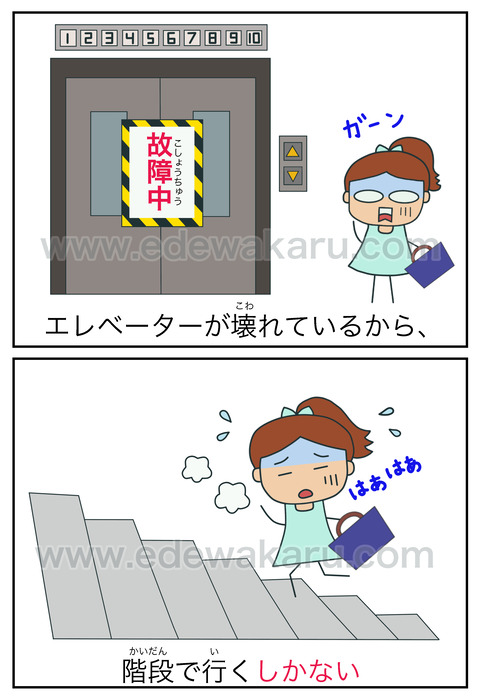
① The elevator is broken, so there’s no choice but to take the stairs.
→ The feeling that taking the stairs is 【tiring】 and 【a hassle】 (Review: 〜くさい)
② There’s no choice but to buy a new smartphone.
→ The feeling that buying a new smartphone is 【unwanted】
③ There’s no choice but to give up on the trip.
→ The feeling that giving up on the trip is 【regrettable】, 【a shock】, or 【unwanted】
④ There’s no choice but to go home by taxi.
→ The feeling that taking a taxi home is 【unwanted】 and 【expensive】
This pattern is also used very often in conversation, so it’s a good idea to learn it. 😉
【Similar sentence patterns】
In context 4 examples
エレベーターが壊れているから、階段で行くしかない
→エレベーターが壊れているから、階段で行く以外に方法がないThe elevator is broken, so there’s no choice but to take the stairs. → The elevator is broken, so there’s no other way than to take the stairs.
スマホをなくしてしまった…新しいのを買うしかない
→スマホをなくしてしまった…新しいのを買う以外に方法がないI lost my smartphone… I have no choice but to buy a new one. → I lost my smartphone… There’s no other way than to buy a new one.
熱が出たんだから、旅行はあきらめるしかないな…
→熱が出たんだから、旅行はあきらめなければならないI’ve got a fever, so I have no choice but to give up on the trip… → I’ve got a fever, so I have to give up on the trip.
最終電車(さいしゅうでんしゃ)が行っちゃった…タクシーで帰るしかないな(復習:〜ちゃう・〜じゃう)
→最終電車が行っちゃった…タクシーで帰らなければならないな…The last train has left… I guess I have no choice but to go home by taxi. (Review: 〜ちゃう・〜じゃう) → The last train has left… I guess I have to go home by taxi…
Read the original source text
Meaning
〜するだけだ
〜以外に方法がない
〜以外に方法がないので〜しなければならない
How to use it
動詞[辞書形]+しかない
Explanation
「〜しかない」は「〜以外に方法がない」という意味で使われる文型です。「
〜以外に方法がないので、しかたなく〜する」という気持ちを込めて使われます
😀(復習:〜を込めて・〜を込めた)また、
この文型は話者の【不満】【残念だと思う気持ち】などがとても強調されます
😮
[例]
①エレベーターが壊れているので、階段で行く
しかない
→階段で行くのは
【疲れる】【面倒くさい】
という気持ち(復習:〜くさい)
②新しいスマホを買う
しかない
→新しいスマホを買うのは
【嫌だ】
という気持ち
③旅行はあきらめる
しかない
→旅行をあきらめるのは
【残念だ】【ショックだ】【嫌だ】
という気持ち
④タクシーで帰る
しかない
→タクシーで帰るのは
【嫌だ】【お金がかかる】
という気持ち
この文型は会話でもとてもよく使いますので、覚えておくといいと思います😉
【類似文型】
どんなときどう使う 日本語表現文型辞典
Meaning
can't but, can only
How to use it
Vる/noun formed from a する verb+しかない
Explanation
それ以外に方法はない
「ほかに方法がない・しかたがないからそうする」とあきらめの気持ちで言うときの表現。
Expresses resignation that there is no way out of doing something.
In context 3 examples
1度決心したら最後までやるしかない。
Once you’ve made up your mind, you have no choice but to see it through to the end.
この事故の責任はこちら側にあるのだから、謝るしかないと思う。
Since we’re responsible for this accident, I think we have no choice but to apologize.
ビザの延長ができなかったのだから、帰国するしかない。
Since I couldn’t extend my visa, I have no choice but to return home.
Read the original source text
Meaning
can't but, can only
How to use it
Vる/する動詞のN+しかない
Explanation
それ以外に方法はない
「ほかに方法がない・しかたがないからそうする」とあきらめの気持ちで言うときの表現。
Expresses resignation that there is no way out of doing something.
日本語NET JLPT文法解説まとめ
Usage 1
Read this source entry ↗Meaning
"only"
An expression used when you feel that the degree is lower or the amount is smaller than you expected.
How to use it
Noun + しか
Number + counter + しか
Explanation
"only"
An expression used when you feel that the degree or amount of something is less than you expected.
Verbs always take the negative form.
In context 17 examples
マークさんは日本に3年も留学したのに、ひらがなしか書けません。
Even though Mark studied abroad in Japan for as long as three years, he can only write hiragana.
昨日、忙しすぎて4時間しか寝られませんでした。
Yesterday I was so busy that I could only sleep for four hours.
今、財布の中には500円しかありません。
I only have 500 yen in my wallet right now.
1,500円もするのに、これだけしかありません。少なすぎますよ。
It cost 1,500 yen, and this is all there is. That’s far too little.
昨日、30分しか勉強できませんでした。
Yesterday I could only study for 30 minutes.
昨日は彼女と10分しか電話で話せなかった。
Yesterday I could only talk to my girlfriend on the phone for 10 minutes.
夜は野菜しか食べないんです。
At night, I only eat vegetables.
休みは日曜日しかありません。月曜日から土曜日まで働きます。
I only have Sundays off. I work from Monday through Saturday.
えっ!断食の時は1日に1食しか食べられないんですか。
What! You can only eat one meal a day while fasting?
私の英語は挨拶しかできないレベルです。
My English is only good enough for greetings.
このお店は予約した人しか入れません。
Only people who made a reservation can enter this shop.
頑張って勉強したのに、テストの結果は30点しかありませんでした。
Even though I studied hard, I only got 30 points on the test.
あー、あと10分しかないのに、まだ半分以上問題が残っている。
Ah, there are only 10 minutes left, but more than half the questions are still unfinished.
シャンプーがもう少ししかないので、明日買ってきて。
There’s only a little shampoo left, so buy some tomorrow.
昨日の試験は3割しかわからなかった。
I only understood 30 percent of yesterday’s exam.
A:今夜の飲み会の場所はここから遠いの?
A: Is the place for tonight’s drinking party far from here?
A:え、富士山は夏しか登れないんですか。
A: What, you can only climb Mount Fuji in summer?
Read the original source text
Meaning
「〜だけ」
期待していたよりも程度が低いと感じた時や、量が少ないと感じた時に使う表現。
How to use it
Noun + しか
Number + counter + しか
Explanation
"only"
An expression used when you feel that the degree or amount of something is less than you expected.
動詞は常に否定の形をとる
Usage 2
Read this source entry ↗Meaning
“There is no other way.”
An expression used when saying, with a sense of resignation, that there is no other way and it can't be helped, so this is what one will do.
How to use it
V (dictionary form) + しかない
V (dictionary form) + (より)ほか(しかたが)ない
Explanation
"there is no other way."
A phrase used when saying, "there is no other way, so I will do it because there is no choice," with a feeling of resignation.
In context 11 examples
ここまで来たら、ゴールするまで走り続けるしかない。
Now that we've come this far, we have no choice but to keep running until we reach the finish line.
1度やると言ったからには、最後までやるしかない。
Since I said I would do it, I have no choice but to see it through to the end.
契約を更新してもらえなかったので、会社を辞めるしかない。
Since they wouldn't renew my contract, I have no choice but to quit the company.
診断の結果、ガンが見つかりました。治すには手術しかないそうです。
The diagnostic results showed cancer. Apparently, surgery is the only way to cure it.
もう、こうするしかなかったんだよ・・・。
I had no choice but to do it this way...
うっかりして、終電を逃しちゃったから、タクシーで帰るしかないね。
I wasn't paying attention and missed the last train, so I guess I have no choice but to go home by taxi.
雨も強いし、雷もなっているし、今日のイベントは中止するしかない。
The rain is heavy and there's thunder, so we have no choice but to cancel today's event.
こんな経営状況が続くようであれば、店を閉めるほかないですよ。
If business conditions like this continue, there will be no choice but to close the store.
終電に乗り遅れたし、バスも無いし、タクシーで帰るほかないですね。
I missed the last train, and there are no buses, so I have no choice but to go home by taxi.
友達が財布を忘れたから、私が払うほかありません。
My friend forgot their wallet, so I have no choice but to pay.
もし進学に失敗したら、国に帰るほかありません。
If I fail to get into school, I have no choice but to return to my country.
Read the original source text
Meaning
"それ以外に方法がない"
他に方法がない、仕方がないからそうすると、あきらめの気持ちで言う時に使う表現
How to use it
V(辞) + しかない
V(辞) + (より)ほか(しかたが)ない
Explanation
"there is no other way."
A phrase used when saying, "there is no other way, so I will do it because there is no choice," with a feeling of resignation.
毎日のんびり日本語教師
Meaning
Have no choice but to…
How to use it
Verb dictionary form + しかない
Explanation
Connected to the dictionary form of a verb, this means there is no other method or option, and no other possibility.
「~しかない」 has a pessimistic nuance, but in everyday conversation it is sometimes used with a positive meaning as well (examples 2 and 3).
However, sentences used with a positive meaning are likely to be marked incorrect in exams and the like.
A similar sentence pattern used with a positive meaning is 「【N0文法】ただ~あるのみだ」.
Notes
Related grammar: 「【N0文法】ただ~あるのみだ」
Related grammar: 「【N2文法】~だけのことだ」
In context 6 examples
寂しいけど我慢するしかない。(虽然寂寞但是只能忍耐。)
It's lonely, but I have no choice but to put up with it. (Although it's lonely, I can only endure it.)
先輩には感謝しかありません。
I have nothing but gratitude for my senior.
今なら半額なんだから行くしかないでしょう。
It's half price now, so we have to go, right?
他人に教えてもらったとしても、結局は自分で試行錯誤するしかない。
Even if someone else teaches you, in the end you can only learn through trial and error on your own.
ここまで来たら、もうやるしかない。
Now that we've come this far, there's nothing left to do but go for it.
自転車が壊れてしまい、歩いて帰るしかなくなった。
My bicycle broke, so I had no choice but to walk home.
Read the original source text
Meaning
~ほかない
How to use it
動詞辞書形+しかない
Explanation
動詞辞書形に接続して他の方法や選択肢がなく、その他の可能性もないという意味を表します。
「~しかない」には悲観的なニュアンスが含まれますが、日常会話ではプラスの意味でも用いられることがあります。(例文2、3)
ただしプラスの意味で使われた文は試験等で間違いとされる可能性が高いです。
プラスの意味で用いられる似ている文型に「【N0文法】ただ~あるのみだ」があります。
Notes
関連文法「【N0文法】ただ~あるのみだ」
関連文法「【N2文法】~だけのことだ」
AIUEO JLPT Grammar
Meaning
This sentence pattern emphasizes a limited quantity or range, showing that it is not more than that. It is often used with「しか」followed by a negative form, expressing a sense of deficiency or dissatisfaction. Similar to "only …” in English.
How to use it
Noun (+ particle) + しか + negative sentence
In context 5 examples
一つしかない。
There is only one.
この問題は先生しか解けない。
Only the teacher can solve this problem.
ここには一人しかいない。
There is only one person here.
彼は日本語しか話せないです。
He can only speak Japanese.
彼女しか知りません。
I only know her.
Read the original source text
Meaning
This sentence pattern emphasizes a limited quantity or range, showing that it is not more than that. It is often used with「しか」followed by a negative form, expressing a sense of deficiency or dissatisfaction. Similar to "only …” in English.
How to use it
名詞 (+助詞)+しか+否定文
Explanation · 日本語
この文型は、限定された数量や範囲を強調し、それ以上ではないことを表す表現です。名詞に「しか」をつけ、後に否定形を使うことで、話者が不足感や不満を感じている状況でよく使用されます。
文法
Usage 1
Meaning
An expression used when saying resignedly that there is no other way and that, since nothing else can be done, one will do it.
How to use it
V (dictionary form) + しかない
V (dictionary form) + (より)ほか(しかたが)ない
In context 11 examples
ここまで来たら、ゴールするまで走り続けるしかない。
Now that we've come this far, we have no choice but to keep running until we reach the finish line.
1度やると言ったからには、最後までやるしかない。
Since I said I would do it, I have no choice but to see it through to the end.
契約を更新してもらえなかったので、会社を辞めるしかない。
Since they wouldn't renew my contract, I have no choice but to quit the company.
診断の結果、ガンが見つかりました。治すには手術しかないそうです。
The diagnostic results showed cancer. Apparently, surgery is the only way to cure it.
もう、こうするしかなかったんだよ・・・。
I had no choice but to do it this way...
うっかりして、終電を逃しちゃったから、タクシーで帰るしかないね。
I wasn't paying attention and missed the last train, so I guess I have no choice but to go home by taxi.
雨も強いし、雷もなっているし、今日のイベントは中止するしかない。
The rain is heavy and there's thunder, so we have no choice but to cancel today's event.
こんな経営状況が続くようであれば、店を閉めるほかないですよ。
If business conditions like this continue, there will be no choice but to close the store.
終電に乗り遅れたし、バスも無いし、タクシーで帰るほかないですね。
I missed the last train, and there are no buses, so I have no choice but to go home by taxi.
友達が財布を忘れたから、私が払うほかありません。
My friend forgot their wallet, so I have no choice but to pay.
もし進学に失敗したら、国に帰るほかありません。
If I fail to get into school, I have no choice but to return to my country.
Read the original source text
Meaning
それ以外に方法がない他に方法がない、仕方がないからそうすると、あきらめの気持ちで言う時に使う表現
How to use it
V(辞) + しかない
V(辞) + (より)ほか(しかたが)ない
Usage 2
Meaning
"only"
An expression used when you feel that the degree is lower or the amount is smaller than you expected.
How to use it
Noun + しか
Number + counter + しか
Notes
The verb always takes a negative form.
In context 15 examples
マークさんは日本に3年も留学したのに、ひらがなしか書けません。
Even though Mark studied abroad in Japan for as long as three years, he can only write hiragana.
昨日、忙しすぎて4時間しか寝られませんでした。
Yesterday I was so busy that I could only sleep for four hours.
今、財布の中には500円しかありません。
I only have 500 yen in my wallet right now.
1,500円もするのに、これだけしかありません。少なすぎますよ。
It cost 1,500 yen, and this is all there is. That’s far too little.
昨日、30分しか勉強できませんでした。
Yesterday I could only study for 30 minutes.
昨日は彼女と10分しか電話で話せなかった。
Yesterday I could only talk to my girlfriend on the phone for 10 minutes.
夜は野菜しか食べないんです。
At night, I only eat vegetables.
休みは日曜日しかありません。月曜日から土曜日まで働きます。
I only have Sundays off. I work from Monday through Saturday.
えっ!断食の時は1日に1食しか食べられないんですか。
What! You can only eat one meal a day while fasting?
私の英語は挨拶しかできないレベルです。
My English is only good enough for greetings.
このお店は予約した人しか入れません。
Only people who made a reservation can enter this shop.
頑張って勉強したのに、テストの結果は30点しかありませんでした。
Even though I studied hard, I only got 30 points on the test.
あー、あと10分しかないのに、まだ半分以上問題が残っている。
Ah, there are only 10 minutes left, but more than half the questions are still unfinished.
シャンプーがもう少ししかないので、明日買ってきて。
There’s only a little shampoo left, so buy some tomorrow.
昨日の試験は3割しかわからなかった。
I only understood 30 percent of yesterday’s exam.
Read the original source text
Meaning
「〜だけ」
期待していたよりも程度が低いと感じた時や、量が少ないと感じた時に使う表現。
How to use it
Noun + しか
Number + counter + しか
Notes
動詞は常に否定の形をとる
Bunpro Grammar Reference
Usage 1
Meaning
There's only, Nothing but
How to use it
Noun + しか + Verb[ない]
Nuance
A phrase that highlights that one specific thing is all that exists.
Explanation
The adverbial particle しか is often compared to だけ, in that it also expresses 'only'. However, unlike だけ, しか can only be used in negative statements. Due to this, しか~ない is regularly translated as 'there's only (A)', or 'there's nothing but (A)'. しか~ない may be used to express numbers, or nouns. In this lesson we will examine nouns.
Like しか~ない, the construction used for expressing numbers, when used before a noun, this expression will mean that nothing apart from that one 'thing' exists. Any verb may be used after しか, but it must be in its ない (or ありません) form.
犯人はまだ3人しか捕まっていない。
Only 3 of the criminals have been caught so far.
この店は牛丼しか置いていない。
This store only has gyudon.
釣りに行って、一匹しか釣れないと悲しくなる。
I get sad when I go fishing and only catch one fish.
Caution
When しかない directly follows a verb, the translation is a little bit different, and means that 'nothing apart from (A) can be done'. This is a separate grammar point that we will study a bit later.
明日から雨が降るから、今日行くしかない。
Since it will start raining tomorrow, we have no choice but to go today.
In context 16 examples
- 座るところがここしかありません。
There is nowhere else to sit but here.
- 釣りに行って、一匹しか釣れないと悲しくなる。
I get sad when I go fishing and only catch one fish.
- 犯人はまだ3人しか捕まっていない。
Only 3 of the criminals have been caught so far.
- この店は牛丼しか置いていない。
This store only has gyudon.
- 遠いので、車で行くことしか出来ない。
Because it is far away, you can only go by car.
- 「はい」と「いいえ」しか言わない人とは話しにくい。
It is difficult to talk to people who only respond with 'yes' and 'no'.
- すみませんが、午後しか空いていないみたいです。
I am sorry, but it looks like only the afternoon is open.
- 冷蔵庫に牛乳しか残っていない。
There is nothing but milk in the fridge.
- 手袋を一枚しか見つけられない。
I can only find one glove.
- 多く見えるけど、ちょっとしかない。
It looks like there is a lot, but there's only a few. (nothing but)
- 勉強をするなら、今しか出来ない!
If you are going to study, it is now or never! (nothing but)
- お茶しかないけど、よかったらどうぞ。
We have nothing but tea, but, if you like, please help yourself.
- 空気が綺麗だし、皆が優しいから、ここにしかすまないだろう。
Not only is the air clear, everyone is so nice. There is no other place to live but here.
- 泥棒がロウソクしか取らなかったので、警察に電話していない。
The thief took nothing but the candles, so I didn't call the police.
- このテレビはチャネルが二つしかないけど、テレビをあまり見ないからいい。
This TV only has two channels, but I don't really watch TV so it's okay.
- 明日から雨が降るから、今日行くしかない。
Since it will start raining tomorrow, we have no choice but to go today.
Read the original source text
Meaning
There's only, Nothing but
How to use it
Noun + しか + Verb[ない]
Nuance
A phrase that highlights that one specific thing is all that exists.
Explanation
The adverbial particle しか is often compared to だけ, in that it also expresses 'only'. However, unlike だけ, しか can only be used in negative statements. Due to this, しか~ない is regularly translated as 'there's only (A)', or 'there's nothing but (A)'. しか~ない may be used to express numbers, or nouns. In this lesson we will examine nouns.
Like しか~ない, the construction used for expressing numbers, when used before a noun, this expression will mean that nothing apart from that one 'thing' exists. Any verb may be used after しか, but it must be in its ない (or ありません) form.
犯人はまだ3人しか捕まっていない。
Only 3 of the criminals have been caught so far.
この店は牛丼しか置いていない。
This store only has gyudon.
釣りに行って、一匹しか釣れないと悲しくなる。
I get sad when I go fishing and only catch one fish.
Caution
When しかない directly follows a verb, the translation is a little bit different, and means that 'nothing apart from (A) can be done'. This is a separate grammar point that we will study a bit later.
明日から雨が降るから、今日行くしかない。
Since it will start raining tomorrow, we have no choice but to go today.
Nuance · 日本語
ある一つのものだけが存在しているということを表す表現。
Usage 2
Meaning
Have no choice but, Only, Just
How to use it
Verb + しかない
Verb + しかありません
Nuance
A structure that specifically expresses that no action apart from (A) is possible.
Explanation
しかない is a commonly used expression in Japanese that is partnered with verbs. It is a combination of しか, the adverbial particle, and the い-Adjective ない. This structure may be translated as 'to have no choice but (A)', or 'there is only (A)'. しかない regularly emphasizes the point that nothing apart from (A) is possible.
To use しかない, simply attach it directly to the non-past form of whichever verb you would like to highlight as being the 'only' possible action.
こうなったら警察を呼ぶしかない。
If it's come to this, there is no choice but to call the police.
もう電車が来ないから、車で行くしかない。
Since trains won't be coming anymore, there is no choice but to go by car.
Unlike だけ, which implies that one particular option was chosen (out of several), しか always insinuates that (A) is the only option, and therefore will sound much stronger than だけ. Also, as only one option exists, it will often be assumed by the listener that some particular circumstances resulted in (A) being all that can be done.
この時間帯はピザハット以外どこも開いていないね。こうなったらピザを頼むしかないね。
At this hour, nowhere is open other than Pizza Hut. Now that it's come to it, there is no choice but to order some pizza, right?
今月は休めないから、コンサートに行くのを我慢するしかない。
I can't take a day off this month, so I have no choice but to resist going to the concert.
Fun Fact
Occasionally, しかない may be used in manga, anime, or other forms of media that use casual language. In these cases, it is not uncommon to see しか abbreviated to っきゃ, resulting in っきゃない. However, this is not a common abbreviation in daily language.
この技で倒れないのなら、必殺技を使うっきゃないな!
If I can't defeat them using this move, there is no other choice but to use my special move, is there?
これほど完璧なチャンスは二度とないから、今やるっきゃないでしょう。
An opportunity this perfect will not come around a second time, so I have no other choice but to do it now.
In context 18 examples
- 人が多いから、並ぶしかない。
Because there are a lot of people, we have no choice but to line up.
- こうなったら警察を呼ぶしかない。
If it's come to this, there is no choice but to call the police.
- もう電車が来ないから、車で行くしかない。
Since trains won't be coming anymore, there is no choice but to go by car.
- この時間帯はピザハット以外どこも開いていないね。こうなったらピザを頼むしかないね。
At this hour, nowhere is open other than Pizza Hut. Now that it's come to it, there is no choice but to order some pizza, right?
- 今月は休めないから、コンサートに行くのを我慢するしかない。
I can't take a day off this month, so I have no choice but to resist going to the concert.
- 時が来るのを待つしかないですよ。
You have no choice but to wait for the time to come.
- こんなにうまくいかないかなあ… もう笑うしかない。
To think that it would go this poorly... I have no choice but to laugh!
- 素直に謝るしかないです。
I have no choice but to sincerely apologize.
- この部屋はゴミだらけなので掃除するしかない。
This room is full of trash. I have no choice but to clean it.
- 日本は資源を輸入するしかない。
Japan has no choice but to import resources.
- 飲みに行くしかない。だって、私の誕生日だから。
We have no choice but to go drinking. Why? Because it's my birthday.
- 迎えに来てもらえないので、歩いて帰るしかない。
(They) won't come pick us up so we have no choice but to walk home.
- 私ならほかの仕事をするだろうけど、上司の命令だから、従うしかない。
If it was up to me, I would be doing other work but it is an order from my superior, so I have no choice but to obey.
- 犬が外に出たがるから、散歩に連れていくしかない。
The dog wants to go out, so I have no choice but to take it for a walk.
- 彼らが暴力を振ってくるところだったから身を守るしかなかった。
Because they were about to resort to violence, I had no choice but to defend myself.
- 山から降りられるなら降りたいんだ。でも、強い雨が降り始めたから、この雨が止むまで頂上で待っているしかない。
If I could go down the mountain, I would go down. However, it started pouring rain, so I have no other choice but to continue waiting at the peak until the rain stops.
- この技で倒れないのなら、必殺技を使うっきゃないな!
If I can't defeat them using this move, there is no other choice but to use my special move, is there?
- これほど完璧なチャンスは二度とないから、今やるっきゃないでしょう。
An opportunity this perfect will not come around a second time, so I have no other choice but to do it now.
Read the original source text
Meaning
Have no choice but, Only, Just
How to use it
Verb + しかない
Verb + しかありません
Nuance
A structure that specifically expresses that no action apart from (A) is possible.
Explanation
しかない is a commonly used expression in Japanese that is partnered with verbs. It is a combination of しか, the adverbial particle, and the い-Adjective ない. This structure may be translated as 'to have no choice but (A)', or 'there is only (A)'. しかない regularly emphasizes the point that nothing apart from (A) is possible.
To use しかない, simply attach it directly to the non-past form of whichever verb you would like to highlight as being the 'only' possible action.
こうなったら警察を呼ぶしかない。
If it's come to this, there is no choice but to call the police.
もう電車が来ないから、車で行くしかない。
Since trains won't be coming anymore, there is no choice but to go by car.
Unlike だけ, which implies that one particular option was chosen (out of several), しか always insinuates that (A) is the only option, and therefore will sound much stronger than だけ. Also, as only one option exists, it will often be assumed by the listener that some particular circumstances resulted in (A) being all that can be done.
この時間帯はピザハット以外どこも開いていないね。こうなったらピザを頼むしかないね。
At this hour, nowhere is open other than Pizza Hut. Now that it's come to it, there is no choice but to order some pizza, right?
今月は休めないから、コンサートに行くのを我慢するしかない。
I can't take a day off this month, so I have no choice but to resist going to the concert.
Fun Fact
Occasionally, しかない may be used in manga, anime, or other forms of media that use casual language. In these cases, it is not uncommon to see しか abbreviated to っきゃ, resulting in っきゃない. However, this is not a common abbreviation in daily language.
この技で倒れないのなら、必殺技を使うっきゃないな!
If I can't defeat them using this move, there is no other choice but to use my special move, is there?
これほど完璧なチャンスは二度とないから、今やるっきゃないでしょう。
An opportunity this perfect will not come around a second time, so I have no other choice but to do it now.
Nuance · 日本語
(A)以外の動作は不可能だということを表す表現。
Explanation · 日本語
「しかない」は、動詞と一緒に使われる表現です。副助詞の「しか」とイ形容詞の「ない」からできています。この文法は、「(A) のほかに方法がない」「できることは (A) だけだ」のような意味を強く伝えたいときに使われます。
「しかない」は、動詞の辞書形につないで使われ、その動詞が「唯一できる行動」であることを表します。
こうなったら警察を呼ぶしかない。
If it's come to this, there is no choice but to call the police.
もう電車が来ないから、車で行くしかない。
Since trains won't be coming anymore, there is no choice but to go by car.
「しか」には (A) が唯一の選択肢であるというニュアンスがあります。そのため、複数の中から一つを選ぶことを示す「だけ」よりも強く聞こえます。「しか」は、ほかに方法がないことを表すので、この文法を使うと、「そうしなければならない事情があったのだろう」と聞き手に受け取られることもあります。
この時間帯はピザハット以外どこも開いていないね。こうなったらピザを頼むしかないね。
At this hour, nowhere is open other than Pizza Hut. Now that it's come to it, there is no choice but to order some pizza, right?
今月は休めないから、コンサートに行くのを我慢するしかない。
I can't take a day off this month, so I have no choice but to resist going to the concert.
豆知識
漫画やアニメのようなくだけた表現いが多いメディアでは、「しか」が「っきゃ」と略され、「っきゃない」という形になることもあります。ただし、これは日常会話ではそれほど使われません。
この技で倒れないのなら、必殺技を使うっきゃないな!
If I can't defeat them using this move, there is no other choice but to use my special move, is there?
これほど完璧なチャンスは二度とないから、今やるっきゃないでしょう。
An opportunity this perfect will not come around a second time, so I have no other choice but to do it now.
NINJAL 日本語文型データベース
Usage 1
Meaning
Used when you want to single out one thing and emphasize that it is the only thing, or clearly express that there is nothing else.
“〜だけしか〜ない,” used together with “〜だけ,” emphasizes the meaning “only ~” even more.
How to use it
Nしか〜ない
Other
Notes
The particles “が・を” are replaced with “しか.” With particles other than “が・を,” “しか” is added after the particle, as in “でしか・にしか・へしか・からしか.”
When “〜” is a clause, use “こと・もの” to turn it into a noun before connecting.
In context 11 examples
マリさんはベジタリアンなので、野菜しか食べません。
Mari is a vegetarian, so she only eats vegetables.
おばあちゃんに1万円もらったのに、もう100円しか残っていない。
Even though Grandma gave me 10,000 yen, I have only 100 yen left.
せっかく大学に入ったのに、弟は楽をすることしか考えていない。
Even though my younger brother went to all the trouble of getting into university, all he thinks about is taking it easy.
スキーをするため北海道に行ったが、天気が悪くてスキーはできなかった。ただ寒かったことしか覚えていない。
I went to Hokkaido to ski, but the weather was bad and I couldn’t ski. I only remember that it was cold.
「日本料理の作り方を教えてほしいと言われても、簡単なものしか作れませんよ」
“Even if you ask me to teach you how to make Japanese food, I can only make simple things.”
この日本酒は京都でしか買えないものです。
This sake is only available in Kyoto.
この話は佐藤さんにしか話していないのに、加藤さんが知っていた。変だ。
I had only told Mr. Sato about this, but Mr. Kato knew. That’s strange.
この店の電話は、営業開始時間の10時からしかつながりません。
This shop’s phone line is only open from 10 a.m., when business starts.
両親を事故で亡くし、私の家族は弟だけしかいないんです。
I lost my parents in an accident, so my younger brother is the only family I have.
家でとれた野菜を近所の人にあげたら、みんなたくさんもらってくれて、もうこれだけしか残っていない。
When I gave the vegetables I grew at home to the neighbors, they all took a lot, and this is all that’s left now.
日本にもう10年住んでいますが、東京には1回だけしか行ったことがありません。
I’ve lived in Japan for ten years now, but I’ve only been to Tokyo once.
Read the original source text
Meaning
ひとつのことを取りあげて、〜だけだということを強調したいときや、他のことがないことをはっきりと表したいときに使います。
「〜だけ」と一緒に使う「〜だけしか〜ない」は、「〜だけ」という意味をより強調しています。
How to use it
Nしか〜ない
その他
Notes
助詞「が・を」を「しか」に置き換えて使います。「が・を」以外の助詞は、「でしか・にしか・へしか・からしか」のように、助詞の後に「しか」がつく形になります。
「〜」が文の場合は、「こと・もの」を使って名詞にして接続します。
Usage 2
Meaning
Since there is no other way, this expresses that one has no choice but to do something, does it reluctantly, or accepts that this is inevitably the only possibility.
How to use it
Vるしかない
Nしかない (N is a noun that forms a suru verb)
In context 10 examples
志望校に合格できなかったら、もう1年頑張るしかない。
If I don’t get into the school I want, I’ll have no choice but to work hard for another year.
いい仕事が見つかりませんでした。しばらくアルバイトで暮らすしかありません。
I couldn’t find a good job. I have no choice but to get by on part-time work for a while.
傷んだ食べ物は捨てるしかありません。もったいないですけど。
There’s no choice but to throw away spoiled food. It’s such a waste, though.
体力がなくなってきたので、退職するしかなかった。
My stamina was running out, so I had no choice but to retire.
あのチームの粘り強い戦いには、ただ脱帽するしかない。
All one can do is take one’s hat off to that team’s tenacious performance.
「あれ、この竹、根元から曲がって伸びている」「重い石があるから、まっすぐに伸びられなくて、曲がるしかなかったんでしょう」
“Huh, this bamboo is bent and growing from the base.” “There’s a heavy rock there, so it probably couldn’t grow straight and had no choice but to bend.”
レポートの締め切りは明日だ。今夜は徹夜しかない。
The report is due tomorrow. I have no choice but to stay up all night.
病状がここまで進んでしまったのだから、後は手術しかないだろう。
Since the illness has progressed this far, surgery is probably the only option now.
このところうちの店は赤字続きだ。こうなったらもう閉店しかない。
Our shop has been in the red lately. At this point, we have no choice but to close.
親に頼れず、経済的に困窮している学生は少なくない。中途退学しかない場合もある。
Quite a few students are financially struggling and unable to rely on their parents. In some cases, they have no choice but to drop out.
Read the original source text
Meaning
それ以外に方法がないので、しかたなく~しなければならない・覚悟して~する・必然的にその可能性だけになるということを表します。
How to use it
Vるしかない
Nしかない(Nは、する動詞のN)