DoJG 日本語文法辞典(全集)
Meaning
Even though (it is/was the case that); even if (it is true that); although (it is/was the case that); whatever/whoever/etc.; no matter what/who/how/etc.; whether X or Y
How to use it
(i) Vinformal | に{しろ/せよ} | |
| {行く/行った}に{しろ/せよ} | Even though someone goes/went |
(ii) Adjectiveいinformal | に{しろ/せよ} | |
| {高い/高かった}に{しろ/せよ} | Even though something is/was expensive |
(iii) Adjectiveなstem | {∅/である/だった/であった}に{しろ/せよ} | |
| 不十分{∅/である/だった/であった}に{しろ/せよ} | Even though something is/was insufficient |
(iv) Noun | {∅/である/だった/であった}に{しろ/せよ} | |
| 子供{∅/である/だった/であった}に{しろ/せよ} | Even though it is/was a child |
| 誰{∅/である/だった/であった}に{しろ/せよ} | Whoever it may be/have been |
| いずれに{しろ/せよ} | Whichever it may be; at any rate |
(v) Adverb | に{しろ/せよ} | |
| ゆっくりに{しろ/せよ} | Even though something happens slowly |
Explanation
にしろ・せよ A conjunctive phrase that carries the meaning of concession.
In context 16 examples
時間があまりなかったに{しろ/せよ}、この仕事はひどすぎる。
Even though he didn't have much time, this work is too sloppy.
誰が書くに{しろ/せよ}、絶対間違いがあってはいけない。
No matter who writes it, there can be absolutely no mistakes.
行くに{しろ/せよ}、行かないに{しろ/せよ}、後で電話を下さい。
Whether you go or not, please give me a call later.
何に{しろ/せよ}、このままでは問題は解決しない。
At any rate (literally: whatever it is), leaving the situation as it is won't solve the problem.
たとえ練習に{しろ/せよ}、真面目にやらなければならない。
Even though it is just practice, you have to take it seriously.
程度の差はあるにせよ、性差別のない国はないだろう。
Although the degree may differ from country to country (literally: there may be differences in degree), there is no country without gender discrimination.
薬を飲むことですべての問題が解決はしないにしろ、あなたの場合は薬で症状を軽減させることが先決です。
Even if (it's true that) taking the drug will not solve all your problems, in your case, you have to alleviate the symptoms first (by taking it).
誰かに書いてもらうにしろ、内容は我々が考えなければならない。
Even if we ask someone to write it for us, we will have to think of what to say (literally: the content) ourselves.
どのソフトを使うにしろ、早く使い方に慣れてもらわないといけない。
Whichever software application you use, you must quickly get comfortable using it (literally: get used to how to use it).
誰がそれを説明するにせよ、相手の気持ちを傷つけないように細心の注意が必要だ。
Whoever explains it (to him) must be very careful not to hurt his feelings.
どんな事情があったにせよ、何も言わずに仕事を辞めるのは無責任すぎる。
No matter what the circumstances were, quitting the job without saying anything is just (too) irresponsible.
ホームページの制作に関する書籍は書店の棚にあふれている状態で、自分が読むにせよ、他人に勧めるにせよ、大いに迷う。
Books on Web page design are spilling off of bookstore shelves, and whether we want to read them ourselves or recommend them to someone else, it is hard to know what to choose.
現政権を支持するにせよ批判するにせよ、まずはじめに問題に対する正確な理解と冷静な分析が不可欠である。
First of all, whether you support the current administration or criticize it, an accurate understanding and a cool analysis of the problems are indispensable.
野球にせよサッカーにせよ、プロでやっていくには並の努力では続かない。
Whether it be baseball or soccer, you cannot stay as a professional player just with an ordinary effort.
普通の人は、意識的にせよ無意識的にせよ、不快なことを避けようとする。
Whether they do it consciously or unconsciously, ordinary people try to avoid unpleasant things.
一旦ネットに発信してしまった情報は、それが真実にせよそうでないにせよ、取り消しができない。
Whether it is true or not, once you send out information on the Internet, you can't take it back.
日本語文型辞典
Meaning
A formal written-language form of 「…にしても」. 「…にせよ」 is also used.
Examples:
1. It is an issue whether the official accepted a bribe, but even if no money changed hands, it is certain that he received some kind of reward.
2. Neither his wife nor his children tried to understand his feelings.
3. Whichever plan is adopted, the members must be given a thorough explanation.
See also: にしても
Read the original source text
Meaning
基本情報説明「…にしても」の改まった書きことばの言い方。「…にせよ」とも言う。例文① 役人がわいろを受け取ったかどうか問題になっているが、かりに金銭の授受はなかったにしろ、なんらかの報酬をもらったことは間違いない。② 妻にしろ子供達にしろ、彼の気持ちを理解しようとするものはいなかった。③ どちらの案を採用するにしろ、メンバーには十分な説明をする必要がある。参照⇾にしても
絵でわかる日本語
Meaning
Whether it is case A or case B…
Both A and B, in either case…
How to use it
Verb, adjective, or noun [plain form] + にしても〜にしても
Explanation
“AにしてもBにしても” is a sentence pattern meaning “whether it is case A or case B, either way.” Sometimes it takes the form “AにしてもAないにしても,” and sometimes “A” and “B” are things from the same group. 😮
[Learn these together]
“〜にしても〜にしても” can be changed to “〜にしろ〜にしろ” or “〜にせよ〜にせよ.” 😊 Remember that “〜にしろ” and “〜にせよ” are slightly more formal than “〜にしても.” 😀
[Examples]
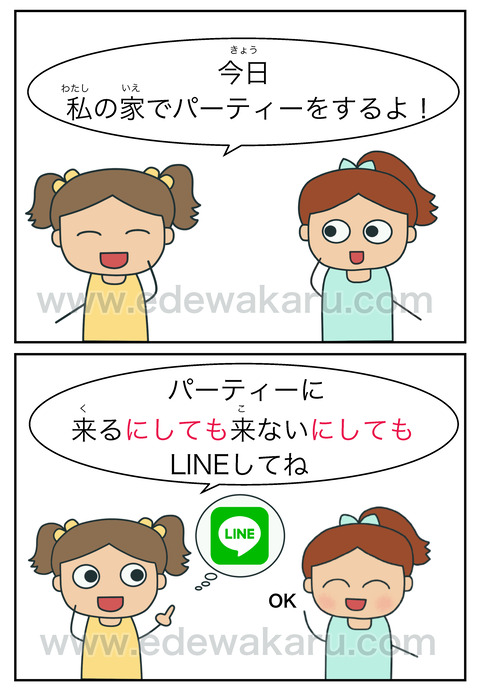
Whether or not you come to the party, send me a LINE message.
= Whether or not you come to the party, send me a LINE message.
= Whether or not you come to the party, send me a LINE message.
Whether it’s a dog or a cat, keeping a pet is hard.
= Whether it’s a dog or a cat, keeping a pet is hard.
= Whether it’s a dog or a cat, keeping a pet is hard.
There are many expressions and words used with “〜にしても,” “〜にしろ,” and “〜にせよ,” so I think it’s useful to learn them as a set. 😉
In context 4 examples
パーティーに来るにしても来ないにしてもLINE(ライン)してね
→パーティーに来る場合も来ない場合もどちらの場合でもLINEしてね(復習:「Google」や「Twitter」は日本語でどう読むの?)Whether you come to the party or not, send me a LINE message. (Review: How do you pronounce “Google” and “Twitter” in Japanese?)
N1を受けるにしても受けないにしても、毎日しっかり勉強しなくちゃ
→N1を受ける場合も受けない場合も、毎日しっかり勉強しなくちゃ(復習:〜なくちゃ)Whether you take N1 or not, you have to study hard every day. (Review: 〜なくちゃ)
犬にしても猫にしてもペットを飼うのは大変だ
→犬でも猫でもどちらの場合でも、ペットを飼うのは大変だWhether it’s a dog or a cat, keeping a pet is hard. → Either way, whether it’s a dog or a cat, keeping a pet is hard.
高いにしても安いにしても、教科書は買わざるを得ない
→高くても安くてもどちらの場合でも、教科書は買わざるを得ない(復習:〜ざるを得ない)Whether they’re expensive or cheap, I have no choice but to buy the textbook. (Review: 〜ざるを得ない)
Read the original source text
Meaning
〜の場合も〜の場合も〜
〜も〜もどちらの場合でも〜
How to use it
動詞・形容詞・名詞[普通形]+にしても〜にしても
Explanation
「AにしてもBにしても」は「Aの場合もBの場合も、どちらの場合でも」という意味を表す文型です。「AにしてもAないにしても」になる場合と、「A」と「B」に同じグループのものがくる場合があります😮
【一緒に覚えましょう】
「〜にしても〜にしても」は「〜にしろ〜にしろ」「〜にせよ〜にせよ」にチェンジすることができます
😊「〜にしろ」「〜にせよ」は「〜にしても」より少しかたい言い方だと覚えておきましょう😀
[例]
パーティーに来る
にしても
来ない
にしても
LINEしてね
=パーティーに来る
にしろ
こない
にしろ
LINEしてね
=パーティーに来る
にせよ
来ない
にせよ
LINEしてね
犬
にしても
猫
にしても
ペットを飼うのは大変だ
=犬
にしろ
猫
にしろ
ペットを飼うのは大変だ
=犬
にせよ
猫
にせよ
ペットを飼うのは大変だ
「〜にしても」「〜にしろ」「〜にせよ」を使う表現や単語はたくさんありますので、セットで覚えておくといいと思います😉
どんなときどう使う 日本語表現文型辞典
Usage 1
Meaning
whether it's
How to use it
V-dictionary form / N + にしろ + V-dictionary form / N + にしろ
Explanation
にしろ~にしろ
~でも~でも
1)「~でも~でも」と例をいくつかあげて「その全部に当てはまる」と言いたいときに使う。
2) ❹ のように、対立的なものを並べて「そのどちらの場合でも」という意味で使うこともある。
3)「にしても~にしても・にせよ~にせよ」と用法は同じ。
3)Patterns にしても~にしても, and にせよ~にせよ are used same way.
1)Lists multiple examples and shows that something is true in every case.
2)Also describes contrasts, as in sentence ❹ , to show that something is true in either case.
In context 4 examples
野球にしろサッカーにしろ、スポーツにけがはつきものです。
Whether it’s baseball or soccer, injuries are part and parcel of sports.
私鉄にしろ JR にしろ、車内の冷暖房の省エネ化がなかなか進まない。
Whether it’s a private railway or JR, energy-saving improvements to heating and air conditioning in the cars are not making much progress.
泳ぐにしろ走るにしろ、体を動かすときは準備運動が必要だ。
Whether you’re swimming or running, you need to warm up when exercising.
旅行に行くにしろ行かないにしろ、決めたらすぐ知らせてください。
Whether you’re going on the trip or not, please let me know as soon as you’ve decided.
Read the original source text
Meaning
whether it's
How to use it
Vる/N+にしろ+Vる/N+にしろ
Explanation
にしろ~にしろ
~でも~でも
1)「~でも~でも」と例をいくつかあげて「その全部に当てはまる」と言いたいときに使う。
2) ❹ のように、対立的なものを並べて「そのどちらの場合でも」という意味で使うこともある。
3)「にしても~にしても・にせよ~にせよ」と用法は同じ。
3)Patterns にしても~にしても, and にせよ~にせよ are used same way.
1)Lists multiple examples and shows that something is true in every case.
2)Also describes contrasts, as in sentence ❹ , to show that something is true in either case.
Usage 2
Meaning
even if; whether or not
How to use it
N / [plain form] (な-adjective + である / N + である) + にしろ
Explanation
~と仮定しても
1)「~にしろ、…」の形で、「もし~となっても、~であっても」と言い、「…」で、話者の主張・判断・評判・納得できない気持ち・非難などを述べる。
2)「たとえ・仮に・疑問詞」などの言葉とともに使うことが多い。
3)「としても・にしても」より硬い言葉で、意味は同じ。
2)Often used with たとえ, 仮に, or interrogatives.
3)More formal than としても, or にしても, but has same meaning.
1)"Even if." Speaker's assertion, judgment, evaluation, feeling of inability to agree, or criticism follow.
In context 3 examples
たとえお金がないにしろ、食事だけはきちんと取るべきだ。
Even if you have no money, you should at least eat properly.
勤め先が小さい会社であるにしろ、社員は就業規則を守らなければならない。
Even if your workplace is a small company, employees must follow the work rules.
もし少年が家出をしたにしろ、まだそんなに遠くへは行っていないだろう。
Even if the boy has run away from home, he probably hasn’t gone very far yet.
Read the original source text
Meaning
even if; whether or not
How to use it
N/〔普通形〕(ナAである/Nである)+にしろ
Explanation
~と仮定しても
1)「~にしろ、…」の形で、「もし~となっても、~であっても」と言い、「…」で、話者の主張・判断・評判・納得できない気持ち・非難などを述べる。
2)「たとえ・仮に・疑問詞」などの言葉とともに使うことが多い。
3)「としても・にしても」より硬い言葉で、意味は同じ。
2)Often used with たとえ, 仮に, or interrogatives.
3)More formal than としても, or にしても, but has same meaning.
1)"Even if." Speaker's assertion, judgment, evaluation, feeling of inability to agree, or criticism follow.
毎日のんびり日本語教師
Usage 1
Read this source entry ↗How to use it
Verb plain form + ~にしろ/~にしたって/~にせよ/~にしても
I-adjective plain form + ~にしろ/~にしたって/~にせよ/~にしても
Na-adjective stem (+ である) + ~にしろ/~にしたって/~にせよ/~にしても
Noun (+ である) + ~にしろ/~にしたって/~にせよ/~にしても
Explanation
Indicates that something holds true without exception.
It often pairs with expressions such as 「どんなに」 and 「いくら」.
Notes
Related grammar: 「~にしろ~にしろ/~にせよ~にせよ/~にしても~にしても」
In context 5 examples
何にせよまず安全第一である。
Whatever the case, safety comes first.
いくら大好物にせよ、食べ過ぎると飽きる。
No matter how much I love it, I’ll get tired of it if I eat too much.
いずれにしても探し回っている時間はない。
In any case, there’s no time to search around.
子供のしたことにせよ、許されることではない。
Even if it was something a child did, it cannot be forgiven.
相手が年下にしろ、最低限の礼儀は必要だ。
Even if the other person is younger, basic manners are necessary.
Read the original source text
How to use it
動詞普通形+~にしろ/~にしたって/~にせよ/~にしても
い形容詞普通形+~にしろ/~にしたって/~にせよ/~にしても
な形容詞語幹(+である)+~にしろ/~にしたって/~にせよ/~にしても
名詞(+である)+~にしろ/~にしたって/~にせよ/~にしても
Explanation
例外無く物事が成立することを表します。
「どんなに」「いくら」などが呼応します。
Notes
関連文法「~にしろ~にしろ/~にせよ~にせよ/~にしても~にしても」
Usage 2
Read this source entry ↗How to use it
Verb plain form + ~にしろ / ~にせよ / ~にしても
い-adjective plain form + ~にしろ / ~にせよ / ~にしても
な-adjective stem (+ である) + ~にしろ / ~にせよ / ~にしても
Noun (+ である) + ~にしろ / ~にせよ / ~にしても
Explanation
Two different, opposing situations are presented in the preceding and following clauses to express that something holds true without exception, whatever the situation.
Notes
Related grammar: 「~にしろ/~にしたって/~にせよ/~にしても」
In context 6 examples
リハーサルにしろ本番にしろ、同じような気持ちで挑めれば一番良い。
Whether it’s a rehearsal or the actual performance, it would be best if we could approach both with the same mindset.
続けるにせよ辞めるにせよ、決めるのは早いほうがいい。
Whether you continue or quit, it’s better to make a decision sooner.
猫にしても犬にしても、ここではペットを飼ってはいけないことになっている。
Whether it’s a cat or a dog, pets are not allowed here.
成功するにしろ失敗するにしろ、どっちもいい経験になる。
Whether we succeed or fail, either way it’ll be a good experience.
プロにせよアマにせよ、その競技を好きな気持ちは変わらない。
Whether a professional or an amateur, their love of the sport doesn’t change.
家族にしろ恋人にしろ、彼を擁護する人は一人もいなかった。
No one defended him, whether family or romantic partner.
Read the original source text
How to use it
動詞普通形+~にしろ/~にせよ/~にしても
い形容詞普通形+~にしろ/~にせよ/~にしても
な形容詞語幹(+である)+~にしろ/~にせよ/~にしても
名詞(+である)+~にしろ/~にせよ/~にしても
Explanation
前項と後項で相反する二つの異なる状況を挙げて、たとえどのような状況でも例外無く物事が成立することを表します。
Notes
関連文法「~にしろ/~にしたって/~にせよ/~にしても」
日本語文型辞典 英語版
Meaning
A formal, written expression of ...にしても. Can be rephrased as ...にせよ.
→
In context 3 examples
役人がわいろを受け取ったかどうか問題になっているが、かりに金銭の授受はなかったにしろ、なんらかの報酬をもらったことは間違いない。
Whether the officer took a bribe or not is at issue, but even if there was no money given or received, there is no doubt that he received some sort of remuneration.
妻にしろ子供達にしろ、彼の気持ちを理解しようとするものはいなかった。
Neither his wife nor his children—no one tried to understand his feelings.
どちらの案を採用するにしろ、メンバーには十分な説明をする必要がある。
Whichever proposal you adopt, you need to explain it sufficiently to the members.
AIUEO JLPT Grammar
Usage 1
Meaning
This sentence pattern is used when presenting assumptions or conditions and stating opinions or evaluations that follow. It is often used when emphasizing a point by juxtaposing contrasting elements or giving extreme examples.
How to use it
Verb に + しろ or せよ or しても; i-adjective に + しろ or せよ or しても; na-adjective に + しろ or せよ or しても; Noun に + しろ or せよ or しても
In context 5 examples
仮に引っ越すにしても、どこに行くつもりですか?
Even if you were to move, where would you go?
どういう状況であるにせよ、説明は必要じゃない?
Whatever the situation, surely an explanation is needed?
遅れるにしろ、連絡だけはしてください。
Even if you’re going to be late, please at least let me know.
この問題はいくら難しいにしても、解決しなければならない。
However difficult this problem may be, it must be solved.
どういう状況にせよ、よく考えた方がいい。
Whatever the situation, you should think carefully.
Read the original source text
Meaning
This sentence pattern is used when presenting assumptions or conditions and stating opinions or evaluations that follow. It is often used when emphasizing a point by juxtaposing contrasting elements or giving extreme examples.
How to use it
動詞に+しろorせよorしても形容詞に+しろorせよorしても形容動詞に+しろorせよorしても名詞に+しろorせよorしても
Explanation · 日本語
この文型は、仮定や条件を提示しながら、それに続く意見や評価を述べるときに使われる表現です。対立する要素を並べたり、極端な例を挙げて意見を強調する場合によく使われます。
Usage 2
Meaning
This sentence pattern expresses that no matter which example is considered, the same result or situation will apply. It is similar to 「〜にしても〜にしても」.
How to use it
Verb に + しろ + verb に + しろ; adjective に + しろ + adjective に + しろ; な-adjective に + しろ + な-adjective に + しろ; noun に + しろ + noun に + しろ
In context 5 examples
行くにしろ行かないにしろ、早く決めてください。
Whether you go or not, please decide quickly.
高いにしろ安いにしろ、品質が大事だ。
Whether it’s expensive or cheap, quality is important.
学生にしろ社会人にしろ、時間の管理は大切だ。
Whether you’re a student or a working adult, time management is important.
難しいにしろ簡単にしろ、挑戦してみる価値がある。
Whether it’s difficult or easy, it’s worth trying.
独身であるにしろ結婚しているにしろ、自分の人生を楽しむべきだ。
Whether you are single or married, you should enjoy your life.
Read the original source text
Meaning
This sentence pattern expresses that no matter which example is considered, the same result or situation will apply. It is similar to 「〜にしても〜にしても」.
How to use it
動詞に+しろ+動詞に+しろ形容詞に+しろ+形容詞に+しろ形容動詞に+しろ+形容動詞に+しろ名詞に+しろ+名詞に+しろ
Explanation · 日本語
この文型は、対照的な例を挙げながら、そのどちらの場合でも同じ結果や状況が成り立つことをを表す表現です。「〜にしても〜にしても」と似た意味で使われます。
Bunpro Grammar Reference
Meaning
Whether… or
How to use it
Verb + にしろ(1) + Verb + にしろ(1)
[い]Adjective + にしろ(1) + [い]Adjective + にしろ(1)
[な]Adjective + (である) + にしろ(1) [な]Adjective + (である) + にしろ(1)
Noun + (である) + にしろ(1) + Noun + (である) + にしろ(1)
(1) にせよ
Nuance
A strong, imperative phrase, expressing that regardless of whether it is (A) or (B), the result will not change. Often used with antonyms.
Explanation
にせよ, and にしろ are two phrases that are often translated as 'even if (A)', or 'no matter if (A)'. This structure is a combination of に, and either of the imperative forms of する; せよ, or しろ. せよ tends to be more common in written material, while しろ is more common in speech. Despite the English translations, this particular use of the imperative form of する translates more accurately to 'so it's (A), who cares!', as the speaker is just strongly stating that the actual condition of (A) is unimportant in the overall sentence.
When repeated, にせよ~にせよ illustrates that regardless of either '(A) or (B), (C) is still true'. In many cases, (A) and (B) will only be a small sample of possibilities, with the actual meaning being 'in (A), (B), or any similar situation at all, (C) is still true'.
にせよ and にしろ may appear following verbs, い-Adjectives, な-Adjectives or nouns in any of their standard forms.
このイベントに参加するにせよしないにせよ、私に連絡をください。
Whether or not you plan to attend this event, please contact me.
給料が多いにしろ少ないにしろ、給料をもらっている以上ちゃんと働かないといけない。
As long as you are getting paid, you must properly do your job whether you get paid well or not.
勉強が好きにせよ嫌いにせよ、子供である以上、勉強はしなくてはいけません。
Whether you like studying or not, as long as you are a child, you have to study.
社長にしろアルバイトにしろ、工場内での喫煙は禁止されている。
Whether you are the president or a part-time worker, smoking is prohibited in the factory.
Caution
Although not grammatically incorrect, it is quite unnatural to mix the use of にしろ with にせよ. Due to this, when using this pattern, it will be important to repeat the same exact expression.
このレストランは、料理にせよ接客態度にしろ、全てが最悪だ。
Everything about this restaurant, whether it be the food or the customer service attitude, is terrible. (Unnatural Japanese)
Fun-fact
にせよ~にせよ is regularly used with pairs of antonyms. In a broad sense, this just illustrates that 'for the opposites of (A), (B), and everything between, (C)'.
浅い川にしろ深い川にしろ、子供にはライフジャケット着させないといけない。
Whether the river is deep or shallow, children must wear life jackets.
In context 18 examples
- 好きにしろ嫌いにしろ、このワクチンは義務づけられている。
Whether you like it or hate it, the vaccine is obligatory.
- 給料が多いにしろ少ないにしろ、給料をもらっている以上ちゃんと働かないといけない。
As long as you are getting paid, you must properly do your job whether you get paid well or not.
- 社長にしろアルバイトにしろ、工場内での喫煙は禁止されている。
Whether you are the president or a part-time worker, smoking is prohibited in the factory.
- このイベントに参加するにせよしないにせよ、私に連絡をください。
Whether or not you plan to attend this event, please contact me.
- 勉強が好きにせよ嫌いにせよ、子供である以上、勉強はしなくてはいけません。
Whether you like studying or not, as long as you are a child, you have to study.
- 公務にしろプライベートにしろ、ルールはちゃんと守ってください。
Whether it is public or private, please properly obey the rules.
- 古典にしろ新作にしろ、とにかく彼の落語が好きだ。
Whether it is his old stuff or a new, in any case, I like his rakugo.
- 言葉遣いにしろ態度にしろ、彼の印象はとにかく悪い。
Whether in speech or attitude, I have a really bad impression of him.
- 寿司にしろ刺身にしろ、とにかく生の魚が好きなんです。
Whether it is sushi or sashimi, in any case, I like raw fish.
- 下書きするにしろしないにしろ、ちゃんと完成させてくれたらそれでいい。
Whether you made a rough draft or not, it would be good if you properly finished it.
- 実用化されるにしろされないにしろ、僕はこのアイデアを形にしたい。
Whether or not you implement it, I want to make this idea take form.
- 国語にしろ算数にしろ、勉強というものはすべて苦手だ。
Whether it is Japanese or math, I am bad at studying everything.
- 作者にしろ編集者にしろ、こんな本を出版しようと思うなんてどうかしている。
Whether it was the writer or the editor, what were they thinking planning on publishing such a book.
- 勝ったにしろ、勝てなかったにしろ、去年の優勝者に対して善戦した。
Regardless of whether they won or lost, they put up a good fight against last year's champion.
- 村にせよ大都市にせよ、近代では下水は絶対必要だ。
Whether it is a village or a big city, the sewage system is absolutely necessary in modern times.
- 平凡な住人にしろ大統領にしろ、この辺りでは喫煙は禁じられている。
Whether you are an ordinary inhabitant or the president, smoking is forbidden in this area.
- このレストランは、料理にせよ接客態度にしろ、全てが最悪だ。
Everything about this restaurant, whether it be the food or the customer service attitude, is terrible. (Unnatural Japanese)
- 浅い川にしろ深い川にしろ、子供にはライフジャケット着させないといけない。
Whether the river is deep or shallow, children must wear life jackets.
NINJAL 日本語文型データベース
Meaning
Used to give two examples with “~” and say that the same thing applies in either case.
The form “~にしろ [interrogative word] + にしろ” is also used to express that the same thing applies in every similar case.
How to use it
V1 plain form + にしろ V2 plain form + にしろ
i-A1 plain form + にしろ i-A2 plain form + にしろ
na-A1 plain form + にしろ na-A2 plain form + にしろ (however, “na-Aだ” → “na-A + にしろ・na-Aである + にしろ”)
N1 plain form + にしろ N2 plain form + にしろ (however, “Nだ” → “N + にしろ・Nである + にしろ”)
Notes
The two “~” expressions may sometimes be different parts of speech.
“~” is followed by words that are semantically related or have opposite meanings.
In context 17 examples
海外旅行をするにしろ国内旅行をするにしろ、時間とお金が必要になる。
Whether you travel abroad or within the country, you’ll need time and money.
掃除しないにしろ洗濯しないにしろ大した問題ではない。疲れているときは家のことをするより休むほうがいい。
Whether you don’t clean or don’t do the laundry, it’s not a big problem. When you’re tired, it’s better to rest than to do housework.
この事業が成功したにしろ失敗したにしろ、私には関係ないことだ。
Whether this business succeeds or fails, it has nothing to do with me.
この授業では出欠をとらないので、出席したにしろしなかったにしろ、評価には関わらない。テストの点数が全てだ。
Attendance isn’t taken in this class, so whether you attended or not won’t affect your evaluation. It all comes down to your test score.
家族と離れて心細いにしろ寂しいにしろ、一人で頑張らなければいけない。留学生はみんな同じ環境なのだ。
Whether you feel anxious or lonely being away from your family, you have to do your best on your own. All international students are in the same situation.
外がそんなに暑くないにしろ寒くないにしろ、電車の中では、いつもエアコンがガンガン効いている。
Whether it’s not that hot or not that cold outside, the air conditioning is always blasting on the train.
「不動産屋が勧めてくれた物件だったけど、駅から近かったにしろ家賃が安かったにしろ、当時、大型犬を飼っていたからマンションはだめだったんだ」
“It was a property recommended by the real estate agent, but whether it was close to the station or had cheap rent, I couldn’t live in an apartment because I had a large dog at the time.”
「ここのラーメン屋、つぶれたみたいだね。値段も手頃でまずくはなかったと思うけど」「安かったにしろ、まずくなかったにしろ、この辺りはラーメン屋の激戦区だから難しいよ」
“It looks like the ramen shop around here went out of business. I thought the prices were reasonable and the food wasn’t bad.” “Whether it was cheap or not bad, this area is a fiercely competitive ramen-shop district, so it’s tough.”
バイト先の店長が無愛想であるにしろ頑固であるにしろ、給料がいいからやめるつもりはない。
Whether the manager at my part-time job is unfriendly or stubborn, I don’t plan to quit because the pay is good.
「好きじゃないにしろ得意じゃないにしろ、勉強できるときにやっておいた方がいいよ。勉強したくてもできない人は山ほどいるんだから」
“Whether you don’t like studying or aren’t good at it, you should do it while you can. There are so many people who want to study but can’t.”
その頃は孤独だったにしろ金がなかったにしろ、精神的に悩んでいる余裕がなかった。
Whether I was lonely or broke at the time, I couldn’t afford to worry about it emotionally.
上司の指示が明確じゃなかったにしろ十分じゃなかったにしろ、どうにかして指示された書類を完成させなければならなかった。
Whether my boss’s instructions weren’t clear or weren’t sufficient, I had to somehow finish the documents I’d been instructed to prepare.
サッカーにしろ野球にしろ、スポーツは生で見るのが一番です。
Whether it’s soccer or baseball, watching sports live is best.
5千円にしろ1万円にしろ、私にとっては大金だ。
Whether it’s 5,000 yen or 10,000 yen, it’s a lot of money to me.
甘い物にしろ何にしろ、寝る前に何か食べると必ず太る。
Whether it’s something sweet or anything else, if you eat something before bed, you’ll definitely gain weight.
弟は出張だったにしろ旅行だったにしろ、母にはいつも宿泊先を知らせていた。
Whether my younger brother was on a business trip or on vacation, he always told our mother where he was staying.
上司が山本部長だったにしろ、山本部長じゃなかったにしろ、いずれにしても私はこの会社を辞めていたと思う。
Whether my boss was Department Manager Yamamoto or not, I think I would have left this company either way.
Read the original source text
Meaning
〜で2つの例を挙げて、どちらの場合でも同じことが言えると言いたいときに使います。
「〜にしろ[疑問詞]+にしろ」の形も使い、同じような場合なら全部同じことが言えることを表します。
How to use it
V1普通形+にしろV2普通形+にしろ
i-A1普通形+にしろi-A2普通形+にしろ
na-A1普通形+にしろna-A2普通形+にしろ(ただし、「na-Aだ」→「na-A+にしろ・na-Aである+にしろ」)
N1普通形+にしろN2普通形+にしろ(ただし、Nだ」→「N+にしろ・Nである+にしろ)
Notes
2つの「〜」には異なる品詞がくる場合もあります。
「〜」には、意味的に関連のある言葉、または対立する意味の言葉がきます。