絵でわかる日本語
Usage 1
Read this source entry ↗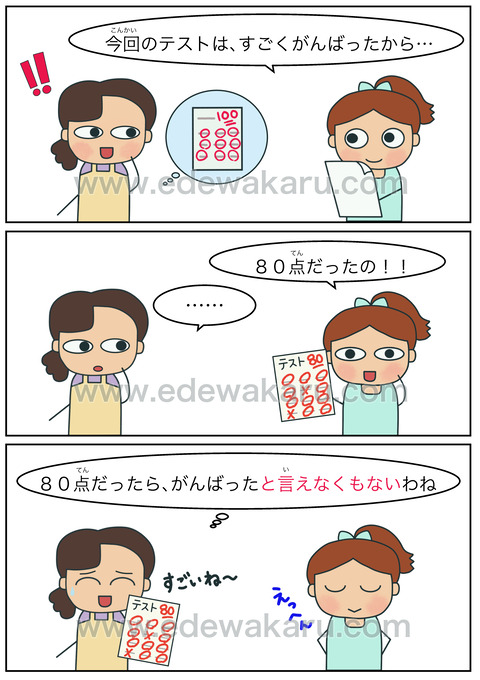
Meaning
Fairly ~
You could say it is fairly ~
How to use it
Verb, adjective, or noun [plain form] + と言えなくもない
Explanation
「Aと言えなくもない」 is a sentence pattern that uses a double negative and means “It’s fairly A” or “You could say it is fairly A.” It is often used when you want to say, “You could say it’s fairly A, but...” This pattern is used when you do not want to state definitively that “it is A” or “you could say it is A.”
[Examples]
① If it was 80 points, I guess you could say I tried fairly hard.
→ If it was 80 points, I guess you could say I did fairly well.
② Hmm, I guess you could say he’s fairly handsome.
→ I guess he’s fairly handsome.
③ You could say his way of thinking is somewhat wrong.
→ I think his way of thinking is a little wrong.
④ The food here is fairly tasty, but it’s a little too expensive.
→ It’s fairly tasty, but it’s a little too expensive.
⑤ That singer is very popular, but you could say they’re a fairly bad singer...
→ You could say they’re fairly bad...
Japanese has other sentence patterns that express double negatives, so let’s review them 😉
【Double-negative patterns】
In context 5 examples
80点だったら、がんばったと言えなくもないわね
If it was 80 points, I guess you could say I tried fairly hard.
A:田中さんの彼氏はイケメンなの?B:う〜ん、イケメンと言えなくもないかな
A: Is Mr. Tanaka’s boyfriend handsome? B: Hmm, I guess you could say he’s fairly handsome.
彼の考え方が間違っていると言えなくもない
You could say his way of thinking is somewhat wrong.
ここの料理はおいしいと言えなくもないが、ちょっと高すぎる
The food here is fairly tasty, but it’s a little too expensive.
あの歌手はとても人気があるが、歌が下手だと言えなくもない…
That singer is very popular, but you could say they’re a fairly bad singer...
Read the original source text
Meaning
まあまあ〜だ
まあまあ〜だと言える
How to use it
動詞・形容詞・名詞[普通形]+と言えなくもない
Explanation
「Aと言えなくもない」は二重否定(にじゅうひてい)を使った文型で、「まあまあ、Aだ」「まあまあ、Aだと言える」という意味です。「まあまあAだと言えるが、しかし〜」と言いたい時によく使われます。はっきりと「Aだ」「Aだと言える」と断定しない場合に使用される文型です。
[例]
①80点だったら、がんばった
と言えなくもない
わね
→80点だったら、まあまあがんばったと言えるわね
②う〜ん、イケメン
と言えなくもない
かな
→まあまあイケメンかな
③彼の考え方が間違っている
と言えなくもない
→彼の考え方が少し間違っていると思う
④ここの料理はおいしい
と言えなくもない
が、ちょっと高すぎる
→まあまあおいしいが、ちょっと高すぎる
⑤あの歌手はとても人気があるが、歌が下手だ
と言えなくもない
…
→まあまあ下手だと言える…
日本語には、他にも二重否定を表す文型がありますので復習をしておきましょう😉
【二重否定の文型】
Usage 2
Read this source entry ↗Meaning
Fairly ~
You could say it is fairly ~
How to use it
Verb, adjective, or noun [plain form] + と言えなくもない
Explanation
「Aと言えなくもない」 is a sentence pattern that uses a double negative and means “It’s fairly A” or “You could say it is fairly A.” It is often used when you want to say, “You could say it’s fairly A, but...” This pattern is used when you do not want to state definitively that “it is A” or “you could say it is A.”
[Examples]
① If it was 80 points, I guess you could say I tried fairly hard.
→ If it was 80 points, I guess you could say I did fairly well.
② Hmm, I guess you could say he’s fairly handsome.
→ I guess he’s fairly handsome.
③ You could say his way of thinking is somewhat wrong.
→ I think his way of thinking is a little wrong.
④ The food here is fairly tasty, but it’s a little too expensive.
→ It’s fairly tasty, but it’s a little too expensive.
⑤ That singer is very popular, but you could say they’re a fairly bad singer...
→ You could say they’re fairly bad...
Japanese has other sentence patterns that express double negatives, so let’s review them 😉
【Double-negative patterns】
Read the original source text
Meaning
まあまあ〜だ
まあまあ〜だと言える
How to use it
動詞・形容詞・名詞[普通形]+と言えなくもない
Explanation
「Aと言えなくもない」は二重否定(にじゅうひてい)を使った文型で、「まあまあ、Aだ」「まあまあ、Aだと言える」という意味です。「まあまあAだと言えるが、しかし〜」と言いたい時によく使われます。はっきりと「Aだ」「Aだと言える」と断定しない場合に使用される文型です。
[例]
①80点だったら、がんばった
と言えなくもない
わね
→80点だったら、まあまあがんばったと言えるわね
②う〜ん、イケメン
と言えなくもない
かな
→まあまあイケメンかな
③彼の考え方が間違っている
と言えなくもない
→彼の考え方が少し間違っていると思う
④ここの料理はおいしい
と言えなくもない
が、ちょっと高すぎる
→まあまあおいしいが、ちょっと高すぎる
⑤あの歌手はとても人気があるが、歌が下手だ
と言えなくもない
…
→まあまあ下手だと言える…
日本語には、他にも二重否定を表す文型がありますので復習をしておきましょう😉
【二重否定の文型】
毎日のんびり日本語教師
How to use it
Verb plain form + と言えなくもない
い-adjective + と言えなくもない
な-adjective stem (+ だ/である) + と言えなくもない
Noun (+ だ/である) + と言えなくもない
Explanation
This expresses a subjective evaluation as a relatively tentative affirmation by means of a double negative.
It is less definitive than the assertive expression 「~といえる」.
Notes
Nothing in particular.
In context 8 examples
年収から見ると、彼はまあまあ成功してると言えなくもない。
Judging by his annual income, you could say he's moderately successful.
8時起床は早起きと言えなくもない。
Getting up at eight could be considered getting up early.
今朝のはこの冬一番の積雪と言えなくもない。
This morning's snowfall could be called the heaviest of this winter.
この見方はある種本質を見抜いてると言えなくもない。
You could say that this perspective sees through to a certain essence of the matter.
彼女は遠目から見ると、あのアイドルに似ていると言えなくもない。
From a distance, you could say she looks like that idol.
開始早々得点し、理想的な展開と言えなくもない。
They scored right at the start, so you could call it an ideal turn of events.
道に迷うのは旅の楽しみの一つと言えなくもない。
Getting lost could be considered one of the joys of traveling.
カッコいいと言えなくもない程度の男が私の理想のタイプ。(不帅也不丑的男人是我的理想型。)
A man who's not exactly handsome but not ugly either is my ideal type.
Read the original source text
How to use it
動詞普通形+と言えなくもない
い形容詞+と言えなくもない
な形語幹(+だ/である)+と言えなくもない
名詞(+だ/である)+と言えなくもない
Explanation
二重否定による比較的消極的な肯定で主観的な評価を表します。
断定表現である「~といえる」には及ばない程度の表現です。
Notes
特になし
AIUEO JLPT Grammar
Meaning
This sentence pattern is used to express that, while the speaker doesn’t fully agree, they recognize that a certain amount of the claim or opinion might be true.
How to use it
Verb + と言えなくもない; adjective dictionary form + と言えなくもない; adjectival noun + と言えなくもない; noun + と言えなくもない
In context 5 examples
そうと言えなくもないけど、もう少し考えてみたほうがいいかもしれない。
You could say that, but it might be better to think about it a little more.
この計画は可能と言えなくもなかったが、反対した。
This plan was not entirely impossible, but it was opposed.
彼の言い分も理解できると言えなくもないが、賛成できない。
You could say I understand his point, but I can’t agree with it.
彼女の行動は自己中心的と言えなくもない。
You could say her behavior is selfish.
この結果は予想外と言えなくもないが、完全に驚くことでもない。
You could say the result was unexpected, but it’s not entirely surprising.
Read the original source text
Meaning
This sentence pattern is used to express that, while the speaker doesn’t fully agree, they recognize that a certain amount of the claim or opinion might be true.
How to use it
動詞と+言えなくもない形容詞辞書形と+言えなくもない形容動詞と+言えなくもない名詞と+言えなくもない
Explanation · 日本語
この文型は、完全には賛同できないが、一部はそうだと認める余地がある、という控えめな表現です。話者がある主張や意見に対して、完全には同意しないが、ある程度の理解を示す場合に使われます。