AIUEO JLPT Grammar
Meaning
This sentence pattern is used to indicate reasons or grounds for making a decision, often employed in casual speech when explaining why a choice was made or proposing something.
How to use it
Verb + ことだし; adjective + ことだし; adjectival noun な + ことだし; noun の + ことだし
In context 5 examples
天気もいいことだし、散歩に行こう。
Since the weather is nice, let’s go for a walk.
みんな集まったことだし、そろそろ始めましょう。
Since everyone has gathered, let’s get started soon.
時間もあることですし、もう少し話し合いましょう。
We have some time, so let's talk some more.
せっかくここまで来たことだし、ついでに観光もしよう。
Since we've come all the way here, let's do some sightseeing as well.
試験も終わったことですし、ゆっくり休みましょう。
Since the exam is over, let’s take a nice rest.
Read the original source text
Meaning
This sentence pattern is used to indicate reasons or grounds for making a decision, often employed in casual speech when explaining why a choice was made or proposing something.
How to use it
動詞+ことだし形容詞+ことだし形容動詞な+ことだし名詞の+ことだし
Explanation · 日本語
この文型は、理由や根拠を示しながら、何かを行う判断をする際に使われる表現で、何かを決定したり、提案したりするときにその理由を述べるために使います。話し言葉で使われることが多く、比較的カジュアルな表現です。
文法
Meaning
Because / since
A way of expressing a mild reason.
How to use it
V (plain form) + ことだし
な-adjective (plain form) + ことだし
Noun + の + ことだし
In context 4 examples
せっかく海外にいることだし、日本食じゃないものを食べようよ。
Since we’re in another country, after all, let’s eat something other than Japanese food.
天気もいいことだし、今日は外で遊ぼうよ。
Since the weather is nice, let’s play outside today.
試験も終わったことだし、今からカラオケいかない?
Now that the exam is over, want to go to karaoke?
雨も止んだことだし、そろそろ帰るか。
Since the rain has stopped, shall we head home soon?
Read the original source text
Meaning
ので / から
軽い理由を表す言い方。
How to use it
V(普通形)+ことだし
ナA(普通形)+ことだし
Nの+ことだし
Bunpro Grammar Reference
Meaning
(And) so, Because, Since
How to use it
Verb + ことだし
[い]Adjective + ことだし
[な]Adjective + な(1) + ことだし
Noun + の(1) + ことだし
(1) である
Nuance
A construction used for listing reasons. It's the thing which is (A), amongst other things.
Explanation
ことだし is a combination of the noun こと 'thing', the auxiliary verb だ, and the conjunction particle し, used for listing reasons. The whole structure itself often translates simply as 'because (A)', or 'since (A)', but places extra emphasis on there being other reasons besides what the speaker has specified.
This structure may appear after any word in its attributive form, or after a noun that has been followed with の.
せっかく君のお父さんとお母さんが来ることだし、どっかいい焼肉屋さんにでも行こう。
Since your father and mother are coming all the way (to see us), let's go to a nice yakiniku restaurant.
天気もいいことだし、みんなで公園にでも行きましょう。
Since the weather is nice, let's all go to the park together.
彼が勤めている会社は有名なことだし、給料もいいんだろう。
Since the company he works for is famous, his salary must be good.
彼のことだし、また遅れてくるんじゃないの。
Knowing him, I bet that he will come late as usual.
Just like with its standard use in creating lists, し is being used in this grammar point to show that (A) is not exclusive. The way this comes across is that 'while there are other reasons, (A) is good enough to (B)'. (B) is usually some suggestion, invitation, or expression of determination.
In context 16 examples
- 飛行機代も安いことだし天気もいいから沖縄に行こうよ。
Since plane tickets are cheap and the weather is nice, let's go to Okinawa.
- 天気もいいことだし、みんなで公園にでも行きましょう。
Since the weather is nice, let's all go to the park together.
- 彼が勤めている会社は有名なことだし、給料もいいんだろう。
Since the company he works for is famous, his salary must be good.
- 彼のことだし、また遅れてくるんじゃないの。
Knowing him, I bet that he will come late as usual.
- せっかく君のお父さんとお母さんが来ることだし、どっかいい焼肉屋さんにでも行こう。
Since your father and mother are coming all the way (to see us), let's go to a nice yakiniku restaurant.
- 割引クーポンもあることだし、明日映画を一緒に観に行かない?
I also have discount coupons, so why don't we go watch a movie together tomorrow?
- もう夜も更けてくることだし、今日のパーティはこれでお開きにしよう!
It's getting late, so let's call it a night with this!
- 風邪を引いていることだし、今日くらいは何もしないでゆっくり休んだら?
Since you have caught a cold, at least for today, how about you rest without doing anything?
- 彼女のことだし、きっと次の試合には勝つとわたしは信じているよ!
Knowing her, I am convinced that she will surely win the next match.
- 彼も十分反省していることだし、今回はもうこの辺で許してあげたら?
I'm sure he's also sufficiently remorseful, so why won't you already let him off the hook this time?
- 私は朝から重い物は嫌だ。それに徹夜しちゃったことだし軽い物が食べたいな。
I dislike eating heavy things in the morning. Plus, I have pulled an all-nighter so I want to eat something light.
- 天気も悪いことだし、今日は外に出ずに家の中で勉強とか仕事をする事にしよう。
The weather is bad today, so I decided not to go outside, but to do things like study and work inside.
- 彼氏が彼女に:「もう長年付き合ってきて互いを十分に理解していることだし、近々結婚するのはどう?」
A boyfriend to his girlfriend: 'Since we have been together for many years, and we both sufficiently understand what is going on, why don't we get married soon?'
- まだ入社して三週間しか経っていないことだし、彼の失敗を大目に見ることにしよう。
Since it has only been 3 weeks since he entered the company, let's overlook his mistake.
- 大学受験も終わったことだし、今日からは目一杯マンガを読んだりアニメを見たりして夜更かしするぞ!
Since the university acceptance exams are also finished, I am going to sit up all night doing things like reading manga and watching anime as much as possible!
- せっかく高い学費を払って大学に通っていることだし、興味のある分野だけでなく他の分野の授業もとってみようかな〜。
Since I went to the effort of paying expensive tuition and am going to university, not only fields that I am interested in, but I will also try taking classes in other fields.
絵でわかる日本語
Meaning
Because…
Since…
How to use it
Verb, adjective, or noun [plain form] + ことだし
Explanation
“〜ことだし” means “because…” or “since…,” and is a sentence pattern used to give a reason for making a decision or judgment, or for making a suggestion. There are several sentence patterns commonly used with it, so I think it’s useful to remember them. 😉
[Patterns used with “〜ことだし”]
・〜ことだし+〜よう
・〜ことだし+〜ましょう
・〜ことだし+〜ようかな
・〜ことだし+〜ませんか?
・〜ことだし+〜たいと思います
・〜ことだし+〜てはどうですか?
・〜ことだし+〜たら?
(Review: 〜たら (suggestion))
Also, remember that there is a polite form, “〜ことですし.” 😀
[Example]
We’re hungry too, so how about getting some ramen?
“〜ことだし” is often used in conversation, so give it a try too. 😉
[“こと” Series]
〜こと (command)
〜ことか
〜ことから
〜ことがある
〜ことができる (possibility)
〜ことができる (ability)
〜ことこの上ない
〜ことだ・〜ないことだ
〜ことだから
〜ことだし
〜ことで (Nのことで)
〜こととて
〜ことなしに
〜ことなく
〜ことに
〜ことにしている
〜ことにする
〜ことになっている
〜ことになる・〜こととなる
〜ことには
〜ことは〜が① (adjectives/nouns)
〜ことは〜が② (verbs)
〜ことはない
〜ことはならない
〜たことがある (experience)
〜だこと!
(〜は)〜てのこと
〜ても〜すぎることはない
〜ということだ
〜とのことだ
〜ないこともない
〜ないことには
〜なかったことがある
In context 4 examples
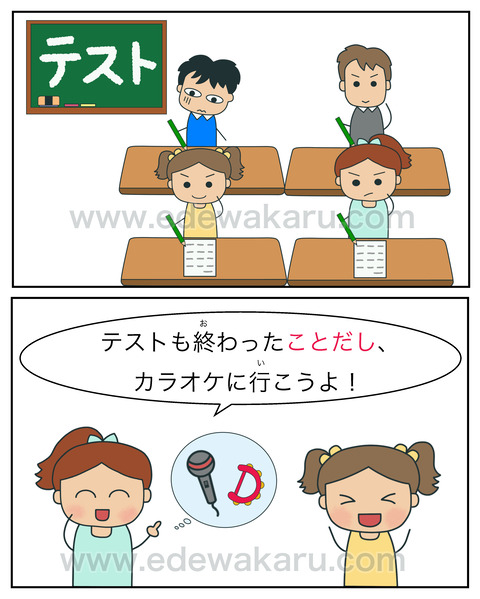
テストも終わったことだし、カラオケに行こうよ
→テストも終わったから、カラオケに行こうよSince the test is over too, let’s go to karaoke! → Since the test is over too, let’s go to karaoke!
お腹も空いてきたことだし、ラーメンでも食べない?
→お腹も空いてきたから、ラーメンでも食べない?(復習:〜てくる(発生・開始))(復習:〜でも)I’m getting hungry too, so want to get some ramen? (Review: 〜てくる (occurrence/beginning)) (Review: 〜でも)
天気もいいことだし、散歩に行こうかな
→天気もいいから、散歩に行こうかな(復習:〜かな・〜かしら(文法))(復習:〜かな・〜かしら(口語形))The weather is nice too, so maybe I’ll go for a walk. (Review: 〜かな・〜かしら (grammar)) (Review: 〜かな・〜かしら (colloquial form))
雨も降ってきたことだし、家に帰ろうっと
→雨も降ってきたから、家に帰ろうっと(復習:〜ようっと)It’s started raining too, so I’ll head home. (Review: 〜ようっと)
Read the original source text
Meaning
〜から
〜ので
How to use it
動詞・形容詞・名詞[普通形]+ことだし
Explanation
「〜ことだし」は「〜から」「〜ので」という意味で、決定や判断、提案をする理由を言う時に使う文型です。一緒によく使う文型がいくつかありますので、覚えておくといいと思います😉
[「〜ことだし」と一緒に使う文型]
・〜ことだし+〜よう
・〜ことだし+〜ましょう
・〜ことだし+〜ようかな
・〜ことだし+〜ませんか?
・〜ことだし+〜たいと思います
・〜ことだし+〜てはどうですか?
・〜ことだし+〜たら?
(復習:〜たら(勧め))
また、丁寧形として
「〜ことですし」
という言い方もあると覚えておきましょう😀
[例]
お腹も空いた
ことですし、ラーメンでも食べませんか?
「〜ことだし」は会話でもよく使いますので、みなさんも使ってみてくださいね😉
【「こと」シリーズ】
〜こと(命令)
〜ことか
〜ことから
〜ことがある
〜ことができる(可能)
〜ことができる(能力)
〜ことこの上ない
〜ことだ・〜ないことだ
〜ことだから
〜ことだし
〜ことで(Nのことで)
〜こととて
〜ことなしに
〜ことなく
〜ことに
〜ことにしている
〜ことにする
〜ことになっている
〜ことになる・〜こととなる
〜ことには
〜ことは〜が①(形容詞・名詞)
〜ことは〜が②(動詞)
〜ことはない
〜ことはならない
〜たことがある(経験)
〜だこと!
(〜は)〜てのこと
〜ても〜すぎることはない
〜ということだ
〜とのことだ
〜ないこともない
〜ないことには
〜なかったことがある
日本語文型辞典
Meaning
Basic information: N/Na であることだし; Naなことだし; A/V ことだし. Attached to a clause. Its structure is ことだ+し, and it is used to state circumstances or conditions that serve as the reason or basis for some judgment, decision, or hope. ことですし, as in ②, is a more polite form. It can be used when giving two reasons, as in ③, just one, as in ②, or as an afterthought at the end, as in ①. Conversational, but more formal than し alone.
Examples:
① It looks like it’s going to rain, so shall we skip our walk today? The children have colds, too.
② Since the delicious-looking food has arrived, I think I’ll end my poor greeting here.
③ Since most of the committee members are here and the scheduled time has passed, why don’t we get the meeting started?
Read the original source text
Meaning
基本情報N/Na であることだしNaなことだしA/V ことだし説明節に付く。「ことだ+し」という構造で、なんらかの判断・決定・希望の理由・根拠となる事情・状況を述べるときに使う。②のような「ことですし」はより丁寧な形。③のように理由をふたつ述べる場合や②のようにひとつだけの場合、また①のように最後につけたしのように言う場合などがある。話しことばだが、「し」だけよりもあらたまった表現。例文① 雨がふってきそうだから、きょうは散歩はやめておこうか。こどもたちもかぜをひいていることだし。② おいしそうな料理もでてきたことですし、私のへたなごあいさつはこのへんで終わりにしたいと存じます。③ 委員も大体そろったことだし、予定時間も過ぎているので、そろそろ委員会を始めてはいかがですか。
日本語文型辞典 英語版
Meaning
【ことだし】[N/Na であることだし][Na なことだし][A/V ことだし]
Attaches to a clause. This construction combines ことだ+し and is used when describing the conditions or circumstances that form the reason or basis for some kind of judgment, decision, or hope. ことですし, as in
(2)
, is a more polite form. Sometimes two reasons are stated, as in
(3)
, sometimes one reason is stated, as in
(2)
, and sometimes the reason is tacked on at the end as additional information, as in
(1)
. Although this is a spoken language expression, it is more formal than using only し.
In context 3 examples
雨がふってきそうだから、きょうは散歩はやめておこうか。こどもたちもかぜをひいていることだし。
Since it looks like it’s going to rain, why don’t we put off going for a walk today? Besides, the children have colds.
おいしそうな料理もでてきたことですし、私のへたなごあいさつはこのへんで終わりにしたいと存じます。
With all this delicious food ready to eat, I will put an end here to my clumsy remarks.
委員も大体そろったことだし、予定時間も過ぎているので、そろそろ委員会を始めてはいかがですか。
Since most of the committee members are present, and we are already a little behind schedule, how would it be if we started the meeting?
日本語NET JLPT文法解説まとめ
Meaning
Because ~ / since ~
A way of giving a mild reason.
How to use it
V (plain form) + ことだし
な-adjective (plain form) + ことだし
Noun + の + ことだし
Explanation
since / because
In context 4 examples
せっかく海外にいることだし、日本食じゃないものを食べようよ。
Since we’re in another country, after all, let’s eat something other than Japanese food.
天気もいいことだし、今日は外で遊ぼうよ。
Since the weather is nice, let’s play outside today.
試験も終わったことだし、今からカラオケいかない?
Now that the exam is over, want to go to karaoke?
雨も止んだことだし、そろそろ帰るか。
Since the rain has stopped, shall we head home soon?
Read the original source text
Meaning
"〜ので / 〜から"
軽い理由を表す言い方。
How to use it
V(普通形)+ことだし
ナA(普通形)+ことだし
Nの+ことだし
Explanation
since / because
毎日のんびり日本語教師
How to use it
Verb plain form + ことだし
い-adjective plain form + ことだし
な-adjective plain form + な/である + ことだし
Noun + である + ことだし
Explanation
Expresses a reason.
The first clause gives a reason or cause as grounds, and the second clause states some judgment or decision based on it.
The reason is one among several, implying that there are other reasons as well.
Notes
Nothing in particular.
In context 8 examples
熱もあることだし寝ます。(也有点发烧了睡觉吧。)
I have a fever too, so I’ll go to bed.
テストも終わったことだし、明日から思いっきり好きなことする。
Now that the test is over, I’m going to do whatever I like starting tomorrow.
天気も良いことだし、散歩でも一緒にどう。
The weather’s nice too, so how about going for a walk together?
採譜も全部終わったことだし練習に入る。
Now that I’ve finished transcribing all the music, I’ll start practicing.
1か月頑張ったことだし、給料入ったら高い美容液を自分へのご褒美に買いたい。
I’ve worked hard for a month, so when I get paid, I want to buy an expensive serum as a treat for myself.
目も覚めてしまったことだし、起きて仕事行く準備でもしよう。
I’m awake now anyway, so I might as well get up and get ready for work.
朝ご飯も食べたことだしどっか行こうかな。
Now that I’ve had breakfast, maybe I’ll go somewhere.
目撃者も多数いることだし、犯人が捕まるのも時間の問題だろう。
There are also many witnesses, so it’s probably only a matter of time before the culprit is caught.
Read the original source text
How to use it
動詞普通形+ことだし
い形容詞普通形+ことだし
な形容詞普通形+な/である+ことだし
名詞+である+ことだし
Explanation
理由を表します。
前件では根拠になる理由や原因が来て、後件では前件に対する何らかの判断や決定を述べます。
理由は数ある理由のうちの一つで、それ以外の理由の存在も暗示します。
Notes
特になし
NINJAL 日本語文型データベース
Meaning
This is a way of giving a reason for a proposal or judgment after looking objectively at the whole situation. It implies that there are other reasons as well.
「〜ことですし」 is the polite form.
It can also be used at the end of a sentence in the forms 「〜ことだし。・〜ことですし。」.
How to use it
V plain form + ことだし
i-A plain form + ことだし
na-A plain form + ことだし (however, 「na-Aだ」 becomes 「na-Aな+ことだし」)
N plain form + ことだし (however, 「Nだ」 becomes 「Nの+ことだし」)
Notes
「も」 is often used in the 「〜」 clause. After 「~ことだし」 comes a clause expressing the speaker’s judgment, hope, or intention, or a clause urging the other person to do something.
In context 19 examples
友達も遊びに来ることだし、花でも飾っておこうかな。
A friend is coming over too, so maybe I’ll put out some flowers.
時間もないことですし、そろそろ結論を出しませんか。
Since we’re also short on time, shall we reach a conclusion soon?
二十歳になったことだし、一人暮らしをしてみたいと思っている。
Now that I’ve turned 20, I’m thinking I’d like to try living on my own.
暗くなってきたことだし、そろそろ帰るか。
It’s getting dark, so shall we head home soon?
ウォーキングシューズを買ったことだし、できるだけ歩くようにしよう。
Now that I’ve bought walking shoes, I’ll try to walk as much as possible.
夫「夏休み、どこか旅行したいね」妻「そうだね。去年もおととしもどこにも行かなかったことだし」
Husband: “I’d like to go somewhere on a trip during summer vacation.” Wife: “Yeah. We didn’t go anywhere last year or the year before, after all.”
「クリスマスも近いことだし、子どもたちのプレゼントでも探しに行きましょう」
“Christmas is coming up too, so let’s go look for presents for the children.”
「明日も朝から忙しいことだし、もう寝たほうがいいよ」
“You’ll be busy from the morning tomorrow too, so you should go to bed now.”
「今日の仕事はそんなに多くないことですし、早めに帰れるんじゃないでしょうか」
“We don’t have that much work today, so I think we might be able to go home early.”
期末試験の結果もよかったことだし、これで安心して遊びに行ける。
Since I did well on the final exams too, I can go out and have fun without worrying now.
私の案は採用されなかったけど、賛成してくれる人も少なくなかったことだし、よしとしよう。
My proposal wasn’t adopted, but quite a few people supported it, so I’ll consider that good enough.
星空もきれいなことだし、ゆっくり歩いて帰ろうか。
The starry sky is beautiful too, so shall we take a leisurely walk home?
「児童館のボランティア、一緒にやってみない?」「そうだなあ……子ども相手も嫌じゃないことだし、やってみるか」
“Want to try volunteering at the children’s center together?” “Well… I don’t mind being around children, so shall I give it a try?”
先生「今日のテストは簡単だったことだし、みんないい点がとれただろう」生徒「えー、十分難しかったです」
Teacher: “Today’s test was easy, so everyone probably got a good score.” Student: “What? It was quite difficult.”
子どもも夏休み中のことだし、どこかに連れて行ってあげたいなあ。
The children are on summer vacation too, so I’d like to take them somewhere.
「この店なら、有名店のことですし、社長にも喜んでいただけるんじゃないでしょうか」「そうですね。今度の会食はここにしましょうか」
“This place is a famous restaurant, so I think the president would be pleased with it.” “That’s true. Shall we hold our dinner meeting here next time?”
今日の会は仕事の集まりじゃないことだし、ネクタイはしていかなくてもいいよね。
Since today’s gathering isn’t a work event, I don’t have to wear a tie, right?
姉「美香たち、今日、サイクリング行ったんじゃない? どうだったのかな」母「いい天気だったことだし楽しかったんじゃないかな」
Older sister: “Did Mika and the others go cycling today? I wonder how it went.” Mother: “The weather was nice, so I imagine they had fun.”
「ああ、悔しいなあ」「でも、ひどい負け方じゃなかったことだし、これからだよ」
“Ah, that’s frustrating.” “But it wasn’t a terrible defeat, so there’s always next time.”
Read the original source text
Meaning
状況全体を客観的に見て、ある提案や判断をするときの理由を挙げる言い方です。ほかにも理由があることを暗示します。
「〜ことですし」は、丁寧な形です。
「〜ことだし。・〜ことですし。」の形で文末に使うこともあります。
How to use it
V普通形+ことだし
i-A普通形+ことだし
na-A普通形+ことだし(ただし、「na-Aだ」→「na-Aな+ことだし」)
N普通形+ことだし(ただし、「Nだ」→「Nの+ことだし」)
Notes
「〜」の文には「も」を使うことが多いです。「~ことだし」の後には話し手の判断・希望・意向を表す文や相手への働きかけの文がきます。
どんなときどう使う 日本語表現文型辞典
Meaning
since
How to use it
〔Plain form〕(ナAな・ナAである/Nの・Nである)+ことだし (since; and given that)
Explanation
から/ので
軽い理由を表す言い方。ほかにも理由があるという感じがある。「し」だけの言い方と似ているが、やや丁寧で、いくらか理由を強調した言い方。
Indicates insignificant reasons. Gives impression that there are other reasons for some event as well. Similar to し, but slightly more polite and emphatic.
In context 3 examples
雨も降っていることだし、4時になったからそろそろ終わりにしましょうか。
Since it's raining and it's already four o'clock, shall we wrap things up soon?
あの山小屋は不便な所にあることだし、建物も小さいから、泊まるのは難しい。
That mountain lodge is in an inconvenient location, and the building is small, so it would be difficult to stay there.
まだ年齢も若いことだし、体も丈夫だから、また来年挑戦してください。
You're still young and in good health, so please try again next year.
Read the original source text
Meaning
since
How to use it
〔普通形〕(ナAな・ナAである/Nの・Nである)+ことだし
Explanation
から/ので
軽い理由を表す言い方。ほかにも理由があるという感じがある。「し」だけの言い方と似ているが、やや丁寧で、いくらか理由を強調した言い方。
Indicates insignificant reasons. Gives impression that there are other reasons for some event as well. Similar to し, but slightly more polite and emphatic.