AIUEO JLPT Grammar
Meaning
This sentence pattern is used to provide reasons or excuses, typically when the speaker wants to explain unavoidable circumstances or special reasons for their actions or situation. It is mainly used in casual conversations or personal excuses.
How to use it
Verb + ものだから; adjective + ものだから; na-adjective + な + ものだから; noun + な + ものだから
In context 5 examples
急いでいたものだから、家に鍵を忘れてしまった。
Because I was in a hurry, I forgot my keys at home.
天気が悪かったものだから、遅れてしまいました。
I was late because the weather was bad.
昨日は休んでごめんなさい。忙しかったものですから。
I'm sorry I was absent yesterday. I was busy.
食堂が混んでいたものだから、まだ昼ご飯を食べてないです。
I haven't had lunch yet because the cafeteria was crowded.
友達に誘われたものだから、仕方なくパーティーに参加しました。
I had no choice but to attend the party because my friend invited me.
Read the original source text
Meaning
This sentence pattern is used to provide reasons or excuses, typically when the speaker wants to explain unavoidable circumstances or special reasons for their actions or situation. It is mainly used in casual conversations or personal excuses.
How to use it
動詞+ものだから形容詞+ものだから形容動詞な+ものだから名詞な+ものだから
Explanation · 日本語
この文型は、理由や言い訳を述べるときに使われる表現です。話し手が自分の行動や状況について、避けられない事情や特別な理由を説明したいときに用います。主にカジュアルな会話や個人的な言い訳に適しています。
文法
Meaning
Because ~
A way of giving a reason. It is used when apologetically saying, “I really didn't want to do this, but because ~.”
How to use it
V (plain form) + ものだから
い-adjective (plain form) + ものだから
な-adjective + な + ものだから
N + な + ものだから
Notes
The casual form of 「もので」 is 「もんで」.
In context 5 examples
申し訳ありません。ちょっと明日は国から両親が来ることになっているものですから。
I’m very sorry. It’s just that my parents are coming from my home country tomorrow.
すみません。ビールは苦手なものですから。
Sorry. It’s just that I’m not fond of beer.
目覚まし時計が壊れたものですから、遅刻してしまいました。
Because my alarm clock broke, I ended up being late.
すみません、風邪を引いてしまったものですから、調子がよくないんです。
Sorry, I’ve caught a cold, so I’m not feeling well.
急な出張が入ってしまったものですから、今日の飲み会は欠席します。
An unexpected business trip came up, so I’ll be absent from tonight’s get-together.
Read the original source text
Meaning
~ので
理由を言うときの言い方で、「本当は〜したくなかったが、〜なので」と謝罪の意味を込めて言う時に使われる。
How to use it
V(普) + ものだから
イA(普) + ものだから
ナAな + ものだから
Nな + ものだから
Notes
「もので」のくだけた形は「もんで」。
Bunpro Grammar Reference
Meaning
Because, The reason is
How to use it
Verb + ものだから(1) + Phrase
[い]Adjective + ものだから(1) + Phrase
[な]Adjective + な + ものだから(1) + Phrase
Noun + な + ものだから(1) + Phrase
(1) もので、もんで、もんだから
Nuance
A somewhat strong expression indicating that (A) being (A) is the reason that a specific thing is expected or resulted.
Explanation
ものだから is a strong phrase that is used when explaining something or giving an excuse for one's reasoning. This grammar structure can simply be thought of as an extension of から 'because', with the noun もの 'thing' having its usual role of emphasizing what is said before it. Common translations include 'because (A)', and 'the reason is (A)'.
ものだから may appear directly after verbs and い-Adjectives, or な-Adjectives and nouns that are followed with な.
すみません、今仕事をしているものだから、また後でかけ直します。
Sorry, because I am working right now, I will call you back later.
週末は人が多いものだから、週末に行くのはあまりお勧めしません。
I would not recommend going on the weekends, because it is usually crowded on weekends.
生の魚は苦手なものだから、寿司は食べられない。
I can't eat sushi because I don't like raw fish.
彼は新人なものだから、まだこの会社のルールをよくわかっていない。
Because he is new, he doesn't really understand the rules of this company.
Occasionally, ものだから will be abbreviated to もので, or もんで, without any change in the overall meaning. The change of だ to its conjunctive form で indicates that there is something coming after, despite the fact that what comes after may sometimes be omitted if it is obvious.
今日は夕方から娘の発表会があるもので、私はそろそろ帰りますね。
Because my daughter has a recital this evening, I am going to go home soon.
最近は日本語を話す機会が減ってきているもんで、日本語を忘れてきた感じがする。
I feel as if I have forgotten some Japanese, because I have fewer opportunities to speak Japanese these days.
まあ、安いもんで...
Well, because it's cheap…
Fun-fact
Although it is not a rule, ものだから will primarily be used when explaining one's actions, as a way of emphasizing that the situation of (A) specifically led to the speaker doing (B).
In context 19 examples
- 郊外に家を買ったものだから、通勤に2時間もかかる。
Because I bought a house in the suburbs, the commute to work takes two hours.
- 最近は日本語を話す機会が減ってきているもんで、日本語を忘れてきた感じがする。
I feel as if I have forgotten some Japanese, because I have fewer opportunities to speak Japanese these days.
- すみません、今仕事をしているものだから、また後でかけ直します。
Sorry, because I am working right now, I will call you back later.
- 週末は人が多いものだから、週末に行くのはあまりお勧めしません。
I would not recommend going on the weekends, because it is usually crowded on weekends.
- まあ、安いもんで...
Well, because it's cheap…
- 今日は夕方から娘の発表会があるもので、私はそろそろ帰りますね。
Because my daughter has a recital this evening, I am going to go home soon.
- 彼は新人なものだから、まだこの会社のルールをよくわかっていない。
Because he is new, he doesn't really understand the rules of this company.
- 生の魚は苦手なものだから、寿司は食べられない。
I can't eat sushi because I don't like raw fish.
- 税関に引っかかったものだから、遅くなってしまいました。
Because I was stopped by the customs officer, I ended up being late.
- 素人が制作したものだから、やっぱりすぐに壊れてしまった。
Because it is something created by a novice, as expected, it broke right away.
- 英語が苦手なものだから、海外旅行に行くのは楽しくない。
Because I am bad at English, taking trips abroad isn't fun.
- 墨で黒く塗ってしまったものだから、何て書いてあったか分からない。
Because it is painted black with ink, I don't know what was written.
- 寸法を測り間違えたものだから、袖が長すぎて困ります。
Because the measurement was done incorrectly, I am stuck with sleeves that are too long.
- テレビの番組で宣伝したものだから、次の日お客さんが殺到しました。
Because of the publicity from the TV program, customers flooded in the next day.
- 線路で立ち往生したものだから、帰りたくても帰れない状況です。
Because the train line came to a standstill, I am in a position where even if I wanted to go home, I couldn't.
- 全速力で走ったものだから、次の日は全身筋肉痛だ。
Because I ran at full speed, my whole body was sore the next day.
- 彼は何でも率直に言うものだから、ある人たちからは嫌われています。
Because he says everything frankly, he is disliked by certain people.
- 雨で登板予定がスライドしたものだから、立ち上がりなかなか調子が出なかった。
Because rain changed the batting arrangement, the pitcher isn't doing very well.
- 道が渋滞していたものだから、時間通りに来られませんでした。遅れて来てすみません。
Because there was a lot of traffic, I could not come in time. Sorry for being late.
どんなときどう使う 日本語表現文型辞典
Meaning
because
How to use it
[plain form] (ナAな / Nな) + ものだから
Explanation
~ので
学生:目覚まし時計が壊れていたものですから。
西:ええ、妹が結婚したもんで、いなかに帰ってたんです。
1)理由を言う言い方であるが、個人的な言い訳をしたいときによく使う言い方。
2)後の文に、命令や意志のある文はほとんど使わない。
3) ❸ ~ ❺ のように「もので」という形もある。「もんで」はくだけた会話の中で使う。
3)Also form もので, as in sentences ❸ to ❺ . Form もんで is used in informal speech.
1)Gives reason, but is often personal excuse.
2)Clauses with commands or volition rarely follow.
In context 5 examples
教師:どうして遅刻したんですか。
Teacher: Why were you late?
いつもは敬語なんか使わないものだから、偉い人の前に出ると緊張します。
I don't usually use honorific language, so I get nervous when I have to appear in front of important people.
今週は忙しかったもので、お返事するのがつい遅くなってしまいました。
I've been busy this week, so I ended up replying rather late.
わたしは新人なもんで、ここでは知らないことが多いんです。
I'm a newcomer, so there are many things I don't know around here.
(同僚と)東:西さん、先週、あんまり会わなかったね。
(Talking with a colleague) Azuma: Nishi, I hardly saw you at all last week.
Read the original source text
Meaning
because
How to use it
〔普通形〕(ナAな/Nな)+ものだから
Explanation
~ので
学生:目覚まし時計が壊れていたものですから。
西:ええ、妹が結婚したもんで、いなかに帰ってたんです。
1)理由を言う言い方であるが、個人的な言い訳をしたいときによく使う言い方。
2)後の文に、命令や意志のある文はほとんど使わない。
3) ❸ ~ ❺ のように「もので」という形もある。「もんで」はくだけた会話の中で使う。
3)Also form もので, as in sentences ❸ to ❺ . Form もんで is used in informal speech.
1)Gives reason, but is often personal excuse.
2)Clauses with commands or volition rarely follow.
絵でわかる日本語
Meaning
(Cause / reason) Because 〜 / since 〜
How to use it
Verb / adjective / noun [plain form] + もので / ものだから
* The present affirmative form of nouns and な-adjectives is “ーなもので” or “ーなものだから”
(Examples: 学生なもので・きれいなものだから)
Explanation
“〜もので” and “〜ものだから” are expressions of cause and reason. These patterns are often used when you want to say that something happened “because there was an unforeseen circumstance or an unwilling reason, even though I actually didn’t want to do 〜.” In spoken language, “〜もんで” and “〜もんだから” are used. “〜ものですから” is also used as a polite form 😊
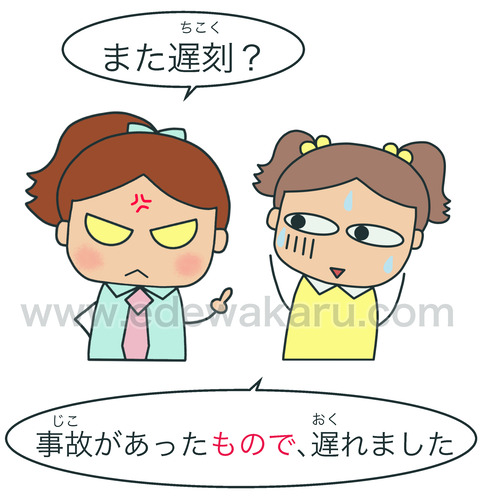
Examples: I was late because there was an accident.
I don’t remember well because it was a long time ago.
I bought a lot because it was cheap.
[Additional note]
As you learned at the beginner level, “〜から” emphasizes cause and reason more than “〜ので,” so you should avoid using it when apologizing. “〜もので・〜ものだから” is close in meaning to “〜ので,” so it is often used when apologizing 😉
[The “もの” series]
〜たいものだ・〜てほしいものだ
〜たものだ
〜たものではない
〜というもの (Nというもの)
〜ないものだろうか
〜ないものは〜ない
〜もの・〜んだもの
〜ものか
〜ものがある
〜ものだ (feeling/emotion)
〜ものだ (inherent property / general way of thinking)
〜ものだ・〜ものではない
〜もので・〜ものだから
〜ものと思っていた
〜ものなら
〜ものの
〜ものを
〜ようものなら
In context 3 examples
事故があったもので、遅れました
→事故があったので、遅れましたI was late because there was an accident. →I was late because there was an accident.
昔のことなもので、よく覚えていません
→昔のことなので、よく覚えていませんIt was a long time ago, so I don’t remember well. →It was a long time ago, so I don’t remember well.
安かったものだから、たくさん買ってしまった
→安かったので、たくさん買ってしまったIt was cheap, so I ended up buying a lot. →It was cheap, so I ended up buying a lot.
Read the original source text
Meaning
(原因・理由)〜ので / 〜から
How to use it
動詞・形容詞・名詞[普通形]+もので / ものだから
*名詞・な形容詞の現在肯定形は「ーなもので」「ーなものだから」
(例:学生なもので・きれいなものだから)
Explanation
「〜もので」「〜ものだから」は
原因・理由
を表す表現です。この文型は「
本当は〜したくなかったが、〜ので」というように、「予定外のことや不本意な理由があったので〜だ」と言いたい時によく使用されます。話し言葉では「
〜もんで」「
〜もんだから」が使われます。丁寧形として「
〜ものですから」という言い方もあります😊
例:事故があったもんで、遅れちゃったんだ
昔のことなもんだから、よく覚えていないの
安かったものですから、たくさん買ってしまいました
【補足】
初級で勉強したように「〜から」は「〜ので」より、原因・理由を強調してしまいますから、謝る時には使用しないようにしましょう。「〜もので・〜ものだから」は「〜ので」に近い文型ですから、謝る時によく使われます😉
【「もの」シリーズ】
〜たいものだ・〜てほしいものだ
〜たものだ
〜たものではない
〜というもの(Nというもの)
〜ないものだろうか
〜ないものは〜ない
〜もの・〜んだもの
〜ものか
〜ものがある
〜ものだ(感慨)
〜ものだ(本来の性質・一般的な考え方)
〜ものだ・〜ものではない
〜もので・〜ものだから
〜ものと思っていた
〜ものなら
〜ものの
〜ものを
〜ようものなら
日本語文型辞典
Meaning
Basic information: N/Na なものだから Aものだから Vものだから
Expresses a cause or reason. It can be rephrased as 「から」, but cannot be followed by an expression of intention or a command.
Often used to state that “the situation was intense or serious, and because of it, something happened.” Generally used in spoken language; the casual form is 「もんだから」.
It is roughly the same as 「思ったから」, but 「思ったものだから」 gives the impression of an excuse.
How to use it
…ものだから
…おもったものだから
In context 13 examples
私の前を走っている人が転んだものだから、それにつまづいて私もころんでしまった。
The person running in front of me fell, so I tripped over them and fell too.
「父危篤すぐ帰れ」という電報が来たものだから、あわてて新幹線に飛び乗って帰って来た。
I received a telegram saying, “Father is critically ill. Come home immediately,” so I hurriedly jumped on the Shinkansen and came back.
彼がこの本をあまりに薦めるものだから、つい借りてしまった。
He recommended this book so strongly that I ended up borrowing it.
駅まであまりに遠かったものだから、タクシーに乗ってしまった。
It was so far to the station that I ended up taking a taxi.
A:昨日は練習に来なかったね。
B:ええ、妹が熱を出したものですから。A: You didn't come to practice yesterday. B: No, my younger sister had a fever.
英語が苦手なものですから外国旅行は尻ごみしてしまいます。
Since I'm not good at English, I hesitate to travel abroad.
(誤) 近いものだから、歩こう。
(Incorrect) Since it's close, let's walk.
(正) 近いから歩こう。
(Correct) It's close, so let's walk.
彼はもう知っていると思ったものだから、伝えませんでした。
I thought he already knew, so I didn't tell him.
彼女はたぶんいないと思ったものですから、電話しませんでした。
I thought she probably wasn't there, so I didn't call.
子供の様子がいつもとは違うと思ったものですから、すぐ病院へ連れて行きました。
I thought the child seemed different from usual, so I took them to the hospital right away.
雨が降るといけないと思ったものですから、洗濯ものを取り込んでおきました。
I thought it might rain, so I brought in the laundry.
手紙では間に合わないと思ったものだから、ファックスにしました。
I thought a letter wouldn't get there in time, so I sent a fax.
Read the original source text
Meaning
基本情報N/Na なものだからAものだからVものだから
原因・理由を表す。「から」に言いかえることができるが、あとに意志表現、命令表現はつけられない。
「事態の程度が激しい、あるいは、重大で、そのせいで何かをしてしまった」ということを述べるのに用いられることが多い。話しことばで使われるのが普通で、くだけた言い方では「もんだから」となる。
「思ったから」とだいたい同じだが、「思ったものだから」は言い訳めいた感じをあたえる。
How to use it
…ものだから
…おもったものだから
日本語文型辞典 英語版
Meaning
【ものだから】[N/Na なものだから][Aものだから][Vものだから]
B:ええ、妹が熱を出したものですから。
That’s right, because my little sister had a temperature.
Shows cause or reason. It can be rephrased as から, but volitional and imperative expressions cannot follow.
(×)近いものだから、歩こう。
Because it’s close, let’s walk.
(○)近いから歩こう。
Because it’s close, let’s walk.
Often used to express that the situation is intense or serious and, because of that, something is done. Usually used in speech and becomes もんだから in casual speech.
This is almost the same as 思ったから but has more of a sense of giving an excuse.
How to use it
1. because ...; the reason is that ...
2. because I thought ...
In context 11 examples
私の前を走っている人が転んだものだから、それにつまづいて私もころんでしまった。
The person running in front of me fell down and so I tripped (on him/her) and fell, too.
「父危篤すぐ帰れ」という電報が来たものだから、あわてて新幹線に飛び乗って帰って来た。
I got a telegram saying, “Father critically ill. Return immediately,” and so I jumped on a shinkansen (bullet train) and came back.
彼がこの本をあまりに薦めるものだから、つい借りてしまった。
He recommended this book so much that (against my better judgment) I borrowed it.
駅まであまりに遠かったものだから、タクシーに乗ってしまった。
It was too far to the station, so I took a taxi.
A:昨日は練習に来なかったね。
You didn’t come to the practice yesterday, eh?
英語が苦手なものですから外国旅行は尻ごみしてしまいます。
Because I’m bad at English, I’m hesitant to take trips abroad.
彼はもう知っていると思ったものだから、伝えませんでした。
Because I thought he already knew, I didn’t tell him.
彼女はたぶんいないと思ったものですから、電話しませんでした。
I thought she would probably not be there, and so I didn’t telephone her.
子供の様子がいつもとは違うと思ったものですから、すぐ病院へ連れて行きました。
I thought the child’s appearance was different than normal, so I immediately took her to the hospital.
雨が降るといけないと思ったものですから、洗濯ものを取り込んでおきました。
Thinking it would not be good if it rained, I brought the laundry in.
手紙では間に合わないと思ったものだから、ファックスにしました。
I didn’t think a letter would make it on time, so I sent a fax.
Read the original source text
Meaning
【ものだから】[N/Na なものだから][Aものだから][Vものだから]
B:ええ、妹が熱を出したものですから。
That’s right, because my little sister had a temperature.
Shows cause or reason. It can be rephrased as から, but volitional and imperative expressions cannot follow.
(×)近いものだから、歩こう。
Because it’s close, let’s walk.
(○)近いから歩こう。
Because it’s close, let’s walk.
Often used to express that the situation is intense or serious and, because of that, something is done. Usually used in speech and becomes もんだから in casual speech.
This is almost the same as 思ったから but has more of a sense of giving an excuse.
How to use it
1. ...ものだから
2. ...おもったものだから
くらべてわかる日本語表現文型辞典
Meaning
Explains one's own actions by giving A as the reason. An indirect, roundabout way of justifying one's actions.
How to use it
AものだからB (AもんだからB)
[Verb] ものだから
[i-adjective—plain form] ものだから
[na-adjective—な / である / だった / ではない] ものだから
In context 4 examples
電気がついていなかったものだから、留守だと思ったよ。
The lights weren't on, so I thought nobody was home.
このクッキーはおいしいものだから、つい食べすぎてしまう。
These cookies are so delicious that I end up eating too many.
クレジットカードは便利なものだから、使いすぎて、いつも赤字だ。
Credit cards are so convenient that I overuse them and am always in the red.
彼があんな変なことを言うもんだから、思わず笑ってしまった。
He said something so strange that I couldn't help laughing.
Read the original source text
Meaning
Aを理由にして、自分の行動の説明をする。自分の行動を正当化する、もってまわった言い方。
How to use it
AものだからB(AもんだからB)
[動詞]ものだから
[イ形-普]ものだから
[ナ形-な/である/だった/ではない]ものだから
日本語NET JLPT文法解説まとめ
Meaning
“Because”
A way of giving a reason. It is used when apologizing with the implication, “I didn’t really want to do it, but because…”
How to use it
V (plain form) + ものだから
い-adjective (plain form) + ものだから
な-adjective + な + ものだから
N + な + ものだから
Explanation
“Because”
Used to decline an invitation or tell a personal excuse.
The casual form of 「もので」 is 「もんで」.
In context 5 examples
申し訳ありません。ちょっと明日は国から両親が来ることになっているものですから。
I’m very sorry. It’s just that my parents are coming from my home country tomorrow.
すみません。ビールは苦手なものですから。
Sorry. It’s just that I’m not fond of beer.
目覚まし時計が壊れたものですから、遅刻してしまいました。
Because my alarm clock broke, I ended up being late.
すみません、風邪を引いてしまったものですから、調子がよくないんです。
Sorry, I’ve caught a cold, so I’m not feeling well.
急な出張が入ってしまったものですから、今日の飲み会は欠席します。
An unexpected business trip came up, so I’ll be absent from tonight’s get-together.
Read the original source text
Meaning
"~ので"
理由を言うときの言い方で、「本当は〜したくなかったが、〜なので」と謝罪の意味を込めて言う時に使われる。
How to use it
V(普) + ものだから
イA(普) + ものだから
ナAな + ものだから
Nな + ものだから
Explanation
"because"
Used to decline an invitation or tell a personal excuse.
「もので」のくだけた形は「もんで」。
毎日のんびり日本語教師
How to use it
Verb (plain form) + ものだから/もんだから
い-adjective (plain form) + ものだから/もんだから
な-adjective stem + な + ものだから/もんだから
Noun + な + ものだから/もんだから
Explanation
Expresses a reason or cause.
A characteristic use of this grammar is to state that the latter clause came about because the situation in the first clause was so severe.
「もんだから」is colloquial.
Notes
Nothing in particular.
In context 8 examples
夜蚊に起こされたものだから寝不足で頭痛がひどい。
Mosquitoes woke me up during the night, so I’m sleep-deprived and have a bad headache.
ずっと座ってるもんだからお尻が痛い。
My butt hurts because I’ve been sitting the whole time.
あの人ずっとこっちを見てくるもんだから怖かった。
That person kept looking this way, so I was scared.
娘があまりに可愛いもんだからつい抱きしめたくなる。
My daughter is so cute that I can’t help wanting to hug her.
突然物音がしたものだから、起きて確認しに行かずにはいられなかった。
I heard a sudden noise, so I couldn’t help getting up and going to check.
一人暮らしが長いもんだから料理も自然と上達する。
I’ve lived alone for so long that I’ve naturally gotten better at cooking.
歯並びが良くないもんだから、人前で思いっきり笑いたくない。
My teeth aren’t straight, so I don’t want to laugh freely in front of people.
窓開けてるもんだから、話し声が聞こえてきてうるさい。
The window’s open, so voices carry in and it’s noisy.
Read the original source text
How to use it
動詞普通形+ものだから/もんだから
イ形普通形+ものだから/もんだから
ナ形語幹+な+ものだから/もんだから
名詞+な+ものだから/もんだから
Explanation
理由、原因を表します。
この文法は、前件の程度がひどいので後件の状態になったことを述べるときに用いるのが特徴です。
「もんだから」は口語です。
Notes
特になし
NINJAL 日本語文型データベース
Meaning
This is used to give the cause or reason for something from a personal point of view. It is also often used when apologizing, and often to assert that something is justified because one cannot change the situation and there is nothing to be done about it, or to seek empathy about the circumstances.
「〜ものですから」 is the polite form.
It can also be used at the end of a sentence in the form 「〜ものだから。・~ものですから。」.
How to use it
Ⅴ普通形+ものだから
i-A普通形+ものだから
na-A普通形+ものだから(ただし、「na-Aだ」→「na-Aな+ものだから」)
N普通形+ものだから(ただし、「Nだ」→「Nな+ものだから」)
Notes
「〜」 is filled by a cause or reason. After 「~ものだから」 comes a sentence expressing a situation that results from that cause or reason.
In context 19 examples
親が結婚に反対しているものだから、結婚式は挙げないつもりです。
Because my parents are opposed to the marriage, I don't plan to have a wedding ceremony.
夫は普段料理をしないものだから、塩やコショウがどこにあるかさえ知らないんです。
My husband doesn't usually cook, so he doesn't even know where the salt and pepper are.
この事業は確実に採算が取れるという保証はあるのか、その点を疑問に思ったものですから、質問させていただきました。
I wondered whether there was any guarantee that this project would definitely be profitable, so I took the liberty of asking about that point.
「すみません。風邪をひいてしまったものですから、こんなひどい声で」
“I'm sorry. I've caught a cold, so my voice is so hoarse.”
係員「あの、この項目が空欄になっているのですが……」利用者「すみません。どう書いたらいいかわからなかったものですから……。書き方を教えていただけますか」
Staff member: “Um, this field has been left blank...” User: “I'm sorry. I didn't know what to write... Could you show me how to fill it in?”
仕事が忙しいものだから、帰宅はいつも11時過ぎで、入浴もせずに寝てしまうことが多いんだ。
Because work is busy, I always get home after 11, and I often go to bed without even taking a bath.
客「あの、そちらで15人ほどの食事会を考えているんですが……」レストランの人「申し訳ございませんが、うちはそれほど広くないものですから、大人数でのパーティーはちょっと難しいと思います」
Customer: “Um, we're thinking of having a dinner party for about 15 people at your restaurant...” Restaurant staff: “We're very sorry, but our place isn't that spacious, so I think it would be rather difficult to hold a party for a large group.”
「先輩にゴルフを習ったけれど、あまりにも難しかったものだから、すぐにやめたんですよ」
“I learned golf from a senior colleague, but it was so difficult that I quit right away.”
私が就職活動していたころは景気がよくなかったものですから、いい就職先を見つけるのが大変でした。
When I was job hunting, the economy wasn't good, so it was difficult to find a good place to work.
「この辺りは周りに何もなくて不便なものだから、どうしても車がないと生活できないんですよね」
“There's nothing around here, so it's inconvenient; we really can't get by without a car.”
手芸や裁縫は一切しないんです。器用じゃないものだから。
I don't do any handicrafts or sewing. I'm not dexterous, you see.
来日した当時はまだ日本語が下手だったものだから、お客様相手の接客の仕事はできませんでした。
When I first came to Japan, my Japanese was still poor, so I couldn't work in customer service.
結婚式の司会をお引き受けしましたが、あのような場は不慣れだったものですから、うまくできなくて……。
I agreed to be the emcee at the wedding, but I wasn't used to a setting like that, so I couldn't do it well...
赴任先は治安が悪くて、バスや電車は安全じゃなかったものだから乗らないようにしていました。
The area where I was assigned had poor public safety, and the buses and trains weren't safe, so I tried not to use them.
今日は、舞台初日なものだから、緊張しているんです。
It's opening night for the play today, so I'm nervous.
「山田はまだ新人なものですから、至らないことが多くてすみません」
“Yamada is still new, so I'm sorry that there are many things he hasn't mastered yet.”
うちは余裕のある家庭じゃないものだから、奨学金をもらって大学に行けたらいいと思ってます。
My family isn't well-off, so I hope I can go to university with a scholarship.
「ごめんなさいね。この前は時間がなくて。仕事だったものだから」
“I'm sorry. I didn't have time the other day. I was working.”
「とにかく仕事の締め切りに間に合うかどうか気が気じゃなかったものだから、しばらく連絡できなくてすみませんでした」
“I was so worried about whether I'd meet the work deadline that I couldn't contact you for a while. I'm sorry.”
Read the original source text
Meaning
個人的な観点で物事の原因・理由を言うときに使います。おわびの場面でもよく使い、自分では状況を変えられず、しかたがないという意味で正当性を主張するときや、その事情について共感を求めるときに使うことが多いです。
「〜ものですから」は丁寧な形です。
「〜ものだから。・~ものですから。」の形で文末に使うこともあります。
How to use it
Ⅴ普通形+ものだから
i-A普通形+ものだから
na-A普通形+ものだから(ただし、「na-Aだ」→「na-Aな+ものだから」)
N普通形+ものだから(ただし、「Nだ」→「Nな+ものだから」)
Notes
「〜」には、原因・理由がきます。「~ものだから」の後には、その原因・理由から生じる事態を表す文がきます。