絵でわかる日本語
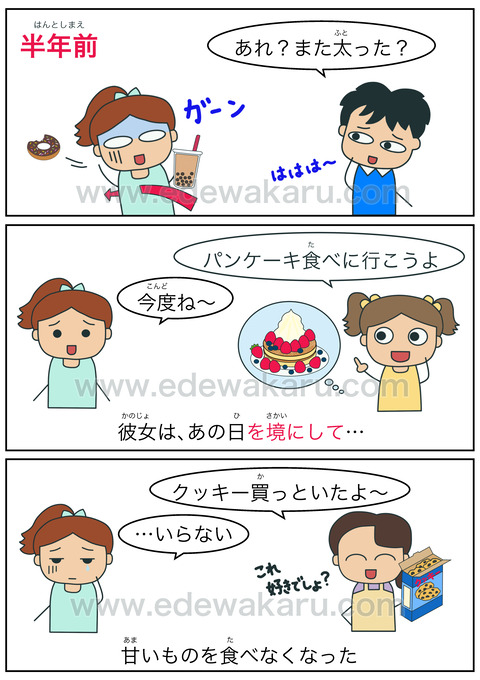
Meaning
A major change occurred from 〜 onward
How to use it
Noun [dictionary form] + を境にして
Noun [dictionary form] + を境に
Explanation
“Aを境にして” is a pattern meaning “a major change occurred from A onward.” It is used to say that “the situation changed greatly around A” or “things were one way before A, but changed greatly after A.”
[Examples]
① She stopped eating sweets from that day onward.
[A] That day
→She ate sweets before “that day,” but stopped after “that day.”
② I stopped seeing Yamada after graduation.
[A] Graduation
→We used to see each other before graduation, but stopped after graduating.
③ He stopped going to drinking parties after he got married.
[A] Marriage
→He used to go to drinking parties before he got married, but stopped after he got married.
④ I decided to live overseas after retiring.
[A] Retirement
→I lived in Japan before retirement, but decided to live overseas after “marriage.”
⑤ A: I heard those two had a fight.
B: Yeah. Apparently, they stopped talking altogether from that day onward.
[A] That day (the day they fought)
→They used to talk before they had a fight, but stopped talking after the fight.
⑥ I lost contact with him from one day onward.
[A] One day
→I was able to contact him before “one day,” but couldn’t after that.
“〜を境にして” can also be changed to “〜を境に.”
[Example]
I stopped eating sweets from that day onward.
= I stopped eating sweets from that day onward.
Let’s review patterns similar to “〜を境にして・〜を境に” 😊
[Related patterns]
Read the original source text
Meaning
〜から、大きな変化があった
How to use it
名詞[辞書形]+を境にして
名詞[辞書形]+を境に
Explanation
「Aを境にして」は「Aから、以前と大きな変化があった」という意味の文型です。「Aの前後で、状況が大きく変化した」「Aの前は〜だったが、Aの後からすごく変化した」と言いたい時に使います。
[例]
①彼女は、あの日
を境にして
甘いものは食べなくなった
【A】あの日
→「あの日」の前は甘いものを食べていたが、「あの日」の後は食べなくなった
②山田くんとは、卒業
を境にして
会わなくなった
【A】卒業
→「卒業」前は会っていたが、「卒業」後は会わなくなった
③彼は結婚
を境にして、飲み会に行かなくなった
【A】結婚
→「結婚」前は飲み会に行っていたが、「結婚」後は飲み会に行かなくなった
④退職
を境にして、海外に住むことにした
【A】退職
→「退職」前は日本に住んでいたが、「結婚」後は海外に住むことにした
⑤A:あの二人、ケンカをしたらしいね
B:うん。なんでもあの日
を境にして、いっさい話さなくなったそうよ
【A】あの日(ケンカをした日)
→「ケンカをする」の前は話をしていたが、「ケンカをした」後は話さなくなった
⑥ある日
を境にして、彼と連絡が取れなくなった
【A】ある日
→「ある日」の前は連絡が取れたが、その後は連絡が取れなくなった
また、「〜を境にして」は「〜を境に」にチェンジすることができます。
[例]
あの日
を境にして
甘いものは食べなくなった
=あの日
を境に
甘いものは食べなくなった
「〜を境にして・〜を境に」に似ている文型を復習しておきましょう😊
【関連文型】
毎日のんびり日本語教師
How to use it
Noun + を境にして
Explanation
Indicates that the nature of something changes completely before and after a certain point in time.
It is mainly attached to nouns expressing time.
Notes
Nothing in particular.
In context 8 examples
夏至を境に、日が短くなっていく。
From the summer solstice onward, the days grow shorter.
彼はある日を境に突然冷たくなった。
One day, he suddenly became cold toward me.
ある研究によると、年収630万円を境に幸福感は増えにくくなるらしい。
According to one study, people’s sense of happiness apparently becomes less likely to increase once their annual income reaches 6.3 million yen.
1月1日を境に一切タバコ吸ってない。
I haven’t smoked at all since January 1.
ある事件を境にして、彼は犯人への復讐心にかられることになった。
After a certain incident, he came to be consumed by a desire for revenge against the culprit.
人は、何を境に生とされ、何を境に死と見なされるのだろうか。
What is the point at which a person is considered alive, and what is the point at which they are considered dead?
ある日を境に筋トレを始めてから、ちょっとしたことでも疲れにくくなった。
Since I started strength training one day, which marked a turning point, I’ve become less likely to get tired even from minor things.
メニューを変えたあの日を境に、客層ががらりと変わった。
The customer base changed completely after the day we changed the menu.
Read the original source text
How to use it
名詞+を境にして
Explanation
ある時点の前後でその性質は全く異なるものになることを表します。
主に時間を表す名詞に接続します。
Notes
特になし