日本語文型辞典
Meaning
Basic information: Used by men in casual conversation.
Attached to expressions of questions, such as question words or clauses containing question words, to express a question directed at the listener. It can also be used like an interjection, as in ⑦ and ⑧, to convey a questioning or critical attitude. Spoken and somewhat old-fashioned. Usually used by adult men.
Used by boys to express strong assertion.
How to use it
Question expression+だい
…だい
N/Na だい
In context 11 examples
いま何時だい?
What time is it now?
いつだい?花子の入学式は。
When is Hanako’s entrance ceremony?
その手紙だれからだい?
Who’s that letter from?
どうだい。元気かい。
How are you? Doing well?
そんなことだれから聞いたんだい?
Who did you hear that from?
何時にどこに集ればいいんだい?
What time and where are we supposed to meet?
どうだい、すごいだろう。
How about that? Pretty amazing, huh?
何だい、今頃やってきて。もう準備はぜんぶ終わったよ。
What’s this, showing up at this hour? All the preparations are already finished.
そんなことうそだい。
That’s a lie!
いやだい。絶対教えてあげないよ。
No way! I absolutely won’t tell you.
ぼくのはこれじゃないよ。それがぼくのだい。
This one isn’t mine. That one’s mine.
Read the original source text
Meaning
基本情報説明くだけた会話で、男性が使う。
疑問詞や疑問詞を含む節などの疑問を表す表現に付いて、聞き手に対する問いかけの気持ちを表す。⑦や⑧のように問いかけや非難の気持ちをこめて感動詞的に使うこともある。話しことばで、少し古めかしい言い方。ふつうは大人の男性が用いる。
男の子が強い断定の気持ちを表すのに用いる。
How to use it
疑問表現+だい
…だい
N/Na だい
AIUEO JLPT Grammar
Meaning
This sentence pattern is a casual interrogative expression used in close relationships. 「〜だい」is mainly used with question words like 「何」, and 「〜かい」is used in general interrogative sentences.
How to use it
Interrogative word + だい; interrogative sentence + かい
In context 5 examples
宿題は終わったかい?
Did you finish your homework?
最近、元気かい?
Have you been well lately?
旅行の準備はできたかい?
Are you ready for the trip?
夕食は何だい?
What’s for dinner?
株価はどうだい?
How are the stock prices?
Read the original source text
Meaning
This sentence pattern is a casual interrogative expression used in close relationships. 「〜だい」is mainly used with question words like 「何」, and 「〜かい」is used in general interrogative sentences.
How to use it
疑問詞+だい疑問文+かい
Explanation · 日本語
この文型は、親しい間柄で使われるカジュアルな疑問表現です。「〜だい」は主に「何」などの疑問詞と共に使われ、「〜かい」は一般的な疑問文に使われます。
DoJG 日本語文法辞典(全集)
How to use it
(1) {Adjective な stem/ N} | だい | |
| 静かだい | Something is quiet? |
| 先生だい | Someone is a teacher? |
(2) {V/Adjective い} informal | んだい | |
| {話す/話した} んだい | Someone talks/talked? |
| {高い/高かった} んだい | Something is/was expensive? |
(3) {Adjective な stem/ N} | {な/だった} んだい | |
| {静かな/ 静かだった} んだい | Something is/was quiet? |
| {先生な/先生だった} んだい | Someone is/was a teacher? |
Explanation
A sentence final particle which indicates an interrogative word question in informal male speech.
In context 5 examples
どこが静かだい。
What place is quiet?
誰が行くんだい。
Who is going?
新しい仕事はどうだい。
How's your new job
あの人は誰だい。
Who is that person?
何が可笑しいんだい。
What's funny?
絵でわかる日本語
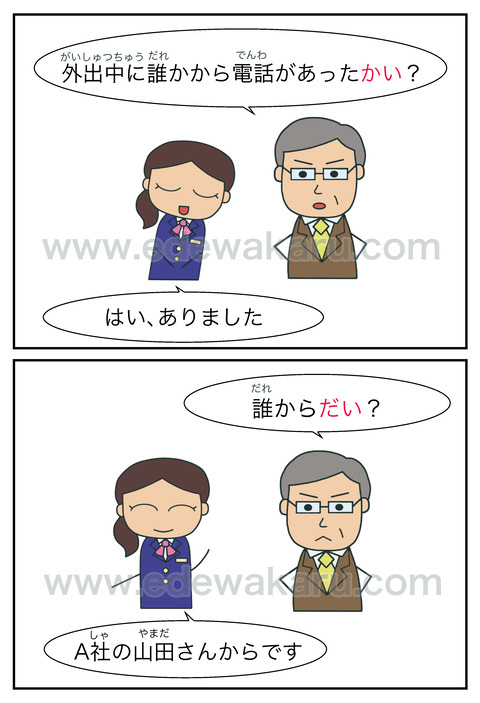
日本語文型辞典 英語版
Meaning
【だい】Used by men in casual conversation.
Attaches to interrogative expressions, such as question words or clauses that include a question word. Expresses the feeling of asking the listener a question. Sometimes used as an exclamation that conveys the feeling of asking a question or criticizing, as in
(7)
and
(8)
. A slightly old-fashioned expression used in spoken language. Usually used by adult males.
Used by boys to make a strong assertion.
How to use it
1. 疑問表現+だい
2. ...だい。[N/Na だい]
In context 11 examples
いま何時だい?
What time is it now?
いつだい? 花子の入学式は。
When is it? Hanako’s entrance ceremony, I mean.
その手紙だれからだい?
So who’s the letter from?
どうだい。元気かい。
So how are things? Are you doing well?
そんなことだれから聞いたんだい?
Who’d you hear that from?
何時にどこに集ればいいんだい?
What time and where should we meet?
どうだい、すごいだろう。
Whaddaya think? Great, isn’t it!
何だい、今頃やってきて。もう準備はぜんぶ終わったよ。
Whaddaya think you’re doing, arriving at this hour? We’re already finished getting everything ready!
そんなことうそだい。
That’s a lie!
いやだい。絶対教えてあげないよ。
No. I won’t tell you, ever.
ぼくのはこれじゃないよ。それがぼくのだい。
This one isn’t mine. That one’s mine.
Read the original source text
Meaning
【だい】Used by men in casual conversation.
Attaches to interrogative expressions, such as question words or clauses that include a question word. Expresses the feeling of asking the listener a question. Sometimes used as an exclamation that conveys the feeling of asking a question or criticizing, as in
(7)
and
(8)
. A slightly old-fashioned expression used in spoken language. Usually used by adult males.
Used by boys to make a strong assertion.
How to use it
1. 疑問表現+だい
2. ...だい。[N/Na だい]
Yokubi — The Common Grammar Guide (https://yoku.bi)
Explanation
っけ is used when the speaker has forgotten something or is trying to recall something they once knew. It is usually, although not exclusively, used as a question directed to oneself.
っけ is almost never used with non-nouns except in the past tense. When it is, other stuff (like explanatory んだ) is usually put in between.
Similar to っけ, there is also かな. It is usually pronounced with a rising intonation as a question, but just like っけ it is a self-directed one. It simply means the speaker is wondering or unsure or hesitant about something, similar to "I wonder" in English. Needless to say it comes from the union of the question particle か and the sentence ending particle な.
It often comes after the volitional form of a verb to indicate that the speaker is about to decide to do something.
かい is a "friendly" question marker, especially for masculine speakers. Outside of familiar conversation, it can come across as rude/too direct. It's not as common in real life as it is in media. In standard usage, it can only be used to ask yes/no questions.
Parallel to かい, there is also だい. The vibes are pretty much the same, but unlike かい, だい is used to ask questions that expect an actual answer.
じゃない can also be used to ask confirmation questions. Yes, when attached to nouns, it's identical to normal "is not". No, there's no way around it. If you are lucky, there will be a question mark after it.
Note how adding a copula after verbs and い adjectives is technically incorrect but this type of じゃない lives on its own and can show up after them. It's not negating the predicate, it's just adding a negative question nuance ("isn't it?") and behaves like a sentence-ending particle.
じゃん is a casual contraction of じゃない.
In context 1 examples
君たちはこれからどうするんだい?
What are you guys going to do from now on?