AIUEO JLPT Grammar
Meaning
This sentence pattern expresses doing something without considering a specific condition or excluding certain elements. It indicates the action proceeds regardless of those conditions.
How to use it
Noun + 抜きで; Noun + 抜きに; Noun + 抜きに; Noun を + 抜きに + して; Noun は + 抜きに + して
In context 5 examples
冗談抜きで、彼は本気でそう言っているんだ。
Seriously, he really means it.
細かい説明を抜きにして、すぐに本題に入った。
Without going into too much detail, he got straight to the point.
彼女は、意見の対立を抜きに、冷静に話し合いたいと言った。
She said she wanted to discuss things calmly, without the conflict of opinions.
お金の話は抜きにして、まずは私たちの関係を考えよう。
Let’s set aside the money issue and think about our relationship first.
彼は遠慮抜きで、自分の意見をはっきり述べた。
He expressed his opinion clearly, without any hesitation.
Read the original source text
Meaning
This sentence pattern expresses doing something without considering a specific condition or excluding certain elements. It indicates the action proceeds regardless of those conditions.
How to use it
名詞+抜きで名詞+抜きに名詞+抜きに名詞を+抜きに+して名詞は+抜きに+して
Explanation · 日本語
この文型は、特定の要素や条件を取り除いた状態で何かを行うこと、または、ある条件を考慮せずに話を進めることを示します。
Bunpro Grammar Reference
Meaning
Without, Unless
How to use it
Noun + 抜きで(は)
Noun + 抜きに(は)
Noun + を + 抜きにして(は)
Noun + は + 抜きとして(は)
Noun + 抜き + の + Noun
Nuance
A grammar point which expresses that something has had (A) extracted from it, which would usually be there. Without (A).
Explanation
抜きで, a combination of the noun form of the う-Verb 抜く 'to extract', and the particle で, is a construction that usually indicates something being done 'without (A)', or 'with the removal of (A)'. As ぬき indicates the extraction of something, this grammar pattern is primarily used to indicate 'leaving out', or 'setting aside' something that is regularly included.
抜きで acts as a suffix, so will be utilized after nouns, to indicate the thing that is being left out. Both the plain hiragana and kanji forms are fairly common. Additionally, の will replace で when ぬき is followed directly by another noun.
あの人は冗談抜きで怖いから怒らせない方がいいよ。
That guy is scary, no joke, so you shouldn't upset him.
あいつら全然来ないな、あいつら抜きで始めちゃおうぜ。
They aren't coming at all (it doesn't seem like they are coming anytime soon). Let's start without them.
ワサビ抜きの寿司なんて寿司じゃないよ。
Sushi without wasabi is not sushi.
Occasionally, にして may also replace で, but this structure is more common when the part (B) section of the sentence includes a ない or できない based statement. These expressions indicate that something 'will not happen without (A)', or 'is not possible without (A)'.
若い労働者抜きにしては、日本の建築業は成り立たない。
Without young workers, Japan's construction industry would not exist.
公共交通機関抜きにしては便利な生活ができない。
Without public transportation, you cannot live a convenient life.
However; this is not always the case, as ぬきで or ぬきでは may also appear in negative sentences, with the same meaning.
In context 16 examples
- リスク抜きには決してフグを食べられない。
You can never eat fugu without risk.
- ワサビ抜きの寿司なんて寿司じゃないよ。
Sushi without wasabi is not sushi.
- 若い労働者抜きにしては、日本の建築業は成り立たない。
Without young workers, Japan's construction industry would not exist.
- 公共交通機関抜きにしては便利な生活ができない。
Without public transportation, you cannot live a convenient life.
- あの人は冗談抜きで怖いから怒らせない方がいいよ。
That guy is scary, no joke, so you shouldn't upset him.
- あいつら全然来ないな、あいつら抜きで始めちゃおうぜ。
They aren't coming at all (it doesn't seem like they are coming anytime soon). Let's start without them.
- 「クソ、渋滞だ。あいつら、パーティーをオレ抜きで始めそうだ。」
'Damn, a traffic jam. It seems that they will start the party without me.'
- 「食べれる」のような「ら」抜きの言葉は人気になっている。
Words without 'ら', like '食べれる' are getting more popular.
- C(シー):「A(エー)とB(ビー)は付き合ってんのよ」D(ディー):「マジ!?冗談抜きで?」
C: 'A and B are dating!' D: 'Whaa? No kidding? (without joking)'
- 夫婦の会話:「子供抜きでどこか面白いところに行こう!」
A conversation between a married couple: 'Let's go somewhere fun, without the children!'
- 私にとってコーラ抜きでハンバーガーを食べることは考えられない。
It is totally unacceptable for me to eat a hamburger without a coke.
- くろさわあきらという監督抜きにして日本の映画を語ることはできない。
It is impossible to talk about Japanese cinematography without mentioning the director Akira Kurosawa.
- グルテン抜きの食べ物はセリアック病という病気の人のために必要である。
Gluten-removed food is necessary for those who are ill with celiac disease.
- 日本語の場合、文脈抜きのスタンドアロンの文は分かりにくい。
In the case of Japanese, standalone sentences without context are hard to understand.
- 女の子:「あたしの料理、好きなの?」男の子:「お世辞抜きで、今までの人生でこれよりうまいものは食べた事がない。」
Girl: 'Do you like my cooking?' Boy: 'Without flattery, I haven't eaten anything more delicious than this in my life.'
- お寿司屋さん:「ご注文はお決まりですか?」お客さん:「はい、マグロのにぎりをワサビ抜きでお願いします。」
Sushi restaurant employee: 'Are you ready to order?' Guest: 'Yes, I would like to have tuna nigiri without wasabi.'
絵でわかる日本語
Meaning
Do ~ without ~
Do ~ leaving ~ out
How to use it
Noun [dictionary form] + 抜きで
Noun [dictionary form] + 抜きの + noun
Explanation
“〜抜きで” is a sentence pattern meaning “do ~ without ~.” It is used to say “do ~ without something that is normally present” or “do ~ without someone who is usually there.”
[Examples]
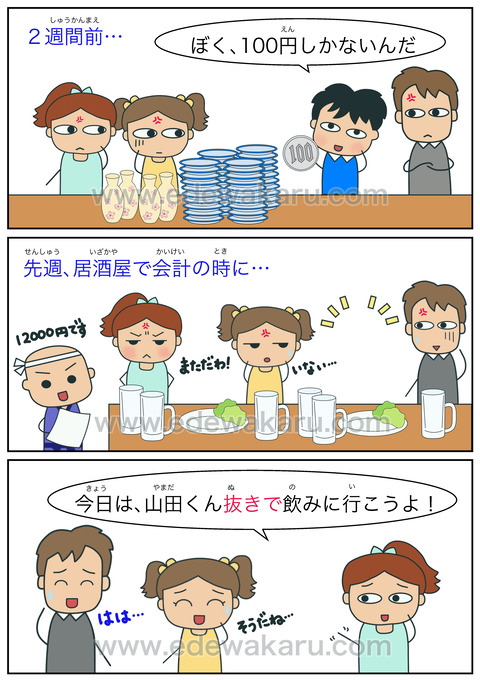
①Let’s go drinking today without Yamada-kun
→We usually go with Yamada-kun too, but today we’ll go without him
②A: What is decaf?
B: It’s coffee without caffeine
→Coffee normally contains caffeine, but decaf does not
③The children always eat sushi without wasabi
→Sushi normally has wasabi, but they eat it without any
④I overslept after going back to sleep, so today I came to work without breakfast
→I usually eat breakfast, but today I came to work without it
Remember that when a noun follows, the form is “〜抜きの + noun.”
[Related grammar]
In context 4 examples
A:今日は、山田くん抜きで飲みに行こうよB:そうね。彼、いつも会計の時にいなくなるもんね
A: Let’s go drinking today without Yamada-kun. B: Sure. He always disappears when it’s time to pay, after all.
A:デカフェって何?B:カフェイン抜きのコーヒーのことよ
A: What is decaf? B: It’s coffee without caffeine.
子供たちは、いつもわさび抜きでお寿司を食べます
The children always eat sushi without wasabi.
二度寝してしまい、今日は朝ごはん抜きで会社に来た
I went back to sleep and overslept, so I came to work without breakfast today.
Read the original source text
Meaning
〜なしで〜する
〜はなしにして〜する
How to use it
名詞[辞書形] +抜きで
名詞[辞書形]+抜きの+名詞
Explanation
「〜抜きで」は「〜なしで〜する」という意味を表す文型です。「普通あるものはなしで〜する」「いつもいる人はなしで〜する」と言いたい時に使われます。
[例]
①今日は山田くん
抜きで
飲みに行こうよ
→いつも山田くんも一緒に行くが、今日は山田くんなしで行く
②A:デカフェって何?
B:カフェイン
抜きの
コーヒーのことよ
→コーヒーには普通カフェインが入っているが、デカフェには入っていない
③子供たちは、いつもわさび
抜きで
お寿司を食べます
→お寿司には普通わさびが入っているが、入っていないものを食べる
④二度寝してしまい、今日は朝ごはん
抜きで
会社に来た
→いつもは朝ごはんを食べるが、今日は朝ごはんなしで会社に来た
後ろに名詞がくる場合は「〜抜きの+名詞」になると覚えておきましょう。
【関連文法】
毎日のんびり日本語教師
How to use it
Noun + 抜きで
Noun + 抜きの
Noun + は抜きで
Noun + は抜きにして
Noun + を抜きにして
Explanation
Indicates omitting or removing the thing in question. The latter part describes doing something in that state.
Notes
Nothing in particular.
In context 9 examples
体臭がひどいのは冗談抜きでNG。
Severe body odor is unacceptable, no joke.
あいつはお世辞抜きで本当にすごいと思う。
I think that guy is truly amazing, no flattery.
小難しいことは抜きにしてただ楽しめばいい。(不拘小难只要享受就好。)
Just enjoy yourself without worrying about complicated things. (Just enjoy yourself without getting caught up in difficult details.)
堅苦しい挨拶は抜きにして、早速本題に入ろう。
Let’s skip the formal greetings and get straight to the main topic.
解説抜きで見るスポーツの試合はあまり面白くない。
Watching a sports game without commentary isn’t very interesting.
炭水化物抜きのダイエットは健康に良くない。
A carbohydrate-free diet is not good for your health.
勝ち負けの話は抜きにして、お互いよくやったと思う。
Putting aside talk of winning and losing, I think we both did well.
そういう暗い話は抜きにしませんか。
Could we leave out that kind of gloomy talk?
先入観を抜きにして考えるべきだ。
We should think about it without preconceptions.
Read the original source text
How to use it
名詞+抜きで
名詞+抜きの
名詞+は抜きで
名詞+は抜きにして
名詞+を抜きにして
Explanation
そのものを省略したり、取り除くことを表します。後項にはその状態で何かを行うことが述べられます。
Notes
特になし