DoJG 日本語文法辞典(全集)
Meaning
Because; be caused by the fact that ~; from the fact that ~
How to use it
(i) {V/Adjectiveい}informal | ところから | |
| {する/した}ところから | Because someone does/did something |
| {高い/高かった}ところから | Because something is/was expensive |
(ii) Adjectiveなstem | {な/である/だった/であった}ところから | |
| 便利{な/である/だった/であった}ところから | Because something is/was convenient |
(iii) Noun{である/だった/であった} | ところから | |
| 日本人{である/ だった/であった}ところから | Because someone is/was a Japanese |
Explanation
A phrase that introduces the origins of names, theories, ideas and events.
In context 9 examples
この宝石は猫の目に似ているところから「猫目石」と名づけられている。
This gem is called ""cat's-eye"" because it resembles a cat's eye.
私が両者にそのことを十分説明しなかったところから誤解が生じた。
The misunderstanding was caused by the fact that I didn't explain it to both of them fully.
田中先生はいつも蝶ネクタイをしていたところから「蝶ネクタイ先生」と呼ばれていた。
Dr. Tanaka was called ""Professor Bow Tie"" because he always wore one.
日本は憲法が戦力の保持を禁止しているところから、「軍隊」ではなく「自衛隊」を持っている。
Because its constitution bans the possession of military power, Japan has ""Self-Defence Forces,"" but not an ""army.""
この説は、両者が生物的に多くの共通点を持っているところから来ている。
This theory comes from the fact that, biologically, the two species have many things in common.
論語に「何もしないでいるよりは碁を打つ方がましだ」という教えがあるところから、碁は孔子以前にかなり普及していたとみられる。
Because the Analects teach us that ""It is better to play Go than to not do anything,"" it appears that Go was already fairly popular before Confucius' time.
そのイギリス人とは家が近くだったところから、よく遊びに行って英語や英語の歌を教えてもらったりした。
Because my house was close to the Englishman's, I visited him often and he taught me English and English songs and other things.
この雑誌は最初、ある有名月刊誌の別冊として刊行されたのが好評だったところから、後に単独の雑誌として独立したものだ。
This magazine was first published as a separate volume of a famous monthly magazine and later became an independent publication because it was so well received.
今音楽で広く使われているCDは、実はベートーベンの第九交響曲の演奏時間が74分間だったところからその容量が決められたということだ。
I heard that the capacity of the CDs we use so widely now for music was settled on because a (certain) performance of Beethoven's Ninth Symphony was 74 minutes long.
絵でわかる日本語
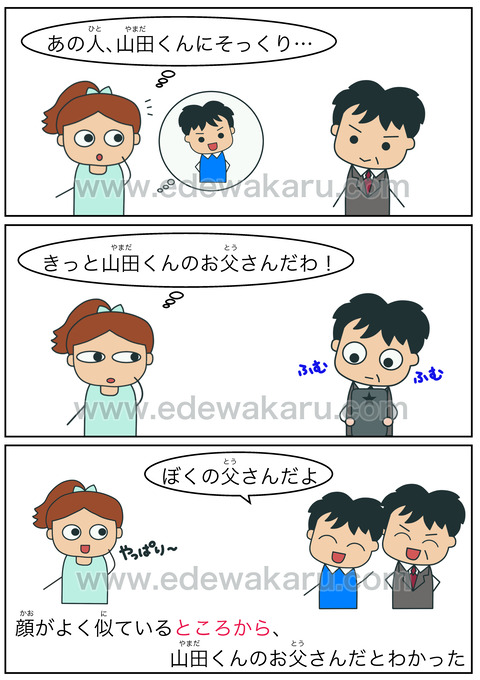
Meaning
〜が理由で — because of …
〜から判断して — judging from …
〜という状況から — based on the situation that …
How to use it
Verb・adjective・noun[plain form]+ところから
*For the affirmative present form of な-adjectives: “ーなところから” or “ーであるところから”
*For the affirmative present form of nouns: “ーであるところから”
Explanation
“〜ところから” is a sentence pattern meaning “because of …,” “judging from …,” or “based on the situation that ….” In the form “AところからB,” it is used to say “Because of A, we found out that B” or “B happened because the situation was A.”
A similar sentence pattern is “〜ことから,” so learn them together. 😉 There are many sentence patterns that use “ところ,” so review them.
【List of sentence patterns that use “ところ”】
In context 5 examples
顔がよく似ているところから、山田くんのお父さんだとわかった
→顔がよく似ているということから判断して、山田くんのお父さんだとわかったBecause their faces looked so alike, I realized that Yamada’s father was the man in question. →Judging from how much their faces looked alike, I realized that it was Yamada’s father.
道が濡れているところから、昨日の夜に雨が降ったと思った
→道が濡れているという状況から、昨日の夜に雨が降ったと思ったJudging from the wet road, I thought it had rained last night. →Based on the situation that the road was wet, I thought it had rained last night.
瓜二つであるところから、あの二人は双子だと思う
→瓜二つなので、あの二人は双子だと思うSince they are virtually identical, I think those two are twins. →Because they are virtually identical, I think those two are twins.
彼らは同じ会社だったところから付き合うようになり、結婚した
→同じ会社だという状況から付き合うようになり、結婚したThey started dating because they worked at the same company, and they got married. →They started dating because they were in the situation of working at the same company, and they got married.
アボカドは脂肪が多くバターのような食感であるところから、「森のバター」と呼ばれている
→脂肪が多く、バターのような食感なのが理由で、「森のバター」と呼ばれているAvocados are called “the butter of the forest” because they are high in fat and have a buttery texture. →They are called “the butter of the forest” because they are high in fat and have a buttery texture.
Read the original source text
Meaning
〜が理由で
〜から判断して
〜という状況から
How to use it
動詞・形容詞・名詞[普通形]+ところから*な形容詞の現在肯定形は「ーなところから」「ーであるところから」*名詞の現在肯定形は「ーであるところから」
Explanation
「〜ところから」は「〜が理由で」「〜から判断して」「〜という状況から」という意味の文型です。「AところからB」の形で、「Aが理由で、Bだとわかった」「Aという状況だったから、Bになった」と言いたい時に使われます。
類似文型に「〜ことから」がありますので、一緒に覚えておきましょう😉「ところ」がつく文型はたくさんありますので復習しておきましょう。
【「ところ」がつく文型リスト】
NINJAL 日本語文型データベース
Meaning
Used when you want to say that something brings about a certain state as its origin or cause, or that you make a certain judgment or decision based on something or with something as its source.
How to use it
V plain form + ところから
i-A plain form + ところから
na-A plain form + ところから (however, 「na-Aだ」 becomes 「na-Aな+ところから・na-Aである+ところから」)
N plain form + ところから (however, 「Nだ」 becomes 「Nである+ところから」)
In context 17 examples
生卵を上に乗せたうどんは、卵の黄身が満月の形に似ているところから、「月見うどん」と呼ばれる。
Udon topped with a raw egg is called 「月見うどん」 (“moon-viewing udon”) because the egg yolk resembles the shape of a full moon.
松の木は、葉の色が一年中変わらないところから、長寿の象徴とされてきました。
Pine trees have been considered symbols of longevity because the color of their leaves does not change throughout the year.
大小の足跡が残っていたところから、親子の熊がこの付近にいたと推測される。
Since large and small footprints had been left behind, it is presumed that a mother bear and her cub were in this area.
ごく簡単な質問にも日本語で答えられなかったところから、彼の日本語力は低いと判断された。
Because he could not answer even very simple questions in Japanese, it was judged that his Japanese ability was low.
アルミニウムは軽くて加工しやすいところから、様々な用途に向くと言われる。
Aluminum is said to be suitable for a variety of uses because it is lightweight and easy to process.
遺跡から出土した矢は長くないところから、短い弓に用いられたものだと考えられている。
Since the arrows excavated from the ruins were not long, it is thought that they were used with short bows.
供述に不自然な点が多かったところから、参考人Aが事件に関わっていることが疑われた。
Because there were many unnatural points in the statement, suspect A was suspected of being involved in the case.
地元の食材を使った料理を出す店が多くなかったところから、需要があるのではないかと考え、この店の開店を思いついた。
Since there weren’t many restaurants serving dishes made with local ingredients, I thought there might be demand and came up with the idea of opening this restaurant.
彼の隣にいる子どもは彼にそっくりなところから、彼の息子に違いないと私は確信した。
Because the child next to him looks exactly like him, I was certain that the child must be his son.
人を悪く言わず常に謙虚であるところからも、山野さんの育ちのよさが感じられる。
Even from the fact that Mr. Yamano never speaks ill of others and is always humble, one can sense that he was brought up well.
このイベントが準備不足であることは、進行がスムーズではないところから明らかである。
It is clear that this event was poorly prepared from the fact that its proceedings are not running smoothly.
言い分が不明瞭だったところから、この人はうそをついているのではないかという疑念を持った。
Because his account was unclear, I began to suspect that he might be lying.
当時海外旅行さえまだ一般的でなかったところから、単身フランスに渡って洋菓子作りの修業をしたこの店の創業者の苦労がしのばれる。
Given that even overseas travel was not yet commonplace at the time, one can imagine the hardships faced by the founder of this shop, who traveled alone to France to train in making Western-style confectionery.
「ライオン」というのは、ライオンのように広がった髪型であるところから彼に付けられたあだ名だ。
“Lion” is a nickname given to him because his hairstyle spreads out like a lion’s mane.
「哲学」という学問は平易なイメージではないところから一般的には敬遠されがちだ。
The field of study called “philosophy” tends to be avoided in general because it does not have an approachable image.
写真に写っていた人物は制服姿だったところから、高校生と見られている。
Because the person in the photograph was wearing a uniform, they are thought to be a high school student.
小川さんがいつものような楽しげな様子ではなかったところから、何かあったのだろうかと誰もが思った。
Since Mr. Ogawa didn’t seem as cheerful as usual, everyone wondered whether something had happened.
Read the original source text
Meaning
〜が発端・原因で、ある状態になると言いたいとき、また、〜を根拠・由来として、ある判断・決定をすると言いたいときに使います。
How to use it
V普通形+ところから
i-A普通形+ところから
na-A普通形+ところから(ただし、「na-Aだ」→「na-Aな+ところから・na-Aである+ところから」)
N普通形+ところから(ただし、「Nだ」→「Nである+ところから」)