絵でわかる日本語
Meaning
I thought ~, but it turned out to be ~.
Contrary to expectations, ~.
How to use it
Verb/adjective [plain form] + わりに
Noun [dictionary form] + のわりに
Explanation
「〜わりに」 means “I thought ~, but it turned out to be ~” or “contrary to expectations, ~.” It is used when the actual state differs from what you would naturally expect based on common sense 😊 This pattern can be used for both good and bad things 😮
[Examples]
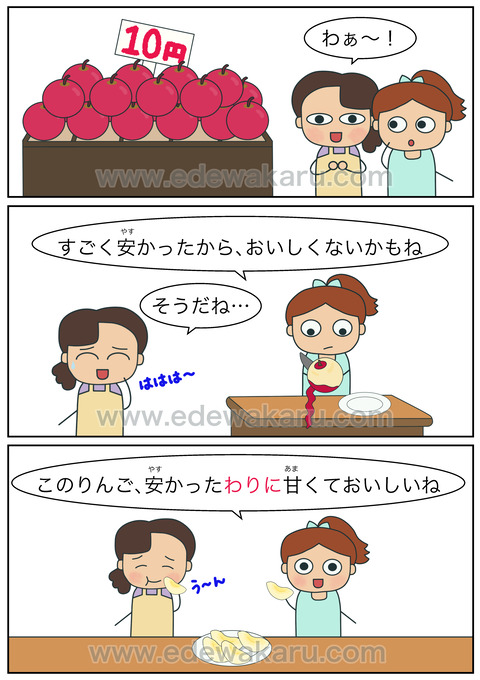
① This apple was cheap
わりに
it’s sweet and tasty!
[Expectation] It wouldn’t taste good because it was cheap.
[Reality] It’s cheap, yet sweet and tasty.
② That restaurant is famous
わりに, but the food isn’t very good.
[Expectation] It must be good because it’s famous.
[Reality] It’s famous, yet it isn’t very good.
③ I studied hard
わりに, my test score wasn’t good.
[Expectation] I worked hard, so my test score should be good.
[Reality] I worked hard, but it wasn’t good.
④ My mother looks young
のわりに
for her age.
→My mother looks younger than her actual age.
⑤ Despite people saying this book is really good
わりに, I didn’t find it interesting.
[Expectation] It must be interesting since people say it’s really good.
[Reality] People say it’s good, but I didn’t find it interesting.
⑥ You’re good at skiing, considering it’s your first time
のわりに
.
[Expectation] Since it’s your first time, you probably wouldn’t be good.
[Reality] It’s your first time, yet you’re good.
There are several similar patterns to 「〜わりに」, so review those as well 😀
[Related patterns]
In context 6 examples
このりんご、安かったわりに甘くておいしいね!
This apple is sweet and tasty for how cheap it was!
あのレストランは有名なわりに、あまりおいしくない
That restaurant is famous, but the food isn’t very good.
がんばって勉強したわりに、テストの点はよくなかった
I studied hard, but my test score wasn’t good.
お母さんは、年齢のわりに若く見える
My mother looks young for her age.
この本はすごくいいと言われているわりに、おもしろくなかった
Despite people saying this book is really good, I didn’t find it interesting.
初めてスキーをしたのわりには上手だね
You’re good at skiing for it being your first time.
Read the original source text
Meaning
〜と思ったのに〜だった
予想と違って〜
How to use it
動詞・形容詞[普通形]+わりに
名詞[辞書形]+のわりに
Explanation
「〜わりに」は「〜と思ったのに〜だった」「予想と違って〜」という意味を表す文型です。常識から考えて「当然〜だろう」と予想したことと、実際の状態が違っている時に使われます😊この文型は
【いいこと】
にも
【悪いこと】
にも使えます😮
[例]
①このりんご、安かった
わりに
甘くておいしいね!
【予想】安かったからおいしくない
【実際】安かったのに甘くておいしい
②あのレストランは有名な
わりに、あまりおいしくない
【予想】有名だからおいしいだろう
【実際】有名なのにあまりおいしくない
③がんばって勉強した
わりに、テストの点はよくなかった
【予想】がんばったから、テストの点はいいだろう
【実際】がんばったのに、よくなかった
④お母さんは、年齢の
わりに
若く見える
→お母さんは、本当の年齢より若く見える
⑤この本はすごくいいと言われている
わりに、おもしろくなかった
【予想】すごくいいと言われているので、おもしろいだろう
【実際】いいと言われているのに、おもしろくなかった
⑥初めてスキーをしたの
わりに
は上手だね
【予想】初めてだから、上手じゃないだろう
【実際】初めてなのに、上手だ
「〜わりに」には似ている文型がいくつかありますので、復習をしておきましょう😀
【関連文型】
どんなときどう使う 日本語表現文型辞典
Meaning
considering
How to use it
Nの / V・A [plain form] (ナAな・ナAである) + わりに (は)
Explanation
わりに(は)
~こととは不釣り合いに
1)「~わりに(は)」の形で「~のことから考えて当然であると思われる程度に合っていない」と言いたいときに使う。
2)「にしては」と意味・用法がよく似ているが、「わりに(は)」は不釣り合いであることを問題にしていることが特徴的。「わりに(は)」の前後には程度を表す表現が来ることが多い。
2)Similar in meaning and usage to にしては, but わりに(は) is unique in that it poses problem of inappropriateness. Often words describing degree precede and follow わりに(は).
ヲ行わりに
1)Something is inappropriate considering what would be natural degree.
In context 4 examples
わたしの母は、年を取っているわりには新しいことに意欲的です。
Although my mother is getting old, she is enthusiastic about new things.
きのうの講演会は、思ったわりには人が集まらなかった。
Fewer people gathered for yesterday’s lecture than I expected.
このくつは値段が高いわりによく売れる。
These shoes sell well despite their high price.
彼女は年齢のわりには若く見えます。
She looks young for her age.
Read the original source text
Meaning
considering
How to use it
Nの/V・Aの〔普通形〕(ナAな・ナAである)+わりに(は)
Explanation
わりに(は)
~こととは不釣り合いに
1)「~わりに(は)」の形で「~のことから考えて当然であると思われる程度に合っていない」と言いたいときに使う。
2)「にしては」と意味・用法がよく似ているが、「わりに(は)」は不釣り合いであることを問題にしていることが特徴的。「わりに(は)」の前後には程度を表す表現が来ることが多い。
2)Similar in meaning and usage to にしては, but わりに(は) is unique in that it poses problem of inappropriateness. Often words describing degree precede and follow わりに(は).
ヲ行わりに
1)Something is inappropriate considering what would be natural degree.
日本語NET JLPT文法解説まとめ
Meaning
More ... than one would expect / out of proportion to ...
Used when something turns out to be better or worse than expected, compared with the level one had anticipated. The degree of difference can vary.
How to use it
V (plain form) + わりに
I-adjective (plain form) + わりに
Na-adjective (plain form) + わりに ※ナAなわりに
N + のわりに ※Nのわりに
V: 言う → 言うわりに
I-adjective: 高い → 高いわりに
Na-adjective: 大変な → 大変なわりに
N: 値段 → 値段のわりに
Explanation
"considering"
Used when you thought it would be at this level, but it was actually better or worse. The difference in degree can vary.
In context 15 examples
同僚はいつも忙しいと言っているわりに、仕事中によくスマホでFacebookを見ている。
My colleague always says they’re busy, yet they often look at Facebook on their phone while working.
彼は勉強していなかったわりに、テストの点が良かった。
Despite not studying, he got a good score on the test.
田中さんは留学の経験がないわりに、綺麗な発音で英語を話す。
Despite never having studied abroad, Tanaka speaks English with beautiful pronunciation.
この鞄は高いわりに、よく売れる。
This bag sells well despite being expensive.
日本語教師の仕事は忙しいわりに、給料は安く辞める人も多い。
Despite being busy, Japanese teaching jobs pay poorly, so many people quit.
プログラマーの仕事は大変なわりに、給料が低いのでフリーランスになる人も増えている。
Despite being demanding, programming jobs pay little, so more people are becoming freelancers.
このラーメンは値段のわりに、おいしかった。
This ramen was delicious for the price.
息子はインフルエンザのわりに、食欲もあるし元気だ。
Despite having the flu, my son has an appetite and is energetic.
今日は休日のわりに人が少ないね。どうしてだろう。
There aren’t many people here, considering it’s a holiday. I wonder why.
このコンピューター、中古のわりに高くない?
Isn’t this computer expensive for a used one?
相手の選手は負けたわりに、あまり悔しそうにしていなかった。
Despite losing, the opposing player didn’t seem very disappointed.
昨日見た映画は評判のわりに、面白くなかった。
The movie I saw yesterday wasn’t very interesting, considering its reputation.
このレストラン、レビューが星5のわりに、そんなに美味しくないね。
This restaurant has five-star reviews, yet it isn’t all that tasty.
(写真を見ながら)え?この人、50歳なの?歳のわりに、若く見えますね。
(Looking at a photo) Huh? This person is 50? They look young for their age.
本当にスキーしたことのないの?初めてのわりに、上手に滑れているよ。
You really have never skied before? You’re skiing well for a first-timer.
Read the original source text
Meaning
~と思えないくらい / ~とは不釣り合いに
この程度のレベルかなと思っていたのに、実際にはそれよりもよかった、あるいは悪かった時に使う。程度の差には幅がある。
How to use it
V(普通形) + わりに
イA(普通形) + わりに
ナA(普通形) + わりに ※ナAなわりに
N + のわりに ※Nのわりに
V言う言うわりにはイA高い高いわりにナA大変な大変なわりにN値段値段のわりに
Explanation
"considering"
Used when you thought it would be at this level, but it was actually better or worse. The difference in degree can vary.
毎日のんびり日本語教師
How to use it
Verb plain form + わりに(は)
い-adjective plain form + わりに(は)
な-adjective stem + な/である + わりに(は)
Noun + の/である + わりに(は)
Explanation
Indicates that a result has occurred that is contrary to what would generally be expected.
Notes
Similar grammar pattern: “【N3 Grammar】~くせに/くせして”
Similar grammar pattern: “【N2 Grammar】~にしては”
In context 14 examples
中古のわりに高い。
It’s expensive for a secondhand item.
このイヤホンは高いわりに音が悪い。
These earphones sound bad for how expensive they are.
パンはお腹が膨れるわりに栄養はほとんどない。
Bread fills you up, but has hardly any nutritional value.
初心者のわりには頑張ったと思う。(我觉得虽然是初学者但是很努力。)
I think I did well, considering I’m a beginner.
あのチーム、負けたわりには悔しそうにしていないのが不思議だ。
It’s strange that the team doesn’t seem very upset, considering they lost.
好きな曲は多いわりに、歌える曲が少ない。
I have a lot of songs I like, but there are few I can sing.
雨が降っているわりにはあまり寒くない。
It isn’t very cold, considering it’s raining.
そこのお店は値段のわりに量が多くてよく通っている。
That shop gives you a lot for the price, so I go there often.
寝不足のわりに体調は悪くない。
I don’t feel bad, considering I’m short on sleep.
この料理は手間がかかるわりにあまりおいしくない。
This dish takes a lot of effort, but it isn’t very tasty.
年齢のわりには大人っぽい息子に育ちました。
My son has grown up to be rather mature for his age.
職種のわりに年収低くないですかって言われた。
Someone told me, “Isn’t your annual income low for your line of work?”
38.1度、熱のわりに体は楽。
My temperature is 38.1°C, but I feel pretty comfortable for having a fever.
30度のわりには天気が不安定なせいか、暑いけどエアコンはいらなかった。
Although it’s 30 degrees, perhaps because the weather is unstable, it was hot but I didn’t need the air conditioner.
Read the original source text
How to use it
動詞普通形+わりに(は)
い形容詞普通形+わりに(は)
な形容詞語幹+な/である+わりに(は)
名詞+の/である+わりに(は)
Explanation
一般的に想定される結果とは相反する結果が生じたことを表します。
Notes
似ている文法「【N3文法】~くせに/くせして」
似ている文法「【N2文法】~にしては」
AIUEO JLPT Grammar
Meaning
This sentence pattern is used to express a situation or result that is different from an expected or desired outcome based on a certain standard or expectation. It is used to describe unexpected or inappropriate situations.
How to use it
Verb + わりに (+ は); adjective + わりに (+ は); na-adjective + な + わりに (+ は); noun + の + わりに (+ は)
In context 5 examples
彼は年齢のわりに若く見える。
He looks young for his age.
このレストランは値段のわりに料理が美味しい。
This restaurant has surprisingly good food for the price.
天気が悪かったわりに、試合はスムーズに進んだ。
Despite the bad weather, the match proceeded smoothly.
この映画は予算が少なかったわりに、かなりの成功を収めた。
This movie was quite successful despite having a small budget.
この本は、短いわりに内容が充実している。
This book is quite comprehensive considering its length.
Read the original source text
Meaning
This sentence pattern is used to express a situation or result that is different from an expected or desired outcome based on a certain standard or expectation. It is used to describe unexpected or inappropriate situations.
How to use it
動詞+わりに(+は)形容詞+わりに(+は)形容動詞な+わりに(+は)名詞の+わりに(+は)
Explanation · 日本語
この文型は、ある基準や期待に対して、それとは異なる結果や印象を表すときに使われる表現です。主に、予想外や不釣り合いな状況を述べるときに使用されます。
文法
Usage 1
Meaning
~ more than one would expect / out of proportion to ~
Used when something turns out better or worse than expected, given the level one had in mind. The degree of difference can vary.
How to use it
V (plain form) + わりに
イA (plain form) + わりに
ナA (plain form) + わりに ※ナAなわりに
N + のわりに ※Nのわりに
In context 15 examples
同僚はいつも忙しいと言っているわりに、仕事中によくスマホでFacebookを見ている。
My colleague always says they’re busy, yet they often look at Facebook on their phone while working.
彼は勉強していなかったわりに、テストの点が良かった。
Despite not studying, he got a good score on the test.
田中さんは留学の経験がないわりに、綺麗な発音で英語を話す。
Despite never having studied abroad, Tanaka speaks English with beautiful pronunciation.
この鞄は高いわりに、よく売れる。
This bag sells well despite being expensive.
日本語教師の仕事は忙しいわりに、給料は安く辞める人も多い。
Despite being busy, Japanese teaching jobs pay poorly, so many people quit.
プログラマーの仕事は大変なわりに、給料が低いのでフリーランスになる人も増えている。
Despite being demanding, programming jobs pay little, so more people are becoming freelancers.
このラーメンは値段のわりに、おいしかった。
This ramen was delicious for the price.
息子はインフルエンザのわりに、食欲もあるし元気だ。
Despite having the flu, my son has an appetite and is energetic.
今日は休日のわりに人が少ないね。どうしてだろう。
There aren’t many people here, considering it’s a holiday. I wonder why.
このコンピューター、中古のわりに高くない?
Isn’t this computer expensive for a used one?
相手の選手は負けたわりに、あまり悔しそうにしていなかった。
Despite losing, the opposing player didn’t seem very disappointed.
昨日見た映画は評判のわりに、面白くなかった。
The movie I saw yesterday wasn’t very interesting, considering its reputation.
このレストラン、レビューが星5のわりに、そんなに美味しくないね。
This restaurant has five-star reviews, yet it isn’t all that tasty.
(写真を見ながら)え?この人、50歳なの?歳のわりに、若く見えますね。
(Looking at a photo) Huh? This person is 50? They look young for their age.
本当にスキーしたことのないの?初めてのわりに、上手に滑れているよ。
You really have never skied before? You’re skiing well for a first-timer.
Read the original source text
Meaning
~と思えないくらい / ~とは不釣り合いに
この程度のレベルかなと思っていたのに、実際にはそれよりもよかった、あるいは悪かった時に使う。程度の差には幅がある。
How to use it
V(普通形) + わりに
イA(普通形) + わりに
ナA(普通形) + わりに ※ナAなわりに
N + のわりに ※Nのわりに
Usage 2
Meaning
× Although I studied as much as 10 hours every day, I failed.
〇 Although I studied as much as 10 hours every day, my grades weren't very good.
As in the sentences above, there are restrictions on what can follow 「~わりには」. In the incorrect example, there are only two possible outcomes—pass or fail—and no range between them.
「~わりには」 cannot be used with something that has no such range.
In context 1 examples
× 毎日、10時間も勉強したわりには、不合格だった。
〇 毎日、10時間も勉強したわりには、成績があまりよくなかった。× Although I studied as much as 10 hours every day, I failed. 〇 Although I studied as much as 10 hours every day, my grades weren't very good.
Read the original source text
Meaning
× 毎日、10時間も勉強したわりには、不合格だった。
〇 毎日、10時間も勉強したわりには、成績があまりよくなかった。
上の文のように、「~わりには」の後件には制限があります。誤用例では、合格か不合格か2つしか結果がなく、その間の幅がありません。
このように幅がないものには「~わりには」が使えません。
NINJAL 日本語文型データベース
Meaning
Used when you want to say that something does not match the degree one would reasonably expect from ~.
How to use it
V plain form + わりに
i-A plain form + わりに
na-A plain form + わりに (however, 「na-Aだ」 → 「na-Aな+わりに・na-Aである+わりに」)
Nのわりに
Other forms
Notes
「~」 takes words whose meanings allow for a range of degree, such as 「努力する・高い・大変」. What follows 「~わりに」 is a sentence expressing an evaluation whose degree does not match 「~」.
In context 20 examples
兄はよく食べるわりに、痩せている。
My older brother is thin despite eating a lot.
母はテレビをあまり見ないわりに、テレビタレントのことをよく知っている。
My mother doesn’t watch much TV, yet she knows a lot about TV celebrities.
ピアノを習っていたけど、頑張ったわりに上手にならなかった。
I took piano lessons, but despite working hard, I didn’t improve much.
あまり宣伝しなかった割に、新商品の売れ行きはよかった。
Despite not advertising much, the new product sold well.
今朝は気温が低いわりに、それほど寒く感じない。
Although the temperature was low this morning, it doesn’t feel that cold.
兄は頭がいいわりに常識がない。
My older brother is smart, but lacks common sense.
高くないわりに、おいしいワインってあるよね。
There are wines that taste good despite not being expensive, right?
昨日食べたみかんは、まだ時期が早かったわりに、甘かった。
The mandarins I ate yesterday were sweet, even though it was still early in the season.
あのレストランは店内の雰囲気があまりよくなかった割に、客が多かった。
There were a lot of customers at that restaurant, even though the atmosphere inside wasn’t very nice.
今の仕事は大変なわりに、給料がよくない。
My current job is demanding, but the pay isn’t good.
田中さんは、暇なわりに、飲み会にはあまり来ない。
Tanaka doesn’t come to drinking parties very often, despite having plenty of free time.
介護士の仕事は重要であるわりに社会的な位置付けや処遇が十分であるとは言えない。
Despite the importance of care work, its social standing and compensation cannot be said to be adequate.
このイヤホンは高価じゃないわりに音がいいので、お薦めです。
These earphones sound good despite not being expensive, so I recommend them.
母は料理が得意だったわりに、なぜかあまり作ってくれなかった。
My mother was good at cooking, but for some reason she didn’t cook for us very often.
妹はあまり真面目じゃなかった割に、勉強はそこそこできた。
My younger sister wasn’t very serious, but she did reasonably well in her studies.
その映画は評判のわりに、それほど面白くなかった。
That movie wasn’t all that interesting, considering its reputation.
この中古車は走行距離のわりに、車体が傷んでいる。
The body of this used car is quite worn for its mileage.
不動産屋「いかがですか。面積のわりに広く感じるお部屋だと思います」
Real estate agent: “What do you think? I think this room feels spacious for its size.”
この歌手って、実力のわりに世間の評価が低すぎるよね。
This singer’s public reputation is far too low for their ability, don’t you think?
田中家は資産家だ。しかし、その割に、質素に暮らしている。
The Tanaka family is wealthy. Yet they live modestly.
Read the original source text
Meaning
~から常識的に予想される程度とは合わないと言いたいときに使います。
How to use it
V普通形+わりに
i-A普通形+わりに
na-A普通形+わりに(ただし、「na-Aだ」→「na-Aな+わりに・na-Aである+わりに」)
Nのわりに
その他
Notes
「~」には、程度の幅のある意味の言葉(「努力する・高い・大変」など)がきます。「~わりに」の後には、「~」と合わない程度の評価を表す文がきます。
IMABI
Considering…: わりに(は) & にしては
Read this IMABI lesson ↗Explanation
Considering…: わりに(は) & にしては
In this lesson, we will learn about two related expressions used when you’re encountered with unexpected situations.
わりに(は)
In the expression “A + わりに(は)+ B,” B is an unexpected outcome/judgment of A. The addition or omission of は is based on how much emphasis you wish to place on the contrast to one’s preconception.
[Formation]
This expression is used with nouns, adjectives, adjectival nouns, and verbs. This includes past tense and negative forms of said parts of speech that can conjugate.
Noun Noun + {の・である}わりに(は)
Adjectives Adj. + わりに(は)
Adjectival Nouns Adj. Noun + わりに(は)
Verbs Plain Form + わりに(は)
Grammar Note: The use of である instead of の with nouns is only seen in old-fashioned speech largely limited to the written language.
[Usage]
This pattern is frequently used in both positive and negative connotations, but it is best used with generalizations rather than with exact details. However, it is grammatical so long as the phrase it attaches to does not involve individual things/people.
Below are example sentences with the various formation patterns from the table above.
1. カルビは、安やすいわりには美味おいしい。
Considering how cheap it is, galbi is delicious.
Word Note: Galbi is a loanword from Korean meaning 肋骨ろっこつ (rib). In context of cooking, it refers to meat around the rib, which if in a non-Korean cuisine context is called ばら肉にく.
2. 勉強べんきょうしなかったわりには、よくできたなあ。
Considering how you didn’t study, you did pretty well.
3. 私わたしは、太ふとってるわりにはあんまり食たべません。
Considering how much I weigh, I hardly eat.
4. 井いノ川かわさんは、歳としのわりにはとても若わかく見みえますね。
Considering his age, Mr. Inokawa sure looks young, huh.
5. うちの彼氏かれしなんですが、何回なんかいも結婚けっこんしたくないと言いっているわりには、他愛無たわいない話はなしの中なかで、いつも子供こどもや結婚式けっこんしきの話はなしをしたりします。
Considering how many times my boyfriend says he doesn’t want to get married, he always talks about kids and having a wedding in silly talk.
6. 料金りょうきんが安やすかったわりには完璧かんぺきでしたよ。
Considering how cheap the fee/rate was, it was perfect.
7. 10じゅう年以上中国語ねんいじょうちゅうごくごを勉強べんきょうしたわりには、あまり上手じょうずになってない気きがします。
Considering how I’ve studied Chinese for over ten years, I feel like I haven’t become all that good at it.
8. 世評せひょうが高たかかったわりには、すごくつまらなすぎて2に度どと観みたくもない。
Considering how high its review was, it was so boring I don’t even want to watch it again.
9. 個人的こじんてきには比較的外食ひかくてきがいしょくの回数かいすうが多おおいわりには、体重たいじゅうが増ふえてない。
Considering how relatively frequent my eating out personally is, my weight isn’t going up.
10. この子こ、小型犬こがたけんのわりには、落ち着ついているほうです。
Considering how it’s a small-sized dog, it’s laid-back.
11. よく食たべるわりにあまり太ふとってない。
I’m not that fat considering how often I eat.
12. 農業のうぎょうは、大変たいへんなわりにあまり儲もうからない。
Agriculture doesn’t profit much considering how tough it is.
13. お金かねが無ないわりに、よく買かい物ものするね。
You sure shop often considering how you don’t have money.
14. ここは、知名度ちめいどのわりにあまり観光地化かんこうちかされていない。
This place hasn’t really become a tourist area considering its name recognition.
15. 橘たちばなさんは、四国出身しこくしゅっしんのわりに、あんまり訛なまりを感かんじませんね。
Mr. Tachibana doesn’t have much of an accident considering he’s from Shikoku, no?
16. 簡単かんたんなわりに美味しかったね。
That was delicious considering how easy it was, no?
17. 免税店めんぜいてんのわりに、為替かわせレートがいいよね。
The exchange rate is good considering it’s a duty-free shop, no?
The Noun 割(り)
わり comes from the noun 割(り). This literally means “ratio/percentage.” It can also mean 10% and other specialized meanings.
18. 3さん割引わりびきです。
It’s 30% off.
19. もっと割わりのいい仕事しごとをしてほしい。
I’d like you to do a more lucrative job.
20. おおむね1いっ週間しゅうかんに1いっ回かいの割わりで通院つういんしています。
I’m generally commuting to the hospital once a week.
21. 私わたしは焼酎しょうちゅうをお湯割ゆわりで飲のんでいます。
I drink shochu mixed with hot water.
Word Note: Shochu is a Japanese alcoholic beverage distilled from rice, barley, sweet potatoes, buckwheat, or brown sugar.
22. 本割りとは大相撲おおずもうおおずもうで発表はっぴょうされた取組表とりくみおもてとりくみひょうによって行おこなわれる正規せいきの取組とりくみである。
”Honwari” are official matches in professional sumo wrestling held according to the matches table.
割 (り){に・と}
As an adverb, 割(り)に, alternatively seen as 割(り)と, is used to mean “relatively/comparatively.”
23. 私わたしは花粉症かふんしょうです。症状しょうじょうは割わりと重おもい方ほうだと思おもいます。
I have allergies. My symptoms are relatively severe.
24. 仕事しごとは大分慣だいぶなれたので、割わりと楽らくになってきました。
I’ve gotten used to my job a lot, so it’s become relatively comfortable.
25. 作つくって売うるだけなら、割わりと簡単かんたんですよ。
If you’re just making and selling it, then it’s relatively easy.
26. 聖書学者せいしょがくしゃといわれる人ひとは、割わりに古ふるい家柄いえがらの人ひとが多おおいようです。
It seems that a lot of people who are called Bible scholars are of relatively old pedigree.
わりにゃ(あ)
In very casual speech, わりには may be contracted to わりにゃ(あ).
27. 上品じょうひんそうな顔かおのわりにゃ(あ)、やる事ことがえげつないなあ。
Considering how elegant (her) face is, what she does is pretty vulgar.
28. 店全体みせぜんたいのスペースのわりにゃ(あ)、席せきが少すくない気きがします。
It feels like there are few seats considering the store’s space as a whole.
29. 期待きたいしたわりにゃ(あ)、大たいしたことでもなかったな。
It really wasn’t all that much considering how much I was expecting it to be.
30. あいつはアホなわりにゃ(あ)、よく能書のうがき垂たれるよな。
That guy sure likes to boast considering he’s an idiot.
にしては
The pattern “A + にしては + B” is also used to describe a situation that is contrary to one’s expectation. It can be used in both positive and negative contexts. As far as tone is concerned, it typically isn’t used in harsh critiques. Any negative context is limited to disappointment/regret.
[Formation]
This pattern cannot be used with adjectives or adjectival nouns. This is due to the fact that adjectives/adjectival nouns by nature don’t have to refer to exact standards. Even when it’s used with verbs, the situation it follows is always well-defined.
Nouns Noun + にしては
Verbs Plain Form + にしては
Translation Note: This pattern is usually translated as “for…” or “considering…”
[Usage]
With concrete concepts, especially those concerning quality, degree, age, price, etc., にしては is interchangeable with わりに(は). However, one defining difference is that にしては can be used when the situation is hypothetical. However, whether the situation is concrete or hypothetical, the standard of comparison needs to be made clear. For instance, “considering…age” can be translated as 年齢ねんれいのわりに(は), but you can only use にしては if you replace 年齢 with something more specific like 60ろくじゅっ歳さい (sixty years old).
As such, にしては isn’t used with generalizations. The situation itself may be concrete or hypothetical in nature, but there is a standard of some sort that must be established in order for it to be grammatical. It’s also important to note that the phrase before it can be an individual person/thing, which is not the case with わりに(は).
Examples
31. マックのハンバーガーの値段ねだんにしては割わりに合あってるお肉にくだと思おもいますが、違ちがうんでしょうか。
For the price of a McDonald’s hamburger, the meat is considerably fitting, am I wrong?
32. この辺あたりの鰻屋うなぎやにしては割わりとうまいと思おもいます。
For an eel restaurant in this area, I think it’s relatively good.
33. 報酬ほうしゅうにしては割わりに合あわない。
For a reward, it’s not used much.
34. 夏なつにしては、よく雨あめが降ふりましたね。
It rained a lot for summer, huh.
35. 健太君けんたくんは小学生しょうがくせいにしてはよく漢字かんじを知しってるね。
Kentaro sure knows Kanji well for an elementary school student, no?
36. 泉いずみさんって、70ななじゅっ歳さいにしては若わかく見みえますね。
Mr. Izumi sure looks young for 70, doesn’t he?
37. 外国人がいこくじんにしては日本語にほんごが上手じょうずすぎてまるで日本人にほんじんのようですね。
Considering he’s a foreigner, (his) Japanese is so good it’s as if he’s Japanese, no?
38. 中国ちゅうごくにしては高価格こうかかくにもかかわらず、ほとんどの読者どくしゃが定期購読ていきこうどくをしている。
Considering it’s China, despite the high price, most readers are subscribers.
39. 中古品ちゅうこひんにしては保存状態ほぞんじょうたいが良よいですね。
Its condition is good for a secondhand good, no?
40. アライグマにしては素早すばやい!
It’s fast for a raccoon!
41. アイスクリームにしては、全然甘ぜんぜんあまくないよ。
This isn’t sweet at all for ice cream.
42. 「あんたが作つくったにしては、美味おいしいよ。」「え、どういうこと?酷ひどい言いい方かただなあ。」
“It’s delicious considering you made it.” “Huh, what? What an awful thing to say.”
43. 掃除そうじしたにしては、部屋へやがまだまだ汚きたないなあ。
The room is still dirty considering you cleaned it.
44. 外国人がいこくじんにしてはいけないことというと、外国人がいこくじんの訛なまりを真似まねすること、外国人がいこくじんが一緒いっしょにいるのに日本人にほんじんとばかり話したりすることなどが思おもい付つきます。
When talking about things that you mustn’t do to foreigners, mimicking a foreigners accident and only speaking to people who are Japanese when you’re with a foreigner come to mind.
45. 僕ぼくにしてはスペイン語ごの勉強頑張べんきょうがんばってますよ。
Considering how I am, I’m doing my best in my Spanish studies.
46. ちょっと春はるにしては暑あついんじゃないですか。
Isn’t it a little hot for spring?
47. 千円せんえんにしては質しつがいいですよ。
For a thousand yen, the quality is good.
48. ダイエットしてるにしては、よく食たべるね。
You sure eat a lot considering you’re on a diet.
49. 「英検はうまくいった?」「んん、どうだろう。4級にしては問題が難しかったよ。」
“Did you do okay on the English proficiency test?” “Mm, I’m not sure. The problems were pretty difficult for Level 4.”
50. 初はじめてにしては上手じょうずだな。
You’re pretty good for it being your first time.
にしちゃ
In casual contexts, にしては can be contracted to にしちゃ.
51. 2に年ねんしか勉強べんきょうしてないにしちゃ、英語えいごうまいっすな。
Considering you’ve only studied for two years, your English is pretty good.
52. あの値段ねだんにしちゃ美味おいしかったしね。
It was also delicious for that price.
53. 君きみにしちゃ、珍めずらしいな。
That’s pretty rare for you.
54. 人生じんせいを無駄むだにしちゃいけないよ。
You mustn’t waste your life.
Grammar Note: Do not confuse this にしちゃ with the にしちゃ seen as a contraction in the phrase にしてはいけない (mustn’t do…)
にして = であって
In semi-archaic speech, にして can be seen used with the meaning of であって.
55. 荘厳しょうごんにして華麗かれいな逸品いっぴんです。
It is a sublime, gorgeous article of rare beauty.
In context 55 examples
カルビは、安やすいわりには美味おいしい。
Considering how cheap it is, galbi is delicious.
勉強べんきょうしなかったわりには、よくできたなあ。
Considering how you didn’t study, you did pretty well.
私わたしは、太ふとってるわりにはあんまり食たべません。
Considering how much I weigh, I hardly eat.
井いノ川かわさんは、歳としのわりにはとても若わかく見みえますね。
Considering his age, Mr. Inokawa sure looks young, huh.
うちの彼氏かれしなんですが、何回なんかいも結婚けっこんしたくないと言いっているわりには、他愛無たわいない話はなしの中なかで、いつも子供こどもや結婚式けっこんしきの話はなしをしたりします。
Considering how many times my boyfriend says he doesn’t want to get married, he always talks about kids and having a wedding in silly talk.
料金りょうきんが安やすかったわりには完璧かんぺきでしたよ。
Considering how cheap the fee/rate was, it was perfect.
10じゅう年以上中国語ねんいじょうちゅうごくごを勉強べんきょうしたわりには、あまり上手じょうずになってない気きがします。
Considering how I’ve studied Chinese for over ten years, I feel like I haven’t become all that good at it.
世評せひょうが高たかかったわりには、すごくつまらなすぎて2に度どと観みたくもない。
Considering how high its review was, it was so boring I don’t even want to watch it again.
個人的こじんてきには比較的外食ひかくてきがいしょくの回数かいすうが多おおいわりには、体重たいじゅうが増ふえてない。
Considering how relatively frequent my eating out personally is, my weight isn’t going up.
この子こ、小型犬こがたけんのわりには、落ち着ついているほうです。
Considering how it’s a small-sized dog, it’s laid-back.
よく食たべるわりにあまり太ふとってない。
I’m not that fat considering how often I eat.
農業のうぎょうは、大変たいへんなわりにあまり儲もうからない。
Agriculture doesn’t profit much considering how tough it is.
お金かねが無ないわりに、よく買かい物ものするね。
You sure shop often considering how you don’t have money.
ここは、知名度ちめいどのわりにあまり観光地化かんこうちかされていない。
This place hasn’t really become a tourist area considering its name recognition.
橘たちばなさんは、四国出身しこくしゅっしんのわりに、あんまり訛なまりを感かんじませんね。
Mr. Tachibana doesn’t have much of an accident considering he’s from Shikoku, no?
簡単かんたんなわりに美味しかったね。
That was delicious considering how easy it was, no?
免税店めんぜいてんのわりに、為替かわせレートがいいよね。
The exchange rate is good considering it’s a duty-free shop, no?
3さん割引わりびきです。
It’s 30% off.
もっと割わりのいい仕事しごとをしてほしい。
I’d like you to do a more lucrative job.
おおむね1いっ週間しゅうかんに1いっ回かいの割わりで通院つういんしています。
I’m generally commuting to the hospital once a week.
私わたしは焼酎しょうちゅうをお湯割ゆわりで飲のんでいます。
I drink shochu mixed with hot water.
本割りとは大相撲おおずもうおおずもうで発表はっぴょうされた取組表とりくみおもてとりくみひょうによって行おこなわれる正規せいきの取組とりくみである。
”Honwari” are official matches in professional sumo wrestling held according to the matches table.
私わたしは花粉症かふんしょうです。症状しょうじょうは割わりと重おもい方ほうだと思おもいます。
I have allergies. My symptoms are relatively severe.
仕事しごとは大分慣だいぶなれたので、割わりと楽らくになってきました。
I’ve gotten used to my job a lot, so it’s become relatively comfortable.
作つくって売うるだけなら、割わりと簡単かんたんですよ。
If you’re just making and selling it, then it’s relatively easy.
聖書学者せいしょがくしゃといわれる人ひとは、割わりに古ふるい家柄いえがらの人ひとが多おおいようです。
It seems that a lot of people who are called Bible scholars are of relatively old pedigree.
上品じょうひんそうな顔かおのわりにゃ(あ)、やる事ことがえげつないなあ。
Considering how elegant (her) face is, what she does is pretty vulgar.
店全体みせぜんたいのスペースのわりにゃ(あ)、席せきが少すくない気きがします。
It feels like there are few seats considering the store’s space as a whole.
期待きたいしたわりにゃ(あ)、大たいしたことでもなかったな。
It really wasn’t all that much considering how much I was expecting it to be.
あいつはアホなわりにゃ(あ)、よく能書のうがき垂たれるよな。
That guy sure likes to boast considering he’s an idiot.
マックのハンバーガーの値段ねだんにしては割わりに合あってるお肉にくだと思おもいますが、違ちがうんでしょうか。
For the price of a McDonald’s hamburger, the meat is considerably fitting, am I wrong?
この辺あたりの鰻屋うなぎやにしては割わりとうまいと思おもいます。
For an eel restaurant in this area, I think it’s relatively good.
報酬ほうしゅうにしては割わりに合あわない。
For a reward, it’s not used much.
夏なつにしては、よく雨あめが降ふりましたね。
It rained a lot for summer, huh.
健太君けんたくんは小学生しょうがくせいにしてはよく漢字かんじを知しってるね。
Kentaro sure knows Kanji well for an elementary school student, no?
泉いずみさんって、70ななじゅっ歳さいにしては若わかく見みえますね。
Mr. Izumi sure looks young for 70, doesn’t he?
外国人がいこくじんにしては日本語にほんごが上手じょうずすぎてまるで日本人にほんじんのようですね。
Considering he’s a foreigner, (his) Japanese is so good it’s as if he’s Japanese, no?
中国ちゅうごくにしては高価格こうかかくにもかかわらず、ほとんどの読者どくしゃが定期購読ていきこうどくをしている。
Considering it’s China, despite the high price, most readers are subscribers.
中古品ちゅうこひんにしては保存状態ほぞんじょうたいが良よいですね。
Its condition is good for a secondhand good, no?
アライグマにしては素早すばやい!
It’s fast for a raccoon!
アイスクリームにしては、全然甘ぜんぜんあまくないよ。
This isn’t sweet at all for ice cream.
「あんたが作つくったにしては、美味おいしいよ。」「え、どういうこと?酷ひどい言いい方かただなあ。」
“It’s delicious considering you made it.” “Huh, what? What an awful thing to say.”
掃除そうじしたにしては、部屋へやがまだまだ汚きたないなあ。
The room is still dirty considering you cleaned it.
外国人がいこくじんにしてはいけないことというと、外国人がいこくじんの訛なまりを真似まねすること、外国人がいこくじんが一緒いっしょにいるのに日本人にほんじんとばかり話したりすることなどが思おもい付つきます。
When talking about things that you mustn’t do to foreigners, mimicking a foreigners accident and only speaking to people who are Japanese when you’re with a foreigner come to mind.
僕ぼくにしてはスペイン語ごの勉強頑張べんきょうがんばってますよ。
Considering how I am, I’m doing my best in my Spanish studies.
ちょっと春はるにしては暑あついんじゃないですか。
Isn’t it a little hot for spring?
千円せんえんにしては質しつがいいですよ。
For a thousand yen, the quality is good.
ダイエットしてるにしては、よく食たべるね。
You sure eat a lot considering you’re on a diet.
「英検はうまくいった?」「んん、どうだろう。4級にしては問題が難しかったよ。」
“Did you do okay on the English proficiency test?” “Mm, I’m not sure. The problems were pretty difficult for Level 4.”
初はじめてにしては上手じょうずだな。
You’re pretty good for it being your first time.
2に年ねんしか勉強べんきょうしてないにしちゃ、英語えいごうまいっすな。
Considering you’ve only studied for two years, your English is pretty good.
あの値段ねだんにしちゃ美味おいしかったしね。
It was also delicious for that price.
君きみにしちゃ、珍めずらしいな。
That’s pretty rare for you.
人生じんせいを無駄むだにしちゃいけないよ。
You mustn’t waste your life.
荘厳しょうごんにして華麗かれいな逸品いっぴんです。
It is a sublime, gorgeous article of rare beauty.
DoJG 日本語文法辞典(全集)
Meaning
For; despite; although; (not) as much as; (not) ~ because of that; considering
How to use it
(i) Noun | {の/である/だった/であった}割に(は) | |
| 値段の割に(は) | For it’s price |
| 先生{の/である/だった/であった}割に(は) | Considering that someone is/was a teacher |
(ii) Vinformal | 割に(は) | |
| よく{行く/行った}割に(は) | Considering that someone goes/went often; for as often as someone goes/went |
(iii) Adjectiveいinformal | 割に(は) | |
| {小さい/小さかった}割に(は) | For it’s small size; considering that something is/was small |
(iv) Adjectiveなstem | {な/である/だった/であった}割に(は) | |
| 貧乏{な/である/だった/であった}割に(は) | Considering that someone is/was poor |
Explanation
割に(は)A phrase that expresses the idea that something is not in proportion to what one would normally expect.
In context 13 examples
この店のサービスランチは値段の割に(は)おいしくボリュームがある。
The bargain lunch at this restaurant is tasty and the portions are generous for the price.
ビルはよく勉強している割に(は)成績が伸びない。
For all his hard work, Bill's grades don't seem to improve. / Although Bill studies hard, his grades do not improve.
このチームは強い割に(は)人気がない。
This team is not popular despite its strength.
彼は大学で秀才だった割に(は)実社会であまり成功していない。
He's not doing very well in the business world considering that he was such a brilliant student at college. / He was a brilliant student at college, but, despite that, he is not doing very well in the business world.
彼女はずばらしい研究をしているが、その割に(は)認められていない。
She is doing excellent research, but hasn't gained as much recognition as she deserves.
清水さんは年の割には若く見える。
Ms. Shimizu looks young for her age.
この辺りはいつも海からの風があるので、強い日射しの割には過ごしやすい。
Because there is always a wind coming up off the sea in this area, it is comfortable (to stay here) despite the strong sun.
このソフトは安い割には機能がよく、使いやすいです。
For as cheap as it is, this software is easy to use and has good functionality.
この図書館は建物が立派な割には中の設備がよくない。
Despite the impressive building, the facilities inside this library are not that good.
多くの人が「有機野菜」表示を気にする割には、その意味を知っている人は少ない。
Although many people pay attention to ""organic vegetable"" labels (on produce), few know what they mean.
シアトルなどの都市がある北部太平洋岸は比較的暖かく、緯度が北海道と変わらない割には冬の寒さも厳しくない。
The Pacific Northwest, which is home to cities like Seattle, has a relatively mild climate, and the winter is not as bitterly cold (as one would think,) despite the fact that it is at about the same latitude as Hokkaido.
記念すべきイベントの割には参加者が少なく物足りない気がする。
For an event that should be commemorated, there aren't many participants; I'm not quite satisfied.
彼は自国の大学で英語を教えていると言っているが、その割には英語が下手だ。
He says that he teaches English at a university in his country, but despite that his English is poor.
くらべてわかる日本語表現文型辞典
Meaning
Meaning 1: B does not match what one would expect from A, or the two do not easily go together.
Meaning 2: A and B are contrasted to show that they are out of balance.
How to use it
A, considering A, B (A, considering A, B)
[Verb] 割に
[i-adjective—plain form] 割に
[na-adjective—な/である/だった/ではない] 割に
[Noun—の/である/ではない/だった] 割に
Explanation
[Contrast 1]
“AにしてはB” (Meaning 1, p. 233)
[Contrast 2]
“AとしてはB” (Meaning 3, p. 176)
“AとしてはB” uses B to evaluate A itself. “A割にはB” is used when A and B are out of balance.
×立派な建物としては、家具が貧相だ。 — For such a splendid building, the furnishings are shabby.
○立派な建物の割りには、家具が貧相だ。 — For such a splendid building, the furnishings are shabby.
In context 8 examples
交渉が難航した割に、契約条件は我が社に有利なようにできた。
Considering how difficult the negotiations were, the contract terms turned out to be favorable to our company.
昨日の日曜日は、天気がよかった割には人出が少なかった。
Although the weather was good yesterday, Sunday, there were few people out.
あの事件は新聞やテレビで盛んに報道される割に、一般の関心は薄い。
Although that incident is frequently reported in newspapers and on television, the general public has little interest in it.
病気の割には元気な声だ。
He has a surprisingly energetic voice for someone who is ill.
値段の割においしくない。
It’s not very tasty for the price.
身長の割には体重が少ない。
His weight is low for his height.
東京で評判がよかった割には、大阪では人気がなかった。
Although it had a good reputation in Tokyo, it wasn’t popular in Osaka.
兄が出世した割には、弟は目立たないサラリーマンだった。
Although his older brother got ahead in life, his younger brother was an inconspicuous company employee.
Read the original source text
Meaning
意味1:Aから予想されることとBが合わない、あるいは、簡単に結びつかない。
意味2:AとBを対比させ、バランスがとれていないことを表す。
How to use it
A割にB(A割にはB)
[動詞]割に
[イ形-普]割に
[ナ形-な/である/だった/ではない]割に
[名詞-の/である/ではない/だった]割に
Explanation
【対比1】
「AにしてはB」(意味1 P.233)
【対比2】
「AとしてはB」(意味3 P.176)
「AとしてはB」はAそのものの評価をBで述べる。「A割にはB」は、AとBのバランスがとれていないときに使う。
×立派な建物としては、家具が貧相だ。
○立派な建物の割りには、家具が貧相だ。