AIUEO JLPT Grammar
Meaning
This sentence pattern expresses focusing on something while setting aside other matters. It is used when changing the topic or clarifying priorities.
How to use it
Noun は + ともかく (+ として)
In context 5 examples
結果はともかく、まずは努力することが大事だ。
Regardless of the result, what’s important is to make an effort.
味はともかく、見た目はとても綺麗だ。
Setting aside the taste, the appearance is very beautiful.
見た目はともかくとして、味が悪くて食べられない。
Setting aside the appearance, it tastes so bad that I can’t eat it.
内容はともかくとして、プレゼンテーションの仕方が良くない。
Leaving aside the content, the way the presentation was delivered was not good.
量はともかく、質を重視するべきだ。
Regardless of the quantity, we should prioritize quality.
Read the original source text
Meaning
This sentence pattern expresses focusing on something while setting aside other matters. It is used when changing the topic or clarifying priorities.
How to use it
名詞は+ともかく (+として)
Explanation · 日本語
この文型は、他の事柄を一旦置いておき、別の事柄に焦点を当てるときに使われる表現です。この表現は、話題を転換したい場合や、優先順位を明確にするときに使用されます。
文法
Meaning
~ is not a concern for now; it is ~. ~ needs to be considered, but for now, set it aside and prioritize ~.
How to use it
N + はともかく(として)
In context 5 examples
あの店は味はともかく、安い値段でたくさん食べられる点がいい。
Putting the taste aside, what's good about that restaurant is that you can eat a lot for a low price.
彼女の料理は見た目はともかく、味は美味しい。
Her cooking may not look good, but it tastes delicious.
試験に合格できるかどうかはともかくとして、後悔しないようにできるだけのことはするつもりだ。
Whether I can pass the exam or not aside, I intend to do everything I can so I won't have any regrets.
結婚式の費用はともかく、まずはいつ式をあげるか、誰を呼ぶか考えようよ。
Putting the cost of the wedding aside, let's first think about when to have the ceremony and whom to invite.
結婚相手は、顔はともかく、料理ができる人がいいなぁ。
As for a marriage partner, putting looks aside, I'd like someone who can cook.
Read the original source text
Meaning
~は今は問題にしないで・・・だ。~について考える必要があるが、今は置いておいて・・・を優先させる。
How to use it
N + はともかく(として)
Bunpro Grammar Reference
Meaning
Setting aside, Apart from
How to use it
Noun + は + ともかく(として)
Nuance
An expression used to change topic, by alluding to or hinting at there being other important things to discuss or do.
Explanation
はともかく is an expression which makes use of the adverbial-particle は, and the adverb 兎も角 meaning 'to set aside', or 'at any rate'. This structure will be used when the speaker wants to change the topic from (A) to (B), or mention (B) as being something additional on top of (A).
はともかく is primarily seen following nouns in their dictionary forms. In many cases, this will be when (A) is something that the speaker thinks is not worth considering, or not worth making an issue out of when (B) is more important.
この料理の見た目はともかく、味はとてもいい。
Apart from the appearance of this dish, it is very delicious.
家賃が高いか安いかはともかく、東京駅の近くに住みたい。
Setting aside whether the rent is expensive or cheap, I want to live near Tokyo station.
給料はともかく、やりがいのある仕事がしたい。
Setting aside the pay, I want a worthwhile job.
Fun-fact
The adverb 兎も角 is thought to have come from the Buddhist expression 兎角亀毛, meaning 'horns on rabbits, fur on turtles', referring to things that do not exist. Although this particular meaning is not widely accepted as being strongly related to the modern meaning of 兎も角, some relation can be drawn between it and English phrases such as '(A) is neither here nor there' in reference to something that is non-existent, or of little importance.
美人か美人じゃないかはともかく、優しくて料理が上手な人と結婚をしたい。
I want to marry someone who is kind and a good cook, whether she is beautiful or not is neither here nor there.
In context 16 examples
- 冗談は兎も角、そろそろビジネスの話だ。
All jokes aside, let's get down to business.
- この料理の見た目はともかく、味はとてもいい。
Apart from the appearance of this dish, it is very delicious.
- 家賃が高いか安いかはともかく、東京駅の近くに住みたい。
Setting aside whether the rent is expensive or cheap, I want to live near Tokyo station.
- 給料はともかく、やりがいのある仕事がしたい。
Setting aside the pay, I want a worthwhile job.
- 家屋は兎も角としてもだ、せめてアルバムだけでも持って逃げたい。
Setting aside the house, I at least want to take the album and run.
- カタカナは兎も角、平仮名は読めないと困ります。
Setting aside katakana, you will be in trouble if you can't read hiragana.
- 楽器は兎も角、せめて歌だけでも歌いましょうよ。
Setting aside instruments, let's at least sing a song.
- 関東は兎も角、関西でだけでもいいから売れたい。
Apart from Kanto, even if it is just Kansai that's fine, I just want to sell it.
- 看病は兎も角、買い物だけでもしてもらえると助かります。
Putting aside the caregiving, if you could at least do the shopping (for me), it would be a big help.
- 行事は兎も角、授業にはちゃんと出席してください。
Apart from the event, please also properly attend class.
- このスマホの形は兎も角、性能は一線級だと思ってる。
Apart from the shape of this smartphone, I think its performance is top-notch.
- この実験、方法は兎も角として、結果は予想外に素晴らしい。
This experiment, setting methods aside, has unexpectedly amazing results.
- 怒った妻:「どうしてこんな夜遅くに帰ってきたの?それは兎も角、あなたの服、どこなの?」
An angry wife: 'Why are you coming home so late? Apart from that, your clothes, where are they?'
- 外部の人間は兎も角、内部の人間にはちゃんと機密を守ってもらいます。
Apart from the outsiders, the insiders will properly protect the secret.
- 日本語能力試験に合格したかは兎も角、過去半年間にたくさんのことを学んだ。
Setting aside whether I passed the JLPT or not, I have learned a lot over the last six months.
- 美人か美人じゃないかはともかく、優しくて料理が上手な人と結婚をしたい。
I want to marry someone who is kind and a good cook, whether she is beautiful or not is neither here nor there.
Read the original source text
Meaning
Setting aside, Apart from
How to use it
Noun + は + ともかく(として)
Nuance
An expression used to change topic, by alluding to or hinting at there being other important things to discuss or do.
Explanation
はともかく is an expression which makes use of the adverbial-particle は, and the adverb 兎も角 meaning 'to set aside', or 'at any rate'. This structure will be used when the speaker wants to change the topic from (A) to (B), or mention (B) as being something additional on top of (A).
はともかく is primarily seen following nouns in their dictionary forms. In many cases, this will be when (A) is something that the speaker thinks is not worth considering, or not worth making an issue out of when (B) is more important.
この料理の見た目はともかく、味はとてもいい。
Apart from the appearance of this dish, it is very delicious.
家賃が高いか安いかはともかく、東京駅の近くに住みたい。
Setting aside whether the rent is expensive or cheap, I want to live near Tokyo station.
給料はともかく、やりがいのある仕事がしたい。
Setting aside the pay, I want a worthwhile job.
Fun-fact
The adverb 兎も角 is thought to have come from the Buddhist expression 兎角亀毛, meaning 'horns on rabbits, fur on turtles', referring to things that do not exist. Although this particular meaning is not widely accepted as being strongly related to the modern meaning of 兎も角, some relation can be drawn between it and English phrases such as '(A) is neither here nor there' in reference to something that is non-existent, or of little importance.
美人か美人じゃないかはともかく、優しくて料理が上手な人と結婚をしたい。
I want to marry someone who is kind and a good cook, whether she is beautiful or not is neither here nor there.
Nuance · 日本語
他に話すべき、又はするべき重要なことがあるということをほのめかしたりして、話題を変えるために使われる表現。
Explanation · 日本語
「はともかく」は副助詞「は」に副詞「兎も角」(意味:別として)を組み合わせた表現です。これは話し手が話題を (A) から (B) に変えたいときや、(A) よりも (B) が大事だと言いたいときに使われます。
「はともかく」は主に名詞にそのまま付けて使われます。大抵、(A) よりも (B) の方が重要なので、(A) についてはわざわざ触れる必要はないと話し手が判断しているときに使われます。
この料理の見た目はともかく、味はとてもいい。
Apart from the appearance of this dish, it is very delicious.
家賃が高いか安いかはともかく、東京駅の近くに住みたい。
Setting aside whether the rent is expensive or cheap, I want to live near Tokyo station.
給料はともかく、やりがいのある仕事がしたい。
Setting aside the pay, I want a worthwhile job.
豆知識
副詞「兎も角」は仏教の「兎角亀毛」という表現から来ていると考えられています。これは「うさぎに角が生え、亀に毛が生える」ことのように、現実には存在しないものを指す表現です。これと現代の「兎も角」に直接の関係はないとされていますが、「兎角亀毛」の「存在しないもの」という意味は、「兎も角」の「重要でない」というニュアンスにどこか繋がっていると言えるでしょう。
美人か美人じゃないかはともかく、優しくて料理が上手な人と結婚をしたい。
I want to marry someone who is kind and a good cook, whether she is beautiful or not is neither here nor there.
どんなときどう使う 日本語表現文型辞典
Meaning
leaving aside the problem of
How to use it
Nは + ともかく(として)
Explanation
はともかく(として)
~は今は問題にしないで
「~はともかく…」の形で、二つの事柄を比較して、「~の問題も考えなければならないが、今はそれよりも…を優先させる」という気持ちで使う。
Compares two matters; implies topic brought up also has to be considered, but that for now, some other topic should receive priority.
In context 3 examples
費用の問題はともかく、旅行の目的地を決める方が先です。
Leaving the question of cost aside, deciding where to go on the trip comes first.
コストの問題はともかくとして、重要なのはこの商品が売れるか売れないかだ。
Putting the question of cost aside, what matters is whether this product will sell or not.
この計画は実行できるかどうかはともかくとして、まず実行する価値があるかどうかをもう1度よく考えてみよう。
Whether this plan can be carried out or not aside, let’s first think carefully once more about whether it is worth carrying out at all.
Read the original source text
Meaning
leaving aside the problem of
How to use it
Nは+ともかく(として)
Explanation
はともかく(として)
~は今は問題にしないで
「~はともかく…」の形で、二つの事柄を比較して、「~の問題も考えなければならないが、今はそれよりも…を優先させる」という気持ちで使う。
Compares two matters; implies topic brought up also has to be considered, but that for now, some other topic should receive priority.
絵でわかる日本語
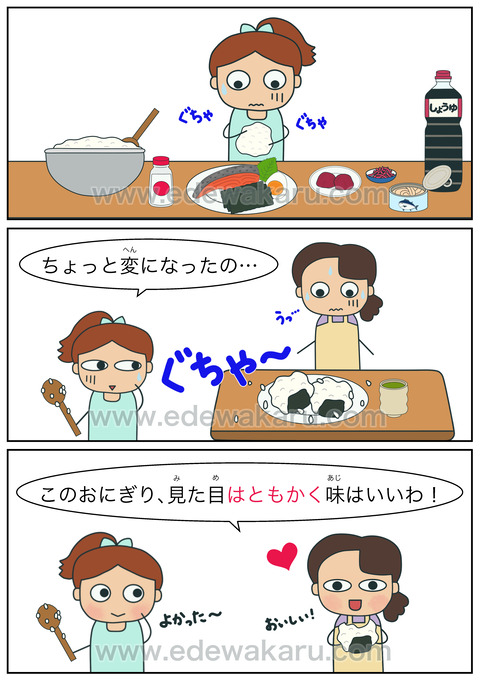
Meaning
Without considering ~
Without treating ~ as an issue
How to use it
Noun [dictionary form] + はともかく
Explanation
「AはともかくB」 is a sentence pattern meaning “set A aside for now and B” or “don’t make A an issue for now; B.” It is used when you want to say, “We don’t need to think about A now; B is more important,” or “A is not the issue now; B is what matters.” It can be changed to 「〜はともかくとして」.
[Example]
This rice ball, appearance
はともかく
it tastes good.
= This rice ball, appearance
はともかくとして
it tastes good.
[For those with time to spare]
「〜はともかく」 can also take the form 「question word + か + はともかく」.
[Examples]
A: Where should we hold the New Year’s party?
B:
Leaving aside where we’ll hold it, first we need to check how many people are coming.
A: What will you eat when you go on your trip?
B:
Leaving aside what we’ll eat, first we have to decide where to go…
Remember that 「AはともかくB」 is used when you want to emphasize B more than A 😀
In context 5 examples
このおにぎり、見た目はともかく味はいいわ
→見た目はよくないけど、おいしいわ【見た目】より【味】のほうが大切This rice ball may not look good, but it tastes good. →It doesn’t look good, but it’s tasty【taste matters more than appearance】
あそこのパンは、味はともかく安いからよく買う
→あまりおいしくないが、安いからよく買う【味】より【安いこと】のほうが大切The bread from that place may not taste great, but I often buy it because it’s cheap. →It’s not very tasty, but I often buy it because it’s cheap【being cheap matters more than taste】
A:N1に合格できなかったの…B:結果はともかく、がんばったことが大切なんだよ
→結果は残念だったけど、がんばったことが大切なんだよ【結果】より【がんばったこと】が大切A: I didn’t pass N1… B: Regardless of the result, the important thing is that you tried hard. →The result was disappointing, but the important thing is that you tried hard【trying hard matters more than the result】
A:納豆はくさいしまずいし嫌い〜B:においや味はともかく、栄養があるから食べたほうがいいよ!
→においと味はよくないが、栄養があるからいいよ【におい・味】より【栄養があること】を強調A: Natto smells bad and tastes bad, so I hate it~ B: Whatever the smell and taste, it’s nutritious, so you should eat it! →The smell and taste aren’t good, but it’s nutritious【emphasizes nutrition over smell and taste】
A:彼は大根役者(だいこんやくしゃ)だよね…B:うん。でも演技はともかく、すごくかっこいいよね〜
→演技は下手だけど、すごくかっこいい【演技】より【かっこいい】ということを強調A: He’s a terrible actor, isn’t he… B: Yeah. His acting aside, he’s really handsome~ →He’s bad at acting, but really handsome【emphasizes his good looks over his acting】
Read the original source text
Meaning
〜のことは考えないで
〜のことは問題にしないで
How to use it
名詞[辞書形]+はともかく
Explanation
「AはともかくB」は「Aのことは、今は考えないでB」「今はAのことを問題にしないでB」という意味を表す文型です。「今はAのことは考えなくていい。今はBの方が大切だ。」「今はAは問題ではない。大切なのはBだ」と言いたい時に使います。
「〜はともかくとして」
という形にチェンジすることができます。
[例]
このおにぎり、見た目
はともかく
味はいいわ
=このおにぎり、見た目
はともかくとして
味はいいわ
【余裕のある人へ】
「〜はともかく」は「疑問詞+か+はともかく」という形もあります。
[例]
A:新年会はどこでやろうか?
B:
どこでやるかはともかく、まず何人来るか確認しないといけないね
A:旅行に行ったら何を食べる?
B:
何を食べるかはともかく、まずどこに行くかを決めなきゃ…
「AはともかくB」は、「A」よりも「B」をもっと強調して言いたい場合に使われると覚えておきましょう😀
くらべてわかる日本語表現文型辞典
Meaning
Meaning 1: A is still acceptable, but B is too much to accept.
Meaning 2: I give up on A, but I want to somehow make at least B happen.
Meaning 3: Put A on hold; what matters is B.
How to use it
A はともかく B (A はともかくとして B / A ならともかく B)
Connection 1:
[Verb—dictionary form + の] はともかく
[i-adjective—い] + の + はともかく
[na-adjective—な/である/だった/ではない] + の + はともかく
Connection 2:
[Noun—∅] はともかく
Connection 3:
[Verb—dictionary form + negative form] はともかく
[Noun—∅] はともかく
Explanation
【Contrast 3】
「AはさておきB」 (Meaning 2, p. 281)
Notes
【Note 1】
・In 「AならともかくB」, 「なら」 is hypothetical: it means that A would be acceptable, but B is not. This form can only be used with Meaning 1.
In context 12 examples
ボーナスが遅れるのはともかく、出ないなんてあんまりだ。
It’s one thing for the bonus to be delayed, but not to get one at all is too much.
歌うのはともかくとして、踊るのは勘弁してくれ。
Forget singing; just spare me from having to dance.
手伝うのならともかく、邪魔をするなら出ていってくれ。
If you’re going to help, that’s one thing, but if you’re going to get in the way, get out.
焼いた魚ならともかく、生は食べられない。
I can eat grilled fish, but I can’t eat it raw.
外国語はともかく、自分の国の言葉ぐらいはきちんと話しなさい。
Forget foreign languages; at least speak the language of your own country properly.
漢字は、書くのはともかくとして、読めるようにしておきなさい。
When it comes to kanji, forget writing them; make sure you can read them.
優勝はともかく、Aクラス入りはなんとかしたい。
Winning the championship aside, I’d at least like us to make it into the A division.
入学を辞退したのだから、入学金はともかく、授業料は返してほしい。
Since I declined admission, I want the tuition refunded, even if they keep the admission fee.
私のことはともかく、君の方の仕事は順調かい?
Never mind me; how’s your work going?
試合内容はともかく、一勝したことに意義がある。
The quality of the match aside, winning once has significance.
受験するしないはともかく受験に必要な書類は準備しておきなさい。
Whether or not you’re going to take the entrance exam, get the documents you need for it ready.
宿泊先はともかくとして、旅行の行き先だけでも早く決めよう。
The place we’ll stay can wait; let’s at least decide on our destination soon.
Read the original source text
Meaning
意味1:Aはまだ許すことができるが、Bまでは許すことが出来ない。
意味2:Aはあきらめるが、Bだけでもなんとか実現したい。
意味3:Aについては保留しておいて、大切なのはBである。
How to use it
AはともかくB(AはともかくとしてB/AならともかくB)
接続1:
[動詞-る形+の]はともかく
[イ形-い]+の+はともかく
[ナ形-な/である/だった/ではない]+の+はともかく
接続2:
[名詞-∅]はともかく
接続3:
[動詞-る形+ない形]はともかく
[名詞-∅]はともかく
Explanation
【対比3】
「AはさておきB」(意味2 P.281)
Notes
【注意1】
・「AならともかくB」の「なら」は仮定でありAならば許してもいいがBは駄目だという意味になる。この形は意味1でしか使えない。
毎日のんびり日本語教師
How to use it
Noun + はともかく(として)
Verb plain form + かどうかはともかく(として)
い-adjective plain form + かどうかはともかく(として)
な-adjective plain form + かどうかはともかく(として)
Explanation
Indicates setting aside the content of the first clause and first addressing the latter clause.
It is the same as 「【N2 Grammar】~は別にして/は別として」.
Notes
Similar sentence pattern: 「【N1 Grammar】~はさておき/はさておいて」
In context 6 examples
結果はともかくとして、そこまでの道中が大変だった。
Regardless of the result, the journey getting there was difficult.
数学はともかく、算数は生きていく上で必要なものだ。
Setting mathematics aside, arithmetic is necessary for living.
彼の行動が悪いかどうかはともかく、結果的に良かったと思う。
Whether his actions were bad or not aside, I think things turned out well.
風はともかく、雨が嫌だ。
The wind aside, I hate the rain.
あの店は、味はともかくとにかく安い。
As for that shop, the taste aside, it’s cheap.
天気が不安定で、日中はともかく夜は寒くなりそう。
The weather is unstable, and while it may be fine during the day, it looks like it will get cold at night.
Read the original source text
How to use it
名詞+はともかく(として)
動詞普通形+かどうかはともかく(として)
い形容詞普通形+かどうかはともかく(として)
な形容詞普通形+かどうかはともかく(として)
Explanation
前項の内容については考えず、まず後項について触れることを表します。
「【N2文法】~は別にして/は別として」と同じです。
Notes
似ている文型「【N1文法】~はさておき/はさておいて」
NINJAL 日本語文型データベース
Meaning
This is used when you want to say that although something does need to be considered, other matters should take priority for now. It is a way of shifting the focus of the discussion to something else.
How to use it
N はともかく
Other
Notes
“~” can be an ordinary noun, a pair of words with opposite meanings such as “賛否・是非・有無・勝ち負け・良し悪し・大小・上手下手,” or forms such as “~かどうか・~か否か・[question word]+~か.”
After “~はともかく” comes a sentence explaining something to be emphasized more than “~”.
In context 9 examples
理由はともかく、原稿の締め切りには遅れないほうがいいよ。締め切りを守らないと仕事が来なくなるからね。
Whatever the reason, it’s better not to miss the manuscript deadline. If you don’t meet deadlines, you’ll stop getting work.
この小説は話としては平凡だが、ストーリーはともかく、登場人物が個性的で面白い。
This novel is ordinary as a story, but setting the plot aside, the characters are distinctive and interesting.
新人歌手のひとみさんは歌い方の技術はともかく、抜群の声量と声質なので、これからの成長が楽しみだ。
As for the singing technique of Hitomi, a new singer, that’s beside the point; her vocal power and tone are outstanding, so I’m looking forward to seeing how she develops.
現行の選挙制度にもいろいろ問題があるとは思う。しかし、それはともかく、今回の選挙の投票率の低さには失望した。
I think the current electoral system has various problems. But setting that aside, I was disappointed by the low turnout in this election.
母はよくハーモニカを吹いていた。上手下手はともかくハーモニカを楽しんでいた。
My mother often played the harmonica. Whether she was good at it or not, she enjoyed playing it.
いつ診察を受けるかはともかく、受診する病院を先に探そう。
Regardless of when we have the appointment, let’s first find a hospital to go to.
採用されるかどうかはともかく、働きたいとずっと思っていた会社なんだから、応募してみたらどうですか。
Regardless of whether you get hired, this is a company you’ve always wanted to work for, so why not apply?
電子レンジでもオムレツは作れます。味がいいか悪いかはともかく、簡単です。
You can make an omelet in a microwave, too. Whether it tastes good or bad, it’s easy.
業者の見積もりが適切か否かはともかく、屋根の修復は早急にやらないといけないなあ。
Whether the contractor’s estimate is appropriate or not, we need to repair the roof as soon as possible.
Read the original source text
Meaning
~も考えなければならないことではあるが、今は他の事柄を優先して考える、と言いたいときに使います。話のポイントを他の事柄に移す言い方です。
How to use it
Nはともかく
その他
Notes
「~」には、一般的な名詞のほかに、対立する意味の言葉の組み合わせの「賛否・是非・有無・勝ち負け・良し悪し・大小・上手下手」などの言葉や、「~かどうか・~か否か・[疑問詞]+~か」などの形がきます。
「~はともかく」の後には「~」より強調したい内容を説明する文がきます。