絵でわかる日本語
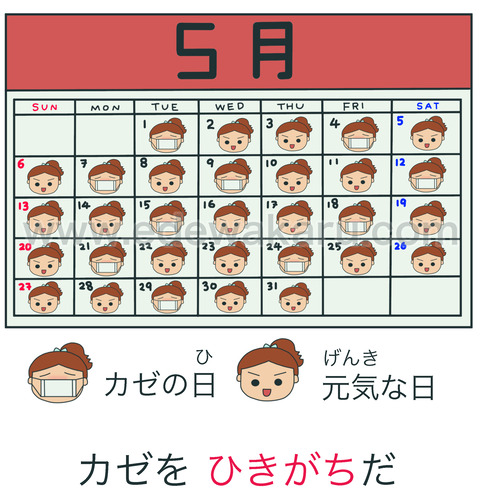
Meaning
Often does 〜 /
Tends to do 〜
Easily gets into the state of 〜
How to use it
Verb [ます-form] + がちだ
Verb [ます-form] + がちの + noun
Explanation
“〜がち” is a sentence pattern that means “often does 〜.” It is used when you want to say that something happens frequently, and it is used for negative things. For positive things, use “よく〜する” 😀
[Example]
❌He often gets 100 points.
⭕️He often gets 100 points.
“〜がち” is also commonly used in conversation, so be sure to memorize it 😄 If you remember “がち = tendency,” you may confuse it with “〜ぽい,” so it’s better to remember that “〜がち” is used for things that happen frequently 😊
In context 5 examples
最近カゼをひきがちだ
→最近よくカゼをひく/カゼをひく回数が多いRecently, I tend to catch colds often. →Recently, I catch colds often / I catch colds frequently.
お正月は運動不足になりがちだ
→運動不足になりやすいPeople tend to get too little exercise over New Year’s. →It is easy to get too little exercise over New Year’s.
A:ここのところ、山田くんは学校を休みがちだねB:うん。どうしたのかな…
→よく学校を休むA: Lately, Yamada-kun has been missing school often. B: Yeah. I wonder what’s wrong… →He often misses school.
先生:最近、遅刻しがちですよ。気をつけてください学生:すみません
→最近、よく遅刻をしますねTeacher: You’ve been late a lot recently. Please be careful. Student: I’m sorry. →You’ve been late often recently.
多くの学生は「〜がち」と「〜っぽい」を混乱しがちだ
→多くの学生は「〜がち」と「〜っぽい」を混乱する傾向があるMany students tend to confuse “〜がち” and “〜っぽい.” →Many students tend to confuse “〜がち” and “〜っぽい.”
Read the original source text
Meaning
よく〜する
/
〜する傾向がある
〜の状態になりやすい
How to use it
動詞[ます形]+がちだ
動詞[ます形]+がちの+名詞
Explanation
「〜がち」は「よく〜する」という意味を表す文型です。「回数が多い」と言いたい時に使われ、マイナスのことに使用されます。いいことには「よく〜する」を使うようにしましょう😀
[例]
❌彼は100点を取り
がちだ
⭕️彼は
よく1
00点を取る
「〜がち」は、会話でもよく使う文法ですからしっかり覚えましょう😄
「がち=傾向」と覚えてしまうと「〜ぽい」と混乱しますので「〜がち」は「回数が多い」ことに使う
と覚えるといいですね😊
くらべてわかる日本語表現文型辞典
Meaning
Meaning 1: When a certain condition occurs, situation or state A is generally likely to follow. A is often an undesirable situation.
Meaning 2: A negative state A occurs with high frequency or is a strong tendency.
Meaning 3: In the form 「A がちに B」, B is done in a manner resembling A.
How to use it
A がちだ (A がちに B / A がちの B)
[verb ます-form] がち
[noun with no particle] がち
Explanation
[Contrast 2]
「A ぎみだ」 (Meaning 1, p. 72)
「A っぽい」 (Meaning 1, p. 138)
「A きらいがある」 (Meaning 1, p. 75)
Notes
[Note 1]
・It is often used in the form 「とかく~がちだ」.
In context 12 examples
人間、ほめられると、とかくうぬぼれがちだ。
People tend to get conceited when they are praised.
雨の日が続くと、家にこもりがちだが、健康にはよくない。
When rainy days continue, I tend to stay cooped up at home, but that is not good for my health.
他人の噂話はついうっかりとしゃべりがちだ。
People tend to blurt out gossip about others without thinking.
誰でも、自分の失敗は棚にあげて、人のせいにしがちだ。
Everyone tends to blame others while conveniently overlooking their own mistakes.
来週1週間は曇りがちの天気が続くでしょう。
Cloudy weather is expected to continue for the coming week.
一応時刻は合わせたけど、この時計は遅れがちなので気をつけてね。
I’ve set the time for now, but this clock tends to run slow, so be careful.
この地方は夏になると水が不足しがちのため、住民の節水意識が高い。
This region tends to have water shortages in summer, so residents are very conscious of conserving water.
彼女は子どものころから病気がちだから、激しい運動は無理だ。
She has been prone to illness since childhood, so strenuous exercise is out of the question.
彼女は振り向くと、恥じらいがちにほほえんだ。
When she turned around, she smiled shyly.
伏し目がちに話すところが、お姉さんそっくりだ。
The way she speaks with her eyes lowered is exactly like her older sister.
彼女はためらいがちに返事をした。
She replied hesitantly.
彼は遠慮がちに金を貸してくれといった。
He somewhat reluctantly asked me to lend him money.
Read the original source text
Meaning
意味1:ある状態になるとAという事態・状態になるのが一般的だ。Aはマイナスの事態になることが多い。
意味2:マイナスの状態Aになる傾向や頻度が高い。
意味3:「AがちにB」の形で。AのようなようすでBをする。
How to use it
Aがちだ(AがちにB/AがちのB)
[動詞-ます形]がち
[名詞-∅]がち
Explanation
【対比2】
「Aぎみだ」(意味1 P.72)
「Aっぽい」(意味1 P.138)
「Aきらいがある」(意味1 P.75)
Notes
【注意1】
・「とかく〜がちだ」の形で使われることが多い。
NINJAL 日本語文型データベース
Meaning
Expresses a tendency to do 〜 frequently, to enter a state of 〜, or to have a strong tendency toward 〜.
How to use it
Notes
“〜” is often a word with an unusual or negative meaning.
It is treated as a noun or na-adjective and used in forms such as “〜がちだった・〜がちで・〜がちに・〜がちな・〜がちの.”
In context 11 examples
年度末のこの時期、報告書の提出が遅くなりがちです。期限を守ってください。
At this time of year, at the end of the fiscal year, reports tend to be submitted late. Please meet the deadline.
父はこの冬寝込みがちだったが、最近は元気だ。
My father tended to be bedridden this winter, but he’s been well lately.
ハイキングに行くグループがハイテンションになって盛り上がる。ありがちな光景だ。
Groups going hiking get excited and worked up. It’s a common sight.
週の前半は曇りがちの日が続くでしょう。
Cloudy days are likely to continue through the first half of the week.
雨の日が続くと、とかく気分もふさぎがちになる。こんなときはどうやって気分転換をすればいいだろうか。
When rainy days continue, I tend to feel down. How can I lift my spirits at times like this?
忘年会が続くと、つい酒を飲みすぎてしまいがちだ。気をつけなければ……。
When year-end parties keep coming, I tend to end up drinking too much. I have to be careful…
あの人は見た目から怖い印象を持たれがちだが、本当はとても優しい人だ。
That person is often thought to seem scary based on their appearance, but they’re actually very kind.
私は子どものころ病気がちだったから、母は苦労したと思う。
I was often ill as a child, so I think it was hard for my mother.
リーさんは前はよくこの勉強会に来ていたのに、このごろ欠席がちですね。どうしたのでしょう。
Mr. Lee used to come to this study group often, but lately you’ve been absent quite a bit. I wonder what happened.
講習会の最後の質疑応答の時間に、遠慮がちに手を挙げた人の質問がとてもよかった。
During the question-and-answer session at the end of the seminar, the question from someone who raised their hand hesitantly was very good.
外食中心の食事ではとかく野菜が不足がちになります。野菜を食べる方法を上手に工夫しましょう。
When you mostly eat out, you tend to be short on vegetables. Let’s come up with good ways to eat them.
Read the original source text
Meaning
頻繁に~する傾向があることや、~の状態になること、~の傾向が強いことを表します。
How to use it
Notes
「~」には、普通でない、よくない意味を表す言葉を使うことが多いです。
名詞またはナ形容詞として扱い、「~がちだった・~がちで・~がちに・~がちな・~がちの」のような形で使います。