DoJG 日本語文法辞典(全集)
Meaning
Not limited to ~ (but also); not only ~ (but also)
How to use it
Noun | に限らず | |
| 日本語に限らず | Not limited to Japanese |
Explanation
Not limiting something to ~.
In context 5 examples
見合い結婚は日本に限らずほかの国でも行われている。
Arranged marriage is not limited to Japan; it is practiced in other countries, too.
音楽はクラシックに限らず何でも聞きます。
Talking about music, I listen to any music, not just classical music.
このバーは男性だけに限らず女性の間にも人気がある。
This bar is popular not only among men but also among women.
果物は何に限らず好きです。
My preference for fruit is unlimited (literally: not limited to something); I like any kind.
何事に限らず仕事は誠意をもって行うことが大切だ。
Whatever you do (literally: Not limited to anything), it is important to do it with sincerity.
どんなときどう使う 日本語表現文型辞典
Meaning
not limited to
How to use it
N + に限らず
Explanation
~だけでなく
「~だけでなく、~が属するグループの中の全部に当てはまる」と言いたいときに使う。
Means "not only N," or or something pertains to everything in a certain group.
In context 3 examples
日曜日に限らず、休みの日はいつでも、家族と運動をしに出かけます。
Not just on Sundays, but on any day off, I go out to exercise with my family.
男性に限らず女性も、新しい職業分野の可能性を広げようとしている。
Women, as well as men, are trying to expand the possibilities in new fields of work.
この家に限らず、この辺りの家はみんな庭の手入れがいい。
Not just this house; all the houses in this area have well-kept gardens.
Read the original source text
Meaning
not limited to
How to use it
N+に限らず
Explanation
~だけでなく
「~だけでなく、~が属するグループの中の全部に当てはまる」と言いたいときに使う。
Means "not only N," or or something pertains to everything in a certain group.
絵でわかる日本語
Meaning
Not only 〜 (but … too)
How to use it
Noun + に限らず (…も)
Explanation
“限る” has the meaning of limitation. “〜に限らず・・・も” means “not only 〜, but other things too,” or “not limited to 〜; … too.” There are many sentence patterns formed with “限る,” so those taking N2 or N3 should be sure to distinguish and memorize them 😊
[The “限る” series]
〜限り (limit)
〜限り
〜限りだ
〜限りで・N限りのN (limitation)
〜限りでは (scope)
限りなく〜に近い
〜とは限らない
〜ない限り
〜に限ったことではない
〜に限らず (〜も)
〜に限る
〜を限りに
In context 3 examples
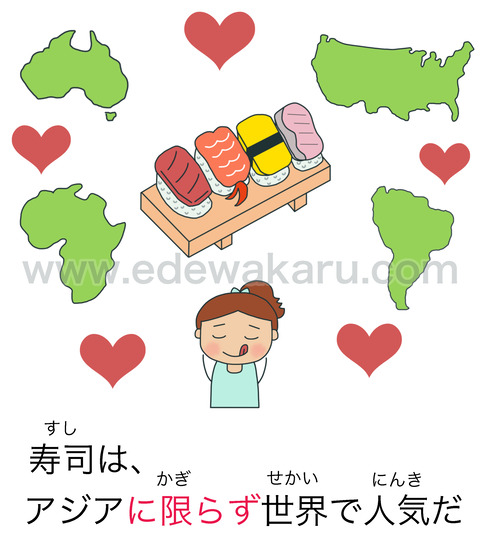
寿司は、アジアに限らず世界で人気だ
→寿司は、アジアだけでなく世界で人気だSushi is popular around the world, not just in Asia. →Sushi is popular around the world, not just in Asia.
あのアイドルは、若者に限らずお年寄りにも知られている
→あのアイドルは若者だけでなく、お年寄りにも知られているThat idol is known not only among young people, but also among the elderly. →That idol is known not only among young people, but also among the elderly.
このアニメは、男性に限らず女性にも人気がある
→このアニメは男性だけでなく、女性にも人気があるThis anime is popular not only with men, but with women too. →This anime is popular not only with men, but with women too.
Read the original source text
Meaning
〜だけでなく(・・・も)
How to use it
名詞+に限らず(・・・も)
Explanation
「限る」には
限定
の意味があります。「〜に限らず・・・も」は「〜だけではなく他にもある」という意味で、「
〜に限定しないで・・・も」という意味です。「限る」が作る文型もたくさんありますのでN2・N3を受ける方はしっかり区別して覚えましょう😊
【「限る」シリーズ】
〜限り(限界)
〜限り
〜限りだ
〜限りで・N限りのN(限定)
〜限りでは(範囲)
限りなく〜に近い
〜とは限らない
〜ない限り
〜に限ったことではない
〜に限らず(〜も)
〜に限る
〜を限りに
くらべてわかる日本語表現文型辞典
Meaning
In response to the listener’s belief that A is C, a broader range B is also C.
How to use it
A ni kagirazu B (mo C)
[Noun - ∅] ni kagirazu
Explanation
【Contrast 1】
“A dake de naku B”
In “A ni kagirazu B (mo C),” B means everyone, whereas “A dake de naku B” simply means both A and B.
○試験は筆記だけでなく面接もある。 — The exam includes not only a written test but also an interview.
×試験は筆記に限らず、面接もある。 — The exam includes not only a written test but also an interview.
“A nomi narazu B” (Meaning 1, p. 270)
“A ni kagitta koto dewa nai” (Meaning 1, p. 220)
In context 4 examples
最近では、男性に限らず女性も危険な仕事に従事するようになった。
Recently, women, as well as men, have come to work in dangerous jobs.
イタリア料理に限らずヨーロッパ料理はオリーブオイルをよく使う。
Not only Italian food but European cuisine in general uses a lot of olive oil.
エコノミー症候群は飛行機を利用したときに限らず起こる。
Economy-class syndrome can occur even when you have not traveled by plane.
最近のゲームは子どもに限らず、大人も夢中にさせるものが多い。
Many recent games captivate adults as well as children.
Read the original source text
Meaning
聞き手が持っているAはCだという考えに対し、より広い範囲のBもC。
How to use it
Aに限らずB(もC)
[名詞-∅]に限らず
Explanation
【対比1】
「AだけでなくB」
「Aに限らずB(もC)」のBは、みんなという意味だが、「AだけでなくB」は単にAもBもという意味。
○試験は筆記だけでなく面接もある。
×試験は筆記に限らず、面接もある。
「AのみならずB」(意味1 P.270)
「Aに限ったことではない」(意味1 P.220)
NINJAL 日本語文型データベース
Meaning
Used when you want to say that a matter does not remain within the scope of ~, but also includes a broader range.
How to use it
N, not limited to ~
Notes
Words expressing matters mentioned in the context or matters that are easy to anticipate come in the ~ position. After “~に限らず,” come words expressing a broader range than ~, or words expressing another matter that is less predictable than ~.
The particle “も” is often added to words expressing another matter. It is not added to words expressing a broader range.
In context 5 examples
最近では若い男性に限らず幅広い年代の男女が格闘技を習っている。
These days, people of a wide range of ages, both men and women, are learning martial arts, not just young men.
うちの母は掃除や洗濯に限らず全ての家事を手際よくこなす。
My mother is efficient at all household chores, not just cleaning and laundry.
斉藤さんは猫に限らず動物なら何でも好きらしい。
Saito seems to like all animals, not just cats.
このゲームは若者に限らずいろいろな世代の人たちが夢中になっている。
People of many generations, not just young people, are absorbed in this game.
この薬を飲んでいる人は、グレープフルーツを摂取してはいけません。果実に限らず、ジュースやゼリーなどの加工品も同じです。
People taking this medicine must not consume grapefruit. This applies not only to the fruit itself, but also to processed products such as juice and jelly.
Read the original source text
Meaning
ある事柄が~という範囲に収まらないで、さらに広い範囲まで含むと言いたいときに使います。
How to use it
Nに限らず
Notes
「~」には、文脈にある事柄や予想しやすい事柄を表す言葉がきます。「~に限らず」の後には、「~」より広い範囲を表す言葉や「〜」より予想しにくい別の事柄を表す言葉がきます。
別の事柄を表す言葉には「も」をつけることが多いです。より広い範囲を表す言葉にはつけません。