くらべてわかる日本語表現文型辞典
Meaning
The present situation is A. The situation is A based on what things are like now.
How to use it
A ところだ
[Verb — passive] ところだ
In context 4 examples
この事件が世間に与える影響が心配されるところだ。
There is concern about the impact this incident will have on the public.
15歳で優勝した彼には今後の活躍が期待されるところだ。
Having won at the age of 15, he is expected to achieve great things in the future.
欧米での状況からみると、日本でもほぼ同様の事態が起こるだろうと予想されるところだ。
Judging from the situation in Europe and America, it is expected that much the same thing will happen in Japan as well.
料理店の評価は客の好みや年代によって大きく左右されるところだ。
Restaurant ratings are greatly affected by customers’ tastes and age groups.
Read the original source text
Meaning
今の状況がAだ。今の状況からAだ。
How to use it
Aところだ
[動詞-受身]ところだ
DoJG 日本語文法辞典(全集)
Usage 1
Meaning
~ is (in) a place where it takes ~ to get to
Explanation
ところだ (1) A place is in a location which takes a certain amount of time to get to.
In context 3 examples
私のうちは駅から歩いて十分のところだ・です。
My house is in a place where it takes ten minutes to get to from the station on foot. / On foot my house is ten minutes from the station.
学校はうちからバスで三十分のところです。
My school is in a place where it takes thirty minutes to get to from home by bus. / By bus it takes thirty minutes to get from home to school.
その病院はここから車で十五分のところだ。
The hospital is in a place where it takes fifteen minutes to get to from here by car. / By car the hospital is fifteen minutes from here.
Usage 2
Meaning
Be just about to do something; be in the midst of doing something; have just done something; have been doing something; almost did something
Explanation
ところだ (2) Someone/something is in the state where he/it is just about to do something, is doing something, has done something, or has been doing something.
In context 15 examples
春江は晩ご飯を食べるところだ・です。
Harue is just about to eat her supper.
春江は晩ご飯を食べているところだ・です。
Harue is in the midst of eating her supper.
春江は晩ご飯を食べたところだ・です。
Harue has just eaten her supper.
春江は晩ご飯を食べていたところだ・です。
Harue has been eating her supper.
私はもう少しで宿題を忘れるところだった・でした。
I almost forgot (was about to forget) my homework.
私は危ないところをジーンに助けてもらった・もらいました。
I was saved by Gene was I was in a crisis (literally: dangerous state).
お仕事中のところをすみません。
I'm sorry to bother you in the midst of your work.
僕は今出かけるところです。
I'm just about to go out now.
テリーと踊っているところをマーサに見られてしまった。
The state in which I was dancing with Terry was seen by Martha. / Martha saw me when I was dancing with Terry.
ご飯を食べ終わったところにまり子が訪ねて来た。
Mariko came (to see me) at the state in which I had just finished my meal. / Mariko came to see me when I’d just finished my meal.
三章まで読んだところで寝てしまった。
I fell asleep when I had read up to the third chapter (literally: in the state in which I had read it up to the third chapter).
私は危なく溺れるところだった。
I was almost drowned.
お忙しいところをどうもありがとうございました。
Thank you very much (for helping me) in the state when you are busy. / Thank you very much for sparing your precious time with me.
利男は一番大事なところでよく勉強しなかったから何も分からなくなってしまった。
Toshio has come to the point of not understanding anything because he didn’t study well in the state where (the class) was the most important. / Toshio has gotten totally lost because he didn’t study hard when it was most important.
お休みのところをすみません。
I’m sorry (to disturb) the state in which you are off duty. / I’m sorry to bother you when you are off duty/on vacation.
日本語文型辞典
Meaning
Used with verbs to report what stage an event or situation has reached. 「ところだった」 indicates that it was at such a stage in the past. 「ところだ」 itself does not readily take a negative or interrogative form. The verb preceding it is also ordinarily not used in the negative form.
a. V-たところだ
Indicates that an action or change is at the stage immediately after it occurred. Often used with adverbs indicating a very recent time, such as 「今、さっき、ちょっと前」.
b. V-ているところだ
Indicates that an action is in progress.
c. V-ていたところだ
Indicates that a state had continued from some earlier time up to the time stated in the sentence. Often used to describe a thought or psychological state, particularly when a new change or development occurs in that situation.
d. V-るところだ
Indicates that an action or change is at the stage immediately before it occurs. Adverbs such as 「ちょうど、今、これから」 may also be used.
Expresses a counterfactual situation meaning “if circumstances had been different, this is what would have happened.” It is often preceded by a conditional clause such as 「たら/なら/ば」.
a. …たらVところだ
A verb in dictionary or past form follows a conditional clause such as 「…ば」 or 「…たら」. The expression imagines a situation that would have come about if such circumstances had occurred, although reality is different. In example ①, it means “in the past, a person would have been executed,” but that does not happen in modern society.
b. …ところだった
Means that an event that would have happened under different circumstances was avoided just before it occurred. Often preceded by a conditional clause such as 「…ば」 or 「…たら」. To emphasize that it nearly happened, say 「もうすこしで…ところだった」, for example.
c. …なら(ば)…ところ だが/を
Used with expressions such as 「普通/通常/本来ならば」 to mean that ordinarily things would be this way, but the current situation is an exception.
How to use it
Vところだ【stage of a situation】
Vところだ【counterfactual】
V-るところだった
V-ていたところだった
In context 23 examples
今帰ってきたところです。
I just got home.
海外勤務を終え、先月帰国したところです。
I finished my overseas assignment and returned to Japan last month.
電話したら、あいにくちょっと前に出かけたところだった。
When I called, unfortunately, they'd just gone out a little while before.
A:もしもし、和雄君いますか。
B:今お風呂に入っているところなんです。A: Hello, is Kazuo there? B: He's taking a bath right now.
ただ今電話番号を調べているところですので、もう少々お待ちください。
We're looking up the phone number right now, so please wait just a little longer.
ふすまを開けると、妻は着物を片付けているところだった。
When I opened the sliding door, my wife was putting away her kimono.
いい時に電話をくれました。私もちょうどあなたに電話しようと思っていたところなんです。
You called at a good time. I was just thinking of calling you, too.
思いがけなくも留学のチャンスが舞い込んできた。そのころ私は、将来の進路が決められずいろいろ思い悩んでいたところだった。
Unexpectedly, an opportunity to study abroad came along. At the time, I was worrying about various things because I couldn't decide on my future path.
これから家を出るところですから、30分ほどしたら着くと思います。
I'm just about to leave home, so I think I'll arrive in about 30 minutes.
飛行機は今飛び立つところだ。
The plane is just about to take off.
A:ご飯もう食べた?
B:ううん、これから食べるところ。A: Have you eaten yet? B: No, I'm just about to eat.
家に戻って来ると、妻は買い物に出掛けるところだった。
When I got back home, my wife was just about to go shopping.
昔だったらそんな過激な発言をする人間は、処刑されているところだ。
In the old days, a person who made such an extreme statement would have been executed.
父がそのことを知ったら激怒するところだ。
If my father found out about that, he'd be furious.
先生がお元気だったら、今日のような日には一緒に中華料理でも食べているところでしょう。
If our teacher were well, on a day like today we would probably be eating Chinese food together.
知らせていただかなければ、とっくにあきらめていたところです。
If you hadn't let me know, I would have given up long ago.
もし気がつくのが遅かったら、大惨事になるところだった。
If we had been any later to notice, it would have turned into a major disaster.
あっ、あなたに大事な話があるのを思い出しました。うっかり忘れるところでした。
Oh, I just remembered I have something important to tell you. I almost forgot.
ありがとうございます。注意していただかなければ忘れていたところでした。
Thank you. If you hadn't reminded me, I would have forgotten.
普通ならただではすまないところだが、今回だけは見逃してやろう。
Normally, this wouldn't go unpunished, but I'll let it go just this once.
本来ならば直接お伺いすべきところですが、書面にて失礼致します。
Under normal circumstances, I should visit you in person, but please excuse this letter.
通常は定価どおりのところを、お得意さんに限り特別に1万円引きになっております。
It is normally sold at the list price, but valued customers receive a special 10,000-yen discount.
いつもなら1時間で行けるところを、今日は交通事故があって3時間もかかった。
It normally takes an hour to get there, but today there was a traffic accident and it took as long as three hours.
Read the original source text
Meaning
動詞に付いて場面・状況や出来事がどのような進展の段階にあるかを報告するような場合に用いる。「ところだった」の場合は、過去においてそのような段階にあったということを表す。「ところだ」自体は否定形や疑問形にはなりにくい。また、前に付く動詞には否定形が使われないのが普通。
a. V-たところだ
動作・変化がその「直後」の段階にあることを表す。「今、さっき、ちょっと前」などの、直前の時を表す副詞と共に用いられることが多い。
b. V-ているところだ
動作がその「最中」の段階にあることを表す。
c. V-ていたところだ
以前から文の表す時点に至るまでそのような状態が続いていたということを表す。思考や心理状態を説明するような場合が多く、その状況に新たな変化・展開が起きたような場合によく用いられる。
d. V-るところだ
動作や変化がその「直前」の段階にあることを表す。「ちょうど、今、これから」などの副詞が用いられることもある。
「もし場合が違っていればこうであるはずだ」という事実に反することがらを表す。前に「たら/なら/ば」などの条件節を伴うことが多い。
a. …たらVところだ
「…ば」「…たら」などの条件節を伴い動詞の辞書形、タ形を受け、事実はこれとは異なるが、もしそのような場合だったら成立したはずの状況を想像して述べる表現。①の例で言えば「昔だったら処刑されているはずだ」が現代の社会ではそのようなことはないという意味を表す。
b. …ところだった
事情が異なれば起こっていたはずの出来事がその直前のところで避けられたという意味を表す。「…ば」「…たら」などの条件節を伴うことが多い。直前まできていたという意味を強めるときは「もうすこしで…ところだった」のように言う。
c. …なら(ば)…ところ だが/を
「普通/通常/本来ならば」などの表現を伴い、普通はこうなのだが、現状がそれとは異なり特別だという意味を表す。
How to use it
Vところだ【事態の局面】
Vところだ【反事実】
V-るところだった
V-ていたところだった
絵でわかる日本語
Usage 1
Read this source entry ↗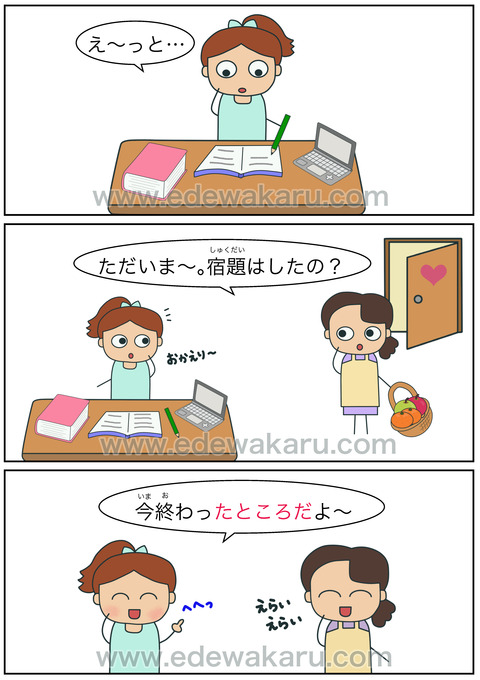
Meaning
Immediately after doing ~
Just finished doing ~
How to use it
Verb [た-form]+ところだ
Explanation
「〜たところだ」is a grammar pattern meaning “just finished doing ~” or “immediately after doing ~.” It emphasizes “right after doing something” and describes the state or situation just after an action or change has ended.
[Examples]
① Mother: Have you done your homework?
Daughter: I just finished it.
→ The state immediately after the homework was finished.
② I just woke up.
→ The state immediately after waking up.
③ I ate a little while ago.
→ Right after finishing a meal.
④ A: Where are you now?
B: Sorry! I just left home…
→ Immediately after leaving home.
⑤ I just got back.
→ The situation immediately after getting back.
It may help to learn expressions often used with 「〜たところだ」😊
[Expressions often used with 「〜たところだ」]
・今 (just now)
+〜たところだ
・さっき (a little while ago)
+〜たところだ
・ちょっと前に (a short while ago)
+〜たところだ
・たった今 (just now)
+〜たところだ
A similar grammar pattern is 「〜たばかりだ」. There is a difference in usage, so review it 😉
[Related grammar patterns]
In context 5 examples
母:宿題はしたの?娘:今終わったところだよ
Mother: Have you done your homework? Daughter: I just finished it.
さっき起きたところだ
I just woke up.
ちょっと前にごはんを食べたところだ
I ate a little while ago.
A:今どこ?B:ごめん!今家を出たところなの…
A: Where are you now? B: Sorry! I just left home…
たった今帰ってきたところだ
I just got back.
Read the original source text
Meaning
〜した直後
〜するのが、今終わった
How to use it
動詞[た形]+ところだ
Explanation
「〜たところだ」は「〜するのが、今終わった」「〜した直後」という意味を表す文型です。これは、
「〜したすぐ後」
というのを強調する文型で、動作や変化が終わったすぐ後の状態や場面を表します。
[例]
①母:宿題はしたの?
娘:今終わっ
たところだ
よ
→宿題が
終わったすぐ後
の状態
②さっき起き
たところだ
→起きた
直後
の状態
③ちょっと前にごはんを食べ
たところだ
→ごはんを食べ
終わったすぐ後
④A:今どこ?
B:ごめん!今家を出
たところ
なの…
→家を出た
直後
⑤たった今帰ってき
たところだ
→帰ってきた
直後
の場面
「〜たところだ」とよく一緒に使われる表現を覚えておくといいと思います😊
[「〜たところだ」とよく一緒に使う表現]
・
今
+〜たところだ
・
さっき
+〜たところだ
・
ちょっと前に
+〜たところだ
・
たった今
+〜たところだ
「〜たところだ」に似ている文型に
「〜たばかりだ」
があります。用法に違いがありますので、復習しておきましょう😉
【関連文型】
Usage 2
Read this source entry ↗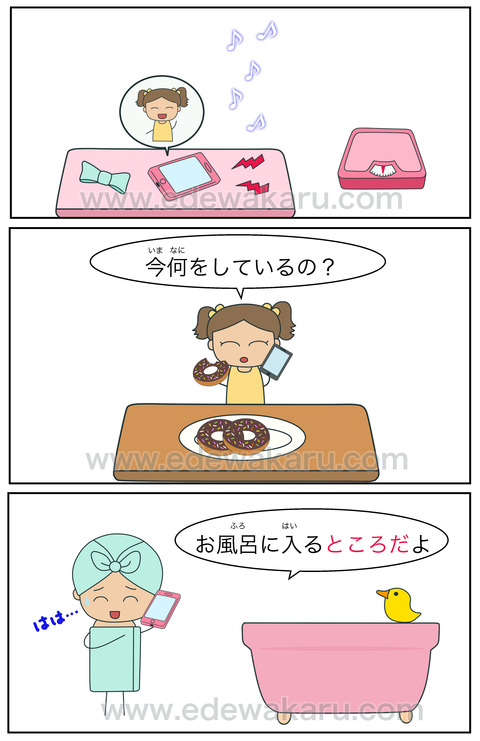
Meaning
Just before doing ~
About to do ~ now
How to use it
Verb [dictionary form]+ところだ
Explanation
「Verb dictionary form+ところだ」means “about to do ~” and is a grammar pattern that expresses the moment just before doing something. Since 「Verb dictionary form+ところだ」emphasizes the moment immediately before an action, the meaning is the same even without 「ところ」. It is used when you want to emphasize “right now, just before doing ~” 😅
[Examples]
A: What are you doing now?
B: I’m just about to get in the bath~
→ Just before getting in the bath.
A: Have you eaten yet?
B: I’m just about to go eat.
→ Just before going to eat.
A: Have you bought the new game yet?
B: I’m just about to go buy it~
→ Just before going to buy the new game.
Mother: Go to bed now.
Daughter: I’m just about to go to bed!
→ Just before getting into bed.
Mother: What time are you going out today?
Daughter: I’m just about to go out.
→ Just before going out.
Be careful: 「〜ところだ」expressing a moment just before an action cannot be used with [non-volitional verbs] 😨
[Example]
❌ It is just about to rain.
⭕️ It looks like it’s going to rain.
(Review: 〜そうだ (possibility))
There are many grammar patterns with 「〜ところ」, so remember this as one of the “ところ series” 😀
In context 5 examples
A:今何をしているの?B:お風呂に入るところだよ〜(復習:〜ている(進行中))
A: What are you doing now? B: I’m just about to get in the bath~ (Review: 〜ている (in progress))
A:もうごはん食べた?B:今から食べに行くところだよA:じゃあ、一緒に行こう〜
A: Have you eaten yet? B: I’m just about to go eat. A: Then let’s go together~
A:新しいゲームはもう買った?B:今から買いに行くところだよ〜
A: Have you bought the new game yet? B: I’m just about to go buy it~
母:早く寝なさい娘:今から寝るところ!
Mother: Go to bed now. Daughter: I’m just about to go to bed!
母:今日は何時に出かけるの?娘:今出かけるところだよ
Mother: What time are you going out today? Daughter: I’m just about to go out.
Read the original source text
Meaning
〜する直前
今から〜する
How to use it
動詞[辞書形]+ところだ
Explanation
「V辞書形+ところだ」は「今から〜する」という意味で、何かをする直前を表す文型です。「V辞書形+ところだ」は
動作の直前を強調する文型ですので、「ところ」がなくても意味は同じです
😅「今、ちょうど〜する直前」というのを強調したい場合に使われます。
[例]
A:今何をしているの?
B:お風呂に入る
ところだ
よ〜
→お風呂に入る
直前
A:もうごはん食べた?
B:今から食べに行く
ところだ
よ
→ごはんを食べに行く
直前
A:新しいゲームはもう買った?
B:今から買いに行く
ところだ
よ〜
→新しいゲームを買いに行く
直前
母:早く寝なさい
娘:今から寝る
ところ!
→ベッドに入る
直前
母:今日は何時に出かけるの?
娘:今出かける
ところだ
よ
→出かける
直前
直前を表す「〜ところだ」は、【無意志動詞】には使うことができませんので注意しましょう😨
[例]
❌雨が降る
ところだ
⭕️雨が降り
そうだ
(復習:〜そうだ(可能性))
「〜ところ」がつく文型はたくさんありますので「ところシリーズ」の1つとして覚えておきましょう😀
Usage 3
Read this source entry ↗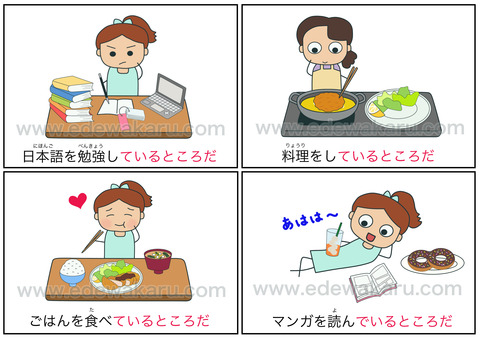
Meaning
Doing ~ now
In the middle of doing ~
How to use it
Verb [ている-form]+ところだ
Explanation
「Verb ている+ところだ」is a grammar pattern meaning “doing ~ now.” It expresses that an action is taking place now.
It means the same as 「〜ている」expressing an action in progress, so the meaning does not change even without 「ところ」. Remember that 「〜ているところだ」is used to emphasize that an action is in progress 😅
(Review: 〜ている (in progress))
[Examples]
I’m studying Japanese.
→
Now
The action of “studying Japanese” is taking place.
I’m eating a meal.
→
Now
The action of “eating a meal” is taking place.
The meaning of 「〜ところだ」changes depending on which verb form it is used with, so learn to distinguish them.
In context 5 examples
日本語を勉強しているところだ
→今日本語を勉強しているI’m studying Japanese right now. → I’m studying Japanese right now.
料理をしているところだ
→今料理をしているI’m cooking right now. → I’m cooking right now.
ごはんを食べているところだ
→今ごはんを食べているI’m eating right now. → I’m eating right now.
マンガを読んでいるところだ
→今マンガを読んでいるI’m reading manga right now. → I’m reading manga right now.
A:今何をしているの?B:ゲームをしているところだよ〜
→今ゲームをしているA: What are you doing now? B: I’m playing a game right now~ → I’m playing a game right now.
Read the original source text
Meaning
今〜ている
今〜ている最中
How to use it
動詞[ている形]+ところだ
Explanation
「Vている+ところだ」は「今〜している」という意味の文型です。この文型は、今動作が行なわれていることを表します。
進行中動作(しんこうちゅうどうさ)を表す「〜ている」と同じ意味ですので「ところ」がなくても意味が変わりません
😅「〜ているところだ」は動作が進行中だというのを強調したい時に使うと覚えておきましょう。
(復習:〜ている(進行中))
[例]
日本語を勉強し
ているところだ
→
今
「日本語を勉強する」という
動作が行なわれている
ごはんを食べ
ているところだ
→
今
「ごはんを食べる」という
動作が行なわれている
「〜ところだ」は動詞の何形に使うかで意味が変わりますので、区別して覚えておきましょう。
日本語NET JLPT文法解説まとめ
Meaning
① Indicates that an action is about to begin. About to do ~.
② Indicates that an action is happening right now.
③ Indicates that an action has just finished. Just did ~.
How to use it
① V (dictionary form) + ところだ.
② V (て-form) いる + ところだ.
③ V (た-form) + ところだ.
Explanation
① Indicates just before an action starts. About to ~.
② Indicates that an action is currently in progress. In the middle of ~.
③ Indicates just after an action has finished. Just ~.
In context 15 examples
今から、電車に乗るところです。
I'm just about to get on the train.
これから飛行機に乗るところなので、着いたら連絡します。
I'm just about to board the plane, so I'll contact you when I arrive.
今から、ご飯を食べるところです。
I'm just about to eat.
今から、会社を出るところだよ。
I'm just about to leave the office.
A:もう映画始まった?
A: Has the movie started yet?
今、電車に乗っているところだから、後で電話するね。
I'm on the train right now, so I'll call you later.
今、宿題をしているところだから、後で遊ぼう。
I'm doing my homework right now, so let's play later.
今、エラーの原因を調べているところなので、もう少し待ってください。
I'm looking into the cause of the error right now, so please wait a little longer.
今、晩ご飯の準備をしているところだから、もう少し待ってね。
I'm getting dinner ready right now, so please wait a little longer.
A:今から遊びに行ってもいい?
A: Is it okay if I come over to hang out now?
今、電車を降りたところなので、あと10分ぐらいで着きます。
I've just gotten off the train, so I'll arrive in about ten minutes.
ちょうど今、宿題が終わったところなので、一緒に遊べますよ。
I just finished my homework, so I can hang out with you.
ちょうど今、ご飯を食べ終わったところで、お腹いっぱいなので動けません。
I just finished eating, and I'm so full I can't move.
あ、もしもし、ちょうど今、カフェに着いたところだよ。
Oh, hello. I just got to the café.
A:ごめん、待った?
A: Sorry, have you been waiting long?
Read the original source text
Meaning
① ある動作が始まる直前を表す。これから〜する。
② ある動作が今、まさに行われている最中であることを表す。
③ ある動作が終わった直後を表す。たった今〜した。
How to use it
① V(辞書形)+ところだ。
② V(て形)いる + ところだ。
③ V(た形)+ ところだ。
Explanation
① Indicates just before an action starts. About to ~.
② Indicates that an action is currently in progress. In the middle of ~.
③ Indicates just after an action has finished. Just ~.
毎日のんびり日本語教師
Usage 1
Read this source entry ↗How to use it
Dictionary-form verb + ところ
Volitional-form verb + というところ/ってところ
Explanation
Expresses that an action is about to take place.
The preceding clause readily pairs with words such as 「これから」(“in a little while”), 「ちょうど」(“just”), and 「今」(“now”).
Notes
The 「ところ」 series
In context 7 examples
これから出かけるところだ。
I’m just about to go out.
これから手伝ってくれる人を集めるところです。
I’m just about to gather people who can help me.
家に帰るところだ。(我正要回家。)
I’m just about to go home.
今階段を下りていくところですからもう少し待っていてください。
I’m just about to go down the stairs, so please wait a little longer.
これからそちらに向かうところです。
I’m just about to head over there.
私は今寝るところです。(我现在正要睡觉。)
I’m just about to go to sleep.
これから仕事に行くところだ。(我正要去工作。)
I’m just about to go to work.
Read the original source text
How to use it
動辞形+ところ
動意向形+というところ/ってところ
Explanation
動作が行われる直前であることを表します。
前件には「これから(一会儿)」「ちょうど(正好)」「今(现在)」等の語が呼応しやすいです。
Notes
「ところ」シリーズ
Usage 2
Read this source entry ↗How to use it
Verb dictionary form + ところだ
Verb ta-form + ところだ
Explanation
This expresses a counterfactual condition, describing what would have happened if something that did not actually occur had happened.
The preceding clause contains a conditional expression such as 「~ば」「~たら」 or 「~なら」.
Notes
The 「ところ」 series
In context 8 examples
一国の主を批判する行為は、昔だったら処刑されているところだ。
In the old days, criticizing the ruler of a country would have gotten you executed.
もし遅刻しなければ、今頃ゆっくりお昼ご飯でも食べてるところだろう。
If I hadn’t been late, I’d probably be enjoying a leisurely lunch right about now.
父が生きていたら、一緒にテーブルを囲んで料理を食べていたところだろう。
If my father were alive, we’d probably be sitting around the table eating together.
手伝ってくれなければ、とっくに諦めていたところだ。
If you hadn’t helped me, I would have given up long ago.
落とした財布を届けてくれなかったら、今頃途方に暮れていたところだ。
If you hadn’t delivered my lost wallet, I’d be at a loss right now.
秘密がバレたら大喧嘩になっていたところだ。
If the secret had gotten out, it would have led to a huge fight.
アドバイスをくれなければ逃げ出していたところだ。
If you hadn’t given me advice, I would have run away.
パソコン修理してくれなかったら今頃買い替えていたところだ。
If you hadn’t repaired my computer, I would have replaced it by now.
Read the original source text
How to use it
動辞形+ところだ
動た形+ところだ
Explanation
実際には起こらなかったことを、もし起こっていればどうなっていたかということを述べる反事実条件を表します。
前件に「~ば」「~たら」「~なら」等の条件文が来ます。
Notes
「ところ」シリーズ
日本語文型辞典 英語版
Meaning
a. V-たところだ
Expresses the stage immediately after an action or change has taken place. Often used with adverbs that refer to the time immediately preceding, such as 今 (now), さっき (just a moment ago), or ちょっと前 (a little while ago).
b. V-ているところだ
B:今お風呂に入っているところなんです。
Right now he is taking a bath.
Expresses that an action is currently in progress.
c. V-ていたところだ
Expresses that a certain condition has continued from a previous time to the point in time indicated in the sentence. Often used when explaining one’s thinking or psychological condition, to express that it has changed or a new development has come about.
d. V-るところだ
B:ううん、これから食べるところ。
No, I’m just about to eat.
Expresses the stage immediately before an action or change takes place. Sometimes used with adverbs like ちょうど (just now), 今 (now), and これから (after this/now).
a. ...たらVところだ
Placed after the dictionary form or ta-form of a verb and preceded by a conditional clause marked by ...ば, ...たら, etc. Expresses that, although the reality is different, the speaker can imagine a situation that would arise if a certain condition were realized.
For example,
(1)
means “If this were the old days, we would expect them to be executed,” but this does not happen in present-day society.
b. ...ところだった[V-るところだった][V-ていたところだった]
Means that under different circumstances a certain event would have occurred, but it was narrowly avoided, just in time. Often used with conditional clauses marked with ...ば or ...たら. To emphasize that the event was right on the verge of occurring, the expression もうすこしで...ところだった (any longer and...would have...) may be used.
c. ...なら(ば)...ところ だが/を
Used with expressions such as 普通 (usually), 通常 (normally), and 本来ならば (under ordinary circumstances). Expresses that the current state of affairs is special and differs from the usual one.
How to use it
1. Vところだ〈phase of a situation〉ところだ attaches to verbs and is used to report the current status or progress of a situation or event. ところだった expresses that something was at a certain stage in the past. The expression ところだ itself does not usually appear in negative or interrogative forms. The preceding verb does not usually take the negative form, either.
2. Vところだ〈counter-factual〉Expresses a situation counter to reality. Means “if things were different, then such-and-such would be the case.” Often preceded by a conditional clause marked with たら, なら, or ば.
In context 23 examples
今帰ってきたところです。
I just got home.
海外勤務を終え、先月帰国したところです。
I finished my overseas assignment and returned home just last month.
電話したら、あいにくちょっと前に出かけたところだった。
When I called, unfortunately she had just stepped out a little earlier.
A:もしもし、和雄君いますか。
Hello, is Kazuo-kun there?
だだ今電話番号を調べているところですので、もう少々お待ちください。
I am looking up that phone number right now, so please wait a few moments.
ふすまを開けると、妻は着物を片付けているところだった。
When I slid the doors open, my wife was in the middle of putting her kimono away.
いい時に電話をくれました。私もちょうどあなたに電話しようと思っていたところなんです。
You’ve called at a good time. I was just thinking about giving you a call, too.
思いがけなくも留学のチャンスが舞い込んできた。そのころ私は、将来の進路が決められずいろいろ思い悩んでいたところだった。
I was unexpectedly blessed with the chance to study overseas. At that time in my life, I couldn’t decide on a future direction and was worrying about all sorts of things.
これから家を出るところですから、30 分ほどしたら着くと思います。
I am just about to leave home, so I should be there in about thirty minutes.
飛行機は今飛び立つところだ。
The plane is just about to take off.
A:ご飯もう食べた?
Have you already had (breakfast/lunch/supper)?
家に戻って来ると、妻は買い物に出掛けるところだった。
When I returned home, my wife was just leaving to go out shopping.
昔だったらそんな過激な発言をする人間は、処刑されているところだ。
If this were still the old days, people who make such radical statements would be executed.
父がそのことを知ったら激怒するところだ。
If my father found out about that, he would be furious.
先生がお元気だったら、今日のような日には一緒に中華料理でも食べているところでしょう。
If my teacher were still in good health, on a day like today we would be together eating Chinese food or something.
知らせていただかなければ、とっくにあきらめていたところです。
If you hadn’t let me know, I would already have given up.
もし気がつくのが遅かったら、大惨事になるところだった。
If we had noticed too late, it could have been a real tragedy.
あっ、あなたに大事な話があるのを思い出しました。うっかり忘れるところでした。
Oh, I just remembered that I have something important to discuss with you. I had almost forgotten.
ありがとうございます。注意していただかなければ忘れていたところでした。
Thank you so much. If you hadn’t warned me, I would have forgotten.
普通ならただではすまないところだが、今回だけは見逃してやろう。
Ordinarily I wouldn't let this pass, but I'll overlook it just this once.
本来ならば直接お伺いすべきところですが、書面にて失礼致します。
I know that under normal circumstances I should come to see you in person, but I hope you don’t mind my sending you a letter instead.
通常は定価どおりのところを、お得意さんに限り特別に1万円引きになっております。
Although normally we charge the list price, we are offering a special 10,000 yen discount to our best customers only.
いつもなら1時間で行けるところを、今日は交通事故があって3時間もかかった。
We can usually get there in an hour, but today there was a car accident, so it took us three hours.
文法
Meaning
① Indicates that an action is about to begin. About to do ~.
② Indicates that an action is happening right now.
③ Indicates that an action has just ended. Just did ~.
How to use it
① V (dictionary form) + ところだ.
② V (て-form) いる + ところだ.
③ V (た-form) + ところだ.
In context 15 examples
今から、電車に乗るところです。
I'm just about to get on the train.
これから飛行機に乗るところなので、着いたら連絡します。
I'm just about to board the plane, so I'll contact you when I arrive.
今から、ご飯を食べるところです。
I'm just about to eat.
今から、会社を出るところだよ。
I'm just about to leave the office.
A:もう映画始まった?
B:ううん、今から始まるところだよ。A: Has the movie started yet? B: No, it's just about to start.
今、電車に乗っているところだから、後で電話するね。
I'm on the train right now, so I'll call you later.
今、宿題をしているところだから、後で遊ぼう。
I'm doing my homework right now, so let's play later.
今、エラーの原因を調べているところなので、もう少し待ってください。
I'm looking into the cause of the error right now, so please wait a little longer.
今、晩ご飯の準備をしているところだから、もう少し待ってね。
I'm getting dinner ready right now, so please wait a little longer.
A:今から遊びに行ってもいい?
B:ごめん、今部屋を掃除しているところだから、終わってからでいい?_A: Is it okay if I go out to have fun now? B: Sorry, I'm cleaning my room right now, so can we go after I'm done?_
今、電車を降りたところなので、あと10分ぐらいで着きます。
I've just gotten off the train, so I'll arrive in about ten minutes.
ちょうど今、宿題が終わったところなので、一緒に遊べますよ。
I just finished my homework, so I can hang out with you.
ちょうど今、ご飯を食べ終わったところで、お腹いっぱいなので動けません。
I just finished eating, and I'm so full I can't move.
あ、もしもし、ちょうど今、カフェに着いたところだよ。
Oh, hello. I just got to the café.
A:ごめん、待った?
B:ううん。私も今着いたところだよ。A: Sorry, have you been waiting long? B: No. I just got here too.
Read the original source text
Meaning
① ある動作が始まる直前を表す。これから〜する。
② ある動作が今、まさに行われている最中であることを表す。
③ ある動作が終わった直後を表す。たった今〜した。
How to use it
① V(辞書形)+ところだ。
② V(て形)いる + ところだ。
③ V(た形)+ ところだ。
NINJAL 日本語文型データベース
Meaning
[1] In the sequence of actions or events, this expression clearly indicates the point just before an action or event “〜.” It is often used when you want to convey that the timing is just right or bad because “〜” is about to begin or happen.
[2] In the sequence of actions or events, this expression clearly indicates that an action or event “〜” is in progress.
[3] In the sequence of actions or events, this expression clearly indicates that an action or event “〜” has just been completed.
[4] In the sequence of actions or events, this expression clearly indicates that an action “〜” was in progress up to that point. It is used when you want to say that it was just the right time for something.
How to use it
Vるところだ
Vているところだ
Vたところ
Vていたところだ
Notes
[1] “〜” is the dictionary form of a verb.
It is used only when it is certain that the action or event “〜” will take place.
「〜ところ」 is treated as a noun and used in forms such as 「〜ところではない・〜ところだった・〜ところで・〜ところの」.
[2] “〜” is the 「〜ている」 form of a verb.
It takes verbs expressing ongoing actions or events, such as 「調べる・話し合う・作る・準備する」 (investigate, discuss, make, prepare).
「〜ところ」 is treated as a noun and used in forms such as 「〜ところではない・〜ところだった・〜ところで・〜ところの」.
[3] “〜” is the ta-form of a verb.
It takes verbs expressing momentary actions or events, such as 「着く・終わる・出発する」 (arrive, finish, depart).
「〜ところ」 is treated as a noun and used in forms such as 「〜ところではない・〜ところだった・〜ところで・〜ところの」.
[4] “〜” is the 「〜ていた」 form of a verb.
It takes verbs expressing ongoing actions or events, such as 「考える・話す・掃除する」 (think, talk, clean).
「〜ところ」 is treated as a noun and used in forms such as 「〜ところではない・〜ところだった・〜ところで・〜ところの」.
In context 21 examples
時刻は間もなく7時になるところです。
It’s almost seven o’clock.
今、太陽が昇るところです。東の空が真っ赤です。
The sun is just about to rise. The eastern sky is bright red.
これから決勝戦が始まるところです。会場では大勢の人が試合開始を待っています。
The final match is about to begin. A large crowd is waiting for the game to start at the venue.
「お母さん、今から飛行機に乗るところ。元気に行ってきます」
“Mom, I’m about to board the plane. I’m off, and I’ll be fine.”
「もしもし、田中ですが」「あ、田中さん。すみませんが、これから出かけるところなので、後でこちらからお電話してもいいですか」
“Hello, this is Tanaka.” “Oh, Mr. Tanaka. I’m sorry, but I’m just about to go out. Would it be all right if I called you back later?”
山田君にばったり会った。駅へ友達を迎えに行くところだったようだ。
I ran into Yamada. It seemed he was about to go to the station to meet a friend.
「レポート、出来上がった?」「うん、今、見直しをしているところだよ」
“Is the report finished?” “Yeah, I’m reviewing it right now.”
「昼ご飯、どこで食べるの?」「ちょっと待って。ネットでいい店を探しているところだから」
“Where are we having lunch?” “Just a moment. I’m looking for a good place online right now.”
先生「文化祭の準備は進んでいますか」生徒「はい、今、当日の進行を相談しているところです」
Teacher: “How are the preparations for the school festival going?” Student: “Fine. We’re discussing the schedule for the day right now.”
客「ピザを注文したんですが、まだですか」店員「すみません、ただいま作っているところですので、もう少しお待ちください」
Customer: “I ordered a pizza. Is it ready yet?” Server: “Sorry, we’re making it right now, so please wait a little longer.”
まもなく全国野球大会の開会式が始まります。選手たちは今、入場行進の準備をしているところのようです。
The opening ceremony for the national baseball tournament will begin shortly. It seems the players are preparing for the parade into the stadium right now.
「今日の決定事項をみんなに知らせておいてくださいね」「はい、今メールを送ったところです」
“Please let everyone know what was decided today.” “Yes, I’ve just sent an email.”
「もしもし、私。今、空港に着いたところ」「お帰りなさい。待っていたよ」
“Hello, it’s me. I’ve just arrived at the airport.” “Welcome back. I’ve been waiting for you.”
今、コンサートが終わったところらしい。たくさんの人がホールから出てくる。
It seems the concert has just ended. A lot of people are coming out of the hall.
バス停に着いたら、ちょうどバスが出たところだった。
When I got to the bus stop, the bus had just left.
岩下さんが慌てて入ってきたが、もう会議は終わって、後片づけを始めたところだった。
Mr. Iwashita rushed in, but the meeting had already ended, and they had just started cleaning up.
「あ、桜井さん、ちょうどあなたのことを話していたところです。お元気でしたか」
“Oh, Ms. Sakurai, we were just talking about you. How have you been?”
「こんばんは」「あ、いらっしゃい。今、晩ご飯を作っていたところ。もしよかったら、食べていってね」
“Good evening.” “Oh, come on in. I was just making dinner. If you like, stay and eat.”
インターネットで注文したお菓子が届いた。ちょうど実家に送る荷物をまとめていたところだったので、そのお菓子も半分、荷物の中に入れた。
The sweets I ordered online arrived. I was just packing a parcel to send to my family home, so I put half of the sweets in it too.
小川さんから電話がかかってきた。ちょうど小川さんにメールを書いていたところだった。
Mr. Ogawa called. I was just writing him an email.
「あ、林さん、私たち今からランチに行こうって相談していたところなんだけど、一緒にどう?」
“Oh, Ms. Hayashi, we were just talking about going to lunch now. Would you like to come with us?”
Read the original source text
Meaning
[1] 一連の動作・出来事の流れの中で、~の動作・出来事の直前の時点であることを特にはっきり表す言い方です。まもなく~が始まる・~になるというタイミングなのでちょうどいい、あるいは悪いということを伝えたいときによく使います。
[2] 一連の動作・出来事の流れの中で、〜の動作・出来事が進行中であることを特にはっきり表す言い方です。
[3] 一連の動作・出来事の流れの中で、〜の動作・出来事が完了直後であることを特にはっきり表す言い方です。
[4] 一連の動作・出来事の流れの中で、その時点まで~の動作が進行中だったことを特にはっきり表す言い方です。それがちょうど何かのタイミングだったと言いたいときに使います。
How to use it
Vるところだ
Vているところだ
Vたところ
Vていたところだ
Notes
[1] 「〜」は動詞の辞書形です。
「〜」の動作・出来事が実現することが確実にわかっている場合にだけ使います。
「〜ところ」を名詞として扱い、「〜ところではない・〜ところだった・〜ところで・〜ところの」などのような形で使います。
[2] 「〜」は動詞の「〜ている」の形です。
「調べる・話し合う・作る・準備する」など、継続的な動作・出来事を表す動詞がきます。
「〜ところ」を名詞として扱い、「〜ところではない・〜ところだった・〜ところで・〜ところの」などのような形で使います。
[3] 「〜」は動詞のタ形です。
「着く・終わる・出発する」など、瞬間的な動作・出来事を表す動詞がきます。
「〜ところ」を名詞として扱い、「〜ところではない・〜ところだった・〜ところで・〜ところの」などのような形で使います。
[4] 「〜」は動詞の「〜ていた」の形です。
「考える・話す・掃除する」など、継続的な動作・出来事を表す動詞がきます。
「〜ところ」を名詞として扱い、「〜ところではない・〜ところだった・〜ところで・〜ところの」などのような形で使います。
どんなときどう使う 日本語表現文型辞典
Meaning
about to
How to use it
Vる・Vている・Vた+ところだ
Explanation
B:今、手紙を書いているところなので、後で飲みます。
A:ホテル、どのへんかなあ。
B:ちょっと待って。今地図で調べてるところだから。
B:ええ、今、ファクスを送ったところです。
B:あ、ちょうどよかった。わたし、今、帰ってきたところなの。
⓫家を出るところを母に呼び止められ、いろいろ用事を頼まれた。
1)ある動作、作用の流れの中で、行為や変化のどの時点であるかを特に言いたいときに使う。「Vるところ」は直前の時点を表す。「Vているところ」は進行中の時点を表す。「Vたところ」は直後の時点であることを示す。
2)「Vるところ」は、そうするだろう、そうなるだろうと予想する場合には使わない。意図のある行為やはっきりそうなるとわかっている変化を表す場合に使う。
◆ × あの二人は今けんかをするところです。→○あの二人は、今新幹線に乗るところです。
3)「Vているところ」は状態性のこと、意図のない行為などには使わない。
◆ × 今日本に住んでいるところです。 × 彼は今、せきをしているところです。
4)くだけた会話では ❺ のように「ているところだ」が「てるところだ」になる。
5)後の文にどんな動詞が来るかによって「ところ」の後ろにつく助詞が「ところで・ところに・ところへ・ところを」のように変化する。
1)Indicates specific point of time in change of action or certain process. Vるところ indicates time just prior to action; Vているところ, the middle; and Vたところ, just after action.
2)Vるところ is not used for predicting future action, but only for intentional actions definitely known to be about to occur.
◆ × あの二人は今けんかをするところです。→○あの二人は、今新幹線に乗るところです。
3)Vているところis not used for state or unintentional actions.
◆ × 今日本に住んでいるところです。 × 彼は今、せきをしているところです。
4)In informal speech ているところだ becomes てるところだ, as in sentence ❺ .
5)Depending on verb following ところ, particles can be で, に, へ, or を.
In context 10 examples
(時報前に)時刻は間もなく3時になるところです。
(Before the time signal) It will soon be three o’clock.
会場に着いたのは3時だった。ちょうど会議が始まるところだった。間に合ってよかった。
I arrived at the venue at three. The meeting was just about to start. I’m glad I made it in time.
コンサートは6時に始まります。今、会場の用意をしているところです。
The concert starts at six. We’re preparing the venue now.
A:マリアさん、お茶を飲みますか。
A: Maria, would you like some tea?
(車の中で)
(Inside a car)
A:このニュース、もう山田さんに知らせましたか。
A: Have you told Mr. Yamada this news yet?
A:もしもし、夏子さん、わたし、ゆり子。
A: Hello, Natsuko? It’s me, Yuriko.
いい夢を見ていたのに、ごちそうを食べるところで目が覚めてしまった。
I was having a lovely dream, but I woke up just as I was about to eat a feast.
ご飯を食べているところに電話がかかってきた。
The phone rang just as I was eating.
会議が終わったところへ小林さんがあわてて入ってきた。
Just as the meeting ended, Mr. Kobayashi hurried in.
Read the original source text
Meaning
about to
How to use it
Vる・Vている・Vた+ところだ
Explanation
B:今、手紙を書いているところなので、後で飲みます。
A:ホテル、どのへんかなあ。
B:ちょっと待って。今地図で調べてるところだから。
B:ええ、今、ファクスを送ったところです。
B:あ、ちょうどよかった。わたし、今、帰ってきたところなの。
⓫家を出るところを母に呼び止められ、いろいろ用事を頼まれた。
1)ある動作、作用の流れの中で、行為や変化のどの時点であるかを特に言いたいときに使う。「Vるところ」は直前の時点を表す。「Vているところ」は進行中の時点を表す。「Vたところ」は直後の時点であることを示す。
2)「Vるところ」は、そうするだろう、そうなるだろうと予想する場合には使わない。意図のある行為やはっきりそうなるとわかっている変化を表す場合に使う。
◆ × あの二人は今けんかをするところです。→○あの二人は、今新幹線に乗るところです。
3)「Vているところ」は状態性のこと、意図のない行為などには使わない。
◆ × 今日本に住んでいるところです。 × 彼は今、せきをしているところです。
4)くだけた会話では ❺ のように「ているところだ」が「てるところだ」になる。
5)後の文にどんな動詞が来るかによって「ところ」の後ろにつく助詞が「ところで・ところに・ところへ・ところを」のように変化する。
1)Indicates specific point of time in change of action or certain process. Vるところ indicates time just prior to action; Vているところ, the middle; and Vたところ, just after action.
2)Vるところ is not used for predicting future action, but only for intentional actions definitely known to be about to occur.
◆ × あの二人は今けんかをするところです。→○あの二人は、今新幹線に乗るところです。
3)Vているところis not used for state or unintentional actions.
◆ × 今日本に住んでいるところです。 × 彼は今、せきをしているところです。
4)In informal speech ているところだ becomes てるところだ, as in sentence ❺ .
5)Depending on verb following ところ, particles can be で, に, へ, or を.