くらべてわかる日本語表現文型辞典
Meaning
Meaning 1: A completely; A in its entirety.
Meaning 2: An emphatic expression asserting A with confidence.
Meaning 3: Very A; extremely A.
How to use it
Aきる (AきってB)
[Verb—ます form] きる
Explanation
【Comparison 1】
“Aつくす” (Meaning 1, p. 133)
“Aつくす” means to do all of A, leaving none of a limited amount; the emphasis is on there being nothing left. By contrast, “Aきる” emphasizes completing something entirely.
○こんなにたくさんの料理を一人では、食べきれません。
○遭難2日目で、持っている食料を食べ尽くしてしまった。
“Aぬく” (Meaning 1, p. 266)
Notes
【Note 1】
・It is also used as a noun in the form “Aきり.”
○貸しきりバスで、遠足にいった。
○続き物より、読みきりの漫画の方が好きだ。
In context 12 examples
力を出しきることができたから、優勝できなくても後悔しません。
Since I was able to give it my all, I have no regrets even though I couldn't win.
レストランを借りきって、パーティーを開いた。
We rented out the entire restaurant and held a party.
空には数えきれないほどの星が輝いていた。
The sky glittered with countless stars.
有り金を使いきってしまい、どうすればいいかわからない。
I spent all the money I had, and now I don't know what to do.
彼は「ぼくは無実だ」とはっきり言いきった。
He stated clearly and decisively, “I am innocent.”
警察は犯人逮捕に踏みきった。
The police decided to move ahead with the arrest of the criminal.
S社は自社方式を押しきったが、消費者に受け入れられなかった。
Company S pushed through its own system, but consumers did not accept it.
目撃者がいるといっても、彼女が犯人だとは言いきれない。
Even if there is an eyewitness, we cannot say for certain that she is the culprit.
澄みきった青空のもと、競技会は開催された。
The competition was held beneath a perfectly clear blue sky.
二人の冷えきった愛情は、もうもとには戻らないだろう。
The two of them’s love has grown completely cold, and it probably won’t return to the way it was.
今更、分かりきった話は聞きたくない。
I don’t want to hear something that’s obvious at this point.
妻は出張から疲れきって帰ってきた。
My wife came back from her business trip completely exhausted.
Read the original source text
Meaning
意味1:全部・完全にA。
意味2:自信を持ってAという強調表現。
意味3:大変・非常にA。
How to use it
Aきる(AきってB)
[動詞-ます形]きる
Explanation
【対比1】
「Aつくす」(意味1 P.133)
「Aつくす」は一定の限度のものを残らず・すべてAするという意味で、残りがないという意味が強いのに対し、「Aきる」は完全に完了するという意味が強い。
○こんなにたくさんの料理を一人では、食べきれません。
○遭難2日目で、持っている食料を食べ尽くしてしまった。
「Aぬく」(意味1 P.266)
Notes
【注意1】
・「Aきり」の形で「名詞」として使うこともある。
○貸しきりバスで、遠足にいった。
○続き物より、読みきりの漫画の方が好きだ。
日本語文型辞典
Meaning
Basic information. Explanation: Attached to the continuative form of a verb, it adds various meanings to the action expressed by the verb.
Means “do … through to the end” or “finish doing …”.
Means “do … thoroughly” or “do … intensely”.
Means to cut off. From this, it can also mean to throw away or give up.
Means “cannot … completely” or “cannot … sufficiently”.
How to use it
R-きる【completion】
R-きる【thoroughly】
R-きる【cutting off】
R-きれない
In context 12 examples
お金を使いきってしまった。
I used up all the money.
山道を登りきったところに小屋があった。
There was a hut at the top of the mountain path.
長編の冒険小説を1週間かけて読み切った。
I finished reading the long adventure novel over the course of a week.
無理な仕事をして疲れきってしまった。
I got completely exhausted from doing unreasonable work.
そんな分かりきったことをいつまで言っているんだ。
How long are you going to keep saying something so obvious?
この絵はその情景を十分に描き切っているとは言えない。
It cannot be said that this painting fully captures that scene.
彼女は絶対に自分が正しいと言い切った。
She stated categorically that she was absolutely right.
大きな布を二つに断ち功った。
I cut the large piece of cloth in two.
別れてからも彼女のことを思い切ることができない。
Even after we broke up, I can’t bring myself to forget her.
故郷にとどまりたいという思いを断ち切って出発した。
I set off after cutting off my desire to stay in my hometown.
それはいくら悔やんでも悔やみきれないことだった。
It was something I could regret without end, no matter how much I regretted it.
その人との別れは、あきらめきれないつらい思い出として、今でも私の胸の奥底にある。
Even now, my parting from that person remains deep in my heart as a painful memory I cannot resign myself to.
Read the original source text
Meaning
基本情報説明動詞の連用形に付いて動詞の表す動作に様々な意味を添える。
「最後まで…する」「…し終える」という意味を表す。
「十分に…する」「強く…する」という意味を表す。
切断するという意味を表す。そこから、捨てる、あきらめるという意味にもなる。
「完全に…できない」「十分に…できない」という意味を表す。
How to use it
R-きる【完了】
R-きる【十分】
R-きる【切断】
R-きれない
絵でわかる日本語
Usage 1
Read this source entry ↗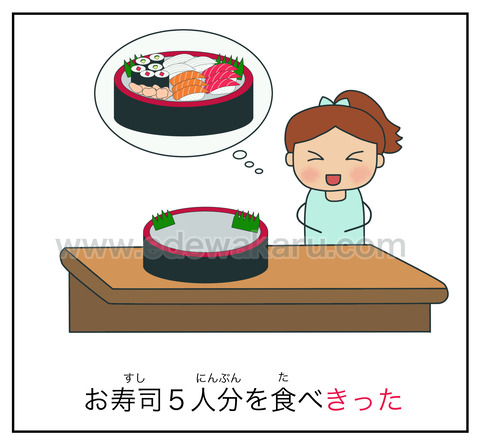
Meaning
Do … all
Do … to the very end
How to use it
Verb [ます-form] + きる
Explanation
「〜きる」is a sentence pattern meaning “do … all” or “do … to the very end.” It is used with verbs that express actions and indicates [completion] or [finishing] 😊
「〜きる」has other uses as well, so review them 😉
In context 5 examples
お寿司5人分を食べきった
→お寿司5人分を全部食べたI ate all five servings of sushi. →I ate all five servings of sushi.
マラソン42.195キロを走りきった
→マラソン42.195キロを最後まで走ったI ran the full 42.195 kilometers of the marathon. →I ran the 42.195-kilometer marathon to the very end.
ベストセラー小説を1日で読みきった
→ベストセラー小説を1日で最後まで読んだI finished reading the bestselling novel in one day. →I read the bestselling novel to the very end in one day.
ボーナスを全部使いきってしまった…
→ボーナスを完全に全部使ってしまったI ended up spending my entire bonus… →I completely spent all of my bonus.
マイクは、ひらがなを3日で覚えきった
→ひらがなを3日で全部覚えたMike learned all the hiragana in three days. →He learned all the hiragana in three days.
Read the original source text
Meaning
全部〜する
最後まで〜する
How to use it
動詞[ます形]+きる
Explanation
「〜きる」は「全部〜する」「最後まで〜する」という意味の文型です。動作を表す動詞に使い、[完成]や[完了]を表します😊
「〜きる」には、他にも用法がありますので復習しておきましょう😉
Usage 2
Read this source entry ↗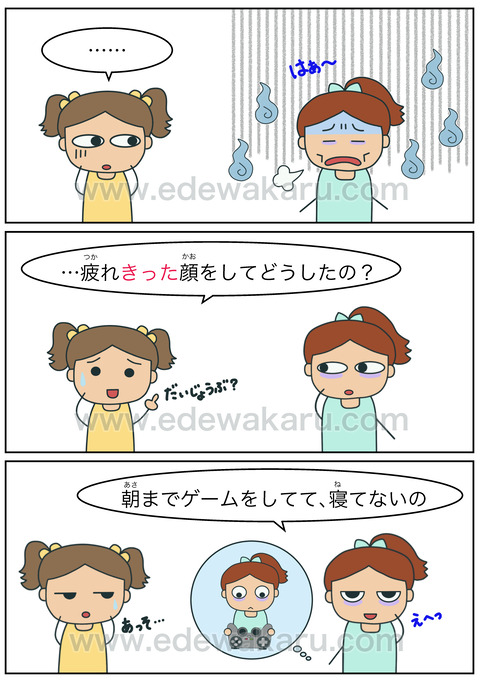
Meaning
become extremely ~
How to use it
Verb [ます-form] + きる
Explanation
「Aきる」 is a grammatical pattern meaning “become extremely A.” 「A」 is a verb that describes a state, and the pattern expresses an extreme state. 😮
「〜きる」 also has a use that expresses completion, so let’s review that too. 😉
In context 5 examples
A:疲れきった顔をしてどうしたの?B:朝までゲームをしてて、寝てないのA:…あっそ
→すごく疲れた顔をしてどうしたの?A: Why do you look so exhausted? B: I was playing games until morning and haven’t slept. A: …Oh, I see. →Why do you look so exhausted?
彼女はどうしたらいいのかわからず、困りきっているようだ
→すごく困っているようだShe seems to be extremely troubled, not knowing what to do. →She seems to be extremely troubled.
お母さんは、疲れきって寝てしまった
→お母さんは、すごく疲れて寝てしまったMom was so exhausted that she fell asleep. →Mom was extremely tired and fell asleep.
彼は、私のことを信じきっている
→彼は、完全に私のことを信じているHe completely trusts me. →He completely trusts me.
そんなわかりきったことを聞かないでくれ
→そんな言わなくてもわかるようなことを聞かないでくれDon’t ask me something so obvious. →Don’t ask me something you already know without being told.
Read the original source text
Meaning
すごく〜の状態
How to use it
動詞[ます形]+きる
Explanation
「Aきる」は「すごくAの状態になる」という意味の文型です。「A」には状態性(じょうたいせい)の動詞が入り、極限状態(きょくげじょうたい)を表します😮
「〜きる」には[完了]を表す用法もありますので、復習をしておきましょう😉
Usage 3
Read this source entry ↗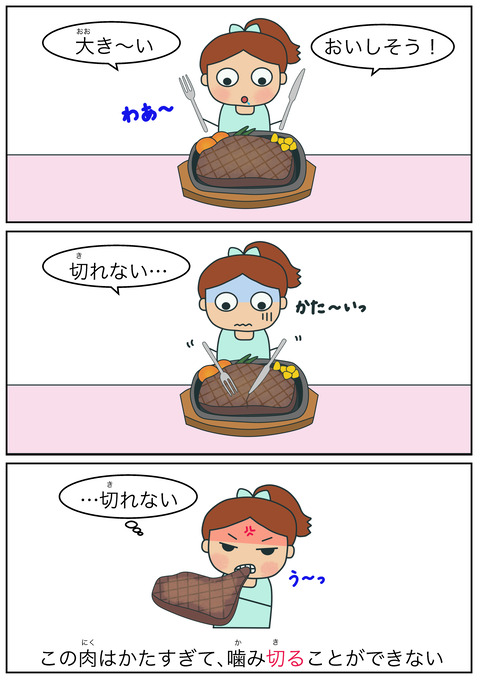
Meaning
expresses severance
How to use it
Verb [ます-form] + きる
Explanation
「〜きる」 is a grammatical pattern expressing severance. In the form 「Aきる」, it is used to say “do A and cut/separate it off.” This 「〜きる」 meaning severance is usually written with the kanji 「〜切る」. The verbs that can be used as 「A」 are mostly fixed, and it can also mean “throw away” or “give up.”
[「〜切る」 used to mean “throw away” or “give up”]
・
思い切る
→give up
・
断ち切る
→①cut something apart with scissors, a knife, etc.
②end a relationship; break off
・
打ち切る
→stop; discontinue
「〜きる」 also has uses expressing completion and an extreme state, so learn those together as well. 😉
[Uses of 「〜きる」]
In context 6 examples
この肉はかたすぎて、噛み切ることができない…
→噛んで切断することができないThis meat is so tough that I can’t bite through it… →I can’t bite it and cut it through.
太いロープを焼き切る
→焼いて切断するBurn through a thick rope. →Burn it and cut through it.
太いロープを石で叩き切る
→叩いて切断するCut through a thick rope by striking it with a stone. →Strike it and cut through it.
布を半分に断ち切る
Cut the cloth in half.
野球選手(やきゅうせんしゅ)になる夢を思い切った
I gave up on my dream of becoming a baseball player.
A:田中さん、結婚したらしいねB:…うん。早く彼女への思いを断ち切らなければならないな…
A: I hear Tanaka-san got married. B: …Yeah. I have to break off my feelings for her soon…
Read the original source text
Meaning
切断を表す
How to use it
動詞[ます形]+きる
Explanation
「〜きる」は[切断]を表す文型です。「Aきる」の形で「Aして、切り離す」と言いたい時に使われます。[切断]を表す「〜きる」は、「〜切る」というように、ほとんどの場合は漢字が使われます。この文型は「A」に入る動詞がほとんど決まっていて、「捨てる」「あきらめる」という意味で使われることもあります。
[「捨てる・あきらめる」の意味で使われる「〜切る」]
・
思い切る
→あきらめる
・
断ち切る
→①はさみやナイフなどで切り離す
②関係をなくす・やめる
・
打ち切る
→やめる・中止する
「〜きる」には[完了]や[極限状態(きょくげんじょうたい)]を表す用法もありますので、一緒に覚えておきましょう😉
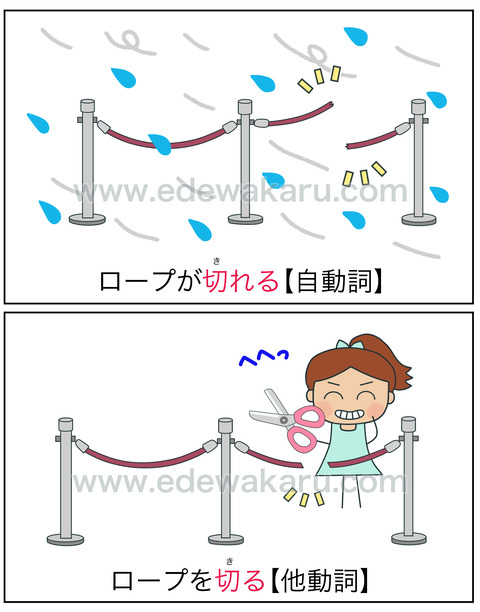
【「〜きる」の用法】
どんなときどう使う 日本語表現文型辞典
Meaning
ompletely; finish the whole…
How to use it
Vます+きる (do completely; finish doing)
Explanation
全部~する
「Vきる」の形で、動詞に「全部~する/最後まで~する」( ❶ ❷ )、「強く~する」( ❸ )、「非常に~する」( ❹ )などの意味を加える。
Adds to verb nuance "to do all, do until the end," (as in sentences ❶ and ❷ ); "strengthen," (sentence ❸ ); or "make extremely" (sentence ❹ ).
In context 4 examples
5巻まである長い小説を夏休み中に全部読みきった。
I read all of the long novel, which runs to five volumes, during summer vacation.
水泳が苦手だった幸子は中学生になってから1,000メートルを泳ぎきって自信をつけたようだ。
Sachiko, who used to be bad at swimming, seems to have gained confidence after swimming 1,000 meters once she entered middle school.
慎重な彼が「絶対にやれる」と言いきったのだから、相当の自信があるのだろう。
Since he, being so cautious, declared that he could definitely do it, he must be quite confident.
田中さんは年を取った両親と入院中の奥さんを抱え、困りきっているらしい。
Mr. Tanaka seems completely overwhelmed, with his elderly parents and his wife in the hospital to care for.
Read the original source text
Meaning
ompletely; finish the whole…
How to use it
V ます+きる
Explanation
全部~する
「Vきる」の形で、動詞に「全部~する/最後まで~する」( ❶ ❷ )、「強く~する」( ❸ )、「非常に~する」( ❹ )などの意味を加える。
Adds to verb nuance "to do all, do until the end," (as in sentences ❶ and ❷ ); "strengthen," (sentence ❸ ); or "make extremely" (sentence ❹ ).
日本語NET JLPT文法解説まとめ
Meaning
① To do something completely / all the way to the end
② To do something intensely / very much
How to use it
V (ます-form)ます + きる
In context 14 examples
田中さんは足を怪我しながらも、なんとか42.195km走りきった。
Even though Tanaka-san had injured his leg, he somehow managed to run the full 42.195 km.
勉強熱心なトムさんは、みんなの日本語初級1の単語を3週間で覚えきった。
Tom, who is diligent about studying, learned all the vocabulary in Minna no Nihongo Beginner 1 in three weeks.
数えきれないほどの星が空一面に広がっている。
Countless stars are spread across the entire sky.
山下さんは疲れきって、熟睡している。
Yamashita-san is completely exhausted and is sleeping soundly.
黒田さんは「明日までに絶対に完成させます」と言いきったのに、今朝確認すると全体の50%しか終わっていなかった。
Although Kuroda-san declared, “I’ll definitely finish it by tomorrow,” when I checked this morning, only 50% of the whole thing was done.
息子は大学を卒業しても働かず、毎日家でYouTubeばかりみていて、私は困りきっている。
Even though my son graduated from university, he doesn't work and just watches YouTube at home every day, and I'm at my wits' end.
こんなたくさんの料理、一人では食べきれません。
I can't possibly eat this much food by myself.
やっぱり私には諦めきれません。
After all, I just can't give up.
フィリピンの人はよく給料をもらうと数日のうちに使いきる人が多いと聞きました。
I heard that many people in the Philippines tend to spend all their pay within a few days of receiving it.
持っていきたいものが多すぎて、カバンの中に入りきらない。
There are too many things I want to take, and they won't all fit in my bag.
割り切れない数字は四捨五入してください。
Round numbers that cannot be divided evenly to the nearest whole number.
人気バンドのコンサートチケットは発売開始から、5分で売り切れた。
Tickets for the popular band's concert sold out five minutes after sales began.
この激辛大盛りカレーを10分以内に食べきったら賞金1万円差し上げます。
If you finish eating this extra-large, extremely spicy curry within 10 minutes, we'll give you a prize of 10,000 yen.
100%の力を出しきれたので、たとえ結果が悪くても後悔はありません。
I gave it 100% of my effort, so even if the result is bad, I have no regrets.
Read the original source text
Meaning
①全部〜する / 最後まで〜する
②強く〜する / 非常に〜する
How to use it
V(ます形)ます + きる
日本語文型辞典 英語版
Meaning
【きる】Attaches to a verb stem and adds various meanings to the action.
Expresses “doing something to the utmost.”
Expresses doing something sufficiently or strongly.
Means “cutting.” Derived meanings include “discarding” and “giving up.”
Expresses the notion that one “can’t do something completely” or “can’t do something enough.”
How to use it
1. R-きる〈completion〉
2. R-きる〈thoroughly〉
3. R-きる〈severance〉
4. R-きれない
In context 12 examples
お金を使いきってしまった。
I ran out of money.
山道を登りきったところに小屋があった。
At the end of the mountain trail was a small hut.
長編の冒険小説を1週間かけて読み切った。
I read an entire adventure novel in a week.
無理な仕事をして疲れきってしまった。
I was exhausted from the excessive work load.
そんな分かりきったことをいつまで言っているんだ。
How long are you going to keep telling me such obvious things?
この絵はその情景を十分に描き切っているとは言えない。
I can’t say that this picture fully depicts the scene.
彼女は絶対に自分が正しいと言い切った。
She insisted that she was absolutely correct.
大きな布を二つに断ち切った。
I cut a big cloth into two pieces.
別れてからも彼女のことを思い切ることができない。
I can’t stop thinking about her even since we broke up.
故郷にとどまりたいという思いを断ち切って出発した。
I gave up my intentions to remain in my hometown and set out.
それはいくら悔やんでも悔やみきれないことだった。
I can’t get over my regret.
その人との別れは、あきらめきれないつらい思い出として、今でも私の胸の奥底にある。
The memory of being unable to accept our breakup still pains me deep in my heart.
AIUEO JLPT Grammar
Meaning
“〜きる” is a sentence pattern used with the masu-stem of verbs to indicate the completion of an action or the thoroughness of an activity. This expression emphasizes the full accomplishment or thoroughness of the action.
How to use it
Verb in ます-form + きる
In context 5 examples
この洗剤を全部使いきりました。
I used up all of this detergent.
この本を読みきった。
I finished reading this book.
彼はマラソンを走りきった。
He finished the marathon.
彼は欲しいものを全部買いきった。
He bought everything he wanted.
子供たちはお菓子を全部食べきりました。
The children finished all the snacks.
Read the original source text
Meaning
“〜きる” is a sentence pattern used with the masu-stem of verbs to indicate the completion of an action or the thoroughness of an activity. This expression emphasizes the full accomplishment or thoroughness of the action.
How to use it
動詞ます形+きる
Explanation · 日本語
「〜きる」は、動詞ます形に接続して、動作が完全に終わることや、徹底的に行われることを表す表現です。この表現は、何かを完全にやり遂げることや、徹底的に行うことを強調するときに使われます。
文法
Meaning
① To do something completely / all the way to the end
② To do something intensely / very much
In context 14 examples
田中さんは足を怪我しながらも、なんとか42.195km走りきった。
Even though Tanaka-san had injured his leg, he somehow managed to run the full 42.195 km.
勉強熱心なトムさんは、みんなの日本語初級1の単語を3週間で覚えきった。
Tom, who is diligent about studying, learned all the vocabulary in Minna no Nihongo Beginner 1 in three weeks.
数えきれないほどの星が空一面に広がっている。
Countless stars are spread across the entire sky.
山下さんは疲れきって、熟睡している。
Yamashita-san is completely exhausted and is sleeping soundly.
黒田さんは「明日までに絶対に完成させます」と言いきったのに、今朝確認すると全体の50%しか終わっていなかった。
Although Kuroda-san declared, “I’ll definitely finish it by tomorrow,” when I checked this morning, only 50% of the whole thing was done.
息子は大学を卒業しても働かず、毎日家でYouTubeばかりみていて、私は困りきっている。
Even though my son graduated from university, he doesn't work and just watches YouTube at home every day, and I'm at my wits' end.
こんなたくさんの料理、一人では食べきれません。
I can't possibly eat this much food by myself.
やっぱり私には諦めきれません。
After all, I just can't give up.
フィリピンの人はよく給料をもらうと数日のうちに使いきる人が多いと聞きました。
I heard that many people in the Philippines tend to spend all their pay within a few days of receiving it.
持っていきたいものが多すぎて、カバンの中に入りきらない。
There are too many things I want to take, and they won't all fit in my bag.
割り切れない数字は四捨五入してください。
Round numbers that cannot be divided evenly to the nearest whole number.
人気バンドのコンサートチケットは発売開始から、5分で売り切れた。
Tickets for the popular band's concert sold out five minutes after sales began.
この激辛大盛りカレーを10分以内に食べきったら賞金1万円差し上げます。
If you finish eating this extra-large, extremely spicy curry within 10 minutes, we'll give you a prize of 10,000 yen.
100%の力を出しきれたので、たとえ結果が悪くても後悔はありません。
I gave it 100% of my effort, so even if the result is bad, I have no regrets.
Read the original source text
Meaning
①全部〜する / 最後まで〜する
②強く〜する / 非常に〜する
IMABI
Used to/together…
Read this IMABI lesson ↗Explanation
~慣れる, ~合う・合わせる, & ~切る
This lesson continues on with intermediate compound verb endings.
Grammar Note: 来る can only be used with the following patterns: 来慣れる (to be used to coming to) and 来合わせる (to make one’s appearance). If you think about the meanings of these phrases as they are discussed, this will make sense to you.
~慣れる
慣なれる, an 一段 verb, means “to get used to” and may also mean “to domesticate”, which is in essence animals getting used to human control. 慣れる is intransitive and is used as a compound ending to show an inclination to liking or being accustomed to something.
1. この街には住み慣れました。
I got used to living in this town.
2. 彼は都市の生活に慣れることができなかった。
He couldn’t get used to living in the city.
3. 通学に慣れるのは重要じゅうようです。
It is important that you become used to commuting to school.
4. コンピューターは使い慣れるのは時間がかかります。
It takes time to get used to the computer.
5. 彼は旅慣たびなれている。
He’s well-traveled.
6a. 日本料理{は、・を}食べ慣れました。
6b. 日本料理に慣れました。(もっと自然)
I’ve gotten used to eating Japanese food.
7. 私は人前ひとまえで話すことに慣れていません。
I am not used to speaking in front of people.
8. 日本の天候てんこうに慣れる。
To get used to Japanese weather.
9. まだ明るさに慣れてねー。(砕くだけた言い方)
(My eyes) are still not adjusted to the light.
10. 寵愛ちょうあいに慣れるのはだめですよ。
It is no good to be over-familiar with attention.
Orthography Note: なれる may be written as 狎れる when specifically referring to domestication.
~合う・合わせる
合う shows how something “fits”. In compounds it shows “to…with each other”. So, there is someone else with you doing the same action. Essentially, ~合う shows people doing something with each other–reciprocal action. The object(s) of the sentence must be similar.
The causative form 合わせる may show that one makes something into one, looks into differences, reciprocally does, or does something all of a sudden.
11. ロミオとジュリエットは愛し合っていた。
Romeo and Juliet loved each other.
12. 誘さそい合わせる。
To invite each other.
13. 彼らは宿題を手伝てつだい合った。
They helped each other with homework.
14. 犯行現場はんこうげんばに居合わせました。
I was present at the crime scene.
15. 何時に待ち合わせようか?
What time shall we meet?
16. 彼と彼女は君が代よを歌い合っていた。?
彼と彼女は君が代を一緒に歌っていた。〇
He and she sang Kimigayo with each other.
Culture Note: 君きみが代よ is the national anthem (国歌こっか) of Japan.
17. 二人で聖書せいしょを読み上げ合いました。
The two read aloud the bible with each other.
18. 彼らは想おもいを打ち明け合うだろう。
They will probably confide their feelings with each other.
19. ケーキを一緒に{食べましょう 〇・ 食べ合いましょう X}。
Let’s eat cake together.
20. 乗り合わせた乗客
Fellow passengers
21. 計算を読み合わせる。
To read out and compare calculations.
22. このドレスはあたしにぴったり{(と)合いますか・ですか}。 (Feminine)
Does this dress fit perfectly with me?
23. 申し合わせた通りにしましょう。
Let’s do as arranged.
24. お互たがいに引き合わせる。
To introduce to each other.
25. 警察に問い合わせましたか。
Did you check with the police?
26. 書類しょるいを綴とじ合わせましたか。
Have you bound the documents together?
27. 布を縫ぬい合わせる。
To sew together.
28. 傷口きずぐちを縫い合わせてもらった。
I had my wound(s) sewn up.
29. 各種詰づめ合あわせキャンディーを買かいに行いった。
I went to buy mixed candies.
30. それらの糸は縒より合わせ難がたい。
These threads are hard to twist together.
31. 悲しみを分かち合う。
To share in the sadness.
Word Note: 分かち合う is typically interchangeable with 分け合う, but it is generally more 文語的. However, in the case of “sharing” non-physical items such as sadness, you should use 分かち合う.
32. 家族の都合が合うのは今日だけだ。
Today is only when my convenience matches with my family’s.
Word Note: 都合が合う is unavoidable in contexts like these, but it is generally not liked when referring to just one’s convenience. In which case, you should say 都合がいい.
There is also another ending that shows mutual action: ~違える. This sometimes confusingly has a meaning of ~間違える. This is because the verb 違える itself has the following meanings: to not have something be the same; to mess up; to be against a contract; to injure one’s muscles. You have to essentially learn on a case by case basis.
33. 靴を履き違える。
To mix up shoes.
34. 約束を違える。
To break one’s promise.
Reading Note: This 違える may be read as either ちがえる or たがえる.
35. 寝違えて、首筋が痛い。
I got a crick in my neck, and now it hurts.
36. 社長と刺し違える。
To expose the company president and receive repercussions from him/her.
37. 一審を差し違える。
To overturn the first match decision (and give the win to the other opponent).
~切る
切きる means “to cut” and may be used literally and figuratively. ~切る shows that “something is done completely”.
38. 彼は読書に浸ひたり切っていた。
He was completely engrossed in reading.
39. 紙をはさみで切る。
To cut paper with scissors.
漢字 Note: 鋏 is not uncommonly used to spell はさみ.
40. 彼はかの歌手の全ての歌を歌い切った。
He sang all of that singer’s songs completely.
41. いつかは地球に残っている石油は全て使い切ってしまうだろう。
The remaining oil on the earth will probably one day end up completely used.
42. 紐ひもを切る。
To cut a string.
43. 電話を切る。
To hang up the phone.
44. {手・関係}を切る。
To break a relationship.
45. 彼がイギリス海峡かいきょうの距離きょりを泳ぎ切りました。
He completely swam the (entire) distance of the English Channel.
46. 水泳選手は、日本海を一緒に泳ぎきりました。
The swimmers swam across the Sea of Japan together.
47. ジョーンズ先生は来月までに約やく10冊読み切っているでしょう。
Ms. Jones will have probably read around 10 books by next month.
In context 48 examples
この街には住み慣れました。
I got used to living in this town.
彼は都市の生活に慣れることができなかった。
He couldn’t get used to living in the city.
通学に慣れるのは重要じゅうようです。
It is important that you become used to commuting to school.
コンピューターは使い慣れるのは時間がかかります。
It takes time to get used to the computer.
彼は旅慣たびなれている。
He’s well-traveled.
日本料理{は、・を}食べ慣れました。
I’ve gotten used to eating Japanese food.
日本料理に慣れました。(もっと自然)
I’ve gotten used to eating Japanese food.
私は人前ひとまえで話すことに慣れていません。
I am not used to speaking in front of people.
日本の天候てんこうに慣れる。
To get used to Japanese weather.
まだ明るさに慣れてねー。(砕くだけた言い方)
(My eyes) are still not adjusted to the light.
寵愛ちょうあいに慣れるのはだめですよ。
It is no good to be over-familiar with attention.
ロミオとジュリエットは愛し合っていた。
Romeo and Juliet loved each other.
誘さそい合わせる。
To invite each other.
彼らは宿題を手伝てつだい合った。
They helped each other with homework.
犯行現場はんこうげんばに居合わせました。
I was present at the crime scene.
何時に待ち合わせようか?
What time shall we meet?
彼と彼女は君が代よを歌い合っていた。?
He and she were singing Kimigayo to each other. ?
二人で聖書せいしょを読み上げ合いました。
The two read aloud the bible with each other.
彼らは想おもいを打ち明け合うだろう。
They will probably confide their feelings with each other.
ケーキを一緒に{食べましょう 〇・ 食べ合いましょう X}。
Let’s eat cake together.
乗り合わせた乗客
Fellow passengers
計算を読み合わせる。
To read out and compare calculations.
このドレスはあたしにぴったり{(と)合いますか・ですか}。 (Feminine)
Does this dress fit perfectly with me?
申し合わせた通りにしましょう。
Let’s do as arranged.
お互たがいに引き合わせる。
To introduce to each other.
警察に問い合わせましたか。
Did you check with the police?
書類しょるいを綴とじ合わせましたか。
Have you bound the documents together?
布を縫ぬい合わせる。
To sew together.
傷口きずぐちを縫い合わせてもらった。
I had my wound(s) sewn up.
各種詰づめ合あわせキャンディーを買かいに行いった。
I went to buy mixed candies.
それらの糸は縒より合わせ難がたい。
These threads are hard to twist together.
悲しみを分かち合う。
To share in the sadness.
家族の都合が合うのは今日だけだ。
Today is only when my convenience matches with my family’s.
靴を履き違える。
To mix up shoes.
約束を違える。
To break one’s promise.
寝違えて、首筋が痛い。
I got a crick in my neck, and now it hurts.
社長と刺し違える。
To expose the company president and receive repercussions from him/her.
一審を差し違える。
To overturn the first match decision (and give the win to the other opponent).
彼は読書に浸ひたり切っていた。
He was completely engrossed in reading.
紙をはさみで切る。
To cut paper with scissors.
彼はかの歌手の全ての歌を歌い切った。
He sang all of that singer’s songs completely.
いつかは地球に残っている石油は全て使い切ってしまうだろう。
The remaining oil on the earth will probably one day end up completely used.
紐ひもを切る。
To cut a string.
電話を切る。
To hang up the phone.
{手・関係}を切る。
To break a relationship.
彼がイギリス海峡かいきょうの距離きょりを泳ぎ切りました。
He completely swam the (entire) distance of the English Channel.
水泳選手は、日本海を一緒に泳ぎきりました。
The swimmers swam across the Sea of Japan together.
ジョーンズ先生は来月までに約やく10冊読み切っているでしょう。
Ms. Jones will have probably read around 10 books by next month.
Read the original source text
Explanation
~慣れる, ~合う・合わせる, & ~切る
This lesson continues on with intermediate compound verb endings.
Grammar Note: 来る can only be used with the following patterns: 来慣れる (to be used to coming to) and 来合わせる (to make one’s appearance). If you think about the meanings of these phrases as they are discussed, this will make sense to you.
~慣れる
慣なれる, an 一段 verb, means “to get used to” and may also mean “to domesticate”, which is in essence animals getting used to human control. 慣れる is intransitive and is used as a compound ending to show an inclination to liking or being accustomed to something.
1. この街には住み慣れました。
I got used to living in this town.
2. 彼は都市の生活に慣れることができなかった。
He couldn’t get used to living in the city.
3. 通学に慣れるのは重要じゅうようです。
It is important that you become used to commuting to school.
4. コンピューターは使い慣れるのは時間がかかります。
It takes time to get used to the computer.
5. 彼は旅慣たびなれている。
He’s well-traveled.
6a. 日本料理{は、・を}食べ慣れました。
6b. 日本料理に慣れました。(もっと自然)
I’ve gotten used to eating Japanese food.
7. 私は人前ひとまえで話すことに慣れていません。
I am not used to speaking in front of people.
8. 日本の天候てんこうに慣れる。
To get used to Japanese weather.
9. まだ明るさに慣れてねー。(砕くだけた言い方)
(My eyes) are still not adjusted to the light.
10. 寵愛ちょうあいに慣れるのはだめですよ。
It is no good to be over-familiar with attention.
Orthography Note: なれる may be written as 狎れる when specifically referring to domestication.
~合う・合わせる
合う shows how something “fits”. In compounds it shows “to…with each other”. So, there is someone else with you doing the same action. Essentially, ~合う shows people doing something with each other–reciprocal action. The object(s) of the sentence must be similar.
The causative form 合わせる may show that one makes something into one, looks into differences, reciprocally does, or does something all of a sudden.
11. ロミオとジュリエットは愛し合っていた。
Romeo and Juliet loved each other.
12. 誘さそい合わせる。
To invite each other.
13. 彼らは宿題を手伝てつだい合った。
They helped each other with homework.
14. 犯行現場はんこうげんばに居合わせました。
I was present at the crime scene.
15. 何時に待ち合わせようか?
What time shall we meet?
16. 彼と彼女は君が代よを歌い合っていた。?
彼と彼女は君が代を一緒に歌っていた。〇
He and she sang Kimigayo with each other.
Culture Note: 君きみが代よ is the national anthem (国歌こっか) of Japan.
17. 二人で聖書せいしょを読み上げ合いました。
The two read aloud the bible with each other.
18. 彼らは想おもいを打ち明け合うだろう。
They will probably confide their feelings with each other.
19. ケーキを一緒に{食べましょう 〇・ 食べ合いましょう X}。
Let’s eat cake together.
20. 乗り合わせた乗客
Fellow passengers
21. 計算を読み合わせる。
To read out and compare calculations.
22. このドレスはあたしにぴったり{(と)合いますか・ですか}。 (Feminine)
Does this dress fit perfectly with me?
23. 申し合わせた通りにしましょう。
Let’s do as arranged.
24. お互たがいに引き合わせる。
To introduce to each other.
25. 警察に問い合わせましたか。
Did you check with the police?
26. 書類しょるいを綴とじ合わせましたか。
Have you bound the documents together?
27. 布を縫ぬい合わせる。
To sew together.
28. 傷口きずぐちを縫い合わせてもらった。
I had my wound(s) sewn up.
29. 各種詰づめ合あわせキャンディーを買かいに行いった。
I went to buy mixed candies.
30. それらの糸は縒より合わせ難がたい。
These threads are hard to twist together.
31. 悲しみを分かち合う。
To share in the sadness.
Word Note: 分かち合う is typically interchangeable with 分け合う, but it is generally more 文語的. However, in the case of “sharing” non-physical items such as sadness, you should use 分かち合う.
32. 家族の都合が合うのは今日だけだ。
Today is only when my convenience matches with my family’s.
Word Note: 都合が合う is unavoidable in contexts like these, but it is generally not liked when referring to just one’s convenience. In which case, you should say 都合がいい.
There is also another ending that shows mutual action: ~違える. This sometimes confusingly has a meaning of ~間違える. This is because the verb 違える itself has the following meanings: to not have something be the same; to mess up; to be against a contract; to injure one’s muscles. You have to essentially learn on a case by case basis.
33. 靴を履き違える。
To mix up shoes.
34. 約束を違える。
To break one’s promise.
Reading Note: This 違える may be read as either ちがえる or たがえる.
35. 寝違えて、首筋が痛い。
I got a crick in my neck, and now it hurts.
36. 社長と刺し違える。
To expose the company president and receive repercussions from him/her.
37. 一審を差し違える。
To overturn the first match decision (and give the win to the other opponent).
~切る
切きる means “to cut” and may be used literally and figuratively. ~切る shows that “something is done completely”.
38. 彼は読書に浸ひたり切っていた。
He was completely engrossed in reading.
39. 紙をはさみで切る。
To cut paper with scissors.
漢字 Note: 鋏 is not uncommonly used to spell はさみ.
40. 彼はかの歌手の全ての歌を歌い切った。
He sang all of that singer’s songs completely.
41. いつかは地球に残っている石油は全て使い切ってしまうだろう。
The remaining oil on the earth will probably one day end up completely used.
42. 紐ひもを切る。
To cut a string.
43. 電話を切る。
To hang up the phone.
44. {手・関係}を切る。
To break a relationship.
45. 彼がイギリス海峡かいきょうの距離きょりを泳ぎ切りました。
He completely swam the (entire) distance of the English Channel.
46. 水泳選手は、日本海を一緒に泳ぎきりました。
The swimmers swam across the Sea of Japan together.
47. ジョーンズ先生は来月までに約やく10冊読み切っているでしょう。
Ms. Jones will have probably read around 10 books by next month.
毎日のんびり日本語教師
Meaning
~finish doing
~become completely
How to use it
Verb ます-stem + きる
Verb ます-stem + きれる
Verb ます-stem + きれない
Explanation
There are two meanings: one indicates completing an action, and the other indicates reaching an extreme state. In either case, it particularly emphasizes that the action has been carried through to completion.
「きれる」 is the potential form of 「きる」.
「きれない」 is the negative form and means that one cannot do something all the way to the end.
The kanji 「切る」 may also be used.
Notes
A similar pattern is 「~抜く」, which carries the nuance of working hard to see something difficult through to the end. 「~切る」 does not have this meaning.
In context 7 examples
フルマラソンを走りきったのはこれが初めてだ。
This is the first time I've completed a full marathon.
ずっと考えてたんだけど、やっぱり君のことを諦めきれない。
I've been thinking about it for a long time, but I still can't give up on you.
疲れ切ったのか、帰宅してすぐ寝てしまった。
Maybe because I was completely exhausted, I fell asleep as soon as I got home.
昨日大量に買ったチョコをもう食べきってしまった。
I already finished all the chocolate I bought in bulk yesterday.
給料日なのにもう全部使いきってしまった。
Even though it's payday, I've already spent it all.
到底食べ切れない量を注文してしまった。
I ordered an amount that I could never finish eating.
たくさん買い物して冷蔵庫に入りきらない。
I bought so much that it won't all fit in the refrigerator.
Read the original source text
Meaning
~し終わる
完全に~になる
How to use it
動ます形+きる
動ます形+きれる
動ます形+きれない
Explanation
意味は2つあり、一つは動作の完了、もう一つは極限の状態になることを表します。いずれにしても特に動作が完遂されたことを強調しています。
「きれる」は「きる」の可能形です。
「きれない」は否定形で、最後まで~できないという意味になります。
漢字の「切る」を使うこともあります。
Notes
似ている文型に「~抜く」がありますが、こちらは大変なことを最後まで一生懸命やったというニュアンスがあります。「~切る」にはこの意味がありません。
NINJAL 日本語文型データベース
Meaning
It indicates finishing something with a fixed total amount all the way to the end. It also indicates making something completely or thoroughly reach a certain state, or something becoming completely or thoroughly that way.
How to use it
In context 8 examples
息つぎなしで25m泳ぎ切った。私は息つぎが苦手なのだ。
I swam 25 meters without stopping to catch my breath. I’m bad at breathing while swimming.
スプレー缶は、必ず中身を使い切ってから捨ててください。
Be sure to use up the contents of the spray can before throwing it away.
この小説は、今の時代の雰囲気を見事に描き切っている。
This novel superbly captures the atmosphere of the present age.
頑張って勉強したのに、試験当日に体調を崩し、実力を出し切ることができなかった。
Although I studied hard, I fell ill on the day of the exam and couldn’t show everything I was capable of.
イベント準備のため残業続きで、社員はみんな疲れ切っている。
With overtime day after day to prepare for the event, all the employees are completely exhausted.
寒い中、長時間バスを待っていたので、体が冷え切ってしまった。
I waited a long time for the bus in the cold, so my body became completely chilled.
「この山、歩いて登るんだよね」「もちろん。わかり切ったことを聞かないで」
“We’re climbing this mountain on foot, right?” “Of course. Don’t ask something so obvious.”
Tシャツの首回りが伸びきってしまって、だらしない感じになっている。
The neckline of my T-shirt has stretched out completely, making it look shabby.
Read the original source text
Meaning
全体量が決まっている物事を、最後まで〜し終わることを表します。また、ある物事を完全に・十分に〜した状態にすること、あるいは、ある物事が完全に・十分に〜した状態になることも表します。