AIUEO JLPT Grammar
Meaning
This sentence pattern expresses that doing something is meaningless, does not lead to a solution, or will not change the situation. It is used when actions are futile or when the situation is already too late to be resolved.
How to use it
Verb (て-form) ても + 始まらない
In context 5 examples
もう終わったことを後悔しても始まらない。
It’s no use regretting what’s already done.
過ぎた時間を嘆いても始まらないから、これからどうするかを考えよう。
It’s pointless to lament the time that’s passed, so let’s think about what to do next.
いくら文句を言っても始まらないから、早く解決策を見つけよう。
Complaining won’t help, so let’s quickly find a solution.
今さら焦っても始まらないと思います。
I don't think it's worth getting anxious now.
ここで立ち止まって考えても始まりません。
There’s no point in stopping to think here.
Read the original source text
Meaning
This sentence pattern expresses that doing something is meaningless, does not lead to a solution, or will not change the situation. It is used when actions are futile or when the situation is already too late to be resolved.
How to use it
動詞て形ても+始まらない
Explanation · 日本語
この文型は、何かをしても意味がない、解決にならない、または状況が変わらないことを表す表現です。無駄な行動や、すでに遅すぎる状況に対して使われます。
文法
Meaning
〜ても意味がない / 〜ても進まない: Expresses that doing something will not lead to any progress in the situation.
How to use it
V (て-form) + も始まらない
イくても + 始まらない
ナAでも + 始まらない
In context 7 examples
今さら後悔しても始まらないし、次のことを考えよう。
There’s no point regretting it now, so let’s think about what to do next.
どうにもならないことをいくら悩んでも始まらない。
There’s no point worrying about something that can’t be changed, no matter how much you worry.
もう終わったことなんだから、くよくよしてても始まらないよ。
It’s already over, so there’s no point dwelling on it.
待っていても始まらないので、自分からアプローチしてみよう。
Waiting around won’t get us anywhere, so let’s make the first move.
自分で考えても始まらないので、先生に聞いてみよう。
There’s no point trying to figure it out by myself, so I’ll ask the teacher.
A:仕事のトラブルで残業しなくちゃいけないよ。あー本当ムカつく。この仕事本当に嫌。
B:文句ばかり言っても始まらないし、早く終わらせて帰ろう。A: I have to work overtime because of a problem at work. Ugh, I’m so annoyed. I really hate this job. B: There’s no point complaining all the time, so let’s finish up quickly and go home.
A:勤務地どこになるかな。地方には行きたくないなあ。
B:心配していても始まらないし、今は研修に集中しようよ。A: I wonder where I’ll be assigned. I really don’t want to go somewhere rural. B: There’s no point worrying about it, so let’s focus on our training for now.
Read the original source text
Meaning
〜ても意味がない / 〜ても進まないそれをしても事態の進展には繋がらないことを表す。
How to use it
V(テ形)も + 始まらない
イくても + 始まらない
ナAでも + 始まらない
絵でわかる日本語
Usage 1
Read this source entry ↗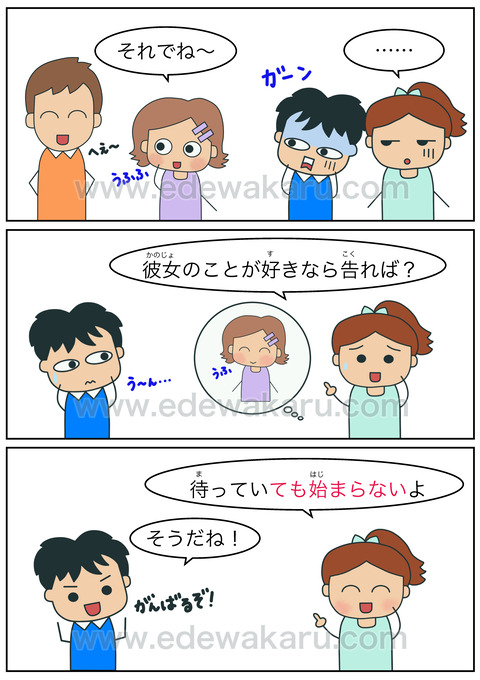
Meaning
There’s no point in doing 〜
Doing 〜 is useless
It’s too late to do 〜
Even if you keep doing 〜, the situation won’t change
How to use it
Verb [て-form] + ても始まらない
Explanation
“〜ても始まらない” is a sentence pattern meaning “there’s no point in doing 〜” or “even if you keep doing 〜, nothing new will happen.” It is often used when you want to say “the situation won’t progress and there’s no point in continuing to do 〜, so it would be better to do something” or “doing 〜 won’t solve the problem.” The colloquial form “〜たって” can also be used with “〜ても始まらない,” as in “〜たって始まらない.”
[Example]
There’s no point in waiting.
→ There’s no point in waiting.
“〜ても始まらない” is also often used in conversation, so be sure to learn it 😉
In context 5 examples
彼女のことが好きなら告れば?待っていても始まらないよ
→待っていても、状況はかわらないよIf you like her, why not tell her? Nothing will change if you keep waiting. → The situation won’t change if you keep waiting.
終わったことを今さら後悔しても始まらない
→今さら後悔しても、もう遅いThere’s no point regretting what’s already over now. → It’s too late to regret it now.
泣いても始まらないから、何か解決する方法を考えましょう
→泣いていても状況は変わらないから、何か解決する方法を考えましょうThere’s no point crying, so let’s think of a way to solve the problem. → The situation won’t change if we keep crying, so let’s think of a way to solve the problem.
もう決まったことだから、文句を言っても始まらない
→文句を言っても無駄だよIt’s already been decided, so there’s no point complaining. → Complaining is pointless.
A:また失敗して、部長に怒られたの…B:いつまでもへこんでいても始まらないよ。A:そうね。次は失敗しないようにしなきゃ
→いつまでもへこんでいても状況は変わらないよA: I made another mistake and the department manager got mad at me… B: There’s no point staying depressed forever. A: You’re right. I have to make sure I don’t make a mistake next time. → The situation won’t change if you stay depressed forever.
Read the original source text
Meaning
〜ても意味がない
〜ても無駄だ
〜ても、もう遅い
〜していても、状況は変わらない
How to use it
動詞[て形]+ても始まらない
Explanation
「〜ても始まらない」は「〜ても意味がない」「〜ていても、新しいことは起こらない」という意味の文型です。「〜していても状況は進展しないし意味がないから、何かしたほうがいい」「〜することは問題解決(もんだいかいけつ)にならない」と言いたい時によく使います。「〜ても始まらない」は[口語形]の「〜たって」を使って、「〜たって始まらない」と言うこともできます。
[例]
待ってい
ても始まらない
よ
→待ってい
たって始まらない
よ
「〜ても始まらない」は、会話でもよく使われますので覚えておきましょう😉
Usage 2
Read this source entry ↗Meaning
There’s no point in doing 〜
Doing 〜 is useless
It’s too late to do 〜
Even if you keep doing 〜, the situation won’t change
How to use it
Verb [て-form] + ても始まらない
Explanation
“〜ても始まらない” is a sentence pattern meaning “there’s no point in doing 〜” or “even if you keep doing 〜, nothing new will happen.” It is often used when you want to say “the situation won’t progress and there’s no point in continuing to do 〜, so it would be better to do something” or “doing 〜 won’t solve the problem.” The colloquial form “〜たって” can also be used with “〜ても始まらない,” as in “〜たって始まらない.”
[Example]
There’s no point in waiting.
→ There’s no point in waiting.
“〜ても始まらない” is also often used in conversation, so be sure to learn it 😉
In context 5 examples
彼女のことが好きなら告れば?待っていても始まらないよ
→待っていても、状況はかわらないよIf you like her, why not tell her? Nothing will change if you keep waiting. → The situation won’t change if you keep waiting.
終わったことを今さら後悔しても始まらない
→今さら後悔しても、もう遅いThere’s no point regretting what’s already over now. → It’s too late to regret it now.
泣いても始まらないから、何か解決する方法を考えましょう
→泣いていても状況は変わらないから、何か解決する方法を考えましょうThere’s no point crying, so let’s think of a way to solve the problem. → The situation won’t change if we keep crying, so let’s think of a way to solve the problem.
もう決まったことだから、文句を言っても始まらない
→文句を言っても無駄だよIt’s already been decided, so there’s no point complaining. → Complaining is pointless.
A:また失敗して、部長に怒られたの…B:いつまでもへこんでいても始まらないよ。A:そうね。次は失敗しないようにしなきゃ
→いつまでもへこんでいても状況は変わらないよA: I made another mistake and the department manager got mad at me… B: There’s no point staying depressed forever. A: You’re right. I have to make sure I don’t make a mistake next time. → The situation won’t change if you stay depressed forever.
Read the original source text
Meaning
〜ても意味がない
〜ても無駄だ
〜ても、もう遅い
〜していても、状況は変わらない
How to use it
動詞[て形]+ても始まらない
Explanation
「〜ても始まらない」は「〜ても意味がない」「〜ていても、新しいことは起こらない」という意味の文型です。「〜していても状況は進展しないし意味がないから、何かしたほうがいい」「〜することは問題解決(もんだいかいけつ)にならない」と言いたい時によく使います。「〜ても始まらない」は[口語形]の「〜たって」を使って、「〜たって始まらない」と言うこともできます。
[例]
待ってい
ても始まらない
よ
→待ってい
たって始まらない
よ
「〜ても始まらない」は、会話でもよく使われますので覚えておきましょう😉
日本語NET JLPT文法解説まとめ
Meaning
“It’s no use / it won’t get you anywhere even if ~”
Indicates that doing something will not lead to any progress in the situation.
How to use it
V (て-form) + も始まらない
イくても + 始まらない
ナAでも + 始まらない
Explanation
"It's pointless to ~ / It doesn't progress even if ~"
It indicates that doing so will not lead to any progress in the situation.
In context 7 examples
今さら後悔しても始まらないし、次のことを考えよう。
There’s no point regretting it now, so let’s think about what to do next.
どうにもならないことをいくら悩んでも始まらない。
There’s no point worrying about something that can’t be changed, no matter how much you worry.
もう終わったことなんだから、くよくよしてても始まらないよ。
It’s already over, so there’s no point dwelling on it.
待っていても始まらないので、自分からアプローチしてみよう。
Waiting around won’t get us anywhere, so let’s make the first move.
自分で考えても始まらないので、先生に聞いてみよう。
There’s no point trying to figure it out by myself, so I’ll ask the teacher.
A:仕事のトラブルで残業しなくちゃいけないよ。あー本当ムカつく。この仕事本当に嫌。
A: I have to work overtime because of a problem at work. Ugh, it’s so irritating. I really hate this job.
A:勤務地どこになるかな。地方には行きたくないなあ。
A: I wonder where I’ll be assigned. I don’t want to go somewhere rural.
Read the original source text
Meaning
"〜ても意味がない / 〜ても進まない"
それをしても事態の進展には繋がらないことを表す。
How to use it
V(テ形)も + 始まらない
イくても + 始まらない
ナAでも + 始まらない
Explanation
"It's pointless to ~ / It doesn't progress even if ~"
It indicates that doing so will not lead to any progress in the situation.
毎日のんびり日本語教師
How to use it
Verb te-form + も始まらない
Explanation
Indicates that the preceding matter is of no help whatsoever in moving the situation forward.
Notes
Nothing in particular.
In context 8 examples
留学先でどうなるかなんて心配していても始まらないし、実行あるのみだ。
There’s no point worrying about what might happen while studying abroad; all we can do is go ahead with it.
今さら終わったことを後悔しても始まらない。
There’s no point regretting something that’s already over.
泣き言言っても始まらない。(发牢骚也无济于事。)
There’s no point in complaining.
自分にはどうにもならないことでくよくよしても始まらない。(因为自己无能为力而郁闷是无济于事的。)
There’s no point in brooding over something you can’t do anything about.
否定ばかりしていても始まらないし、新しいことを受け入れていくことも重要だ。
There’s no point in doing nothing but deny everything, and it’s also important to accept new things.
自分を責めても始まらないと分かっているが、今でもあの光景が脳裏から離れない。
I know there’s no point blaming myself, but even now that scene won’t leave my mind.
愚痴を言っていても始まらない。
There’s no point in complaining.
じっとしていても何も始まらない。(一动不动也无济于事。)
Nothing will get started if you just sit still.
Read the original source text
How to use it
動て形+も始まらない
Explanation
前件が事態の進展に何の役にも立たないことを表します。
Notes
特になし