AIUEO JLPT Grammar
Meaning
「までに」is a particle that indicates a deadline or time by which an action or event should be completed. It is used when something must be finished within a specified timeframe.
How to use it
Verb dictionary form + までに; noun + までに
In context 5 examples
夕食までに帰ってきてね。
Come back by dinner time.
宿題は明日までに提出してください。
Please submit your homework by tomorrow.
試合は午後5時までに終わります。
The game will end by 5 PM.
システムは明日までに復旧します。
The system will be restored by tomorrow.
論文は来月までに完成させる予定です。
I intend to finish the thesis by next month.
Read the original source text
Meaning
「までに」is a particle that indicates a deadline or time by which an action or event should be completed. It is used when something must be finished within a specified timeframe.
How to use it
動詞辞書形+までに名詞+までに
Explanation · 日本語
「までに」は、ある行動や出来事が完了するべき期限や時点を示す助詞です。指定された期限内に特定の行動を終える必要がある場合に使われます。
文法
Meaning
Before that time or date arrives.
How to use it
V (dictionary form) + までに
N (time/date) + までに
In context 13 examples
レポートは来週の水曜日までに出してください。
Please submit the report by next Wednesday.
死ぬまでに1度はアフリカへ行ってみたいです。
I'd like to go to Africa at least once before I die.
月末までに、きちんと家賃を払ってくださいね。
Please make sure to pay the rent by the end of the month.
今日の5時までに、終わらせてください。
Please finish it by five o'clock today.
参加したい人は、明日までに連絡ください。
If you'd like to participate, please let me know by tomorrow.
イベントは朝9時からスタートしますから、8時までに学校に来てください。
The event starts at 9 a.m., so please come to school by 8.
30歳になるまでに結婚したいです。
I'd like to get married by the time I turn 30.
トムさんの分はないので、彼が来るまでに食べてしまってください。
There's none for Tom, so please finish eating before he gets here.
この本、15日までに返してくださいね。
Please return this book by the 15th.
部長が出張から戻ってくるまでに、なんとかこの資料を完成させなければ。
I have to somehow finish these materials before the department manager returns from his business trip.
大学を卒業するまでに、なんとか仕事を見つけたい。
I want to somehow find a job before I graduate from university.
日が暮れるまでに帰らないと、怒らちゃう。
If I don't get home before dark, I'll get scolded.
シンデレラは夜12時までに帰らないと魔法が解けるということで慌てて帰りました。
Cinderella hurried home because the spell would break if she didn't return by midnight.
Read the original source text
Meaning
その時間や日付が来る前に
How to use it
V(辞書形)+ までに
N(時間 / 日付)+ までに
Bunpro Grammar Reference
Meaning
By ~, By the time that ~, Before ~
How to use it
Verb + までに
Noun + までに
Nuance
A phrase commonly used to highlight a deadline by which something should be done.
Explanation
までに is a combination of two different types of particles. The adverbial particle まで, and the case marking particle に. までに is very similar to まで when it means 'until'. However, there is one very important distinction. This distinction is that までに means 'by', not 'until'.
To use までに, we will need to attach it to the end of a noun, or verb in the non-past form.
5時までに駅に来てください。
Please come to the station by 5 o'clock.
遊びに行くまでに片付けてね。
Please tidy up by the time you go out to play.
To understand the difference between まで, and までに, we need to remember that に usually marks a 'target', or a 'destination' for where something will happen. In this case, まで is the 'target' that に is marking. This is due to the fact that まで means 'as far as' (まで is sometimes written using kanji 迄, especially in older/formal texts, and newspapers).
来月までにレポートを書く。
I will write a report by next month. (Focus is on 'next month' being the deadline)
来月までレポートを書く。
I am writing a report until next month. (Focus is on 'next month' being the end point for something that will continue until that point)
In this way, までに more literally means '(A) as far as (に marks the target), (B).
Fun Fact
Originally, まで meant 'as far as' in regard to the passing of a particular event. However, in modern Japanese, most people will assume that the speaker means 'by the beginning of (A)'. Due to this, sentences that have a very broad event, such as 夏までに could actually be interpreted as 'by the start of summer', or 'before the end of summer', depending on who you are talking to. In these cases, it would be better to add a more specific time frame.
冬が終わるまでにスキーをしたい。
I want to go skiing by the end of winter. (Not just 'by winter', but specifically 'by the end of winter')
In context 17 examples
- 明日までに電話をください。
Please call by tomorrow.
- 遊びに行くまでに片付けてね。
Please tidy up by the time you go out to play.
- 5時までに駅に来てください。
Please come to the station by 5 o'clock.
- 来月までレポートを書く。
I am writing a report until next month. (Focus is on 'next month' being the end point for something that will continue until that point)
- 来月までにレポートを書く。
I will write a report by next month. (Focus is on 'next month' being the deadline)
- お昼までには着きます。
I will arrive by noon.
- 10時までに帰ってきてください。
Could you please come back home by 10?
- 来週までには終わります。
I will be done by next week.
- 8時までに学校につかなくてはいけない。
I have to arrive at school by 8 o'clock.
- 11月末までに、クリスマスプレゼントを買いに行きましょう。
Let's go Christmas present shopping by the end of November.
- 10時までに帰ってくることは無理です。
It will be impossible for me to be back by ten.
- 下書きを見て欲しい人は、明日までに提出してください。
For those who want their first draft to be looked at, please turn it in by tomorrow.
- 締め切りまでに出すことは難しいです。
Turning it in by the deadline is going to be difficult.
- 5時までに漢字100文字覚えるのは大変です。
Remembering 100 kanji by five o'clock is going to be rough.
- まだ全部覚えていませんが、来週までに絶対に覚えます。
I still haven't memorized it all, but I will definitely have it memorized by next week.
- 21歳までに、兄より背が高くなりたいです。
By the time I'm 21, I want to be taller than my older brother.
- 冬が終わるまでにスキーをしたい。
I want to go skiing by the end of winter. (Not just 'by winter', but specifically 'by the end of winter')
Read the original source text
Meaning
By ~, By the time that ~, Before ~
How to use it
Verb + までに
Noun + までに
Nuance
A phrase commonly used to highlight a deadline by which something should be done.
Explanation
までに is a combination of two different types of particles. The adverbial particle まで, and the case marking particle に. までに is very similar to まで when it means 'until'. However, there is one very important distinction. This distinction is that までに means 'by', not 'until'.
To use までに, we will need to attach it to the end of a noun, or verb in the non-past form.
5時までに駅に来てください。
Please come to the station by 5 o'clock.
遊びに行くまでに片付けてね。
Please tidy up by the time you go out to play.
To understand the difference between まで, and までに, we need to remember that に usually marks a 'target', or a 'destination' for where something will happen. In this case, まで is the 'target' that に is marking. This is due to the fact that まで means 'as far as' (まで is sometimes written using kanji 迄, especially in older/formal texts, and newspapers).
来月までにレポートを書く。
I will write a report by next month. (Focus is on 'next month' being the deadline)
来月までレポートを書く。
I am writing a report until next month. (Focus is on 'next month' being the end point for something that will continue until that point)
In this way, までに more literally means '(A) as far as (に marks the target), (B).
Fun Fact
Originally, まで meant 'as far as' in regard to the passing of a particular event. However, in modern Japanese, most people will assume that the speaker means 'by the beginning of (A)'. Due to this, sentences that have a very broad event, such as 夏までに could actually be interpreted as 'by the start of summer', or 'before the end of summer', depending on who you are talking to. In these cases, it would be better to add a more specific time frame.
冬が終わるまでにスキーをしたい。
I want to go skiing by the end of winter. (Not just 'by winter', but specifically 'by the end of winter')
Nuance · 日本語
あることの締め切りを強調するためによく使われるフレーズ。
DoJG 日本語文法辞典(全集)
Meaning
By; by the time (when)
How to use it
(i) Noun (time) | までに | |
| 五時までに | By five o’clock |
| 明日までに | By tomorrow |
(ii) Vinformal nonpast | までに | |
| 話すまでに | By the time someone talks/talked |
| 食べるまでに | By the time someone eats/ate |
Explanation
A particle that indicates a time limit on/for an action.
In context 5 examples
私は十時までに帰る・帰ります。
I'll come home by 10 o'clock.
学校が始まるまでにこの本を読んでおいて下さい。
Please read this book (in advance) by the time school starts.
A:何時までに空港に行けばいいでしょうか。 B:出発の一時間前までに来て下さい。
A: By what time should I go to the airport? B: Please come one hour before departure.
僕はこのレポートを一月二十日までに書き上げなければならないんだ。
I have to finish writing this paper by January 20.
ジェット機がパリに着くまでに本を三冊読んでしまいました。
By the time the jet got to Paris, I had finished reading three books.
絵でわかる日本語
Meaning
Before that day comes, ~
Before that time comes, ~
Before it reaches that time, ~
How to use it
Verb [dictionary form]+までに
Time/date+までに
Explanation
「〜までに」is a grammar pattern meaning “before that day comes,” “before that time comes,” or “before it reaches that time.” It is used with expressions of time and indicates a [deadline] or [cutoff].
[Examples]
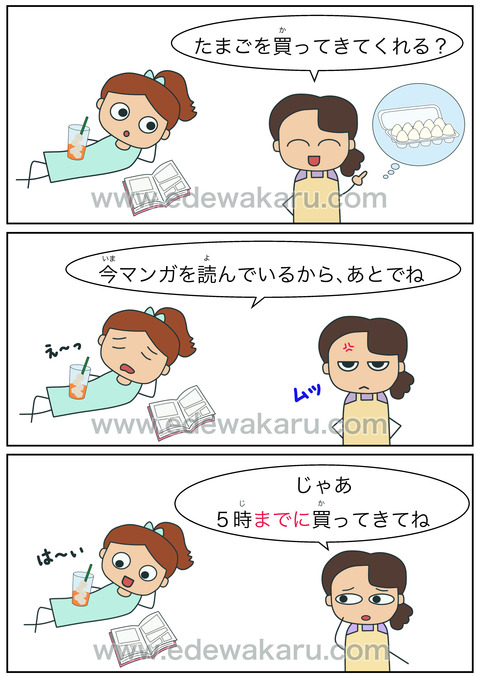
① Mother: Okay, then buy it by 5 o’clock.
[Deadline] 5 o’clock
→ Buy it before it gets to be 5 o’clock.
② A: Can you lend me 1,000 yen? I’ll pay you back by Saturday!
[Deadline] Saturday
→ I’ll pay you back before Saturday comes!
③ Please submit your report by next week.
[Deadline] Next week
→ Please submit your report before next week comes.
④ Boyfriend: Think about where you want to go on Sunday before we meet tomorrow.
[Deadline] Tomorrow
→ Think about it before we meet tomorrow.
⑤ I want to pass N2 before I study abroad in Japan.
[Deadline] When I study abroad
→ I want to pass N2 before studying abroad in Japan.
⑥ I want to get married before I turn 30.
[Deadline] 30 years old
→ I want to get married before the time I turn 30.
⑦ Let’s finish our homework before Mom gets back!
[Deadline] When Mom gets back
→ Let’s finish our homework before Mom gets back!
Remember that when it is used with a verb, it attaches to the [dictionary form] 😀
[Grammar patterns that use 「まで」]
〜たまでだ・〜たまでのことだ
〜たらそれまでだ・〜ばそれまでだ
〜ないまでも
〜に至るまで
〜までして
〜までだ・〜までのことだ(V dictionary form+までだ)
〜までに
〜までになる
〜までもない
In context 7 examples
母:たまごを買ってきてくれる?娘:今マンガを読んでいるから、あとでね母:じゃあ、5時までに買ってきてね(復習:〜てくる(継起))
Mother: Could you buy some eggs for me? Daughter: I’m reading manga right now, so later. Mother: Okay, then buy them by 5 o’clock. (Review: 〜てくる (sequence))
A:1000円貸してくれる?土曜日までに返すから!B:いいよ〜(復習:貸す・借りる(説明))(復習:貸す・借りる(練習))
A: Can you lend me 1,000 yen? I’ll pay you back by Saturday! B: Sure~ (Review: lend and borrow (explanation)) (Review: lend and borrow (practice))
来週までに、レポートを出すようにしてください(復習:〜ようにする)
Please make sure to submit your report by next week. (Review: 〜ようにする)
彼氏:日曜日はどこに行きたいか、明日会うまでに考えといてね彼女:うん、わかった(復習:〜とく・〜どく)
Boyfriend: Think about where you want to go on Sunday before we meet tomorrow. Girlfriend: Okay, got it. (Review: 〜とく・〜どく)
日本に留学するまでに、N2に合格したいと思っています
I want to pass N2 before I study abroad in Japan.
30歳になるまでに結婚したいな〜
I want to get married before I turn 30~
お母さんが帰ってくるまでに、宿題をやっちゃおう!(復習:〜ちゃう・〜じゃう)
Let’s finish our homework before Mom gets back! (Review: 〜ちゃう・〜じゃう)
Read the original source text
Meaning
その日が来る前に〜
その時が来る前に〜
その時間になる前に〜
How to use it
動詞[辞書形]+までに
時間・日にち+までに
Explanation
「〜までに」は「その日が来る前に〜」「その時が来る前に〜」「その時間になる前に〜」という意味を表す文型です。この文型は、時や時間を表す表現と一緒に使い
【期限】や【締め切り】
を表します。
[例]
①母:じゃあ、5時
までに
買ってきてね
【期限】5時
→5時になる前に買ってきてね
②A:1000円貸してくれる?土曜日
までに
返すから!
【期限】土曜日
→土曜日になる前に返すから!
③来週
までに、レポートを出すようにしてください
【期限】来週
→来週になる前に、レポートを出すようにしてください
④彼氏:日曜日はどこに行きたいか、明日会う
までに
考えといてね
【期限】明日
→明日会う前に考えといてね
⑤日本に留学する
までに、N2に合格したいと思っています
【期限】留学する時
→留学する前にN2に合格したいと思っています
⑥30歳になる
までに
結婚したいな〜
【期限】30歳
→30歳になる時より前に結婚したいな〜
⑦お母さんが帰ってくる
までに、宿題をやっちゃおう!
【期限】お母さんが帰ってくる時
→お母さんが帰ってくる前に、宿題をやっちゃおう!
動詞と使う場合は
[辞書形]
につくと覚えておきましょう😀
【「まで」がつく文型】
〜たまでだ・〜たまでのことだ
〜たらそれまでだ・〜ばそれまでだ
〜ないまでも
〜に至るまで
〜までして
〜までだ・〜までのことだ(V辞+までだ)
〜までに
〜までになる
〜までもない
日本語文型辞典
Meaning
Basic information: Nまでに/V-るまでに
Attached to a noun indicating time or a clause indicating an event, it indicates a deadline for an action. It is followed by an expression indicating an action or effect, and expresses that it will take place at some point before the deadline. “-まで…する” indicates that an action or state continues all the way “until a certain point,” while “…までに…する” indicates the occurrence of an event, not continuation. Therefore, an expression of continuation cannot be used after “…までに.”
Examples: ① Please submit the report by next Thursday. ② By what time should I come? ③ I want to finish this work by tomorrow. ④ I want to finish reading this book before summer vacation ends.
Example (incorrect): I’ll wait here until five o’clock.
Example (correct): I’ll wait here until five o’clock.
Also, apart from phrases indicating deadlines, there is the fixed expression “参考までに,” used in letters and the like. It means “for your reference” or “this might be helpful as a reference.”
Example: For your reference, I am sending you the materials.
Read the original source text
Meaning
基本情報NまでにV-るまでに説明時間を表す名詞や出来事を表す節に付いて、動作の期限や締切を表す。後ろには動作や作用を表す表現を伴って、その期限以前のある時点に動作や作用が行われることが表される。「-まで…する」は動作や状態が「ある時点まで」ずっと続くことを表すが、「…までに…する」の方は継続ではなく、ある出来事の生起を表す。したがって、「…までに」の句では後ろに継続を表す表現を用いることができない。例文① レポートは来週の木曜日までに提出して下さい。② 何時までに伺えばよろしいですか。③ 明日までにこの仕事を済ませてしまいたい。④ 夏休みが終わるまでにこの本を読んでしまいたい。例文(誤) 5時までにここで待っています。例文(正) 5時までここで待っています。説明また、期限を表す句とは別に、手紙などに使われる慣用的な表現で、「参考までに」という句がある。これは「参考のために」「参考になるかもしれませんので」という意味で用いられる。例文(例) ご参考までに資料をお送りします。
日本語文型辞典 英語版
Meaning
【までに】[Nまでに][V-るまでに]
Attached to nouns of time or clauses which show events, expresses the time frame or deadline of an action. When an expression which shows an action or function comes after this phrase, it shows that the action or function will take place at a point in time before the given time period or deadline.
...まで...する shows that an action or situation continues until a certain point in time, but ...までに...する does not denote continuity and demonstrates the occurrence of a certain event. Therefore, phrases expressing continuity cannot be used after ...までに.
(×)5時までにここで待っています。
I will be waiting here until five o’clock.
(○)5時までここで待っています。
I will be waiting here until five o’clock.
Apart from demonstrating time frames, there is an idiom 参考までに that is used in letters, etc. Here it means “for reference” or “for your information.”
(例)ご参考までに資料をお送りします。
I will send the documents for your reference.
In context 4 examples
レポートは来週の木曜日までに提出して下さい。
Please submit your report by Thursday of next week.
何時までに伺えばよろしいですか。
What time should I be there by?
明日までにこの仕事を済ませてしまいたい。
I want to get this job finished by tomorrow.
夏休みが終わるまでにこの本を読んでしまいたい。
I want to finish reading this book by the end of summer vacation.
日本語NET JLPT文法解説まとめ
Meaning
Before that time or date arrives.
How to use it
V (dictionary form) + までに
N (time/date) + までに
Explanation
“までに” indicates “time limit”.
Used when talking about doing something within a given time period.
In context 13 examples
レポートは来週の水曜日までに出してください。
Please submit the report by next Wednesday.
死ぬまでに1度はアフリカへ行ってみたいです。
I'd like to go to Africa at least once before I die.
月末までに、きちんと家賃を払ってくださいね。
Please make sure to pay the rent by the end of the month.
今日の5時までに、終わらせてください。
Please finish it by five o'clock today.
参加したい人は、明日までに連絡ください。
If you'd like to participate, please let me know by tomorrow.
イベントは朝9時からスタートしますから、8時までに学校に来てください。
The event starts at 9 a.m., so please come to school by 8.
30歳になるまでに結婚したいです。
I'd like to get married by the time I turn 30.
トムさんの分はないので、彼が来るまでに食べてしまってください。
There's none for Tom, so please finish eating before he gets here.
この本、15日までに返してくださいね。
Please return this book by the 15th.
部長が出張から戻ってくるまでに、なんとかこの資料を完成させなければ。
I have to somehow finish these materials before the department manager returns from his business trip.
大学を卒業するまでに、なんとか仕事を見つけたい。
I want to somehow find a job before I graduate from university.
日が暮れるまでに帰らないと、怒らちゃう。
If I don't get home before dark, I'll get scolded.
シンデレラは夜12時までに帰らないと魔法が解けるということで慌てて帰りました。
Cinderella hurried home because the spell would break if she didn't return by midnight.
Read the original source text
Meaning
その時間や日付が来る前に
How to use it
V(辞書形)+ までに
N(時間 / 日付)+ までに
Explanation
“までに” indicates “time limit”.
Used when talking about doing something within a given time period.
毎日のんびり日本語教師
How to use it
Noun + までに
Verb dictionary form + までに
Explanation
Used with words expressing time, it indicates the final deadline for starting or completing an action.
「参考までに」(for reference only) is a set expression and is unrelated to this grammar.
Notes
Nothing in particular.
In context 8 examples
午後2時までに受け付けを済ませてください。
Please finish checking in by 2 p.m.
夏までに5kg痩せたい。(想在夏天之前瘦5kg。)
I want to lose 5 kg by summer.
新校舎は5月までに完成する予定だ。(新校舍预计5月之前完工。)
The new school building is scheduled to be completed by May.
仕事終わらない。せめて10時までには帰りたい。(工作做不完。至少想在10点之前回去。)
I can't finish work. At least, I want to get home by 10.
なぜ失敗したのか、明日までに自分で考えておいてください。
Please think for yourself by tomorrow about why you failed.
明日までには結論を出さなければいけない。
I have to reach a conclusion by tomorrow.
60歳までに死にたい。(我想在60岁之前死。)
I want to die before I turn 60.
死ぬまでに一度はこの目でオーロラを見てみたい。(在死之前想亲眼看看极光。)
Before I die, I want to see the aurora with my own eyes at least once.
Read the original source text
How to use it
名詞+までに
動辞形+までに
Explanation
時間を表す語について、動作の開始、終了の最終的な期限を表します。
「参考までに(仅供参考/谨供参考)」は慣用表現で、この文法とは関係ありません。
Notes
特になし
NINJAL 日本語文型データベース
Meaning
Used to indicate the deadline by which an action or event must be completed.
How to use it
Vるまでに
Nまでに
Notes
「~」 takes words indicating a point in time or a sentence expressing an instantaneous action or event. After 「〜まで」 comes a sentence expressing an instantaneous action or event.
In context 11 examples
夏休みが終わるまでに本をあと10冊読んでしまいたい。
I want to finish reading ten more books before summer vacation ends.
チャイムが鳴るまでに教室に入って、自分の席に座ってください。
Please enter the classroom and sit in your seat before the bell rings.
夏が来るまでにプールの修理工事が終わるだろうか。
I wonder if the pool repairs will be finished before summer comes.
旅行に出発するまでにやっておかなければならないことがたくさんあります。
There are many things I have to do before leaving on my trip.
「お母さん、外で遊んでくるよ」「暗くなるまでには帰ってきなさいよ」
“Mom, I’m going outside to play.” “Be back by the time it gets dark.”
レポートは18日までに提出すること。
Submit your report by the 18th.
20歳までに車の免許を取るつもりです。
I plan to get my driver’s license by the time I’m 20.
この仕事は何としても期日までに終わらせなければならない。
I have to finish this work by the deadline, no matter what.
宿泊日の3日前までに予約をキャンセルした場合、キャンセル料はかかりません。
If you cancel your reservation at least three days before your stay, there is no cancellation fee.
地球温暖化の対策を取らなければ、2100年までに世界の平均気温は4度上昇すると言われている。
It is said that if measures are not taken to address global warming, the world’s average temperature will rise by 4 degrees by 2100.
「今、出先ですが、5時までには会社に戻ります」
“I’m out right now, but I’ll be back at the office by five.”
Read the original source text
Meaning
ある動作・出来事が完了する期限を表すときに使います。
How to use it
Vるまでに
Nまでに
Notes
「~」には、時点を表す言葉や瞬間的な動作・出来事を表す文がきます。「〜まで」の後には、瞬間的な動作や出来事を表す文がきます。
IMABI
The Particle まで II
Read this IMABI lesson ↗Explanation
The Particle まで II
Back in Lesson 63, we learned that the particle まで has four broad usages which all center around the concept of “extent” while differing on the exact grammatical mechanics. In that same spirit, we will be investigating other applications of まで, categorizing by how まで functions from the point of view of part of speech.
Usage 1: Case Particle まで = “Until/Up to”
Usage 2: (Range-Indicating) Case Particle まで = “From… To…”
Usage 3: Adverbial Particle まで = Extremity
Usage 4: Adverbial Noun/Dummy Noun = Severe Degree/Furthest
Usage III: ~てまで
A very important application of Usage III of まで which was not covered in the first lesson is when it follows the て form of verbs. This pattern indicates that the agent goes through the effort despite their reluctance to bring about the following clause. If the following clause fails, it is often followed by the particle のに, which is then followed by the ultimate consequence.
1. 県民大会けんみんたいかいを開いてまで反対を訴うったえたのに、オスプレイは配備はいびされてしまった。
Although we voiced our protest by going as far as to open a meeting of the prefecture citizens, the Ospreys ended up being deployed.
From NHK on January 22, 2012.
2. 体を壊してまで、仕事を続ける。
To continue the/a job to the point of damaging one’s health.
3. 「苦肉の策」は自分の身を傷めてまでも敵を欺くことを指す言葉です。
“Kuniku no saku” is a phrase that refers to deceiving an enemy even at the cost of hurting oneself.
As an application of Usage III, the relationship ~てまで has with the negative is complicated. Consider the following:
4. お金を払ってまでコーラを飲まない。
I don’t drink coke to the point of spending money for it.
One major reason for why the extreme degree (Usage III) iteration of まで is said to not work with the negative is because the extreme degree marked by まで necessitates that something occur because of it. This remains true for Ex. 4 in how it cannot be interpreted. Meaning, Ex. 4 cannot mean “I go so far to spend money to not drink coke.” Here, the negation can be seen negating the premise of the entire sentence. Even so, there are still two potential interpretations of the sentence.
4′. [お金を払ってまでコーラを飲ま]ない。
I don’t [drink coke to the point of spending money for it].
(Agent doesn’t drink coke)
4”. [お金を払って]までコーラを飲まない。
I don’t drink coke to the point of [spending money for it].
(Agent does drink coke but doesn’t pay for it)
5. 10万ドル払はらってまでテキサス大学に入りたくないよ。
I don’t want to go to the University of Texas to the point of paying $100,000.
Usage III: ~までして
Of the same vein as ~てまで but with a distribution, ~までして is seen after nouns (including verbal nouns with する) and adverbial determiners. Intrinsically, this is just the て form of Usage III being used with する, and as such,する is not restricted to being in this form (Ex. 9).
6. そこまでして勝ちたいのか。
You’d go that far just to win?
7. 何故そうまでして嘘をつかなきゃいけないんだよ!
Why would you have to go that far to lie?
8. 徹夜{までして・してまで}とても頑張ったそうです。
I heard that (he) tried so hard that he went so far as to stay up all night.
9. 借金{までして・してまで}物を買う人がいますが、どうしてお金が貯まってから買わないのでしょうか。
There are people who will by things to the point of going into debt, but why is it that they don’t buy (those things) once they’ve saved up the money (for them)?
10. 回収まですることなのでしょうか。
Do (they) really need to go so far as to recall (it)?
Usage IV: ~まで(のこと)だ = The Extent of the Matter at hand
The pattern ~まで(のこと)だ indicates that the intent of the agent does not extent beyond the action in question. This intent to not go beyond the extent declared, however, is borne from a willpower made possible only by there being no perceivable other option. That in and of itself, though, is presented in a light-hearted, unserious manner by the part of the agent.
The inclusion of のこと both emphasizes the structure and re-nominalizes the phrase as a whole. This subtle difference is what prevents this structure from being alternatively interpreted as severe degree, which would otherwise be inherent of the dummy-noun まで when it possesses a far more adverbial role.
11. 誰も協力してくれないんなら、自分でやってみるまでさ。
If no one else will help out, I’ll just have to do it myself.
12. 来月ビザが更新できないのであれば、帰国するまでのことです。
In the case I can’t renew my visa next month, then I’ll be returning to my country, and that’s that.
13. 給料があがらないのなら、転職するまでだ。
If your salary doesn’t go up, then switch jobs: that’s that.
14. ここまでして罪を認めないなら、裁判を起こすまでだ。
If you’ve gone this far yet won’t admit to your wrongdoing, then I am left with no other choice but to file a lawsuit.
Whenever this pattern is used with the past tense, it indicates how the action of the agent was inconsequential, which although in line with what is above, is usually discussed as a separate
15. 考え事をしていたまでです。
I was just thinking (and nothing more).
16. 人として正しいことをしたまでだ。
I did only what was right as a person (and nothing more).
Usage IV: ~までもない
~までもない indicates a lack of need to go so far as to do the act in question, and it is most often translated as “there is no need to…”
17. それをするまでもない。
There’s no need to do that.
18. 手紙に書くまでもないことだから、電話で伝える。
Because it’s not necessary to write a letter, I’ll tell you on the telephone.
19. 確かめるまでもなく明らかだった。
It was clear without even having to check.
20. それは言うまでもないよ。
That goes without saying.
Usage IV: ~ないまでも
The pattern ~ないまでも, while similar in construction to ~までもない, above, differs with how も functions grammatically. Here, も functions as a conjunctive particle indicating a contrastive circumstance (逆接).
The exact nuancing at hand indicates that V1, though not reaching the extent it could, still reaches the threshold with which V2 is true, translating more literally into English as “even though not quite to the point of…” The key to using this structure naturally is making sure that V1 be either an extreme example or ideal (that can never be reached = extreme situation) and that V2 (the actual result) be within the realm of acceptability.
21. セス先生のお父さんは、プロにはなれないまでも、ゴルフをやり続けていくつもりらしい。
Seth Sensei’s father apparently intends on continuing playing golf although he may never quite become a pro.
22. 毎年とは言わないまでも、数年に一度はエアコンフィルターを交換しておいた方がいいですよ。
Although not quite every year, it’d be best to change out your air conditioner’s filter at least once every other several years.
Usage III: ~(ほど)までに
When after the 連体形 of a verb, ~までに1 may indicate how said event is now well within the realm of possibility. In this sense, the severe degree to which this is in line with Usage IV, but given how the adverbial particle ほど may intervene in the structure, the adverbial particle nature of まで indicating an extremity is also strongly felt. This application of まで is best translated as “to the point of.”
23a. わたしは死ぬほど(までに)苦くるしんだ。
23b. わたしは死ぬ(ほど)までに苦しんだ。
I suffered to the point of death.
24. 彼らは生きている人間と見紛うまでに精巧なオートマトンを作り出した。
They produce an automaton so exquisitely to the point it could be confused for a living human being.
The use of the particle に clarifies the intensity as a metaphor as opposed to a literal realization of V1 This can be contrasted with Usage 1 of まで after verbs, which does have V1‘s realization taken literally. Note that, though not discussed in Lesson 63, Usage 1 of まで when after verbs may be preceded by とき (when) as well as くらい・ほど with no change in meaning or function.
25. テイラー君は死ぬ(とき)まで苦しんでいた。
Taylor-kun had suffered until (the moment) he died.
In the case of くらい・ほど being followed by まで, まで would normally not follow given how setting an estimated goal as the furthest extent would limit further development of the situation that might follow.
26. 胃痛になるほど(まで)悩んだ。
I worried by myself (up) to the point of having stomach aches.
27. カラオケで歌えるようになるくらい(まで)練習しなさい。
Please practice to the point (until) you can sing at karaoke.
These examples also indicate how the extent of time Usage I まで establishes blends into the particle’s ability to indicate degree/severity, as an intense situation unfolding described by the situation still requires time to occur, though whether time elapsing is really at the forefront of the speaker’s mind depends on the severity being described. For instance, in Ex. 26, the anxiety the speaker experienced could have onset the stomach pain instantaneously, but there is nothing intrinsic about Usage III まで seen here that indicates a more concrete temporal interpretation.
Meanwhile, in Ex. 27, まで can more safely be interpreted as Usage I > Usage III, as the degree is not severe. The same can be said for Ex. 28.
28. 小さい文字がはっきり読めるまで画面を明るくしました。
I brightened up the screen to the point I could clearly read (the) small print.
29. ミドリを入れるまで、ドリンクは緑色ではなかった。
The drink was not green until I added in the Midori.
However, a key difference between Usage I and Usage III is that severe degree as opposed to extent of time cannot be attributed to a negative outcome2 (Ex. 29), as we also saw with ~てまで. This critical feature of Usage III is what also distinguishes it from other particles which denote extreme situations like さえ3.
Grammatically speaking, the only context in which Usage 1/Usage III and さえ appear, albeit with different meanings, where confusion may consequently occur is when they follow a noun with the potential of an intervening case particle, most notably に. That being said, consider the difference between the following:
30a. 親にまでゲイであることを打ち明けた。
30b. 親にさえゲイであることを打ち明けた。
30c. 親にまでゲイであることを打ち明けなかった。
30d. 親にさえゲイであることを打ち明けなかった。
30e. 親にまではゲイであることを打ち明けなかった。
30f. 親にまでゲイであることを打ち明けたのではない。
30g. 親にもゲイであることを打ち明けなかった。
30h. 親にでもゲイであることを打ち明けなかった。
30a. I went so far as to come out as gay to my parents.
30b. I even came out as gay to my parents.
30c. I didn’t take that final step of coming out as gay to my parents.
30c’. I didn’t come out as gay to the extent of doing so to my parents.
30d. I didn’t even come out as gay to my parents.
30d’. I didn’t come out as gay to my parents on top of (who I did come out to). X
30e. I didn’t come out as gay to my parents (but I did manage to do so to others).
30f. I did not make that final step of coming out as gay to my parents.
30g. I also/even didn’t come out as gay to my parents.
30h. I didn’t come out as gay, even to my parents.
Ex. 30 forces us to consider how まで and さえ differ within the broad distribution – affirmative/negative sentences – where they may both occur.
30a. indicates that agent likely came out to their parents as a last resort, with their parents being the final extent.
30b. indicates that the agent coming out to their parents is a big deal, with さえ heavily emphasizing the sense of “even.” Whether their parents were the last, crucial people to find out is not indicated.
30c. has two interpretations – 30c and 30c’ – based on the consequence of the extent set by まで. In 30c, the agent’s parents are viewed as the highest source of trust between the agent and that the agent did not go to the extent of even coming out to them. This reading rests on the notion that まで is more akin to Usage III, which albeit irregular, is not impossible due to the agent’s situation not changing – the agent is still in the closet. 30c’ is the more likely interpretation, as it applies that while the agent’s parents may still be the furthest extent coming out to may be carried out, the issue is not serious enough to warrant having to go that far; meaning, some people were told, just not to the extent of telling the parents.
30d. The more natural rendering of the first interpretation of 30c, the agent highly emphasizes how they didn’t even come out to their parents; however, the possibility of 30d’, although unlikely, is striking both in how it exists and how it still differs from 30c’, which rests on a far more literal interpretation of さえ4 that has disappeared from negative sentences in modern usage, thus the X grammaticality judgment.
30e. is a non-ambiguous rendering of 30c’.
30f. is a non-ambiguous yet far heavier rendering of 30c, negating a result that the agent is culpable for not doing, which the agent will subsequently explain their reasoning for.
30g. The most no-strings-attached rendition, the use of も does not indicate that the choice of not coming out to their parents is extreme, but it does give the sense that their parents weren’t the only ones not told.
30h. With the use of でも, the negation is heavily stilted towards [親に], but just like with も, the predicate of “coming out” is not being presented as an extreme situation.
The paraphrases 30e-f are most telling as for how まで and さえ differ in negative constructions. While wide-scope interpretations like 30c are possible with まで but more likely to be rephrased with さえ, narrow-scope interpretations like in 30c’, 30e-f are far more likely with まで but also impossible with さえ.
31. テイラー君{まで 〇・さえ X}試験に合格したのではない。(Narrow Scope)
It is not the case (the students) passed the test to the point Taylor-kun did.
Usage I or III: まで + Case Particles
While まで’s relationship with the other particles is fairly predictable in general practice, its dual case/adverbial particle results in rather weird combinations. Excluding ~までに and ~までで which were covered in Lesson 63, consider the following combinations.
~までが
So long as the particle まで is used as a case particle, it may be optionally followed by the case particle が. The effect this has on the sentence is one of grammatical emphasis. This also applies when が is used in conjunction with から (Usage II).
32. 足の下の畳たたみまでが冷ひえて来るので、一人で湯ゆに行こうとすると、 「待って下さい。私も行きます。」と、今度は女が素直すなおについて来た。
While I was about to go bathe alone since even the tatami mat underneath my feet was getting cold, she finally came by this time and meekly said, “Wait for me. I’m going too.”
From 『雪国』 by 川端康成.
33. 緊急時において、経営層から現場の第一線までが適切に行動できるよう、それぞれの役割に応じた訓練を実施しております。
So that (we) can adequately mobilize from our management level to those on the front line, we routinely conduct drills suited to every role.
~までを
So long as the particle まで is used as a case particle, it may be optionally followed by the case particle を. The effect this has on the sentence is one of grammatical emphasis. This also applies when を is used in conjunction with から (Usage II).
34. 円周率は小数点以下2000桁までを暗記している。
I have pi memorized up to 2000 digits past the decimal point.
35. 子供からお年寄りまでを繋げるプロジェクトを開催いたしました。
We opened a project to connect (the community) from children to the elderly.
~をまで
Though excessively rare, the case particle を may appear before まで when it indicates extreme degree. This is highly literary and unlikely to ever be heard in the spoken language. Though, due to the emphatic nature of the combination, it is usually rendered as ~をまでも (see below).
~までへ
Structurally redundant though not impossible, this case particle combination would be used to exaggerate the distance factor behind the extent set by まで.
36. 我々は社員が納得できるビジョンを組織のトップから組織の隅々までへと浸透させていく。
We are aimed to spread a vision that our employees can back from those in the senior management of the organization to those in its every last nook and cranny.
~へまで
The reverse, ~へまで, is very common. Here, へ ought to be viewed as a case particle, while まで should be viewed as an adverbial particle (Usage III) which emphasizes such a great distance as the extent reached.
37. 彼は大破局で得た傷も癒えぬまま、未来へまで飛び込んだ。
With the wounds he had earned from his major collapse unhealed, he jumped into his future (that being the furthest extent he could jump).
~にまで
This combination has about just as many interpretations as に does usages, with the case particle role being established by に and the (extreme) degree being emphasized by まで.
38. この戦いは今日にまで至る。
This fight spans up into the present day.
39. 山の水が湖に流れるのだが、車の走っている道にまで流れているのだ。
Though the mountain water flows into the lake, it is flowing up into streets with cars passing.
40. 寒月君、君の事を譫語(うわがと)にまで言った婦人の名は、当時秘密であったようだが、もう話しても善かろう。
Coldmoon, my dear fellow, I seem to remember at the time the name of that young lady who called your name from the depths of her delirium was to be kept secret, but surely the time has now come when you can speak of her?
From 『吾輩は猫である』by 夏目漱石.
41. 客足が約1割にまで減ったという。
(They) report that customer traffic has dropped to approximately 10% (of what it usually is).
42. 女には逃げられるわ、ヤクザには脅されるわ、終いにゃ売春婦にまで騙された。
Being avoided by women and intimidated by the yakuza, in the end, I was even deceived by a prostitute.
43. 今までは車屋のかみさんでも捕
つらまえて、鼻づらを松の木へこすりつけてやろうくらいにまで怒
おこっていた主人が、突然この反古紙
ほごがみを読んで見たくなるのは不思議のようであるが、こう云う陽性の癇癪持ちには珍らしくない事だ。
The fact that my master, who until but a moment ago was so frenetically incensed that he could happily have grabbed the wife of the rickshawman and ground her snout against some pine tree, now suddenly wishes to read old scraps of paper may seem a little strange, but actually such conduct is not all that unusual in an extrovert so easily entered.
From 『吾輩は猫である』by 夏目漱石.
Usage III~IV: ~までも + {が・を}
While we have established how ~までも exists as an emphatic variant of Usage III, the adverbial nature of both まで and も also have the added effect of canceling out the case particles が・を, yet on seldom occasion, this factor alone fails to delete them. This results in three odd particle combinations:
・までもが
・までをも
・までもを
While ~までもを may be explained due to the combination をも being heavily used in old-fashioned speech – indicating that the ellipsing of を before adverbial particles5 is a recent phenomenon, the grammaticality of までもが and までもを are both contingent on the lexicalization of the particle も within adverbial noun6 phrases, most notably with interrogatives but also with Usage III of まで. If a speaker finds 誰もに acceptable (as opposed to using the established 誰にも), that same speaker will likely find ~までもを acceptable.
44. 日本人までをも魅了みりょうした異文化いぶんかの習慣しゅうかん
A tradition of another culture that has fascinated even Japanese people
45. あの戦争で愛する夫おっとと父をなくし、終戦後しゅうせんごの混乱こんらんの中で母までもをなくし、あわただしい結婚生活の中で子どもをもうけるいとまなく、以来天涯孤独いらいてんがいこどくの身みをかかえて生きて参まいりました。
I lost my beloved husband and father in that war, and I even lost my mother in the turmoil after the end of the war, and with there being no time to bear a child in my busy married life, I have since picked myself up and lived on alone with no relatives.
From 『海辺のカフカ 上』 by 村上春樹.
46. 忠雄名義の銀行預金口座から、ほぼ全額が引き出されていた。御丁寧なことに、定期預金までもが解約されていた。
Nearly all of the funds had been withdrawn from their bank account which was under his name, Tadao. Even the money that had been in his savings account had been thoroughly removed and account closed.
From 『祈りの幕が下りる時』by 東野圭吾.
Provided まで indicates extreme degree and it is already emphasized by を coming first, that means ~をまでも is also possible. Though highly literary, do not be surprised if you encounter this variant.
47. 同時に、一方では、あのおそろしい猛火と混乱との中で、しまいまで、おちついて機敏に手をつくし、または命をまでもなげ出して、多くの人々をすくい上げた、いろいろの人々のとうといはたらきをも忘れてはなりません。
Meanwhile, simultaneously, amid those terrifying flames and the chaos, one mustn’t forget the noble labor of all the people who, composed and with their quick wit left no stone unturned, sacrificing even their lives, rescued so many people.
From 『大震火災記』by 鈴木三重吉.
参照
二種のマデ節について by 小西正人.
とりたて詞「まで」「さえ」についてー否定との関わりからー by 茂木俊伸.
「さえ・まで」の分布についての一考察 by 朱武平.
This iteration of the particle に is its adverbial function, not its temporal function. ↩︎
It is the extreme situation which affirmatively brings about some change which prevents Usage III from being used with a main clause in the negative, as that change brought about such a severe threshold would consequently not occur. If the sentence does not necessarily describe a change in a situation and the speaker is trying to describe a severe lack of extent which something should have gone for emphatic effect, Usage III may appear valid with the negative, but distinguishing it from Usage I would be both impossible and unproductive. ↩︎
Usage III and さえ both describe extreme situations, but they denote opposite ends of what is meant by “extreme” in negative sentences. まで does not agree with negation as an intensifier, thus being rendered as Usage I when used with ~ない, and as such, it still describes a threshold at the furthest (think upward) extent the situation does not attain. さえ, on the other hand, does agree with negation as an intensifier, and it denotes the lowest extent (think downward) that the situation does not go. ↩︎
さえ’s literal interpretation is “in addition to,” in which case the “extent” of the action is expanded to fit the added element. In the context of さえ…ない, this would be a narrow interpretation, which it no longer has in negative sentences in Modern Japanese. ↩︎
In which case, もは has never existed due to conflicting semantics. ↩︎
While まで here still demonstrates an “extremity,” the appearance of both ~までをも and ~までもを indicates how まで is rather fluid when it comes to part of speech. ↩︎
In context 60 examples
県民大会けんみんたいかいを開いてまで反対を訴うったえたのに、オスプレイは配備はいびされてしまった。
Although we voiced our protest by going as far as to open a meeting of the prefecture citizens, the Ospreys ended up being deployed.
体を壊してまで、仕事を続ける。
To continue the/a job to the point of damaging one’s health.
「苦肉の策」は自分の身を傷めてまでも敵を欺くことを指す言葉です。
“Kuniku no saku” is a phrase that refers to deceiving an enemy even at the cost of hurting oneself.
お金を払ってまでコーラを飲まない。
I don’t drink coke to the point of spending money for it.
10万ドル払はらってまでテキサス大学に入りたくないよ。
I don’t want to go to the University of Texas to the point of paying $100,000.
そこまでして勝ちたいのか。
You’d go that far just to win?
何故そうまでして嘘をつかなきゃいけないんだよ!
Why would you have to go that far to lie?
徹夜{までして・してまで}とても頑張ったそうです。
I heard that (he) tried so hard that he went so far as to stay up all night.
借金{までして・してまで}物を買う人がいますが、どうしてお金が貯まってから買わないのでしょうか。
There are people who will by things to the point of going into debt, but why is it that they don’t buy (those things) once they’ve saved up the money (for them)?
回収まですることなのでしょうか。
Do (they) really need to go so far as to recall (it)?
誰も協力してくれないんなら、自分でやってみるまでさ。
If no one else will help out, I’ll just have to do it myself.
来月ビザが更新できないのであれば、帰国するまでのことです。
In the case I can’t renew my visa next month, then I’ll be returning to my country, and that’s that.
給料があがらないのなら、転職するまでだ。
If your salary doesn’t go up, then switch jobs: that’s that.
ここまでして罪を認めないなら、裁判を起こすまでだ。
If you’ve gone this far yet won’t admit to your wrongdoing, then I am left with no other choice but to file a lawsuit.
考え事をしていたまでです。
I was just thinking (and nothing more).
人として正しいことをしたまでだ。
I did only what was right as a person (and nothing more).
それをするまでもない。
There’s no need to do that.
手紙に書くまでもないことだから、電話で伝える。
Because it’s not necessary to write a letter, I’ll tell you on the telephone.
確かめるまでもなく明らかだった。
It was clear without even having to check.
それは言うまでもないよ。
That goes without saying.
セス先生のお父さんは、プロにはなれないまでも、ゴルフをやり続けていくつもりらしい。
Seth Sensei’s father apparently intends on continuing playing golf although he may never quite become a pro.
毎年とは言わないまでも、数年に一度はエアコンフィルターを交換しておいた方がいいですよ。
Although not quite every year, it’d be best to change out your air conditioner’s filter at least once every other several years.
わたしは死ぬほど(までに)苦くるしんだ。
I suffered to the point of death.
わたしは死ぬ(ほど)までに苦しんだ。
I suffered to the point of death.
彼らは生きている人間と見紛うまでに精巧なオートマトンを作り出した。
They produce an automaton so exquisitely to the point it could be confused for a living human being.
テイラー君は死ぬ(とき)まで苦しんでいた。
Taylor-kun had suffered until (the moment) he died.
胃痛になるほど(まで)悩んだ。
I worried by myself (up) to the point of having stomach aches.
カラオケで歌えるようになるくらい(まで)練習しなさい。
Please practice to the point (until) you can sing at karaoke.
小さい文字がはっきり読めるまで画面を明るくしました。
I brightened up the screen to the point I could clearly read (the) small print.
ミドリを入れるまで、ドリンクは緑色ではなかった。
The drink was not green until I added in the Midori.
親にまでゲイであることを打ち明けた。
30a. I went so far as to come out as gay to my parents.
親にさえゲイであることを打ち明けた。
30a. I went so far as to come out as gay to my parents.
親にまでゲイであることを打ち明けなかった。
30a. I went so far as to come out as gay to my parents.
親にさえゲイであることを打ち明けなかった。
30a. I went so far as to come out as gay to my parents.
親にまではゲイであることを打ち明けなかった。
30a. I went so far as to come out as gay to my parents.
親にまでゲイであることを打ち明けたのではない。
30a. I went so far as to come out as gay to my parents.
親にもゲイであることを打ち明けなかった。
30a. I went so far as to come out as gay to my parents.
親にでもゲイであることを打ち明けなかった。
30a. I went so far as to come out as gay to my parents.
indicates that the agent coming out to their parents is a big deal, with さえ heavily emphasizing the sense of “even.” Whether their parents were the last, crucial people to find out is not indicated.
30e. is a non-ambiguous rendering of 30c’.
has two interpretations – 30c and 30c’ – based on the consequence of the extent set by まで. In 30c, the agent’s parents are viewed as the highest source of trust between the agent and that the agent did not go to the extent of even coming out to them. This reading rests on the notion that まで is more akin to Usage III, which albeit irregular, is not impossible due to the agent’s situation not changing – the agent is still in the closet. 30c’ is the more likely interpretation, as it applies that while the agent’s parents may still be the furthest extent coming out to may be carried out, the issue is not serious enough to warrant having to go that far; meaning, some people were told, just not to the extent of telling the parents.
30e. is a non-ambiguous rendering of 30c’.
The more natural rendering of the first interpretation of 30c, the agent highly emphasizes how they didn’t even come out to their parents; however, the possibility of 30d’, although unlikely, is striking both in how it exists and how it still differs from 30c’, which rests on a far more literal interpretation of さえ4 that has disappeared from negative sentences in modern usage, thus the X grammaticality judgment.
30e. is a non-ambiguous rendering of 30c’.
The most no-strings-attached rendition, the use of も does not indicate that the choice of not coming out to their parents is extreme, but it does give the sense that their parents weren’t the only ones not told.
The most no-strings-attached rendering: the use of も does not indicate that choosing not to come out to their parents is extreme, but it does give the sense that their parents were not the only ones who were not told.
With the use of でも, the negation is heavily stilted towards [親に], but just like with も, the predicate of “coming out” is not being presented as an extreme situation.
With the use of でも, the negation is weighted heavily toward [親に], but, just as with も, the predicate “coming out” is not being presented as an extreme situation.
テイラー君{まで 〇・さえ X}試験に合格したのではない。(Narrow Scope)
It is not the case (the students) passed the test to the point Taylor-kun did.
足の下の畳たたみまでが冷ひえて来るので、一人で湯ゆに行こうとすると、 「待って下さい。私も行きます。」と、今度は女が素直すなおについて来た。
While I was about to go bathe alone since even the tatami mat underneath my feet was getting cold, she finally came by this time and meekly said, “Wait for me. I’m going too.”
緊急時において、経営層から現場の第一線までが適切に行動できるよう、それぞれの役割に応じた訓練を実施しております。
So that (we) can adequately mobilize from our management level to those on the front line, we routinely conduct drills suited to every role.
円周率は小数点以下2000桁までを暗記している。
I have pi memorized up to 2000 digits past the decimal point.
子供からお年寄りまでを繋げるプロジェクトを開催いたしました。
We opened a project to connect (the community) from children to the elderly.
我々は社員が納得できるビジョンを組織のトップから組織の隅々までへと浸透させていく。
We are aimed to spread a vision that our employees can back from those in the senior management of the organization to those in its every last nook and cranny.
彼は大破局で得た傷も癒えぬまま、未来へまで飛び込んだ。
With the wounds he had earned from his major collapse unhealed, he jumped into his future (that being the furthest extent he could jump).
この戦いは今日にまで至る。
This fight spans up into the present day.
山の水が湖に流れるのだが、車の走っている道にまで流れているのだ。
Though the mountain water flows into the lake, it is flowing up into streets with cars passing.
寒月君、君の事を譫語(うわがと)にまで言った婦人の名は、当時秘密であったようだが、もう話しても善かろう。
Coldmoon, my dear fellow, I seem to remember at the time the name of that young lady who called your name from the depths of her delirium was to be kept secret, but surely the time has now come when you can speak of her?
客足が約1割にまで減ったという。
(They) report that customer traffic has dropped to approximately 10% (of what it usually is).
女には逃げられるわ、ヤクザには脅されるわ、終いにゃ売春婦にまで騙された。
Being avoided by women and intimidated by the yakuza, in the end, I was even deceived by a prostitute.
今までは車屋のかみさんでも捕
Until now, even the wife of a car dealer would catch…
日本人までをも魅了みりょうした異文化いぶんかの習慣しゅうかん
A tradition of another culture that has fascinated even Japanese people
あの戦争で愛する夫おっとと父をなくし、終戦後しゅうせんごの混乱こんらんの中で母までもをなくし、あわただしい結婚生活の中で子どもをもうけるいとまなく、以来天涯孤独いらいてんがいこどくの身みをかかえて生きて参まいりました。
I lost my beloved husband and father in that war, and I even lost my mother in the turmoil after the end of the war, and with there being no time to bear a child in my busy married life, I have since picked myself up and lived on alone with no relatives.
忠雄名義の銀行預金口座から、ほぼ全額が引き出されていた。御丁寧なことに、定期預金までもが解約されていた。
Nearly all of the funds had been withdrawn from their bank account which was under his name, Tadao. Even the money that had been in his savings account had been thoroughly removed and account closed.
同時に、一方では、あのおそろしい猛火と混乱との中で、しまいまで、おちついて機敏に手をつくし、または命をまでもなげ出して、多くの人々をすくい上げた、いろいろの人々のとうといはたらきをも忘れてはなりません。
Meanwhile, simultaneously, amid those terrifying flames and the chaos, one mustn’t forget the noble labor of all the people who, composed and with their quick wit left no stone unturned, sacrificing even their lives, rescued so many people.
Read the original source text
Explanation
The Particle まで II
Back in Lesson 63, we learned that the particle まで has four broad usages which all center around the concept of “extent” while differing on the exact grammatical mechanics. In that same spirit, we will be investigating other applications of まで, categorizing by how まで functions from the point of view of part of speech.
Usage 1: Case Particle まで = “Until/Up to”
Usage 2: (Range-Indicating) Case Particle まで = “From… To…”
Usage 3: Adverbial Particle まで = Extremity
Usage 4: Adverbial Noun/Dummy Noun = Severe Degree/Furthest
Usage III: ~てまで
A very important application of Usage III of まで which was not covered in the first lesson is when it follows the て form of verbs. This pattern indicates that the agent goes through the effort despite their reluctance to bring about the following clause. If the following clause fails, it is often followed by the particle のに, which is then followed by the ultimate consequence.
1. 県民大会けんみんたいかいを開いてまで反対を訴うったえたのに、オスプレイは配備はいびされてしまった。
Although we voiced our protest by going as far as to open a meeting of the prefecture citizens, the Ospreys ended up being deployed.
From NHK on January 22, 2012.
2. 体を壊してまで、仕事を続ける。
To continue the/a job to the point of damaging one’s health.
3. 「苦肉の策」は自分の身を傷めてまでも敵を欺くことを指す言葉です。
“Kuniku no saku” is a phrase that refers to deceiving an enemy even at the cost of hurting oneself.
As an application of Usage III, the relationship ~てまで has with the negative is complicated. Consider the following:
4. お金を払ってまでコーラを飲まない。
I don’t drink coke to the point of spending money for it.
One major reason for why the extreme degree (Usage III) iteration of まで is said to not work with the negative is because the extreme degree marked by まで necessitates that something occur because of it. This remains true for Ex. 4 in how it cannot be interpreted. Meaning, Ex. 4 cannot mean “I go so far to spend money to not drink coke.” Here, the negation can be seen negating the premise of the entire sentence. Even so, there are still two potential interpretations of the sentence.
4′. [お金を払ってまでコーラを飲ま]ない。
I don’t [drink coke to the point of spending money for it].
(Agent doesn’t drink coke)
4”. [お金を払って]までコーラを飲まない。
I don’t drink coke to the point of [spending money for it].
(Agent does drink coke but doesn’t pay for it)
5. 10万ドル払はらってまでテキサス大学に入りたくないよ。
I don’t want to go to the University of Texas to the point of paying $100,000.
Usage III: ~までして
Of the same vein as ~てまで but with a distribution, ~までして is seen after nouns (including verbal nouns with する) and adverbial determiners. Intrinsically, this is just the て form of Usage III being used with する, and as such,する is not restricted to being in this form (Ex. 9).
6. そこまでして勝ちたいのか。
You’d go that far just to win?
7. 何故そうまでして嘘をつかなきゃいけないんだよ!
Why would you have to go that far to lie?
8. 徹夜{までして・してまで}とても頑張ったそうです。
I heard that (he) tried so hard that he went so far as to stay up all night.
9. 借金{までして・してまで}物を買う人がいますが、どうしてお金が貯まってから買わないのでしょうか。
There are people who will by things to the point of going into debt, but why is it that they don’t buy (those things) once they’ve saved up the money (for them)?
10. 回収まですることなのでしょうか。
Do (they) really need to go so far as to recall (it)?
Usage IV: ~まで(のこと)だ = The Extent of the Matter at hand
The pattern ~まで(のこと)だ indicates that the intent of the agent does not extent beyond the action in question. This intent to not go beyond the extent declared, however, is borne from a willpower made possible only by there being no perceivable other option. That in and of itself, though, is presented in a light-hearted, unserious manner by the part of the agent.
The inclusion of のこと both emphasizes the structure and re-nominalizes the phrase as a whole. This subtle difference is what prevents this structure from being alternatively interpreted as severe degree, which would otherwise be inherent of the dummy-noun まで when it possesses a far more adverbial role.
11. 誰も協力してくれないんなら、自分でやってみるまでさ。
If no one else will help out, I’ll just have to do it myself.
12. 来月ビザが更新できないのであれば、帰国するまでのことです。
In the case I can’t renew my visa next month, then I’ll be returning to my country, and that’s that.
13. 給料があがらないのなら、転職するまでだ。
If your salary doesn’t go up, then switch jobs: that’s that.
14. ここまでして罪を認めないなら、裁判を起こすまでだ。
If you’ve gone this far yet won’t admit to your wrongdoing, then I am left with no other choice but to file a lawsuit.
Whenever this pattern is used with the past tense, it indicates how the action of the agent was inconsequential, which although in line with what is above, is usually discussed as a separate
15. 考え事をしていたまでです。
I was just thinking (and nothing more).
16. 人として正しいことをしたまでだ。
I did only what was right as a person (and nothing more).
Usage IV: ~までもない
~までもない indicates a lack of need to go so far as to do the act in question, and it is most often translated as “there is no need to…”
17. それをするまでもない。
There’s no need to do that.
18. 手紙に書くまでもないことだから、電話で伝える。
Because it’s not necessary to write a letter, I’ll tell you on the telephone.
19. 確かめるまでもなく明らかだった。
It was clear without even having to check.
20. それは言うまでもないよ。
That goes without saying.
Usage IV: ~ないまでも
The pattern ~ないまでも, while similar in construction to ~までもない, above, differs with how も functions grammatically. Here, も functions as a conjunctive particle indicating a contrastive circumstance (逆接).
The exact nuancing at hand indicates that V1, though not reaching the extent it could, still reaches the threshold with which V2 is true, translating more literally into English as “even though not quite to the point of…” The key to using this structure naturally is making sure that V1 be either an extreme example or ideal (that can never be reached = extreme situation) and that V2 (the actual result) be within the realm of acceptability.
21. セス先生のお父さんは、プロにはなれないまでも、ゴルフをやり続けていくつもりらしい。
Seth Sensei’s father apparently intends on continuing playing golf although he may never quite become a pro.
22. 毎年とは言わないまでも、数年に一度はエアコンフィルターを交換しておいた方がいいですよ。
Although not quite every year, it’d be best to change out your air conditioner’s filter at least once every other several years.
Usage III: ~(ほど)までに
When after the 連体形 of a verb, ~までに1 may indicate how said event is now well within the realm of possibility. In this sense, the severe degree to which this is in line with Usage IV, but given how the adverbial particle ほど may intervene in the structure, the adverbial particle nature of まで indicating an extremity is also strongly felt. This application of まで is best translated as “to the point of.”
23a. わたしは死ぬほど(までに)苦くるしんだ。
23b. わたしは死ぬ(ほど)までに苦しんだ。
I suffered to the point of death.
24. 彼らは生きている人間と見紛うまでに精巧なオートマトンを作り出した。
They produce an automaton so exquisitely to the point it could be confused for a living human being.
The use of the particle に clarifies the intensity as a metaphor as opposed to a literal realization of V1 This can be contrasted with Usage 1 of まで after verbs, which does have V1‘s realization taken literally. Note that, though not discussed in Lesson 63, Usage 1 of まで when after verbs may be preceded by とき (when) as well as くらい・ほど with no change in meaning or function.
25. テイラー君は死ぬ(とき)まで苦しんでいた。
Taylor-kun had suffered until (the moment) he died.
In the case of くらい・ほど being followed by まで, まで would normally not follow given how setting an estimated goal as the furthest extent would limit further development of the situation that might follow.
26. 胃痛になるほど(まで)悩んだ。
I worried by myself (up) to the point of having stomach aches.
27. カラオケで歌えるようになるくらい(まで)練習しなさい。
Please practice to the point (until) you can sing at karaoke.
These examples also indicate how the extent of time Usage I まで establishes blends into the particle’s ability to indicate degree/severity, as an intense situation unfolding described by the situation still requires time to occur, though whether time elapsing is really at the forefront of the speaker’s mind depends on the severity being described. For instance, in Ex. 26, the anxiety the speaker experienced could have onset the stomach pain instantaneously, but there is nothing intrinsic about Usage III まで seen here that indicates a more concrete temporal interpretation.
Meanwhile, in Ex. 27, まで can more safely be interpreted as Usage I > Usage III, as the degree is not severe. The same can be said for Ex. 28.
28. 小さい文字がはっきり読めるまで画面を明るくしました。
I brightened up the screen to the point I could clearly read (the) small print.
29. ミドリを入れるまで、ドリンクは緑色ではなかった。
The drink was not green until I added in the Midori.
However, a key difference between Usage I and Usage III is that severe degree as opposed to extent of time cannot be attributed to a negative outcome2 (Ex. 29), as we also saw with ~てまで. This critical feature of Usage III is what also distinguishes it from other particles which denote extreme situations like さえ3.
Grammatically speaking, the only context in which Usage 1/Usage III and さえ appear, albeit with different meanings, where confusion may consequently occur is when they follow a noun with the potential of an intervening case particle, most notably に. That being said, consider the difference between the following:
30a. 親にまでゲイであることを打ち明けた。
30b. 親にさえゲイであることを打ち明けた。
30c. 親にまでゲイであることを打ち明けなかった。
30d. 親にさえゲイであることを打ち明けなかった。
30e. 親にまではゲイであることを打ち明けなかった。
30f. 親にまでゲイであることを打ち明けたのではない。
30g. 親にもゲイであることを打ち明けなかった。
30h. 親にでもゲイであることを打ち明けなかった。
30a. I went so far as to come out as gay to my parents.
30b. I even came out as gay to my parents.
30c. I didn’t take that final step of coming out as gay to my parents.
30c’. I didn’t come out as gay to the extent of doing so to my parents.
30d. I didn’t even come out as gay to my parents.
30d’. I didn’t come out as gay to my parents on top of (who I did come out to). X
30e. I didn’t come out as gay to my parents (but I did manage to do so to others).
30f. I did not make that final step of coming out as gay to my parents.
30g. I also/even didn’t come out as gay to my parents.
30h. I didn’t come out as gay, even to my parents.
Ex. 30 forces us to consider how まで and さえ differ within the broad distribution – affirmative/negative sentences – where they may both occur.
30a. indicates that agent likely came out to their parents as a last resort, with their parents being the final extent.
30b. indicates that the agent coming out to their parents is a big deal, with さえ heavily emphasizing the sense of “even.” Whether their parents were the last, crucial people to find out is not indicated.
30c. has two interpretations – 30c and 30c’ – based on the consequence of the extent set by まで. In 30c, the agent’s parents are viewed as the highest source of trust between the agent and that the agent did not go to the extent of even coming out to them. This reading rests on the notion that まで is more akin to Usage III, which albeit irregular, is not impossible due to the agent’s situation not changing – the agent is still in the closet. 30c’ is the more likely interpretation, as it applies that while the agent’s parents may still be the furthest extent coming out to may be carried out, the issue is not serious enough to warrant having to go that far; meaning, some people were told, just not to the extent of telling the parents.
30d. The more natural rendering of the first interpretation of 30c, the agent highly emphasizes how they didn’t even come out to their parents; however, the possibility of 30d’, although unlikely, is striking both in how it exists and how it still differs from 30c’, which rests on a far more literal interpretation of さえ4 that has disappeared from negative sentences in modern usage, thus the X grammaticality judgment.
30e. is a non-ambiguous rendering of 30c’.
30f. is a non-ambiguous yet far heavier rendering of 30c, negating a result that the agent is culpable for not doing, which the agent will subsequently explain their reasoning for.
30g. The most no-strings-attached rendition, the use of も does not indicate that the choice of not coming out to their parents is extreme, but it does give the sense that their parents weren’t the only ones not told.
30h. With the use of でも, the negation is heavily stilted towards [親に], but just like with も, the predicate of “coming out” is not being presented as an extreme situation.
The paraphrases 30e-f are most telling as for how まで and さえ differ in negative constructions. While wide-scope interpretations like 30c are possible with まで but more likely to be rephrased with さえ, narrow-scope interpretations like in 30c’, 30e-f are far more likely with まで but also impossible with さえ.
31. テイラー君{まで 〇・さえ X}試験に合格したのではない。(Narrow Scope)
It is not the case (the students) passed the test to the point Taylor-kun did.
Usage I or III: まで + Case Particles
While まで’s relationship with the other particles is fairly predictable in general practice, its dual case/adverbial particle results in rather weird combinations. Excluding ~までに and ~までで which were covered in Lesson 63, consider the following combinations.
~までが
So long as the particle まで is used as a case particle, it may be optionally followed by the case particle が. The effect this has on the sentence is one of grammatical emphasis. This also applies when が is used in conjunction with から (Usage II).
32. 足の下の畳たたみまでが冷ひえて来るので、一人で湯ゆに行こうとすると、 「待って下さい。私も行きます。」と、今度は女が素直すなおについて来た。
While I was about to go bathe alone since even the tatami mat underneath my feet was getting cold, she finally came by this time and meekly said, “Wait for me. I’m going too.”
From 『雪国』 by 川端康成.
33. 緊急時において、経営層から現場の第一線までが適切に行動できるよう、それぞれの役割に応じた訓練を実施しております。
So that (we) can adequately mobilize from our management level to those on the front line, we routinely conduct drills suited to every role.
~までを
So long as the particle まで is used as a case particle, it may be optionally followed by the case particle を. The effect this has on the sentence is one of grammatical emphasis. This also applies when を is used in conjunction with から (Usage II).
34. 円周率は小数点以下2000桁までを暗記している。
I have pi memorized up to 2000 digits past the decimal point.
35. 子供からお年寄りまでを繋げるプロジェクトを開催いたしました。
We opened a project to connect (the community) from children to the elderly.
~をまで
Though excessively rare, the case particle を may appear before まで when it indicates extreme degree. This is highly literary and unlikely to ever be heard in the spoken language. Though, due to the emphatic nature of the combination, it is usually rendered as ~をまでも (see below).
~までへ
Structurally redundant though not impossible, this case particle combination would be used to exaggerate the distance factor behind the extent set by まで.
36. 我々は社員が納得できるビジョンを組織のトップから組織の隅々までへと浸透させていく。
We are aimed to spread a vision that our employees can back from those in the senior management of the organization to those in its every last nook and cranny.
~へまで
The reverse, ~へまで, is very common. Here, へ ought to be viewed as a case particle, while まで should be viewed as an adverbial particle (Usage III) which emphasizes such a great distance as the extent reached.
37. 彼は大破局で得た傷も癒えぬまま、未来へまで飛び込んだ。
With the wounds he had earned from his major collapse unhealed, he jumped into his future (that being the furthest extent he could jump).
~にまで
This combination has about just as many interpretations as に does usages, with the case particle role being established by に and the (extreme) degree being emphasized by まで.
38. この戦いは今日にまで至る。
This fight spans up into the present day.
39. 山の水が湖に流れるのだが、車の走っている道にまで流れているのだ。
Though the mountain water flows into the lake, it is flowing up into streets with cars passing.
40. 寒月君、君の事を譫語(うわがと)にまで言った婦人の名は、当時秘密であったようだが、もう話しても善かろう。
Coldmoon, my dear fellow, I seem to remember at the time the name of that young lady who called your name from the depths of her delirium was to be kept secret, but surely the time has now come when you can speak of her?
From 『吾輩は猫である』by 夏目漱石.
41. 客足が約1割にまで減ったという。
(They) report that customer traffic has dropped to approximately 10% (of what it usually is).
42. 女には逃げられるわ、ヤクザには脅されるわ、終いにゃ売春婦にまで騙された。
Being avoided by women and intimidated by the yakuza, in the end, I was even deceived by a prostitute.
43. 今までは車屋のかみさんでも捕
つらまえて、鼻づらを松の木へこすりつけてやろうくらいにまで怒
おこっていた主人が、突然この反古紙
ほごがみを読んで見たくなるのは不思議のようであるが、こう云う陽性の癇癪持ちには珍らしくない事だ。
The fact that my master, who until but a moment ago was so frenetically incensed that he could happily have grabbed the wife of the rickshawman and ground her snout against some pine tree, now suddenly wishes to read old scraps of paper may seem a little strange, but actually such conduct is not all that unusual in an extrovert so easily entered.
From 『吾輩は猫である』by 夏目漱石.
Usage III~IV: ~までも + {が・を}
While we have established how ~までも exists as an emphatic variant of Usage III, the adverbial nature of both まで and も also have the added effect of canceling out the case particles が・を, yet on seldom occasion, this factor alone fails to delete them. This results in three odd particle combinations:
・までもが
・までをも
・までもを
While ~までもを may be explained due to the combination をも being heavily used in old-fashioned speech – indicating that the ellipsing of を before adverbial particles5 is a recent phenomenon, the grammaticality of までもが and までもを are both contingent on the lexicalization of the particle も within adverbial noun6 phrases, most notably with interrogatives but also with Usage III of まで. If a speaker finds 誰もに acceptable (as opposed to using the established 誰にも), that same speaker will likely find ~までもを acceptable.
44. 日本人までをも魅了みりょうした異文化いぶんかの習慣しゅうかん
A tradition of another culture that has fascinated even Japanese people
45. あの戦争で愛する夫おっとと父をなくし、終戦後しゅうせんごの混乱こんらんの中で母までもをなくし、あわただしい結婚生活の中で子どもをもうけるいとまなく、以来天涯孤独いらいてんがいこどくの身みをかかえて生きて参まいりました。
I lost my beloved husband and father in that war, and I even lost my mother in the turmoil after the end of the war, and with there being no time to bear a child in my busy married life, I have since picked myself up and lived on alone with no relatives.
From 『海辺のカフカ 上』 by 村上春樹.
46. 忠雄名義の銀行預金口座から、ほぼ全額が引き出されていた。御丁寧なことに、定期預金までもが解約されていた。
Nearly all of the funds had been withdrawn from their bank account which was under his name, Tadao. Even the money that had been in his savings account had been thoroughly removed and account closed.
From 『祈りの幕が下りる時』by 東野圭吾.
Provided まで indicates extreme degree and it is already emphasized by を coming first, that means ~をまでも is also possible. Though highly literary, do not be surprised if you encounter this variant.
47. 同時に、一方では、あのおそろしい猛火と混乱との中で、しまいまで、おちついて機敏に手をつくし、または命をまでもなげ出して、多くの人々をすくい上げた、いろいろの人々のとうといはたらきをも忘れてはなりません。
Meanwhile, simultaneously, amid those terrifying flames and the chaos, one mustn’t forget the noble labor of all the people who, composed and with their quick wit left no stone unturned, sacrificing even their lives, rescued so many people.
From 『大震火災記』by 鈴木三重吉.
参照
二種のマデ節について by 小西正人.
とりたて詞「まで」「さえ」についてー否定との関わりからー by 茂木俊伸.
「さえ・まで」の分布についての一考察 by 朱武平.
This iteration of the particle に is its adverbial function, not its temporal function. ↩︎
It is the extreme situation which affirmatively brings about some change which prevents Usage III from being used with a main clause in the negative, as that change brought about such a severe threshold would consequently not occur. If the sentence does not necessarily describe a change in a situation and the speaker is trying to describe a severe lack of extent which something should have gone for emphatic effect, Usage III may appear valid with the negative, but distinguishing it from Usage I would be both impossible and unproductive. ↩︎
Usage III and さえ both describe extreme situations, but they denote opposite ends of what is meant by “extreme” in negative sentences. まで does not agree with negation as an intensifier, thus being rendered as Usage I when used with ~ない, and as such, it still describes a threshold at the furthest (think upward) extent the situation does not attain. さえ, on the other hand, does agree with negation as an intensifier, and it denotes the lowest extent (think downward) that the situation does not go. ↩︎
さえ’s literal interpretation is “in addition to,” in which case the “extent” of the action is expanded to fit the added element. In the context of さえ…ない, this would be a narrow interpretation, which it no longer has in negative sentences in Modern Japanese. ↩︎
In which case, もは has never existed due to conflicting semantics. ↩︎
While まで here still demonstrates an “extremity,” the appearance of both ~までをも and ~までもを indicates how まで is rather fluid when it comes to part of speech. ↩︎