AIUEO JLPT Grammar
Meaning
This sentence pattern expresses that a certain event or situation caused an unexpected or undesirable outcome, often accompanied by regret or disappointment.
How to use it
Verb + ばかりに; adjective + ばかりに; na-adjective + な + ばかりに; noun + である + ばかりに
In context 5 examples
彼が約束を守らなかったばかりに、全てが台無しになった。
Everything was ruined just because he didn’t keep his promise.
お金がないばかりに、旅行に行けなかった。
I couldn’t go on the trip simply because I had no money.
彼女が一言言ったばかりに、皆が怒ってしまった。
Just because of something she said, everyone got angry.
彼は慎重すぎたばかりに、チャンスを逃してしまった。
He missed the opportunity simply because he was too cautious.
彼の不注意な発言があったばかりに、問題が大きくなった。
The problem escalated simply because of his careless remark.
Read the original source text
Meaning
This sentence pattern expresses that a certain event or situation caused an unexpected or undesirable outcome, often accompanied by regret or disappointment.
How to use it
動詞+ばかりに形容詞+ばかりに形容動詞な+ばかりに名詞である+ばかりに
Explanation · 日本語
この文型は、ある事柄が原因となって予想外の結果や悪い結果が生じたことを表す表現で、後悔や残念な気持ちを伴う場合が多いです。
文法
Meaning
~ because / due to ~
Often expresses the speaker’s regret or disappointment, and the following clause describes a bad result.
「~たいばかりに」and「~が欲しいばかりに」mean “because one wants so badly to ~.”
How to use it
V (plain form) + ばかりに
いA (plain form) + ばかりに
なAな/である/だった + ばかりに
Nである/だった + ばかりに
In context 6 examples
Facebookの「いいね」が欲しいばかりに、嘘の投稿までした彼女はみんなから嫌われてしまった。
She became disliked by everyone because she wanted Facebook likes so badly that she even made fake posts.
どうしても新しいi-phoneが欲しいばかりに、親の財布から少しずつお金を盗んだ。
Because he wanted a new iPhone so badly, he stole money little by little from his parents’ wallet.
手を洗わず、ハンバーガーを食べたばかりに、お腹を壊してしまった。
Because I ate a hamburger without washing my hands, I ended up with an upset stomach.
ホラー映画を見たばかりに、怖くてなかなか寝られない。
Because I watched a horror movie, I'm too scared to fall asleep easily.
受験票を忘れたばかりに、テストを受けることができなかった。
Because I forgot my exam admission ticket, I couldn't take the test.
大学を卒業していないばかりに、海外で働きたくてもビザがとれない。
Because I haven't graduated from university, I can't get a visa even though I want to work overseas.
Read the original source text
Meaning
~ので / ~が原因で
話し手の後悔や残念な気持ちを表すことが多く、後ろの文には悪い結果が来る。
「~たいばかりに」や「~が欲しいばかりに」は「どうしても~したいので」という意味になる。
How to use it
V(普通形)+ ばかりに
イA(普通形)+ ばかりに
ナAな/である/だった + ばかりに
Nである/だった + ばかりに
Bunpro Grammar Reference
Meaning
Simply because, Only because, Just because, Simply on account of
How to use it
Verb[た]+ ばかりに
[い]Adjective + ばかりに
[な]Adjective + な(1) + ばかりに
Noun + な(1) + ばかりに
(1) である
Nuance
A slightly formal phrase used to show that just (A) caused (B), often despite being a minor thing.
Explanation
When paired with the case marking particle に, ばかり regularly conveys the meaning of 'simply because', or 'just because'. Literally, this expression means that 'even with just (A), (B) is/was able to occur'. This phrase is regularly paired with the past form of verbs, indicating that something that has already taken place, led to some other result.
To use ばかりに, simply attach the expression to the end of any word in its attributive form.
ボールをキャッチしたばかりに、肩が外れました。
Simply because I caught a ball, I dislocated my shoulders.
体が小さいばかりに、クラスメイトにいじめられた。
Simply because I am small, my classmates bullied me.
彼は練習が大変なばかりに、部活をやめることにした。
Simply because practice was difficult, he decided to quit.
新人であるばかりに、先輩たちがやりたくない仕事を押し付けられた。
Simply because I am new, my senpai made me do all the work they didn't want to.
It should be noted that this particular grammar pattern has a strong tendency to be used with results that are negative. However, this is not a requirement. A high level of eagerness/enthusiasm can also be expressed when paired with grammar points like たい, or ほしい.
釣りに行きたいばかりに、仕事を休んで海に行った。
Simply because he wanted to go fish, he took a day off of work and went to the ocean.
新しい車が欲しいばかりに、貯金を全部使った。
Just because I wanted a new car, I used all my savings.
Fun Fact
As we mention in our ばかり grammar point, one of the more common kanji that ばかり stems from is '許', which means to be 'let off' or 'let through'. It implies a minimum amount of something that is then deemed as 'permissible'. This nuance is kept in ばかりに, as the (A) part of the sentence is being highlighted as that minimum extent of something for which the (often surprising) result of (B) is/was possible. Due to this, translations such as 'even with only/just (A), (B)' are quite similar to ばかりに, so long as it is clear that (A) is surprising.
貰った肉を食べたばかりに、お腹を壊してしまった。
Even just with eating the meat that was given to me, I got a stomach ache.
Fun Fact
The kanji that is used most frequently for ばかり is the same kanji that is used for 許す 'to forgive'. In this particular use of 許, it still means 'to let off', or 'to let through', as 'to forgive' quite often has the nuance of letting something through/pass/slide.
今回は許すけど、またやったら許さないからね。
I will forgive you this time, but I will not forgive you if you do it again.
In context 20 examples
- 財布を忘れたばかりに、お弁当を買えなかった。
Simply because I have forgotten my wallet, I couldn't buy a bento.
- ボールをキャッチしたばかりに、肩が外れました。
Simply because I caught a ball, I dislocated my shoulders.
- 体が小さいばかりに、クラスメイトにいじめられた。
Simply because I am small, my classmates bullied me.
- 彼は練習が大変なばかりに、部活をやめることにした。
Simply because practice was difficult, he decided to quit.
- 新人であるばかりに、先輩たちがやりたくない仕事を押し付けられた。
Simply because I am new, my senpai made me do all the work they didn't want to.
- 新しい車が欲しいばかりに、貯金を全部使った。
Just because I wanted a new car, I used all my savings.
- 釣りに行きたいばかりに、仕事を休んで海に行った。
Simply because he wanted to go fish, he took a day off of work and went to the ocean.
- 彼は驚かされたばかりに、気を失ってしまった。
He passed out simply because he got surprised.
- 恋人に会いたいばかりに、インドネシアに旅行した。
Simply because I wanted to see my significant other, I traveled all the way to Indonesia.
- 良いリーダーがいなかったばかりに、チームは試合に負けた。
Just because they didn't have a good leader, the team lost the match.
- 点検を怠っていたばかりに、タコマナローズ橋は崩壊した。
Just because of negligence in inspections, the Tacoma Narrows Bridge crumbled.
- 病院の予約を入れてしまったばかりに、試合に参加できなかった。
Unfortunately, just because I made an appointment at the hospital, I couldn't participate in the game.
- おとなしそうに見えた犬の頭を撫でたばかりに噛まれたんだ。まだ手が痛いよ。
Just because I patted the head of a docile-looking dog, I got bit. My hand still hurts.
- 私があんなことを言ってしまったばかりに、彼はひどく落ち込んでしまいました。
Just because I said those things to him, he got extremely depressed.
- 父親がたまにしか家にいないばかりに親子関係が冷たくなることがある。
Just because fathers are only home occasionally, the parent-child bond can become distant.
- 彼はスマホをちらりと見たばかりに、事故を起こしたんだ。運転するときは注意が必要だ。
Simply because he glanced at his phone, he caused the accident. It is necessary to be careful when driving.
- ある作家のサインがほしいばかりに、作家が普段、どういった行動をとっているかを調べた。
Just because I wanted the autograph of a certain author, I investigated what his usual routine is like.
- この鳥は孵化したあと弱かったばかりに、親に見放されたんだ。自然界は怖い...ね?
This bird was abandoned by its parents simply because it was weak after hatching. Nature is scary, huh?
- 貰った肉を食べたばかりに、お腹を壊してしまった。
Even just with eating the meat that was given to me, I got a stomach ache.
- 今回は許すけど、またやったら許さないからね。
I will forgive you this time, but I will not forgive you if you do it again.
DoJG 日本語文法辞典(全集)
Meaning
Simply because; just because; simply on account of ~
How to use it
(i) Vinformal past | ばかりに | |
| 食べたばかりに | Simple because someone ate it |
(ii) Adjective い informal | ばかりに | |
| 難し{い/かった}ばかりに | Simply because something is/was difficult |
(iii) Adjective な stem | {な/である/だった/であった}ばかりに | |
| 不便{な/である/だった/であった}ばかりに | Simply because something is/was inconvenient |
(iv) Noun | {である/だった/であった}ばかりに | |
| 学生{である/だった/であった}ばかりに | Simply because someone is/was a student |
Explanation
A conjunction indicating that a single factor causes a negative situation.
In context 11 examples
僕が一言変なことを言ったばかりに彼女との関係は悪くなってしまった。
Just because I said one nasty thing to her, my relationship with her deteriorated.
あの子は、体が弱いばかりにクラスメートにいじめられている。
That child is being bullied by his classmates simply because he is (physically) weak.
あの日たまたま休んでいたばかりに、大事な連絡を聞きそびれた。
I missed a really important announcement just because I happened to be absent that day.
彼女が会いたいと言ってきた時に会いに行かなかったばかりに、それが最後のチャンスになってしまった。
Simply because I didn't go see her when she wanted to see me, it turned out to be my last chance to see her.
遺言がないばかりに相続人の間で遺産争いに発展するということがよくある。
Disputes among heirs over an inheritance often develop simply because there is no will.
お金がなかったばかりに、映画もろくに見られなかった。
I couldn't even go to the movies just because I didn't have any money.
医者の処置が不適切であったばかりに、助かる患者を死なせてしまった。
Simply because the doctor's treatment wasn't appropriate, the patient, who could have been helped, lost his life.
彼女は黒人女性であったばかりに人種差別と性差別を受けた。
She suffered from racial and sexual discrimination simply because she was a black woman.
姑との関係が悪いばかりに嫁はストレスが溜まり、よく病気になった。
Just because her relationship with her mother-in-law was so bad, she often fell ill from the stress.
両親が甘かったばかりに子供たちは自立心がない。
Those children don't have a sense of independence just because they are spoiled so much by their parents.
高校時代の教育がよくなかったばかりに、大学に入ってから苦労している。
I'm having a difficult time in college all because my high school education wasn't good.
どんなときどう使う 日本語表現文型辞典
Meaning
simply because
How to use it
〔Plain form〕(Na-adjective な / Na-adjective である / Noun である) + ばかりに
Explanation
~だけが原因で
1)「~ばかりに、…」の形で、「~だけが原因で、…という予想外の悪い結果となった」と言いたいときに使う。「…」には悪い結果の文が来る。
2)話者の後悔の気持ちや残念な気持ちを表すことが多い。
3) ❸ のような「たいばかりに」を使う場合は、したくないことをあえてやったという意味の文が来る。
3)In sentence ❸ , たいばかりに, implies person didn't want to do particular action, but had little recourse.
1)Some single cause listed before pattern causes some unpredictably bad result. Clauses showing adverse results follow.
2)Often expresses speaker's feelings of regret or disappointment.
In context 4 examples
うっかり生水を飲んだばかりに、おなかを悪くしてしまった。
Just because I carelessly drank untreated water, I ended up with an upset stomach.
パスポートを取りに行ったが、はんこを忘れたばかりに、今日はもらえなかった。
I went to pick up my passport, but just because I forgot my seal, I couldn’t get it today.
彼は子どもの命を助けたいばかりに、薬を買うお金を盗んだのだそうだ。
Apparently, he stole money to buy medicine simply because he wanted to save the child’s life.
パソコンのソフトがうまく使えないばかりに、やりたい仕事ができなかった。
Just because I couldn’t use the computer software well, I couldn’t do the work I wanted to do.
Read the original source text
Meaning
simply because
How to use it
〔普通形〕(ナAな・ナAである/Nである)+ばかりに
Explanation
~だけが原因で
1)「~ばかりに、…」の形で、「~だけが原因で、…という予想外の悪い結果となった」と言いたいときに使う。「…」には悪い結果の文が来る。
2)話者の後悔の気持ちや残念な気持ちを表すことが多い。
3) ❸ のような「たいばかりに」を使う場合は、したくないことをあえてやったという意味の文が来る。
3)In sentence ❸ , たいばかりに, implies person didn't want to do particular action, but had little recourse.
1)Some single cause listed before pattern causes some unpredictably bad result. Clauses showing adverse results follow.
2)Often expresses speaker's feelings of regret or disappointment.
絵でわかる日本語
Meaning
Just because 〜 (led to a bad result)
How to use it
Verb [plain form] + ばかりに
Adjective [plain form] + ばかりに
Explanation
“〜ばかりに” is a grammar pattern meaning “just because of 〜, a bad result occurred.” It is used to convey feelings of “dissatisfaction,” “regret,” or “disappointment” 😮 (Review: 〜を込めて・〜を込めた) A bad result must always follow.
This pattern is ideal when you want to say that something bad happened because of that reason 😊 (Review: 〜せいで・〜せいか)
[“ばかり” series]
〜たばかり
〜てばかりいる・〜てばかりだ
〜てばかりはいられない・〜てばかりもいられない
〜と言わんばかりに・〜とばかりに
〜とばかり思っていた
〜とばかりは言えない
〜ばかり (with a quantity word)
〜ばかりだ
〜ばかりだ (preparations complete)
〜ばかりで
〜ばかりでなく〜も
〜ばかりに
〜ばかりの (figurative)
〜ばかりは
〜んばかり
In context 4 examples
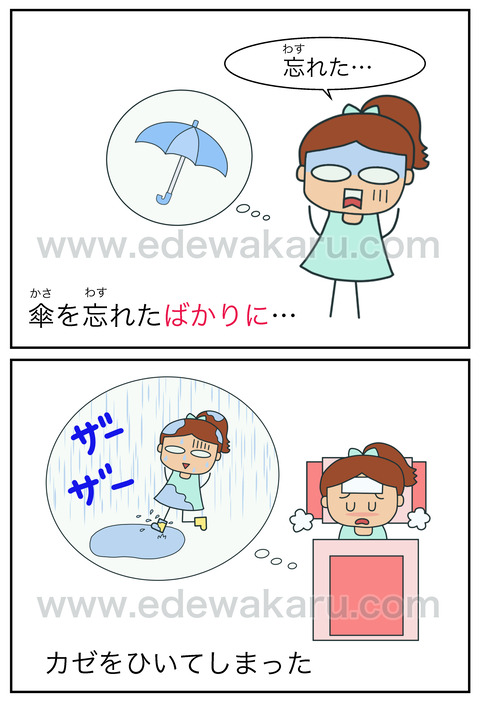
傘を忘れたばかりにカゼをひいてしまった
→傘を忘れたのでカゼをひいてしまったI caught a cold just because I forgot my umbrella. →I caught a cold because I forgot my umbrella.
カゼをひいたばかりに試験が受けられなかった(復習:テストをする・テストを受ける)
→カゼをひいたので試験が受けられなかったI couldn’t take the exam just because I caught a cold. (Review: “take a test” and “sit for a test”) →I couldn’t take the exam because I caught a cold.
名前を書き忘れたばかりに、0点にされてしまった
→名前を書き忘れたので、0点にされてしまったJust because I forgot to write my name, I was given zero points. →I was given zero points because I forgot to write my name.
勉強しなかったばかりに不合格だった
→勉強しなかったので、不合格だったI failed just because I didn’t study. →I failed because I didn’t study.
Read the original source text
Meaning
〜だけの理由で(悪い結果になった)
How to use it
動詞[普通形]+ばかりに
形容詞[普通形]+ばかりに
Explanation
「〜ばかりに」は「〜だけの理由で、よくない結果になった」という意味を表す文型です。この文型は
「不満」や「後悔」、「残念だ」という気持ちを込めて使われます
😮(復習:〜を込めて・〜を込めた) 後ろには必ず「悪い結果」がきます。
その理由のせいで、悪いことが起こってしまったと言いたい時にぴったりの文型です😊(復習:〜せいで・〜せいか)
【「ばかり」シリーズ】
〜たばかり
〜てばかりいる・〜てばかりだ
〜てばかりはいられない・〜てばかりもいられない
〜と言わんばかりに・〜とばかりに
〜とばかり思っていた
〜とばかりは言えない
〜ばかり(数量詞+ばかり)
〜ばかりだ
〜ばかりだ(準備完了)
〜ばかりで
〜ばかりでなく〜も
〜ばかりに
〜ばかりの(比喩)
〜ばかりは
〜んばかり
くらべてわかる日本語表現文型辞典
Meaning
Meaning 1: Precisely because of A, an undesirable result B occurred.
Meaning 2: A expresses the speaker’s wish, and to achieve it, they take an action B that people would not normally take.
How to use it
A ばかりに B (A ばっかりに B)
Connection 1:
[Verb] ばかりに
[i-adjective—plain form] ばかりに
[na-adjective—な/である/だった/ではない] ばかりに
Connection 2:
[Verb—ます-form] + たい/たくない + ばかりに
[i-adjective—い/くない] ばかりに
Explanation
【Contrast 1】
「AだけにB」 (Meaning 1, p. 114)
「AがためにB」 (Meaning 1, p. 56)
Notes
【Note 1】
・A excludes other reasons, emphasizing that it alone was the cause. B is an undesirable result that ordinarily would not happen. The speaker may also feel regret or disappointment.
【Notes 1, 2】
・In conversation or for emphasis, it becomes 「ばっかりに」.
○お金がほしいばっかりに、とうとう盗みまでしてしまった。 — Just because he wanted money so badly, he ended up stealing.
In context 8 examples
あの人を信じたばかりに、とんだ目にあってしまった。
Just because I trusted that person, I ended up in a terrible situation.
彼は才能があるばかりに、学内でも疎まれている。
Precisely because he is talented, he is disliked even within the school.
俺は酒が好きなばかりに、家族にも迷惑をかけたと思っているよ。
I think I caused trouble for my family just because I like drinking.
背が高くなかったばかりに、代表選手から外されてしまった。
Just because he wasn’t tall, he was left off the national team.
大学に合格したいばかりに、問題用紙を盗んだらしい。
Apparently, he stole the exam paper just because he wanted to get into university.
母親が恋しいばかりに、30キロの道を一人で歩いてきたのだ。
Just because he missed his mother, he walked 30 kilometers alone.
保険金を手に入れたいばかりに、妻を殺してしまった。
Just because he wanted to get the insurance money, he ended up killing his wife.
息子は運動会に出たくないばっかりに、頭が痛いと言っている。
My son says he has a headache just because he doesn’t want to take part in the sports day.
Read the original source text
Meaning
意味1:AだからこそBというよくない結果となった。
意味2:Aには話し手の希望がきて、それを望むために普通ではしないような行動Bに出る。
How to use it
AばかりにB(AばっかりにB)
接続1:
[動詞]ばかりに
[イ形-普]ばかりに
[ナ形-な/である/だった/ではない]ばかりに
接続2:
[動詞-ます形]+たい/たくない+ばかりに
[イ形-い/くない]ばかりに
Explanation
【対比1】
「AだけにB」(意味1 P.114)
「AがためにB」(意味1 P.56)
Notes
【注意1】
・Aでほかの理由を排除する、ただ、そのことだけが原因でという理由の強調があり、Bは普通ならそんなことはしないという好ましくない結果。話し手の後悔・残念の気持ちが含まれることもある。
【注意1,2】
・会話体や強めて言うときには「ばっかりに」となる。
○お金がほしいばっかりに、とうとう盗みまでしてしまった。
日本語NET JLPT文法解説まとめ
Meaning
Because of ~ / as a result of ~
This often expresses the speaker's regret or disappointment, and a bad result follows.
「~たいばかりに」 and 「~が欲しいばかりに」 mean "because (someone) wants to do ~ so badly."
How to use it
V (plain form) + ばかりに
いA (plain form) + ばかりに
なAな/である/だった + ばかりに
Nである/だった + ばかりに
Explanation
"because of / due to"
It often expresses the speaker's regret or disappointment, and the following sentence usually contains a negative result.
In context 6 examples
Facebookの「いいね」が欲しいばかりに、嘘の投稿までした彼女はみんなから嫌われてしまった。
She became disliked by everyone because she wanted Facebook likes so badly that she even made fake posts.
どうしても新しいiPhoneが欲しいばかりに、親の財布から少しずつお金を盗んだ。
Because I wanted a new iPhone so badly, I stole small amounts of money from my parents' wallet.
手を洗わず、ハンバーガーを食べたばかりに、お腹を壊してしまった。
Because I ate a hamburger without washing my hands, I ended up with an upset stomach.
ホラー映画を見たばかりに、怖くてなかなか寝られない。
Because I watched a horror movie, I'm too scared to fall asleep easily.
受験票を忘れたばかりに、テストを受けることができなかった。
Because I forgot my exam admission ticket, I couldn't take the test.
大学を卒業していないばかりに、海外で働きたくてもビザがとれない。
Because I haven't graduated from university, I can't get a visa even though I want to work overseas.
Read the original source text
Meaning
~ので / ~が原因で
話し手の後悔や残念な気持ちを表すことが多く、後ろの文には悪い結果が来る。
「~たいばかりに」や「~が欲しいばかりに」は「どうしても~したいので」という意味になる。
How to use it
V(普通形)+ ばかりに
イA(普通形)+ ばかりに
ナAな/である/だった + ばかりに
Nである/だった + ばかりに
Explanation
"because of / due to"
It often expresses the speaker's regret or disappointment, and the following sentence usually contains a negative result.
毎日のんびり日本語教師
How to use it
Verb plain form + ばかりに
い-adjective plain form + ばかりに
Noun + (な/である) + ばかりに
な-adjective + (な/である) + ばかりに
Explanation
Indicates a negative cause. The latter clause describes an undesirable result that occurred because of it and was unexpected from the speaker’s point of view.
Notes
The 「ばかり」 series
In context 8 examples
周囲が反対しているばかりに、留学できずにいる。
I can’t study abroad because everyone around me is against it.
その言葉を信じたばかりにひどい目にあった。
I got into serious trouble just because I believed those words.
先輩のアドバイスを聞き入れなかったばかりに大きな失敗をしてしまった。
I made a major mistake just because I didn’t take my senior’s advice.
経験がないばかりに、周囲に手間をかけさせてしまった。
Just because I lacked experience, I ended up causing trouble for those around me.
絵を描くのが苦手なばかりに、下手だと馬鹿にされた。
Just because I’m bad at drawing, I was mocked for being bad at it.
私が不甲斐ないばかりに、本当に申し訳ない気持ちです。
I feel truly sorry because I’m so inadequate.
親が過保護なばかりに、物心ついたときから自由ではなかった。
Because my parents were overprotective, I had no freedom from the time I was old enough to understand things.
無理やり柵を跳び越えたばかりに怪我をしてしまった。
I ended up getting injured just because I forced my way over the fence.
Read the original source text
How to use it
動詞普通形+ばかりに
い形容詞普通形+ばかりに
名詞+(な/である)+ばかりに
な形容詞+(な/である)+ばかりに
Explanation
悪い原因を表します。後項にはそれによって発生した、話し手にとって意外性のある悪い結果を述べます。
Notes
「ばかり」シリーズ
NINJAL 日本語文型データベース
Meaning
Used when you want to say that something turned out badly solely because of ~. It expresses the feeling that if only that cause, ~, had not existed, things would not have turned out badly.
How to use it
V plain form + ばかりに
i-A plain form + ばかりに
na-A plain form + ばかりに (however, “na-A だ” becomes “na-A な+ばかりに・na-A である+ばかりに”)
N plain form + ばかりに (however, “N だ” becomes “N である+ばかりに・N な+ばかりに”)
Notes
A sentence expressing a cause comes before 「〜」. After 「~ばかりに」 comes a sentence expressing an unexpectedly bad result. A sentence expressing the speaker’s intentional action does not come here. Nor do sentences expressing the speaker’s hopes or intentions, or a sentence urging the other person to do something.
In context 19 examples
あそこに高いビルがあるばかりに、ここからは花火の音しか聞こえない。
Because there is a tall building over there, all I can hear from here is the sound of fireworks.
決断ができないばかりにチャンスを逃してしまってはもったいない。
It would be a shame to miss an opportunity just because you can’t make a decision.
うっかり電車に乗り間違えてしまったばかりに、待ち合わせに遅刻してしまった。
Just because I accidentally got on the wrong train, I ended up being late for our meeting.
外国に行くときは、その国の常識を知らなかったばかりに困るということがないように、よく調べて行ったほうがいい。
When going abroad, you should do your research thoroughly beforehand so that you don’t run into trouble just because you didn’t know what is considered common sense in that country.
食が細いばかりに、おいしそうなものがたくさんあってもいろいろ食べられなくて残念だ。
It’s frustrating that I can’t try a variety of things, even when there are lots of delicious-looking foods, just because I have a small appetite.
主張が正しくても、伝え方が悪いばかりに相手に納得してもらえないこともある。
Even if your argument is correct, sometimes the other person won’t be convinced just because you explain it poorly.
パソコンに詳しくないばかりに、少しの不具合でも人に尋ねなければ解決できない。
Just because I’m not knowledgeable about computers, I can’t solve even a minor problem without asking someone.
引っ越す前は、家が狭かったばかりに自分の部屋が持てないでいた。
Before I moved, I couldn’t have a room of my own simply because the house was small.
洗った後、置いた場所がよくなかったばかりに、グラスが床に落ちて、割れてしまった。
After I washed it, I put the glass in the wrong place, and it fell onto the floor and broke.
能力があるのに、英語が苦手なばかりに、グローバルに活躍する機会を逃してしまう人も多い。
Many people miss opportunities to succeed globally simply because they are not good at English, despite having ability.
言葉の定義があいまいであるばかりに、あの二人の論客の議論はかみ合っていないように感じられる。
Just because the words are vaguely defined, I get the impression that those two debaters aren’t addressing each other’s points.
母は体が丈夫でないばかりに、働きたくてもあまりたくさん働くことができない。
My mother can’t work very much, even though she wants to, simply because she isn’t physically strong.
高校時代の私は、少し臆病だったばかりに、憧れの先輩に声をかけることができなかった。
When I was in high school, I couldn’t bring myself to talk to the senior student I admired, simply because I was a little timid.
私はあまり練習熱心ではなかったばかりに、チームメートに迷惑をかけた。
I caused trouble for my teammates simply because I wasn’t very dedicated to practice.
長男であるばかりに、弟と妹のためにいろいろ我慢させられた。
Just because I was the eldest son, I was made to put up with all sorts of things for my younger brother and sister.
父は言うことが時代おくれなばかりに、家族みんなに敬遠されている。
My father is avoided by the whole family simply because the things he says are outdated.
標準体型ではないばかりに、特注の割高な服を買わなければならない。
I have to buy expensive, custom-made clothes simply because I don’t have a standard body type.
子どものころ遊園地に連れていってもらったが、制限身長以下だったばかりに乗りたかったアトラクションに乗れなくて、悔しい思いをした。
When I was a child, I was taken to an amusement park, but because I was below the height limit, I couldn’t ride the attraction I wanted to, and I felt frustrated.
その日履いていた靴がウォーキング用ではなかったばかりに、長時間歩いて足が痛くなってしまった。
Just because the shoes I was wearing that day weren’t for walking, my feet ended up hurting after I walked for a long time.
Read the original source text
Meaning
〜ということだけが原因で、残念な状態になったと言いたいときに使います。〜という原因さえなければ、残念な状態にはならないのに、という気持ちを表します。
How to use it
V普通形+ばかりに
i-A普通形+ばかりに
na-A普通形+ばかりに(ただし、「na-Aだ」→「na-Aな+ばかりに・na-Aである+ばかりに」)
N普通形+ばかりに(ただし、「Nだ」→「Nである+ばかりに・Nな+ばかりに」)
Notes
「〜」には原因を表す文がきます。「~ばかりに」の後には、予想外の悪い結果を表す文がきます。話し手の意志的な行為を表す文はきません。また、話し手の希望・意向を表す文や相手への働きかけの文もきません。