絵でわかる日本語
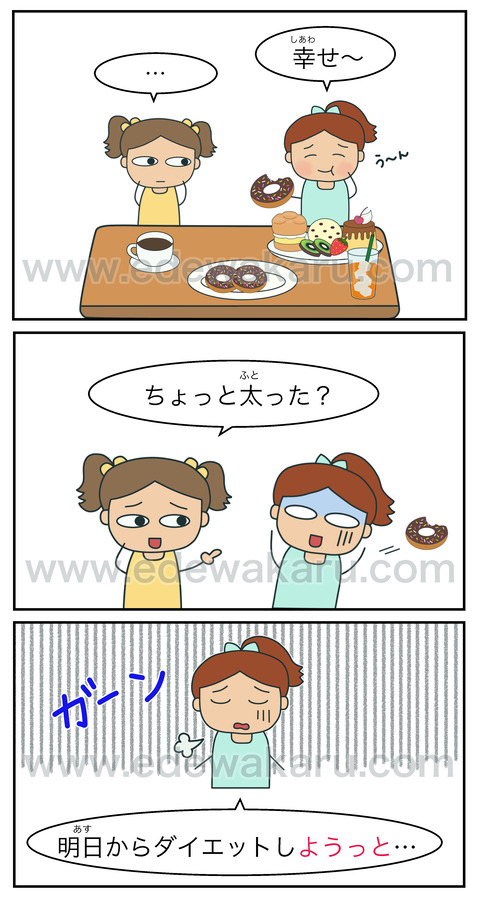
Meaning
〜よう (will/intention)
How to use it
Verb [volitional form] + っと
Explanation
“〜ようっと” is a sentence pattern used with the same meaning as “〜よう” to express the speaker’s intention.
“〜よう” has many meanings, but “〜ようっと” can only be used to express one’s own intention 😨 Also, “〜ようっと” can only be used when talking to oneself 😧
[Usage examples]
①Talking to oneself (no one else is present)
⭕️デパートに行こう
I’ll go to the department store.
⭕️デパートに行こうっと
I’ll go to the department store.
②Suggestion
A: Where do you want to go?
B: ⭕️デパートに行こう
Let’s go to the department store.
❌デパートに行こうっと
③Offer
A: It’s busy today…
B: ⭕️ぼくが手伝おう
I’ll help.
❌ぼくが手伝おうっと
Also, the shortened form of “〜ようっと” is “〜よっと” 😊 Its usage is the same as “〜ようっと.”
[Examples]
①明日からダイエットしようっと
=明日からダイエットしよっと
I’ll start dieting tomorrow.
②ジュースでも飲もうっと
=ジュースでも飲もっと
I’ll have some juice or something.
③本を読もうっと
=本を読もっと
I’ll read a book.
④デパートへ行こうっと
=デパートへ行こっと
I’ll go to the department store.
“〜ようっと” and “〜よっと” are used very often, so you’ll probably hear them frequently on TV shows and in dramas 😀 Try using them when you talk to yourself.
In context 4 examples
明日からダイエットしようっと
→明日ダイエットしようI’ll start dieting tomorrow. →I’ll start dieting tomorrow.
のどがかわいた…ジュースでも飲もうっと
→のどがかわいた…ジュースでも飲もう(復習:〜でも)I’m thirsty… I think I’ll have some juice. →I’m thirsty… I think I’ll have some juice (Review: 〜でも [or something]).
ヒマだから本を読もうっと
→ヒマだから本を読もうI’m bored, so I think I’ll read a book. →I’m bored, so I think I’ll read a book.
日曜日にデパートへ行こうっと
→日曜日にデパートへ行こうI think I’ll go to the department store on Sunday. →I think I’ll go to the department store on Sunday.
Read the original source text
Meaning
〜よう(意志)
How to use it
動詞[意向形]+っと
Explanation
「〜ようっと」は話者の意志を表す「〜よう」と同じ意味で使われる文型です。
「〜よう」にはたくさん意味がありますが、
「〜ようっと」は自分の意志を表す場合にしか使用できません
😨また「〜ようっと」は【独り言】にしか使用できません😧
[使用例]
①独り言(相手がいない)
⭕️デパートに
行こう
⭕️デパートに
行こうっと
②勧誘
A:どこに行きたい?
B:⭕️デパートに
行こう
❌デパートに
行こうっと
③申し出
A:今日は忙しいな…
B:⭕️ぼくが
手伝おう
❌ぼくが
手伝おうっと
また
「〜ようっと」の省略形(しょうりゃくけい)は「〜よっと」です
😊使い方は「〜ようっと」と同じです。
[例]
①明日からダイエット
しようっと
=明日からダイエット
しよっと
②ジュースでも
飲もうっと
=ジュースでも
飲もっと
③本を
読もうっと
=本を
読もっと
④デパートへ
行こうっと
=デパートへ
行こっと
「〜ようっと」「〜よっと」はとてもよく使われますので、テレビ番組やドラマなどで聞く機会がたくさんあると思います😀みなさんも、独り言を言う時に使ってみてくださいね。
NINJAL 日本語文型データベース
Meaning
Expresses the speaker’s intention. Used to express a decision made on the spot. Often used as a soliloquy.
It is a phonetically altered form of “〜うと思う・〜ようと思う.”
How to use it
V(よ)うっと
Notes
“~” is a verb expressing a volitional action, such as “帰る・食べる・休憩する.”
The subject is first person, but it usually does not appear in the sentence.
In context 5 examples
明日も朝から仕事だし、もう帰ろうっと。
I have work again from the morning tomorrow, so I’d better head home now.
あー、疲れた。ちょっと休憩しようっと。
Ah, I’m tired. I’ll take a short break.
あ、ご飯の時間だ。もうゲーム、やめようっと。
Oh, it’s time to eat. I’ll stop playing games now.
もらったプレゼント、開けてみようっと。
I’ll try opening the present I got.
この漫画、もう読まないな。捨てちゃおうっと。
I’m not going to read this manga anymore. I’ll just throw it away.
Read the original source text
Meaning
話し手の意志を表します。その場で決心したことを表すときに使います。独り言の場合が多いです。
「〜うと思う・〜ようと思う」が音声的に変化した形です。
How to use it
V(よ)うっと
Notes
「~」には、「帰る・食べる・休憩する」など、意志的な行為を表す動詞がきます。
主語は一人称ですが、ふつう、文中に現れません。