絵でわかる日本語
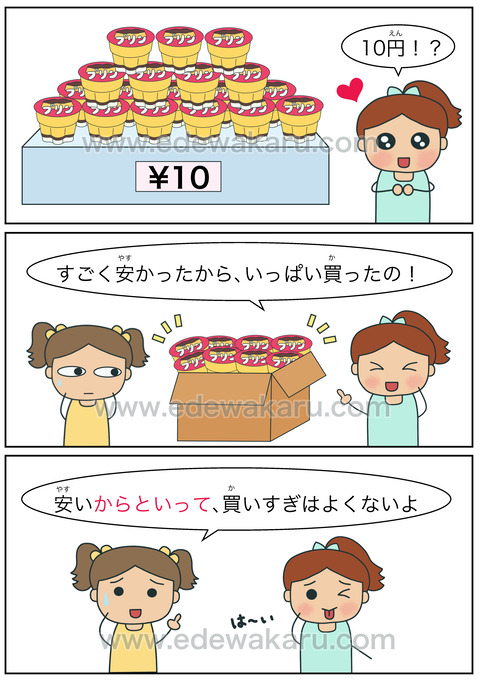
Meaning
No matter what reason there may be
Just because ~
How to use it
Verb・adjective・noun [plain form]+からといって
Explanation
「〜からといって」 is a sentence pattern meaning “even if there is a reason that ~” or “just because ~.” In many cases, it is used when you want to deny the claim that “because ~, it is only natural that ~” 😮
[Examples]
Just because you studied abroad in the United States doesn’t mean you’ll become fluent in English.
→ This denies the claim that “if you study abroad, it’s only natural that you’ll become fluent.”
Just because someone is Japanese doesn’t necessarily mean they can use honorific language properly.
→ This denies the claim that “because they’re Japanese, it’s only natural that they can use honorific language properly.”
Sentence patterns that warn the other person or express partial negation often follow it.
[Patterns often used after 「〜からといって」]
・〜からといって
〜はよくない
・〜からといって
〜ないほうがいい
・〜からといって
〜とは限らない
・〜からといって
〜わけではない
・からといって
〜とは言えない
and so on
Remember also that the colloquial form of 「〜からといって」 is 「〜からって」 😀
[Examples]
Just because it was cheap, you shouldn’t buy too much.
=Just because it was cheap, you shouldn’t buy too much.
Just because you like it, aren’t you eating too much?
=Just because you like it, aren’t you eating too much?
Just because you studied abroad in the United States, it doesn’t necessarily mean you can become fluent in English.
=Just because you studied abroad in the United States, it doesn’t necessarily mean you can become fluent in English.
Remember 「〜からといって・〜からって」 as one of the [sentence patterns containing 「から」] 😉
[The 「から」 series]
〜から〜にかけて
〜からする・〜からある・〜からの
〜からといって・〜からって
〜からなる
〜からには
〜てからでないと〜ない
〜てからというもの
In context 5 examples
安かったからといって、買いすぎはよくないよ
→いくら安かったとしても、買いすぎはよくないよ(復習:〜すぎ(名詞化))Just because it was cheap, you shouldn’t buy too much. → Even if it was cheap, you shouldn’t buy too much. (Review: 〜すぎ (nominalization))
好きだからといって、食べすぎなんじゃない?
→いくら好きでも、食べすぎなんじゃない?(復習:〜すぎる)(復習:〜んじゃない・〜じゃない)Just because you like it, aren’t you eating too much? → Even if you like it, aren’t you eating too much? (Review: 〜すぎる) (Review: 〜んじゃない・〜じゃない)
アメリカに留学したからといって、英語がペラペラになれるわけではない
→ただアメリカに留学したというだけで、英語がペラペラになれるわけではない(復習:〜わけではない)Just because you studied abroad in the United States, it doesn’t mean you can become fluent in English. → Just because you studied abroad in the United States, it doesn’t mean you can become fluent in English. (Review: 〜わけではない)
日本人だからといって、ちゃんと敬語が使えるとは限らない日本人というだけで、ちゃんと敬語が使えるとは限らない(復習:〜とは限らない)
Just because someone is Japanese, it doesn’t necessarily mean they can use honorific language properly. Someone being Japanese alone doesn’t mean they can use honorific language properly. (Review: 〜とは限らない)
見た目が嫌いだからといって、食わず嫌いをしないほうがいい
→ただ見た目が嫌いという理由だけで、食わず嫌いをしないほうがいい(復習:食わず嫌い)(復習:〜ほうがいい)Just because you dislike how it looks, you shouldn’t refuse to try it. → Just because you dislike how it looks, you shouldn’t refuse to try it. (Review: 食わず嫌い) (Review: 〜ほうがいい)
Read the original source text
Meaning
いくら〜という理由があっても
ただ〜という理由だけで
How to use it
動詞・形容詞・名詞[普通形]+からといって
Explanation
「〜からといって」は「〜という理由があっても〜」「〜という理由だけで」という意味を表す文型です。多くの場合、
「〜だから〜は当然だ」と言われることを否定したい時
に使用されます😮
[例]
アメリカに留学した
からといって、英語がペラペラになれるわけではない
→「留学したらからペラペラになるのが当然」ということを否定
日本人だ
からといって、ちゃんと敬語が使えるとは限らない
→
「日本人だから、ちゃんと敬語が使えて当然」ということを否定
後ろには相手を注意する文型や、部分否定を表す文型がよく使われます
[「〜からといって」の後ろによく使われる文型]
・〜からといって
〜はよくない
・〜からといって
〜ないほうがいい
・〜からといって
〜とは限らない
・〜からといって
〜わけではない
・からといって
〜とは言えない
など
また、「〜からといって」の口語形は「〜からって」だと覚えておきましょう😀
[例]
安かった
からといって、買いすぎはよくないよ
=安かった
からって、買いすぎはよくないよ
好きだ
からといって、食べすぎなんじゃない?
=好きだ
からって、食べすぎなんじゃない?
アメリカに留学した
からといって、英語がペラペラになれるとは限らない
=アメリカに留学した
からって、英語がペラペラになれるとは限らない
「〜からといって・〜からって」は
【「から」がつく文型】
の1つとして、しっかりと覚えておきましょう😉
【「から」シリーズ】
〜から〜にかけて
〜からする・〜からある・〜からの
〜からといって・〜からって
〜からなる
〜からには
〜てからでないと〜ない
〜てからというもの
日本語文型辞典 英語版
Meaning
【からって】[N/Na だからって][A/V からって]
からって is an informal form of からといって.
→
In context 2 examples
頭が痛いからって先に帰っちゃった。
She went home before we did, saying she had a headache.
金持ちだからって何でも自由にできるというわけではない。
You can’t do anything you want, even if you are rich.
Read the original source text
Meaning
【からって】[N/Na だからって][A/V からって]
からって is an informal form of からといって.
→
NINJAL 日本語文型データベース
Meaning
This is used when people would normally think that a certain situation follows from 〜, but it sometimes does not, or when you want to say that the situation does not turn out exactly as expected. It expresses the speaker's feeling that one must not reach a conclusion based only on 〜.
This is a phonetic variation of 「〜からといって」.
How to use it
V plain form + からって
i-A plain form + からって
na-A plain form + からって
N plain form + からって
Notes
After 「〜からって」 comes a sentence denying what would be expected from “〜”. Such sentences often use expressions like 「〜とは限らない・〜とはいえない・〜わけではない」.
In context 20 examples
敬語を使ってるからって、必ずしも相手を敬っているわけじゃない。
Just because someone uses honorific language, it doesn't necessarily mean they respect the other person.
本に書いてあるからって、全部が正しいとは思わないほうがいい。
You shouldn't assume that everything is true just because it's written in a book.
お子さんはまだ4歳なんですから、ひらがなが書けないからって、焦ることはありません。
Your child is only four, so there’s no need to panic just because they can’t write hiragana yet.
今は大学を出たからって、仕事がすぐ見つかるとは限らない。
These days, just because you’ve graduated from university doesn’t mean you’ll find a job right away.
ソファとかベッドとかは、買ってみて気に入らなかったからって、すぐに買い換えられるものじゃない。
Things like sofas and beds aren’t something you can replace right away just because you bought one and didn’t like it.
「いくら安いからって、ドーナツ10個は買いすぎでしょう。全部食べきれるの?」
“Even if they are cheap, ten doughnuts is too many to buy. Can you eat them all?”
友達と話すのが楽しいからって、授業中もずっと話しているのはだめでしょう。
Just because you enjoy talking with your friends doesn’t mean it’s okay to talk the whole time during class.
「歯医者に行きたくないからって放っておいたら、もっと悪くなるよ」
“If you leave it alone just because you don’t want to go to the dentist, it’ll get worse.”
昔のほうがよかったからって、昔に戻ることはできない。今がよくなるように考えないと。
Just because things were better in the past doesn’t mean we can go back to those days. We have to think about how to make things better now.
自分にとってその映画が面白くなかったからって、他の人も同じ感想を持つかどうかはわからない。
Just because you didn’t find the movie interesting doesn’t mean we know whether other people felt the same way.
人前で話をするのは苦手だけど、苦手だからって逃げてばかりはいられない。
I’m not good at speaking in front of people, but I can’t keep running away just because I’m bad at it.
給料が不満だからって、仕事の手を抜いてはいけない。
Just because you’re dissatisfied with your pay doesn’t mean you can slack off at work.
大人なんだから、その人が好きじゃないからって口もきかないっていうのは、いいことじゃない。
You’re an adult, so it’s not right to refuse to speak to someone just because you don’t like them.
今日だめだったからって、明日も絶対だめってことはない。失敗は気にしないで、頑張ろう。
Just because today went badly doesn’t mean tomorrow will definitely go badly too. Don’t worry about the failure; let’s do our best.
あるひとりの人が親切じゃなかったからって、その国の人がみんな親切じゃないわけじゃないだろう。
Just because one person wasn’t kind doesn’t mean everyone from that country is unkind.
普通の会社員は、雨だからって、仕事を休めるわけじゃない。
An ordinary office worker can’t take a day off just because it’s raining.
気が強い役を演じることが多い俳優だからって、本人が気が強い人だとは限らない。
Just because an actor often plays strong-willed characters doesn’t mean the actor is strong-willed in real life.
「好きなおかずじゃないからって、食べないで残してばかりいると大きくなれないよ」
“Just because it’s not a side dish you like, if you keep leaving it uneaten, you won’t grow up.”
山の天気は変わりやすいから、さっきまでいい天気だったからって、後で雨にならないとは言えない。雨具は持っていったほうがいい。
Mountain weather changes easily, so just because the weather was fine a moment ago doesn’t mean it won’t rain later. You should take rain gear.
もらったプレゼントがほしかった物じゃなかったからって、お礼も言わないなんてひどい。
It’s awful not even to say thank you just because the present you received wasn’t something you wanted.
Read the original source text
Meaning
〜ならある状況が成立するとふつうは考えるが、成立しない場合もある、または予想と全く同じ状況は成立しないと言いたいときに使います。〜だけで結論づけてはいけないという話し手の気持ちを表します。
「〜からといって」が音声的に変化した形です。
How to use it
V普通形+からって
i-A普通形+からって
na-A普通形+からって
N普通形+からって
Notes
「〜からって」の後には、「〜」から予想されることを否定する文がきます。「〜とは限らない・〜とはいえない・〜わけではない」などの表現を使った文が多いです。