AIUEO JLPT Grammar
Meaning
This sentence pattern expresses regret for something not done in the past or something that was done that shouldn’t have been.
How to use it
Verb ば-form + よかった; verb た-form たら + よかった; verb ない-form + なければ + よかった; verb ない-form + なかったら + よかった
In context 5 examples
もっと早く出発すればよかったです。
I should have left earlier.
あの時、彼に謝ればよかった。今さら後悔しても遅い。
I should have apologized to him at that time. It’s too late to regret it now.
もっと勉強しておけばよかった。試験に落ちてしまった。
I should have studied more. I failed the exam.
あんなこと言わなければよかった。彼を傷つけてしまった。
I shouldn’t have said that. I ended up hurting him.
会社を辞めなければよかったです。
I wish I hadn't left the company.
Read the original source text
Meaning
This sentence pattern expresses regret for something not done in the past or something that was done that shouldn’t have been.
How to use it
動詞ば形+よかった動詞た形たら+よかった動詞ない形+なければ+よかった動詞ない形+なかったら+よかった
Explanation · 日本語
この文型は、過去に何かをしなかったこと、又は何かをしてしまったことを後悔する気持ちを表す表現です。
Bunpro Grammar Reference
Meaning
Should have, I wish, It would have been better to
How to use it
Verb[ば]+ よかった
Examples:
食べる → 食べれば + よかった
飲む → 飲めば + よかった
する → すれば + よかった
Verb[ば]+ よかった + です
Examples:
食べる → 食べれば + よかった + です
飲む → 飲めば + よかった + です
する → すれば + よかった + です
Nuance
A grammar point that expresses a hypothetical outcome that would have been preferred.
Explanation
ばよかった is a common expression used when someone regrets that something has not been/was not done. It is a pairing of the conjunction particle ば, and the past form of the い-Adjective, 良い (remembering that conjugations of いい use よ, and not い). This construction is often translated to 'I wish I did (A)', or 'I should have done (A)'.
ばよかった is used after verbs, so requires the standard ば conjugation, before adding よかった.
サービスエリアが一つもないじゃないか。高速に乗る前にトイレに行けばよかった。
There aren't any service stops, are there? I wish I had gone to the bathroom before we got on the highway.
今日も残業?昨日は早く寝ればよかった。
I have to work overtime again today? I should have gone to sleep early last night.
As ば highlights hypothetical situations, ばよかった literally means that 'it would have been good if (A)', where (A) is the thing that the speaker wishes had happened.
Fun Fact
This grammar point is in direct contrast to ばいい, the non-past version, which is used to express 'it would be good if (A)'.
運転をしたくなかったら、電車で行けばいい。
If you don't want to drive, it would be better if you went by train.
In context 15 examples
- 次の電車を待てば良かったです。
I should have waited for the next train.
- 今日も残業?昨日は早く寝ればよかった。
I have to work overtime again today? I should have gone to sleep early last night.
- サービスエリアが一つもないじゃないか。高速に乗る前にトイレに行けばよかった。
There aren't any service stops, are there? I wish I had gone to the bathroom before we got on the highway.
- ゲームより勉強をすれば良かったです。
It would have been better to study rather than play games.
- 天気予報を見れば良かったです。
I should have looked at the weather forecast.
- スーパーに行った時、牛乳を買えば良かった。
I should have bought milk while I was at the store.
- 寝ないで、日本語を勉強すれば良かった。
It would have been better to study Japanese rather than sleep.
- 勉強することが大切ってもうちょっと早めに分かれば良かった。
I wish that I understood how important studying was earlier.
- 遅れてすみません。家をもっと早く出れば良かったです。
I apologize for my tardiness. I should have left my home earlier.
- またお金がなくなった。ATM(エーティーエム)に行けば良かった。
I'm out of money again. I should have gone to an ATM.
- 杉本さんが持っている車みたいな車を買えば良かった。
I should have bought a car like the one that Sugimoto-san has.
- 嫁さんがそんなカバンを欲しがるなら、買ってあげれば良かった。
If my wife wanted a bag like that, it would’ve been better if I had bought it for her.
- この漢字の意味があまり分からないので、先生に聞けば良かった。
I do not really understand the meaning of this kanji. I should have asked the teacher about it.
- クリスマスにNintendo(ニンテンドー)スイッチが欲しかったら、そう言えば良かった。
If you wanted a Nintendo Switch for Christmas, you should have said so.
- 運転をしたくなかったら、電車で行けばいい。
If you don't want to drive, it would be better if you went by train.
DoJG 日本語文法辞典(全集)
Meaning
I wish ~ had done something
How to use it
(i) Group 1 verbs | Vconditionalばよかった | |
| 話せばよかった | I wish someone had talked |
(ii) Group 2 verbs | Vstemればよかった | |
| 食べればよかった | I wish someone had eaten |
(iii) Irregular verbs | 来る→来ればよかった | I wish someone had come |
| する→すればよかった | I wish someone had done |
Explanation
A phrase which expresses the speaker’s regret.
In context 4 examples
先生に聞けばよかった・ばよかったです。
I wish I had asked my teacher.
あの本を読めばよかった。
I wish I had read that book.
ウェルズさんは日本へ行けばよかったね。
I wish Mr. Wells had gone to Japan, don't you?
ああ、もっと英語を勉強しておけばよかったなあ。
Oh, I wish I had studied English harder!
絵でわかる日本語
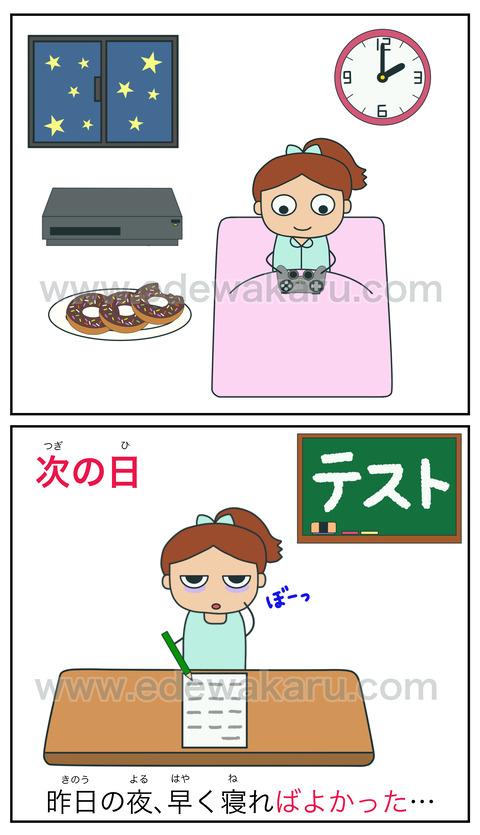
Meaning
I should have done〜, but I didn’t
I should have done〜
How to use it
Verb [ば-form] + よかった
Explanation
“〜ばよかった” is a sentence pattern that means “I should have done ~, but I didn’t” or “I ought to have done ~.” It is used with a feeling of regret, as in “I didn’t do something I should have done.”
😮It is used for things that were not actually done.
(Review: 〜べきだ)
(Review: 〜を込めて・〜を込めた)
[Examples]
① I should have gone to bed early last night…
→ I’m sleepy because I didn’t go to bed early last night, even though I should have.
② I should have eaten breakfast before coming.
→ I’m hungry because I didn’t eat breakfast before coming, even though I should have.
Also, “〜ばよかった” can be changed to “〜たらよかった.”
😊
[Examples]
① I should have gone to bed early last night…
= I should have gone to bed early last night…
② I should have eaten breakfast before coming.
= I should have eaten breakfast before coming.
“〜ばよかった” and “〜たらよかった” are patterns used very frequently in conversation. There are also several patterns in the “よかった” series, so learn them together 😉
(Review: 〜てよかった)
In context 4 examples
昨日の夜、早く寝ればよかった…
→昨日の夜、早く寝たほうがよかったのに寝なかったI should have gone to bed early last night… → I should have gone to bed early last night, but I didn’t.
朝ごはんを食べてくればよかった
→朝ごはんを食べてきたほうがよかったのに食べてこなかったI should have eaten breakfast before coming. → I should have eaten breakfast before coming, but I didn’t.
もっと勉強しとけばよかった
→もっと勉強しといたほうがよかったのにしなかった(復習:〜とく・〜どく)I should have studied more. → I should have studied more, but I didn’t. (Review: 〜とく・〜どく)
お母さんに相談すればよかった
→お母さんに相談したほうがよかったのにしなかった(復習:相談する・相談にのる)I should have talked to my mother about it. → I should have talked to my mother about it, but I didn’t. (Review: 相談する・相談にのる)
Read the original source text
Meaning
〜したほうがよかったのに〜しなかった
〜するべきだった
How to use it
動詞[ば形]+よかった
Explanation
「〜ばよかった」は「〜したほうがよかったのに〜しなかった」「〜するべきだった」という意味を表す文型です。「〜したほうがよかったことをしなかった」というように、
後悔する気持を込めて使われます
😮実際にはしなかったことに使います。
(復習:〜べきだ)
(復習:〜を込めて・〜を込めた)
[例]
①昨日の夜、早く寝れ
ばよかった
…
→早く寝たほうがよかったのに寝なかったから、眠い
②朝ごはんを食べてくれ
ばよかった
→朝ごはんを食べてくるべきだったのに食べなかったから、お腹がすいている
また
「〜ばよかった」は「〜たらよかった」にチェンジすることができます
😊
[例]
①昨日の夜、早く寝れ
ばよかった
…
=昨日の夜、早く寝
たらよかった
…
②朝ごはんを食べてくれ
ばよかった
=朝ごはんを食べてき
たらよかった
「〜ばよかった」「〜たらよかった」は、会話でもとてもよく使う文型です。また「よかった」シリーズはいくつかありますので、まとめて覚えておきましょう😉
(復習:〜てよかった)
毎日のんびり日本語教師
How to use it
Verb ば-form+よかった
Verb ない-form+なければよかった
Explanation
This grammar expresses regret about something in the past, feeling that one should have done it that way.
When used about another person's actions, it includes a sense of reproach.
It can also take the form 「~ばよかったのに」. Here, 「のに」 expresses a contrast, so the second clause states something contrary to the first. The second clause can also be omitted by using 「のに」 like a sentence-final particle.
Colloquial forms are as follows.
Basic form
~ばよかった
~なければよかった
Plain form
Colloquial form
Plain form
Colloquial form
Godan verbs
書く (write)
書けばよかった
書きゃよかった
書かなければよかった
書かなきゃよかった
脱ぐ (take off)
脱げばよかった
脱ぎゃよかった
脱がなければよかった
脱がなきゃよかった
飲む (drink)
飲めばよかった
飲みゃよかった
飲まなければよかった
飲まなきゃよかった
遊ぶ (play)
遊べばよかった
遊びゃよかった
遊ばなければよかった
遊ばなきゃよかった
死ぬ (die)
死ねばよかった
死にゃよかった
死ななければよかった
死ななきゃよかった
取る (take)
取ればよかった
取りゃよかった
取らなければよかった
取らなきゃよかった
待つ (wait)
待てばよかった
待ちゃよかった
待たなければよかった
待たなきゃよかった
会う (meet)
会えばよかった
会やよかった
会わなければよかった
会わなきゃよかった
話す (speak)
話せばよかった
話しゃよかった
話さなければよかった
話さなきゃよかった
Ichidan verbs
寝る (sleep)
寝ればよかった
寝りゃよかった
寝なければよかった
寝なきゃよかった
Irregular ku verbs
来る (come)
来ればよかった
来りゃよかった
来なければよかった
来なきゃよかった
Irregular su verbs
する (do)
すればよかった
すりゃよかった
しなければよかった
しなきゃよかった
Notes
Related grammar
【N3 Grammar】~ばいい/なければいい
【N3 Grammar】~ばよかった/なければよかった
【N0 Grammar】~がいい/がよい
In context 8 examples
高校生の頃に一目惚れした彼に告ればよかったと思う。ずっと忘れられないでいる。(我觉得如果向高中时一见钟情的他告白就好了。一直忘不了他。)
I think I should have confessed to the person I fell in love with at first sight in high school. I still can't forget him. (I think it would have been better if I'd confessed to the person I fell in love with at first sight in high school. I still can't forget him.)
傘忘れた。天気予報見ておけばよかった。(忘记带伞了。事先看天气预报就好了。)
I forgot my umbrella. I should have checked the weather forecast beforehand. (I forgot my umbrella. I should have checked the weather forecast beforehand.)
ちゃんと調べておけばよかった。(要是好好调查一下就好了。)
I should have looked into it properly.
買う前にちゃんと考えればよかった。
I should have thought it through before buying it.
私なんて生まれてこなければよかった。
I wish I had never been born.
二度寝しなければよかった。
I shouldn't have gone back to sleep.
感情がなければよかったのにと思う。
I wish I didn't have emotions.
いつでも女らしさを求められ、女じゃなければよかったと感じる。
People always expect me to be feminine, and I feel that I wish I weren't a woman.
Read the original source text
How to use it
動詞ば形+よかった
動ない形+なければよかった
Explanation
過去のことに対して、そのようにするべきだったと後悔する気持ちを表します。
相手の行為に用いる時はそれを非難する気持ちが含まれます。
「~ばよかったのに」の形を取ることもあります。この「のに」は逆接を表すので、後件には前件とは逆の内容が述べられます。「のに」を終助詞的に使うことで後件を省略することもできます。
口語形は以下。
基本形
~ばよかった
~なければよかった
普通形
口語形
普通形
口語形
五段
書く
書けばよかった
書きゃよかった
書かなければよかった
書かなきゃよかった
脱ぐ
脱げばよかった
脱ぎゃよかった
脱がなければよかった
脱がなきゃよかった
飲む
飲めばよかった
飲みゃよかった
飲まなければよかった
飲まなきゃよかった
遊ぶ
遊べばよかった
遊びゃよかった
遊ばなければよかった
遊ばなきゃよかった
死ぬ
死ねばよかった
死にゃよかった
死ななければよかった
死ななきゃよかった
取る
取ればよかった
取りゃよかった
取らなければよかった
取らなきゃよかった
待つ
待てばよかった
待ちゃよかった
待たなければよかった
待たなきゃよかった
会う
会えばよかった
会やよかった
会わなければよかった
会わなきゃよかった
話す
話せばよかった
話しゃよかった
話さなければよかった
話さなきゃよかった
一段
寝る
寝ればよかった
寝りゃよかった
寝なければよかった
寝なきゃよかった
カ変
来る
来ればよかった
来りゃよかった
来なければよかった
来なきゃよかった
サ変
する
すればよかった
すりゃよかった
しなければよかった
しなきゃよかった
Notes
関連文法
【N3文法】~ばいい/なければいい
【N3文法】~ばよかった/なければよかった
【N0文法】~がいい/がよい