くらべてわかる日本語表現文型辞典
Meaning
Meaning 1: When one did A, the result was B. The state was B.
Meaning 2: Though it is not known for certain, within the scope of A, it is B. A is the scope of one’s own senses, perceptions, or the information one has obtained.
How to use it
AたところB (AたところではB)
[Verb—た form] ところ
Explanation
【Contrast 1】
“AたはずみにB” (Meaning 1, p. 123)
【Contrast 2】
“AかぎりB” (Meaning 3, p. 52)
They can be substituted for one another. However, “AかぎりB” emphasizes that B is true within the scope of A. “AたところB” has a weaker sense of limitation, so in some sentences adding “では” to make “Aたところでは” gives a greater sense of certainty.
○本で読んだところ(では)、彼の超能力はトリックのようだ。 — From what I read in a book (では), his supernatural powers seem to be a trick.
○本で読んだかぎり、彼の超能力はトリックのようだ。 — As far as I read in a book, his supernatural powers seem to be a trick.
Notes
【Note 1】
・B is in the past tense.
・It cannot be substituted with “AたところではB.”
【Note 2】
・It can be substituted with “AたところではB.” However, “AたところではB” carries a strong sense of limitation.
In context 8 examples
先生に国の土産をお渡ししたところ、非常に喜ばれた。
When I gave my teacher a souvenir from my country, they were very pleased.
テレビで見た料理を自分で作ってみたところ、おいしくできた。
When I tried making a dish I had seen on TV myself, it turned out delicious.
久しぶりに友人を訪ねたところ、ちょうど留守でがっかりした。
When I visited a friend for the first time in a long while, they happened to be out, and I was disappointed.
その液体を口に含んだところ、甘い味がした。
When I put that liquid in my mouth, it tasted sweet.
見たところ、傷はたいしたことなかった。
From the looks of it, the injury wasn’t serious.
私が聞いたところ、参加者は5人だそうだ。
From what I’ve heard, there are supposedly five participants.
トランクは私が持ってみたところ、20キロはなさそうだ。
When I tried lifting the trunk, it didn’t seem to weigh even 20 kilos.
う~ん、食べたところじゃ、蟹そっくりの味だが、本当は何ですか。
Hmm, from tasting it, it tastes just like crab, but what is it really?
Read the original source text
Meaning
意味1:AをしたらBという結果になった。Bという状態だった。
意味2:はっきりとはわからないが、Aの範囲ではBである。Aは自分の感覚、知覚、得た情報の及ぶ範囲。
How to use it
AたところB(AたところではB)
[動詞-た形]ところ
Explanation
【対比1】
「AたはずみにB」(意味1 P.123)
【対比2】
「AかぎりB」(意味3 P.52)
置き換え可能。ただし、「AかぎりB」はAの範囲ではBだとAの範囲を強調する表現。「AたところB」は限定が弱いため「Aたところでは」と「では」をつけたほうが安定感が感じられる文もある。
○本で読んだところ(では)、彼の超能力はトリックのようだ。
○本で読んだかぎり、彼の超能力はトリックのようだ。
Notes
【注意1】
・Bは過去の形である。
・「AたところではB」とは置き換えできない。
【注意2】
・「AたところではB」との置き換えは可能。ただし、「AたところではB」は限定が強い。
絵でわかる日本語
Meaning
When I did 〜, … happened
When I did 〜, it turned out to be …
When I did 〜, I found out that …
How to use it
Verb [た-form] + ところ … た
Explanation
“〜たところ・・・た” is a sentence pattern that expresses discovery and means the same as “〜たら・・・た.” It emphasizes surprise more strongly than “〜たら・・・た” 😊 Since this pattern describes something that has already happened, it must be followed by the “た-form.” It’s good to remember it as “〜たところ・・・た” 😉
[The “ところ” series]
〜たところ〜た
〜たところで〜ない
〜ていたところだ
〜といったところだ・〜というところだ
〜ところ (Nのところ)
〜ところだ (V dictionary form + ところだ)
〜ところだ (ている + ところだ)
〜ところだ (Vた + ところだ)
〜ところまで来る
In context 3 examples
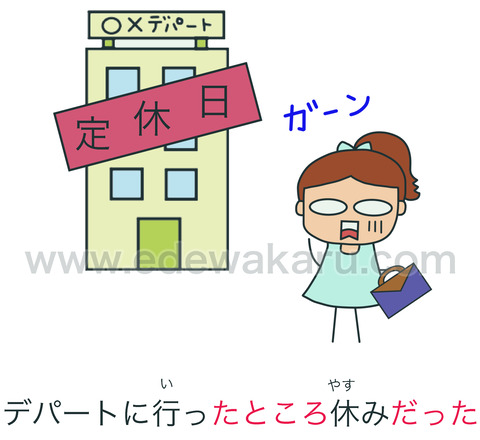
デパートに行ったところ休みだった
→デパートに行ったら休みだったWhen I went to the department store, it was closed. →When I went to the department store, it was closed.
上司に電話したところ不在だった
→上司に電話したら不在だったWhen I called my boss, they weren’t there. →When I called my boss, they weren’t there.
お医者さんにみてもらったところ何も問題はなかった
→お医者さんにみてもらったら何も問題はないとわかったWhen I had the doctor examine me, there was nothing wrong. →When I had the doctor examine me, I found out there was nothing wrong.
Read the original source text
Meaning
〜したら・・・した
〜したら・・・だった
〜したら・・・とわかった
How to use it
動詞[た形]+ところ・・・た
Explanation
「〜たところ・・・た」は
発見の意味を表す
文型で「〜たら・・・た」と同じ意味です。
「〜たら・・・た」よりも驚きの気持ちが強調されます
😊この文型はすでに発生したことを表すものですから、後ろには必ず「た形」がきます。「〜たところ・・・た」と覚えるといいですね😉
【「ところ」シリーズ】
〜たところ〜た
〜たところで〜ない
〜ていたところだ
〜といったところだ・〜というところだ
〜ところ(Nのところ)
〜ところだ(V辞書形+ところだ)
〜ところだ(ている+ところだ)
〜ところだ(Vた+ところだ)
〜ところまで来る
どんなときどう使う 日本語表現文型辞典
Meaning
when
How to use it
Vた + ところ
Explanation
~したら/~した結果
1)「あることをしたら、こうだった」と改まって説明するときに使う。特に、普通のできごとを説明するのではなく、「あることをした結果、こんな状況だった、または、こんな新しいことがわかった」と言いたいときに使う。
2)後の文にはたまたま生じた結果を言うので、話者の意志を表す文は来ない。
◆ × 両親と相談したところ、日本への留学を決めた。
→○両親と相談したところ、日本へ留学してもいいということだった
3) ❶ ❹ のように期待したこととは違っていたと言いたいときは「たところが」という形になる。
◆ × 両親と相談したところ、日本への留学を決めた。
→○両親と相談したところ、日本へ留学してもいいということだった
3)When expressing outcome that differs from expectations, becomes たところが, as in sentences ❶ and ❹ .
1)Explains formally that when one event occurs, things become certain way. Not used to explain very average phenomena, but to indicate as a result of one thing, another situation developed or speaker learned some new fact.
2)Result indicated is something that happened by chance, and thus cannot reflect speaker's volition.
In context 4 examples
昔住んでいた町を訪ねたところが、まったく様子が変わっていて迷ってしまった。
When I visited the town where I used to live, everything had changed so much that I got lost.
留学について父に相談してみたところ、喜んで賛成してくれた。
When I tried talking to my father about studying abroad, he was delighted and agreed.
プリンターが壊れたので店に問い合わせたところ、修理センターに持って行くのが一番いいと言われた。
Since the printer broke, I contacted the store, and they told me the best thing to do was take it to the repair center.
田中さんならわかるだろうと思って聞いてみたところが、彼にもわからないということだった。
Thinking Mr. Tanaka would know, I asked him, but it turned out he didn't know either.
Read the original source text
Meaning
when
How to use it
Vた+ところ
Explanation
~したら/~した結果
1)「あることをしたら、こうだった」と改まって説明するときに使う。特に、普通のできごとを説明するのではなく、「あることをした結果、こんな状況だった、または、こんな新しいことがわかった」と言いたいときに使う。
2)後の文にはたまたま生じた結果を言うので、話者の意志を表す文は来ない。
◆ × 両親と相談したところ、日本への留学を決めた。
→○両親と相談したところ、日本へ留学してもいいということだった
3) ❶ ❹ のように期待したこととは違っていたと言いたいときは「たところが」という形になる。
◆ × 両親と相談したところ、日本への留学を決めた。
→○両親と相談したところ、日本へ留学してもいいということだった
3)When expressing outcome that differs from expectations, becomes たところが, as in sentences ❶ and ❹ .
1)Explains formally that when one event occurs, things become certain way. Not used to explain very average phenomena, but to indicate as a result of one thing, another situation developed or speaker learned some new fact.
2)Result indicated is something that happened by chance, and thus cannot reflect speaker's volition.
毎日のんびり日本語教師
Usage 1
Read this source entry ↗How to use it
Verb た-form + ところ(が)
Explanation
For example, in “I went to the store, only to find it was closed,” the speaker thought the store would not be closed, but contrary to their expectations, it was. This is where the concessive nuance comes from.
Nowadays, 「~たところが」 is very rarely used, but 「~たところ」 with the 「が」 omitted is commonly used, as in example (1).
Also, 「ところが」 can be used on its own as a conjunction.
The expression 「~のに」 in example (4) has the same meaning.
(1) I thought he would know, so I asked him, but he didn't know either.
(2) I thought he would know, so I asked him, but he didn't know either.
(3) I thought he would know, so I asked him. But he didn't know either.
(4) I thought he would know, so I asked him, but he didn't know either.
Notes
The 「ところ」 series
In context 8 examples
彼なら知っていると思って聞いたところ、彼も知らなかった。
I thought he would know, so I asked him, but he didn't know either.
弁当買いに行ったところもう全部売り切れていた。
When I went to buy a boxed lunch, they had already sold out.
お店行ったところ休みだった。
When I went to the store, it was closed.
先生に相談したところ、親身になって話を聞いてくれた。
When I talked to the teacher, they listened to me with genuine concern.
書通りにやってみたところすぐできた。
When I tried doing it according to the book, I was able to do it right away.
呼ばれて行ったところ、時間間違えたのか誰もいなかった。
When I went after being called, nobody was there; maybe I got the time wrong.
数年ぶりに帰省したところ、町は昔と全然変わっていた。
When I returned to my hometown for the first time in several years, the town had changed completely from how it used to be.
お土産を買って行ったところ、これを一度食べてみたかったらしくとても喜んでくれた。
When I brought a souvenir, they were very happy, apparently because they'd wanted to try it for a while.
Read the original source text
How to use it
動た形+ところ(が)
Explanation
例えば「お店に行ったところ、休みだった」では、話者はお店は休みではないと思っていたが、予想に反して休みだったというニュアンスが生まれます。予想とは反するところに逆接があります。
現在「~たところが」を使うことは非常に少なくなっていますが、「が」を省略した「~たところ」は一般的に用いられています。例文(1)
また、「ところが」は接続詞として単独で用いることもできます。
これらと同じ表現に例文(4)の「~のに」があります。
(1) 彼なら知っていると思って聞い
たところが、彼も知らなかった。
(2) 彼なら知っていると思って聞いた
ところ、彼も知らなかった。
(3) 彼なら知っていると思って聞いた。
ところが
彼も知らなかった。
(4) 彼なら知っていると思って聞いた
のに、彼も知らなかった。
Notes
「ところ」シリーズ
Usage 2
Read this source entry ↗How to use it
Verb た-form + ところ
Explanation
Expresses the circumstances surrounding something discovered by chance.
It is used when one discovers by chance that the following clause holds true after the action in the preceding clause.
Therefore, the following clause describes something unexpected for the speaker or the person who performed the action.
Notes
The 「ところ」 series
In context 7 examples
早めに寝るようにしたところ、朝の目覚めが変わった。
When I started going to bed earlier, I noticed a difference in how refreshed I felt in the morning.
枕を変えたところ、睡眠の質も改善された。
When I changed my pillow, my sleep quality improved too.
思い切って彼にお願いしてみたところ、快諾してくれた。
When I mustered up the courage to ask him, he readily agreed.
メガネからコンタクトにしたところ、モテるようになった。
When I switched from glasses to contact lenses, I started getting more attention.
警察に問い合わせたところ、落とした財布が届けられていた。
When I contacted the police, I found out that the wallet I'd lost had been turned in.
友達に相談したところ、一緒に手伝ってくれることになった。
When I talked it over with a friend, they agreed to help me.
注文をキャンセルしたところ、キャンセルはできないと言われた。
When I tried to cancel the order, I was told it couldn't be canceled.
Read the original source text
How to use it
動た形+ところ
Explanation
偶然発見した物事のきっかけを表します。
前件の動作後に後件が成立することを偶然発見したことに使えます。
そのため、後件は話者、動作主にとって意外性のある内容がきます。
Notes
「ところ」シリーズ
AIUEO JLPT Grammar
Usage 1
Meaning
This sentence pattern shows the result of an action or the state right after the action, connecting with the past tense of the verb. It is used when explaining something learned after an action or the consequence of the action. In casual speech, 「ところ」may be simplified to 「とこ」.
How to use it
Verb in た-form + ところ
In context 5 examples
医者に行ったところ、風邪だと言われました。
When I went to the doctor, I was told it was a cold.
運動を始めたところ、体重が減りました。
When I started exercising, I lost weight.
その場所に行ったところ、美しい景色が広がっていました。
When I went to that place, beautiful scenery spread out before me.
今ご飯を食べたとこです。
I just had dinner.
ちょうど着いたとこだ。
We have just arrived.
Read the original source text
Meaning
This sentence pattern shows the result of an action or the state right after the action, connecting with the past tense of the verb. It is used when explaining something learned after an action or the consequence of the action. In casual speech, 「ところ」may be simplified to 「とこ」.
How to use it
動詞た形+ところ
Explanation · 日本語
この文型は、何かを行った結果や、その直後の状態を示す表現で、動詞のた形に接続して使います。この表現は、ある行動をした後に分かったことや、その行動によって起こった結果を述べるために使われます。口語では、「ところ」を「とこ」に簡略化することがよくあります。
Usage 2
Meaning
This sentence pattern expresses that, after performing a certain action or event, an unexpected result or situation occurred. It is used when what was expected does not align with reality.
How to use it
Verb ta-form + ところが
In context 5 examples
早めに出発したところが、渋滞に巻き込まれてしまった。
I left early, but I got caught in traffic.
薬を飲んだところが、全然効かなかった。
I took the medicine, but it didn’t work at all.
彼に頼んだところが、断られてしまった。
I asked him for help, but he refused.
新しいレストランに行ったところが、期待していたほどではなかった。
I went to the new restaurant, but it wasn’t as good as I expected.
説明書を読んだところが、やっぱり分からなかった。
I read the manual, but I still didn’t understand it.
Read the original source text
Meaning
This sentence pattern expresses that, after performing a certain action or event, an unexpected result or situation occurred. It is used when what was expected does not align with reality.
How to use it
動詞た形+ところが
Explanation · 日本語
この文型は、ある行動や出来事を行った後に予想外の結果や状況が発生したことを表す表現で、話し手が期待していたことと現実が異なる場合に使われます。
文法
Meaning
After doing ~, the result was ~ / After doing ~, I found out that ~
An expression that states what triggered or led to something.
How to use it
V (ta-form) + ところ
In context 5 examples
ノートパソコンの代わりにタブレットを買ってみたところ、思ったよりも使いやすかった。
When I tried buying a tablet instead of a laptop, it was easier to use than I expected.
友人のオススメの映画を見てみたところ、とても面白かったので、絶対見たほうがいいです。
When I tried watching a movie my friend recommended, I found it very interesting, so you should definitely watch it.
来週から海外旅行なので、天気を調べて見たところ、天気はあまりよくないようです。
Since I’m going on an overseas trip next week, I checked the weather, and it looks like it won’t be very good.
留学したいと父に相談してみたところ、快く受け入れてくれた。
When I talked to my father about wanting to study abroad, he readily accepted it.
お酒をやめてみたところ、体調がよくなった気がした。
When I tried giving up alcohol, I felt like my health improved.
Read the original source text
Meaning
~したら、~と言う結果になった / ~したら、~ということがわかった
きっかけを言う表現。
How to use it
V(タ形)+ ところ
日本語NET JLPT文法解説まとめ
Meaning
When I did ..., it resulted in ... / When I did ..., I found out that ...
An expression for describing what prompted something.
How to use it
V (ta-form) + ところ
Explanation
"When I did X, it resulted in Y. / "When I did X, I realized Y."
Expressions indicating a trigger or cause.
In context 5 examples
ノートパソコンの代わりにタブレットを買ってみたところ、思ったよりも使いやすかった。
When I tried buying a tablet instead of a laptop, it was easier to use than I expected.
友人のオススメの映画を見てみたところ、とても面白かったので、絶対見たほうがいいです。
When I tried watching a movie my friend recommended, I found it very interesting, so you should definitely watch it.
来週から海外旅行なので、天気を調べて見たところ、天気はあまりよくないようです。
Since I’m going on an overseas trip next week, I checked the weather, and it looks like it won’t be very good.
留学したいと父に相談してみたところ、快く受け入れてくれた。
When I talked to my father about wanting to study abroad, he readily accepted it.
お酒をやめてみたところ、体調がよくなった気がした。
When I tried giving up alcohol, I felt like my health improved.
Read the original source text
Meaning
~したら、~と言う結果になった / ~したら、~ということがわかった
きっかけを言う表現。
How to use it
V(タ形)+ ところ
Explanation
"When I did X, it resulted in Y. / "When I did X, I realized Y."
Expressions indicating a trigger or cause.