AIUEO JLPT Grammar
Meaning
This sentence pattern is used when referencing a topic or example related to a noun.
How to use it
Noun と + いうと; noun と + 言えば; noun と + 言ったら
In context 5 examples
夏と言ったら、やはり海と花火ですね。
Speaking of summer, the sea and fireworks come to mind.
彼の料理の腕前と言ったら、素晴らしいです。
When it comes to his cooking skills, they are amazing.
旅行と言えば、今年の夏はどこに行く予定ですか?
Speaking of travel, where do you plan to go this summer?
日本というと、多くの人は富士山を思い浮かべるでしょう。
When you think of Japan, many people think of Mount Fuji.
健康と言えば、最近運動を始めました。
Speaking of health, I recently started exercising.
Read the original source text
Meaning
This sentence pattern is used when referencing a topic or example related to a noun.
How to use it
名詞と+いうと名詞と+言えば名詞と+言ったら
Explanation · 日本語
この文型は、名詞に接続して使われ、その名詞に関連した話題や例を引き出す表現です。
絵でわかる日本語
Meaning
(Talking about an association) Speaking of …
How to use it
Noun [dictionary form] + といえば
Noun [dictionary form] + というと
Explanation
「〜といえば・〜というと」is used to respond to a topic by mentioning something associated with it or talking about it 😀
It is similar to the topic-marking particle 「〜は」. It is used to continue a conversation by taking what the other person said as the topic, or to mention something that came to mind from what one heard 😀 In most cases 「〜といえば」and「〜というと」can be switched, but 「〜といえば」has other uses too, which will be covered next time 😉
【For advanced learners】(A very fine distinction 😳)
In most cases, the associative 「〜といえば」and「〜というと」can be rewritten for one another, but 「〜といえば」is often used when something comes to mind, whereas 「〜というと」tends to be used when asking the other person to clarify.
When asking the other person a question about the topic, 「〜といえば」cannot be used 😨
[Example]
Secretary: President, Mr. Yamada called.
President: When you say Mr. Yamada, do you mean Mr. Yamada from Company A?
Secretary: Yes, that’s right.
In this case, the president is asking the secretary to clarify the topic, “Mr. Yamada,” so 「といえば」cannot be used 😦
⭕️山田さん
というと
A会社の山田さんか? (Clarification is okay)
❌山田さん
といえば
A会社の山田さんか? (Clarification is not okay)
This explanation is a little detailed, but advanced learners should be sure to remember it 😀
【The「という」series】
〜ということだ
〜というところだ
〜というのは
〜というのも〜からだ
〜というもの (Nというもの)
〜というより
In context 4 examples
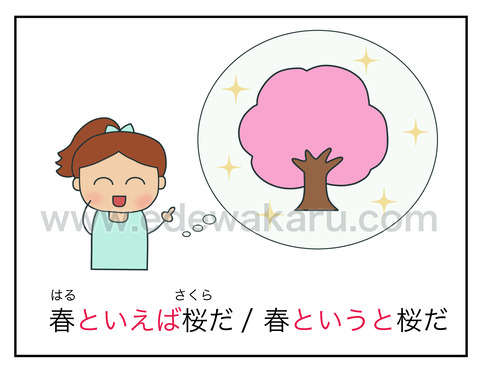
春といえば桜だ / 春というと桜だ
→春と聞くと桜を連想するSpeaking of spring, it’s cherry blossoms / Speaking of spring, it’s cherry blossoms. →When I hear “spring,” I think of cherry blossoms.
2020年といえば東京オリンピックですね / 2020年というと東京オリンピックですね
→2020年は東京オリンピックの年ですねSpeaking of 2020, it’s the Tokyo Olympics / Speaking of 2020, it’s the Tokyo Olympics. →2020 is the year of the Tokyo Olympics.
和食といえばお寿司ね / 和食というとお寿司ね
→和食と聞くと、お寿司を1番に連想するねSpeaking of Japanese food, it’s sushi / Speaking of Japanese food, it’s sushi. →When I hear Japanese food, sushi is the first thing I think of.
A:もう2月だね…時間が経つのは早いねB:2月といえばもうすぐバレンタインだね! / 2月というともうすぐバレンタインだね!
→2月はバレンタインデーがある月だね!A: It’s already February… Time passes so quickly. B: Speaking of February, Valentine’s Day is coming soon! / Speaking of February, Valentine’s Day is coming soon! →February is the month when Valentine’s Day takes place!
Read the original source text
Meaning
(連想することについて話す)〜について話すと
How to use it
名詞[辞書形]+といえば
名詞[辞書形]+というと
Explanation
「〜といえば・〜というと」はある話題を受けて、そこから連想することを言ったり、それについて話したりする時に使われます
😀
主題や話題を表す助詞の「〜は」に似ています。相手が話したことを聞いてそれを話題にして会話を続けたり、相手から聞いて連想したことを言う時に使用されます😀「〜といえば」と「〜というと」はほとんどの場合チェンジすることができますが、「〜といえば」には他の使い方もありますので、それはまた次回掲載します😉
【上級レベルの人へ】(とても細かい説明です😳)
連想を表す「〜といえば」「〜というと」はほとんどの場合書き換えが可能ですが、「〜といえば」が何かを思い出した時に使用されることが多いのに対し「〜というと」は相手に聞き返す場合によく使われるという性質があります。
相手にその話題について質問する場合は「〜といえば」は使えなくなります
😨
[例文]
秘書:社長、山田さんから電話がありました
社長:山田さん
というと
A会社の山田さんか?
秘書:はい、そうです。
この場合、
社長が秘書に話題である「山田さん」について聞き返す状況になっていますので「といえば」は使用不可になります
😦
⭕️山田さん
というと
A会社の山田さんか?(
聞き返しOK)
❌山田さん
といえば
A会社の山田さんか?(
聞き返し不可)
少し細かい説明になりましたが、上級レベルの人はぜひ覚えておいてください😀
【「という」シリーズ】
〜ということだ
〜というところだ
〜というのは
〜というのも〜からだ
〜というもの(Nというもの)
〜というより
日本語文型辞典
Meaning
Used to take up a topic and say something associated with it, or add an explanation about it. It is also said as …といえば. In spoken language it may become っていうと.
Used to check the meaning or definition of a word or phrase. It often asks about a term brought up in the preceding context. In speech, って may be used instead of というと. This is an expression for confirmation, so questions like “What does NGO mean?” are awkward.
An expression that responds to what the other person has said and prompts them to elaborate. The polite expression is といいますと.
How to use it
…というと
というと…のことですか
というと
In context 10 examples
スペインというと、すぐフラメンコが心に浮かぶ。
Speaking of Spain, flamenco immediately comes to mind.
北海道というと、広い草原や牛の群れを思い出す。
When I think of Hokkaido, I remember its vast grasslands and herds of cows.
漱石というと、「こころ」という小説を思い出す人も多いだろう。
Speaking of Soseki, many people probably think of the novel “Kokoro.”
モーツァルトというと没後200年の年には随分たくさん行事がありましたね。
Speaking of Mozart, there were quite a lot of events in the year marking the 200th anniversary of his death.
A:スキーというと、今年は長野オリンピックですが、Bさんスキーはなさいますか。
B:ええ、でもあまり上手じゃないんですよ。A: Speaking of skiing, this year is the Nagano Olympics. Do you ski, B? B: Yes, but I'm not very good.
「しめなわ」というと、あの、お正月につける飾りのことですか。
When you say “shimenawa,” do you mean that decoration put up at New Year's?
NGOというと、民間の援助団体のことですか。
When you say NGO, do you mean a private aid organization?
A:困っていたとき、ケリーが金を貸してくれまして。
B:あの、ケリーというと、あの銀行家のケリーのことですか。A:ああ、そうです。A: When I was in trouble, Kelly lent me some money. B: Um, when you say Kelly, do you mean that banker Kelly? A: Yes, that's right.
A:この企画は大筋はいいが、細かいところで少々無理があるね。
B:というと。
A:今から説明するよ。A: The overall plan is good, but some of the details are a little unreasonable. B: What do you mean? A: I'll explain now.
A:この事件は終わったように見えて、実はまだ終わってはいないんだ。
B:というと、まだ何か起こるんですか?A: It looks like this case is over, but in fact it isn't over yet. B: What do you mean? Is something else going to happen?
Read the original source text
Meaning
ある話題を受けて、そこから連想されることについて述べたり、それについて説明を加えたりするのに用いる。「…といえば」とも言う。話しことばでは「っていうと」となることもある。
単語、語句の意味や定義を確認するのに使う。先行文脈で出された語句をとりあげてたずねる場合が多い。話しことばでは、「というと」のかわりに、「って」を使うこともある。確認の表現であり、「NGOというと、何のことですか」というような質問はしにくい。
相手の言葉をうけて、くわしく展開するようにうながす表現。丁寧表現として「といいますと」がある。
How to use it
…というと
というと…のことですか
というと
日本語文型辞典 英語版
Meaning
B:ええ、でもあまり上手じゃないんですよ。
Well, yes, but I’m not very good.
Used in response to a certain topic, to describe what it reminds the speaker of or to add some explanation about it. といえば can also be used. In spoken language, it sometimes takes the form っていうと.
B:あの、ケリーというと、あの銀行家のケリーのことですか。
Umm, when you say Kelly, do you mean Kelly the banker?
A:ああ、そうです。
Yes, that’s right.
Used to confirm the meaning or definition of a word or phrase. Often used to ask a question about a word or phrase given in the preceding context. In spoken language, って may be used instead of というと. This is an expression of confirmation; a more direct question, like “When you say NGO, what is that?” (NGOというと、何のことですか), is difficult to ask.
B:というと。
By which you mean...?
A:今から説明するよ。
I’m going to explain now.
B:というと、まだ何か起こるんですか?
You mean to say that something may still happen?
Used in response to something another person has said, to press for further details or explanation. The polite form of this expression is といいますと.
How to use it
1. ...というと
2. というと...のことですか
3. というと
In context 10 examples
スペインというと、すぐフラメンコが心に浮かぶ。
When you say Spain, the flamenco immediately springs to mind.
北海道というと、広い草原や牛の群れを思い出す。
When I hear Hokkaido, I am reminded of wide-open grasslands and herds of cattle.
漱石というと、「こころ」という小説を思い出す人も多いだろう。
If you say Soseki, many people will remember the novel Kokoro.
モーツァルトというと没後 200年の年には随分たくさん行事がありましたね。
Speaking of Mozart, there were so many events in the year of the 200th anniversary of his death, weren’t there?
A:スキーというと、今年は長野オリンピックですが、Bさんスキーはなさいますか。
Speaking of skiing, the Nagano Olympics are this year—do you ski?
「しめなわ」というと、あの、お正月につける飾りのことですか。
When you say shimenawa (sacred straw rope), umm, is that the decoration people put up at New Year’s?
NGOというと、民間の援助団体のことですか。
Does NGO mean a private aid organization?
A:困っていたとき、ケリーが金を貸してくれまして。
When I was in trouble, Kelly lent me some money.
A:この企画は大筋はいいが、細かいところで少々無理があるね。
This plan is essentially sound, but there are a few problems with the details.
A:この事件は終わったように見えて、実はまだ終わってはいないんだ。
This incident appears to be over, but in fact it is not over yet.
Read the original source text
Meaning
B:ええ、でもあまり上手じゃないんですよ。
Well, yes, but I’m not very good.
Used in response to a certain topic, to describe what it reminds the speaker of or to add some explanation about it. といえば can also be used. In spoken language, it sometimes takes the form っていうと.
B:あの、ケリーというと、あの銀行家のケリーのことですか。
Umm, when you say Kelly, do you mean Kelly the banker?
A:ああ、そうです。
Yes, that’s right.
Used to confirm the meaning or definition of a word or phrase. Often used to ask a question about a word or phrase given in the preceding context. In spoken language, って may be used instead of というと. This is an expression of confirmation; a more direct question, like “When you say NGO, what is that?” (NGOというと、何のことですか), is difficult to ask.
B:というと。
By which you mean...?
A:今から説明するよ。
I’m going to explain now.
B:というと、まだ何か起こるんですか?
You mean to say that something may still happen?
Used in response to something another person has said, to press for further details or explanation. The polite form of this expression is といいますと.
How to use it
1. ...というと
2. というと...のことですか
3. というと
NINJAL 日本語文型データベース
Meaning
Used to take something mentioned in the context up as a new topic. It can also be used to confirm something that came up in the other person’s conversation or to ask for more details about it.
How to use it
Nというと
Notes
After 「~というと」 comes a sentence describing an association with 「〜」, a sentence about something else that 「〜」 brought to mind, or a sentence giving a typical example of 「~」.
In context 5 examples
今日はウィルスについてお話します。ウィルスというと、皆さんは真っ先にどんなことを考えますか。
Today I’m going to talk about viruses. When you hear “virus,” what’s the first thing that comes to mind?
私、ガーデニングを始めました。ガーデニングというとおしゃれな趣味だというイメージがありますが、私がやっていることは、まだ草取りだけです。
I’ve started gardening. Gardening brings to mind a stylish hobby, but all I’ve done so far is pull weeds.
今度の演劇発表会で、私は和服を着て出る役になった。和服というと茶道をしていた祖母のことを思い出す。
I’ve been given a role that requires me to wear traditional Japanese clothes at the upcoming theater performance. Speaking of traditional Japanese clothes, I think of my grandmother, who practiced the tea ceremony.
日本の代表的調味料というとしょうゆで、これは和食を作るには欠かせないものです。
When it comes to Japan’s representative seasoning, it’s soy sauce, which is indispensable for making Japanese food.
「この間、久しぶりに山口君に会ったよ」「山口君というと、高校の時に同級だったあの山口君?」
“I ran into Yamaguchi-kun the other day for the first time in ages.” “Yamaguchi-kun—do you mean that Yamaguchi-kun who was in our class in high school?”
Read the original source text
Meaning
文脈中にある~を新しい話題として取り上げるときに使います。相手の話の中に出てきた~を確認したり詳しく尋ねたりするときに使うこともあります。
How to use it
Nというと
Notes
「~というと」の後には、「〜」について連想することを述べる文、「〜」から想起された別の内容について述べる文、「~」の代表的な例を示す文がきます。
IMABI
“When it Comes to…” I:というと, といえば, & といったら
Read this IMABI lesson ↗Explanation
“When it Comes to…” I: というと, といえば, & といったら
In this lesson, we will begin coverage on expressions that can roughly all translate to “when it comes to…” to some capacity. The expressions in this lesson all involve the verb 言う in its respective conditional forms. If you have a firm grasp of these forms, the nuance differences that you are to soon be introduced to will not be news to you.
~というと: When/in speaking of…
~というと is used to indicate what is representative or deeply associated with something, and it can even describe an inevitable correlation between something (as seen in Ex. 3). This pattern is quite objective in nature and is seen most frequently in the written language. In a literal sense, you can translate it as “if one were to speak…of,” but its translation can be flexible to more easily translated as “when/in/if speaking of…”
1. 日本にほんの古都ことというと、平安京へいあんきょう、奈良ならでしょう。
In speaking of the former capitals of Japan, they’re Heian-kyō and Nara.
2. イギリスと言いうと、いつも曇くもっているというイメージがあるかと思おもいます。
In speaking of England, I think you might have an image of it always being cloudy.
3. ずっと晴天せいてんが続つづいていたのにお祭まつりだと言いうと天気てんきが悪わるくなるのは気きのせいかな?
Is it just my imagination that the weather certainly gets bad whenever there’s a festival despite it being clear skies the whole time?
4. 5ご大新聞だいしんぶんと言いうと、読売よみうり・朝日あさひ・毎日まいにち・産経さんけい・東京とうきょうを指さすことが多おおい。
When speaking of the five major newspapers, the Yomiuri, Asahi, Mainichi, Sankei, and Tokyo are often referred to.
5. アメリカに根付ねづいた日本文化にほんぶんかというと、寿司すし・生いけ花ばな・アニメ・漫画まんが・禅ぜんなどがあります。
In speaking of Japanese culture that has taken root in America, there is sushi, ikebana, anime, manga, Zen, etc.
6. 天候てんこうというと「晴はれ」「雨あめ」など思おもい浮うかべますが、「波なみ」「風かぜ」も天候てんこうなんですね。
We’re reminded of “clear weather” and “rain” in speaking of the weather, but “waves” and “the wind” are also part of the weather, you know.
7. 政治せいじというと、不審ふしんなものの代名詞だいめいしのように思おもえます。
When speaking of politics, it would certainly seem to be a classic example of something suspicious.
8. 微生物びせいぶつというと、不潔ふけつなばい菌きんや病気びょうきを引ひき起おこす悪者わるものを連想れんそうする人ひとが多おおいかもしれない。
When speaking of microbes, there may be many people who associate them with filthy germs or bad guys that cause illness.
9. 肉眼にくがんで確認かくにんできる太陽系たいようけいの惑星わくせいというと、水星すいせい、金星きんせい、火星かせい、木星もくせい、土星どせいまでであり、それに地球ちきゅうを加くわえて6むっつです。
When speaking of the planets in the solar system that can be verified with the naked eye, there is Mercury, Venus, Mars, Jupiter, and Saturn, and when you add Earth to the mix, there are six.
10. 従来じゅうらい、企業きぎょうの社会的責任しゃかいてきせきにんというと、企業倫理きぎょうりんりや法令順守ほうれいじゅんしゅなどが中心ちゅうしんだった。
Conventionally, when speaking of societal responsibility to the company, company ethics, compliance, and such were at the center.
11. ワシントン州の有名な州立大学というと、ワシントン大学ですね。
In speaking of famous state universities in the State of Washington, there is Washington University.
12. 韓国かんこくドラマというと、不治ふじの病やまいや交通事故こうつうじこ、有あり得えない擦すれ違ちがいなどが頻出ひんしゅつする恋愛れんあいドラマを想像そうぞうするという人ひとが多おおいだろう。
When speaking of Korean dramas, there are probably many people who associate them with romance dramas which frequently feature incurable diseases, traffic accidents, impossible crossing of paths, and what not.
~はというと: As far as…goes
~はというと is very similar to ~というと, but it always intrinsically illustrates a stark contrast of some sort, whether implicitly or explicitly stated.
13. 西田にしださんは魚料理さかなりょうりが好すきで何なんでも食たべますが、肉料理にくりょうりはというとかなり好すき嫌きらいがあるらしいです。
Mr. Nishida loves fish-based dishes and will eat anything, but as far as meat dishes go, he seems to have considerable likes and dislikes.
14. 私わたしは理科系りかけいの科目かもくは得意とくいなんですが、文科系ぶんかけいの科目かもくはというと、全まったく苦手にがてなんです。
I am good at science courses, but as far as liberal arts go, I’m absolutely bad at them.
15. 父ちちも母ははものんびり過すごしていますが、私わたしはというと、毎日まいにちただ忙いそがしくて働はたらいています。
My father and my bother live leisurely, but I on the other hand am just busy at working every day.
16. 草食動物そうしょくどうぶつはというと、基本きほんは植物しょくぶつしか食たべません。
As far as herbivores go, they basically only eat plants.
17. 地球上ちきゅうじょうで最大さいだいの動物どうぶつはというと、南氷洋なんぴょうようのシロナガスクジラです。
As far as the largest animal on Earth goes, that would be the blue whale from the Antarctic Ocean.
18. 日本にほんのように、蕎麦そばを麺めんに加工かこうして食たべる国くにはというと、隣となりの中国ちゅうごくや朝鮮ちょうせんおよびブータンぐらいしかない。
As far as countries that manufacture buckwheat into noodles to eat like Japan go, there are only say neighboring China and Korea as well as Bhutan.
19. 世界せかいで最もっとも幅はばのある海峡かいきょうはというと、カナダのバフィン島とうとグリーンランドに挟はさまれたデービス海峡かいきょうです。
As far as the widest straight in the world goes, it would be the Davis Strait, which is sandwiched between Baffin Island and Greenland.
20. 日本政府にっぽんせいふはというと、菅官房長官すがかんぼうちょうかんは調査ちょうさに否定的ひていてきな見解けんかいを示しめしている。
In speaking of the Japanese government, Chief Secretary Suga has expressed negative views on investigation (of the matter).
21. アメリカ同時多発どうじたはつテロ事件じけんと言いうと、あの頃ころの中東ちゅうとうアジアの情勢悪化じょうせいあっかを思おもい出だします。
In speaking of the American Simultaneous Sequential Terrorist Event (9/11), I think of the worsening state of affairs in the Middle East at the time.
22. 私わたしは兄あにが大嫌だいきらいです。何故なぜかというと、とても自己中心的じこちゅうしんてきだからです。
I hate my older brother. The reason why is because he is extremely self-centered.
~といえば: Speaking of which…
When using ~といえば, a lot of enthusiasm is felt when bringing up something into conversation. It is seen a lot in conversation and can be very definitive as far as the emotional context of one’s statement is concerned.
23. 日本代表の漫画といえばナルトですよね。
Speaking of a manga that represents Japan, that would be Naruto, huh.
24. サンフランシスコで、一番有名いちばんゆうめいな観光名所かんこうめいしょといえば、ゴールデン・ゲート・ブリッジでしょう。
Speaking of the most famous tourist spot in San Francisco, that would be the Golden Gate Bridge.
25. 夏なつの食たべ物ものといえば、スイカ、アイス、素麺そうめんでしょう。
Speaking of summer foods, there’s watermelons, ice cream, and somen.
26. タイ料理りょうりといえば、駅前えきまえに新あたらしいレストランが出来できたの知しってる?
Speaking of Thai cuisine, did you know there’s a new restaurant in front of the station?
27.
A氏し: 市川いちかわさん、先日交通事故せんじつこうつうじこに遭あって入院にゅういんしたらしいですよ。
B氏し: え、そうなんですか。あ、入院にゅういんしたといえば、三上みかみさんが来週退院らいしゅうたいいんだそうですよ。
Person A: It seems that Mr. Ichikawa became hospitalized the other day due to getting in a traffic accident.
Person B: Wow, really? Oh, speaking of being put in the hospital, I hear that Mr. Mikami is to be released from the hospital next week.
28. 古典芸能こてんげいのうといえば、歌舞伎かぶきでしょう。
Speaking of classical theatre, there’s kabuki.
29. 車くるまと言いえば、君きみはトヨタ車しゃを買かったそうだね。
Speaking of cars, I hear you’ve bought yourself a Toyota?
30. リンカーンと言いえば奴隷制度どれいせいどを思おもい出だします。
In speaking of Lincoln, we think of the slavery system.
31. 動物どうぶつと言いえば、僕ぼくの犬いぬは話はなせるんだ。
Speaking of animals, my dog can talk.
32. レオナルドダヴィンチといえば、世界的せかいてきな芸術家げいじゅつかだ。
In speaking of Leonard da Vinci, he is as world-famous artist.
33. イギリスといえば、{紅茶こうちゃ・ロンドン・二階建にかいだてバス・ビートルズ・イギリス王室おうしつ・ハリーポッター}など思おもい浮うかべる人ひとが多おおいでしょう。
In speaking of England, there are surely many people who think of [tea/London/two-story buses/the Beatles/the British Royal Family/Harry Potter].
34. メキシコの代表的だいひょうてきな食たべ物ものといえば、タコスです。
In speaking of Mexico’s signature food, there’s the taco.
35. 今いまの若者わかものの流行りゅうこうといえば、男性だんせいの間あいだではひげが流行はやっていて、女性じょせいの間あいだでは涙袋なみだぶくろメイクが流行はやっている。
In speaking of trends among young people today, beards are trending among men and namidabukuro is trending among women.
Word Note: 涙袋メイク makes it look like you have the impression of tears under your eyes.
Spelling Note: ひげ in 漢字 may either be 髭, 髯, or 鬚. However, the first refers to beards around the mouth, the second refers to beards on the cheeks, and the third refers to beards on the chin. These respectively may be said/written as 口髭・髭, 頬髭・頬髯・髯, and 顎髭・顎鬚・鬚. You are not required to remember this.
~といったら: When it comes to…/speaking of…
In a literal sense, ~といったら means “were to say.”
36. 怖こわくないと言いったら嘘うそになる。
If I said I wasn’t scared, that’d be a lie.
37. フランス人じんに「アミは友達ともだちです」と言いったら混乱こんらんしそうですね。
If were to say “Ami is my friend” to a French person, they might get confused.
In similar contexts seen with ~といえば, however, it is used in much the same way to give example of something intrinsically tied to whatever is the focus of conversation. It is arguably the most common form in conversation. It’s not so ecstatic, but it’s just as assertive.
38. シアトルの景色けしきといったら、口くちで言いい表あらわせない程ほどです。
When it comes to the scenery of Seattle, it’s beyond expression.
39. 山田やまださんの中国語能力ちゅうごくごのうりょくといったら、中国人ちゅうごくじんがびっくりするほどだそうです。
Speaking of Mr. Yamada’s Chinese proficiency, I hear it even surprises Chinese people.
40. アメリカの元大統領もとだいとうりょうといったら、オバマですね。
Speaking of the former president of America, that’d be Obama, right?
41. 一昔前ひとむかしまえはお寿司すしといったら高級こうきゅうな食たべ物ものの代表だいひょうでした。
Long ago when speaking of sushi, it was representative of high class cuisine.
42. 東北とうほくで熊くまといったらツキノワグマです。
Speaking of bears in Tohoku, there’s the Asian black bear.
43. 冬ふゆといったら鍋料理なべりょうりですね。
When it comes to winter, it’s time for hot pot cooking.
44. 果物王国くだものおうこくといったらどこでしょうか。
Speaking of the king of fruit, where would that be?
45. 家具かぐといったらやっぱりイケアですね。
When it comes to furniture, you definitely go with IKEA.
In context 44 examples
日本にほんの古都ことというと、平安京へいあんきょう、奈良ならでしょう。
In speaking of the former capitals of Japan, they’re Heian-kyō and Nara.
イギリスと言いうと、いつも曇くもっているというイメージがあるかと思おもいます。
In speaking of England, I think you might have an image of it always being cloudy.
ずっと晴天せいてんが続つづいていたのにお祭まつりだと言いうと天気てんきが悪わるくなるのは気きのせいかな?
Is it just my imagination that the weather certainly gets bad whenever there’s a festival despite it being clear skies the whole time?
5ご大新聞だいしんぶんと言いうと、読売よみうり・朝日あさひ・毎日まいにち・産経さんけい・東京とうきょうを指さすことが多おおい。
When speaking of the five major newspapers, the Yomiuri, Asahi, Mainichi, Sankei, and Tokyo are often referred to.
アメリカに根付ねづいた日本文化にほんぶんかというと、寿司すし・生いけ花ばな・アニメ・漫画まんが・禅ぜんなどがあります。
In speaking of Japanese culture that has taken root in America, there is sushi, ikebana, anime, manga, Zen, etc.
天候てんこうというと「晴はれ」「雨あめ」など思おもい浮うかべますが、「波なみ」「風かぜ」も天候てんこうなんですね。
We’re reminded of “clear weather” and “rain” in speaking of the weather, but “waves” and “the wind” are also part of the weather, you know.
政治せいじというと、不審ふしんなものの代名詞だいめいしのように思おもえます。
When speaking of politics, it would certainly seem to be a classic example of something suspicious.
微生物びせいぶつというと、不潔ふけつなばい菌きんや病気びょうきを引ひき起おこす悪者わるものを連想れんそうする人ひとが多おおいかもしれない。
When speaking of microbes, there may be many people who associate them with filthy germs or bad guys that cause illness.
肉眼にくがんで確認かくにんできる太陽系たいようけいの惑星わくせいというと、水星すいせい、金星きんせい、火星かせい、木星もくせい、土星どせいまでであり、それに地球ちきゅうを加くわえて6むっつです。
When speaking of the planets in the solar system that can be verified with the naked eye, there is Mercury, Venus, Mars, Jupiter, and Saturn, and when you add Earth to the mix, there are six.
従来じゅうらい、企業きぎょうの社会的責任しゃかいてきせきにんというと、企業倫理きぎょうりんりや法令順守ほうれいじゅんしゅなどが中心ちゅうしんだった。
Conventionally, when speaking of societal responsibility to the company, company ethics, compliance, and such were at the center.
ワシントン州の有名な州立大学というと、ワシントン大学ですね。
In speaking of famous state universities in the State of Washington, there is Washington University.
韓国かんこくドラマというと、不治ふじの病やまいや交通事故こうつうじこ、有あり得えない擦すれ違ちがいなどが頻出ひんしゅつする恋愛れんあいドラマを想像そうぞうするという人ひとが多おおいだろう。
When speaking of Korean dramas, there are probably many people who associate them with romance dramas which frequently feature incurable diseases, traffic accidents, impossible crossing of paths, and what not.
西田にしださんは魚料理さかなりょうりが好すきで何なんでも食たべますが、肉料理にくりょうりはというとかなり好すき嫌きらいがあるらしいです。
Mr. Nishida loves fish-based dishes and will eat anything, but as far as meat dishes go, he seems to have considerable likes and dislikes.
私わたしは理科系りかけいの科目かもくは得意とくいなんですが、文科系ぶんかけいの科目かもくはというと、全まったく苦手にがてなんです。
I am good at science courses, but as far as liberal arts go, I’m absolutely bad at them.
父ちちも母ははものんびり過すごしていますが、私わたしはというと、毎日まいにちただ忙いそがしくて働はたらいています。
My father and my bother live leisurely, but I on the other hand am just busy at working every day.
草食動物そうしょくどうぶつはというと、基本きほんは植物しょくぶつしか食たべません。
As far as herbivores go, they basically only eat plants.
地球上ちきゅうじょうで最大さいだいの動物どうぶつはというと、南氷洋なんぴょうようのシロナガスクジラです。
As far as the largest animal on Earth goes, that would be the blue whale from the Antarctic Ocean.
日本にほんのように、蕎麦そばを麺めんに加工かこうして食たべる国くにはというと、隣となりの中国ちゅうごくや朝鮮ちょうせんおよびブータンぐらいしかない。
As far as countries that manufacture buckwheat into noodles to eat like Japan go, there are only say neighboring China and Korea as well as Bhutan.
世界せかいで最もっとも幅はばのある海峡かいきょうはというと、カナダのバフィン島とうとグリーンランドに挟はさまれたデービス海峡かいきょうです。
As far as the widest straight in the world goes, it would be the Davis Strait, which is sandwiched between Baffin Island and Greenland.
日本政府にっぽんせいふはというと、菅官房長官すがかんぼうちょうかんは調査ちょうさに否定的ひていてきな見解けんかいを示しめしている。
In speaking of the Japanese government, Chief Secretary Suga has expressed negative views on investigation (of the matter).
アメリカ同時多発どうじたはつテロ事件じけんと言いうと、あの頃ころの中東ちゅうとうアジアの情勢悪化じょうせいあっかを思おもい出だします。
In speaking of the American Simultaneous Sequential Terrorist Event (9/11), I think of the worsening state of affairs in the Middle East at the time.
私わたしは兄あにが大嫌だいきらいです。何故なぜかというと、とても自己中心的じこちゅうしんてきだからです。
I hate my older brother. The reason why is because he is extremely self-centered.
日本代表の漫画といえばナルトですよね。
Speaking of a manga that represents Japan, that would be Naruto, huh.
サンフランシスコで、一番有名いちばんゆうめいな観光名所かんこうめいしょといえば、ゴールデン・ゲート・ブリッジでしょう。
Speaking of the most famous tourist spot in San Francisco, that would be the Golden Gate Bridge.
夏なつの食たべ物ものといえば、スイカ、アイス、素麺そうめんでしょう。
Speaking of summer foods, there’s watermelons, ice cream, and somen.
タイ料理りょうりといえば、駅前えきまえに新あたらしいレストランが出来できたの知しってる?
Speaking of Thai cuisine, did you know there’s a new restaurant in front of the station?
古典芸能こてんげいのうといえば、歌舞伎かぶきでしょう。
Speaking of classical theatre, there’s kabuki.
車くるまと言いえば、君きみはトヨタ車しゃを買かったそうだね。
Speaking of cars, I hear you’ve bought yourself a Toyota?
リンカーンと言いえば奴隷制度どれいせいどを思おもい出だします。
In speaking of Lincoln, we think of the slavery system.
動物どうぶつと言いえば、僕ぼくの犬いぬは話はなせるんだ。
Speaking of animals, my dog can talk.
レオナルドダヴィンチといえば、世界的せかいてきな芸術家げいじゅつかだ。
In speaking of Leonard da Vinci, he is as world-famous artist.
イギリスといえば、{紅茶こうちゃ・ロンドン・二階建にかいだてバス・ビートルズ・イギリス王室おうしつ・ハリーポッター}など思おもい浮うかべる人ひとが多おおいでしょう。
In speaking of England, there are surely many people who think of [tea/London/two-story buses/the Beatles/the British Royal Family/Harry Potter].
メキシコの代表的だいひょうてきな食たべ物ものといえば、タコスです。
In speaking of Mexico’s signature food, there’s the taco.
今いまの若者わかものの流行りゅうこうといえば、男性だんせいの間あいだではひげが流行はやっていて、女性じょせいの間あいだでは涙袋なみだぶくろメイクが流行はやっている。
In speaking of trends among young people today, beards are trending among men and namidabukuro is trending among women.
怖こわくないと言いったら嘘うそになる。
If I said I wasn’t scared, that’d be a lie.
フランス人じんに「アミは友達ともだちです」と言いったら混乱こんらんしそうですね。
If were to say “Ami is my friend” to a French person, they might get confused.
シアトルの景色けしきといったら、口くちで言いい表あらわせない程ほどです。
When it comes to the scenery of Seattle, it’s beyond expression.
山田やまださんの中国語能力ちゅうごくごのうりょくといったら、中国人ちゅうごくじんがびっくりするほどだそうです。
Speaking of Mr. Yamada’s Chinese proficiency, I hear it even surprises Chinese people.
アメリカの元大統領もとだいとうりょうといったら、オバマですね。
Speaking of the former president of America, that’d be Obama, right?
一昔前ひとむかしまえはお寿司すしといったら高級こうきゅうな食たべ物ものの代表だいひょうでした。
Long ago when speaking of sushi, it was representative of high class cuisine.
東北とうほくで熊くまといったらツキノワグマです。
Speaking of bears in Tohoku, there’s the Asian black bear.
冬ふゆといったら鍋料理なべりょうりですね。
When it comes to winter, it’s time for hot pot cooking.
果物王国くだものおうこくといったらどこでしょうか。
Speaking of the king of fruit, where would that be?
家具かぐといったらやっぱりイケアですね。
When it comes to furniture, you definitely go with IKEA.
DoJG 日本語文法辞典(全集)
Meaning
When ~ mention; if ~ say that ~; when ~ say that ~; when it comes to
How to use it
(i) Noun | と言うと | |
| 長崎と言うと | When it comes to Nagasaki |
(ii) Sinformal | と言うと | |
| 家を買ったと言うと | If I say that I’ve bought a house |
Explanation
A phrase which is used when something which someone has mentioned causes an involuntary response.
In context 7 examples
サンフランシスコと言うと、あのケーブルカーを思い出す。
When you mention San Francisco, I remember those cable cars.
日本語を話すと言うと聞こえはいいんですが、実は簡単な挨拶が出来るだけなんです。
It sounds impressive when I say that I can speak Japanese, but the fact is that all I can do is exchange simple greetings.
パリと言うと、誰でも真っ先にあのエッフェル塔を思い浮かべるだろう。
When someone mentions Paris, the (literally: that) Eiffel Tower is the first thing likely to come to everyone's mind.
柔道と言うと、毎日練習した学生時代を思い出す。
When it comes to judo, I remember my school days when I used to practice it every day.
漫画と言うと馬鹿にする人もあるが、あれはあれで面白いのだ。
Some people ridicule comics (literally: Some people despise you when you mention comics), but comics are interesting in their own way.
東大卒と言うと偉そうに聞こえるが、私は勉強なんか全然しない劣等生だったんです。
It sounds great when I say that I am a graduate of the University of Tokyo, but I was (in fact) a poor student who didn't study at all.
会社を辞めたと言うと体裁がいいんですが、彼は本当は辞めさせられたんですよ。
It sounds good when he says that he quit his company, but the truth of the matter is that he was fired (literally: was made to quit).
どんなときどう使う 日本語表現文型辞典
Usage 1
Meaning
whenever…comes to mind
How to use it
N / 〔Plain form〕 + というと
Explanation
というと〈連想〉
~という言葉を使うと
あることを話題にしたとき、すぐ浮かぶイメージを言う言い方。
Expresses image that immediately comes to mind when speaking on some topic.
In context 3 examples
この町に新しく病院ができた。病院というとただ四角いだけの建物を想像するが、この病院はカントリーホテルという感じのものだ。
A new hospital was built in this town. When you hear “hospital,” you might imagine nothing more than a square building, but this one feels like a country hotel.
わたしは草花研究会で野草の研究をしています。研究をしているというと難しいことを想像するでしょうが、野や山を歩いて野草の観察をするんです。
I study wild grasses with the Wildflower Study Group. When I say I do research, you might imagine something difficult, but I walk through fields and mountains observing wild grasses.
小学校というと大勢の子どもたちや広い校庭がまず頭に浮かぶでしょうが、わたしの通った小学校は山の中の小さな寺のようなものでした。
When you think of an elementary school, you probably first picture lots of children and a spacious playground, but the elementary school I attended was like a small temple in the mountains.
Read the original source text
Meaning
whenever…comes to mind
How to use it
N/〔普通形〕+というと
Explanation
というと〈連想〉
~という言葉を使うと
あることを話題にしたとき、すぐ浮かぶイメージを言う言い方。
Expresses image that immediately comes to mind when speaking on some topic.
Usage 2
Meaning
when (you) say… do (you) mean…
How to use it
See 2).
Explanation
というと〈確認〉
あなたが今言った~は
B:林さんというと、前にここの受付をしていた林さんのことですか。
B:帰ったというと、もう日本には戻らないということでしょうか。
B:というと、赤ちゃんが生まれたのですね。
1)相手の言った言葉を受けて、それが自分の思っている内容と同じかどうか確かめるときに使う。
2)接続は、取り上げようとする言葉にそのまま続ける場合が多い。
3) ❸ のように「というと」の前を省略して接続詞的に使う場合もある。
1)Verifies that what other party says coincides with what listener thinks about topic.
2)Often appended directly to topic brought up.
3)Sometimes used as conjunction after discourse that has been omitted, as in sentence ❸ .
In context 3 examples
A:林さんが結婚したそうです。あいさつ状が来ました。
A: I heard Mr. Hayashi got married. An announcement came.
A:リーさんは荷物を整理して、もう国へ帰りました。
A: Mr. Lee packed his things and has already gone back to his country.
A:ヤンさんの家族は今3人ですよ。
A: There are three people in Mr. Yang’s family now.
Read the original source text
Meaning
when (you) say… do (you) mean…
How to use it
2)参照
Explanation
というと〈確認〉
あなたが今言った~は
B:林さんというと、前にここの受付をしていた林さんのことですか。
B:帰ったというと、もう日本には戻らないということでしょうか。
B:というと、赤ちゃんが生まれたのですね。
1)相手の言った言葉を受けて、それが自分の思っている内容と同じかどうか確かめるときに使う。
2)接続は、取り上げようとする言葉にそのまま続ける場合が多い。
3) ❸ のように「というと」の前を省略して接続詞的に使う場合もある。
1)Verifies that what other party says coincides with what listener thinks about topic.
2)Often appended directly to topic brought up.
3)Sometimes used as conjunction after discourse that has been omitted, as in sentence ❸ .