日本語文型辞典
Meaning
Basic information: R-やすい. It conjugates like an i-adjective. Attached to the continuative form of a verb, it expresses that an action is easy to do or that something is liable to happen. When describing a tendency as a personal quality, expressions such as “すぐに…する” (“quickly/easily…”) are used; for example, “すぐに人を好きになる” (“fall for people easily”) is more natural than “恋をしやすい.” With words such as “おこりやすい” and “泣きやすい,” “すぐにおこる、おこりっぽい” (“get angry easily, be quick-tempered”) and “すぐに泣く” (“cry easily”) are more common. An expression with the opposite meaning is “…にくい.” Example sentences: ① This pen is very easy to write with. ② The teacher is friendly and easy to talk to, but his wife looks scary, so it’s hard to go visit their home. ③ That town has low prices and kind people, and it is a pleasant place to live. ④ Katakana “ツ” and “シ” are easy to mix up, so please be careful. ⑤ Apparently, he has a constitution that makes him prone to gaining weight, so he tries not to overeat. ⑥ That toy breaks easily and is dangerous.
Read the original source text
Meaning
基本情報R-やすい説明イ形容詞と同じように活用する。動詞の連用形に付いて、その動作が簡単に出来ること、起こり得ることを表す。性質としてそうなる傾向があるときは、たとえば「恋をしやすい」より「すぐに人を好きになる」のように「すぐに…する」などの表現が使われる。「おこりやすい」「泣きやすい」などは「すぐにおこる、おこりっぽい」「すぐに泣く」のほうが普通。反対の意を表すことばに「…にくい」がある。例文① このペンはとても書きやすい。② 先生は気さくで話しやすいが、奥さんはこわそうなので家に遊びに行きにくい。③ その町は物価も安く、人も親切で住みやすいところです。④ かたかなの「ツ」と「シ」は間違えやすいので気をつけてください。⑤ 彼はふとりやすい体質なので、食べすぎないようにしているそうだ。⑥ そのおもちゃは壊れやすくてあぶない。
絵でわかる日本語
Usage 2
Read this source entry ↗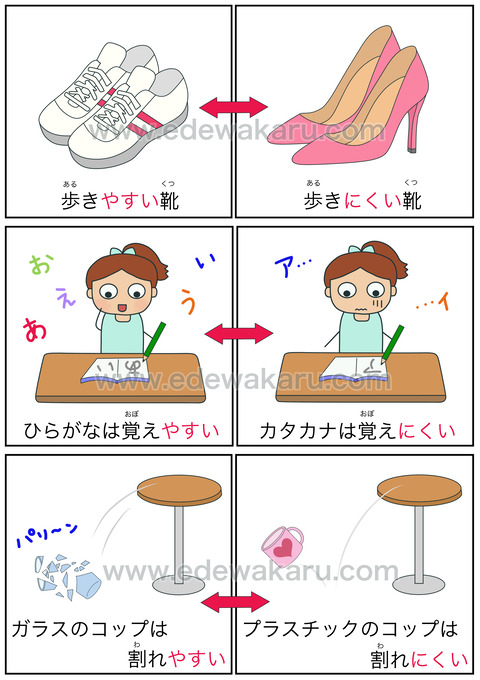
In context 10 examples
歩きやすい靴歩きにくい靴
Easy-to-walk-in shoes Shoes that are difficult to walk in
ひらがなは覚えやすいカタカナは覚えにくい
Hiragana is easy to memorize; katakana is difficult to memorize.
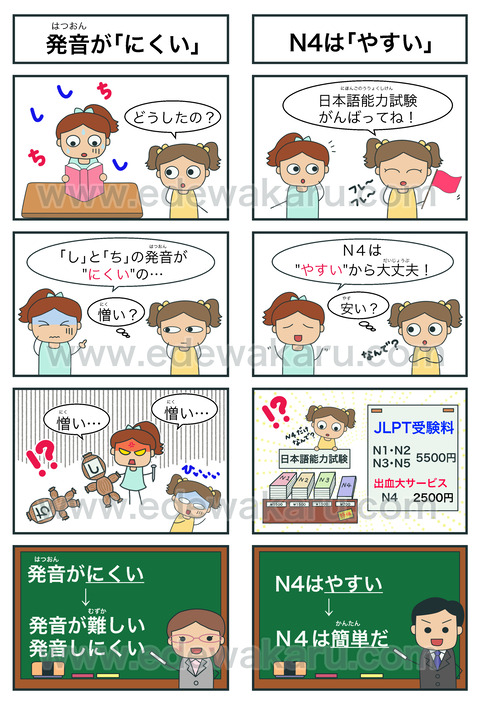
「あ」は発音しやすい「し」と「ち」は発音しにくい
“あ” is easy to pronounce; “し” and “ち” are difficult to pronounce.
この薬は甘くて飲みやすいこの薬は苦くて飲みにくい
This medicine is sweet and easy to drink. This medicine is bitter and difficult to drink.
先生の説明はわかりやすい先生の説明はわかりにくい
The teacher’s explanation is easy to understand. The teacher’s explanation is difficult to understand.
字がきれいで読みやすい字が汚くて読みにくい
The handwriting is neat and easy to read. The handwriting is messy and difficult to read.
ガラスのコップは割れやすいプラスチックのコップは割れにくい
Glass cups break easily. Plastic cups are hard to break.
彼女は太りやすい彼女は太りにくい
She gains weight easily. She doesn’t gain weight easily.
このメガネは壊れやすいこのメガネは壊れにくい
These glasses break easily. These glasses are hard to break.
カビが生えやすい季節カビが生えにくい季節(復習:髪が伸びるvs髪が生える)「〜やすい」と「〜にくい」は初級で勉強する文型ですが、とても重要で日常会話(にちじょうかいわ)でもよく使います😊上手に使えるようにしっかりと復習をしておきましょう😀(復習:〜ように(目的))【関連記事】
Seasons when mold grows easily Seasons when mold is less likely to grow (Review: hair grows long vs. hair grows) 「〜やすい」and 「〜にくい」are grammar patterns studied at the beginner level, but they are very important and often used in everyday conversation 😊 Review them carefully so you can use them well 😀 (Review: 〜ように (purpose)) [Related articles]
Read the original source text
Usage 3
Read this source entry ↗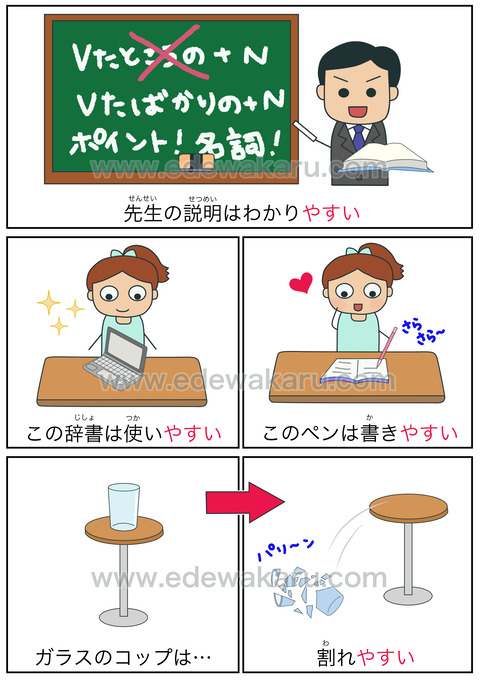
Meaning
~ is easy to do
Can easily do ~
Easily become ~
A state of ~ occurs easily
How to use it
Verb [ます-form]+やすい
Explanation
「〜やすい」is a grammar pattern meaning “easy to do ~” or “easily become ~.” With 「volitional verb+やすい」, it means “easy to do ~”; with 「non-volitional verb+やすい」, it means “easily become ~” 😊
[Examples]
① The teacher’s explanation is easy to understand.
→ It is easy to understand the teacher’s explanation.
② This dictionary is easy to use.
→ It is easy to use this dictionary.
③ This pen is easy to write with.
→ It is easy to write with this pen.
④ Hiragana is easier to memorize than katakana.
→ Hiragana is easier to memorize than katakana.
⑤ Glass cups break easily.
→ Glass cups break easily.
⑥ 「〜たところだ」and 「〜たばかりだ」are easy to confuse.
→ Errors often occur when distinguishing 「〜たところだ」from 「〜たばかりだ」.
⑦ She gains weight easily.
→ She easily gains weight.
「〜やすい」is used in the same way as an adjective, so it can also be used before a noun 😮
[Example]
① Easy to understand
In context 7 examples
先生の説明はわかりやすい
The teacher’s explanation is easy to understand.
この辞書は使いやすい
This dictionary is easy to use.
このペンは書きやすい
This pen is easy to write with.
ひらがなはカタカナより覚えやすい
Hiragana is easier to learn than katakana.
ガラスのコップは割れやすい(復習:「ガラス」と「グラス」)
Glass cups break easily (Review: “ガラス” and “グラス”).
「〜たところだ」と「〜たばかりだ」は間違えやすい(復習:〜たばかりvs〜たところ)(復習:〜たばかり)
“〜たところだ” and “〜たばかりだ” are easy to confuse (Review: 〜たばかり vs. 〜たところ) (Review: 〜たばかり).
彼女は太りやすい
She gains weight easily.
Read the original source text
Meaning
〜するのが簡単だ
簡単に〜できる
簡単に〜の状態になる
〜という状態が簡単に発生してしまう
How to use it
動詞[ます形]+やすい
Explanation
「〜やすい」は「〜するのが簡単だ」「簡単に〜の状態になる」という意味を表す文型です。
「意志動詞+やすい」の場合は「〜するのが簡単だ」という意味になり、「無意志動詞+やすい」の場合は「簡単に〜の状態になる」という意味になります😊
[例]
①先生の説明はわかり
やすい
→先生の説明は
簡単に
理解
できる
②この辞書は使い
やすい
→この辞書は使うのが
簡単だ
③このペンは書き
やすい
→このペンは
簡単に
書くことができる
④ひらがなはカタカナより覚え
やすい
→ひらがなはカタカナより覚えるのが
簡単だ
⑤ガラスのコップは割れ
やすい
→ガラスのコップは
簡単に
割れ
てしまう
⑥「〜たところだ」と「〜たばかりだ」は間違え
やすい
→「〜たところだ」と「〜たばかりだ」は
よく
間違え
が発生する
⑦彼女は太り
やすい
→彼女は
簡単に
太ってしまう
「〜やすい」は形容詞と同じように使われますので、名詞の前に使うこともできます😮
[例]
①わかり
やすい
どんなときどう使う 日本語表現文型辞典
Meaning
easy to
How to use it
Vます + やすい
Explanation
「~するのが簡単だ・容易に~する」という意味。 ❶ ❷ のようにプラス評価も ❸ ❹ のようにマイナス評価もある。
Easy to do. Can be used in positive evaluations, such as in sentences ❶ and ❷ , or in negative ones, such as in ❸ and ❹ .
In context 4 examples
この本は字が大きくて読みやすいです。
This book has large print and is easy to read.
あの病院のお医者さんは、病気のことをわかりやすく説明してくれます。
The doctors at that hospital explain illnesses in an easy-to-understand way.
(手紙)風邪をひきやすい季節です。どうぞお大事に。
(In a letter) It's the season when people easily catch colds. Please take care.
この花びんは壊れやすいから気をつけてください。
This vase breaks easily, so please be careful.
Read the original source text
Meaning
easy to
How to use it
Vます+やすい
Explanation
「~するのが簡単だ・容易に~する」という意味。 ❶ ❷ のようにプラス評価も ❸ ❹ のようにマイナス評価もある。
Easy to do. Can be used in positive evaluations, such as in sentences ❶ and ❷ , or in negative ones, such as in ❸ and ❹ .
日本語NET JLPT文法解説まとめ
Meaning
It is easy to do … / It easily becomes …
How to use it
V (ます-form) ます + やすい
Explanation
easy to do
In context 16 examples
「山」という漢字は実際の山と形が似ているため、覚えやすいです。
The kanji “山” is easy to remember because its shape resembles an actual mountain.
スプーンとフォークを使ったほうが食べやすいですよ。
It's easier to eat with a spoon and fork.
野菜を食べやすい大きさに切ってください。
Please cut the vegetables into easy-to-eat pieces.
このスマホは機能がシンプルなので使いやすいです。
This smartphone is easy to use because its functions are simple.
田中先生の説明は他の先生よりもわかりやすいです。
Mr. Tanaka's explanations are easier to understand than the other teachers'.
こっちの道を通ったほうが渋滞もないので、行きやすいですよ。
It's easier to get there if you take this road because there's no traffic jam.
山田さんはやさしくて、おしゃべりなのでとても話しやすいです。
Yamada is kind and talkative, so it's very easy to talk to him.
この教科書は漢字の上にルビがあるからわかりやすいです。
This textbook is easy to understand because it has furigana above the kanji.
この入れ物は割れやすいので、注意してください。
This container breaks easily, so please be careful.
この街は静かで、車も少ないから住みやすいです。
This town is easy to live in because it's quiet and there aren't many cars.
この問題は間違えやすいから注意してください。
This problem is easy to get wrong, so please be careful.
このカメラでは初心者でも使いやすいですよ。
This camera is easy for even beginners to use.
インドネシア語は日本人にとって勉強しやすい外国語らしい。
Apparently, Indonesian is an easy foreign language for Japanese people to study.
働きやすい環境で仕事がしたいね。
I'd like to work in an environment where it's easy to work.
私は他の人よりも太りやすい。
I gain weight more easily than other people.
年をとると、髪も抜けやすくなります。
As you get older, your hair starts to fall out more easily.
Read the original source text
Meaning
〜するのが簡単だ / 簡単に〜という状態になる
How to use it
V(ます形)ます + やすい
Explanation
easy to do
日本語文型辞典 英語版
Meaning
【やすい】[R-やすい]
Conjugates in the same way as i-adjectives. Attaches to the verb stem and expresses that that action can be done easily or is possible. When referring to a predisposition, expressions in the form of すぐに...する are more commonly used. For example, すぐに人を好きになる is used instead of 恋をしやすい. Phrases such as すぐにおこる, おこりっぽい, and すぐに泣く are more common than おこりやすい and 泣きやすい. The phrase ...にくい carries the opposite meaning.
In context 6 examples
このペンはとても書きやすい。
This pen is easy to write with.
先生は気さくで話しやすいが、奥さんはこわそうなので家に遊びに行きにくい。
Our teacher is good-humored and easy to talk to but his wife seems scary, so going to their house is difficult.
その町は物価も安く、人も親切で住みやすいところです。
In that town the cost of living is cheap and the people are kind; it is an easy place to live.
かたかなの「ツ」と「シ」は間違えやすいので気をつけてください。
Katakana ‘tsu’ and ‘shi’ are easily confused, so please be careful.
彼はふとりやすい体質なので、食べすぎないようにしているそうだ。
He is prone to putting on weight, so he tries not to overeat, I hear.
そのおもちゃは壊れやすくてあぶない。
That toy will break easily and is dangerous.
AIUEO JLPT Grammar
Meaning
「〜やすい」is used to express that an action is easy to perform or that a certain state is likely to occur. It is used to describe actions that are easy to carry out or tendencies that are common.
How to use it
Verb in ます-form + やすい
In context 5 examples
このペンは書きやすいです。
This pen is easy to write with.
彼の文章は理解しやすかった。
His writing was easy to understand.
このソフトウェアは使いやすいです。
This software is easy to use.
この靴は履きやすくない。
These shoes are not easy to put on.
この道は歩きやすいです。
This path is easy to walk on.
Read the original source text
Meaning
「〜やすい」is used to express that an action is easy to perform or that a certain state is likely to occur. It is used to describe actions that are easy to carry out or tendencies that are common.
How to use it
動詞ます形+やすい
Explanation · 日本語
「〜やすい」は、ある行動が容易にできる、または特定の状態が発生しがちなことを表す表現です。行動が簡単にできることや、ある傾向があるときに使います。
文法
Meaning
It is easy to do … / It easily becomes …
How to use it
V (ます-form) ます + やすい
In context 15 examples
「山」という漢字は実際の山と形が似ているため、覚えやすいです。
The kanji “山” is easy to remember because its shape resembles an actual mountain.
スプーンとフォークを使ったほうが食べやすいですよ。
It's easier to eat with a spoon and fork.
野菜を食べやすい大きさに切ってください。
Please cut the vegetables into easy-to-eat pieces.
このスマホは機能がシンプルなので使いやすいです。
This smartphone is easy to use because its functions are simple.
田中先生の説明は他の先生よりもわかりやすいです。
Mr. Tanaka's explanations are easier to understand than the other teachers'.
こっちの道を通ったほうが渋滞もないので、行きやすいですよ。
It's easier to get there if you take this road because there's no traffic jam.
山田さんはやさしくて、おしゃべりなのでとても話しやすいです。
Yamada is kind and talkative, so it's very easy to talk to him.
この教科書は漢字の上にルビがあるからわかりやすいです。
This textbook is easy to understand because it has furigana above the kanji.
この入れ物は割れやすいので、注意してください。
This container breaks easily, so please be careful.
この街は静かで、車も少ないから住みやすいです。
This town is easy to live in because it's quiet and there aren't many cars.
この問題は間違えやすいから注意してください。
This problem is easy to get wrong, so please be careful.
このカメラでは初心者でも使いやすいですよ。
This camera is easy for even beginners to use.
インドネシア語は日本人にとって勉強しやすい外国語らしい。
Apparently, Indonesian is an easy foreign language for Japanese people to study.
働きやすい環境で仕事がしたいね。
I'd like to work in an environment where it's easy to work.
私は他の人よりも太りやすい。
I gain weight more easily than other people.
Read the original source text
Meaning
〜するのが簡単だ / 簡単に〜という状態になる
How to use it
V(ます形)ます + やすい
Bunpro Grammar Reference
Meaning
Easy to, Likely to
How to use it
Verb[stem]+ やすい
Verb[stem]+ やすい + です
Nuance
A word that is often used to highlight the simplicity of actions.
Explanation
易い is an い-Adjective that is regularly seen attached to the ます stem of verbs (the form of a verb that can be used as a noun). When attached in this way, it carries the meaning of 'easy to (A)', where (A) is the verb that comes before やすい.
私は食べやすいサイズにステーキを切る。
I will cut the steak into a size that's easy to eat.
この漫画にはフリガナがついているから読みやすいです。
Since this manga has furigana included, it's easy to read.
Sometimes, やすい has a translation that is a bit closer to 'prone to (A)', or 'likely to (A)' in English. This nuance is regularly seen when the verb is related to emotions.
あの先輩は怒りやすいからめんどくさい。
That senpai is prone to getting angry, so he's annoying.
カスミちゃんは泣きやすいから優しくしてね。
Kasumi is likely to cry, so please be nice to her. (Kasumi cries easily)
Caution
There is another adjective 安い that has the meaning of 'cheap'. This kanji should never be used with verbs to mean 'easy'. Most of the time, やすい itself will be written in hiragana, and usage of 易い is quite limited.
Fun Fact
Although 易い is an い-Adjective, it is almost never used by itself (when not attached to verbs). In such cases, it is much more natural to use the な-Adjective 簡単.
昨日やすいゲームを買った。
Yesterday, I bought a cheap game. (安(やす)い meaning cheap, not 易(やす)い meaning easy)
私は簡単なゲームが好きです。
I enjoy easy games. (易(やす)い would not work here, as it is not usually used without a verb)
In context 18 examples
- ケーキは作りやすい。
Cake is easy to make.
- 私は食べやすいサイズにステーキを切る。
I will cut the steak into a size that's easy to eat.
- あの先輩は怒りやすいからめんどくさい。
That senpai is prone to getting angry, so he's annoying.
- カスミちゃんは泣きやすいから優しくしてね。
Kasumi is likely to cry, so please be nice to her. (Kasumi cries easily)
- この漫画にはフリガナがついているから読みやすいです。
Since this manga has furigana included, it's easy to read.
- この魚は食べやすいです。
This fish is easy to eat.
- 昨日の練習はしやすかった。
Yesterday's practice was easy to do.
- この白い服は、汚れやすいです。
These white clothes are easy to get dirty.
- この音楽が好きだから、踊りやすい。
Because I like this music, it is easy to dance.
- この箸は使いやすい。
These chopsticks are easy to use.
- その動物園は近いから行きやすい。
That zoo is easy to go to, because it is close.
- あの店員さんとは話しやすかった。
That clerk over there was easy to talk to.
- この薬は飲みやすい。
This medicine is easy to take.
- 雪が降ったので、滑りやすくなりました。
Since it snowed, it has become easy to slip.
- 東京から大阪へは電車が行きやすいですよ。
It is easy to go from Tokyo to Osaka by train!
- 今日の宿題は少なかったので、しやすかった。
Since there was only a little homework today, it was easy to do.
- 昨日やすいゲームを買った。
Yesterday, I bought a cheap game. (安(やす)い meaning cheap, not 易(やす)い meaning easy)
- 私は簡単なゲームが好きです。
I enjoy easy games. (易(やす)い would not work here, as it is not usually used without a verb)
NINJAL 日本語文型データベース
Meaning
[1] Expresses that something can be done without difficulty or comfortably. It is often used in a positive sense.
[2] Expresses the tendency to do ~ easily. It is used in both positive and negative senses.
How to use it
Notes
[1] “〜” is usually a verb expressing a volitional action, such as “住む・食べる・利用する” (“live,” “eat,” “use”).
It changes form in the same way as an i-adjective, as in “〜やすくない・〜やすかった・やすくて”.
[2] “〜” is usually a verb that does not primarily express a volitional action, such as “壊れる・太る・消化する” (“break,” “gain weight,” “be digested”).
It changes form in the same way as an i-adjective, as in “〜やすくない・〜やすかった・やすくて”.
In context 13 examples
この町は便利で暮らしやすいです。
This town is convenient and easy to live in.
新しく買ったスマートフォンは、操作が簡単で使いやすい。
The new smartphone I bought is easy to use because its controls are simple.
この眼鏡はとても見やすいので愛用しています。
I use these glasses all the time because they make things very easy to see.
「君のお父さんに会うのが怖いな」「心配ないよ。父は気さくで話しやすい人だから」
“I’m scared to meet your father.” “Don’t worry. My father is an easygoing person and easy to talk to.”
この入門書はとても理解しやすかったので、お薦めです。
This introductory book was very easy to understand, so I recommend it.
子どもの服は着やすければいいんだ。ブランドは問題ではない。
Children’s clothes just need to be easy to put on. The brand doesn’t matter.
ビタミンCは熱で壊れやすい。
Vitamin C is easily destroyed by heat.
うちの子は緊張しやすい性格なので、試験で実力を発揮できるかどうか心配です。
My child tends to get nervous, so I’m worried about whether they’ll be able to perform to their ability on the exam.
私は太りやすいので、甘い物を食べないようにしています。
I gain weight easily, so I try not to eat sweets.
誕生日にもらったシャツは、風を通しやすくて気持ちがいい。
The shirt I got for my birthday lets the air through easily, so it feels nice.
梅雨の時期は、食べ物が腐りやすくなります。
During the rainy season, food spoils easily.
このカーペットは、汚れが落ちやすい素材でできている。
This carpet is made of a material that makes stains easy to remove.
うどんは消化しやすくて、胃腸の調子が悪いときに最適です。
Udon is easy to digest, so it’s ideal when your stomach or intestines are upset.
Read the original source text
Meaning
[1] ~が難しさを感じないでできたり、快適にできたりすることを表します。いい意味で使われることが多いです。
[2] 簡単に〜する性質であることを表します。いい意味でも悪い意味でも使います。
How to use it
Notes
[1] 「〜」には、ふつう、「住む・食べる・利用する」など、意志的な行為を表す動詞がきます。
「〜やすくない・〜やすかった・やすくて」などのように、イ形容詞と同じ形に変化します。
[2] 「〜」には、ふつう、「壊れる・太る・消化する」など、主に意志的な行為を表さない動詞がきます。
「〜やすくない・〜やすかった・やすくて」などのように、イ形容詞と同じ形に変化します。
IMABI
Easy I: ~やすい
Read this IMABI lesson ↗Explanation
Easy I: ~やすい
It would be easy enough to learn how to say “easy” if it weren’t for the fact that Japanese has multiple ways of saying “easy” as well as distinguishing “it’s easy to do…” from a simple “X is easy” statement. Although a dozen things to think about to say “easy” isn’t easy at all, let’s get started!
※Some content once in this lesson has been removed while it is being remastered into separate lessons. In the meantime, content for ~がたい and ~づらい will not be available. Thank you for your understanding.
“Easy” Adjectives 「Easy」を意味する表現
1. 口にするのは簡単だが、実行するのは難しい。
Saying is easy, but doing is hard.
In this example, we see the adjectival noun 簡単な meaning “easy.” As “easy” as that may seem, this word alone presents us with the trouble that most individual words have, which is that 簡単 has more than one nuance, and when it comes down to using it correctly in comparison to other options, or when trying to translate it into English, “easy” may just be one of several options. In the case of 簡単な, its other nuance is “brief/quick,” unlike this explanation.
2. 簡単なことだよ。
It’s really (quick and) easy/simple.
3. 簡単なことから始めるのがコツだ。
Starting with the easy things is the trick.
4. お皿に料理を載せるだけの簡単な仕事じゃないですか。
The work is so easy, isn’t it just putting plating food?
5. 簡単な単語だけしかないのに難しい。
All there is are simple words, but it’s still difficult.
The other words for “easy” are pretty straightforward, but they each exhibit their unique nuances, and it is not the case that they’re entirely interchangeable with each other. The words that we’ll look at now are those which any beginner or intermediate learner will come across.
単語 定義
たやすいThis word describes things that can easily be carried out. It also has the secondary meaning of “to be light on,” which itself is an extension of taking something as not causing too much trouble. It is spelled in Kanji as 容易い.
やさしいTechnically the same word as 優しい meaning “kind,” it refers to ease. It describes things that are simple, readily comprehensible, and easy to learn. It is frequently used with words like 問題 (problem), 言葉 (word/language), 人 (person), etc. Its Kanji spelling is 易しい.
容易(な)The Sino-Japanese version of たやすい, it is identical in meaning. Due to it being Sino-Japanese, it is not as common in the spoken language, but using it in conversation is done on occasion in precise contexts.
イージー(な)Taken from the English “easy,” it is used more so in the same sense as たやすい, and it has also gained the nuance of “quick (to do)” and “handy.”
楽(な) This adjectival noun refers to “ease” and “comfort.” It is used in a range of contexts from peace of mind to doing something without trouble. So, unlike some of these words like やさしい, the focus is not on something that’s just easily comprehendible, but rather, the situation is done with ease. Thus, it would not be a good substitute for たやすい or 容易な if the “plain/straightforward” situation does not solve the problem. With 楽な, there are no problems. It is that simple.
簡単(な)Although it can still refer to things that don’t take much time or effort, its mostly used to mean “simple and straightforward,” and in other words, “easy to maneuver/understanding.” Despite being Sino-Japanese, it is heavily used in both the spoken and written languages. This word is thought to be an abbreviation of 簡易で手短だ (simple and brief), indicating that the mean of “simple/brief” is its literal meaning. To stress this nuance, the spelling 簡短 is allowed but rather rare.
Before delving into a lot of example sentences, there are a few specific comparisons that ought to be made first.
i. Though both 簡単な and やさしい overlap in describing things that may be easy to comprehend, the former simply indicates the simplicity of something whereas the latter suggests that the situation is still easily comprehensible even if carrying the situation out may still pose a challenge.
6. 日本語がやさしいというのは噓だよね。
Saying that Japanese is easy is a lie.
Even if it were relatively easy for someone to learn Japanese, and even if the person weren’t struggling to comprehend the grammar and how to use words, learning a language itself is still a major undertaking. In that sense, Japanese would certainly not be 簡単.
ii. Where たやすい and 容易な differ from the others is that though they refer to “easy” situations, the plain and simple they reference may not actually cut it.
7. 【たやすい・容易な】ことではとても到達できない。
There’s no way one will attain it through [simple/[plain] means.
iii. Loanwords from English abound in Japanese, and many speakers have this rather unfounded fear that these words are slowly eating away at existing words for the same things. However, in the case of イージーな, it has already adapted its unique Japanese-made nuances which at first glance bear resemblance to “easy” but could just as easily or more naturally be worded as something else in English proper.
8. スローでイージーなルーティンで過ごしている。
I have a slow and easy/carefree routine.
9. イージーで履き心地のいいパンツを履くのが好きです。
I love wearing underpants that are simple/handy and feel good.
iv. You may have noticed that 簡易 was in the chart with the meaning of “simple/convenient.” It is just one of still many other synonyms out there. However, because the remaining synonyms are more nuanced and advanced in nature, we will leave those words to our second instillation of this topic.
v. We learned at the start of this section that 簡単な has more than one meaning and that words in general are guilty of this nuance game. English words are just as guilty. Think about the word “easy.” What is meant by, “he’s so easy”? Were you talking about the guy being “easily tricked” or about how he’s “promiscuous”? Either way, the Japanese ‘options’ and their implications would be just as varied.
Even then, we still would just be touching the surface on the other numerous idioms and various other meanings of the word “easy” that cannot just be paraphrased with a synonym like “simple.” These nuances would, understandably, require different Japanese translations. So as not to totally detract from the conversation at hand in this lesson, the topic on how to go about saying these other “easy” expressions will be left for our second instillation.
10. 担当者さん、もうちょっとやさしい日本語で例文を書いてみたらいかがでしょうか。
Director, how about you try making example sentence with a little easier Japanese?
11. ビザ取得と生活を営むことはたやすいことではないだろう。
Obtaining a visa and going about one’s life is likely no easy task.
12. 簡単な食事で済ませたい。
I want to get through with a simple meal.
13. 楽な問題を選ばないで、難しい問題にチャレンジしてよかった。
I’m glad that I challenged myself with difficult problems by not choosing easy problems.
14. 私たちが抱えている大きな問題の解決は容易ではないと承知している。
We recognize that the solution to the major problem we carry is not easy.
15. フリックするようにイージー!
(It’s) easy as flicking!
Word Note: Typing in Japanese on smart devices involves a form of swiping known as フリック入力. The user presses their finger lightly on four-directional character pads for each column of sounds depicted with Kana, and in doing so, any word is just a flick or two away. Although “flicking” would be the correct verb in English, for someone who has never typed in Japanese before on a phone, Ex. would not be so easy to understand.
Adverb Forms 「Easy」を意味する単語の副詞形
As there is nothing irregular to these adjectives’ conjugation capabilities, the adverbial forms shown in the right-hand column below should be easily recognizable.
形容(動詞)形 副詞形
簡単(な)簡単に
容易(な)容易に
たやすいたやすく
やさしいやさしく
楽(な)楽に
イージー(な)イージーに
16. 先生はいつも内容をやさしくかみ砕いて説明してくださいます。
Sensei always explanations content by breaking it down.
Word Note: This is an example of a context in which やさしい can be interpreted as both 易しい and 優しい.
17. 犯罪がここで起こるのは容易に想像(が)できる。
I can easily imagine crime occurring here.
18. 世の中で、嘘をつく人間がたやすく成功することがある。
In this world, there are times when people who lie succeed with ease.
19. 基礎をしっかり固めておけば、大半の問題は楽に解けたのでしょう。
If [I/you] had gotten the basics down, [I/you] would’ve easily been able to solve most of the problems.
20. 難易度をイージーにした。
I changed the difficulty to easy.
~やすい
At long last, it is time to discuss ~やすい. First, let’s go down memory lane.
21. 言うはやすく行うは難し。
Saying is easy, but doing is hard.
We saw the Modern Japanese version of this same sentence as Ex. 1. Although this discussion is about how to say “easy,” you may be wondering how ~やすい connects with 安い (cheap). After all, native words with the same pronunciation but with different Kanji spellings are more or less the same word with layered nuances.
In the past, the meaning of “cheap” was not the primary meaning of やすい. Instead, as the Kanji 安 suggests, it meant “calm/peaceful,” which has been taken over by 安らか in modern speech. When written with the Kanji 易, it had the meaning of “simple” and “easygoing.” However, even when 安 was used, it could still mean “carefree,” and by extension, people of no value due to their carefree nature, which led to the broad meaning of “cheap.”
Nonetheless, its meaning of “easy” lives on in ~やすい, an ending that attaches to the 連用形 of verbs as follows.
Verb Class +~やすい
一段 Verbs着やすい (easy to wear)
食べやすい (easy to eat)
五段 Verbs 飼いやすい (easy to raise (animal))
書きやすい (easy to write)
泳ぎやすい (easy to swim)
話しやすい (easy to talk)
勝ちやすい (easy to win)
死にやすい (to easily die)
読みやすい (easy to read)
売りやすい (easy to sell)
するしやすい (easy to do)
来る来(き)やすい (easy to come)
22. お箸では食べやすいよ。
(It)’s easy to eat with chopsticks.
23. 人間は死にやすい動物だ。
Humans are animals that easily die.
24. この場所は埼玉から来やすいよ。
This place is easy to arrive at from Saitama.
25. 説明自体は長いかもしれないけど、「いまび」先生の説明は他の先生よりわかりやすいと思います。
Although the explanations themselves might be long, IMABI Sensei’s explanations are easier to understand than other those of other sensei.
26. 「山」という字は実際の山と形が似ているので、覚えやすいですね。
The character “山” is easy to remember because its shape resembles an actual mountain, huh.
27. この問題は間違えやすいからよーく注意してください。
This problem is easy to mess up, so please pay very clo~se attention.
Particle Use
~やすい can be described as having two distinct nuances depending on the volition or lack thereof implied by the verb. When used with volitional verbs, it shows “how easy” something can be done. When used with non-volitional verbs, it shows tendency, and even for these verbs, the tendency ‘easily’ occurs.
28. この薬は意外にも美味しくて飲みやすい。 Volitional Verb
This medicine is surprisingly delicious and easy to drink.
29. 白いシャツは汚れやすい。 Non-Volitional Verb
White shirts are easily dirtied.
30. この靴は走りやすい。Volitional Verb
These shoes are easy to run in.
31. この季節は洗濯物が乾きやすくない。 Non-Volitional Verb
As for this season, laundry [doesn’t easily dry/tends not to dry well].
As for volitional verbs, at times, the ease of the action may be an emotional ease rather than a physical ease.
32. 夜中でも歩きやすい。
It’s easy to walk even at night.
What may be more confusing in a grammatical sense is how the particle を seems to show up with both volitional and nonvolitional verbs alike under predictable circumstances.
The first such situation is when the verb phrase it attaches to can be viewed as a single word made of multiple parts, one of which incidentally being を.
33. 以前と比べて、[風邪を引き]やすくなった。
I now more easily catch colds compared to before.
34. 最近[怪我をし]やすくなった気がする。
I feel like I’ve become more easily injured as of late.
The second situation involves contexts with non-volitional verbs that still possess an object. Replacing を with が in either of the next two sentences would alter the meaning and make the sentences unnatural. Moreover, when attached to transitive verbs, we find that を appears regardless of whether the agent is willfully acting or not as the subject-transitive predicate still has an object.
35. その菌を殺しやすい抗生物質ではないと効果がありません。(Volitional Verb)
There will be no effect if it isn’t an antibiotic that will easily kill that bacteria.
To use が naturally after 菌, you would need to use the potential form of 殺す, which 殺せる. The reason why a speaker would opt for 殺しやすい instead of the potential form would be to emphasize how ‘容易に’ the antibiotic needs to act. Antibiotics do not have minds of their own, but if they do not work with ease, the bacteria could gain the upper hand. By using the otherwise volitional verb 殺す, though, the speaker is personifying the antibiotic as an agent. The use of を here actually mimics how it is used with the potential form, and although the morphology of ~やすい is adjectival, the phrase 殺しやすい in this sentence maintains a verbal quality.
36. 整理整頓するのが苦手な人にはよく物を落としやすい傾向がある。
There is a tendency in people who are bad at organizing to easily drop things.
In this sentence, it is not the case that the items are easily dropped. Rather, the people drop things habitually. The habit, in turn, is what easily occurs. Thus, these instances can be rationalized no differently than Exs. 28-29.
~られやすい
Having looked at the last few examples, it might strike you as odd that ~やすい would be combined with ~(ら)れる. Yet, there are plenty of examples of this.
37. 人に顔を覚えられやすいです。
People easily remember my face.
In this sentence, the passive voice is used in the Japanese version, but it is no different in meaning than the English active voice equivalent. When the passive voice is intended with ~やすい, the verb is non-volitional in nature, meaning that ~やすい is showing the ease in tendency.
In ‘correct’ grammar, ~やすい should not be used with potential verbs as that would be redundant. Although examples of this can be heard, it is mostly frowned upon. The potential for confusion between whether the potential or passive sense is meant only occurs with 一段 verbs as examples of ~やすい with 五段 verbs simply don’t exist in natural, proper speech. This is indicative of ~(ら)れやすい being restricted to the passive sense.
Further proof of this is how 出来やすい is interpreted. Although 出来る can mean “can do,” it also has the broader meaning of “to be made,” which is how it is interpreted when used with ~やすい.
38. 青痣が出来やすい。
I easily bruise.
39. 尿路結石が出来やすい。
I easily get kidney stones.
40. 口内炎が出来やすい。
I get mouth ulcers easily.
In context 40 examples
口にするのは簡単だが、実行するのは難しい。
Saying is easy, but doing is hard.
簡単なことだよ。
It’s really (quick and) easy/simple.
簡単なことから始めるのがコツだ。
Starting with the easy things is the trick.
お皿に料理を載せるだけの簡単な仕事じゃないですか。
The work is so easy, isn’t it just putting plating food?
簡単な単語だけしかないのに難しい。
All there is are simple words, but it’s still difficult.
日本語がやさしいというのは噓だよね。
Saying that Japanese is easy is a lie.
【たやすい・容易な】ことではとても到達できない。
There’s no way one will attain it through [simple/[plain] means.
スローでイージーなルーティンで過ごしている。
I have a slow and easy/carefree routine.
イージーで履き心地のいいパンツを履くのが好きです。
I love wearing underpants that are simple/handy and feel good.
担当者さん、もうちょっとやさしい日本語で例文を書いてみたらいかがでしょうか。
Director, how about you try making example sentence with a little easier Japanese?
ビザ取得と生活を営むことはたやすいことではないだろう。
Obtaining a visa and going about one’s life is likely no easy task.
簡単な食事で済ませたい。
I want to get through with a simple meal.
楽な問題を選ばないで、難しい問題にチャレンジしてよかった。
I’m glad that I challenged myself with difficult problems by not choosing easy problems.
私たちが抱えている大きな問題の解決は容易ではないと承知している。
We recognize that the solution to the major problem we carry is not easy.
フリックするようにイージー!
(It’s) easy as flicking!
先生はいつも内容をやさしくかみ砕いて説明してくださいます。
Sensei always explanations content by breaking it down.
犯罪がここで起こるのは容易に想像(が)できる。
I can easily imagine crime occurring here.
世の中で、嘘をつく人間がたやすく成功することがある。
In this world, there are times when people who lie succeed with ease.
基礎をしっかり固めておけば、大半の問題は楽に解けたのでしょう。
If [I/you] had gotten the basics down, [I/you] would’ve easily been able to solve most of the problems.
難易度をイージーにした。
I changed the difficulty to easy.
言うはやすく行うは難し。
Saying is easy, but doing is hard.
お箸では食べやすいよ。
(It)’s easy to eat with chopsticks.
人間は死にやすい動物だ。
Humans are animals that easily die.
この場所は埼玉から来やすいよ。
This place is easy to arrive at from Saitama.
説明自体は長いかもしれないけど、「いまび」先生の説明は他の先生よりわかりやすいと思います。
Although the explanations themselves might be long, IMABI Sensei’s explanations are easier to understand than other those of other sensei.
「山」という字は実際の山と形が似ているので、覚えやすいですね。
The character 山 resembles an actual mountain in shape, so it’s easy to remember, isn’t it?
この問題は間違えやすいからよーく注意してください。
This problem is easy to mess up, so please pay very clo~se attention.
この薬は意外にも美味しくて飲みやすい。 Volitional Verb
This medicine is surprisingly delicious and easy to drink.
白いシャツは汚れやすい。 Non-Volitional Verb
White shirts are easily dirtied.
この靴は走りやすい。Volitional Verb
These shoes are easy to run in.
この季節は洗濯物が乾きやすくない。 Non-Volitional Verb
As for this season, laundry [doesn’t easily dry/tends not to dry well].
夜中でも歩きやすい。
It’s easy to walk even at night.
以前と比べて、[風邪を引き]やすくなった。
I now more easily catch colds compared to before.
最近[怪我をし]やすくなった気がする。
I feel like I’ve become more easily injured as of late.
その菌を殺しやすい抗生物質ではないと効果がありません。(Volitional Verb)
There will be no effect if it isn’t an antibiotic that will easily kill that bacteria.
整理整頓するのが苦手な人にはよく物を落としやすい傾向がある。
There is a tendency in people who are bad at organizing to easily drop things.
人に顔を覚えられやすいです。
People easily remember my face.
青痣が出来やすい。
I easily bruise.
尿路結石が出来やすい。
I easily get kidney stones.
口内炎が出来やすい。
I get mouth ulcers easily.
Read the original source text
Explanation
Easy I: ~やすい
It would be easy enough to learn how to say “easy” if it weren’t for the fact that Japanese has multiple ways of saying “easy” as well as distinguishing “it’s easy to do…” from a simple “X is easy” statement. Although a dozen things to think about to say “easy” isn’t easy at all, let’s get started!
※Some content once in this lesson has been removed while it is being remastered into separate lessons. In the meantime, content for ~がたい and ~づらい will not be available. Thank you for your understanding.
“Easy” Adjectives 「Easy」を意味する表現
1. 口にするのは簡単だが、実行するのは難しい。
Saying is easy, but doing is hard.
In this example, we see the adjectival noun 簡単な meaning “easy.” As “easy” as that may seem, this word alone presents us with the trouble that most individual words have, which is that 簡単 has more than one nuance, and when it comes down to using it correctly in comparison to other options, or when trying to translate it into English, “easy” may just be one of several options. In the case of 簡単な, its other nuance is “brief/quick,” unlike this explanation.
2. 簡単なことだよ。
It’s really (quick and) easy/simple.
3. 簡単なことから始めるのがコツだ。
Starting with the easy things is the trick.
4. お皿に料理を載せるだけの簡単な仕事じゃないですか。
The work is so easy, isn’t it just putting plating food?
5. 簡単な単語だけしかないのに難しい。
All there is are simple words, but it’s still difficult.
The other words for “easy” are pretty straightforward, but they each exhibit their unique nuances, and it is not the case that they’re entirely interchangeable with each other. The words that we’ll look at now are those which any beginner or intermediate learner will come across.
単語 定義
たやすいThis word describes things that can easily be carried out. It also has the secondary meaning of “to be light on,” which itself is an extension of taking something as not causing too much trouble. It is spelled in Kanji as 容易い.
やさしいTechnically the same word as 優しい meaning “kind,” it refers to ease. It describes things that are simple, readily comprehensible, and easy to learn. It is frequently used with words like 問題 (problem), 言葉 (word/language), 人 (person), etc. Its Kanji spelling is 易しい.
容易(な)The Sino-Japanese version of たやすい, it is identical in meaning. Due to it being Sino-Japanese, it is not as common in the spoken language, but using it in conversation is done on occasion in precise contexts.
イージー(な)Taken from the English “easy,” it is used more so in the same sense as たやすい, and it has also gained the nuance of “quick (to do)” and “handy.”
楽(な) This adjectival noun refers to “ease” and “comfort.” It is used in a range of contexts from peace of mind to doing something without trouble. So, unlike some of these words like やさしい, the focus is not on something that’s just easily comprehendible, but rather, the situation is done with ease. Thus, it would not be a good substitute for たやすい or 容易な if the “plain/straightforward” situation does not solve the problem. With 楽な, there are no problems. It is that simple.
簡単(な)Although it can still refer to things that don’t take much time or effort, its mostly used to mean “simple and straightforward,” and in other words, “easy to maneuver/understanding.” Despite being Sino-Japanese, it is heavily used in both the spoken and written languages. This word is thought to be an abbreviation of 簡易で手短だ (simple and brief), indicating that the mean of “simple/brief” is its literal meaning. To stress this nuance, the spelling 簡短 is allowed but rather rare.
Before delving into a lot of example sentences, there are a few specific comparisons that ought to be made first.
i. Though both 簡単な and やさしい overlap in describing things that may be easy to comprehend, the former simply indicates the simplicity of something whereas the latter suggests that the situation is still easily comprehensible even if carrying the situation out may still pose a challenge.
6. 日本語がやさしいというのは噓だよね。
Saying that Japanese is easy is a lie.
Even if it were relatively easy for someone to learn Japanese, and even if the person weren’t struggling to comprehend the grammar and how to use words, learning a language itself is still a major undertaking. In that sense, Japanese would certainly not be 簡単.
ii. Where たやすい and 容易な differ from the others is that though they refer to “easy” situations, the plain and simple they reference may not actually cut it.
7. 【たやすい・容易な】ことではとても到達できない。
There’s no way one will attain it through [simple/[plain] means.
iii. Loanwords from English abound in Japanese, and many speakers have this rather unfounded fear that these words are slowly eating away at existing words for the same things. However, in the case of イージーな, it has already adapted its unique Japanese-made nuances which at first glance bear resemblance to “easy” but could just as easily or more naturally be worded as something else in English proper.
8. スローでイージーなルーティンで過ごしている。
I have a slow and easy/carefree routine.
9. イージーで履き心地のいいパンツを履くのが好きです。
I love wearing underpants that are simple/handy and feel good.
iv. You may have noticed that 簡易 was in the chart with the meaning of “simple/convenient.” It is just one of still many other synonyms out there. However, because the remaining synonyms are more nuanced and advanced in nature, we will leave those words to our second instillation of this topic.
v. We learned at the start of this section that 簡単な has more than one meaning and that words in general are guilty of this nuance game. English words are just as guilty. Think about the word “easy.” What is meant by, “he’s so easy”? Were you talking about the guy being “easily tricked” or about how he’s “promiscuous”? Either way, the Japanese ‘options’ and their implications would be just as varied.
Even then, we still would just be touching the surface on the other numerous idioms and various other meanings of the word “easy” that cannot just be paraphrased with a synonym like “simple.” These nuances would, understandably, require different Japanese translations. So as not to totally detract from the conversation at hand in this lesson, the topic on how to go about saying these other “easy” expressions will be left for our second instillation.
10. 担当者さん、もうちょっとやさしい日本語で例文を書いてみたらいかがでしょうか。
Director, how about you try making example sentence with a little easier Japanese?
11. ビザ取得と生活を営むことはたやすいことではないだろう。
Obtaining a visa and going about one’s life is likely no easy task.
12. 簡単な食事で済ませたい。
I want to get through with a simple meal.
13. 楽な問題を選ばないで、難しい問題にチャレンジしてよかった。
I’m glad that I challenged myself with difficult problems by not choosing easy problems.
14. 私たちが抱えている大きな問題の解決は容易ではないと承知している。
We recognize that the solution to the major problem we carry is not easy.
15. フリックするようにイージー!
(It’s) easy as flicking!
Word Note: Typing in Japanese on smart devices involves a form of swiping known as フリック入力. The user presses their finger lightly on four-directional character pads for each column of sounds depicted with Kana, and in doing so, any word is just a flick or two away. Although “flicking” would be the correct verb in English, for someone who has never typed in Japanese before on a phone, Ex. would not be so easy to understand.
Adverb Forms 「Easy」を意味する単語の副詞形
As there is nothing irregular to these adjectives’ conjugation capabilities, the adverbial forms shown in the right-hand column below should be easily recognizable.
形容(動詞)形 副詞形
簡単(な)簡単に
容易(な)容易に
たやすいたやすく
やさしいやさしく
楽(な)楽に
イージー(な)イージーに
16. 先生はいつも内容をやさしくかみ砕いて説明してくださいます。
Sensei always explanations content by breaking it down.
Word Note: This is an example of a context in which やさしい can be interpreted as both 易しい and 優しい.
17. 犯罪がここで起こるのは容易に想像(が)できる。
I can easily imagine crime occurring here.
18. 世の中で、嘘をつく人間がたやすく成功することがある。
In this world, there are times when people who lie succeed with ease.
19. 基礎をしっかり固めておけば、大半の問題は楽に解けたのでしょう。
If [I/you] had gotten the basics down, [I/you] would’ve easily been able to solve most of the problems.
20. 難易度をイージーにした。
I changed the difficulty to easy.
~やすい
At long last, it is time to discuss ~やすい. First, let’s go down memory lane.
21. 言うはやすく行うは難し。
Saying is easy, but doing is hard.
We saw the Modern Japanese version of this same sentence as Ex. 1. Although this discussion is about how to say “easy,” you may be wondering how ~やすい connects with 安い (cheap). After all, native words with the same pronunciation but with different Kanji spellings are more or less the same word with layered nuances.
In the past, the meaning of “cheap” was not the primary meaning of やすい. Instead, as the Kanji 安 suggests, it meant “calm/peaceful,” which has been taken over by 安らか in modern speech. When written with the Kanji 易, it had the meaning of “simple” and “easygoing.” However, even when 安 was used, it could still mean “carefree,” and by extension, people of no value due to their carefree nature, which led to the broad meaning of “cheap.”
Nonetheless, its meaning of “easy” lives on in ~やすい, an ending that attaches to the 連用形 of verbs as follows.
Verb Class +~やすい
一段 Verbs着やすい (easy to wear)
食べやすい (easy to eat)
五段 Verbs 飼いやすい (easy to raise (animal))
書きやすい (easy to write)
泳ぎやすい (easy to swim)
話しやすい (easy to talk)
勝ちやすい (easy to win)
死にやすい (to easily die)
読みやすい (easy to read)
売りやすい (easy to sell)
するしやすい (easy to do)
来る来(き)やすい (easy to come)
22. お箸では食べやすいよ。
(It)’s easy to eat with chopsticks.
23. 人間は死にやすい動物だ。
Humans are animals that easily die.
24. この場所は埼玉から来やすいよ。
This place is easy to arrive at from Saitama.
25. 説明自体は長いかもしれないけど、「いまび」先生の説明は他の先生よりわかりやすいと思います。
Although the explanations themselves might be long, IMABI Sensei’s explanations are easier to understand than other those of other sensei.
26. 「山」という字は実際の山と形が似ているので、覚えやすいですね。
The character “山” is easy to remember because its shape resembles an actual mountain, huh.
27. この問題は間違えやすいからよーく注意してください。
This problem is easy to mess up, so please pay very clo~se attention.
Particle Use
~やすい can be described as having two distinct nuances depending on the volition or lack thereof implied by the verb. When used with volitional verbs, it shows “how easy” something can be done. When used with non-volitional verbs, it shows tendency, and even for these verbs, the tendency ‘easily’ occurs.
28. この薬は意外にも美味しくて飲みやすい。 Volitional Verb
This medicine is surprisingly delicious and easy to drink.
29. 白いシャツは汚れやすい。 Non-Volitional Verb
White shirts are easily dirtied.
30. この靴は走りやすい。Volitional Verb
These shoes are easy to run in.
31. この季節は洗濯物が乾きやすくない。 Non-Volitional Verb
As for this season, laundry [doesn’t easily dry/tends not to dry well].
As for volitional verbs, at times, the ease of the action may be an emotional ease rather than a physical ease.
32. 夜中でも歩きやすい。
It’s easy to walk even at night.
What may be more confusing in a grammatical sense is how the particle を seems to show up with both volitional and nonvolitional verbs alike under predictable circumstances.
The first such situation is when the verb phrase it attaches to can be viewed as a single word made of multiple parts, one of which incidentally being を.
33. 以前と比べて、[風邪を引き]やすくなった。
I now more easily catch colds compared to before.
34. 最近[怪我をし]やすくなった気がする。
I feel like I’ve become more easily injured as of late.
The second situation involves contexts with non-volitional verbs that still possess an object. Replacing を with が in either of the next two sentences would alter the meaning and make the sentences unnatural. Moreover, when attached to transitive verbs, we find that を appears regardless of whether the agent is willfully acting or not as the subject-transitive predicate still has an object.
35. その菌を殺しやすい抗生物質ではないと効果がありません。(Volitional Verb)
There will be no effect if it isn’t an antibiotic that will easily kill that bacteria.
To use が naturally after 菌, you would need to use the potential form of 殺す, which 殺せる. The reason why a speaker would opt for 殺しやすい instead of the potential form would be to emphasize how ‘容易に’ the antibiotic needs to act. Antibiotics do not have minds of their own, but if they do not work with ease, the bacteria could gain the upper hand. By using the otherwise volitional verb 殺す, though, the speaker is personifying the antibiotic as an agent. The use of を here actually mimics how it is used with the potential form, and although the morphology of ~やすい is adjectival, the phrase 殺しやすい in this sentence maintains a verbal quality.
36. 整理整頓するのが苦手な人にはよく物を落としやすい傾向がある。
There is a tendency in people who are bad at organizing to easily drop things.
In this sentence, it is not the case that the items are easily dropped. Rather, the people drop things habitually. The habit, in turn, is what easily occurs. Thus, these instances can be rationalized no differently than Exs. 28-29.
~られやすい
Having looked at the last few examples, it might strike you as odd that ~やすい would be combined with ~(ら)れる. Yet, there are plenty of examples of this.
37. 人に顔を覚えられやすいです。
People easily remember my face.
In this sentence, the passive voice is used in the Japanese version, but it is no different in meaning than the English active voice equivalent. When the passive voice is intended with ~やすい, the verb is non-volitional in nature, meaning that ~やすい is showing the ease in tendency.
In ‘correct’ grammar, ~やすい should not be used with potential verbs as that would be redundant. Although examples of this can be heard, it is mostly frowned upon. The potential for confusion between whether the potential or passive sense is meant only occurs with 一段 verbs as examples of ~やすい with 五段 verbs simply don’t exist in natural, proper speech. This is indicative of ~(ら)れやすい being restricted to the passive sense.
Further proof of this is how 出来やすい is interpreted. Although 出来る can mean “can do,” it also has the broader meaning of “to be made,” which is how it is interpreted when used with ~やすい.
38. 青痣が出来やすい。
I easily bruise.
39. 尿路結石が出来やすい。
I easily get kidney stones.
40. 口内炎が出来やすい。
I get mouth ulcers easily.
毎日のんびり日本語教師
How to use it
Verb ます-stem + やすい
Explanation
Attaches to the verb ます-stem and indicates that the action is easy, or that the state occurs easily.
「やすい」 is treated as an い-adjective.
Notes
Related grammar: 「~難い(~にくい)」
In context 8 examples
先生のはいつも分かりやすい。
The teacher's explanations are always easy to understand.
このペンは使いやすくていつも愛用している。
This pen is easy to use, so I always use it.
私は昔から太りやすい体質だ。
I've always had a constitution that makes me gain weight easily.
加齢からか、最近髪の毛が抜けやすくなってきている。
Perhaps because of age, my hair has recently started falling out easily.
彼は気さくで話しやすい人だ。
He's an easygoing person who's easy to talk to.
風邪は同じ空間に長い時間いるとうつりやすい。
Colds are easy to catch if you stay in the same space for a long time.
この部分は間違えやすいので注意してください。
Please be careful, as this part is easy to get wrong.
冬は肌が乾燥しやすい。(冬天肌肤容易变得干燥。)
In winter, skin gets dry easily.
Read the original source text
How to use it
動ます形+やすい
Explanation
動ます形に接続して、その動作が簡単、あるいはその状態が簡単に発生することを表します。
「やすい」は、い形容詞として扱われます。
Notes
関連文法「~難い(~にくい)」