絵でわかる日本語
Meaning
Must ~
How to use it
Verb [ない-form] + ねば
Verb [ない-form] + ねばならない
Verb [ない-form] + ねばならぬ
Explanation
「〜ねば」 means 「〜なければ」 (“must ~”). 「〜ねば」 is a shortened form of 「〜ねばならない」 and 「〜ねばならぬ」; all three mean the same thing. 😀 All three are characteristic of written language and are rarely used in conversation. 😮 「〜ねばならぬ」 is especially old-fashioned, and I don’t think you’ll hear it in modern everyday conversation. 😅 You may have a chance to hear it in NHK historical dramas or dramas featuring samurai. 😉
In context 3 examples
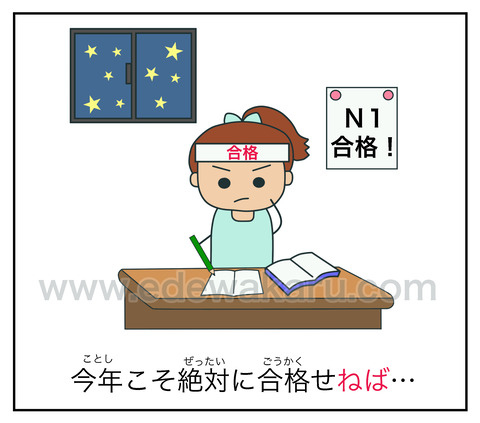
今年こそ絶対に合格せねば…(復習:〜こそ)
→今年こそ絶対に合格しなければ…This year, of all years, I absolutely must pass… (Review: 〜こそ) →This year, of all years, I must pass.
優勝できるようにがんばらねばならない
→優勝できるようにがんばらなければならないI have to work hard so that I can win. →I have to work hard so that I can win.
明日、江戸へ参らねばならぬのだ【時代劇や侍が登場するドラマで…】
→明日、江戸(今の東京)へ行かなければならないのだI must go to Edo tomorrow. [In a period drama or a drama featuring samurai…] →I must go to Edo (present-day Tokyo) tomorrow.
Read the original source text
Meaning
〜なければならない
How to use it
動詞[ない形]+ねば
動詞[ない形]+ねばならない
動詞[ない形]+ねばならぬ
Explanation
「〜ねば」は「〜なければ」という意味を表します。「〜ねば」は「〜ねばならない」「〜ねばならぬ」の省略形で全て意味は同じです
😀3つ全て書き言葉的で、会話ではあまり使われません😮その中でも「〜ねばならぬ」はとても古い言い方で現代の日常会話で聞くことはないと思います😅NHKの大河ドラマや侍が登場するドラマなどでは聞く機会があると思います😉
AIUEO JLPT Grammar
Meaning
This sentence pattern means the same as “〜なければならない” and expresses a strong obligation or necessity. It is often used in more formal or written contexts. For instance, “する” would become “せねばならぬ” or “せねばならない.”
How to use it
Verb ない-form + ねば + ならない; verb ない-form + ねば + ならぬ
In context 5 examples
真実を明らかにせねばならぬ。
We must reveal the truth.
我々は、この困難に立ち向かわねばならぬ。
We must face this difficulty.
この問題について、深く考えねばならない。
We must think deeply about this issue.
新しい計画を早急に立てねばならなかった。
A new plan had to be quickly made.
彼の行動をよく理解せねばならない。
We must understand his actions well.
Read the original source text
Meaning
This sentence pattern means the same as “〜なければならない” and expresses a strong obligation or necessity. It is often used in more formal or written contexts. For instance, “する” would become “せねばならぬ” or “せねばならない.”
How to use it
動詞ない形+ねば+ならない動詞ない形+ねば+ならぬ
Explanation · 日本語
この文型は、「〜なければならない」と同じ意味を持ち、強い義務や必要性を表す表現です。現代語では硬い表現であり、主に書き言葉で使われます。「する」の場合は「せねばならぬ・せねばならない」となります。
日本語文型辞典 英語版
Meaning
【ねばならぬ】[V-ねばならぬ]
An even more literary expression than ...ねばならない.
→
【なければ】2
In context 2 examples
暴力には力を合わせて立ち向かわなければならぬ。
We must work together to fight against violence.
自然破壊は防がねばならぬ。
We must protect the environment from destruction.
NINJAL 日本語文型データベース
Meaning
Expresses obligation, inevitability, or necessity. Used to strongly convey social norms or personal judgment.
It is also used in the form 「〜ねばならぬN」.
How to use it
In context 5 examples
厳しい時代でも、我々は生きねばならぬ。
Even in these difficult times, we must live.
いつまでも黙っていることはできない。本当のことを言わねばならぬ。
I can't stay silent forever. I must tell the truth.
この仕事は、大変でも誰かがやらねばならぬ仕事だ。
This is a job that someone must do, no matter how difficult it is.
過去の偉人たちは、国を豊かにせねばならぬという思いが強かった。
The great people of the past strongly felt that they had to make the country prosperous.
海外の取引先と交渉するため、来週出張せねばならぬことになった。
It has been decided that I must travel on business next week to negotiate with our overseas business partner.
Read the original source text
Meaning
義務・不可避であること、必要があることを表します。社会的常識や、個人的な判断を強く表す場合に使います。
「〜ねばならぬN」の形でも使います。