AIUEO JLPT Grammar
Meaning
This sentence pattern expresses that something cannot be realized or established without a certain condition being met. It’s used when emphasizing the importance of a specific element that is necessary for the result.
How to use it
Noun + 抜きでは; Noun + 抜きには; Noun を + 抜きに + しては
In context 5 examples
努力抜きには、目標を達成することはできない。
Without effort, you cannot achieve your goals.
彼を抜きにしては、このチームは成り立たない。
This team cannot function without him.
インターネット抜きでは、現代社会は成り立たない。
Modern society cannot function without the internet.
信頼関係抜きでは、良いビジネスはできない。
You cannot have good business without trust.
彼の協力を抜きにしては、この問題は解決できなかった。
This problem couldn’t have been solved without his cooperation.
Read the original source text
Meaning
This sentence pattern expresses that something cannot be realized or established without a certain condition being met. It’s used when emphasizing the importance of a specific element that is necessary for the result.
How to use it
名詞+抜きでは名詞+抜きには名詞を+抜きに+しては
Explanation · 日本語
この文型は、ある要素や条件がない状態では何かが成立しない、または実現できないことを表す表現です。特定のものが重要で、それがないと結果が得られない状況で使われます。
絵でわかる日本語
Meaning
Without ~, ~ cannot
If ~ is not considered, ~ cannot
Without including ~, ~ cannot
How to use it
Noun [dictionary form] + 抜きには〜ない
Noun [dictionary form] + 抜きでは〜ない
Noun [dictionary form] + 抜きにしては〜ない
Explanation
“A抜きにBない” is a sentence pattern meaning “without A, there is no B” or “if A is not considered, there is no B.” It is used to emphasize that “B is impossible without A.” “B” is followed by a negative form or expression, such as “〜ない,” “〜できない,” or “〜得ない.” Also, “〜抜きに〜ない” can be changed to “〜抜きでは〜ない” or “〜を抜きにしては〜ない” 😊
[Example]
Without breakfast,
抜きには
I have no energy
ない
= Without breakfast,
抜きでは
I have no energy
ない
= Without breakfast,
抜きにしては
I have no energy
ない
There are several sentence patterns with “抜く・抜き.” It may help to learn to distinguish them so you don’t get confused.
[Related patterns]
In context 6 examples
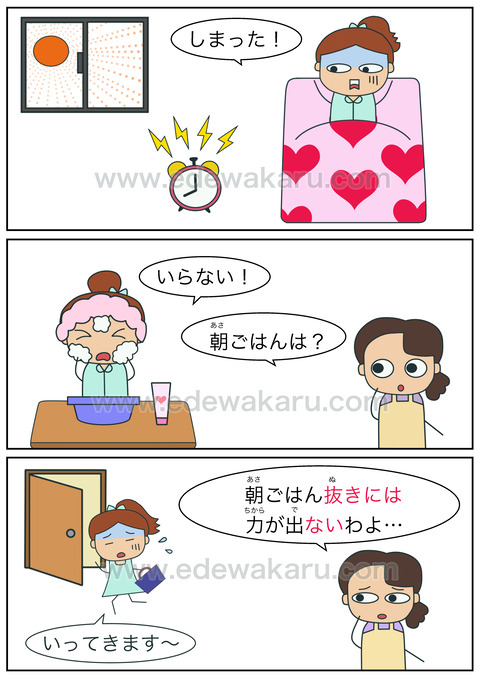
娘:遅刻しそうだから、ごはんいらない母:朝ごはん抜きには力が出ないわよ…
→朝ごはんを食べなければ、力が出ないわよ…Daughter: I might be late, so I don’t need food. Mother: You won’t have any energy without breakfast… →You won’t have any energy if you don’t eat breakfast…
彼女の活躍抜きには、チームは優勝しなかっただろう
→彼女の活躍がなければ、チームは優勝しなかっただろうWithout her outstanding performance, the team probably wouldn’t have won the championship. →If it weren’t for her outstanding performance, the team probably wouldn’t have won the championship.
両親の協力抜きには留学できなかったと思う
→両親の協力がなければ留学できなかったと思うI don’t think I could have studied abroad without my parents’ support. →I don’t think I could have studied abroad without my parents’ support.
これは重大なことなので、社長の意見抜きには決めかねる
→社長の意見がなければ決めかねるThis is an important matter, so I can’t make a decision without the president’s opinion. →I can’t make a decision without the president’s opinion.
先生のご指導抜きには、N1には合格できませんでした
→先生のご指導がなければ、N1には合格できませんでしたI couldn’t have passed N1 without my teacher’s guidance. →I couldn’t have passed N1 without my teacher’s guidance.
寿司抜きには、日本料理を語れない
→寿司を入れなければ、日本料理は語れないYou can’t talk about Japanese cuisine without sushi. →You can’t talk about Japanese cuisine without including sushi.
Read the original source text
Meaning
〜なければ〜ない
〜を考えなければ〜ない
〜を入れないでは〜ない
How to use it
名詞[辞書形]+抜きには〜ない
名詞[辞書形]+抜きでは〜ない
名詞[辞書形]+抜きにしては〜ない
Explanation
「A抜きにBない」は「AがなければBはない」「Aを考えなければBはない」という意味を表す文型です。「AがなければBは不可能だ」というのを強調したい時に使われます。「B」には「〜ない」「〜できない」「〜得ない」など、
否定形・否定表現(ひていひょうげん)
がきます。 また「〜抜きに〜ない」は「〜抜きでは〜ない」「〜を抜きにしては〜ない」にチェンジすることができます😊
[例]
朝ごはん
抜きには
力が出
ない
わよ!
=朝ごはん
抜きでは
力が出
ない
わよ!
=朝ごはん
抜きにしては
力が出
ない
わよ!
「抜く・抜き」がつく文型はいくつかあります。混乱しないように、区別して覚えておくといいと思います。
【関連文型】