どんなときどう使う 日本語表現文型辞典
Meaning
the case that
How to use it
〔Plain form〕(Na-adjective である/Noun である)+次第だF
Explanation
~わけだ
社員:はい、部長から帰れという連絡が入りまして、急いで帰って来た次第です。
店員:はい、まことに申し訳ございませんが、そういう次第でございます。
理由や事情を説明して、「それで~という結果になった」と言いたいときに使う。文中では ❸ のように「しだいで」という形になる。
Result has occurred because of a certain reason or circumstances that speaker first explains. Becomes しだいで in mid-sentence, as in sentence ❸ .
In context 3 examples
社長:君は大阪には寄らなかったんだね。
President: You didn’t stop by Osaka, did you?
客:品物が届かなかったのはそちらの手違いだというんですね。
Customer: You’re saying that the reason the goods didn’t arrive was a mistake on your end, right?
以上のような次第で、来週の工場見学は中止にさせていただきます。
For the reasons stated above, we will have to cancel next week’s factory tour.
Read the original source text
Meaning
the case that
How to use it
〔普通形〕(ナAである/Nである)+次第だF
Explanation
~わけだ
社員:はい、部長から帰れという連絡が入りまして、急いで帰って来た次第です。
店員:はい、まことに申し訳ございませんが、そういう次第でございます。
理由や事情を説明して、「それで~という結果になった」と言いたいときに使う。文中では ❸ のように「しだいで」という形になる。
Result has occurred because of a certain reason or circumstances that speaker first explains. Becomes しだいで in mid-sentence, as in sentence ❸ .
絵でわかる日本語
Usage 1
Read this source entry ↗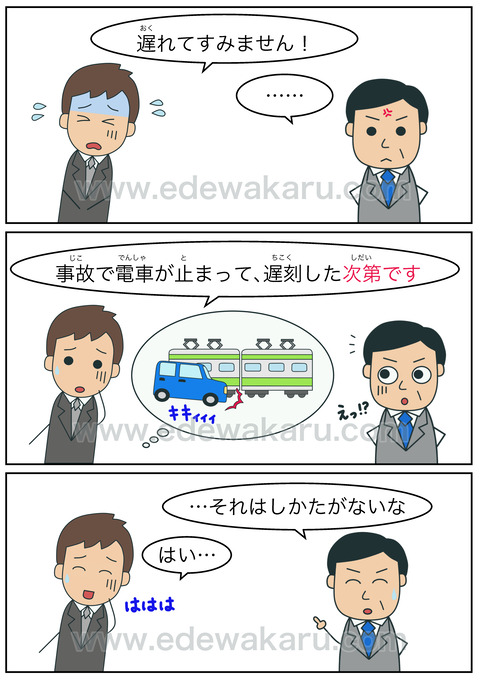
Meaning
It means that 〜
How to use it
Verb [dictionary form / た-form] + 次第だ
Verb [〜ている] + 次第だ
Explanation
“〜次第だ” is a sentence pattern meaning “that is why” or “it means that 〜.” It is used in forms such as “〜ので、〜次第だ” to explain a reason or circumstance to someone, as in “Because 〜, I did 〜.” It is a formal expression and is used only in formal settings. Since it is polite, in most cases it is used in the form “〜次第です.”
“〜次第だ” is rarely used in everyday conversation, but be sure to learn it together with the other patterns that use “次第” 😊
[Patterns that use “次第”]
In context 5 examples
事故で電車が止まり、遅刻した次第です
→事故で電車が止まったので、遅刻しましたThe train stopped because of an accident, so I was late. → The train stopped because of an accident, so I was late.
N1に合格しましたので、伺った次第です
→N1に合格しましたので、伺いましたI came to call on you because I passed N1. → I came to call on you because I passed N1.
お知らせしたいことがあり、ご連絡した次第です
→ご連絡したのは、お知らせしたいことがあったからですI am contacting you because there is something I would like to tell you. → The reason I contacted you is that there was something I wanted to tell you.
母が病気になったため、帰国することにした次第です
→帰国することにしたのは、母が病気になったためですI have decided to return to my country because my mother became ill. → The reason I decided to return to my country is that my mother became ill.
A:どうして日本語を勉強しているんですか?B:将来は日本の会社で働きたいと思っていますA:そうでしたかB:はい。そのような次第で、日本語を勉強しています
→そのような理由で、日本語を勉強していますA: Why are you studying Japanese? B: I want to work for a Japanese company in the future. A: I see. B: Yes. That is why I’m studying Japanese. →For that reason, I’m studying Japanese.
Read the original source text
Meaning
〜というわけだ
How to use it
動詞[辞書形・た形]+次第だ
動詞[ーている]+次第だ
Explanation
「〜次第だ」は「〜というわけだ」という意味の文型です。「〜ので、〜次第だ」などの形で「〜だったので、〜した」というように、相手に理由や事情を説明する場合に使われます。かたい言い方で、改まった場面でしか使われません。丁寧な言い方ですので、ほとんどの場合は「〜次第です」の形で使われます。
「〜次第だ」は日常会話(にちじょうかいわ)で使われることは少ないですが、他の「次第」がつく文型と一緒に覚えておきましょう😊
【「次第」がつく文型】
Usage 2
Read this source entry ↗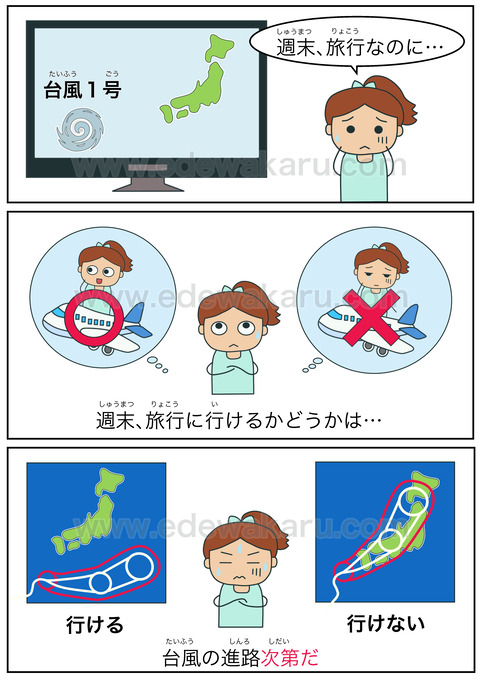
Meaning
... is decided by the circumstances of ...
... changes depending on the circumstances of ...
How to use it
Noun [dictionary form] + 次第で
Noun [dictionary form] + 次第だ
Explanation
“A次第でB” and “BはA次第だ” mean “B is decided by the circumstances of A” and “The state of B changes depending on the circumstances of A.” These patterns are used when you want to say that the state of B varies depending on A.
The grammar pattern 次第 meaning “as soon as…” is a different pattern, so be sure to distinguish them. There are also several other grammar patterns that include 次第, so let’s review them.
[Related patterns]
In context 6 examples
週末旅行に行けるかどうかは、台風の進路次第だ
→週末旅行に行けるかどうかは、台風の進路がどうなるかで決まるWhether we can go on a weekend trip depends on the typhoon’s path. →Whether we can go on a weekend trip will be decided by what happens with the typhoon’s path.
テストの結果次第で、日本に留学できるかどうかが決まる
→テストの結果で、留学できるかどうかが決まるWhether I can study in Japan depends on my test results. →My test results will decide whether I can study abroad.
野菜やフルーツは、天候次第で値段がすごく変わる
→野菜やフルーツの値段は、天候ですごく変わるThe prices of vegetables and fruit change a lot depending on the weather. →The prices of vegetables and fruit change a lot with the weather.
N1に合格するかどうかは、君の努力次第だ
→N1に合格するかどうかは、どれくらい努力するかで決まるWhether you pass N1 depends on your effort. →Whether you pass N1 will be decided by how hard you work.
やりかた次第で、勉強も楽しくなるよ〜
→やりかたによって、勉強も楽しくなるよ〜Depending on how you do it, studying can be fun too~ →Studying can be fun too, depending on how you do it~
次の試合に勝てるかどうかは、毎日の練習次第だと思うよ!
→試合に勝てるかどうかは、毎日の練習によって決まると思うよ!I think whether we win the next match depends on our daily practice! →I think whether we win the match is decided by our daily practice!
Read the original source text
Meaning
〜の状況で、〜が決まる
〜は、〜の状況で変わる
How to use it
名詞[辞書形]+次第で
名詞[辞書形]+次第だ
Explanation
「A次第でB」「BはA次第だ」は「Aの状況で、Bが決まる」「Bの状態は、Aの状況で変わる」という意味の文型です。「Aによって、Bの状態がいろいろ変わる」と言いたい時に使われます。
「〜たら、すぐに」という意味を表す「〜次第」は、別の文法です
ので区別しておきましょう。また「次第」がつく文型はいくつかありますので、復習をしておきましょう。
【関連文型】
くらべてわかる日本語表現文型辞典
Meaning
Meaning 1: To explain the situation by describing the course of events that led to the current state A.
Meaning 2: An expression suggesting that the situation could change in any number of ways depending on A.
How to use it
A次第だ
Connection 1:
[Verb] 次第だ
Connection 2:
[Noun–∅] 次第だ
Explanation
【Contrast 1】
“Aしまつだ (Aというしまつだ)” (Meaning 1, p. 106)
Both describe the course of events, but “Aというしまつだ” focuses on the result and adds the speaker’s negative evaluation. “A次第だ” simply describes and explains the course of events.
○彼は金遣いが荒く、給料を一日で使い果してしまうというしまつだ。 — He is a spendthrift, to the point that he blows his entire salary in one day.
○彼は金遣いが荒く、給料を一日で使い果してしまうという次第だ。 — He is a spendthrift, and that is how he ends up spending his entire salary in one day.
×一生懸命勉強して、やっと合格したというしまつです。 — I studied hard and finally passed, to the point that…
In context 8 examples
彼に急用が出来たため、私が代わりに来た次第です。
He had an urgent matter come up, so that is why I came in his place.
空きベッドがないということで、入院許可を待っている次第です。
Since there are no vacant beds, I am waiting for permission to be admitted.
このことをだれに相談すればいいのかわからず、困っている次第です。
I don’t know whom I should consult about this, and so I am at a loss.
残務処理も終わり、来週にも仕事を引き継ぐ次第です。
The remaining work has been taken care of, and I am now to hand over my duties next week.
いい大学に行きたいといっても、それは君の努力次第だね。
Even if you say you want to go to a good university, it all depends on your effort.
旅は相手次第で楽しくも、つまらなくもなる。
A trip can be enjoyable or boring depending on your companion.
医者として出来るだけのことはした。後は患者の体力次第だ。
I did everything I could as a doctor. From here on, it depends on the patient’s strength.
あした、キャンプに行けるかどうかは天気次第だ。
Whether we can go camping tomorrow depends on the weather.
Read the original source text
Meaning
意味1:現状Aに至った経緯を述べ、状況を説明する。
意味2:Aにより状況はどのようにも変わる可能性があることを示唆する表現。
How to use it
A次第だ
接続1:
[動詞]次第だ
接続2:
[名詞-∅]次第だ
Explanation
【対比1】
「Aしまつだ(Aというしまつだ)」(意味1 P.106)
ともに事の経緯を述べているが「Aというしまつだ」は結果に視点があり、話し手の否定的評価が加わっている。「A次第だ」は単に経緯を述べ、説明している。
○彼は金遣いが荒く、給料を一日で使い果してしまうというしまつだ。
○彼は金遣いが荒く、給料を一日で使い果してしまうという次第だ。
×一生懸命勉強して、やっと合格したというしまつです。
NINJAL 日本語文型データベース
Meaning
Used to say that a situation is decided or changes in response to ~ or with ~ as the decisive factor.
How to use it
N次第だ
Notes
“~” is preceded by words expressing something that can vary or differ, such as “天候,” “価格,” “やり方,” “対応,” and “返答.”
In context 5 examples
今日は、この山小屋に泊まります。明日、山頂を目指すかどうかは明朝の天候次第です。
We’ll stay at this mountain hut tonight. Whether we aim for the summit tomorrow depends on the weather in the morning.
日本語能力試験に合格できるかどうかは、これからの努力次第だ。頑張ろう。
Whether I can pass the Japanese Language Proficiency Test depends on the effort I make from now on. Let’s do our best.
部長「提案内容はいいと思う。契約を取ることができるかどうかは、先方との交渉次第だろう」
Department manager: “I think the proposal is good. Whether we can secure the contract will probably depend on our negotiations with the other party.”
同じ被写体でも感動的な素晴らしい写真になることもあるし、平凡な写真になることもある。それはカメラマンの感性と腕次第なのだ。
Even when photographing the same subject, the result can be a moving, wonderful photo or an ordinary one. It depends on the photographer’s sensibility and skill.
幸福な人生とは、その人の考え方次第だとよく言われる。
It is often said that a happy life depends on a person’s way of thinking.
Read the original source text
Meaning
~に対応して・~を決定的な要素として、事態が決まる・変化すると言いたいときに使います。
How to use it
N次第だ
Notes
「~」には、「天候・価格・やり方・対応・返答」など、幅や違いがあることを表す言葉がきます。