AIUEO JLPT Grammar
Meaning
This sentence pattern expresses that not only a certain matter but also others are naturally included.「〜はもとより」is a more formal expression, often used in written language.
How to use it
Noun は + もちろん; Noun は + もとより
In context 5 examples
健康のためには、食事はもちろん、運動も大切だ。
For your health, exercise is important, let alone diet.
環境問題はもとより、経済問題も深刻化している。
Not only environmental issues, but economic problems are also becoming more serious.
彼女は仕事はもちろん、家庭でも責任感が強い。
She has a strong sense of responsibility not only at work but also at home.
このレストランは味はもちろん、サービスも素晴らしい。
This restaurant’s service is excellent, not to mention the taste.
ここは教育はもとより、医療も充実している地域だ。
This is an area with excellent education and medical care.
Read the original source text
Meaning
This sentence pattern expresses that not only a certain matter but also others are naturally included.「〜はもとより」is a more formal expression, often used in written language.
How to use it
名詞は+もちろん名詞は+もとより
Explanation · 日本語
この文型は、ある事柄が当然そうであることを前提に、それに加えて他の事柄も同様であることを強調する表現です。「〜はもとより」はやや硬い表現で、書き言葉として使われることが多いです。
文法
Meaning
~ goes without saying / let alone ~
How to use it
N + はもちろん
Notes
・The particle 「も」 is often used in the following clause.
・The preceding and following clauses deal with matters of a similar degree.
・Conversational in style. The more formal expression is 「〜はもとより」.
In context 13 examples
この学校では、毎日復習はもちろん、予習もしなければ怒られる。
At this school, you'll get scolded if you don't review every day, as well as preview the lessons.
日本語学校では、日本語はもちろん、日本の文化や習慣についても教えている。
At Japanese language school, they teach not only Japanese, of course, but also Japanese culture and customs.
「NARUTO」は子供はもちろん、大人でも楽しめるアニメだ。
"NARUTO" is an anime that children can enjoy, of course, but adults can enjoy it too.
「ワンピース」は日本ではもちろん、海外でも人気がある漫画だ。
"One Piece" is a manga that's popular overseas as well as in Japan.
ディズニーランドは週末はもちろん、休日も混んでいる。
Tokyo Disneyland is crowded on holidays as well as weekends.
このラーメン屋は、ラーメンはもちろん、チャーハンも美味しい。
At this ramen shop, the fried rice is delicious too, of course, as is the ramen.
このカバンはデザインはもちろん、質もいい。
This bag has good quality as well as good design.
この居酒屋はお酒はもちろん、料理も美味しい。
At this izakaya, the food is delicious as well as the drinks.
彼は顔はもちろん、性格もいいし完璧です。
He's perfect: he's good-looking, of course, and has a great personality too.
トムさんは勉強はもちろん、スポーツも万能だ。
Tom is good at sports as well as his studies.
早くJLPT N1に合格したいので、平日はもちろん、休日も勉強しています。
I want to pass the JLPT N1 soon, so I study on holidays as well as weekdays.
私は旅行が嫌いなので、海外はもちろん、他の県にも行ったことがない。
I hate traveling, so I haven't been abroad, of course, or even to another prefecture.
キムさんはもちろん、マークさんも来る予定ですよ。
Mark is also planning to come, as is Kim, of course.
Read the original source text
Meaning
〜は当然として
How to use it
N + はもちろん
Notes
・後件では助詞「も」を使うことが多い。
・前件と後件は同程度の事柄を扱う。
・話し言葉的。硬い言い方は「〜はもとより」。
Bunpro Grammar Reference
Meaning
Not only but also, Let alone, Not to mention, Of course
How to use it
Noun (A) + はもちろん + Noun (B) + も(1)
(1) さえ
Nuance
A phrase indicating that (A) is of course true in general, but even the more surprising (B) is true too.
Explanation
はもちろん, or occasionally は勿論, is a phrase in Japanese that presents (A) as being something obvious, while (B) should still be considered/mentioned. In this expression, the adverbial particle は presents (A) as being a stand-alone topic, before the adverb もちろん 'naturally' emphasizes that (A) is what it is. After this, the (B) part of the sentence will describe some other factor that is worth mentioning.
はもちろん will be used directly after noun (A), before the sentence will go on to discuss noun (B). This construction can be translated as 'not only (A), but (B)', 'not to mention (A), (B)', and other similar English expressions.
パソコンのことはもちろん、電化製品の事ならなんでも聞いてください。
Please ask me anything, not only about computers but also other electronics.
数学はもちろん、学校の科目を全て一人で教えることができる人を探している。
We are looking for someone not only who can teach math, but every subject in this school by themselves.
In many cases, despite (A) being the obvious factor, (B) is being highlighted as sharing similar qualities to (A). This means that in はもちろん sentences, も will almost always be seen after (B).
彼女は日本語はもちろん、韓国語も話すことができます。
Not only can she speak Japanese, but she can also speak Korean.
この作家の本はもちろん、歌もうまいから人気がある。
This author is popular, not only because of his book, but also because he is a good singer.
Caution
While quite similar in meaning to だけでなく, はもちろん is quite a bit more formal. Due to this, it may sound quite stiff in friendly conversation, unless particularly emphasizing something.
In context 16 examples
- 平日はもちろん、土日も働いている。
I work not only on weekdays, but also weekends.
- 数学はもちろん、学校の科目を全て一人で教えることができる人を探している。
We are looking for someone not only who can teach math, but every subject in this school by themselves.
- パソコンのことはもちろん、電化製品の事ならなんでも聞いてください。
Please ask me anything, not only about computers but also other electronics.
- 彼女は日本語はもちろん、韓国語も話すことができます。
Not only can she speak Japanese, but she can also speak Korean.
- この作家の本はもちろん、歌もうまいから人気がある。
This author is popular, not only because of his book, but also because he is a good singer.
- ここのそば屋はそばはもちろん、カレーも美味しい。
This soba restaurant not only has delicious soba, but also delicious curry.
- 彼は、英語はもちろん、日本語も話せる。
He is not only able to speak in English, but also in Japanese.
- 父は、スマホはもちろん、ガラケーも持っていません。
Not only a smartphone, dad doesn't even have a flip-phone.
- 勉強はもちろん、運動もできるのだからすごい人だ。
He is an amazing person because he is not only good in academics, but also in sports.
- 椅子はもちろん、家具全般取り扱っています。
I will not only handle the chairs, but also all of the furniture.
- あの高級車はシートやフロントガラスはもちろんドアミラーも温められます。
In that high-class car, not only are the seats and the windshield heated, but also the side mirrors.
- チョコやあんこはもちろん、甘いものならなんでも好きです。
I like not only chocolate or bean-paste, but also anything that is sweet.
- パーティーに、家族はもちろん、友達も誘って来てください。
Please invite not only your family, but your friends as well to the party.
- 現在のテレビは、映画を観ることはもちろんネットサーフィンもできる。
On modern TVs you can not only watch movies but you can also surf the internet.
- 新しい仕事を探す時は、給料はもちろん、それ以外の条件も考えます。
When I look for a new job, I consider not only salary, but also other conditions.
- 人生いい時はもちろん、悪い時も助け合って生きていこう。
Let's live our lives by helping each other not only during the good times, but also during the hard times.
Read the original source text
Meaning
Not only but also, Let alone, Not to mention, Of course
How to use it
Noun (A) + はもちろん + Noun (B) + も(1)
(1) さえ
Nuance
A phrase indicating that (A) is of course true in general, but even the more surprising (B) is true too.
Explanation
はもちろん, or occasionally は勿論, is a phrase in Japanese that presents (A) as being something obvious, while (B) should still be considered/mentioned. In this expression, the adverbial particle は presents (A) as being a stand-alone topic, before the adverb もちろん 'naturally' emphasizes that (A) is what it is. After this, the (B) part of the sentence will describe some other factor that is worth mentioning.
はもちろん will be used directly after noun (A), before the sentence will go on to discuss noun (B). This construction can be translated as 'not only (A), but (B)', 'not to mention (A), (B)', and other similar English expressions.
パソコンのことはもちろん、電化製品の事ならなんでも聞いてください。
Please ask me anything, not only about computers but also other electronics.
数学はもちろん、学校の科目を全て一人で教えることができる人を探している。
We are looking for someone not only who can teach math, but every subject in this school by themselves.
In many cases, despite (A) being the obvious factor, (B) is being highlighted as sharing similar qualities to (A). This means that in はもちろん sentences, も will almost always be seen after (B).
彼女は日本語はもちろん、韓国語も話すことができます。
Not only can she speak Japanese, but she can also speak Korean.
この作家の本はもちろん、歌もうまいから人気がある。
This author is popular, not only because of his book, but also because he is a good singer.
Caution
While quite similar in meaning to だけでなく, はもちろん is quite a bit more formal. Due to this, it may sound quite stiff in friendly conversation, unless particularly emphasizing something.
Nuance · 日本語
一般的には(A)は事実だとされているが、驚くことに(B)でもあるということを表す表現。
Explanation · 日本語
「はもちろん」は、(A) は明らかにそうだと認めた上で、(B) についても考えるべき・言うべきだと言いたいときに使われる表現です。この表現では、副助詞の「は」が、(A) が話題であることを表して、副詞の「もちろん」が、(A) が当然であることを示します。そのあと、文の (B) の部分で、話し手が「言うべきだ」と思っている内容が続きます。また、「はもちろん」は漢字で「は勿論」と書かれることもあります。
「はもちろん」は、名詞 (A) のあとに置かれて、そのあとに名詞 (B) が続きます。この文法は、「(A) だけでなく (B) も」や「(A) は当然、(B) も」のような意味で使われます。
パソコンのことはもちろん、電化製品の事ならなんでも聞いてください。
Please ask me anything, not only about computers but also other electronics.
数学はもちろん、学校の科目を全て一人で教えることができる人を探している。
We are looking for someone not only who can teach math, but every subject in this school by themselves.
この表現は、基本的に (A) が当たり前と言いながら、(B) も (A) と同じだと言うときに使われます。そのため、名詞 (B) のあとには「も」が付くことがほとんどです。
彼女は日本語はもちろん、韓国語も話すことができます。
Not only can she speak Japanese, but she can also speak Korean.
この作家の本はもちろん、歌もうまいから人気がある。
This author is popular, not only because of his book, but also because he is a good singer.
注意点
「はもちろん」は「だけでなく」と同じような意味で使われますが、「はもちろん」の方が、よりフォーマルな表現です。普段の会話で使うこともできますが、かたく聞こえることがあります。
どんなときどう使う 日本語表現文型辞典
Meaning
of course; naturally
How to use it
N (+ particle) は + もちろん
Explanation
~は当然として
1)「~は当然として、程度が上の後の事柄も加わる」という意味。
2)より硬い表現として、「はもとより」がある。
2)Somewhat more formal expression: はもとより.
1)One matter is taken for granted; in fact some other element of even greater degree is added.
In context 4 examples
復習はもちろん予習もしなければなりません。
You have to do not only review but also preview.
浅草という街は日曜、祭日はもちろん、ウイークデーもにぎやかだ。
The town of Asakusa is lively not only on Sundays and holidays but also on weekdays.
大都市ではもちろん、地方の小さな農村でも情報がすばやくキャッチできるようになってきた。
It has become possible to quickly access information not only in big cities but also in small rural villages.
田中さんは勉強についてはもちろんのこと、私生活の問題まで何でも相談できる先輩だ。
Tanaka is a senior colleague you can consult about anything, not only your studies but even personal problems.
Read the original source text
Meaning
of course; naturally
How to use it
N(+助詞)は+もちろん
Explanation
~は当然として
1)「~は当然として、程度が上の後の事柄も加わる」という意味。
2)より硬い表現として、「はもとより」がある。
2)Somewhat more formal expression: はもとより.
1)One matter is taken for granted; in fact some other element of even greater degree is added.
絵でわかる日本語
Meaning
A is of course, and B too
Not only A, but also B
How to use it
Noun [dictionary form] + はもちろん
Explanation
“AはもちろんBも” is a sentence pattern meaning “A goes without saying, and B too” or “A is a given, and the same is true of B.” “A” is something so obvious it need not be stated, and is used as a representative example when you want to say that “B” is true as well. “〜はもちろん” can be changed to “〜はもちろんのこと.”
[Example]
She can speak not only English, of course, but Chinese too.
= She can speak not only English, of course, but Chinese too.
The more formal form of “〜はもちろん” is “〜はもとより,” so be sure to learn them together 😊
[Related articles]
In context 6 examples
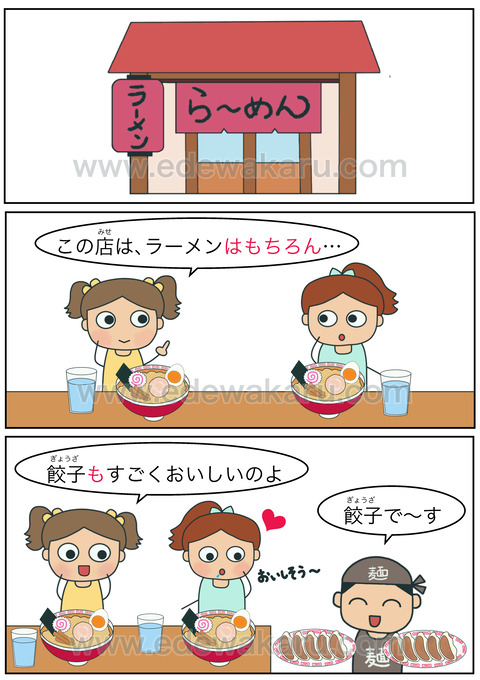
この店は、ラーメンはもちろん餃子もすごくおいしいのよ
→ラーメンは当然、さらに餃子もすごくおいしいのよAt this restaurant, not only the ramen but also the gyoza are really delicious. → The gyoza, as well as the ramen, are really delicious.
彼女は、英語はもちろん中国語も話すことができる
→英語は当然、さらに中国語も話すことができるShe can speak not only English, of course, but Chinese too. → She can speak Chinese as well as English, of course.
彼は勉強はもちろんスポーツもできるからモテるんだね
→勉強は当然として、さらにスポーツもできるからモテるんだねHe’s popular because he can do sports as well as study, of course.
あのカフェは、土日はもちろん平日もお客さんがいっぱいいる
→土日は当然、平日もお客さんがいっぱいいるThat café is full of customers on weekdays as well as weekends, of course.
このアニメは、日本ではもちろん海外でも人気がある
→日本では当然として、海外でも人気があるThis anime is popular overseas as well as in Japan, of course.
先生:今日の授業の復習はもちろん、明日の授業の予習もするように学生:はい
→今日の復習は当然として、予習もするようにTeacher: Be sure to review today’s lesson, and of course prepare for tomorrow’s lesson too. Student: Yes. → Make sure to review today’s lesson, and prepare for tomorrow’s as well.
Read the original source text
Meaning
〜は当然、さらに〜も
How to use it
名詞[辞書形]+はもちろん
Explanation
「AはもちろんBも」は「Aは当然として、さらにBも」「Aは当然〜で、Bも同じだ」という意味の文型です。 「A」には言わなくても当然なことが代表例(だいひょうれい)として入り、さらに「B」も同じだと言いたい時に使われます。「〜はもちろん」は「〜はもちろんのこと」にチェンジすることができます。
[例]
彼女は、英語
はもちろん
中国語も話すことができる
=彼女は、英語
はもちろんのこと
中国語も話すことができる
「〜はもちろん」のかたい言い方は「〜はもとより」ですので、一緒に覚えておきましょう😊
【関連記事】
くらべてわかる日本語表現文型辞典
Meaning
A is naturally C, but B is C too. What the speaker wants to say is that B is also C.
How to use it
A はもちろん B も C
[Verb] + こと + はもちろん [Verb] + こと + も
[Noun—∅] はもちろん [Noun—∅] も
Explanation
【Contrast 1】
「AはもとよりB」 (Meanings 1 and 2, p. 286)
「AはもちろんBもC」 has the same meaning, but 「AはもとよりB」 is the more formal expression.
○海外に行くときは、パスポートはもちろん薬も持って行きなさい。 — When going abroad, take medicine as well as your passport.
×海外に行くときは、パスポートはもとより薬も持って行きなさい。 — When going abroad, take medicine as well as your passport.
「AはもとよりB」 can also mean “originally” or “from the beginning.”
○彼女はもとより素直な子だった。 — She was an honest child from the beginning.
「Aにはおよばない(Aは言うにおよばずB)」 (Note 1, p. 254)
Both 「AはもちろんBもC」 and 「Aは言うにおよばずB」 mean “both A and B,” but 「Aは言うにおよばずB」 strongly conveys the speaker’s feeling that A goes without saying, and that B should be obvious even without mentioning it.
○試験中は話すのはもちろん携帯を見てもカンニングとみなす。 — During an exam, not only talking but even looking at a phone is considered cheating.
○試験中は話すのは言うにおよばず携帯を見てもカンニングとみなす。 — During an exam, not to mention talking, even looking at a phone is considered cheating.
○私は酒を飲むのはもちろん、匂いだけでも気分が悪くなる。 — I feel sick not only from drinking alcohol, but even from its smell.
×私は酒を飲むのは言うにおよばず、匂いだけでも気分が悪くなる。 — I feel sick not to mention drinking alcohol, but even from its smell.
In context 4 examples
日本に来た当初は、漢字はもちろん、ひらがなもわからなかった。
When I first came to Japan, I couldn’t understand hiragana, let alone kanji.
私は泳ぐことはもちろん、浮くこともできないんですよ。
I can’t swim, let alone float.
あの料理屋は味はもちろん、食器やインテリアも私好みだ。
That restaurant’s food is to my taste, and so are its dishes and interior.
この靴は軽いのでスポーツにはもちろん、通勤にも最適だ。
These shoes are light, so they’re ideal for commuting as well as sports.
Read the original source text
Meaning
Aは当然Cだが、BもまたC。話し手が述べたいことは、BもC。
How to use it
AはもちろんBもC
[動詞]+こと+はもちろん[動詞]+こと+も
[名詞-∅]はもちろん[名詞-∅]も
Explanation
【対比1】
「AはもとよりB」(意味1,2 P.286)
「AはもちろんBもC」と意味は同じであるが、「AはもとよりB」の方が硬い表現である。
○海外に行くときは、パスポートはもちろん薬も持って行きなさい。
×海外に行くときは、パスポートはもとより薬も持って行きなさい。
「AはもとよりB」には、もともと・はじめからという意味もある。
○彼女はもとより素直な子だった。
「Aにはおよばない(Aは言うにおよばずB)」(注意1P.254)
「AはもちろんBもC」も「Aは言うにおよばずB」もともにAもBもという意味だが、「Aは言うにおよばずB」はAは言うまでもなくB、Aは言わなくてもわかるだろうという話し手の気持ちが強い。
○試験中は話すのはもちろん携帯を見てもカンニングとみなす。
○試験中は話すのは言うにおよばず携帯を見てもカンニングとみなす。
○私は酒を飲むのはもちろん、匂いだけでも気分が悪くなる。
×私は酒を飲むのは言うにおよばず、匂いだけでも気分が悪くなる。
日本語NET JLPT文法解説まとめ
Meaning
~ goes without saying / let alone ~
How to use it
N + はもちろん
Explanation
as a matter of course
① 後件では助詞「も」を使うことが多い。
② 前件と後件は同程度の事柄を扱う。
③ 話し言葉的。硬い言い方は「〜はもとより」。
① In the latter case, the particle "も" is often used.
② The former and latter clauses address matters of equal importance.
③ This expression is colloquial. A more formal version is "〜はもとより"
In context 13 examples
この学校では、毎日復習はもちろん、予習もしなければ怒られる。
At this school, you'll get scolded if you don't review every day, as well as preview the lessons.
日本語学校では、日本語はもちろん、日本の文化や習慣についても教えている。
At Japanese language school, they teach not only Japanese, of course, but also Japanese culture and customs.
「NARUTO」は子供はもちろん、大人でも楽しめるアニメだ。
"NARUTO" is an anime that children can enjoy, of course, but adults can enjoy it too.
「ワンピース」は日本ではもちろん、海外でも人気がある漫画だ。
"One Piece" is a manga that's popular overseas as well as in Japan.
ディズニーランドは週末はもちろん、休日も混んでいる。
Tokyo Disneyland is crowded on holidays as well as weekends.
このラーメン屋は、ラーメンはもちろん、チャーハンも美味しい。
At this ramen shop, the fried rice is delicious too, of course, as is the ramen.
このカバンはデザインはもちろん、質もいい。
This bag has good quality as well as good design.
この居酒屋はお酒はもちろん、料理も美味しい。
At this izakaya, the food is delicious as well as the drinks.
彼は顔はもちろん、性格もいいし完璧です。
He's perfect: he's good-looking, of course, and has a great personality too.
トムさんは勉強はもちろん、スポーツも万能だ。
Tom is good at sports as well as his studies.
早くJLPT N1に合格したいので、平日はもちろん、休日も勉強しています。
I want to pass the JLPT N1 soon, so I study on holidays as well as weekdays.
私は旅行が嫌いなので、海外はもちろん、他の県にも行ったことがない。
I hate traveling, so I haven't been abroad, of course, or even to another prefecture.
キムさんはもちろん、マークさんも来る予定ですよ。
Mark is also planning to come, as is Kim, of course.
Read the original source text
Meaning
〜は当然として
How to use it
N + はもちろん
Explanation
as a matter of course
① 後件では助詞「も」を使うことが多い。
② 前件と後件は同程度の事柄を扱う。
③ 話し言葉的。硬い言い方は「〜はもとより」。
① In the latter case, the particle "も" is often used.
② The former and latter clauses address matters of equal importance.
③ This expression is colloquial. A more formal version is "〜はもとより"
NINJAL 日本語文型データベース
Meaning
This is used when you want to say that something is so obvious it need not be said, and that something else is true of it as well.
How to use it
N はもちろん
Other
Notes
“~” is a word expressing something easy to expect. After “~はもちろん” comes a word expressing something else that is less predictable than “~.”
The particle “も” is often attached to the word expressing the other thing.
In context 8 examples
毎回の食事では肉や魚類はもちろん、野菜もしっかり食べましょう。
At every meal, make sure to eat vegetables as well as meat and fish.
私の離職には、家族はもちろん友人も誰も賛成しなかった。
When I left my job, no one supported me—not my family, and of course not my friends either.
私はダンスの鑑賞が大好きです。バレエはもちろん、フラメンコやタンゴの舞台にも足を運びます。
I love watching dance. I go to performances of flamenco and tango, as well as ballet.
日本語の外来語には、英語はもちろん、ドイツ語やフランス語からきた言葉もある。
Among Japanese loanwords, there are words that came from German and French, as well as English.
コンビニでは、買い物はもちろん、宅配便の受け取りや公共料金の支払いもできる。
At convenience stores, you can receive parcels and pay utility bills, as well as shop.
釣り好きな友人は国内の川ではもちろん、外国の川でも釣りを楽しんでいる。
My friend who loves fishing enjoys fishing in rivers abroad as well as in rivers in Japan.
母はうちではもちろん、外食の時も自分専用の箸を使う。
My mother uses her own chopsticks at home, and when eating out, too.
吉田先生は高校教師としてはもちろん、研究者としても実績がある。
Professor Yoshida has a track record not only as a high school teacher, but also as a researcher.
Read the original source text
Meaning
~は当然なので言わなくてもわかることだが、それに追加して他のものもそれと同じだと言いたいときに使います。
How to use it
Nはもちろん
その他
Notes
「~」には、予想しやすい事柄を表す言葉がきます。「~はもちろん」の後には、「〜」より予想しにくい別の事柄を表す言葉がきます。
別の事柄を表す言葉に「も」をつけることが多いです。
IMABI
Addition
Read this IMABI lesson ↗Explanation
Addition: ~に加えて, ~にとどまらず, ~もさることながら, ~はおろか, ~はもちろん, ~はもとより, ~ともあれ
When a speaker feels obligated to mention yet another thing into the mix, that is usually done so with negative connotation, and it is this that will be the theme of this lesson.
~に加えて
The transitive verb 加える roughly translates to “to add,” but it may also be translated as “to count (someone) in,” “to deal (damage),” “or even “to gather (speed).”
1. 料理に胡椒こしょうは一つまみも加える必要はない。
There is no need to add a pinch of pepper to a dish.
2. お茶に砂糖を加える。
To mix sugar in the tea.
3. 圧力を加える。
To add pressure.
咥える should not, however, be confused with the homophonous transitive verb 咥える・銜える, which means “to put in one’s mouth,” although they are etymologically tied.
4. 子供は指を銜くわえる嫌いがある。
Children have the tendency to have their fingers in their mouth.
Perhaps the most important use of this verb is its appearance in the phrase ~に加えて meaning “in addition to.” It is used a lot in enumerating negative situations.
5. 彼女は日本語に加えて、英語もあまり分からないみたいだね。
In addition to Japanese, it looks like she barely understands English.
6. イギリスに加えて、フランスもドイツも多文化主義の非を鳴らしています。
In addition to England, France and Germany are also denouncing multiculturalism.
7. そのことに加えて、彼は自分の名前を忘れたよ!
In addition to that, he also forgot his own name!
8. 5日のニューヨーク株式市場かぶしきしじょうは、東京市場で株価が大幅おおはばに値下がりしたことに加えて、アメリカが景気を下支したざさえするために行っている量的緩和りょうてきかんわの縮小しゅくしょう時期など、アメリカの金融きんゆう政策に対する不安から幅広い銘柄めいがらに売り注文が広がりました。
As for the New York Stock Exchange on the fifth, selling orders have spread in a wide range of brands from worries towards American financial policies such as the quantitative easing curtailment period America is carrying out in order to backup the economy in addition to the large drop in prices due to the Tokyo Exchange.
From NHK.
~にとどまらず
The speech modal ~にとどまらず attaches to nouns which can be perceived as some sort of parameter/level/stage with which the following clause indicates an extension of said parameter.
10. マスメディアによる情報というものは、今や一国にとどまらず、世界中に伝わる。
Information by the media doesn’t stay in one country now; it travels the world.
11. 農作物は、台風に襲われた直後にとどまらず、一年中その影響を受ける。
Crops don’t just receive the effects directly after being hit by a typhoon; they feel the impact throughout the year.
12. 彼女は成功にとどまらず、社会貢献に尽力した。
She not only stopped at success, but she also labored as a contribution to society.
Though ~にとどまらず usually attaches itself to nouns, it can on occasion follow the 連体形 of verbs, but in doing so, it is not used with static verbs, as such verbs do not agree with the concept of extending parameters.
13. 一人の人間の明るさは、場を明るくするにとどまらず、周囲の人々に心身の活力をも与えるものである。
The brightness of a person not only brightens up the area, but also it gives energy to the hearts and minds of the surrounding people.
14. 更に執刀した岡山大学病院の大藤剛宏医師は手術後の記者会見で「中葉を使った移植は男の子1人を助けるにとどまらず、これまで助けることができなかった子どもたちに光が当たるという意義がある」と話しました。
In addition, Dc. Oto Takahiro of Okayama University Hospital who did the surgery in a press conference afterwards said that “the transplant using the middle lobe [of the lung] does not just save this one boy, but it gives light to other children that have not been able to be helped till now”.
From the NHK article 『生体肺移植の男児 容体安定』 on 2013年7月2日
When used with adjectives/adjectival noun predicates, the nature of the situation must be in some state of transition to account for an extension of the parameter being described to remain grammatical. So, although adjectival expressions may literally be static by definition, they can be implemented in dynamic circumstances.
As this pattern follows the 連体形, but because it is also generally restricted to rather stiff written language, we can expect it to follow the である-連体形 for adjectival nouns, but as for adjectives1, we find that the particle だけ (only) is placed in between the adjective (though still in the 連体形) and ~に留まらず.
15. あの法令は単に違憲であるにとどまらず、ネットのおかげで実効性も失われて久しい。
That ordinance is not only simply unconstitutional, but thanks to the Internet, it has lost its effectiveness for quite some time.
16. 健康に良いだけにとどまらず、シジミは旨味成分もたくさん含まれています。
Freshwater clams are not just good for your health, but they also contain lots of umami components.
Though not grammatically necessary and in some sense redundant, the particle だけ can generally be seen used with this pattern in general, resulting in ~だけにとどまらず.
17. 弊社は社会貢献だけにとどまらず、様々な活動を展開しております。
Our company is not limiting itself to just contributing to society but is expanding its reach into all sorts of activities.
Orthography Note: Though not typically written in Kanji, its Kanji spelled is ~に留まらず.
~もさることながら
The pattern ~もさることながら follows nouns deemed to obviously be of a certain quality (most often positive), and that the following clause adds to the worth/validity of said statement. This, in turn, is translated into English as “it goes without saying that…”
18. 中華料理ちゅうかりょうりは味あじもさることながら、健康けんこうにいいですよ。
It goes without saying that Chinese food is tasty, but it’s also good for you.
19. 彼女は人柄もさることながら、その頭の働きの良さで周囲の人をぐいぐいと引っ張っていくんですよ。
Her personality goes without saying, and her great mind pulls those around towards her.
Orthography Note: The full Kanji spelling of this pattern is 然る事乍ら.
Grammar Note: 然る is an old-fashioned 連体詞 derived from the Classical Japanese verb 然り, which has the meaning of “to be said/some thing” in a very vague sense, and if it were directly translated into something in Modern Japanese, it would be closest to そういう or とある, which results in it directly equating to “such.” Given how affirming the noun-predicate is, we see that the particle ながら attaches itself to state that the two clauses of the sentence are concurrently in agreeance to that effect.
~はもちろん・もとより・おろか
~はもちろん(のこと)is used when juxtaposing two predicates as being “as matter of fact.” The first clause which it attaches to must be a nominal(ized) phrase, but what follows after it is typically a verbal/adjectival which affirms the first predicate.
In the examples that follow, we can see how the literal meaning of もちろん, that being “of course,” can be taken literally here. To truly understand how this pattern works regarding nuance, though, let’s posit that the first clause is X and the second clause is Y. In the mind of the speaker, X is mentioned first as it has the highest relevance or the highest recognition of being obvious, whereas Y adds to what is obvious or fully expected given knowledge of the situation. Y may at times be far more impressive than Y, but the reason why X is mentioned first is because it has the most relevance.
Speech Style Note: While ~はもちろん is largely used in the written language, whenever it is utilized in the spoken language, it is often rendered as ~もちろんのこと, which grammatically allows for said dependent clause to more clearly function as a noun-predicate that is more parallel in structure to predicate Y.
20. 彼は英語はもちろん、スペイン語も韓国語もできます。
Not to mention English, he can also speak Spanish and Korean.
21 あの子は書くのはもちろん、読むこともできない。
That kid can’t even read, let alone write.
22. 彼は、母語はもちろん(のこと)、他にも7つの言語も話せますよ。
Not only his native language, but he can also speak seven other languages.
23. 彼は修士を得るのはもちろん、入学さえできない。
He can’t even enter college, let alone receive a master’s degree.
Now, whenever Y is not something that cannot be deemed obvious given the situation at hand, ~はもちろん becomes ungrammatical, and it would need to be replaced with something broader such as ~だけでなく.
24. この米には、もみ{だけでなく 〇・はもちろん X}、砂まで入ってるのよ。
Not only is there husks in this rice, there’s even sand in it.
While it may be intrinsically obvious that someone who excels in his main language does indeed have mastery in other languages like in Ex. 22, there is nothing intrinsic about rice being contaminated with all sorts of things.
~はもとより
The nuance spin that ~はもとより provides is that it quality X is “principally” so. Meaning, based on principle, X is that standard which is both most pertinent and obvious in nature, and then Y builds onto that execution of standard. Just as with ~はもちろん(のこと), X is a nominal(ized) phrase, while Y is usually a verbal/adjectival predicate which expands on that notion.
25. 彼女は料理はもとより食器も洗ってくれます。
She not only cooks, but she also washes the dishes.
26. 彼は英語はもとより、スペイン語も韓国語もできます。
Not to mention English, he can also speak Spanish and Korean.
27. 低賃金、劣悪な労働条件、一方的な首切りなどの経済・労働問題はもとより、各種の人道的問題までも引き起こしている。
They are not only suffering from low wages, cases of poor working condition, and economic and labor problems such as one-sided layoffs, they are also troubled to the extent of various forms of discrimination.
28. 地方ごとに、味はもとより、料理の仕方も違ってきますね。
With each region, not to mention flavor, but even cooking methods differ, don’t they?
~はおろか
The word おろか indicates that the noun in the dependent clause X is negligible in how bad Y is obviously true.
29. 一ドルはおろか一セントも持ってないよ。
I don’t have a cent, let alone a dollar!
30. 父はおろか、僕の犬でさえ反対したようだ。
Not to mention my father, even my dog seemed to object.
31. 僕はバイオリンはおろか、ギターも弾けないんだ。
I can’t even play the guitar, much less a violet.
32. あの子は話すのはおろか、足も動かせません。
That child can’t even move her legs, let alone speak.
漢字 Notes: The Kanji spellings of these phrases are as follows:
①おろか → 疎か
②もちろん → 勿論
③もとより →【元・固・素】より.
~ともあれ
~ともあれ is an adverbial phrase that means “never mind/putting aside.” It is also seen in 何はともあれ meaning “in any case.” Grammatically speaking, あれ is the 已然形 of the existential verb ある, which means that as a whole, this adverbial phrase pinpoints the noun in said dependent clause X is already obviously an established issue, but that Y is the ‘real’ problem at hand.
33. 中国語はともあれ、問題は日本語の勉強なんだぞ。
Never mind Chinese, the problem is my Japanese studies!
34. 何はともあれ、後でしよう。
In any case, let’s do (this) later.
In older language, the き-連体形 of adjectives does become valid with this grammar structure.
i. 良き素材で醸されたお酒は香味や余韻の良きにとどまらず、飲み手にはその格に相応しい陶酔感をもたらします。
Sake brewed with excellent ingredients not only has superb flavor and aftertaste, as it provides a level of intoxication befitting of its worth to the consumer. ↩︎
In context 32 examples
料理に胡椒こしょうは一つまみも加える必要はない。
There is no need to add a pinch of pepper to a dish.
お茶に砂糖を加える。
To mix sugar in the tea.
圧力を加える。
To add pressure.
子供は指を銜くわえる嫌いがある。
Children have the tendency to have their fingers in their mouth.
彼女は日本語に加えて、英語もあまり分からないみたいだね。
In addition to Japanese, it looks like she barely understands English.
イギリスに加えて、フランスもドイツも多文化主義の非を鳴らしています。
In addition to England, France and Germany are also denouncing multiculturalism.
そのことに加えて、彼は自分の名前を忘れたよ!
In addition to that, he also forgot his own name!
5日のニューヨーク株式市場かぶしきしじょうは、東京市場で株価が大幅おおはばに値下がりしたことに加えて、アメリカが景気を下支したざさえするために行っている量的緩和りょうてきかんわの縮小しゅくしょう時期など、アメリカの金融きんゆう政策に対する不安から幅広い銘柄めいがらに売り注文が広がりました。
As for the New York Stock Exchange on the fifth, selling orders have spread in a wide range of brands from worries towards American financial policies such as the quantitative easing curtailment period America is carrying out in order to backup the economy in addition to the large drop in prices due to the Tokyo Exchange.
マスメディアによる情報というものは、今や一国にとどまらず、世界中に伝わる。
Information by the media doesn’t stay in one country now; it travels the world.
農作物は、台風に襲われた直後にとどまらず、一年中その影響を受ける。
Crops don’t just receive the effects directly after being hit by a typhoon; they feel the impact throughout the year.
彼女は成功にとどまらず、社会貢献に尽力した。
She not only stopped at success, but she also labored as a contribution to society.
一人の人間の明るさは、場を明るくするにとどまらず、周囲の人々に心身の活力をも与えるものである。
The brightness of a person not only brightens up the area, but also it gives energy to the hearts and minds of the surrounding people.
更に執刀した岡山大学病院の大藤剛宏医師は手術後の記者会見で「中葉を使った移植は男の子1人を助けるにとどまらず、これまで助けることができなかった子どもたちに光が当たるという意義がある」と話しました。
In addition, Dc. Oto Takahiro of Okayama University Hospital who did the surgery in a press conference afterwards said that “the transplant using the middle lobe [of the lung] does not just save this one boy, but it gives light to other children that have not been able to be helped till now”.
あの法令は単に違憲であるにとどまらず、ネットのおかげで実効性も失われて久しい。
That ordinance is not only simply unconstitutional, but thanks to the Internet, it has lost its effectiveness for quite some time.
健康に良いだけにとどまらず、シジミは旨味成分もたくさん含まれています。
Freshwater clams are not just good for your health, but they also contain lots of umami components.
弊社は社会貢献だけにとどまらず、様々な活動を展開しております。
Our company is not limiting itself to just contributing to society but is expanding its reach into all sorts of activities.
中華料理ちゅうかりょうりは味あじもさることながら、健康けんこうにいいですよ。
It goes without saying that Chinese food is tasty, but it’s also good for you.
彼女は人柄もさることながら、その頭の働きの良さで周囲の人をぐいぐいと引っ張っていくんですよ。
Her personality goes without saying, and her great mind pulls those around towards her.
彼は英語はもちろん、スペイン語も韓国語もできます。
Not to mention English, he can also speak Spanish and Korean.
彼は、母語はもちろん(のこと)、他にも7つの言語も話せますよ。
Not only his native language, but he can also speak seven other languages.
彼は修士を得るのはもちろん、入学さえできない。
He can’t even enter college, let alone receive a master’s degree.
この米には、もみ{だけでなく 〇・はもちろん X}、砂まで入ってるのよ。
Not only is there husks in this rice, there’s even sand in it.
彼女は料理はもとより食器も洗ってくれます。
She not only cooks, but she also washes the dishes.
彼は英語はもとより、スペイン語も韓国語もできます。
Not to mention English, he can also speak Spanish and Korean.
低賃金、劣悪な労働条件、一方的な首切りなどの経済・労働問題はもとより、各種の人道的問題までも引き起こしている。
They are not only suffering from low wages, cases of poor working condition, and economic and labor problems such as one-sided layoffs, they are also troubled to the extent of various forms of discrimination.
地方ごとに、味はもとより、料理の仕方も違ってきますね。
With each region, not to mention flavor, but even cooking methods differ, don’t they?
一ドルはおろか一セントも持ってないよ。
I don’t have a cent, let alone a dollar!
父はおろか、僕の犬でさえ反対したようだ。
Not to mention my father, even my dog seemed to object.
僕はバイオリンはおろか、ギターも弾けないんだ。
I can’t even play the guitar, much less a violet.
あの子は話すのはおろか、足も動かせません。
That child can’t even move her legs, let alone speak.
中国語はともあれ、問題は日本語の勉強なんだぞ。
Never mind Chinese, the problem is my Japanese studies!
何はともあれ、後でしよう。
In any case, let’s do (this) later.